
A hose reel buying guide comes down to three numbers you can measure before you shop: the bore of the hose, the length of hose you actually use, and the space the drum leaves you. Those three decide the family you need — wall-mounted, cart, retractable or box — and everything else follows from them.
This guide sets out the principle behind drum capacity and the arithmetic that turns a bore and a length into a drum size. It covers reel-only against complete set, crank against self-winding, and the inlet and leader-hose requirements, then ends with the selection sequence that leads to one specific purchase. Nothing here ranks products or names brands, and no test data is claimed.
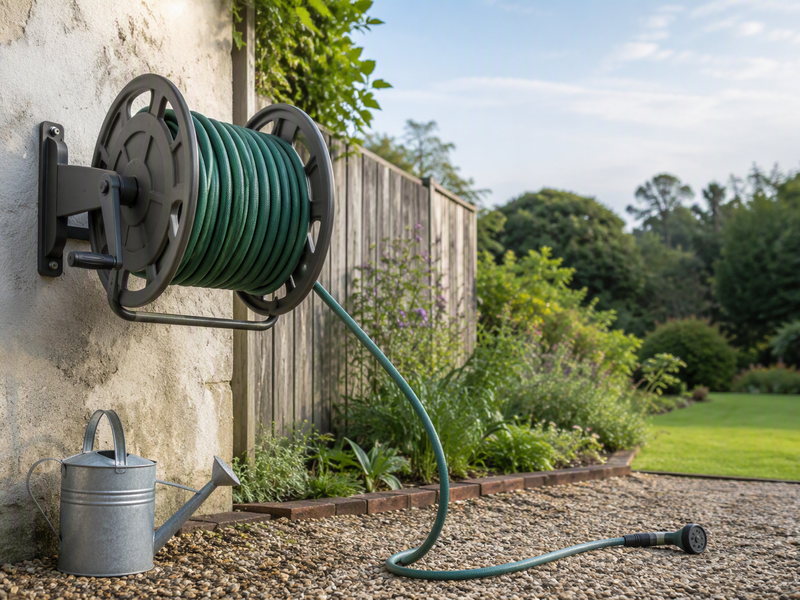
A wall-mounted reel keeps the hose coiled at one fixed point on the wall.
1. What Does a Hose Reel Buying Guide Have to Decide First?
A reel stores a hose; it does not change how that hose performs. Once the bore is fixed, the flow you feel at the nozzle is fixed as well. A reel can only take flow away from you, through a narrow swivel, a tight bend or an undersized leader hose. That is the first rule of any hose reel buying guide: the buying sequence runs hose first, reel second, never the reverse.
Why should the hose be chosen before the reel?
The hose sets four things the reel has to accept: its outside diameter, its length, its mass per metre and the fitting at each end. A drum sized around a light 1/2 in hose will not swallow 30 m of reinforced 5/8 in hose, because outside diameter grows with the wall and the layers stop fitting. Choose the bore for the flow you need and the length for the reach you need. Then find a drum that takes both.
Which measurements should you write down before you shop?
Take these five measurements before you compare anything:
- The distance from the tap to the farthest point you water, measured along the path the hose will follow rather than in a straight line.
- The bore you need, written in millimetres as well as inches, so drums that quote either unit can be compared directly.
- The outside diameter of the hose you intend to wind, measured at a straight section with callipers if the maker does not publish it.
- The space available for the reel: wall height, width between obstacles, and the distance from the tap to the mounting point.
- The fitting at the hose inlet, so the reel connector can be matched before you buy rather than after delivery.
Which decision is hardest to reverse?
Mounting holes are the hardest to reverse. Once a bracket is fixed, the holes stay with the wall, and the drill position decides whether a full drum clears a gate or a door swing. Decide the mounting point before you drill, and treat the choice of drum as the reversible part of the purchase.
2. What Are the Four Reel Families and What Does Each Ask of Your Site?
Reels are grouped by how they are held and how the hose leaves the drum. Each family asks something different of your site: a sound wall, a level path, usable supply pressure, or a footprint that stays out of the way. The table below summarises those demands before the later sections work through the arithmetic. Read it as a filter, not as a ranking — every family has sites where it is the wrong answer.
Four reel families and what each one asks of the site
| Family | How it is held | Hose path | Site it suits | Main constraint |
|---|---|---|---|---|
| Wall-mounted | Bracket fixed to a wall, post or pier | Pulls out radially from one fixed point | Tap on a wall with clear ground in front | Reach is fixed; the wall must carry the load |
| Cart | Wheeled frame moved by hand | Pulls out from wherever the cart is parked | Several zones, level paths, longer runs | Needs a route for the wheels; takes floor space |
| Retractable | Wall bracket or post, with a spring or motor | Self-winding onto a narrow drum | Sites where neat storage matters | Hose bore and stiffness limits; spring is a wear part |
| Box (cabinet) | Standing unit, floor-fixed or ballasted | Hose coils inside a closed enclosure | Decks, terraces, visible facades | Enclosure volume limits capacity; needs drainage |
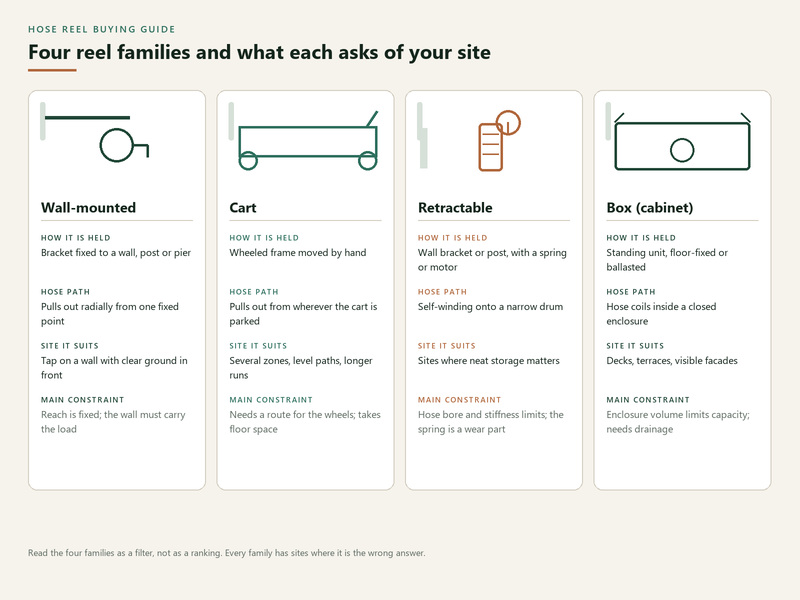
The four reel families and the site each one suits, from wall-mounted to retractable.
What defines a wall-mounted reel?
A wall-mounted reel is a bracket plus a drum, held on a vertical face. It occupies no ground area and the hose always pays out from the same point. The trade-off is a fixed reach and a load that the wall must carry through two or four drilled fixings. It suits a tap on a wall with open ground in front, and a wall that will hold an anchor; a loose fence panel or a rendered face needs another family.
What defines a cart reel?
A hose reel cart is a wheeled frame that carries the drum and travels with you. Because the drum can be parked next to the zone you are watering, a 15 m hose on a cart can cover ground that a 30 m wall-mounted hose cannot reach around a corner. The price is a route: carts need a surface the wheels can cross, and grass, gravel and steps all change how easily they roll. Wheel diameter matters more than wheel count here.
What defines a retractable or self-winding reel?
A retractable hose reel winds the hose back onto a narrow drum using stored spring energy or a motor. You pull the hose out to a latch position and walk it back, and the drum takes up the slack. The mechanism needs a hose that stays round and flexible. Retraction also depends on the hose being walked back, not released and chased.
What defines a stationary box or cabinet?
A hose reel box is a closed enclosure that hides the drum, the hose and the connection point inside a housing. Boxes are chosen for appearance and for keeping the hose out of direct light, and they are the family most limited by internal volume. Fit is tight, so a box needs the hose’s outside diameter confirmed before purchase, and the enclosure needs a way for water to drain out of the base.
3. How Much Hose Fits on a Drum?
Drum capacity is geometry, not a marketing figure, and a usable hose reel buying guide has to show the arithmetic rather than only the answer. Four measurements set capacity: core diameter, flange diameter, the usable width between the flanges, and the hose outside diameter. Layers come from the radial gap between core and flange divided by hose outside diameter. Wraps per layer come from usable width divided by hose outside diameter plus a small clearance. Length per layer is wraps multiplied by pi and the mean diameter of that layer.
The worked example below, and the capacity table after it, are calculated from stated inputs. The drum has a 100 mm core, a 250 mm flange and 250 mm of usable width. The hose is a 1/2 in bore, which is 12.7 mm nominal, with a 1.5 mm wall and therefore a calculated outside diameter of about 15.7 mm. Wraps are counted at a 1 mm clearance and only whole wraps are counted, because a partial wrap is not a wrap you can use.
Worked drum capacity example — calculated from the stated drum and hose dimensions
| レイヤー | Mean winding diameter (mm) | Circumference (mm) | Whole wraps | Length on that layer (m) |
|---|---|---|---|---|
| 1 | 115.7 | 363.5 | 14 | 5.09 |
| 2 | 147.1 | 462.1 | 14 | 6.47 |
| 3 | 178.5 | 560.8 | 14 | 7.85 |
| 4 | 209.9 | 659.4 | 14 | 9.23 |
| Total | — | — | 56 | 28.64 |
Four layers fit inside the flange, and the outer surface of the fourth layer sits at 225.6 mm, still inside the 250 mm flange. The result is 28.64 m, which is about 94 ft at 1 ft = 0.3048 m. That is the order of a nominal 100 ft reel, so the method and that label agree within the rounding of whole layers.
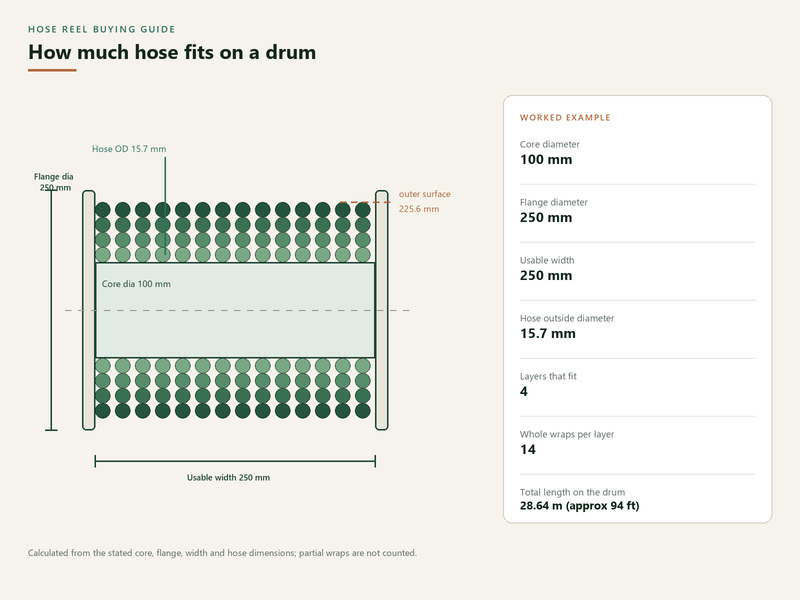
Why a 100 mm core and 250 mm flange give four layers and 28.64 m.
Same drum, different bores — approximate lengths, calculated by scaling with the square of the outside diameter
| Hose | Nominal bore | Wall | Outside diameter | Length on this drum (m) | Length (ft) |
|---|---|---|---|---|---|
| 1/2 in | 12.7 mm | 1.5 mm | 15.7 mm | 28.6 | 94 |
| 1/2 in | 12.7 mm | 2.5 mm | 17.7 mm | 22.5 | 74 |
| 5/8 in | 15.9 mm | 1.5 mm | 18.9 mm | 19.8 | 65 |
| 5/8 in | 15.9 mm | 2.0 mm | 19.9 mm | 17.8 | 58 |
| 5/8 in | 15.9 mm | 2.5 mm | 20.9 mm | 16.2 | 53 |
| 3/4 in | 19.1 mm | 2.5 mm | 24.1 mm | 12.2 | 40 |
How do you take the four measurements?
Measure these four values on the drum, or take them from the maker’s drawing:
- Core diameter — the barrel the first layer rests on, measured across the drum, not across the fittings.
- Flange diameter — the outer disc that stops the hose, measured at its widest point.
- Usable width — the clear distance between the two flanges, minus any space taken by a guide or a stopper.
- Hose outside diameter — measured on a straight, unpressurised section, or taken from the wall thickness the maker publishes.
Why do published capacity figures differ from this calculation?
Makers quote capacity for one specific hose, and that hose is rarely the one you own. A capacity figure may assume a light 1/2 in hose with a thin wall, or a hose that is not included in the purchase at all. Some figures also assume the drum is filled to the flange, which leaves no working clearance between the hose and the flange. Compare drums on outside diameter and usable volume, not on a quoted length.
Which bore should you choose when capacity is tight?
Bore drives both flow and bulk. A 1/2 in bore has an inside area of 127 mm² and a 5/8 in bore has 198 mm², so at equal velocity the 5/8 in hose carries 1.56 times the flow. It also takes about 39 % more room on the drum, calculated from a 2.5 mm wall, which gives outside diameters of 17.7 mm and 20.9 mm. If the drum cannot hold that length in 5/8 in, compare friction loss on a shorter, larger hose against a longer, smaller one before you compromise. The hose size selection guide sets out that comparison in full.
4. Should You Buy a Reel With or Without a Hose?
Purchase form is a separate decision from family, and it is the one buyers most often make by accident. A reel sold alone assumes you own a hose, know its outside diameter, and can fit the end couplings yourself. A reel sold with a hose assumes you will use whatever length and bore the maker chose. Neither is better; they suit different situations. Read the table below before you compare prices.
What each purchase form contains and what you still have to supply
| Purchase form | In the box | Still to supply | Where it suits |
|---|---|---|---|
| Reel only | Drum, frame, crank or spring, inlet connector | Main hose, two end couplings, leader hose | You already own a hose of known bore and outside diameter |
| Reel and hose | Drum, hose cut to length, factory-fitted couplings | Leader hose if the tap is far from the drum | You want capacity and hose settled in one decision |
| Reel and leader only | Drum, short inlet hose | Main hose in the bore you need | The main hose must be chosen for flow or for pressure |
| Box with hose | Enclosure, drum, hose inside | Ballast or fixings, drainage care | Appearance and closed storage matter more than reach |
What does a hose reel without hose actually include?
A hose reel without hose is a bare mechanism: the drum, the frame, the winding device and an inlet connector. The buyer supplies the hose, both end couplings and usually a leader. That is an advantage when you need a specific bore or a hose compound for cold weather, and a disadvantage when you simply want a matched set. Check the drum’s stated capacity against your hose’s outside diameter rather than against its nominal bore.
Does a complete set remove the capacity risk?
It reduces the risk rather than removing it, because the drum was designed around that hose’s outside diameter and coils. The limitation is choice. You take the bore and length offered, so a set that is convenient in every other respect can still be the wrong bore for a long run or the wrong compound for a cold climate.
Which form suits the hose you own today?
Choose the reel-only route when you already own a hose whose outside diameter and couplings you have confirmed, because you keep control of bore, length and compound. Choose the set when the drum and hose must work together and you would rather not calculate the fit yourself. Buy the reel-only form a second time only if you can measure the hose, since a hose reel without hose bought on nominal bore alone is the most common mismatch.
5. Crank or Self-Winding: Which Winding Method Should You Buy?
Winding is a mechanism decision, and it belongs inside any hose reel buying guide because it decides what the last two metres of every job feel like. A crank asks you to turn a handle; a spring asks you to walk the hose back and let the drum take up the slack. Neither is more durable in principle, and neither changes flow. What differs is how much effort you accept per watering, how much the mechanism can go wrong, and how well the drum tolerates the hose you intend to wind.
How does a crank reel work?
A crank reel winds the hose by hand, usually through a handle on the drum or on a geared shaft. The gearing, where it exists, is set by the maker, so one turn of the handle may wind one coil or several. With no spring to lose tension and no latch to wear, the winding system tolerates a wide range of hose outside diameters. The cost is physical: you stand at the reel and turn until the hose is home. For a 30 m hose that is a steady chore rather than a quick one, and it is the reason buyers move to self-winding.
How does a retractable hose reel work?
A retractable hose reel stores energy in a coil spring as you pull the hose out. Each pull position is held by a latch, so the hose stops where you leave it and does not fight you while you water. To rewind, you walk the hose back toward the drum and the spring takes up the slack, while a guide arm or a hose guide lays the coils across the width of the drum. The spring is a wear part and it is pre-tensioned at the factory to a stated hose length.
What should you check on a retractable hose reel?
Check these four points on any self-winding unit before you commit:
- The stated hose length the spring is set for, and whether the unit is supplied with a hose of that type or expects you to supply one.
- The range of hose outside diameters the guide will accept, since an oversized hose will coil unevenly and an undersized one may slip.
- Whether the spring can be re-tensioned or replaced in the field, and whether those parts are sold separately.
- How the unit behaves in cold weather, because plasticised PVC stiffens below about 5 °C (41 °F) and a stiff hose retracts badly.
6. What Do the Inlet, Leader Hose and Coupling Ask You to Buy?
Every hose reel buying guide has to account for the two ends of the drum, because they are where a purchase most often goes wrong. Water arrives at an inlet, travels through the drum to the hose, and leaves at the outlet fitting. If the inlet, the leader or the coupling is smaller, tighter or mismatched, the loss shows up at the nozzle and no amount of drum capacity will recover it.
Where does the water enter the drum?
Water reaches a reel drum in one of two ways. It can enter through the axle, travelling along the centre of the drum and out into the hose through a rotating seal, which is why the swivel is the wearing part of that design. Or it can enter through a port on the drum face, with the hose coupled straight to the drum side. The axle-fed design allows a full 360-degree rotation without the leader twisting. The face-fed design is simpler, but the leader has to accept the winding.
Do you need a leader hose?
A leader hose is the short hose between the tap and the reel inlet, and you need one whenever those two points are not the same place. Its job is to stay connected while the drum turns, so it is usually supplied with the reel rather than chosen freely. Two things matter: its length, which must cover the distance with slack for the drum to rotate, and its bore, which should not be narrower than the main hose if you want to keep the flow you paid for.
What thread should the inlet accept?
Most garden reels are built around garden hose thread (GHT), which is 3/4 in nominal, 11.5 threads per inch, straight rather than tapered, and seals on a washer. Pipe thread is different: NPT is tapered at 1:16 and seals on the threads themselves. The two do not interchange, and tightening a straight thread harder will not make it seal. When a reel inlet or a tap is threaded to a different form, a matching adapter is the answer. The complete guide to hose couplings covers the forms and where each is used.
7. How Do You Compare a Stated Capacity With Your Own Numbers?
The last arithmetic step in any hose reel buying guide is unit conversion, because capacity figures arrive in metres, feet, litres, gallons and millimetres, often in the same catalogue. Conversion errors survive to delivery. The three checks below let you compare two reels that quote capacity in different units and different hose types. Run them before you pay, not after.
How do you convert a published metric capacity to feet?
Multiply metres by 3.2808, or divide feet by the same figure, using 1 ft = 0.3048 m as the anchor. A drum quoted at 30 m therefore holds about 98 ft, and a reel quoted at 100 ft holds about 30.5 m. Bore and wall change the answer more than units do, so convert first and then adjust for the hose you actually own. A mm to inches conversion chart with an instant calculator removes the arithmetic error from that step.
Why does a narrow leader hose matter more than drum size?
Friction loss in a hose falls with the 4.87th power of diameter under the Hazen-Williams relationship. Doubling the bore cuts friction loss by about 29 times at the same flow, which is a calculated consequence of that exponent rather than a measured result. This is why a short, narrow leader can cost more pressure than a long, wide main hose. Domestic supply is commonly planned at 40–80 psi, and a restriction that removes a large share of that is felt at the nozzle immediately.
What does an enclosure do to capacity and to drainage?
A closed enclosure such as a hose reel box gives up capacity to the housing, so a box that looks large from outside can hold less hose than a bare drum of the same footprint. The housing also traps water, and standing water at the base of a box is a durability problem rather than a capacity problem. Confirm the internal drum arithmetic, then confirm that the base drains. If neither is published, treat the enclosure as decorative first and functional second.
8. What Is the Selection Sequence a Hose Reel Buying Guide Recommends?
Work through the seven steps below in order, and stop when a candidate is eliminated. Each step removes options rather than adding features, which is what keeps a reel purchase short. Prices and finishes only become relevant once a family and a drum size have survived the arithmetic.
The steps, in order:
- Fix the bore from the flow you need, using inside areas of 127 mm², 198 mm², 285 mm² and 507 mm² for 1/2 in, 5/8 in, 3/4 in and 1 in.
- Fix the length from the path distance to the farthest point you water, adding a metre of working slack at the nozzle.
- Measure the outside diameter of the hose that will be wound, since capacity follows outside diameter and not nominal bore.
- Decide whether the reel has to travel between zones, because a hose reel cart solves some sites and creates a storage problem on others.
- Choose the winding method from how much effort you will accept per job, and confirm the mechanism suits your hose outside diameter.
- Confirm the inlet form, the leader length and the swivel bore, then check that each of the three is at least as generous as the hose.
- Size the drum with the arithmetic in section 3 and leave clearance at the flange, then choose the mounting position and only then compare prices.
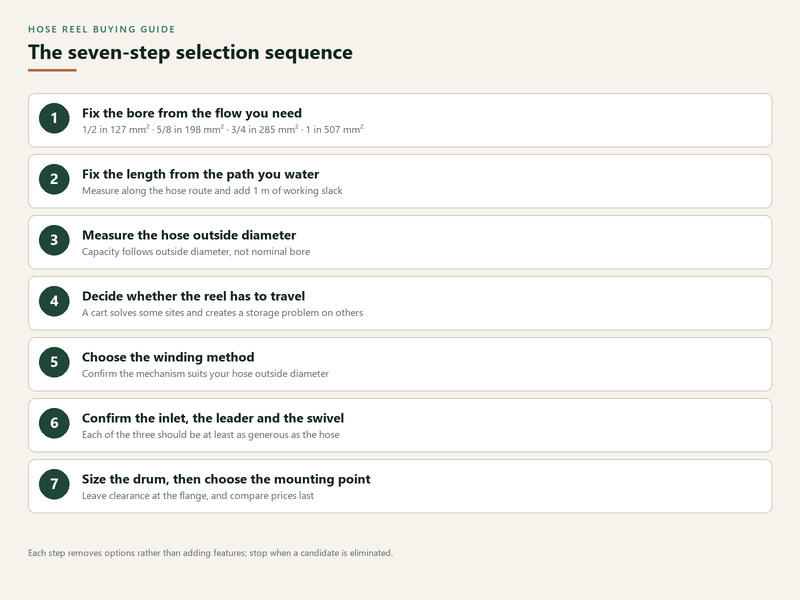
The seven-step selection sequence, from bore and length to the mounting position.
The order matters because the expensive mistakes are structural. A wall-mounted reel drilled into the wrong face cannot be corrected by buying a different hose, and a hose reel cart bought for a gravel path will not roll no matter how good the drum is. Settle the site and the hose, and the mechanism becomes a preference rather than a gamble.
If two candidates survive all seven steps, break the tie on the parts that wear. Check that the swivel, the spring or latch and the guide arm are sold as spares. Confirm that the inlet and outlet fittings are replaceable and that the drum will accept the hose you own today and the one you are likely to buy next. That is the whole of the value in this hose reel buying guide: the arithmetic narrows the field, and the spares position decides between equals.
9. Which Buying Mistakes Are Hard to Undo?
Most reel purchases that disappoint were reversible at the point of ordering and irreversible afterwards. The five faults below are the ones that cost a second purchase, a second set of wall holes or a returned item. None of them requires test data to avoid; each one is a check you can run with a tape measure and the maker’s published figures.
Why does the drum have to follow the hose?
A drum chosen first forces the hose to fit the drum, which inverts the order that protects flow and reach. Buyers who do this often end up shortening a 5/8 in hose to fit, or dropping to a 1/2 in hose to gain length, and both changes alter what the system delivers. Settle bore and length first. Then the drum is a container with a volume you can verify.
Why does a hose reel without hose often not fit?
A hose reel without hose is sold on capacity and on a nominal bore, and those two figures do not fix the fit. The drum accepts an outside diameter, not a nominal size, so a thin-walled hose and a reinforced hose of the same bore can differ by several millimetres. Measure the hose, or ask for the accepted range. This is the single most common reason a reel-only purchase is returned.
Why can a hose reel box hold less than it looks?
A hose reel box adds a housing and subtracts capacity, and the subtraction is rarely stated. Buyers compare the box’s outside dimensions with the drum they had in mind and assume the two match. Confirm the internal drum figures instead. Also confirm drainage, because a box that holds water at its base will keep the hose wet between uses. The enclosure should be the last decision, not the first.
Why is a stated length only conditional?
Capacity figures are conditional. A figure of 30 m may assume a light 1/2 in hose, and the same drum may hold 16 m of 5/8 in hose with a 2.5 mm wall. Before you compare two reels, put both figures onto the same hose outside diameter. That step prevents most of the disappointment that follows a capacity claim.
Why must the winding mechanism suit your site?
A self-winding reel needs a clear straight line to walk the hose back; behind a shrub it fights you. A crank beside a door swing is awkward every time the door opens, and a cart on soft ground will sink. Fit the mechanism to the way you move rather than to the way a catalogue photograph is staged.
よくある質問
What is the first thing to check in a hose reel buying guide?
Start with the hose, not the reel. Fix the bore for the flow you need, then the length for the reach you need, then measure the outside diameter of that hose. Capacity, winding mechanism and inlet form all follow from those three values. Reversing the order is what produces a drum that will not hold the hose you actually want to use.
How do I work out how much hose a reel will hold?
Divide the radial gap between the core and the flange by the hose outside diameter to get the layer count. Divide the usable drum width by the outside diameter plus about a millimetre of clearance to get the wraps per layer. Multiply the whole wraps by pi times the mean diameter of that layer, then total the layers. A 250 mm flange and 250 mm width takes about 28.6 m of 1/2 in hose with a 1.5 mm wall.
What does a reel’s stated capacity actually refer to?
It refers to one hose, usually a light one that may not be included in the purchase. The stated length is therefore a conditional figure rather than a property of the drum. To compare two reels fairly, convert both capacities to the same hose outside diameter. Where a maker publishes the drum’s core, flange and width instead, use the layer calculation.
Can I fit my own couplings to a reel that arrives without a hose?
Usually yes, provided the coupling is the right form for the hose and the hose end will accept it. The hose inlet at the drum is the critical joint, because it sits where the drum turns or where the leader meets the inlet. Use a coupling matched to the hose bore and wall, and confirm the reel inlet thread form before ordering, since garden hose thread and pipe thread do not interchange.
Why will a self-winding reel stop retracting?
The common causes are a spring that has lost tension, a hose wound too tightly, or a hose pulled out beyond the length the spring was set for. A hose that has flattened or stiffened will not lie flat in the coils either. Walk the hose back manually, empty the drum, check the guide for debris, and inspect the spring before concluding that the mechanism has failed.
How do I keep a leader hose from reducing flow?
Keep the leader bore equal to or larger than the main hose bore, and keep it short. Friction loss falls with the 4.87th power of diameter under the Hazen-Williams relationship, so a leader one size down is a real restriction rather than a rounding error. Where the tap sits far from the reel, choose a leader of the same bore and accept the extra length.
Does the drum reduce pressure?
The drum does not, but the path through it can. Water crossing a swivel, an elbow and the inlet fitting meets several restrictions inside a short distance. A swivel bore narrower than the hose bore acts as a permanent restriction, so ask for that bore and compare it with your hose.
What thread does a reel inlet normally use?
Garden reels usually use garden hose thread: 3/4 in nominal, 11.5 threads per inch, straight, sealing on a washer. Tapered pipe thread seals on the threads themselves and will not interchange with it. If a tap or an appliance is threaded differently, use a matching adapter rather than extra force, because a straight thread cannot be sealed by tightening alone.
How much clearance should I leave on the drum?
Leave enough that the outermost layer clears the flange, and treat the flange as a wall rather than a target. A drum filled to the flange leaves no room for a hose that swells slightly under pressure or for the uneven coils that follow a hurried rewind. Reserving a tenth of the usable width is a practical margin, and it costs about a metre or two of hose.
Should I buy the reel and hose together or separately?
Buy them separately when you need a specific bore, length or cold-weather compound, because you keep control of the three values that decide performance. Buy them together when you want the drum and the hose settled in one decision and the maker has matched the pair. Either way, check the hose outside diameter against the drum’s accepted range before you order.
HENGHUAについて
HENGHUA is a hose manufacturer supplying distributors, retailers and OEM or private-label programmes from its own production lines. The consumer range sold through this site covers garden hoses in vinyl, rubber, hybrid and reinforced multi-layer constructions, together with the fittings, leaders and reels that complete a watering system. Published product data on this site uses a working pressure of 150 psi and burst ratings of 400–500 psi, quoted with those conditions rather than as universal figures.
Custom branding, tailored lengths and private-label packaging are supported for trade customers. Buyers who need a specific bore, a specific outside diameter for a drum, or a specific inlet thread for a reel can request a quotation against their own measurements. The technical content on this site states the limits of each product type as well as its range.
Anyone comparing sizes, wall thicknesses or inlet fittings before ordering can review the consumer product range or send measurements through the contact form. Trade and OEM enquiries are handled through the same route, and the shop lists the configurations available for direct order.






 English
  Spanish
  Portuguese
  French
  German
  Arabic
  Russian
  Indonesian
  Japanese
  Korean