
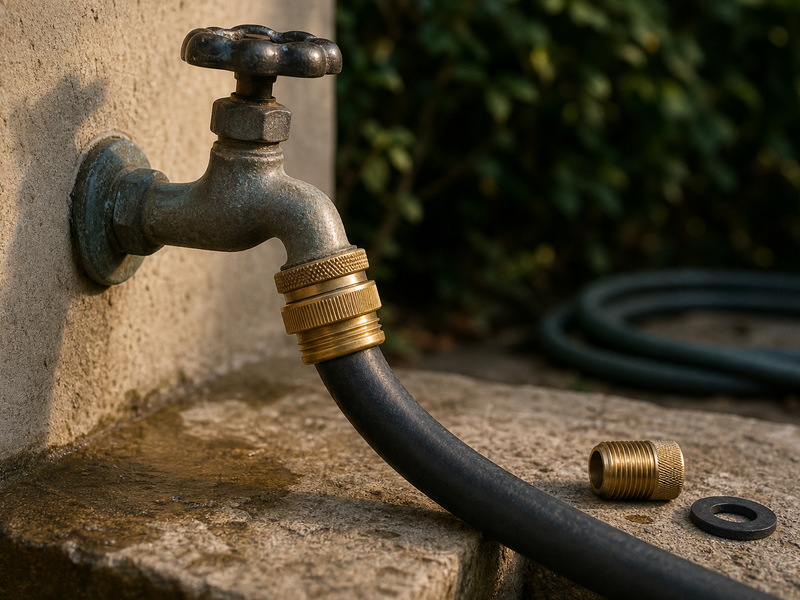
Cover: a hose coupling sealed against the outlet of an outdoor hose bib, the everyday joint where the two thread families meet.
The difference is the thread form: GHT is the straight 0.75-11.5 NH coupling thread sealed by a washer, while the tapered 3/4-14 NPT pipe thread seals by interference. That mechanical difference explains almost every complaint people bring when they compare GHT thread vs NPT fittings: the parts start easily, run in about a turn and a half, then stop hard or drip. This article sets out the published designations behind both threads and the arithmetic that makes them incompatible. It also covers the damage a forced joint leaves behind, the adapter that solves the problem, and the gauge and caliper checks that separate the two families.
Is GHT Thread vs NPT a Difference in Thread Form?
A garden hose coupling is machined to a hose coupling standard, while a pipe socket is machined to a pipe thread standard. ASME B1.20.7, the standard published as Hose Coupling Screw Threads (Inch), defines the hose coupling end, and the everyday size is written 0.75-11.5 NH. Read that as 0.75 in nominal diameter, 11.5 threads per inch, straight form. ASME B1.20.1, Pipe Threads, General Purpose (Inch), covers the pipe end, and the size that causes the confusion is 3/4-14 NPT: 3/4 in nominal, 14 threads per inch, tapered at 1 in 16 on diameter.
Both designations describe an inch series thread with a 60 degree included angle, and both are called three-quarter inch in everyday speech. They are still not interchangeable, because the thread form decides how the joint seals.
The site’s thread size chart for GHT, NPT, BSPP, BSPT and NPSH lists all five families side by side when you need the wider picture. This page stays on the head-to-head decision between the two threads that meet at a garden tap (an outdoor faucet, called a hose bib in North America), and on the adapter that joins them.
What Does Straight Versus Tapered Actually Change?
A straight thread keeps the same diameter from nose to base, so two straight parts can be screwed fully home without binding. Sealing therefore has to come from a separate element, and on a hose coupling that element is a flat washer or gasket squeezed against a seat.
A tapered NPT thread grows smaller toward the nose of the male part. The flank of one thread then rides hard on the flank of the other before the joint bottoms out, and that interference is the seal. It is also why a pipe joint still needs sealant in the helical gap that remains.
Why Does the Designation Matter More Than the Diameter?
The designation matters more than the diameter, because it is the only unambiguous way to order a part. A supplier given the words “three-quarter inch” has two legitimate answers, and a GHT thread vs NPT mix-up is the usual result. Say 0.75-11.5 NH when you want the hose end and 3/4-14 NPT when you want the pipe end. The same discipline works in reverse when you read a label on a tap, a valve or a pump port.
What Do NH, NHR and NPSH Mean in the Same Standard?
ASME B1.20.7 lists three families that are easy to confuse. NH is the full form hose coupling thread produced by cutting or rolling. NHR is the same thread specified for garden hose applications where thin-walled material is formed to the finished thread. NPSH is a straight hose coupling thread series intended to join to taper pipe threads, with a gasket doing the sealing.
Published tables are not consistent about which of the first two they print on a garden hose coupling: some show 0.75-11.5 NH, others show 0.75-11.5 NHR. The pitch, the nominal diameter and the washer seal are identical either way, so the practical advice does not change. Where a drawing specifies NHR, order NHR; the crest profile is the difference, not the thread dimensions.
Table 1. GHT (ASME B1.20.7) against 3/4-14 NPT (ASME B1.20.1) at the three-quarter inch size.
| Feature | GHT (hose coupling) | 3/4-14 NPT (pipe) |
|---|---|---|
| Governing standard | ASME B1.20.7 | ASME B1.20.1 |
| Designation at 3/4 in | 0.75-11.5 NH, printed 0.75-11.5 NHR in the thin-wall form; either printing mates the same | 3/4-14 NPT |
| Form | Straight, parallel | Tapered, 1 in 16 on diameter |
| Threads per inch | 11.5 | 14 |
| Pitch (calculated) | 0.0870 in | 0.0714 in |
| How it seals | Flat washer or gasket compressed against a seat | Crest and root interference along the taper, plus sealant |
| Usual materials | Brass, nylon, ABS | Brass, steel, PVC, CPVC |
| Where you meet it | Hose end, nozzle, sprayer, quick connect | Supply pipe, valve, pump port, riser |
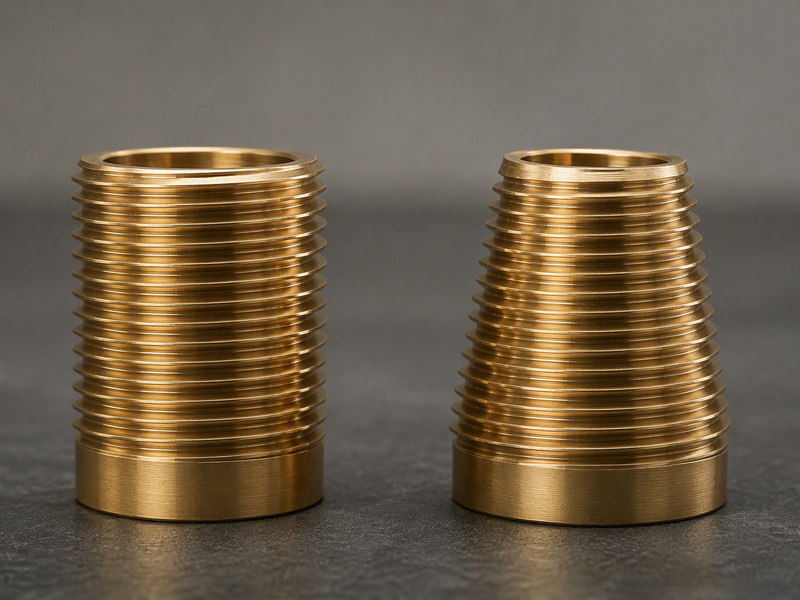
Two brass thread forms side by side: the parallel coupling thread on the left keeps the same diameter, while the conical pipe thread on the right narrows toward its nose.
Why Does GHT Thread vs NPT Screw Together and Then Fail?
Almost everyone who damages a coupling describes the same sequence. The nut starts freely, runs in about a turn and a half, then either goes tight before the faces meet or begins to weep. Three properties of the two thread forms produce that behaviour, and none of them requires a defective part.
Why Do the First Turns Feel Normal?
Nominal size is the first reason the first turns feel normal. At the 3/4 in size a pipe thread measures about 1.050 in across the crests at the end of the pipe, a value published in ASME B1.20.1. A 0.75-11.5 NH coupling thread sits in the same diameter band. The male part therefore enters the female without obvious resistance.
Pitch is the second reason. At 11.5 and 14 threads per inch the two pitches are 0.0870 in and 0.0714 in, so they differ by 0.0156 in (calculated from the rounded pitches). That difference is about 18 percent of the coarser pitch (calculated). For a worked example, after about seventeen engaged crests (roughly 1.5 in of thread at 11.5 threads per inch) the axial error reaches almost 0.27 in (calculated).
The third reason is where the taper sits. A tapered male thread is smaller at the nose than at its base, so it drops into a straight female thread for the first turn or two without loading the flanks. Interference only begins once the taper has grown past the minor diameter of the female thread. By that point the parts have taken a set, and every further turn converts into deformation rather than a seal.
Where Does the Joint Leak Instead of Binding?
Reverse the pair, coupling thread into pipe socket, and the failure changes from a jam to a drip. A straight coupling thread pushed into a tapered pipe socket has no washer seat to press against and no taper of its own to interfere with. The only possible seal would be crest to root contact, and the pitch mismatch stops the crests from settling into the roots at a consistent depth. Water then travels along the helical gap between the flanks. Two or three wraps of tape can hold back a drip at low pressure, which is why the mistake often survives until the system is used hard.
What Damage Does a Forced Joint Leave Behind?
Damage is usually permanent, and it arrives in a predictable order:
- Flattened or sheared crests on the 11.5 threads per inch side, where the wider crests carry the load first.
- A swaged or bell mouthed female coupling, where an oversize tapered male has expanded the thread.
- A split swivel nut at the root of the thread, where hoop stress concentrates.
- A distorted washer seat that keeps leaking even after a correct adapter is fitted to that end.
- Galling on aluminium and stainless steel, worst when both parts are the same alloy.
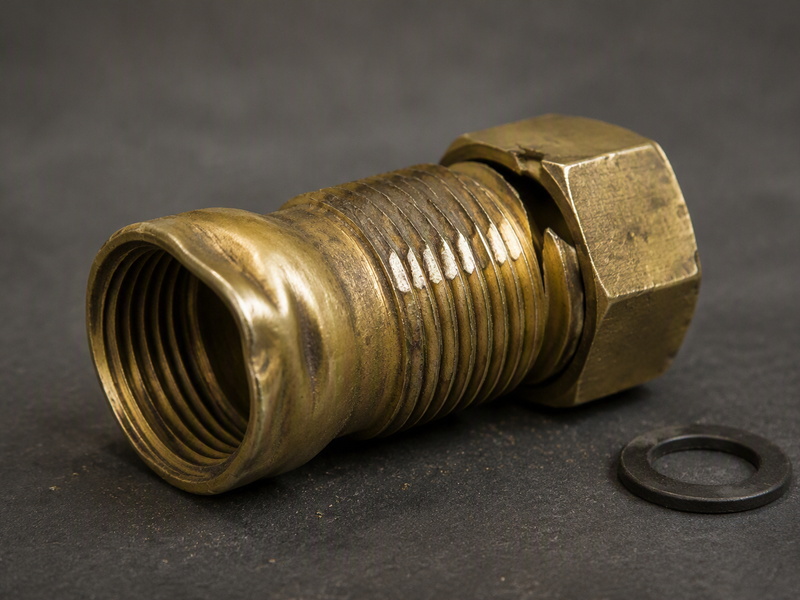
Damage left by a forced joint: flattened crests on the coarser side, a bell-mouthed female coupling, a split swivel nut and a distorted washer seat.
Does Tightening Harder Ever Work?
Occasionally a badly matched pair will hold at low pressure, and that partial success is what makes the mistake expensive. The joint is holding because the crests have deformed enough to close part of the gap, not because the two threads have mated. Every further tightening cycle removes a little more material from the same crests. The joint then fails at the worst moment, which is usually when the tap is opened fully or the pump starts.
Table 2. Symptoms of a mismatched hose coupling thread and pipe thread, and what to check.
| What you see | What it usually means | What to check |
|---|---|---|
| Starts freely, stops after one or two turns | 11.5 and 14 threads per inch cannot share the same crest positions | Pitch check with a gauge blade |
| Nut bottoms out but the joint still weeps | Straight coupling thread in a tapered socket, with no washer seat in sight | Look for a flat seat and a washer |
| Leaks worse after wrapping with tape | Tape cannot correct a pitch mismatch on a straight thread | Remove the tape, fit the right adapter |
| Flanks feel rough after removal | Crests have been flattened or galled | Replace the part, do not reuse it |
| Holds at low flow, leaks at full flow | A taped mismatched joint that was never a seal | Move to a washer sealed adapter |
How Do You Tell GHT From NPT in the Hand?
Three field checks settle the question in under a minute, and none of them needs a laboratory. The first is a thread pitch gauge; the second is a caliper used twice along the axis. A GHT thread vs NPT decision made in the field takes less time than the return shipping on a wrong adapter.
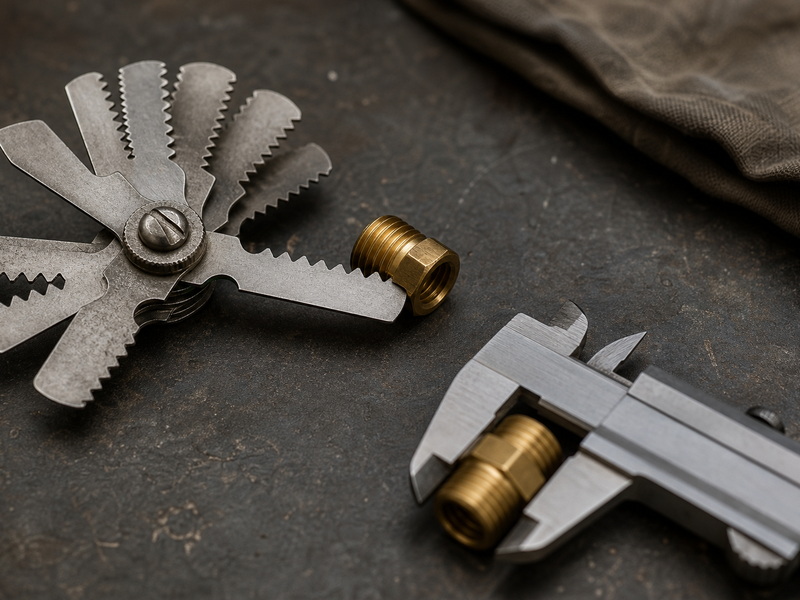
Field checks in progress: a pitch gauge blade seated in the thread, and a caliper reading the major diameter at two points half an inch apart.
Field identification of the two families, in this order:
- Thread pitch gauge: a 14 blade beds down on 3/4-14 NPT and lifts on a 0.75-11.5 NH coupling thread, where it runs a full pitch out of step against the coarser pitch about every sixth crest (calculated).
- Caliper, measured twice half an inch apart: about 0.031 in smaller toward the nose means a tapered thread, and an unchanged reading means a straight coupling thread (calculated from the 1 in 16 taper).
- Eye and steel rule: 14 crests in one inch means a pipe thread, 11 or 12 means a coupling thread.
How Do You Use a Thread Pitch Gauge?
A pitch gauge is a fan of thin blades, each cut to one pitch. Seat the 14 blade in the thread you are testing and rock it along its length. If the set contains an 11.5 blade, use that one, because it is cut for the coupling thread.
How Do You Check With a Caliper?
Measure the major diameter twice, once near the nose and once half an inch further along the axis, then compare the two numbers. On a tapered NPT thread the second reading comes back smaller. On a straight coupling thread the same two readings agree within measurement noise. That comparison separates the two forms even when the nominal size on both parts is identical. A caliper with 0.001 in resolution is enough, because the difference you are looking for is more than thirty times that resolution.
Scope: the caliper check separates a straight thread from a tapered one. It does not by itself identify NPT, because another tapered family shows the same diameter change. Compare the pitch and the thread form before ordering.
Which Other Reading Confirms the Size?
Confirm the family first, then the size: once you know you are holding a straight coupling, compare the measured major diameter against a hose size chart rather than a pipe table. The 3/4 inch GHT measurement walkthrough takes that comparison step by step, including the tolerance bands. The fitting diameter and adapter selection tables cover the rest of the sizes you are likely to meet.
How Do You Rule Out the Nearby Standards?
Four nearby families are worth excluding while the caliper is out. NPSH is a straight coupling thread that joins to a taper pipe thread with a gasket doing the sealing, so it can sit next to a pipe thread without being one. NPSM is also straight and gasket sealed, and it is the form that appears on imported mechanical joints. The British families BSPP and BSPT sit close enough in pitch to be mistaken for NPT at a glance. The site’s guide to NPSM against NPT carries the dimension table for that comparison, and the pitch and form checks tell the four apart.
Can You Identify the Thread by Eye Alone?
Only partly: a taper becomes visible when you sight along the thread against a straight edge, because the crests of a pipe thread fall away toward the nose while a coupling thread stays parallel. Counting crests with a steel rule is the more reliable eye check, and the two counts sit far enough apart to read at a glance. The difference is obvious once you know there are only two candidates.
Will One Pitch Gauge Cover Both Threads?
Yes. A pitch gauge set that includes a blade for each pitch covers both the pipe thread and the coupling thread, so one set is enough for a hose end and a pipe port. Where the 11.5 blade is missing, the caliper check gives the same answer without the gauge. The taper shows up as a diameter change of about 0.031 in along half an inch (calculated from the 1 in 16 taper).
Table 3. Field identification summary for the two families.
| Check | GHT (0.75-11.5 NH) | 3/4-14 NPT |
|---|---|---|
| Threads per inch | 11.5 | 14 |
| Gauge blade that beds down | 11.5, if the set has one | 14 |
| Diameter at two points half an inch apart | Unchanged, because the form is straight | About 0.031 in smaller toward the nose (calculated) |
| Sealing face | Flat washer seat at the base of the coupling | Tapered flanks, no washer seat |
| Effect of thread tape | Can lift the washer off its seat | Fills the helical gap left by the taper |
| Correct partner | Another hose coupling thread | Another taper pipe thread, or a transition adapter |
Which Adapter Makes the Two Threads Work Together?
A pipe port cannot be asked to change its thread, and neither can a hose end, so the joint between them is made by a one piece transition adapter. A garden hose thread to NPT adapter carries a coupling thread on one end and a pipe thread on the other, so each end keeps the sealing method it was designed for. It is the standard answer for taps, pumps, sprayers and pressure washers that arrive with pipe ports. This is also the point at which a GHT thread vs NPT question stops being a measurement problem and becomes a part number.
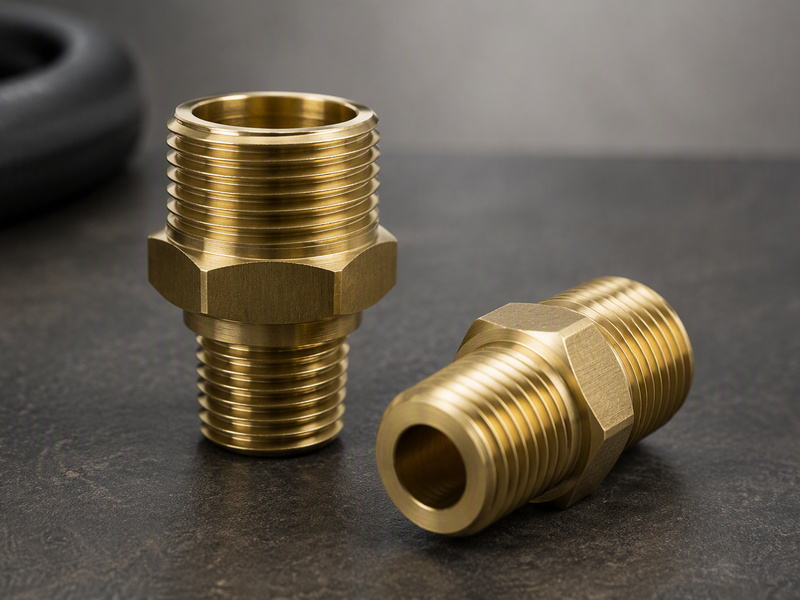
A one-piece transition adapter: coupling thread on one end, tapered pipe thread on the other, with a brass hex across the middle.
What Does a Garden Hose Thread to NPT Adapter Look Like?
The adapter is a short machined part, usually brass, with a hex across the middle and a different thread on each end. Familiar builds include garden hose male to 1/2 NPT male, garden hose male to 3/4 NPT male, and garden hose female to 3/4 NPT male. The hose end seals on its washer, and the pipe end carries an NPT thread that seals on its taper with sealant or tape. Brass suits any joint that will be taken apart and remade; molded plastic is adequate where the adapter stays in place and carries no side load.
How Do You Pick the Right Garden Hose Thread Size?
Start from the hose end, because that is the part in your hand. Measure the outside diameter of the male coupling and compare it with a hose size chart. The garden hose thread size you need is rarely printed on the hose itself, so measurement is the reliable route. In North America the standard coupling thread is 0.75-11.5 NH, so a fitting sold for one bore commonly fits the next size up.
Scope: this applies to hose sold in North America; metric and British couplings are covered below. Then read the pipe end from the equipment: outdoor taps, pump ports and pressure washer inlets commonly carry 1/2 NPT or 3/4 NPT.
When Is an Adapter the Wrong Answer?
An adapter is rarely the wrong answer, but there are two cases to check first. If the pipe end is BSP rather than NPT, an NPT adapter will start and then leak for the same reasons the original mismatch leaked. If the equipment port is a straight mechanical seal rather than a taper, the correct part is an adapter with a gasket instead. In both cases the answer is still a transition adapter, just a different one. The site’s guide to NPT against BSP carries the dimension tables for the first case.
Before you order, have both ends written down: the hose end is 0.75-11.5 NH and the equipment port is 1/2 NPT or 3/4 NPT, and the adapter becomes a catalogue part rather than a guess.
Where Does NPT Belong in a Watering System?
NPT is the wrong thread only at the hose end. Most GHT thread vs NPT confusion starts in the middle of a system that is being asked to do both jobs at once. Upstream of the hose, where a joint is made once and left under pressure, the pipe thread is the correct choice, because it seals without a washer that nobody can reach.
Which Connections Are Correctly NPT?
A pipe thread is the normal choice in these positions:
- The inlet side of an outdoor tap, where the supply pipe enters the valve body.
- Manual valves, solenoid valves, vacuum breakers and backflow assemblies.
- Pressure washer pump inlets and outlets.
- Irrigation risers, sprinkler bodies and drip zone manifolds.
- Tank bulkheads, pump discharge ports and filter housings.
- Water heater drain valves and boiler fill connections.
What Is the Rule of Thumb?
The test is whether a flat face and a washer can be presented to the joint. Where they can, expect a coupling thread, because the washer will do the sealing and hand tightening will be enough. Where the joint is threaded once into a metal or plastic body and then left alone, expect a pipe thread, because the taper and the sealant hold it. A joint buried inside an equipment enclosure cannot rely on a washer that nobody can reach or replace.
Flow does not change any of this. A restrictive fitting reduces the flow a hose can deliver, but it cannot convert one thread family into another, and it does not change the pitch you are measuring. Choose the thread by the standard, then choose the bore by the flow you need from the outlet.
Table 4. Which thread belongs at each end of a watering system.
| Position in the system | Thread that belongs there | Reason |
|---|---|---|
| Supply pipe into a hose bib body | NPT | Rigid joint, made once, permanently under line pressure |
| Hose bib outlet to the hose | GHT | Washer seal, remade by hand every day |
| Hose to nozzle, sprayer or quick connect | GHT | Same washer seal, same nominal coupling size |
| Pump outlet on a pressure washer | NPT in most designs | Port machined into a pump body with a taper |
| Sprinkler riser to a head | NPT | Rigid run with no accessible washer seat |
| Tank wall fitting | NPT into a bulkhead body | Threaded once into a wall, sealed at the flange |
Does Every Garden Hose Use the Same Thread?
Not every hose, but far more than most people expect, and that consistency is worth knowing when you are buying adapters.
Which Sizes Share the 0.75-11.5 NH Thread?
In North America the 1/2 in, 5/8 in and 3/4 in garden hose sizes are sold with the same coupling thread, and that thread is 0.75-11.5 NH. The bore changes the flow a hose can carry; the thread on the end does not change with it. That is why a 5/8 in hose and a 3/4 in hose can share a nozzle, a sprayer or a quick connect set. It is also why a fitting sold for one hose diameter often fits the next size up without complaint.
Do British or Metric Hoses Fit the Same Coupling?
Not usually without an adapter. A 3/4 in British Standard Pipe parallel thread is close to 0.75-11.5 NH in diameter, and the two will start together, but the flank form and pitch are not the same. Metric hose systems use their own nominal sizes again. When a hose arrives with an unfamiliar coupling, treat it as a separate thread family and confirm the pitch before ordering anything.
A hose that stays fitted to its tap is not the problem case. The thread only becomes a decision when a pipe port has to meet a hose end, and that is exactly the point at which a GHT thread vs NPT decision has to be made deliberately.
Which Habits Cause the Worst Damage?
How Do These Five Habits Damage a Joint?
Most of the damage in a GHT thread vs NPT mix-up traces back to five habits:
- Reading “3/4” on a label as proof that the thread on the part is a hose coupling thread.
- Wrapping tape around a hose coupling, where a washer makes the seal and tape can lift it off its seat.
- Tightening past hand tight to stop a drip, which is the moment the crests begin to deform.
- Using a pipe wrench on a swivel nut, which crushes the coupling body before it seals anything.
- Reusing a fitting whose crests have already been flattened, then chasing the same leak a second time.
Where Does Thread Tape Belong?
Tape belongs on an NPT thread, where it fills the helical gap that the taper alone cannot close. On a hose coupling the same tape works against the seal, because it thickens the seating area and lets the washer shift under pressure. If a hose joint drips, replace the washer before you reach for the tape. If a pipe joint drips, check that both parts were made to the same standard before adding another wrap.
よくある質問
Is GHT Thread vs NPT Just a Difference in Size?
No. GHT and NPT are both nominally three-quarter inch, so the real difference is the thread form rather than the diameter. A hose coupling thread is straight and seals on a washer. A pipe thread is tapered at 1 in 16 on diameter and seals by interference between the flanks. That is why GHT thread vs NPT parts can start together and still fail as a joint.
Can You Screw an NPT Fitting Onto a Garden Hose?
No, an NPT fitting will not hold onto a hose coupling. NPT and GHT will engage for a turn or two because the nominal sizes and the pitches are close, but no seal can form. The pipe side has no washer seat, and the hose side has no taper. The result is either a hard stop or a drip. Use a transition adapter instead.
What Is the Garden Hose Thread Size in Inches?
At the common garden hose size the thread is written 0.75-11.5 NH: 0.75 in nominal diameter, 11.5 threads per inch, straight form. The designation matters more than an inch figure on its own, because 3/4 in also describes a pipe thread that will not seal against it. Quote the full designation when you order.
Do I Need a Garden Hose Thread to NPT Adapter for a Pressure Washer?
Usually yes, at the pump end. Pressure washer pumps normally carry 1/2 NPT or 3/4 NPT ports on the inlet and the outlet, while the hose, gun and wand side uses hose coupling threads. One transition adapter at the pump removes the mismatch. A hose set supplied with the right fittings already attached does the same job.
How Do I Tell Whether a Hose Bib Outlet Is a Hose Thread or a Pipe Thread?
Look at the face of the hose bib outlet. A hose thread outlet has a flat sealing face and accepts a swivel nut with a washer, tightened by hand. A pipe thread outlet is tapered, has no washer seat, and usually shows wrench marks from being tightened once and left alone. A pitch gauge confirms the answer in seconds.
Why Does My Hose Fitting Leak After Two Turns?
Two turns is the signature of a pitch and taper mismatch between a hose coupling thread and a pipe thread. At 11.5 and 14 threads per inch the crest positions do not line up, and a taper cannot seal against a straight thread. The joint reaches the end of its travel with gaps between the flanks, so water follows the helix out. A new washer will not fix it.
Is NH the Same as GHT?
For a garden hose coupling, yes in practice. ASME B1.20.7 lists the size as 0.75-11.5 NH, and some tables print 0.75-11.5 NHR for the thin-walled form of the same thread. Both describe a straight thread that seals on a washer, so both need a hose coupling partner rather than a pipe thread.
Is a Hose Bib Thread the Same as GHT?
In most homes, yes. A standard hose bib in North America is fitted with a 0.75-11.5 NH hose coupling thread, the same thread used on garden hose ends, so a hose, nozzle or quick connect built for GHT screws straight on. The exception is a vandal-resistant or non-standard head, which may use a keyed or proprietary outlet that needs its own adapter.
Can You Recut a Hose Thread as a Pipe Thread?
No. Cutting a taper into a straight hose coupling removes material from the crests that carry the load, and the part will then seal neither on its washer nor on the taper. The same applies in reverse to a pipe fitting. Replace the part with the right transition adapter instead of recutting it.
Is NPT Thread the Same as Pipe Thread?
In everyday use, yes. NPT is the tapered pipe thread defined by ASME B1.20.1, and it is what most people mean by pipe thread in North America. It is not the only pipe thread, though. NPSM is straight and gasket sealed, and BSPP and BSPT serve other markets. Each one needs a matching partner.
Do Quick Connect Fittings Change the Thread?
Quick connect fittings change the interface, not the thread. A quick connect set leaves the coupling thread in place and adds a spring-loaded sleeve that joins the two halves. The adapter logic is unchanged: the part meeting the tap still has to match the tap thread, and a transition adapter still sits between a hose end and a pipe port.
Which Thread Does a Hose Bib (Outdoor Tap) Use?
A hose bib uses two threads, one at each end. The inlet that joins the supply pipe is normally a tapered pipe thread, sized 1/2 in or 3/4 in. The outlet that receives the hose is a 0.75-11.5 NH hose coupling thread with a washer seat, unless a vandal-resistant head is fitted. Read each end separately before ordering.
HENGHUAについて
HENGHUA manufactures hose and hose assemblies for industrial, agricultural and consumer applications, and trades under the product brands GLOBHOSE and FLEXMAX. The company supplies distributors, retailers and OEM programmes, and supports private-label hose with custom branding and tailored specifications.
Garden hose, fittings and adapters sit in the same catalogue as hydraulic, air, oil and industrial hose, which is why thread questions arrive from both the consumer side and the industrial side. Where a standard leaves room for interpretation, the working principle is to publish the dimension table rather than a marketing claim.
For specification help, sample requests or volume pricing, the hose fittings range is the place to start, and the contact page reaches the sales and technical team directly. Send the thread designation, the size, and the application, and the team will confirm the matching part.






 English
  Spanish
  Portuguese
  French
  German
  Arabic
  Russian
  Indonesian
  Japanese
  Korean