
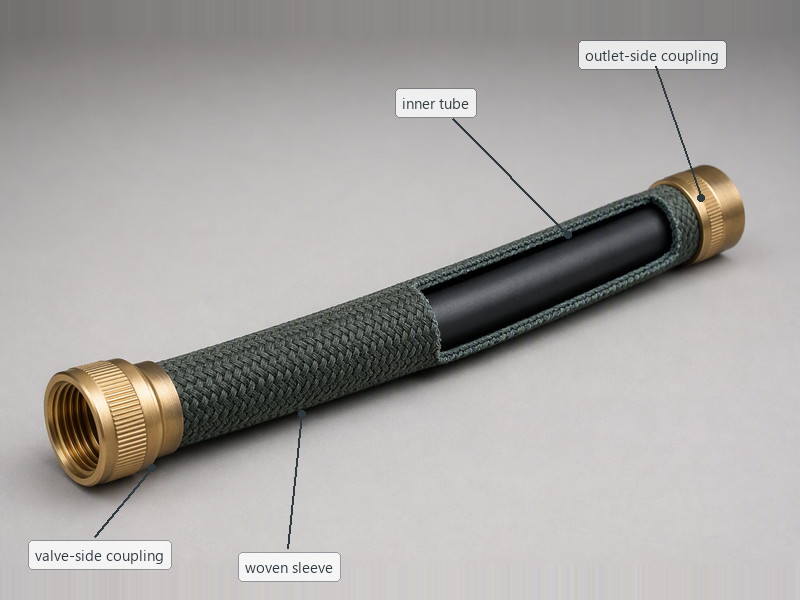
The best expandable hose — sold in shops as an expandable, collapsible or fabric hose — is a two-layer tube: an elastic inner tube that carries the water inside a woven sleeve that controls how far it can stretch. The advertised length is reached only while water pressure holds the tube open. At rest the same hose is a fraction of that length, commonly quoted by makers as about one third. There is no single best expandable hose, because the advertised length, the bore while charged and the coupling construction decide the result, and most listings publish only the first of the three.
This article covers what each layer does, what happens at the two ends under load, and how to judge a listing before you buy.
1. What Is an Expandable Hose Actually Made Of?
An expandable hose is built from two layers: a thin elastic inner tube, usually a rubber or thermoplastic elastomer (TPE), inside a woven fabric sleeve. The inner tube holds the water and provides the elastic recovery; the sleeve controls the stretch and shields the tube. Neither layer works alone.
The sleeve is woven from synthetic yarn, and the weave angle changes as the tube inside it grows. At rest the sleeve is bunched around a short tube. Under pressure the tube lengthens first and then expands, and the sleeve straightens until the weave locks. That lock is what sets the maximum length of the product.
What Does Each Part Do?
Each part of an expandable hose has one primary job:
- Inner tube: seals the water and provides the elastic recovery.
- Woven sleeve: limits the stretch and resists abrasion.
- Valve-side coupling: anchors the sleeve against the pull of the elastic tube.
- Outlet-side coupling: carries the nozzle and the weight of the charged hose.
Two layers of the best expandable hose: inner tube and woven sleeve.
What Is an Expandable Garden Hose Sleeve Made From?
The sleeve is normally a tight weave of polyester or nylon yarn. The yarn resists abrasion and ultraviolet (UV) light; the elastic tube is the layer that needs that protection. A denser weave restricts the maximum diameter, so the weave also sets the practical bore of the charged hose. An expandable garden hose therefore has a bore decided by its sleeve, not by a rigid wall.
Why Does the Inner Tube Matter More Than the Sleeve?
The inner tube decides whether the hose recovers its resting length and whether it can be repaired. A tube that has taken a permanent set no longer pulls itself back, and the hose stays long and limp. A tube that splits cannot be patched from outside, because the sleeve hides the damage. The tube is the layer that ends the working life of the product.
2. Why Does the Best Expandable Hose Only Reach Its Advertised Length While Charged?
Because the length comes from water pressure rather than from material. The elastic tube is stored short and stretched by the water inside it. Remove the pressure and the tube contracts, pulling the sleeve back into its bunched state. The advertised figure therefore describes one condition: the hose fully charged at normal supply pressure.
What Is the Resting Length, and Why Does It Decide Storage?
Resting length is the length of the hose with no water pressure inside it. Makers commonly quote it as about one third of the advertised length. Always check the stated resting length, because it is the figure that decides storage.
Lengths are also sold in feet: at 1 ft = 0.3048 m, a 50 ft listing is 15.2 m, a 75 ft listing is 22.9 m and a 100 ft listing is 30.5 m. On the same one-third basis, a 100 ft hose rests at about 33 ft and a 50 ft hose at about 17 ft, so the storage space to allow follows the resting length in either unit.
Advertised length against resting length, calculated from the commonly quoted one-third figure
| Advertised (charged) length | Resting length, about one third | Length gained under pressure |
|---|---|---|
| 15 m | 5 m | 10 m |
| 30 m | 10 m | 20 m |
| 45 m | 15 m | 30 m |
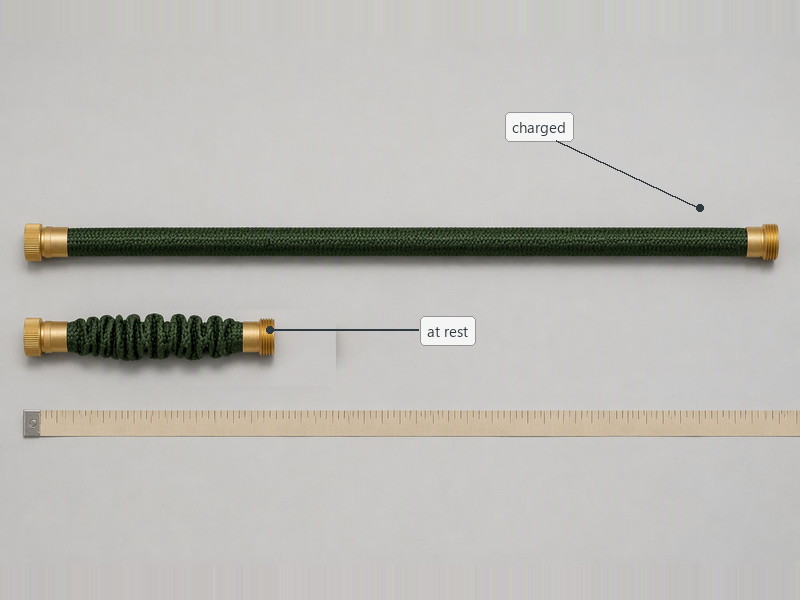
Charged length against resting length on the quoted one-third basis.
How Do You Check the Stated Resting Length Against the Space You Have Before You Buy?
Read the stated resting length on the listing, then check it against the storage space you have available. If the resting length is not published, the quoted one-third figure is your only guide, and it is a maker’s claim rather than a measurement. A product that publishes both lengths is easier to plan around than one that gives only the charged figure.
Does the Hose Change Length While You Water?
An expandable hose changes length while you water it. When the tap opens, the hose extends and pulls against whatever anchors it. When you close the tap, it contracts and can pull on the fittings. This movement under load is the single biggest difference between the best expandable hose and a fixed hose, and it is the source of most end failures.
3. What Bore and Flow Do You Get When Expanded and at Rest?
The bore of an expandable hose changes with pressure, which is unusual for a hose. While charged, the elastic tube is stretched and the sleeve is locked open, so the flow path is at its largest. With the tap closed, the tube relaxes to a smaller diameter. Nominal figures are therefore meaningful only when the pressure condition is stated beside them.
How Does the Bore Change With Pressure?
The elastic tube stretches until the sleeve stops it, so the diameter depends on the weave rather than on wall stiffness. A hose rated at a nominal 5/8 in bore while charged has an inside area of 198 mm² at that condition. The same hose at rest has a smaller passage, which is why a folded expandable hose holds very little water.
Why Does Flow Fall Short of a Fixed Hose of the Same Size?
Friction and length both work against the expandable design. At equal velocity the relative flow at a 1/2 in bore is 1.00, at 5/8 in it is 1.56 and at 3/4 in it is 2.25, so bore dominates delivery. An expandable hose also reaches its full length only while charged, and a longer flow path adds friction along the way.
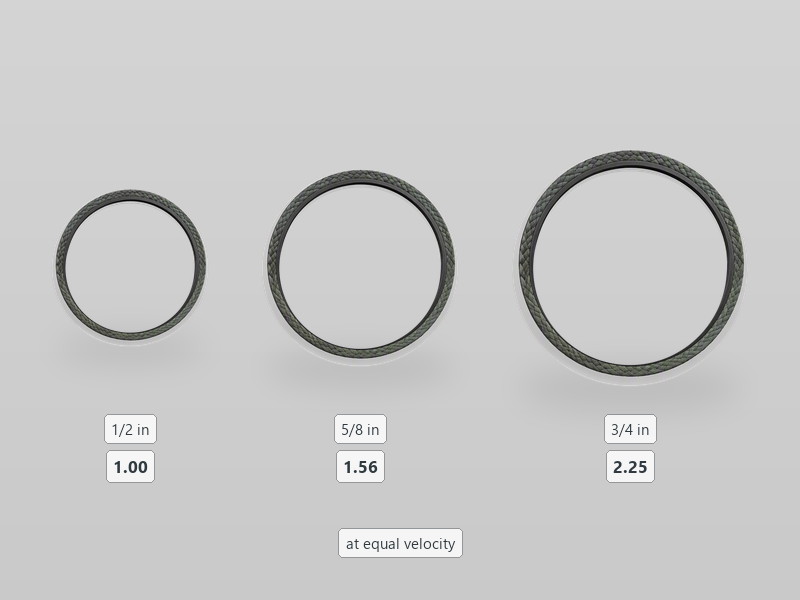
Relative flow at equal velocity across the three bore sizes.
Does the Bore Recover When the Pressure Drops?
The bore recovers when the pressure drops, which is why an expandable hose drains itself and retracts. The trade is that recovery is driven by elastic strain, and strain relaxes over time. A tube that has been stored stretched for months recovers less fully than a new one, so the resting length can grow as the product ages.
Does an Expandable Hose Kink While You Water?
Kinking needs a fold tighter than the tube can hold open. While the hose is charged at supply pressure the sleeve is locked, so the tube resists folding at any radius you can make by hand. When the supply is weak or the tap is part open, the sleeve stays unlocked and the hose folds at a larger radius. Keep the tap fully open and lead the hose around a corner instead of dragging it across one.
4. Which End Loads Actually Cause Failures?
Both ends of an expandable hose carry loads a fixed hose never sees. The sleeve is anchored at the couplings, so every expand-extend cycle loads the same crimp or clamp at both ends.
What Happens at the Valve Side?
The valve side is anchored to a tap or a splitter that does not move, so the hose takes the whole reaction. When the hose extends, the sleeve pulls away from the coupling; when it contracts, the sleeve pulls back. A coupling that grips only the outer sleeve will separate at that joint as the tube slips through.
What Happens at the Outlet Side?
The outlet side carries the nozzle, which may also be held or dragged. That side therefore takes three loads at once: the weight of the charged hose, the pull of the elastic tube, and any force you apply through the nozzle. It is the joint that fails first most often, and it fails at the crimp rather than in the middle of the hose.
Why Does the Crimp Fail Before the Tube?
The couplings are rigid and the hose is elastic. Every contraction pulls the tube toward the center, and every extension pulls the sleeve away from the fitting. A rigid metal fitting has no compliance, so the strain concentrates in the few centimeters of hose behind it. The published ratings used on this site, 150 psi working and 400 to 500 psi burst, describe the tube rather than that joint.
Loads carried at each point of a charged expandable hose
| Point | Loads present | Typical failure |
|---|---|---|
| Valve side | Sleeve tension against a fixed anchor; contraction pull when the tap closes | Coupling slides off the sleeve |
| Outlet side | Hand force and nozzle weight, charged hose weight, elastic contraction | Crimp separates just behind the fitting |
| Middle of the hose | Internal pressure and bending only | Holds in normal service |

The three outlet-side loads: hand force, charged hose weight and elastic contraction.
What Conditions Make the End Loads Worse?
Five conditions raise the load on the two end fittings of an expandable hose:
- Leaving the hose charged for long periods, so the tube stays stretched.
- Dragging the hose by the nozzle instead of by the sleeve.
- Fitting a heavy sprayer or a long rigid wand to the outlet.
- Freezing, which stiffens the tube and raises the contraction force.
- A supply pressure above the working rating printed for the product.
5. What Do Expandable Hose Reviews Measure, and What Do They Miss?
Expandable hose reviews vary widely in method, and most published reviews describe a first impression rather than a service-life result. A review can report how a hose feels, how quickly it extends and how it behaves on one tap in one garden. It usually cannot report how the same construction behaves after a season of use.
What Can a Review Legitimately Compare?
A review can fairly compare the length a hose reaches at a stated pressure, the resting length it returns to, the bore at the couplings and the fittings it ships with. Those are properties a reviewer can measure with a tape and a pressure gauge in a single session.
The mass when charged is arithmetic rather than a measurement. A 5/8 in hose charged to its full 198 mm² inside area holds about 5.9 L of water along 30 m, which is about 1.6 US gal and about 5.9 kg at 1.000 kg per liter. Hoses of the same advertised length differ in that figure only where their charged bores differ.
Which Properties Need an Endurance Test Instead?
Three properties need an endurance test: how many expand cycles a coupling survives, how much strain remains in the inner tube after a winter in storage, and how the sleeve resists abrasion on your own ground. An endurance test is also the only way to compare two products on those three points. Read a first-impression review as a description of one unit rather than as a durability result.
How Do You Read a Review Critically?
Look for the pressure the reviewer used and the length measured at that pressure. If neither figure appears, the length claim cannot be checked. Check whether the review states the resting length and the fitting type, and treat a review that reports only advantages as a specification sheet with commentary attached.
Why Is Method More Important Than a Verdict?
A verdict without a method is only one person’s experience of one unit. The method tells you whether the result transfers to your tap, your pressure and your run. For a product whose whole performance depends on a pressure condition, the method is the finding, and the summary sentence is the part you should read last.
6. Which Jobs Is the Best Expandable Hose Right For?
An expandable hose suits light, occasional watering on a small property. It stores small, extends a long way for its stored size, and is easy to carry once it is drained.
Which Jobs Suit a Fixed Hose Instead?
A fixed hose is the better answer wherever the load is continuous or the run is fixed. A permanent line behind a shed, a drip zone left under pressure, a pressure washer, and a hose dragged daily across paving all punish the elastic design. In those uses a fixed hose costs less over time and fails in a more predictable place.
Uses the expandable hose suits, and uses where another construction fits. The middle column names what to use.
| Use | What to use for this job | Reason |
|---|---|---|
| Watering containers and filling cans | Use the expandable hose | Short, occasional, hand-held, moderate pressure |
| Rinsing a car once a week | Use the expandable hose | Charged briefly, then drained and stored |
| Permanent line left charged | Use a fixed hose | Tube stays stretched and couplings stay loaded |
| Drip zone or irrigation timer | Use a fixed hose for the run | Long charged periods at low flow favor a fixed hose |
| Pressure washer supply | Use a hose rated for the washer | Working pressure exceeds the rating of most designs |
| Daily drag across paving | Use a fixed hose, lifted rather than dragged | Sleeve abrasion plus repeated extension cycles |
If you are matching a hose to a duty rather than to a length claim, our consumer hose range lists the constructions by bore and pressure rating.
What Pressure Should You Expect?
Scope: the published band for an expandable hose is the same band used on this site for water hose, 150 psi working and 400 to 500 psi burst. That band applies to the tube with sound couplings at or below the working rating.
Watering from an ordinary tap fits that scope. A booster pump or a pressure washer exceeds it.
Does Cold Weather Change What an Expandable Hose Can Do?
Cold weather changes what an expandable hose can do: its elastic tube loses elasticity at low temperature, and the plasticized PVC used in fixed vinyl hose stiffens below about 5 °C (41 °F). A hose left charged and then frozen can be damaged by the expansion of the water inside it. In a cold climate an expandable hose should be drained and stored indoors through the winter.
What About Watering a Vegetable Bed?
A vegetable bed usually wants a steady, gentle flow for several minutes, and that is a long charged period at low flow. It is the pattern an expandable hose handles least well, because the tube stays stretched and the couplings stay loaded throughout the watering. A fixed hose or a soaker hose fits that task better.
I Garden on a Balcony With One Tap — How Do I Check an Expandable Hose Will Fit?
Measure the bay you will store the hose in, then divide the advertised length by three to estimate the resting length. If that estimate fits the bay and the run reaches your containers, the construction works on a balcony.
Can I Use an Expandable Hose to Fill a Camper or a Motorhome Tank From a Tap?
A tank fill is a long, continuous charged period at a steady flow, and it is the weakest case for this construction. For a regular tank fill, use a fixed hose and keep the expandable hose for short hand-held jobs.
7. What Is in the Best Expandable Hose Repair Kit, and When Can It Help?
An expandable hose repair kit normally contains replacement couplings or ferrules, a short length of tube or sleeve, and the clamps needed to join them. The kit repairs the ends, because the ends are what usually fail.
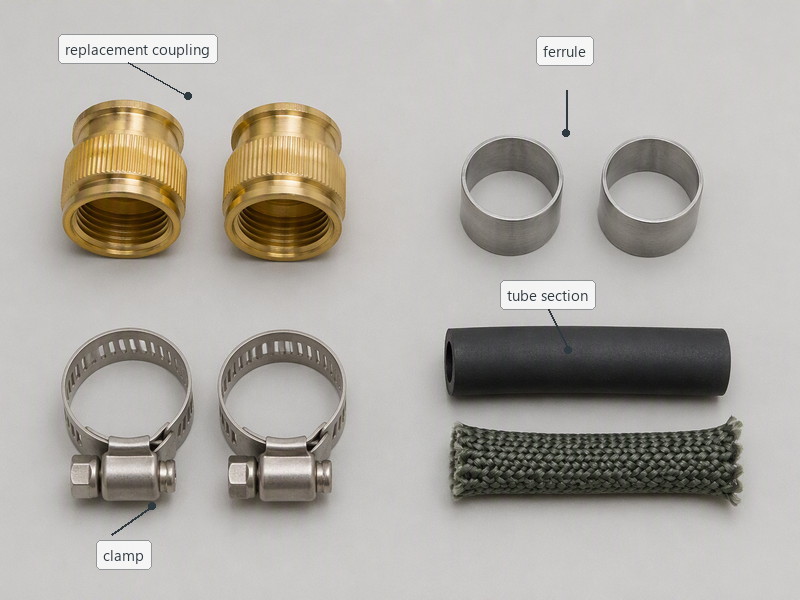
Repair kit contents: couplings, ferrules, clamps and a tube section.
Which Failures Are Repairable?
The repairable failures are the mechanical ones at the couplings. These are the cases a kit is built for:
- A ferrule that has slipped off the sleeve.
- A clamp that has loosened and let the tube move.
- A thread that has stripped on a plastic coupling.
- A washer that has perished and started to leak.
Which Failures Need a New Hose?
Two failures end the hose rather than the joint: a split or a pinhole in the inner tube, because the sleeve covers the pressure boundary, and a permanently stretched tube, because no clamp restores elastic recovery. An expandable hose repair kit is a joint repair rather than a tube repair, and it is useful only while the tube itself is sound.
How Do You Fit a Replacement Coupling?
Cut back to sound hose, slide the ferrule on, push the fitting into the tube and clamp the sleeve over it. The joint must grip the inner tube as well as the sleeve, because the tube carries the pressure and the sleeve carries the stretch. A joint that grips only the sleeve will fail again under the first contraction.
Is a Repair Kit Worth Carrying?
A repair kit is worth carrying if the hose is used away from a tap, because a slipped ferrule ends the job immediately. It is worth less if the product is cheap and the tube is already tired, since the kit is a fraction of the cost of a new hose. Judge it by the price of the kit against the price of the whole product.
What Does a Lifetime Warranty Cover on an Expandable Hose?
A lifetime warranty is a commercial term rather than a durability measurement, and on this construction the exclusions matter more than the term itself. Freezing, storage under pressure and damage at the couplings are the three that normally fall outside cover. Check three details on the listing instead: a stated resting length, a working and burst pressure with the test condition beside it, and whether the coupling is described as gripping the inner tube as well as the sleeve.
Fit a replacement coupling while the tube is sound; when the tube itself has gone, our bore and length figures show what to match on the replacement.
8. How Does an Expandable Hose Compare With a Flexible Garden Hose?
A flexible garden hose is a fixed-length hose made supple by its compound rather than by pressure. It keeps one length, one bore and one shape at rest and while charged. An expandable hose trades that constancy for compact storage, so the choice depends on which property you are unwilling to give up.
When Should You Choose a Flexible Garden Hose Instead?
Choose a fixed hose when the hose stays connected, when the run is fixed, or when flow matters more than storage. It holds its bore at zero pressure, drains predictably and delivers the same flow every time, and it carries no elastic end loads, which removes the coupling failures described above.
When Does Storage Decide the Choice?
On a balcony, in a flat with no outside tap, or in the boot of a car, stored size may be the only criterion that matters. In those settings the expandable design wins, provided the resting length fits the space and the run stays short. Storage is the one criterion where the expandable construction is clearly ahead.
We Share a Standpipe on an Allotment — What Should We Expect From an Expandable Hose?
A shared standpipe usually means an uncertain supply pressure, a long run and repeated dragging by different people. Low pressure keeps the sleeve from locking fully open, a long run adds friction, and dragging wears the sleeve. Expect this duty to shorten the hose’s useful life well before the couplings or the run length become the limit.
Which One Lasts Longer?
A fixed hose has fewer moving parts and no elastic strain cycle, so its expected service is normally longer under the same care. That comparison is qualitative rather than measured, and it is one reason expandable products are usually bought for light, occasional use. Our flexible hose materials guide explains the compound choices that sit behind the difference.
How Do the Two Designs Compare on Cost Per Season?
The purchase price of the hose is only part of the comparison. A design that survives more seasons costs less per season even when the first purchase is higher. Judge the two on the seasons you expect from each, and on whether the stored size is worth the shorter service.
9. How Do You Evaluate the Best Expandable Hose Before Buying?
You evaluate it from four numbers, one physical check and two specification details. The numbers are the charged length, the resting length, the bore while charged and the pressure rating. The check is the coupling, where the inner tube must be held as firmly as the sleeve.
What Should You Confirm on the Listing?
Confirm the details on this list before you pay:
- The charged length and the resting length, both stated separately.
- The nominal bore while charged.
- The thread type at both ends — normally 3/4 in GHT (Garden Hose Thread, also written NH), a straight 3/4 in thread of 11.5 threads per inch that seals on a washer.
- The published working and burst pressure, with the test condition for each.
- Whether the coupling is described as gripping the inner tube as well as the sleeve.
- The tube material, so you know its cold-weather limit.
What Should You Test in the First Week?
Charge the hose, measure the length it reaches, then close the tap and measure what it returns to. Check both couplings for movement at the crimp while the hose contracts. If a coupling slips in the first week, the joint was under-gripped from the start, and that fault will return.
How Do Bore and Run Length Change the Choice?
The nominal bore you need depends on the flow you want, and the flow you want depends on the length of the run. Our hose size selection guide works through that arithmetic. Once the bore is fixed, the expandable question becomes a question about storage rather than about delivery.
Our types of water hoses guide sets out the fixed, flexible, soaker and expandable families side by side.
If you are buying for a trade program rather than for one garden, send the resting length, the bore while charged and the duty you need through contact and we will confirm the construction, the fittings and the pressure rating. If you already know the bore and the duty, the consumer product range lists the constructions and the shop shows current lengths.
10. What Are the Honest Limits of an Expandable Hose?
The honest limit is that the advertised length, the bore and the flow all depend on a condition that appears only once the hose is charged at the tap. The product is clear about its mechanism and vague about its resting state. Two expandable hoses with the same advertised length can differ in stored size, in bore and in coupling quality by a wide margin.
Which Numbers Are Usually Missing?
The resting length, the bore while charged and the coupling construction are the three details most often left out of a listing. Without them a buyer cannot compare two products, and a review of either one cannot be checked. An expandable garden hose that publishes all three is easier to judge than one that publishes none, whatever its length.
What Happens to the Elastic Tube Over Time?
Elastic strain relaxes with time and with heat, so a tube kept stretched recovers less than a tube kept short. That is why storage matters more for this design than for a fixed hose. Draining the hose and storing it retracted keeps the strain low and preserves both the resting length and the grip of the couplings.
What Is the Honest Summary?
The best expandable hose is a compact, light-duty water path with a real but bounded capability. It is at its best on short, occasional, hand-held jobs at moderate pressure, and at its worst where a fixed line would never fail. Choose it for storage, choose a fixed hose for constancy, and check the resting length before you commit.
Buyers who are listing this construction rather than using it should put three details on the packaging: the resting length, the bore measured while charged, and whether the coupling grips the inner tube as well as the sleeve. Those three are what a buyer can check, and they are also what a return usually turns on.
よくある質問
What Is the Resting Length of an Expandable Hose?
Makers commonly quote the resting length as about one third of the advertised length, so a hose sold as 30 m would rest at about 10 m on that basis. Always check the stated resting length on the listing, because that figure decides how much space the hose needs when it is drained and stored.
Why Does My Expandable Hose Not Reach Its Advertised Length With the Tap Fully Open?
The advertised length applies only while the hose is charged at normal supply pressure. A supply below the pressure the maker assumes leaves the sleeve unlocked and the hose short of the figure. Measure again with the tap fully open and no nozzle restriction fitted.
Is an Expandable Garden Hose Good for a Pressure Washer?
A pressure washer is normally the wrong supply for an expandable hose: it delivers flow and pressure well above the working rating of most designs, and the elastic tube plus its couplings are the weakest link. The published band used on this site is 150 psi working and 400 to 500 psi burst, and a washer should be matched to a hose rated for it.
Do Expandable Hose Reviews Cover Durability?
Short expandable hose reviews usually report first-impression measures rather than durability: length, feel and behavior on one tap. Endurance properties such as coupling cycles and residual strain need a long test that most reviews do not run. Treat a first-impression review as a description rather than a life prediction.
What Is Inside an Expandable Hose Repair Kit?
A kit normally contains replacement couplings or ferrules, clamps and sometimes a short section of tube or sleeve. It is designed to rebuild the joints at the two ends, because those are the parts that usually fail. It does not repair a split in the inner tube, because the sleeve covers the pressure boundary.
Can a Flexible Garden Hose Be Stored as Small as an Expandable Hose?
A fixed hose keeps its full length at rest, so it stores at that length whether or not it is charged. That is the clearest advantage of the expandable design. If stored size is the deciding criterion, expandable wins; if flow and constancy matter more, a fixed hose is the better answer.
Does a Smaller Bore Give an Expandable Hose More Pressure?
Bore sets flow rather than pressure. The pressure at the nozzle depends on the supply and on friction losses in the hose, and a smaller bore increases those losses. At equal velocity the relative flow is 1.00 at a 1/2 in bore and 1.56 at 5/8 in, so the larger bore delivers more water at the same pressure.
Can I Leave an Expandable Hose Connected Overnight, or Should I Drain It Before I Store It?
An expandable hose can be left connected overnight, but the tube stays stretched while it is charged and elastic strain relaxes over time. Long periods under pressure also keep both couplings loaded. For the longest service, drain the hose and let it retract once you have finished watering.
Why Do the Couplings on an Expandable Hose Fail First?
The couplings are rigid while the hose is elastic. Every expansion pulls the sleeve away from the fitting, and every contraction pulls the tube toward the middle of the hose. That concentrates strain in the short length of hose behind each fitting. A coupling that does not grip the inner tube will separate there.
My Tap Gives Weak Pressure — Does the Best Expandable Hose Still Work on a Low-Pressure Supply?
An expandable hose can work on a low-pressure supply, but less well than the length claim suggests. The sleeve locks open only when the tube is stretched far enough, so a weak supply may leave the hose part-open and short of its advertised length. Measure the length you actually reach at your own tap before deciding.
I Water Containers on a Small Patio — How Do I Know If an Expandable Hose Is Right for My Garden?
Match an expandable hose to the job rather than to the length claim. If you water containers, fill cans or rinse a car at moderate pressure on a small property, the construction suits the work. If the hose stays connected, feeds a drip line or crosses rough ground daily, a fixed hose is the more durable choice.
How Long Is a 100 ft Expandable Hose in Meters, and How Much Space Does It Need at Rest?
A 100 ft hose is 30.5 m at 1 ft = 0.3048 m, so it is a long run rather than a small one. It rests at about one third of that, near 10 m or 33 ft, which is the figure that decides storage. Check the stated resting length before you count on any of these figures.
HENGHUAについて
HENGHUA manufactures hose for distributors, retailers, OEM and private-label programs, and sells under the corporate HENGHUA brand alongside the GLOBHOSE and FLEXMAX product lines. Water hose production covers fixed vinyl, rubber and hybrid hose as well as reinforced multi-layer constructions, with wall thickness, bore and pressure ratings stated on the specification. Working pressure and burst pressure are established by hydrostatic testing during production, and the test conditions are written down rather than implied.
Each production batch records the hydrostatic test pressure applied to it, so the test condition can be quoted beside the bore and wall thickness on the specification. OEM, custom branding and private-label programs are supported. For technical data or a quotation, use the enquiry form on our contact page.






 English
  Spanish
  Portuguese
  French
  German
  Arabic
  Russian
  Indonesian
  Japanese
  Korean