
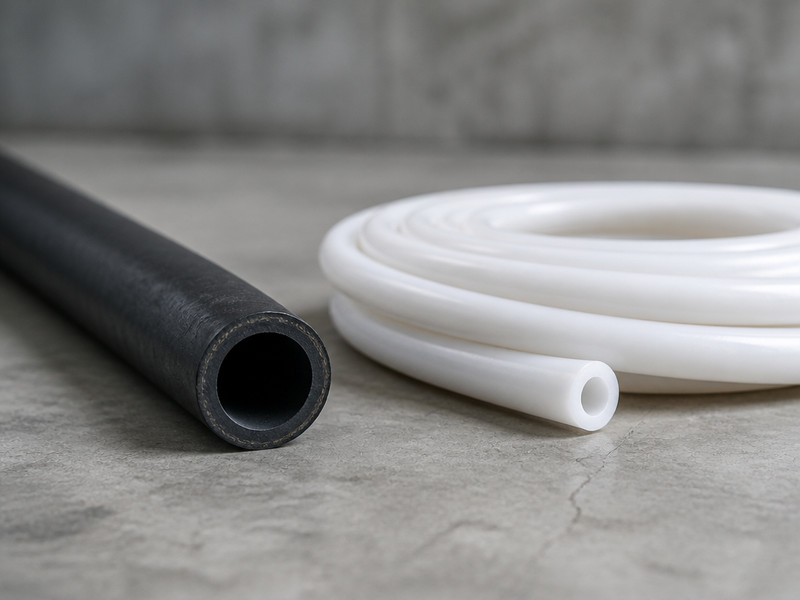
A ptfe chemical hose is the top rung of a ladder that starts with the traditional rubber-lined acid hose, usually an EPDM liner. Above it sit XLPE and UHMWPE, and each rung closes a failure mode of the rung below — oxidizers at XLPE, breadth at UHMWPE, solvents and heat at PTFE (polytetrafluoroethylene), the only rung that raises the ceiling.
For solvent duty, or service above +120 °C, a PTFE liner is the only rung with the range: −70 °C to +260 °C in continuous service. For aqueous and moderate duty, rubber or XLPE does the same work for less.
About a 15-minute read at 250 words per minute; it follows the liner ladder, the PTFE temperature window, smooth-bore versus convoluted PTFE, and where a rubber hose is still the better buy — liner choice only.

Figure 1. The liner ladder runs from a rubber-lined hose up to PTFE, trading flexibility and budget for chemical resistance and heat tolerance.
Short Answer: What a PTFE Chemical Hose Adds to the Line
A rubber-lined hose is the traditional answer for moving acids and many aqueous chemicals. It is inexpensive, flexible and easy to source in long lengths. Add heat, an aggressive solvent, or a strong oxidizer, and the rubber liner becomes the weak link. A ptfe chemical hose replaces that liner with a fluoropolymer that resists almost the entire chemical spectrum.
The trade is real: PTFE has the widest service window of any common hose liner, and the poorest flexibility, the largest bend radius and the highest cost of the group. This article follows the ladder one rung at a time, so you can stop where your process actually stops.
The Liner Progression: Acid Hose, XLPE, UHMWPE and PTFE Chemical Hose
The chemical hose liner is the tube the chemical actually touches. The cover, the textile reinforcement and any steel helix give the hose its shape and strength, but the liner decides what the hose can carry. Liner choice therefore drives every other decision, from pressure rating to fitting selection.
The ladder has four rungs: the rubber liner at the base, then XLPE, UHMWPE and PTFE. This section sets out what each rung does, so you can stop at the one that matches your duty.
Table 1. The liner ladder from a rubber-lined hose to PTFE: heat ceiling against the base rung, and the trade each step makes. Full windows are in Table 3; the base rung may also use an oil-resistant NBR liner.
| Step | Liner | Heat Ceiling vs Base Rung | Resists Well | What It Costs You |
|---|---|---|---|---|
| Base rung | Rubber liner (EPDM) | Same | Acids, bases, ketones, alcohols, ozone, steam | Use this liner where the medium is free of petroleum oils and aromatics |
| Second rung | XLPE | Lower | Acids, bases, hypochlorite and other oxidizing media | Route aromatic solvents to the PTFE rung |
| Third rung | UHMWPE(UPE) | Same | Broad industrial chemical coverage | Confirm strong oxidizing acids and hot aromatics on the PTFE rung |
| Top rung | PTFE | Much higher | Strong acids, bases and solvents | Highest cost, worst flexibility, largest bend radius |
The rubber liner at the base rung is not one material. A traditional rubber liner may use EPDM (ethylene propylene diene monomer) or an oil-resistant synthetic rubber such as NBR, and the two behave differently. EPDM handles acids, bases, ketones, alcohols and steam, but it swells in petroleum-based oils and aromatics. NBR handles petroleum-based oils and fuels, but not ketones, esters, strong acids or ozone. Choosing the base rung well already removes many field failures.
The Rubber Base Rung: What a Traditional Rubber Liner Does Well
The rubber liner earns its place through cost, flexibility and repairability. It bends to a tight radius, coils easily for storage, and tolerates the rough handling of a plant floor. For dilute acids, caustics and most aqueous solutions at moderate temperature, it is the sensible, economical choice.
The limits of a rubber liner appear as soon as the duty changes. Raise the temperature toward the top of the EPDM window and the liner softens; introduce an aromatic solvent and the rubber swells, softens and eventually delaminates. Add a strong oxidizer and the polymer chain breaks down. In practice, the failures we see most often start at a swollen or delaminated inner wall rather than at the cover, and they rarely announce themselves in advance.
XLPE and UHMWPE: The Middle of the Ladder
Cross-linked polyethylene, or XLPE, is the first real step up. Its continuous service window is −40 °C to +100 °C, lower than EPDM at the top end, but it resists hypochlorite and other oxidizing media that attack rubber. It also resists acids and bases well. The one clear exclusion is aromatic solvents, which XLPE does not tolerate.
UHMWPE, also written UPE, sits above XLPE. Its continuous service window is −40 °C to +120 °C, and manufacturer data sheets commonly state that a UHMWPE liner handles about 98% of industrial chemicals. It is broader than XLPE and cheaper than PTFE. Its boundaries are strong oxidizing acids and hot aromatics or halogenated hydrocarbons. For a fuller material profile, see the dedicated guide to UHMWPE chemical hose (planned URL — publish before linking).
What Does Each Step Up the Liner Ladder Buy?
Each rung solves a specific problem. Read the following list as answers to one question: what fails on the rung below?
The liner rungs, in order:
- EPDM at the base rung — covers most aqueous chemical duty at low cost.
- XLPE for oxidizing media — adds hypochlorite and similar oxidizers to the safe list.
- UHMWPE for breadth — covers a very wide chemical range at a mid-range price.
- PTFE for the extremes — the only liner that spans strong acids, bases and solvents across a very wide temperature band.
The ladder shows the same trade from top to bottom. Each step up closes a gap the rung below leaves open, and the price is paid in two currencies at once: flexibility and money. A liner that resists more chemistry is also, as a rule, stiffer and more expensive.
Table 2 sets out that trade in physical terms. The price column is a planning figure only. Actual prices depend on the order and the build, so treat the ranking as directional, not as a quotation.
Table 2. What each step buys and what it costs, ranked by rung (price as a planning figure; the true price depends on bore, length, fittings and order volume).
| Step Up | What You Gain | Flexibility Impact | Bend Radius Impact | Price Basis |
|---|---|---|---|---|
| Rubber to XLPE | Oxidizer resistance, cleaner chemical inertness | Modest loss; still easy to handle | Small increase for the same bore | Above rubber, below UHMWPE |
| XLPE to UHMWPE | Much wider chemical coverage | Noticeable loss; needs more effort to coil | Larger radius than XLPE | The mid-range step |
| UHMWPE to PTFE | Widest chemical resistance and the highest heat ceiling | Largest loss; the stiffest of the group | Largest radius of the group | The highest step |
The PTFE Temperature Window: −70 °C to +260 °C
PTFE is the reason the top of the ladder exists. Its continuous service window runs from −70 °C to +260 °C, far beyond any rubber or polyolefin liner on the list. The ptfe hose temperature range matters most where a process mixes hot and corrosive duty.
A rubber liner that handles a chemical at room temperature may fail the same chemical once the duty moves above the rubber window. PTFE does not have that problem, because the same inert polymer works across nearly the whole window. That is the single most useful fact about the top rung.
Supplied data sheets quote different PTFE ceilings because the rated figure belongs to the finished assembly, not to the polymer alone. Grade, wall thickness, and the reinforcement and end fittings that carry the pressure all move the number.

Figure 2. PTFE spans a far wider temperature band than rubber or polyolefin liners, which is what keeps a solvent line working at temperature.
Hot End and Cold End Behave Differently
At the hot end, PTFE stays chemically inert, but the rest of the hose becomes the design limit. The cover, the reinforcement and the end fittings must survive the same temperature. A wide ptfe hose temperature range is no help if the assembly around it fails first.
At the cold end, the problem is mechanical rather than chemical. PTFE is usable down to −70 °C, but it stiffens well before that. A cold PTFE-lined hose resists bending, so plan a generous bend radius and avoid coiling it tightly in a cold store.
Table 3. Temperature windows and weak points by liner material (liner figures in continuous service, planning values; the finished assembly rating depends on grade, wall thickness and reinforcement — see the note above).
| Liner Material | Continuous Window | Strong At | Weak At |
|---|---|---|---|
| EPDM | −40 °C ~ +120 °C | Acids, bases, ketones, alcohols, steam | Petroleum-based oils and aromatics |
| Oil-resistant synthetic rubber (NBR) | −30 °C ~ +100 °C | Petroleum-based oils and fuels | Ketones, esters, strong acids, ozone |
| XLPE | −40 °C ~ +100 °C | Acids, bases, oxidizing media | 芳香族溶剤 |
| UHMWPE(UPE) | −40 °C ~ +120 °C | 幅広い工業用化学品 | Strong oxidizing acids, hot aromatics |
| PTFE | −70 °C ~ +260 °C | Strong acids, bases, solvents | Molten alkali metals and elemental fluorine |
Where Does a PTFE Chemical Hose Reach Its Limits?
Scope: PTFE suits strong acids, bases and solvents across its full temperature window. Two media sit outside it: molten alkali metals and elemental fluorine.
The other limits are mechanical and commercial. A ptfe chemical hose has the weakest flexibility of any liner here, so it is a poor fit for a hose that must snake through tight spaces or bend repeatedly. It also carries the highest price, so specifying it where EPDM or XLPE would do adds cost without adding safety.
There is also a permeation consideration. Aggressive media migrate slowly through a thin PTFE wall. For continuous or aggressive duty, confirm the liner grade and wall thickness with the manufacturer before you order.
Smooth-Bore vs. Convoluted PTFE: Two Bores, Two Jobs
PTFE liners come in two bore forms, and the choice affects flow, cleaning and flexibility more than the chemistry.
A smooth-bore liner has a straight, uninterrupted internal wall. It gives the best flow, the lowest pressure drop and the easiest cleaning, which matters for food-contact and pharmaceutical duty. A PTFE liner is non-porous and low-friction, so product residue does not cling to the wall and a flush leaves less behind. In exchange, a smooth-bore PTFE hose is the stiffest option, with the largest minimum bend radius for a given bore.
A convoluted liner has a ribbed or corrugated internal wall. The convolutions let the hose bend more easily and accept tighter radii, and they allow the bore to flex without collapsing. The cost is higher pressure drop, a slightly harder clean, and a flow path that traps a little more product.

Figure 3. A smooth bore gives the best flow and the easiest clean; a convoluted bore trades flow for a tighter bend radius.
Table 4. Smooth-bore versus convoluted PTFE liners compared across the properties that decide most transfer jobs.
| Property | Smooth-Bore PTFE | Convoluted PTFE |
|---|---|---|
| Flow and pressure drop | Best flow, lowest pressure drop | Higher pressure drop for the same bore |
| Bend radius | Largest minimum radius; stiffest | Smaller radius; bends more easily |
| Cleaning | Easiest to clean and drain | Ribs can trap residual product |
| Typical duty | Fixed runs, metering, food contact | Flexible routing, vibration, movement |
What Do Flexibility, Bend Radius and Price Cost at the Top?
Flexibility is the hidden tax on every step up the ladder, and it is easiest to see at the top. A rubber-lined hose bends like a garden hose. A ptfe chemical hose bends like a stiff tube. That difference changes how you route it, how tightly you can coil it, and how much support it needs along the run.
The bend radius is the number to check before you order. A liner that resists more chemistry is usually stiffer, so it needs a larger minimum bend radius for the same bore. Ignore that and the hose kinks at a tight turn, which stresses the wall and the fittings at the same time.
Price follows the same curve. Rubber is the lowest-cost option, XLPE and UHMWPE sit in the middle, and PTFE is the most expensive. Every figure here is a planning figure, because the real number depends on bore, length, pressure class, fittings and order volume. As a rule, the gap between rungs widens as the bore grows, because liner material scales with volume.
When Is a PTFE Chemical Hose Genuinely Justified?
The top rung is justified when the duty genuinely needs it, and wasteful when it does not. The deciding factors are the chemical, the temperature, and the handling pattern.
Use the following rules as a filter. Stop at the first line that matches your duty:
- Match the liner to the medium first, not to a price point.
- Step to PTFE when the medium is a solvent that swells rubber and attacks polyolefin.
- Step to PTFE when the temperature sits above the EPDM, XLPE or UHMWPE window.
- Stay with rubber or XLPE when the duty is aqueous, moderate and non-oxidizing.
- Choose a convoluted PTFE bore, or step down to UHMWPE, when the route demands frequent tight bends.
Specify a ptfe chemical hose only when the duty clears those rules. Table 5 turns the same logic into a quick decision map.
Table 5. Choosing a liner by duty, from a rubber liner to PTFE (planning guidance; confirm the final grade against a chemical resistance chart).
| Duty Condition | Suggested Liner | なぜ |
|---|---|---|
| Aqueous acid or alkali below +100 °C | Rubber liner (EPDM) | Adequate and economical; no need to pay for PTFE |
| Oxidizing media such as hypochlorite | XLPE | Resists oxidizers that degrade rubber |
| A broad, changing mix of chemicals | UHMWPE(UPE) | Widest coverage short of PTFE, at lower cost |
| Solvent duty, or service above +120 °C | PTFE | Only liner with the range for solvent and heat together |
| Frequent tight bends on a short run | Convoluted PTFE bore, or UHMWPE | Smooth-bore PTFE is ruled out here by poor flexibility and a large bend radius |
How Do You Choose Between Hose Liners?
A repeatable method prevents the two common errors: specifying PTFE out of habit, and specifying rubber where it will fail. Work through the following sequence for each transfer point on the plant.
The selection method, in order:
- List every chemical the hose will meet, including cleaning agents and flush fluids.
- Record the highest and lowest temperature the liner will see, not the average.
- Cross-check each chemical and temperature against a resistance chart.
- Note the pressure, and whether the line is suction, delivery, or both.
- Measure the tightest bend the route needs and compare it with the liner radius.
- Confirm the fittings, end connections and any antistatic requirement.
- Re-check the chosen liner against the whole list before you order.
Steps four and five catch most mistakes. A suction line needs a hose built to resist collapse, which usually means a steel helix in the construction. A route with tight bends may rule out a stiff PTFE liner even when the chemistry points straight at it.
For the construction side of that check, the guide to suction vs delivery hose explains the difference the reinforcement and helix make. For bore and pressure sizing, the hose size selection guide covers how to match the liner to the flow you need.
Final Verdict: Match the Liner to the Medium, Not to the Habit
The liner ladder is a tool, not a ranking of quality. A rubber-lined hose is not a worse product than a ptfe chemical hose; it is a different answer to a different question. The mistake is buying the top rung for a base-rung duty, or forcing a base rung to do a top-rung job.
Read the duty, follow the ladder to the first rung that clears it, and stop there. It keeps the chemical contained, the hose flexible enough to handle, and the budget spent only where it buys real protection.
If the medium is a solvent or the temperature is high, the extra cost of a PTFE liner is the price of a working line. If the duty is aqueous and moderate, rubber or XLPE does the job for far less. The right answer depends on your chemicals, and the way to be sure is to chart them before you buy.
PTFE Chemical Hose FAQs
What is a ptfe chemical hose used for?
A chemical hose with a PTFE liner is used wherever a medium would attack a rubber or polyolefin liner. Typical duty includes strong acids, bases and solvents, and any process that combines corrosive chemistry with high temperature. It also suits food-contact and pharmaceutical transfer where a smooth, cleanable bore is needed. The common thread is a duty that sits outside the reach of a cheaper liner.
What is the ptfe hose temperature range?
The PTFE continuous service range runs from −70 °C to +260 °C. That is the widest range of any common hose liner, and it is why PTFE is chosen when a process mixes corrosive chemistry with heat. At the cold end the liner stays chemically sound but stiffens, so bends need a larger radius. Always confirm the exact grade and the assembly rating with the manufacturer.
How does a chemical hose liner affect performance?
The chemical hose liner is the only layer that touches the product, so it decides what the hose can safely carry. The cover protects the outside, the reinforcement carries pressure, and any helix resists collapse, but none of those contacts the medium. Change the liner and you change the chemical compatibility and the temperature limit of the whole assembly.
Is a PTFE-lined hose better than a rubber-lined hose?
A rubber-lined hose is not universally the worse choice. It is cheaper, more flexible and easier to coil, and it handles dilute acids and aqueous chemicals well. A PTFE hose wins where the medium is a solvent, an aggressive oxidizer, or a hot chemical that rubber cannot survive. Choose by duty, not by price. Paying for PTFE on a mild aqueous job adds cost without adding protection.
What can damage a PTFE liner?
Two chemical exceptions defeat PTFE entirely: molten alkali metals and elemental fluorine. Mechanical damage is the other common failure mode. A tight bend, a sharp drag over an edge, or a repeated flex beyond the liner radius can kink or crack the tube. Heat above the rated window and damaged fittings also shorten service life. Inspect the hose and the cover regularly.
What is the difference between smooth-bore and convoluted PTFE?
Smooth-bore PTFE has a straight internal wall, giving the best flow, the lowest pressure drop and the easiest cleaning, but it is the stiffest option with the largest bend radius. Convoluted PTFE has a ribbed wall that bends more easily and accepts tighter radii, at the cost of higher pressure drop and a slightly harder clean.
Can a PTFE hose handle steam or hot oil?
PTFE itself resists steam and hot oil, and its window reaches +260 °C, well above rubber liners. The limit is usually the rest of the assembly. The cover, the reinforcement and the end fittings must survive the same temperature, and the pressure rating falls as temperature rises. Rate the whole hose for the hottest condition it will meet, not just the liner.
How do I choose a hose liner?
To choose a hose liner, start with the chemicals, then the temperature, then the handling. List every medium the hose will meet, including cleaning fluids, and note the highest and lowest temperature. Cross-check both against a resistance chart. Measure the tightest bend in the route, confirm the pressure and whether the line is suction or delivery, then pick the lowest rung that clears every condition.
Does a PTFE hose cost more, and is it worth it?
Yes, PTFE carries the highest cost of the liner group. Any price comparison is a planning figure, because the real number depends on bore, length, pressure class, fittings and order volume. It is worth the cost when the duty demands solvent resistance or high temperature. On a mild aqueous job, a rubber-lined hose or an XLPE liner does the same work for less.
About HENGHUA and Our Chemical Hose Line
HENGHUA manufactures hoses and fittings for distributors, retailers and OEM brands. Our chemical hose line covers UHMWPE (UPE), XLPE and PTFE liners, alongside rubber constructions such as EPDM and oil-resistant synthetic rubber. Each build pairs the liner with high-tensile textile reinforcement, and suction duty can add a steel helix for collapse resistance.
We supply factory-crimped assemblies, custom lengths, fittings, cover printing, private label and OEM/ODM work. Because we control the process in one plant, we offer factory-direct pricing and short lead times for bulk orders, backed by a warranty. If you are sourcing chemical hose for your range, send your specification and we will quote against it. Get a quote and free samples
For the wider picture, the complete guide to chemical hose maps types, materials and selection, and the guide to choosing by medium uses chemical hose compatibility by medium (planned URLs — publish before linking). To see how liner families compare outside the PTFE story, read the flexible hose materials guide and the reference on fluid compatibility across NBR, EPDM and FKM.
Written by the HENGHUA engineering team, drawing on hose design and chemical transfer application experience. Last updated: October 2026.






 English
  Spanish
  Portuguese
  French
  German
  Arabic
  Russian
  Indonesian
  Japanese
  Korean