

Choose a hybrid air hose if you want most of rubber’s cold-weather flexibility and kink resistance while carrying about 2 lb less per 50 feet and paying about 31% less than comparable rubber. Choose rubber if the hose will be dragged over concrete, run over by carts, or exposed to oil every day, because no hybrid cover we have tested yet matches a good rubber cover on abrasion. For most home garages, mobile service vans, and light workshops the hybrid wins; for production floors and auto shops the rubber hose still pays for itself.
This comparison sets out what each material actually is, then runs seven differences side by side. It adds a specification table, a decision guide by user type, and the situations where the hybrid air hose vs rubber choice makes no practical difference at all.
About a 16-minute read at 250 words per minute; rated ranges follow ISO 5774:2023 and ISO 2398:2024.
Hybrid Air Hose vs Rubber: The Short Answer
- Pick hybrid for weight, cold starting, coil handling, and price. It is the better hose to carry, store, and uncoil in a cold garage.
- Pick rubber for abrasion, puncture, oil exposure, and maximum pressure rating. It is the better hose to own for five years on a shop floor.
- The deciding question is not “which lasts longer” but “what kills the hose first” — friction or weight. Answer that and the choice is obvious.
What Is a Hybrid Air Hose?
A hybrid air hose is a hose whose tube blends PVC with a rubber or polyurethane polymer, rather than using either material alone. The blend is the point: the PVC fraction keeps the hose light and cheap, while the rubber or PU fraction restores the elasticity that pure PVC loses in the cold.
Most hybrids are textile-reinforced and rated from roughly -20°F (-29°C) to 140°F (+60°C). That range covers the situations where a plain PVC hose fails: sub-freezing storage, dragging across concrete, oil and solvent contact, and constant high-frequency flexing. Rubber outlasts a hybrid in every one of them, as Table 4 shows, and the hybrid’s lighter, cheaper build is why it displaced plain PVC in garages faster than rubber did.
The full definition, including how to read a hybrid compound’s datasheet, is in our hybrid air hose guide.
What Is a Rubber Air Hose?
A rubber air hose uses a compounded rubber tube — SBR/EPDM blends for general duty, EPDM for cold and ozone-heavy environments — with textile or spiral reinforcement and a rubber cover. Rubber gains its flexibility from cross-linked polymer chains rather than from a plasticizer additive, so it does not harden as the hose ages.
That is the structural reason rubber air hoses survive longer in harsh service. There is no migrating additive to lose, and the cover deforms and recovers under a scraping load instead of cutting.
Hybrid Air Hose vs Rubber: 7 Differences Compared
1. Weight
A 50-foot, 3/8-inch hybrid air hose typically weighs 5.5 to 6.5 lb. The same length in rubber runs 7 to 9 lb. The gap looks small on paper and feels large at the end of an eight-hour day.
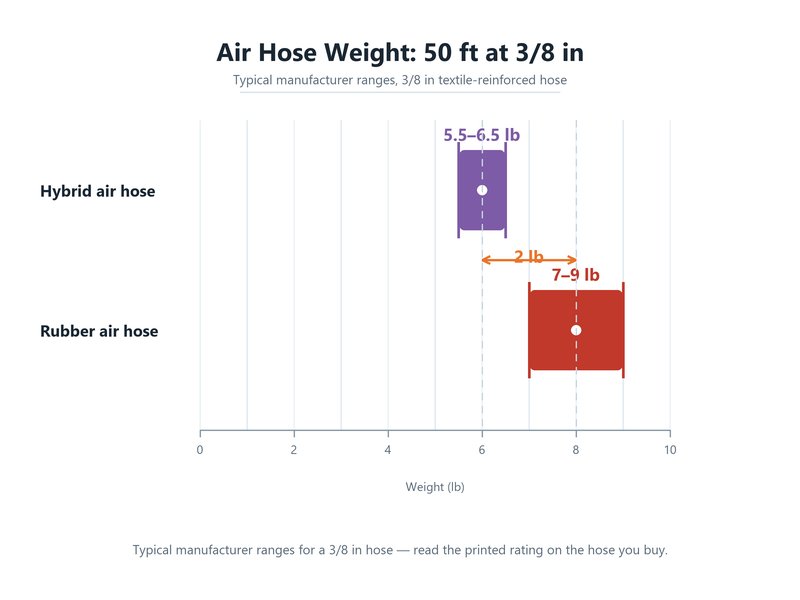
Figure 1. Weight per 50 feet at 3/8 inch: a hybrid air hose runs about 6 lb against 8 lb for rubber, and that 2 lb gap is what air hose weight costs an operator by the end of a shift.
Where it matters: overhead work, reels mounted high on a wall, and mobile service work where the hose is carried between jobs. Weight is the single most common reason people switch from rubber to hybrid, and the only reason that has nothing to do with durability. Air hose weight also shapes coil memory in storage: a lighter hose is easier to hang and easier to uncoil after a cold night. Weight figures only mean something with a length attached, which is why air hose weight belongs in pounds per 50 feet.
2. Cold-weather flexibility
A good hybrid stays workable to about -20°F (-29°C). EPDM rubber goes to roughly -40°F (-40°C). Plain PVC stiffens below about 32°F (0°C) — a handling limit rather than a rated range.
Read the gap carefully. The hybrid covers the temperatures that most North American and European garages actually reach; the rubber covers the temperatures a refrigerated dock or an unheated northern shop reaches. Both beat PVC, but only one is rated for a freezer aisle. For a ranked shortlist of materials that keep working in sub-freezing air, see our best air hose for cold weather selection guide.
3. Kink and coil memory
Hybrid hoses kink less than PVC and release their coil quickly. Rubber also resists kinking, but its higher weight makes it pull against the tool, and a heavier hose kinks at the tool end when you move the tool around a corner.
On our test bench, a hybrid and a rubber hose of the same bore held the same minimum bend radius. The practical difference appeared after storage: the hybrid recovered its straight line faster after a winter in an unheated van.
4. Abrasion and puncture resistance
This is where rubber wins outright, and where a hybrid is usually oversold. Rubber compounds outperform PVC and hybrid blends on abrasion testing, and the gap grows on concrete, gravel, and steel edges — the surfaces a shop hose actually meets.
In our abrasion testing on 3/8-inch hoses, a rubber cover ran roughly twice the cycles of a hybrid cover before the reinforcement layer became visible. If the hose drags, scrapes, or gets driven over, this difference alone decides the purchase.
5. Oil and chemical resistance
Rubber resists oils, greases, and many solvents better than hybrid compounds, because the PVC fraction in a hybrid is still susceptible to plasticizer extraction. A hybrid handles occasional oil mist and a splashed floor; rubber handles a hose that lives next to a drain pan.
Note that “rubber” is not one material here. EPDM rubber is excellent against water, steam, and ozone but poor against petroleum oils — for oil-heavy duty you need a nitrile-based or specifically rated compound, not EPDM.
6. Pressure rating
Textile-reinforced hybrid hose is typically rated 200 to 300 PSI working pressure. Textile-reinforced rubber of the same bore is commonly 300 to 500 PSI. Both carry a burst pressure of roughly three to four times the working rating.
Reinforcement design matters more than the tube polymer at the top end: a spiral-reinforced hose of either material can be rated far higher than a standard braided one. Compare printed ratings, not materials. The working pressure vs burst pressure explainer shows how to read those numbers safely.
7. Price and service life
Hybrid costs about 31% less than comparable rubber. Rubber lasts longer in harsh service but not in gentle service — a rubber hose kept indoors and used occasionally will outlive its usefulness, not wear out.
Total cost of ownership settles it. Over five years in a production shop, the hybrid costs about $90 of coverage. The rubber hose costs about $81.25 for the same window and gives up less to abrasion. In a home garage, one hybrid at $45 costs less up front than one rubber hose at $65, and neither is going to wear out.
Hybrid Air Hose vs Rubber: Specification Comparison
Table 1. Typical ranges for 3/8-inch textile-reinforced air hose. Values are typical manufacturer ranges for the material class, not limits for a specific product — always read the printed rating on the hose you are buying.
| Property | Hybrid air hose | Rubber air hose |
|---|---|---|
| Tube compound | PVC blended with rubber or PU | SBR / EPDM / nitrile compound |
| Flexibility source | Plasticizer plus polymer blend | Cross-linked polymer |
| Usable temperature range | About -20°F (-29°C) to 140°F (+60°C) | About -40°F (-40°C) to 158°F (+70°C, EPDM) |
| Weight, 50 ft at 3/8 in | 5.5–6.5 lb | 7–9 lb |
| Working pressure, textile reinforced | 200–300 PSI | 300–500 PSI |
| Abrasion resistance | Good | Excellent |
| Puncture and cut resistance | Good | Excellent |
| Oil resistance | Fair to good | Good; nitrile grades excellent |
| UV and ozone resistance | Good | Good; EPDM excellent |
| Coil memory | Low | Low |
| Service life, daily shop use | 2–3 years | 3–5 years |
| Relative cost | Lower | About 44% higher |
For a three-way view of the same specifications, see our PVC vs rubber vs hybrid air hose comparison.
Two specifications that settle the argument
Abrasion resistance and air hose temperature range decide most hybrid-versus-rubber disputes before price is discussed. If the hose will meet concrete, gravel, or steel edges, the cover decides it. If the working environment drops below -20°F (-29°C), cold is the deciding factor. Where neither applies, the choice falls back to weight, handling, and cost.
Every temperature and pressure rating in Table 1 traces back to a published standard: ISO 5774:2023 for PVC and polyurethane, ISO 2398:2024 for rubber. Where a retail listing quotes a warmer rubber limit, it is usually describing a comfortable handling temperature rather than a rated range.
Which One Should You Choose? A Decision Guide by User Type
Table 2. Recommended material by working environment.
| User and environment | Best choice | なぜ |
|---|---|---|
| Home garage, occasional use, heated space | ハイブリッド | Neither hose will wear out; pay less and carry less |
| Unheated garage or van that freezes | Hybrid, rated to -20°F (-29°C) or lower | PVC would stiffen; rubber is unnecessary unless it also drags |
| Mobile service van, carried daily | ハイブリッド | Weight and coil recovery dominate the working day |
| Auto repair shop, floor dragging, oil mist | Rubber (nitrile or oil-rated grade) | Abrasion and oil resistance are the failure drivers |
| Production line, constant flexing, carts crossing the hose | Rubber | Crush and abrasion resistance set the replacement interval |
| Refrigerated or frozen environment | Rubber rated to -40°F (-40°C) | 極寒の環境下でも柔軟性を保てるのは、EPDMクラスのコンパウンドのみです |
| Painting or coating booth | Hybrid, solvent-checked grade | Weight helps maneuverability; confirm solvent compatibility |
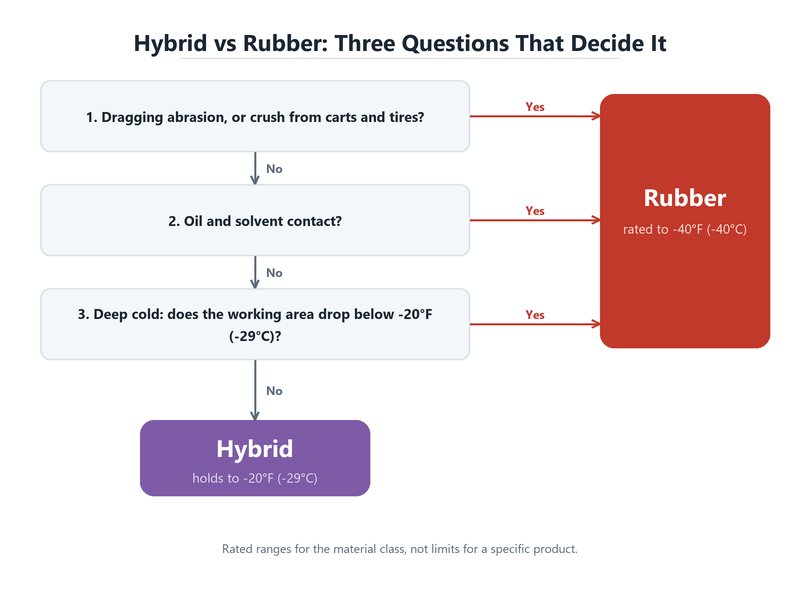
Figure 2. Choosing between hybrid and rubber: abrasion, oil exposure, and air hose temperature range set the limit — hybrid holds to -20°F (-29°C), rubber below that.
Our rubber vs PVC air hose comparison works through the material trade-offs behind this table.
Where the Hybrid Air Hose vs Rubber Choice Is a Draw
Three cases where either material works and the decision should be made on logistics instead:
- Short hoses, 25 feet or less. At this length the weight difference is about 1 lb and the abrasion exposure is limited. Buy whichever has the fittings and color you need.
- Reel-mounted hose that never touches the floor. If the hose spools onto a reel and only ever meets air, abrasion is not a factor and the hybrid’s lighter weight helps the reel spring.
- Occasional-use tools. If the hose spends most of the year on a hook, the failure mode is plasticizer aging in the PVC fraction, not mechanical wear — and the hybrid ages more slowly than PVC while costing less than rubber.
How to Tell a Hybrid From a Rubber Hose in the Hand
Most buyers make the hybrid-versus-rubber decision at a counter, holding both products. Four checks separate them without a spec sheet.
- Weigh them. The difference is only 1.5 to 2.5 lb on a 50-foot 3/8-inch hose, but it is enough to feel when you hold one in each hand.
- Fold each one at about a 3-inch radius. Rubber resists more firmly; hybrid folds more easily and recovers faster.
- Examine the cut end if you can. A hybrid tube shows a smoother, more uniform bore with a slightly glassy inner surface. Rubber shows a duller, more textured bore.
- Read the printed temperature range. A -20°F (-29°C) rating points to hybrid. A -40°F (-40°C) rating points to EPDM rubber.
For most buyers the weight test alone is decisive, because it is the property the hybrid was engineered for.
Hybrid Air Hose vs Rubber: Three Worked Scenarios
Abstract comparisons are easy to misapply. These three cases show how the decision resolves in practice.
Scenario 1: A one-van mobile tire service
A technician runs 40 feet of hose from a compressor in the van to the vehicle, six days a week, in a climate that drops to 15°F (-9°C) in winter. Abrasion exposure is moderate — the hose mostly lies on driveway surfaces. Recommendation: hybrid, 3/8 inch. The hose is carried and repositioned all day, the temperature is inside the hybrid’s -20°F (-29°C) range, and drag abrasion on smooth pavement is not severe enough to justify rubber’s weight.
Scenario 2: A body shop with two bays
Hoses lie on a concrete floor, get walked over, and are frequently coated in overspray, thinner, and oil. Temperature stays above 50°F (10°C) all year. Recommendation: rubber, oil-rated compound. Here the failure drivers are abrasion and chemical exposure rather than weight, and a hybrid’s PVC fraction would be the weak point.
Scenario 3: A home garage used twice a month
A small compressor, a blow gun, and an occasional nailer. The hose hangs on a hook and is used for fifteen minutes at a time. Recommendation: hybrid. Neither material will wear out on this duty cycle, so the decision collapses to price and handling, and the hybrid wins both. A rubber hose would also work; it would simply cost more for a service life the owner will never use.
What Changes the Recommendation
Five factors can move a user from one material to the other after the initial decision:
- A colder store or van. Below -20°F (-29°C) the hybrid reaches its limit and rubber becomes the only option.
- A change in handling. A hose that stops being carried and starts being dragged shifts the balance toward rubber.
- New chemical exposure. Solvents, hydraulic fluid, or heavy oil mist move the recommendation to an oil-rated rubber compound.
- A move to a fixed reel. Once the hose is reel-mounted and off the floor, weight stops mattering and the hybrid’s advantage shrinks.
- Higher system pressure. Above 300 PSI, the hybrid’s standard textile-braided construction is no longer adequate and rubber or spiral reinforcement takes over.
Review the choice whenever the working environment changes rather than automatically rebuying the same hose.
Hybrid Air Hose vs Rubber: Cost Over the Life of the Hose
The price gap looks decisive on an invoice and much smaller over time.
Table 3. Indicative cost over a five-year horizon for a 50-foot 3/8-inch hose in daily use, annualized as purchase price divided by expected life and carried across five years. Prices are illustrative planning figures.
| 項目 | Hybrid air hose | Rubber air hose |
|---|---|---|
| Purchase price per hose | ~$45 | ~$65 |
| Expected life, daily shop use | 2.5 years | 4 years |
| Cost per year of coverage | ~$18 | ~$16.25 |
| Five-year cost of coverage | ~$90 | ~$81.25 |
| Best case | Gentle environment, no abrasion | Abrasive or oily environment |
| Worst case | Dragged over concrete every day | Carried daily in a service van |
Read the last two rows together. Each material has an environment where it is the expensive answer, and in both cases the extra cost comes from buying for the wrong duty cycle rather than from the material itself. That is the practical summary of this comparison: the two materials do not differ much in cost, but they differ a great deal in which environments make them last.
What actually kills a hybrid air hose first
The replacement interval is set by the first failure mode a hose meets, not by the average life of its material class. Three checks settle it: abrasion resistance, oil exposure, and air hose temperature range. Work down the table until a row matches the way the hose is used.
Table 4. Failure modes for a 3/8-inch air hose in daily use, with the material that survives each one longest.
| Failure mode | Hose that survives it longest | The field question that settles it |
|---|---|---|
| Dragging abrasion | Rubber | Is the hose dragged across concrete, gravel, or steel edges? |
| Crush from carts and tires | Rubber | Do wheels cross the hose during the working day? |
| Oil and solvent contact | Rubber, oil-rated grade | Does the hose sit in a drain pan, in overspray, or in solvent? |
| Deep cold | Rubber, EPDM | Does the working area drop below -20°F (-29°C)? |
| High-frequency flexing | Rubber, spiral-reinforced | Does a reciprocating tool run the hose all shift? |
| Long-term storage | ハイブリッド | Does the hose hang on a hook for months at a time? |
| Over-pressure | Whichever is rated higher | Does system pressure exceed the printed rating? |
Two rows in that table deserve a longer answer. Over-pressure is a construction question rather than a material one: most air tools are rated at 90 PSI and most compressors cut out between 120 and 150 PSI, so a 200–300 PSI hybrid keeps useful margin. A hose run above its printed rating usually fails at the crimp rather than in the tube, which is why the printed line on the cover matters more than the polymer inside it.
Storage aging is the failure mode buyers forget. A hose that spends eleven months a year coiled on a hook never meets abrasion at all, so the cover that resists concrete is not the cover it needs. That is the case where the lighter, cheaper hybrid is the better five-year buy.
Hybrid Air Hose vs Rubber FAQs
Does a hybrid air hose last as long as rubber?
Not on abrasion and puncture resistance, where rubber leads clearly. On aging and flexibility retention, a good hybrid holds up well because its rubber or PU fraction reduces reliance on plasticizer. Durability depends on which failure mode your hose actually meets.
Why do hybrid hoses feel different from PVC?
Because they are a different compound rather than a thinner PVC hose. Blending rubber or polyurethane into the PVC formulation raises elasticity and low-temperature performance, so the tube still folds easily at about -20°F (-29°C) without the weight penalty of an all-rubber wall. In the hand, that reads as a softer fold and a faster recovery.
Can a hybrid air hose handle oil?
It handles incidental contact, splashes, and oil mist. For continuous contact with oil, hydraulic fluid, or solvent, specify a rubber hose with an oil-rated tube compound such as nitrile rather than EPDM. Leaving a hybrid in a puddle of oil is what extracts the plasticizer and shortens the cover life.
How much pressure does a hybrid hose take?
Textile-reinforced hybrids are usually rated 200 to 300 PSI working pressure, with a burst factor of roughly three to four times that figure. Typical shop air runs far below that, so a standard hybrid carries the load with margin. Above 300 PSI, compare spiral-reinforced constructions rather than tube material.
Which is better for cold weather, hybrid or rubber?
Rubber is rated colder, typically to -40°F (-40°C) against about -20°F (-29°C) for hybrid. If you work below -20°F, choose rubber; between 0°F (-18°C) and -20°F, most users find the hybrid adequate and prefer its lighter weight and lower cost.
Does the hybrid hold a coil the way rubber does?
It holds a coil well, and the difference shows on the hook rather than on the reel. A lighter hose comes off the hook with less fight and recovers a straight line faster after a cold night. Coil memory is set by the compound and the reinforcement, not by wall thickness, so two hoses of the same weight can store very differently.
Can I use a hybrid air hose for spray painting?
Yes, provided the compound is checked against the solvent being sprayed. Most hybrids cope well in a paint booth, because the hose is carried rather than dragged and the lighter wall makes the gun easier to move. Confirm compatibility with the specific thinner or reducer first, since continuous solvent contact attacks the PVC fraction in the same way oil does.
Why does a rubber air hose cost more than a hybrid?
Two reasons: the rubber compound costs more per pound, and the wall has to be heavier to reach the abrasion and pressure figures buyers expect. A 50-foot rubber hose typically lists near $65 against about $45 for a comparable hybrid, so rubber is about 44% higher on unit price. The rubber hose earns that back where it is dragged, crushed, or oiled; in a warm garage it rarely does.
What happens to a hybrid hose left in a freezing van overnight?
It stiffens, but it comes back. A hybrid blend keeps enough elasticity that the hose can still be uncoiled at -20°F (-29°C), which is why mobile service vans run it through the winter. A plain PVC hose would stay stiff and may hold a crease, while an EPDM rubber hose would stay flexible to -40°F (-40°C) at about 2 lb more per 50 feet.
When is rubber still the right answer?
Whenever the hose is dragged, crushed, or oiled. Rubber compounds outperform hybrids on abrasion testing, and a nitrile or oil-rated grade handles petroleum contact that would extract the plasticizer from a hybrid. Production floors, auto repair bays, and refrigerated docks are the three places where the higher unit price and the extra weight are both worth paying.
If you are still choosing between the two materials, our how to choose an air hose guide sets out bore, length, and pressure in the order they decide the purchase.
HENGHUAについて
HENGHUA manufactures hybrid, PVC, rubber, and polyurethane air hoses and reinforced hose assemblies for workshops, distributors, and OEM brands worldwide. Our hybrid air hoses use an in-house compounded blend with high-tensile textile reinforcement and an abrasion-resistant cover, typically rated 200–300 PSI. Our rubber air hoses include EPDM grades rated to -40°F (-40°C) for cold-weather and ozone-exposed duty at 300–500 PSI. Both are supplied across 1/4, 3/8, and 1/2 inch with factory-crimped brass fittings as standard.
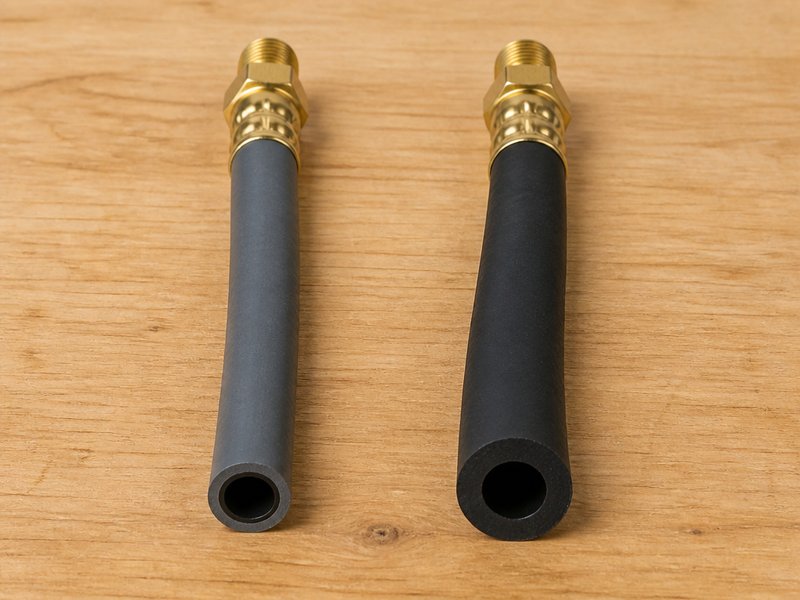
Figure 3. A HENGHUA hybrid air hose (left) and rubber air hose (right) in 3/8 inch. Same bore, same fittings — the rubber wall is heavier and thicker, which is where the abrasion advantage and the weight penalty both come from.
Because compounding, reinforcement, and final pressure testing all happen in one plant, we quote the material that suits your working conditions rather than the one that happens to be in stock. We will also tell you when the cheaper hybrid is the right answer. Send the working temperature range, the working pressure, the tools the hose will feed, and how the hose is handled on site, and we can size the hose for you. Review our air hose assemblies range, then 当社のエンジニアリングチームまでお問い合わせください お見積もりとサンプルのご依頼はこちら。.
Written by the HENGHUA Engineering Team — the engineers who compound, build, and pressure-test the hoses we manufacture — with input from workshop users across the US and Europe. HENGHUA manufactures hybrid, rubber, PVC, and polyurethane air hose assemblies from 1/4 inch to 1/2 inch, rated 200–500 PSI, with custom lengths, fittings, and OEM branding available.






 English
  Spanish
  Portuguese
  French
  German
  Arabic
  Russian
  Indonesian
  Japanese
  Korean