

How do you protect workers from high-pressure hydraulic hazards? Hydraulic hose safety is the set of inspection, restraint, protection, and work-practice controls that keep stored hydraulic energy away from people, and the three that prevent most serious injuries are straightforward: inspect hoses and couplings before they fail, restrain every hose that could whip if it separates, and never search for a leak with your hands. Everything else in this guide exists to make those three habits reliable — the hazards a pressurized hose creates (fluid injection injury, pinhole jet leaks, burst and whip, hot fluid and fire risk), the inspection criteria that take a failing assembly out of service, pressure ratings and test pressure, protective sleeving and routing, whip checks, safe work practices on live systems, and the replacement and storage rules that govern service life.
1. What Is Hydraulic Hose Safety, and Why Does It Matter?
Hydraulic hose safety is the practice of controlling a hose assembly through its whole life so that it carries pressure without injuring anyone. It is not one task; it is five: choosing an assembly rated for the duty, routing and protecting it so it is not damaged, inspecting it on a defined interval, restraining it so a failure cannot whip, and working on it only after the stored energy has been released.
The reason hydraulics deserve their own safety discipline is energy density. A hydraulic system concentrates power into a flexible line the diameter of a garden hose, and that line runs at pressures that a rigid pipe would never see at the same size. When the line fails, everything stored in that fluid column is released through a very small opening, and the release is silent, instant, and often invisible.
Why a pressurized hose stores so much energy
Hydraulic oil is close to incompressible, so it looks harmless from the outside. But the energy is already in the system when the pump stops: an accumulator holds it, a raised cylinder holds it, a pilot line holds it. A flexible hose also expands slightly under pressure and contracts again when the pressure drops, which is why a hose can still spray fluid when the machine has been switched off.
That stored energy is what makes hydraulic injuries different from ordinary workshop injuries:
- A pressurized hose does not simply “leak” — it can eject a jet of fluid through a breach the size of a pin hole.
- The jet is often too thin to see, and it does not look dangerous.
- Skin penetration requires far less pressure than most people assume, so “low pressure” lines are not automatically safe.
- The fluid may also be hot enough to burn, and atomized oil can ignite on a hot surface.
How Often Do Hydraulic Hoses Fail?
Failure analyses tracked by NAHAD (Association for Hose and Accessories Distribution) classify failures by root cause and commonly attribute around 80 percent of hydraulic hose failures to external damage, with abrasion the largest single factor — the hose has usually been rubbed, kinked, over-bent, twisted, or overheated long before the burst. That matters for safety: most failures are visible in advance if anyone is looking for them. The hydraulic hose failure causes and troubleshooting guide takes each one through its symptoms and its fix.
The practical failure list is short and predictable:
- Abrasion — the cover worn through against structure, another hose, or a sharp edge.
- Over-bending and kinking — a radius tighter than the hose is designed for, which loads the wire reinforcement unevenly.
- Twist — the assembly installed with a spiral in the layline, so the reinforcement is fighting itself every pressure cycle.
- Coupling failure — a fitting that pulls off, weeps at the crimp, or was assembled with the wrong ferrule.
- Heat and chemical attack — a cover hardened and cracked by radiant heat, or a tube softened by an incompatible fluid.
- Pressure spike and surge — the line run repeatedly above its rating because a relief valve was set above it, or a fast-acting valve sent a spike up the return line.
This page covers the safety side of owning and working with hose assemblies — what a pressurized hose can do to a person, and the inspection, restraint, protection and work-practice controls that prevent it. For the construction, materials and family-by-family context, start with the hydraulic hose guide, and then work through the ten-point inspection checklist in Section 4.
2. What Are the High-Pressure Hydraulic Hazards?
A pressurized hydraulic system creates seven distinct hazards, and they are controlled in different ways. Treating them as a single “high pressure” category is how controls get missed: a whip check (also called a whip restraint or a safety cable) controls one of them, a protective sleeve controls another, and neither of them protects a person from a pinhole jet.
Table 1. The seven hazards of a pressurized hydraulic system, how each one happens, and the control that actually addresses it. No single control covers more than one or two rows.
| Hazard | How it happens | Who is exposed | Primary control |
|---|---|---|---|
| Fluid injection injury | A jet of fluid from a pin hole or a loosened fitting breaks the skin | Anyone tracing a leak by hand; maintenance technicians; operators checking a suspected weep | Never use hands to find a leak; depressurize before work; use a board or paper |
| Pinhole jet leak | The tube or reinforcement is breached and fluid is forced through a very small opening | Anyone within reach of the jet, which can travel several meters | Isolate and replace the assembly; barrier the area; never tape or clamp a leak |
| Hose burst and whip | The assembly fails under pressure and the released hose thrashes | Anyone inside the arc of the hose, including passers-by | Inspection, correct pressure rating, and rated restraints or whip checks |
| Hot fluid burns | Fluid at operating temperature sprays or pours onto skin | Technicians cracking fittings; operators near a failed line | Let the system cool; use shields and appropriate clothing; route away from people |
| Fire and mist ignition | Atomized hydraulic oil reaches a hot surface, exhaust, or an electrical arc | The whole area, not just the person at the hose | Control leaks at the source; keep ignition sources clear; use fire-resistant fluid where required |
| Crush and entanglement | A failed line drops a load or lets an actuator move unexpectedly | Anyone under or beside the machine | Mechanical blocking, lockout/tagout, and controlled lowering |
| Stored-energy release | Pressure remains in accumulators, cylinders, or pilot lines after the pump stops | Maintenance staff working on a “stopped” machine | Isolate, release, and verify zero energy before breaking any connection |
Which Hydraulic Hazard Kills and Disables Most Often?
Injection injury is the hazard that most often turns a routine leak check into a life-changing injury, because it is the only one where the victim is usually the person deliberately putting their hands next to the leak. Burst and whip injuries tend to involve bystanders or operators; injection injuries overwhelmingly involve the technician who went looking for the leak.
3. Hydraulic Injection Injury: How Little Pressure Is Dangerous?
As little as 100 psi (about 7 bar) is widely cited in industrial safety guidance as the pressure at which fluid has been reported to pass through human skin. For scale, a mobile machine circuit commonly runs at 2,000 to 3,000 psi, and industrial high-pressure systems as a whole span roughly 200 to 12,000 psi; both ranges are published equipment figures rather than test conditions, and neither changes the conclusion. Clinical literature puts the pressure needed to pierce full-thickness skin higher, at roughly 40 bar (about 580 psi), but that figure describes intact skin under controlled conditions, not a margin to work inside. The conclusion is the same either way: any pressurized hydraulic line in a workshop is capable of an injection injury, and no leak is small enough to check with a finger.
Why a Pinhole Leak Is the Most Underrated Hazard
A pinhole jet is hard to see for three reasons. It can be finer than the eye can resolve at working distance. It may be hidden behind a fitting, a guard, or the far side of the hose. And it very often leaves no puddle, because the fluid is atomized into a mist rather than running down the hose.
Because there is no obvious wet patch, the natural reaction is to run a hand or a fingertip along the suspect area to find the source. That is the single behavior that turns a leaking hose into a surgical emergency.
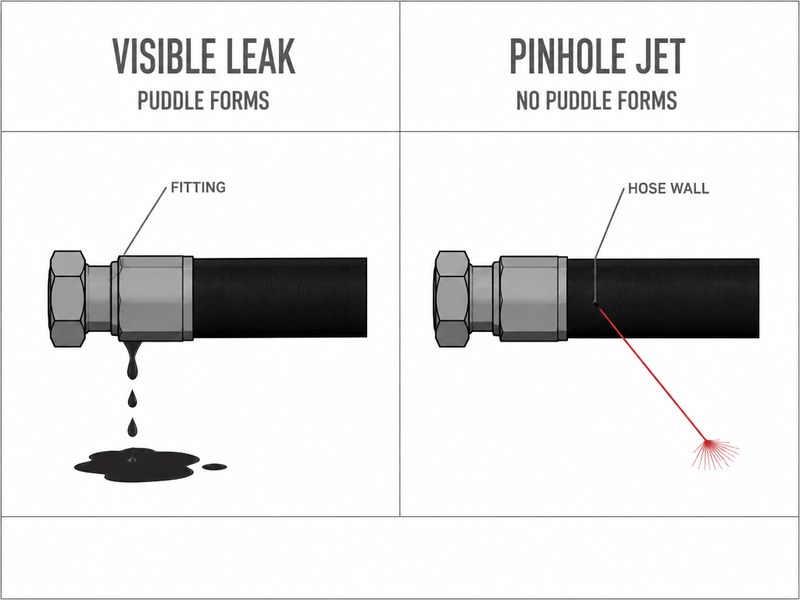
Figure 1. A pinhole jet carries the same system pressure as a visible leak, but it is thin enough to be invisible and it does not leave a puddle — which is why leak detection is never done with the hands.
What Are the Signs of a Hydraulic Injection Injury?
The signs are unreliable by design. The puncture wound is usually tiny, there is often little or no bleeding, and the initial pain can fade within minutes. What follows instead is a delayed pattern that includes:
- A small puncture or scratch that does not look like a serious wound
- Numbness, tingling, or a feeling that the finger or hand “does not feel right”
- Increasing tightness, swelling, or a tense, hard feeling under the skin
- Pain that returns and worsens over the following hours
- Pale or discolored skin beyond the puncture site
The trap is the quiet period. A worker who feels almost nothing after the event tends to finish the shift, and that delay is what determines the outcome.
What Should You Do in the First Minutes?
Treat every suspected injection as a surgical emergency and act on the assumption that fluid went in, even if the skin looks intact:
- Do not squeeze, press, cut, or try to express fluid from the wound.
- Do not apply ice, and do not apply a tight bandage.
- Do not drive yourself, and do not wait to see whether it gets worse.
- Go directly to an emergency department, not to a clinic or a first-aid room.
- Say the words “high-pressure fluid injection injury” on arrival — the wound looks trivial and the diagnosis is missed when the mechanism is not stated.
- Take the fluid’s safety data sheet and note the system pressure, fluid type, and the exact time of the event.
- Ask about tetanus status, and expect an X-ray.
Why Speed Matters More Than Anything Else
Injection injury is treated surgically, usually by wide debridement and decompression, and the delay before that surgery is the strongest predictor of outcome. In the published case series of upper-extremity high-pressure injection injuries — small cohorts drawn from different treatment eras, which is why the percentages differ between papers — an amputation rate of about 30 percent has been reported, with the risk markedly lower when wide surgical debridement was carried out within six hours of the injury and as high as 58 percent where treatment was delayed beyond that window.
The honest nuance is that more recent reviews have reported better outcomes than the older figures, particularly with early and aggressive surgery — which reinforces the same message rather than softening it. What has changed is the treatment; what has not changed is that the clock starts at the moment of injection.
Writing a hose inspection and replacement policy — or a safety module for a crew? Send us the machine type, the circuits you worry about most and the duty you run, and our engineers will come back with the rejection conditions that matter for those positions and the documentation your policy needs — no obligation.
4. How Do You Inspect a Hydraulic Hose for Safety?
A hydraulic hose inspection is a defined, repeatable check against a written rejection list, carried out by someone who knows what a failing hose looks like. The inspection is the core of hydraulic hose safety because it is the only control that acts before the failure rather than after it, and because most of the damage it finds took weeks or months to develop. The recorded procedure and failure-sign list are on the inspection checklist and failure signs page.
How Often Should a Hydraulic Hose Be Inspected?
Frequency should follow the consequence of failure, not a single plant-wide rule:
- Every pre-operation walk-around — the operator looks for wet spots, chafing, kinks, and obvious damage on the lines they can see.
- Formal periodic inspection — a written, recorded check at an interval set by duty and risk. High-duty mobile plant, forestry, mining, and lines above people are typically inspected far more often than a light-duty fixed machine; where a documented period has to be quoted, DGUV 113-020 (following DIN 20066) is a common reference, calling for inspection by a competent person at least every 12 months and shortened for severe duty.
- After any event — a burst, an overpressure, a fire or heat exposure, contact with a chemical, an impact, or any incident where the hose was kinked and straightened.
- Before re-installation and before any pressure test — a hose that has been off the machine is inspected before it goes back into service.
The Ten-Point Hose Inspection Checklist
A ten-point hose inspection checklist fits on one laminated card and takes about four minutes per hose. Print the card, date it, and record who signed it — a failed hose that was signed off as good is a much harder conversation than one that was never inspected.
Table 2. Ten-point hydraulic hose inspection checklist. Anything in the right-hand column takes the assembly out of service — none of these conditions is a “monitor and see” item.
| # | What to check | Acceptable | Reject |
|---|---|---|---|
| 1 | Cover abrasion | Light surface scuffing, cover still intact | Reinforcement wire or textile visible through the cover; deep flat worn area |
| 2 | Cover condition | Flexible, smooth, uniform color | Cracks, blisters, hard or brittle patches, glazed or charred areas |
| 3 | Tube and bore | No swelling, no soft spots | Bulge or soft spot under pressure, blister, swelling along the length |
| 4 | Couplings and crimps | Fittings tight, crimp intact, no weeping | Fluid weeping at the crimp or threads, cracked or corroded fitting, cover pulled back from the ferrule, fitting rotated out of position |
| 5 | Kinks, crushing, flattening | Full round cross-section along the length | Any kink or crushed section, including one that has “spring back” |
| 6 | Bend radius and clearance | At or above the published minimum for static and dynamic service | Bend tighter than the minimum, hose pulled straight at a fitting, contact with structure at the bend |
| 7 | Twist | Layline runs straight along the hose | Layline spirals around the hose, indicating the assembly is twisted in service |
| 8 | Chafing and guarding | Clearance from structure and other hoses, or a guard fitted | Rubbing contact points, hose resting on a sharp edge, missing or displaced protective sleeve |
| 9 | Heat exposure | Within the rated temperature range, routed clear of hot surfaces | Cover hardened, cracked, or discolored by heat; hose touching an exhaust or manifold |
| 10 | Marking, identity, and restraint | Layline legible, assembly traceable, restraint fitted and sound | Marking illegible or missing, no record of the assembly, whip check missing, frayed, or corroded |
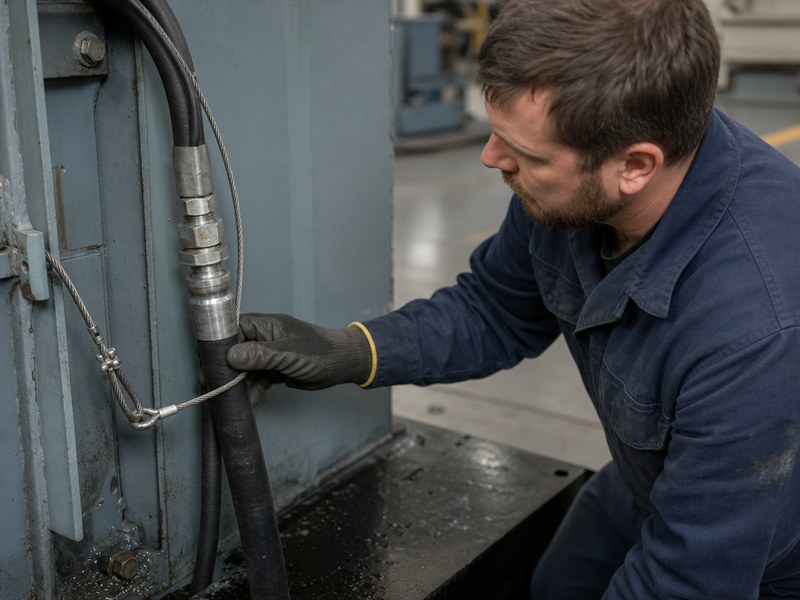
Figure 2. The four inspection points that catch most failures: the cover, the crimp at each end, the bend at the fitting, and the restraint. A hose is inspected in place, in good light, with the machine isolated.
Which Conditions Condemn a Hose Immediately?
Eight conditions condemn a hydraulic hose on the spot. None of the eight is repairable, and none of them is safe to run “until the next service”:
- Reinforcement visible through the cover, or an exposed wire anywhere on the hose
- A cover that is cracked, brittle, blistered, or charred
- Any kink, crush, or flattened section
- A coupling that weeps, has slipped, is cracked, or shows cover pulled back from the ferrule
- A bulge, blister, or soft spot that appears or grows under pressure
- Any hose that has burst, blown a fitting, or been involved in a whip incident
- Any hose exposed to fire, or to a chemical that falls outside the tube-and-cover compatibility list published by the hose or fluid manufacturer
- Any hose whose identity, working pressure, or assembly record cannot be established
An unreadable layline is a condemnation in its own right, because it takes away the only evidence that the assembly is the one the system was designed around — the how to read a hydraulic hose layline guide explains what the marking must contain.
How Do You Look for a Leak Without Getting Hurt?
Leak detection is a procedure, not a reflex:
- Isolate and depressurize the circuit first whenever the machine allows it: most leaks can be found cold, or by watching a clean, dry hose after a short pressurized cycle. Where the system must stay pressurized, keep your body out of the likely jet path and probe the suspect area with cardboard, wood or paper.
- Wear safety glasses and a face shield. Safety glasses alone do not stop a jet.
- Never run a hand, a finger, or a rag along a pressurized hose or fitting. A rag can conceal a jet that is already cutting into your hand.
- Never wrap tape, a clamp, or a self-amalgamating bandage around a leaking hose as a fix. It hides the leak, it does not contain the pressure, and it removes the visual warning that would have stopped the next person.
- When a leak is found, the assembly is replaced rather than repaired. A weeping crimp is a condemned crimp.
What About a Hose That Looks Fine but Is Old?
Age matters, but it is the manufacturer’s stated limit that governs, not a blanket rule from the internet. It helps to separate two different numbers:
- Storage life is the limit on hose sitting in a store. SAE J1273 gives a shelf life of 40 quarters — ten years — from the cure date (the date of manufacture marked on the hose) for rubber hose in bulk form, or for hose assemblies that still pass visual inspection and proof test. Most hose manufacturers publish shorter figures for their own compounds, typically stated in quarters rather than years, and some specify less still.
- Service life is how long a hose lasts in the application, and it depends on pressure, duty cycle, temperature, fluid, and routing. No standard sets a fixed hydraulic hose replacement interval that applies to every machine, and any figure quoted as universal should be treated with suspicion.
The practical consequence of the storage rule is a procurement point: hose ordered years in advance and left on a shelf has consumed part of its life before it ever sees pressure, so a long storage period is not free protection against lead time. Where the choice is between a planned replacement program and running hose to failure, the preventive maintenance and lifecycle cost case is the one that carries the argument.
5. How Do Pressure Ratings and Testing Prevent Hydraulic Hose Failure?
A hydraulic hose assembly is bought with a pressure rating, and almost every hose failure that involves injury involves a line that was run above the rating it was designed for. Underrating usually happens quietly: a relief valve is adjusted upward, a hose is replaced with a cheaper one from a different 100R family, or a pressure spike is dismissed as “normal” because the gauge never shows it.
What Working Pressure, Proof Pressure, and Minimum Burst Pressure Mean
Three numbers describe the pressure side of an assembly, and confusing them is a common and expensive mistake. How each figure is set, and how the 4:1 relationship behaves in practice, are both covered on the working pressure vs burst pressure page.
Table 3. Pressure ratings on a hydraulic hose assembly and what each one is for. The 4:1 relationship is a standard’s minimum burst requirement, not spare capacity that operating pressure is allowed to use.
| Term | What it means | Typical relationship | What it tells you |
|---|---|---|---|
| Maximum working pressure (MWP) | The highest continuous pressure the assembly is designed to carry in service | 1× — the reference point | The limit your system pressure, including surge, must stay below |
| Proof pressure / test pressure | The pressure at which a new assembly is tested before it leaves the maker | Typically 2× MWP | Evidence that this specific assembly was built soundly |
| Minimum burst pressure | The pressure the standard requires the assembly to withstand without bursting | Typically 4× MWP | The standard’s failure floor — a manufacturing floor, not a working range |
If you need the standard tables themselves — which 100R family carries which pressure at each bore — the SAE 100R hydraulic hose standards guide sets them out size by size, and it is the reference to check before accepting a substitute hose.
On wire-braided and spiral hydraulic hose the common standard families — SAE J517, EN 853 and EN 857 — build in a minimum burst pressure of about four times the maximum working pressure. It is widely called a “4:1 safety factor”, and that phrase is the problem: the four-times figure is what the standard requires the hose to survive, not headroom a system is entitled to operate in.
Why an Underrated Hose Fails
Pressure rating failures are usually introduced, not purchased:
- Surge and spike. Fast-acting valves, sudden stops, and dead-headed cylinders send pressure spikes far above the gauge reading. A line sized at exactly the relief valve setting has no margin left for the spike.
- Mismatched replacement. A 100R1 single-braid hose substituted for a 100R2 double-braid assembly of the same bore carries materially less pressure, and the two look identical in a store.
- A relief valve set above the hose. When a valve is adjusted to cure a hydraulic complaint, the weakest line in the circuit becomes the new relief.
- Temperature derating. Working pressure assumes the rated temperature band. Running a hose above its temperature limit reduces the strength of the reinforcement and the tube over time.
- Fitting mismatches. A coupling that is not the maker’s approved fit for that specific hose can reduce the assembly’s pressure capability below the hose’s own rating. The hydraulic hose fittings types guide covers how the thread and seat families differ, which is the usual reason two apparently identical fittings are not interchangeable.
How Is a Hydraulic Hose Assembly Pressure-Tested Safely?
A pressure test is a controlled operation, and the same rules apply whether it is done in a workshop or in the field:
- Test to a written procedure, with a calibrated gauge and a pressure source you can control and vent.
- Guard the assembly, and put a physical barrier between the test piece and every person. Nobody stands at the end of a hose under test, and nobody holds a fitting.
- Fit rated restraints or anchor the assembly before pressure is applied, so a coupling failure cannot whip.
- Fill with water where the test allows it. Stored energy in a compressible medium, and clean-up after a failure, are both worse with oil.
- Know what a test proves. A passing test confirms one thing: that this assembly held that pressure at that moment. It is a build check on the assembly in front of you. Remaining fatigue life, chemical compatibility and fitness for a different duty are established by inspection against the rejection list in Section 4 and by the service history — and an assembly that already meets a rejection condition is replaced, whether or not it passes a test.

Figure 3. The pressure bands on a rated hydraulic hose assembly. The working pressure is the design limit; the proof test confirms the individual assembly; the minimum burst figure is the standard’s floor and must never be treated as usable range.
6. How Do You Protect a Hydraulic Hose From Damage?
Because abrasion is the largest single cause of hydraulic hose failure, hydraulic hose protection is not cosmetic — it is the cheapest reliability and safety measure available. The right protection depends on what is damaging the hose: rubbing, kinking, impact, heat, or a combination. This section covers what each item changes about the hazard a person is exposed to; choosing between the products is the subject of the protection sleeve selection guide.
What Does a Hydraulic Hose Protection Item Actually Prevent?
Table 4. Hydraulic hose protection items that change what a failure can do to a person, with the limits of each. The sleeves, wraps and guards compared on the linked selection guide change how fast damage happens, not what a failure does to a person. None of them contains a pinhole jet or makes a failed hose safe to run.
| Protection | Damage it prevents | Where it works best | Limits |
|---|---|---|---|
| Metallic or armored cover | Impact, abrasion, and radiant heat | Steel mills, foundries, and underground equipment | Adds weight, reduces flexibility, increases bend radius |
| Fire sleeve | Radiant heat and brief flame exposure | Engine compartments and hot machine zones | Corrects radiant heat and brief flame exposure only — a routing fault or a temperature derating problem needs the routing or the specification changed |
| Hydraulic hose whip check | Whip of a hose or coupling after a failure | Any line whose failure could cause a hazard | Controls whip after a separation at the coupling — failure prevention comes from inspection, and leak containment is not achievable at all |
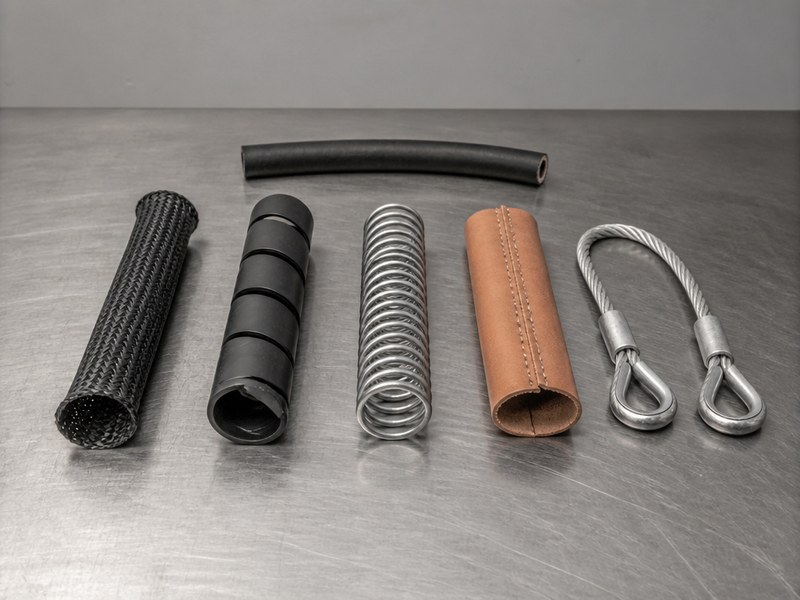
Figure 4. Hydraulic hose protection products are matched to the damage mechanism: sleeves and spiral wrap for chafing, spring guards for kinking at the fitting, armored covers for impact and heat, and a steel whip check for a released hose.
Which Routing Rules Prevent Most Hose Damage?
Routing decides whether a hose survives, and it is free. Three rules carry most of the safety benefit:
- Respect the minimum bend radius. Use the published figure for the service — dynamic bending at a moving joint is a tighter requirement than a static run.
- Keep the layline straight. A twisted installation is one where the reinforcement fights the pressure cycle for its whole life, so check the layline: it runs straight, not spiraling around the run.
- Protect the contact points. Clearance from structure and from other lines, or a guard where clearance cannot be achieved, is what stops rubbing from turning into a failure. Where a line under pressure runs within a meter of an operator, ISO 3457, the guards and shields standard, requires guarding for hose lines above 5 MPa (50 bar) and 50 °C on earth-moving machinery.
The rest of the routing discipline — supporting the run, keeping exhausts and hot castings out of the path, allowing for length change, separating lines, and keeping feet, hands and tie-down straps off the hose itself — is in the hydraulic hose routing mistakes guide.
7. Whip Checks and Restraints: How Do You Stop a Burst From Becoming an Injury?
A hydraulic hose whip check is a steel cable restraint that holds an assembly together if a coupling separates or a hose fails near the connection. It does not stop the failure and it does not contain the fluid; what it does is stop the released hose from thrashing, which is what turns a repair job into a casualty.
What a Whip Check Actually Does
When a pressurized hose separates, the stored energy drives the free end. The freed length whips, and anything inside its arc — a person, a window, a fuel line, a hot surface — is at risk. A restraint keeps the two halves tethered, so the energy is dissipated over a short distance instead of a long one, and the hose stays roughly where it was installed.
Where Restraints Are Required, Not Optional
The general principle is simple and it is applied by regulators in most industrial jurisdictions: if a pressurized hose connection can fail and cause a hazardous condition, it must be restrained. Two concrete anchors for that principle:
- On pneumatic power tools, US federal construction rules — OSHA 29 CFR 1926.302(b)(1) — require hose connections to be secured to prevent whipping: a steel whip check or an equivalent restraint. The same logic is applied routinely to high-pressure hydraulic lines.
- OSHA citation records show employers cited where high-pressure hoses were not outfitted with devices to prevent hose line whip in the event of hose or connection failure. The citation is issued against the practice, not against a broken part.
In practice a restraint is treated as mandatory on: any hose above a walkway or a workstation; lines on mobile plant where a coupling failure could reach an operator; high-pressure test and flushing lines; oilfield and mining equipment; and any line whose content is hot, high-pressure, or flammable.
How Do You Fit and Inspect a Whip Check Correctly?
A hydraulic hose whip check is only as good as its anchorage and its condition, so it is fitted and inspected on the same defined interval as the hose it protects.
- Fit it across the coupling, so it takes the load only if the connection separates, and leave enough slack that the restraint is not loaded in normal service.
- Anchor at least one end to a structural point, not only to the other half of the same hose. A restraint from hose to hose keeps the pair together but still lets the pair move.
- Use a restraint rated for the application, and replace any restraint that has been through an incident — a whip check that has arrested a failure has done its job and is now scrap.
- Inspect for broken strands, fraying, and corrosion at each formal inspection, and record it. A restraint that is missing, loose, or corroded is a finding, not a detail.
- Scope of a whip check. A whip check controls one hazard: the whip of a hose that separates at or near the coupling. The pinhole jet, and a rupture remote from the fitting, are controlled by inspection, by protective sleeving and by planned replacement — which is why a whip check is fitted in addition to those controls, never instead of them.

Figure 5. A whip check fitted across the coupling and anchored to structure. The restraint is inspected for broken strands, fraying, and corrosion, and it is replaced after any incident rather than reused.
8. How Do You Work Safely on a Pressurized Hydraulic System?
Most injection injuries and most serious fluid burns happen during maintenance, not during normal operation, and it is here that hydraulic hose safety is won or lost. The five work practices that prevent them are de-energizing and releasing stored energy, cracking a fitting under control, PPE, training, and incident reporting.
De-energize, Isolate, and Release Stored Energy
A stopped machine is not a depressurized machine. Before any fitting is broken:
- Shut down and isolate the power source, and apply lockout/tagout to the isolation point.
- Release stored energy. Accumulators, raised cylinders, suspended loads, pilot circuits, and return lines can all hold pressure after the pump has stopped. The release sequence for the specific machine should be written down, not remembered.
- Verify zero pressure with a gauge at the point of work, not by loosening a fitting “just a little” to see.
- Block mechanical movement that gravity or spring force can cause, so the machine cannot settle onto the person working on it.
- Let the system cool before opening anything, so that the fluid that does come out is not at burn temperature.
How Do You Crack a Fitting Safely?
Sometimes a connection has to be opened while the system is still wet. When that is genuinely unavoidable:
- Crack the fitting no more than a fraction of a turn and let the pressure bleed to the lowest point of the system, under control.
- Keep your hands, face, and torso out of the path of anything that could come out, and cover the joint with a rag — held with a tool, not a hand.
- Never use a finger to feel whether fluid is moving. Pressure and flow are judged with a gauge, not with skin.
- Never open a fitting to “check whether there is pressure”. Check the gauge, and if there is no gauge, install one.
Which PPE Actually Protects Against Hydraulic Pressure?
Personal protective equipment is the last line of defense, and it has a specific and limited role around hydraulics:
- Eye protection plus a face shield. Safety glasses alone do not stop a jet; a full face shield is the minimum for work on a pressurized line.
- Gloves protect against abrasion, heat, and chemical contact — not against a high-pressure jet. The pressure needed to penetrate skin is around 100 psi; ordinary work gloves are not rated against a hydraulic jet, and gloves tested for fluid-injection resistance supplement isolation rather than replacing it — which is why heavy gloves can give a false sense of protection.
- Long sleeves and a heavy outer layer limit the surface area of a fluid burn and give a small margin during leak checks.
- Hearing protection where a compressed-gas or hydraulic release is possible, and in the general machine area.
- A written, tested emergency response. The person most likely to be injured is the technician, who may be alone. Everyone on the team should know the route to the nearest emergency department and the sentence to say on arrival.
Hydraulic Hose Safety Training: What a Crew Needs to Know
Hydraulic hose safety training works best as a short, specific, repeated module rather than a general induction topic. Six subjects cover the practical risk:
- Hazard recognition — what a failing hose looks like, and why a pinhole leak is not a small problem.
- Injection injury response — the look of the wound, the quiet period, and the rule that the injured person goes directly to an emergency department.
- Isolation and stored energy — lockout/tagout, accumulators, and the verification step.
- Inspection against the rejection list — using the ten-point checklist on the actual machines the crew works on, not on photographs.
- Restraints and reactive forces — why a whip check is fitted, where it is anchored, and how to inspect it.
- The limits of PPE — what a face shield and ordinary gloves can and cannot do.
A useful test of whether the training landed is whether the crew can name the rejection conditions from memory, and whether anyone has actually stopped a job because of one.
What Happens After an Incident?
Report every suspected injection or whip incident, however minor it looks, and preserve the failed assembly for examination rather than cutting it up or discarding it. The pattern of a failed crimp or a chafed cover is how the next failure gets prevented, and an unreported near-miss is a free lesson that nobody collects.
9. What Standards and Regulations Govern Hydraulic Hose Safety?
The standards that underpin hydraulic hose safety fall into three groups: the product standards that define what a hose and assembly can carry, the system standards that define how a hydraulic system must be designed for safety, and the occupational rules that define how the work is carried out.
Table 5. Standards and regulations that apply to hydraulic hose safety, grouped by what they cover. Standard designations are given as published; confirm the current edition and any national adoption for your jurisdiction before relying on a clause.
| Standard or rule | Covers | What it means in practice |
|---|---|---|
| SAE J517 | Hydraulic hose — the 100R family, including 100R1 and 100R2 | Defines construction, working pressure, minimum burst at about 4× working pressure, and marking for each hose type |
| EN 853 and EN 857 | Wire-braided hydraulic hose, 1SN/2SN and the compact 1SC/2SC | The European equivalents of the same pressure discipline, with their own published pressure tables per size |
| ISO 1436 | Wire-braided hydraulic hose | The international counterpart used where a project specifies ISO rather than SAE or EN |
| SAE J1273 | Storage, handling, and service life of hose and hose assemblies | Gives a shelf life of 40 quarters (10 years) from the cure date for bulk rubber hose and for assemblies that still pass inspection and proof test |
| ISO 4413 | Hydraulic fluid power — general rules and safety requirements for systems | Requires the system to be assessed for risk and to be designed so that stored energy and hose failure cannot harm people; national adoptions apply it locally |
| ISO 17165 | Hose assembly practices | Covers how an assembly is made up and handled, which is where fitting selection and crimping discipline come from |
| DGUV 113-020 (following DIN 20066) | Hydraulic hose lines on machinery in Germany, adopted by several EU operators | Recommends inspection by a competent person at least every 12 months, with a shortened interval for severe duty and safety-critical circuits |
| ISO 3457 | Earth-moving machinery — guards and shields | Requires guarding for hose lines above 5 MPa (50 bar) and 50 °C that run within 1.0 m of the operator |
| OSHA 29 CFR 1910.147 | Control of hazardous energy (lockout/tagout) | Governs isolation and release of stored hydraulic energy before maintenance |
| OSHA 29 CFR 1926.302(b)(1) | Pneumatic power tools and hose connections | Requires hose connections to be secured against whipping — the rule most often quoted when restraints are discussed |
Two honest limitations are worth stating plainly. First, in most jurisdictions the duty is to keep equipment in a safe condition and to follow the manufacturer’s instructions; the interval itself is set by the employer’s written policy — a wider duty than a fixed interval, not a lighter one, because the policy has to be written, applied and provable. Second, a hose and a fitting can each be compliant with their own standard and still be an unsafe assembly if they were not designed to be used together — the assembly is the product that has to be right.
When Does a Hydraulic Hose Replacement Become Due?
There are three triggers, and the safest programs use all three:
- Condition-based. Any rejection condition from the inspection checklist ends the assembly’s life immediately. This is the trigger that catches most failures.
- Event-based. Replace after a burst, a coupling failure, a whip incident, fire exposure, contact with an incompatible chemical, or any suspected injection event. A restraint that has arrested a failure is replaced at the same time.
- Time-based ceiling. Apply the manufacturer’s stated service limit for the application as a backstop, and treat the SAE J1273 ten-year figure as a storage limit rather than a service license. Where the manufacturer’s limit is shorter, the manufacturer’s figure governs.
A hydraulic hose replacement policy that rests on only one of these triggers will either replace good hose too early or run bad hose too long. Condition and event triggers catch the failures; the time ceiling catches the hose that has been quietly aging in a hot machine for years.
10. Frequently Asked Questions
What is the most common cause of hydraulic hose failure?
External mechanical damage is the leading cause, and abrasion inside that group is the largest single factor — the hose is normally rubbed, kinked, over-bent, twisted or overheated long before it bursts. Every one of those causes is external, so most failures are visible in advance to anyone who knows what to look for.
How much pressure does it take to cause a hydraulic injection injury?
The threshold is far lower than most people expect, and it is a warning rather than a specification: fluid type, nozzle geometry and exposure time all move it, and the pressure needed to break skin is a fraction of the pressure the system runs at. Treat every pressurized line as capable of a hydraulic injection injury, including the pilot and return lines most often assumed to be safe.
Can a hydraulic injection injury heal without surgery?
No. A high-pressure injection injury is treated in an operating room, usually by wide debridement and decompression, and how long the patient waits before that operation is the strongest predictor of how much function is saved. The injured person goes directly to an emergency department and states the mechanism on arrival, even when the wound looks trivial.
How often should a hydraulic hose inspection be carried out?
The interval follows the consequence of failure rather than a plant-wide rule. A visual check belongs in every pre-operation walk-around, and a formal, recorded hydraulic hose inspection runs at an interval set by duty and risk, so a mining shovel or a line above a walkway is checked far more often than a fixed machine on light duty. Any event — a burst, a fire, an impact or a chemical contact — triggers an inspection regardless of the schedule.
Can a hydraulic hose leak be repaired with tape or a clamp?
No — and the action that replaces the repair is the answer: isolate the circuit, release the stored energy, verify zero pressure at the point of work, and fit a new assembly. Tape, a clamp or a self-amalgamating bandage contains no pressure and hides the leak from the next person, which is how a hand ends up in the jet. A weeping crimp, a pinhole in the tube and a worn cover are all condemned conditions.
Do hydraulic hoses need a whip check?
Not every hose — but every hose whose failure could reach a person. The test is the arc the freed hose would sweep, not the bore, the pressure class or the age of the machine: if a coupling separation would put that arc across a walkway, a workstation or an operator position, the connection is restrained with a hydraulic hose whip check. The whip check section — Section 7 — covers where it is anchored, how it is inspected, and which two hazards it does not control.
Do protective sleeves make a hydraulic hose safe?
No. A sleeve, spiral wrap or guard addresses one damage mechanism — usually abrasion, kinking or impact — and slows the rate at which the hose is destroyed, which is why fitting one is worth doing. Hydraulic hose protection extends service life and lowers the chance that the failure happens next to a person; it does not contain a pinhole jet, and it does not make a leaking hose safe to keep running.
When is a hydraulic hose replacement due?
Three triggers, and the most common error is using only the third: a rejection condition found at inspection, any incident (a burst, a coupling failure, a whip event, fire or chemical exposure), and the maker’s own stated service limit as a time-based backstop. The trap is treating the ten-year storage figure as if it were a service license — it is a storage limit.
Is a hose with a small pinhole leak safe to run until the next service?
No, and the reason is mechanical rather than procedural: a pinhole means the tube or the reinforcement is already breached, so the leak will grow and it is producing an invisible jet at full system pressure right now. That makes it both an injection hazard to anyone nearby and a fire risk if the fluid atomizes onto a hot surface.
11. Sources and Standards
- NAHAD — hose failure analyses by root cause.
- SAE J517, SAE J1273, EN 853, EN 857, ISO 1436, ISO 4413, ISO 17165, ISO 3457 — hose and system standards.
- DGUV 113-020 / DIN 20066 — machinery inspection intervals.
- OSHA 29 CFR 1910.147, 1926.302(b)(1) — stored energy; hose restraint.
- Published injection-injury case series — penetration and quoted system pressures.
12. Final Verdict
Hydraulic hose safety comes down to three habits that fit into the working day: look at the hose against a written rejection list, fit a hydraulic hose whip check wherever a release could put the hose across a person, and keep hands away from anything that might be under pressure. Everything else — the standards, the ratings, the protective sleeves, the training — exists to make those three habits reliable.
The reason to take hydraulic hose inspection seriously — and to treat hydraulic hose replacement as routine maintenance rather than a response to a failure — is that the consequences are asymmetric. A hose that is replaced a year early costs a fraction of a service call. A pinhole leak that someone checks with a fingertip costs a hand.
If you are specifying hose for a maintenance fleet, writing a hose inspection policy, or sourcing assemblies that have to be traceable and pressure-tested, HENGHUA can support the specification work as well as the supply. We manufacture steel wire braided hydraulic hose and the assemblies built from it, and we will review your working pressure including surge, your fittings, your temperature and fluid, and the documentation your inspection policy needs before we quote — so the assembly you receive is one you can inspect and retire on a defined rule rather than on a guess. Send us your specification and we will quote it line by line.






 English
  Spanish
  Portuguese
  French
  German
  Arabic
  Russian
  Indonesian
  Japanese
  Korean