
Garden hose reviews are only as useful as the method behind them, so read the method before the score. A review that names the bore, length and water temperature behind each figure can be checked at your own tap; one that omits whether a number was measured or quoted from marketing material cannot be checked at all. The “10” in this title is a ten-item comparison framework, not a ranked list: HENGHUA publishes no product ranking and no product verdict. It explains how test programs are produced, what each test can show, and how to apply the framework to any hose you are considering.
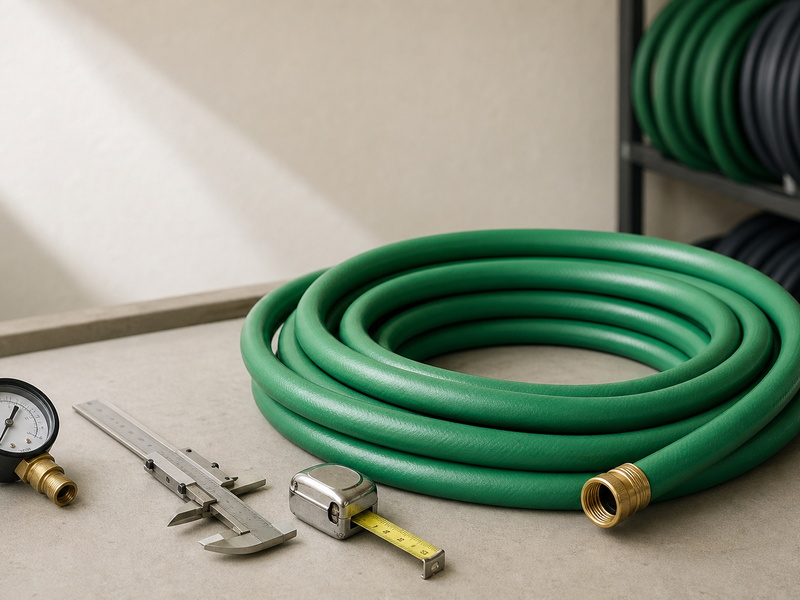
A hose coil, a pressure gauge and calipers on a test bench.
1. How Are Garden Hose Reviews Produced?
A review is a method plus a set of numbers, and the method decides whether the numbers mean anything. Sample selection, conditioning, the order of tests and the number of samples all shape the result before a single score is calculated. Two reviews of the same hose can disagree while both are honestly written, because the conditions behind the measurements were different.
This article is written from manufacturing practice rather than from a test report, and it describes the conditions a hose maker and its buyers have to agree on in writing. HENGHUA publishes the same fields for its own range. No third-party product was tested, ranked or compared for this article.
What Does a Review Program Actually Do?
A program converts a product claim into a repeatable measurement. It draws samples from a stated production period, conditions them at a stated temperature, runs the tests in a fixed order, and records the instrument used for each. Bore (the inside diameter, also written ID), wall and outside diameter are measured with calipers before any pressure is applied, because a hose that is out of tolerance on bore will mislead every later test.
Why Does the Method Matter More Than the Score?
Scores compress many measurements into one number, and the compression hides the conditions. Flow measured over 15 m at one inlet pressure will rank two hoses differently from flow measured over 30 m, because friction loss grows with length and with the bore. Where a review does not say which length and pressure it used, the ranking is only valid inside that review.
What Can a Reader Not Tell from a Review?
Scope: among the nine tests in Table 1, four are repeatable at home: bore, length, mass and flow. Five years of UV exposure and batch variation sit outside that scope, because no short program runs long enough and one sample cannot represent a batch. A fresh hose from a warehouse can also behave differently from one that spent a season on a wall in the sun. Feel, slope behavior and thread fit are installation questions rather than laboratory ones.
A figure published before 2026 should be re-checked against the current data sheet, because hose makers revise their published conditions and a rating from an earlier review may no longer match the hose on sale.
2. What Does a Hose Test Program Measure?
A full program measures mechanical strength, flexibility, joint integrity, material stability and flow, and each of those needs its own condition to be meaningful. Table 1 sets out the nine tests a hose program normally runs, the condition that belongs with each, and the limit of what each can show.
Table 1 — Common hose tests, the conditions that make them comparable, and their blind spots
| Test | What it measures | Condition that must be quoted | What it cannot show |
|---|---|---|---|
| Hydrostatic proof test (also written proof pressure test) | Leak-free behavior at a pressure above the working rating | The pressure, hold time and water temperature | How long the hose lasts in service |
| Burst test (also written burst pressure test) | The pressure at which the hose or a joint fails | Rate of pressure rise, temperature and end fittings | Which part failed, unless the failure location is reported |
| Kink resistance test | Flow or collapse when the hose is bent to a stated radius | The bend radius, flow and inlet pressure | Kink memory after months in storage |
| Cold-bend test | Flexibility at low temperature | The soak temperature and the bend radius used | Behavior at other temperatures |
| Tensile and coupling pull-off | Peak force before a coupling separates or a hose stretches | Sample length, pull rate, wet or dry condition | Repeated load cycles in normal use |
| Layer adhesion test | Force needed to separate bonded layers | Specimen width and test speed | Performance after abrasion or aging |
| UV and ozone exposure | Change in properties after accelerated weathering | Exposure time, irradiance and test temperature | A prediction of calendar years outdoors |
| Flow test | Volume delivered at a stated pressure and length | Inlet pressure, hose length and bore | Flow through a different nozzle or supply |
| Dimensional checks | Bore, wall thickness and outside diameter | The tolerance band applied | Whether the hose fits a coupling not tested |
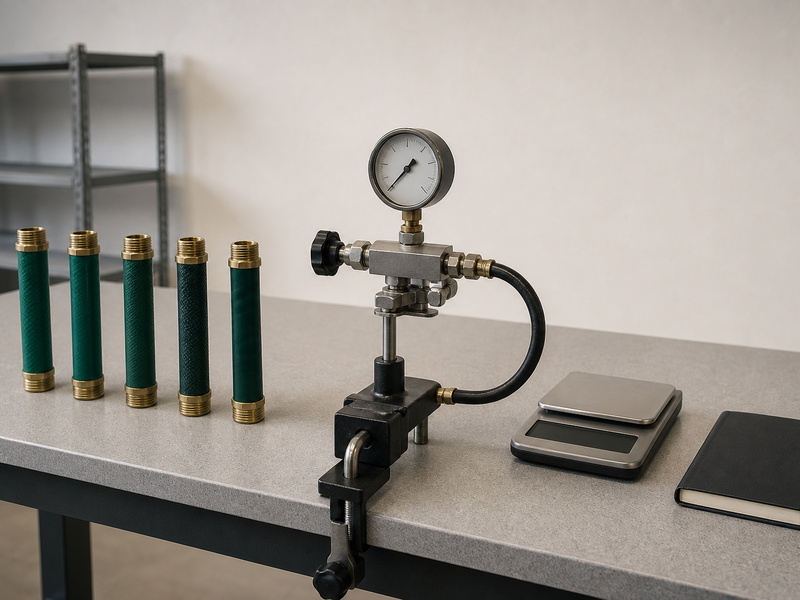
The test program laid out in order: samples, pressure rig, scale, record sheet.
How Are Pressure Tests Run and Reported?
Garden hose reviews report the two pressure tests as a pair of numbers, and the pair is only meaningful with its condition. A proof test confirms the assembly holds pressure without leaking, and a burst test pushes the same assembly until it fails. Makers usually publish the results as a working pressure rating plus a separate burst band, and neither figure can be read without the water temperature and the rate at which pressure was raised.
How Are Kink and Cold-Bend Tests Run?
A kink test bends the charged hose to a fixed radius and measures what happens to flow, or records the radius at which the wall collapses visibly. Without the radius, the flow and the inlet pressure, the result cannot be repeated. A cold-bend test soaks the hose at a stated temperature and then bends it, because plasticized PVC stiffens below about 5 °C (41 °F) and a hose that folds easily at 20 °C can crease at 2 °C.
How Are Couplings and Layers Tested?
A pull-off test grips the hose and the coupling, applies axial load at a stated rate and records the peak force and the location of the failure. A hose body, a coupling shank and a bond line are three different failures with three different causes, so a number without that detail is close to useless. Adhesion testing works the same way, stripping or pulling bonded layers apart at a controlled speed and reporting the force and the failure mode.
How Are UV, Ozone and Flow Reported?
Accelerated weathering exposes samples to a stated irradiance and temperature for a set time, and a mechanical test is then repeated to compare before and after. Scope: the comparison is valid for the exposure the samples received, and it describes the sample rather than a number of calendar years outdoors.
Bore changes delivered flow steeply. A flow figure is a rate, so the length and inlet pressure belong with it. At equal velocity the relative flow of 1/2 in, 5/8 in, 3/4 in and 1 in bores is 1.00 : 1.56 : 2.25 : 4.00, with inside areas of 127, 198, 285 and 507 mm² (calculated). The diameter exponent of 4.87 used in the Hazen-Williams friction-loss relation means doubling the bore cuts friction loss by about 29 times (calculated).
For a Long Run, How Much Flow Do You Lose by Dropping from 3/4 in to 1/2 in Bore?
At equal velocity, a 1/2 in bore passes about 44 percent of the flow a 3/4 in bore passes, because inside area changes with the square of the bore (calculated).
3. How Should You Read Garden Hose Ratings?
A garden hose ratings figure is a promise about a condition, and the condition is often left out. Read three things before you accept a number: the basis it was measured against, the units and scale it is expressed in, and the failure criterion that ends the test. Where any of the three is missing, treat the figure as a description of intent rather than as a measurement.
What Does a Working Pressure Rating Promise?
A working pressure rating — often searched as a garden hose pressure rating or a psi rating — states the pressure the hose is expected to hold continuously without damage. Scope: it describes the hose body at a stated water temperature for an unspecified duration, and the fittings at each end are rated separately from it. Ask for the burst band and the failure location.
Why Do Two Sources Give Different Ratings?
Two sources can print different numbers for the same hose without either being wrong, because the test conditions differ. Water temperature, the rate of pressure rise, the fittings used to cap the ends, and whether the sample was new or aged all shift the result. Where published sources disagree, the honest conclusion is that the conditions differ, and the useful question is which condition matches your use.
Which Garden Hose Ratings Cannot Be Compared Across Products?
Comparability fails in three common ways:
- Ratings measured at different bores, because friction loss and burst behavior both change with bore.
- Ratings measured on different lengths, because a 15 m sample and a 30 m sample load a joint differently.
- Ratings measured at different temperatures, because one laboratory tested at 20 °C and another at 2 °C.
If Your Tap Runs at the Low End of the 40 to 80 psi Range, Which Garden Hose Pressure Rating Should You Look For?
Choose a hose rated well above your measured supply pressure rather than at it, because the rating is a continuous limit and supply pressure varies through the day. Measure your static pressure, then add the drop a sprinkler causes.
4. Why Does Measured Garden Hose Kinking Differ from a Claim?
Garden hose kinking is a behavior, not a property, so a claim that a hose is kink free is a statement about a test that the buyer never sees. A hose can resist kinking at one radius, one pressure and one temperature and fold at another. The honest version of the claim names the condition, and the reader can then decide whether that condition matches the way the hose will be used.
How Is Garden Hose Kinking Measured in Practice?
A typical version bends the charged hose steadily until the section collapses, and the radius at that moment is recorded. A gentler version holds the hose at a fixed radius and records how flow falls off, which produces a curve rather than a single number. Both versions are meaningful, and the radius is the figure that makes either one repeatable by a second laboratory.
Why Does a Garden Hose That Passed a Kink Test in a Warm Workshop Fail on a Frosty Morning?
Flexibility in a plasticized compound falls as the temperature falls, so a bend result is only valid for the temperature it was measured at. That is why a winter kink complaint is often not a product fault but a test condition that was never quoted.
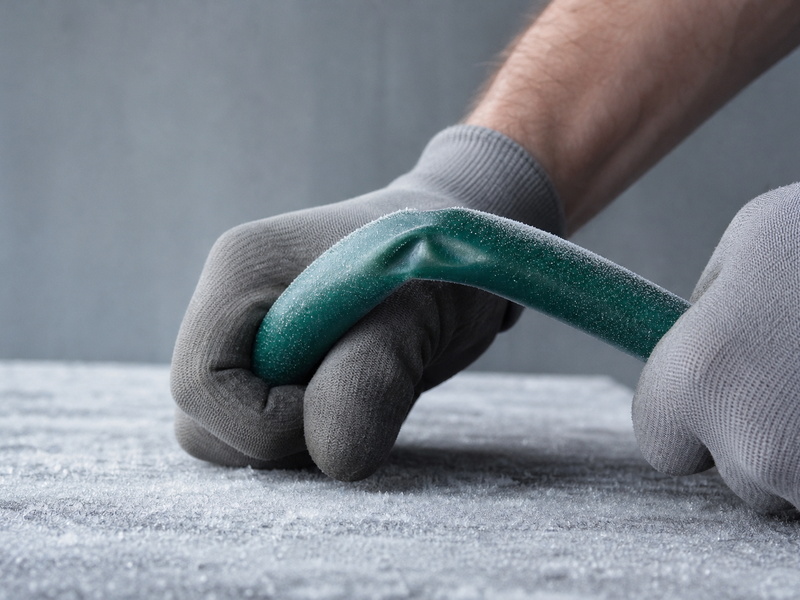
The same hose at a cold bend, where the wall creases.
How Do You Test Kink Tendency Yourself?
You can reproduce the practical part of the test without instruments:
- Charge the hose at your normal supply pressure with the nozzle closed.
- Bend a mid-length section through a steady arc and note the radius where flow stops or the wall flattens.
- Repeat the same bend at the coolest temperature the hose will see in use.
- Repeat once more after the hose has been coiled on the reel for a week, to expose kink memory.
5. What Does a High Pressure Garden Hose Review Actually Promise?
A high pressure garden hose review usually promises strength, but strength is only one of the numbers that matter. A hose can carry a high burst pressure and still deliver a weak stream, because burst resistance and flow are set by different parts of the construction. Wall thickness and reinforcement raise burst performance, while bore and internal smoothness set flow.
What Pressure Can a Domestic Supply Deliver?
Domestic supply pressure is usually treated as a planning range of 40 to 80 psi, which is well below any working rating a manufacturer publishes for a garden hose. That gap matters when a reader compares products. A hose whose working rating sits well above the domestic range carries margin against your supply line. The more useful questions then become flow, kink behavior, cold flexibility and coupling quality rather than headline pressure.
Why Is Working Pressure Not the Same as Burst Pressure?
Garden hose reviews can report a high working pressure for an assembly that still fails a burst test, because the two describe different limits. Working pressure is the level the hose body is expected to survive continuously, and burst pressure is the level at which it fails.
Scope: the burst-to-working ratio is 3 to 1 for general garden service. Use 4 to 1 for any assembly whose failure could injure someone or release a large volume. A high burst number says little unless the working rating, the ratio and the failure location are known.
Where Does the Weakest Point in a High Pressure Garden Hose Sit?
The weakest point is usually a joint rather than a length of extruded hose: a crimped or clamped coupling, a threaded adapter, or a molded connection to a reel inlet. Coupling pull-off testing exists precisely because the body of a hose is rarely the part that separates under load. When you read a pressure claim, ask whether it applies to the hose, the assembly, or the assembly after the couplings are fitted.
6. Which Hose Figures Are Measured and Which Are Marketing?
Some garden hose ratings start on a bench with an instrument on it, and others start in a product meeting. The difference is usually visible in how the number is written: a measured figure carries a condition, while a marketing figure stands alone. A high pressure garden hose described without a working rating, a test length or a failure criterion is being described rather than measured. Anyone working through garden hose reviews eventually meets a figure that carries none of that context.
Table 2 — Claims a reader meets, the measurable definition behind each, and where the claim usually breaks down
| Claim as printed | Measurable definition | What a reader can verify | Where it usually breaks down |
|---|---|---|---|
| Burst strength figure | The pressure at which a stated assembly fails | Ask for rate of rise, water temperature, end fittings and failure location | Hose body quoted, assembly tested |
| Kink free | Flow retained when bent to a stated radius | Ask for the radius, the inlet pressure and the flow | Radius or flow never stated |
| UV resistant | Property retention after stated exposure | Ask for exposure time and irradiance | No exposure basis given |
| High flow figure | Volume per unit time at a stated pressure and length | Ask for the length and the inlet pressure | Length omitted from the claim |
| Cold flexible claim | Bend result after conditioning at a stated temperature | Ask for the temperature and the bend radius | Temperature not stated |
| Lifetime warranty | A commercial term, not a measurement | Read the exclusions list and the wear items | Wear parts excluded from cover |
Why Do Some Garden Hose Ratings Come Without a Method?
A supplier may not have a method, or may have one that applies to a different product in the range. The compound matters: wall construction and plasticizer content decide stiffness, aging and how quickly a hose takes a set, and the HENGHUA guide to flexible hose materials sets out how those differences arise. Where a rating is copied from a compound data sheet onto a finished hose, the condition of the finished assembly has been lost.
What Should You Ask a Supplier for When a Review States a Burst Pressure but No Length, No Temperature and No Failure Location?
Ask for the condition first and the number second, and ask in writing. A usable answer names the bore, wall and length of the sample, the pressure and temperature of the test, the instrument used and the failure criterion. Where a supplier answers with a range of products rather than a sample, the answer describes a family and not the hose you will receive.
Which Numbers Should You Distrust?
Treat any figure without a unit or a condition as decoration, and any round number as a target rather than a measurement. The most common traps are a burst figure with no failure location, a flow figure with no length, and a high pressure garden hose claim with no working rating. If a supplier cannot supply the condition behind a number, the number stands alone and cannot be compared, including against the same figure from another supplier.
What Does a Lifetime Warranty on a Garden Hose Actually Cover?
A warranty is a promise rather than a measurement. Read the exclusion list and identify the wear items, because couplings, seals and the outer cover are commonly excluded, and a term that excludes whatever fails in service is worth less than its length.
7. The Ten-Item Comparison Framework
A reader working through many garden hose reviews needs one fixed list so that every product is judged on the same basis. The ten items in Table 3 run from facts you can check with a tape to behavior that only long service reveals. Apply them in order, and a disagreement between sources usually resolves into a missing condition.
Table 3 — The ten-item comparison framework for judging a hose claim
| Item | How it should be stated | How a reader verifies it |
|---|---|---|
| 1. Bore and outside diameter | Nominal bore in inches and millimeters (1/2 in = 12.7 mm, 5/8 in = 15.9 mm, 3/4 in = 19.1 mm, 1 in = 25.4 mm), plus measured outside diameter | Calipers at a straight section |
| 2. Wall thickness | Millimeters per wall, with a tolerance | Calipers across a cut end |
| 3. Length and resting length | Charged length plus resting length for expanding types | Measure before and after charging |
| 4. Working and burst pressure | Working rating plus burst band and the ratio between them | Ask for the test condition and failure location |
| 5. Flow at stated conditions | Volume per unit time at a stated inlet pressure and length | Bucket and stopwatch at your own tap |
| 6. Kink behavior | Bend radius at which flow stops or the hose wall flattens | Bend a charged hose through an arc |
| 7. Cold flexibility | The temperature at which the hose stops bending freely | Repeat the bend test on a cold morning |
| 8. Coupling and thread | Coupling type, thread form and pull-off basis | Thread the coupling by hand and check the seal |
| 9. Mass per meter | Dry mass and wet mass per meter, referenced to a 5/8 in nominal bore where a 1.5 mm vinyl wall is about 115 g per m, a 2.0 mm EPDM rubber wall about 135 g per m, a 2.0 mm hybrid wall about 140 g per m and a 2.5 mm reinforced multi-layer wall about 166 g per m (calculated) | Weigh the coil, then add water by bore area |
| 10. Material and construction | Compound family, wall build and UV exposure basis | Compare against the published material guide |
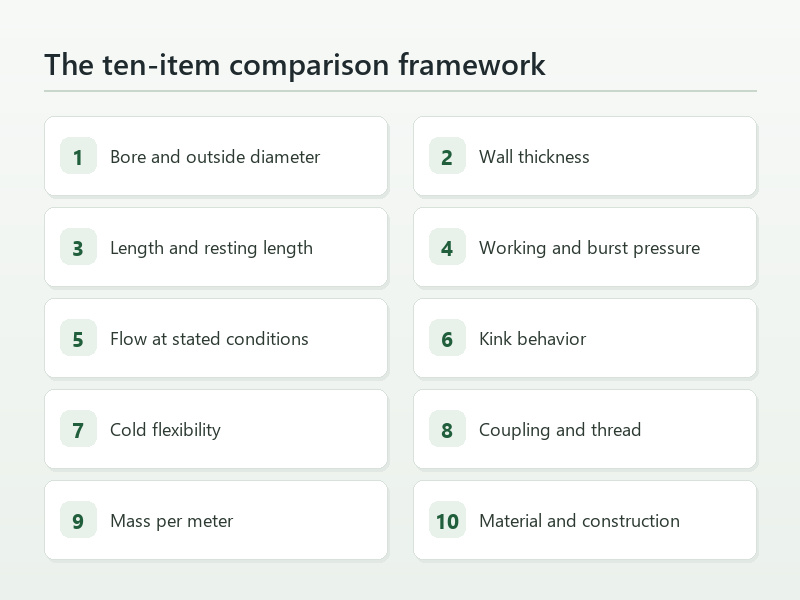
The ten items, in the order they are applied to a claim.
How Do You Use the Ten Items?
Fill the ten rows for each candidate before you read any verdict, then compare rows rather than products. Most disagreements disappear at rows one to four, because one source was working at a different bore or length. Where a hose has to serve a long run from the tap, the hose size selection guide shows how bore, length and flow constrain each other before the framework is applied.
Which Items Carry the Most Weight?
Items four, five and eight carry the most weight for a domestic user, because pressure margin, delivered flow and joint integrity decide whether the hose works at all. Items six and seven decide whether it keeps working through a winter. Items one to three are the facts that make the rest comparable, which is why a review that omits them cannot be checked.
What Does the Framework Not Cover?
Scope: the framework covers the ten measurable items in Table 3. Feel, coiling and tap fit sit outside it, and garden hose kinking in service still depends on your layout as much as on the product. Soaker lines and supply hose are handled separately by the guide to water hose types. Use the ten items to compare like with like, not to compare a soaker hose with a pressure hose.
8. How Do You Check a Garden Hose Reviews Claim Yourself?
The four home checks need a tape, calipers, a scale, a bucket, a stopwatch and a pressure gauge, and together they take about an afternoon. The point is not to reproduce a laboratory but to replace a claim with your own measurement. Compare your figures with the dimensions and the pressure basis a product page states, and start from the consumer products range.
How Do You Check the Bore and Outside Diameter of a Hose You Already Own, Using Only a Tape and Calipers?
Check the dimensions that make every other figure meaningful:
- Bore and outside diameter with calipers at three points along the hose.
- Length when charged, and resting length if the hose expands.
- Mass of the whole coil, which divided by length gives dry mass per meter at a 5/8 in nominal bore.
- Flow at your tap pressure, timed into a bucket over a known length.
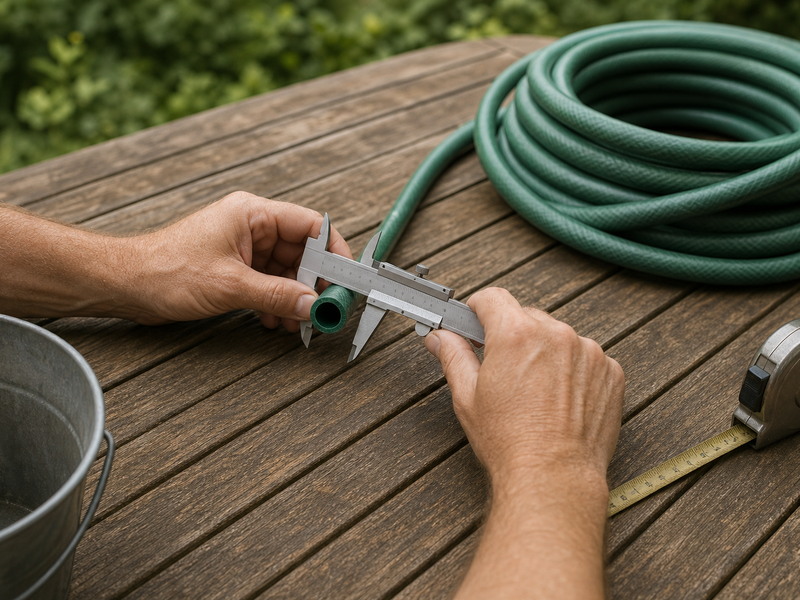
Calipers at a cut end, with mass and flow read at the tap.
What Requires a Laboratory?
Scope: burst pressure, proof pressure, pull-off force, layer adhesion and accelerated weathering are laboratory measurements. The four a reader can measure at home are bore and outside diameter, length, mass and flow. That is why reported laboratory figures should also carry their conditions, and why a supplier should hold the data rather than reconstruct it after a question.
How Do You Record What You Find?
Write down the measurement, the instrument and the date, then keep the note with the hose. A second measurement after a season outdoors is the most useful evidence you can gather, because aging is the one property no short program can measure. Two measured points, taken a year apart on your own hose, say more about durability than any single figure.
9. Why Do Two Garden Hose Reviews Disagree?
Two garden hose reviews can both be accurate and still reach different conclusions, because each measured a different condition. Disagreement is therefore informative rather than confusing, provided the conditions are visible. When they are not visible, the disagreement cannot be resolved by reading more carefully, and the honest answer is that one or both sources did not disclose enough.
What Are the Common Sources of Disagreement?
Disagreements cluster in a few recurring places. The common ones are a flow figure taken at another bore or length, a cold test at a different temperature, and a new sample compared against an aged one. A pressure claim applied to a hose body, where the tested item was an assembly with couplings, is another. Each of these is a condition difference rather than a contradiction, and each can be checked with one written question.
How Should You Handle Disagreement?
Answer: when two reviews disagree, compare the four conditions first: bore, length, water temperature and end fittings. Where any of the four differs, the disagreement is a condition difference. Where all four match and the numbers still differ, the disagreement is real.
Decide which condition matches your situation and weight that source accordingly. If your tap delivers at the bottom of the domestic planning range, a review measured at high pressure tells you less than one that states a lower test pressure. If your winters are cold, the cold-bend condition outranks the highest burst pressure quoted anywhere.
Where two accounts genuinely conflict, the resolution is a specification rather than a preference. HENGHUA publishes dimensional and pressure data for its garden hose range through the shop and answers technical questions about construction and test conditions through the contact page, including OEM and private-label programs. A reader who asks for the condition attached to a number will usually find the number was true, and measured on something other than the hose in front of them.
Send a technical inquiry naming the bore, the length, the end fittings and the water temperature, and HENGHUA will return the same fields for your own hose.
10. How Many Samples Should a Review Report, and Can the Result Be Repeated?
Sample count and repeatability decide whether a set of figures describes one hose or a production batch. A report that names the sample count, the production periods the samples came from and the repeat measurement on a second set can be judged; one published without those three details describes a single hose.
What Makes a Measured Figure Repeatable?
A figure is repeatable when the method is complete enough for another laboratory to run the same test on its own samples and land inside the same tolerance band. Sample count, conditioning, instrument and failure criterion are the fields that make that possible.
Häufig gestellte Fragen
What Makes a Hose Review Trustworthy?
A review states its method: the sample, the conditioning, the instruments and the order of tests. A trustworthy review also states its limits, including how many samples were measured and what the program did not cover. Where those details are missing, the review may still be useful as a shopping description, but it cannot be used as a comparison of measured performance.
What Does a Kink Free Claim Actually Mean?
The claim usually means the hose passed a bend at one radius, at one temperature and at one pressure. Garden hose kinking depends on the conditions, so the claim describes a test rather than a guarantee. The claim becomes usable when the radius and the flow retained are stated. Ask for both, then bend the charged hose through a similar arc at your own tap pressure. A hose that passes in a warm workshop may still crease in a cold garden.
If Two Websites Publish Different Ratings for the Same Hose, Which Condition Should You Compare First?
The two figures came from different test conditions, most often in bore, length, water temperature or the fittings that capped the ends. Two figures can both be correct for the sample tested. Compare the conditions rather than the numbers, and prefer the source that states the length and the pressure at which its flow figure was measured.
How Is Burst Pressure Measured?
A capped assembly is pressurized until it fails, with water temperature and rate of rise controlled. The result is only useful with the failure location, because a body failure and a coupling pull-off are different events. HENGHUA publishes a 150 psi working rating paired with a 400 to 500 psi burst band, a ratio near 3 to 1, both measured on the hose body under those controlled conditions.
What Is a Proof Test?
A proof test holds an assembly above its working rating for a stated time and checks for leakage without intending to destroy it. It answers whether a batch holds pressure, not how much pressure it can take. The pressure, the hold time and the water temperature belong with the result, because each of them changes what the test proves.
How Do I Know If a Hose Is Cold Flexible?
Look for a stated test temperature and a stated bend radius. Plasticized PVC in a hose stiffens as the temperature falls, which is when a hose that coiled easily in autumn begins to crease. A claim without a temperature cannot be checked against your climate, and a hose stored outdoors in a cold season will show the effect quickly.
Can I Measure Flow at Home?
Yes, with a bucket and a stopwatch at your usual supply pressure and over a known length. Record the volume, the time, the length and the bore, because a flow figure without those conditions cannot be compared with anything. Repeat the same measurement with a different bore and the effect of bore on flow becomes obvious within minutes.
What Does UV Resistant Mean on a Hose Label?
A UV resistant label means a sample retained properties after accelerated exposure for a stated time at a stated irradiance. That exposure is the promise; how long the cover lasts outdoors depends on sun angle, shade and surface temperature. Ask for the exposure basis, and check the cover construction, since an outer layer that resists abrasion usually resists sunlight as well.
Why Does a Coupling Pull Off Before the Hose Bursts?
The joint between hose and coupling concentrates load in a short length, so a clamped or crimped connection can be the weakest link in an assembly. Pull-off and proof tests exist to find that limit before it appears at your tap. This is also why a pressure claim should say whether it covers the hose body or the finished assembly.
What Should a Reader Take from Garden Hose Reviews Overall?
Take the method, not the medal table. Garden hose reviews are most valuable when they hand you conditions you can reproduce: a bore, a length, a pressure and a temperature, plus a note on how the couplings were tested. With those, you can judge a product against your own supply and climate, which is a more reliable test than any single verdict.
About HENGHUA
HENGHUA is a hose manufacturer supplying garden hose, water hose and reel assemblies to distributors, retailers and OEM programs under the GLOBHOSE and FLEXMAX brands. The consumer products range covers nominal bores from 1/2 in to 3/4 in in vinyl, EPDM rubber, hybrid and reinforced multi-layer constructions, with bore, wall, outside diameter and mass data supplied for each program.
Manufacturing positions relevant to a reader comparing hose claims include published ratings of 150 psi (about 1,034 kPa, calculated) working pressure and a burst band of 400 to 500 psi. Dimensional control on bore and wall keeps a stated flow or mass figure at a named bore true between batches. Couplings are supplied to the straight 3/4 in nominal garden hose thread (GHT, also called NH) with 11.5 threads per inch, which seals on a washer, and to tapered pipe thread (NPT), which seals on the threads.
The company publishes engineering data rather than rankings or editorial verdicts. What it can supply is the basis behind a claim: wall thickness, mass per meter, pressure basis, coupling type and thread form. OEM, custom branding and tailored lengths are supported, and technical inquiries are handled through the contact page.






 English
  Spanish
  Portuguese
  French
  German
  Arabic
  Russian
  Indonesian
  Japanese
  Korean