
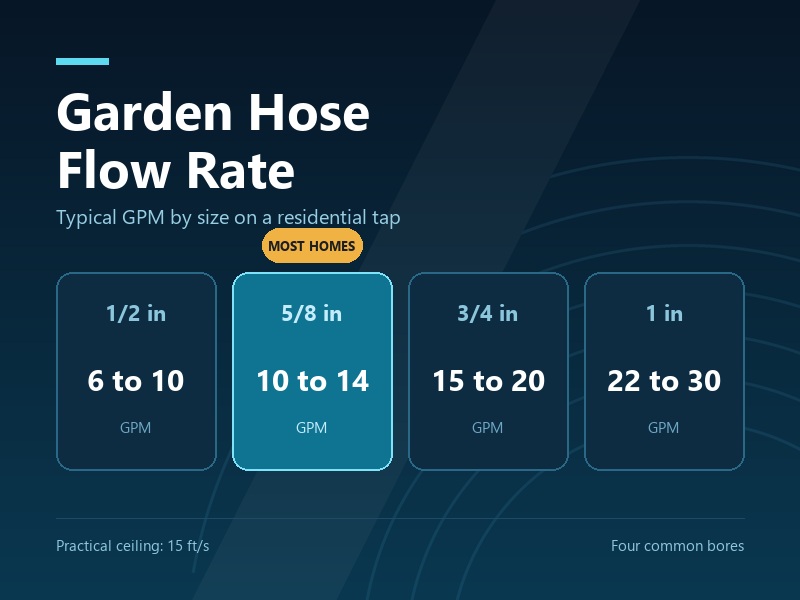
A 5/8-inch garden hose, the size most homes use, delivers about 10 to 14 gallons per minute at a residential tap. Your exact garden hose flow rate is set by four variables. They are the inside diameter of the hose, the pressure the tap can hold while water is moving, the length and internal smoothness of the run, and the fittings and nozzle on the end.
This guide covers the principle first, then the numbers for each common size. It then explains the real-world conditions that pull those numbers down, and how to choose a diameter for the job in front of you. A companion guide covers how to measure the output of your own hose with a bucket and a timer.
What Actually Sets How Much Water a Hose Delivers?
Water only moves when a pressure difference pushes it, and a hose is a resistance placed in that path. The tap supplies pressure, while the hose, the couplings and the nozzle consume it. The flow that arrives at the far end is the rate at which the pressure left over exactly balances the friction created by the moving water.
Pressure Is Potential, Not Delivery
Pressure and flow are different quantities, and treating them as the same thing is the most common mistake in hose selection. The pressure at a closed tap is called static pressure, and it is commonly 40 to 60 psi in a North American home. Once water starts moving, part of that pressure is spent overcoming friction, so the pressure at the far end of the hose is always lower than at the tap.
Diameter Sets the Volume Ceiling
Volume flow equals cross-sectional area multiplied by velocity, so the bore (the inside diameter, also called the ID) sets how much water can pass at a given speed. Because area grows with the square of the diameter, a small change in bore produces a large change in capacity. Going from a 1/2-inch bore to 5/8 inch adds 56 percent more area, calculated from the cross-sectional areas in the table below, and moving up to 3/4 inch more than doubles it.
The Flow Equation in Symbols
The relationship can be written in one line as Q = A x v, where Q is volume flow, A is the cross-sectional area and v is the water velocity. Area is fixed by the hose you bought and velocity is set by the pressure you can supply. That single equation explains why two hoses on the same tap behave so differently, and why the same hose behaves differently on two taps.
Length, Bends and Fittings Add Resistance
Three things raise the friction that a given flow creates:
- Length: friction loss rises roughly in proportion to the length of the run.
- Bends and kinks: a tight bend or a kink compresses the bore and behaves like a much narrower pipe.
- Fittings and nozzles: every coupler, quick-connect and spray head adds its own restriction.
Water Temperature and Hose Construction
Colder water is slightly more viscous, so it flows a little less readily through the same bore. Construction matters as well, because a smooth inner wall creates less friction than a ribbed or heavily reinforced bore. A hose that kinks easily will lose far more flow in practice than its nominal diameter suggests.
Why the Far End Is What Counts
What matters for a sprinkler, a nozzle or a filling hose is the pressure that survives to the far end, not the pressure at the tap. A short, wide hose keeps most of the tap pressure available for useful work. A long, narrow hose spends most of that pressure on friction before the water ever reaches the outlet.
Garden Hose Flow Rate by Size: The Numbers
A garden hose flow rate by size table is only useful if it states the pressure and the length it assumes. The tables below separate the geometry, which is fixed, from the flow, which depends on your supply. Both are calculated from the continuity relationship rather than copied from a product sheet.
The Geometry of Common Hose Sizes
Nominal size describes the bore in inches, and the cross-section follows directly from it. The table lists the inside diameter, the resulting area and the capacity relative to the smallest common size.
Inside diameter, cross-sectional area and relative capacity of common garden hose sizes
| Nominal size | Inside diameter (in) | Area (sq in) | Relative capacity |
|---|---|---|---|
| 1/2 in | 0.500 | 0.196 | 1.00 |
| 5/8 in | 0.625 | 0.307 | 1.56 |
| 3/4 in | 0.750 | 0.442 | 2.25 |
| 1 in | 1.000 | 0.785 | 4.00 |
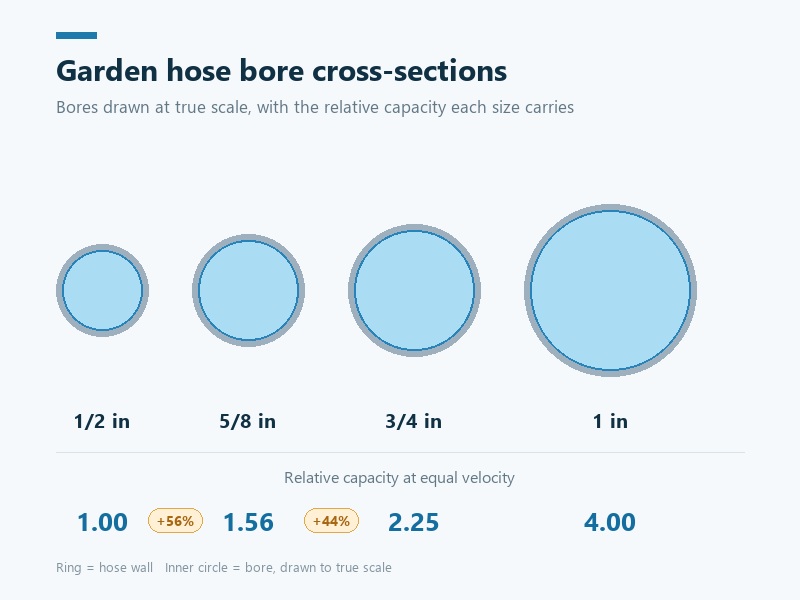
Bore at true scale. Relative capacity at equal velocity: 1/2 inch 1.00, 5/8 inch 1.56, 3/4 inch 2.25, 1 inch 4.00.
The relative capacity column shows how the sizes compare when water moves at the same speed. That column is fixed by geometry and does not change with pressure.
Discharge at a Given Velocity
Velocity is the link between area and volume. The next table converts three practical velocities into gallons per minute for each bore. It uses the conversion that one cubic foot per second equals 448.83 gallons per minute.
Calculated discharge in gallons per minute at three water velocities, by inside diameter
| Nominal size | 5 ft/s | 10 ft/s | 15 ft/s |
|---|---|---|---|
| 1/2 in | 3.1 | 6.1 | 9.2 |
| 5/8 in | 4.8 | 9.6 | 14.3 |
| 3/4 in | 6.9 | 13.8 | 20.7 |
| 1 in | 12.2 | 24.5 | 36.7 |
In a residential setting the practical ceiling is around 15 feet per second. That is why the 5/8-inch and 3/4-inch rows matter most to a homeowner, and why the 1-inch row is rarely reached on a domestic tap.
Why 5/8 Inch Became the Default
Most residential hoses are sold in 5/8 inch because it balances three competing needs. It carries enough water for a lawn or a car wash, it stays flexible enough to coil in cold weather, and it is light enough to drag around a garden. At about 15 feet per second, a 5/8-inch bore delivers roughly 14 gallons per minute.
What Is the Flow Rate Through a 3/4-Inch Hose?
The garden hose flow rate by size relationship is steep, so 3/4 inch is a genuine step up rather than a minor one. Its bore carries 44 percent more water than 5/8 inch at the same velocity. At 15 feet per second the flow through a 3/4-inch hose reaches about 20.7 gallons per minute. That shortens the time needed to fill a drum, a trough or a pool, at the cost of weight, stiffness and a higher price per foot.
When a 1/2-Inch Hose Is Enough
A 1/2-inch hose suits short runs and light tasks such as watering pots, hanging baskets and a few garden beds. It coils easily, weighs little and is often adequate when the hose is under about 25 feet. It becomes frustrating on longer runs, where limited area and rising friction combine to slow the flow noticeably.
Is a 1-Inch Hose Worth It?
A 1-inch hose is a bulk-transfer tool rather than a garden tool. It can move a large volume quickly, but only if the tap and the supply line can deliver that volume in the first place. On a typical domestic tap the hose will not reach its geometric capacity, because the plumbing behind it becomes the limit.
Metric and Imperial Sizes
Hose is sold by nominal bore in both inches and millimeters, and the two are not always exact conversions. A hose marked 12 mm is close to 1/2 inch, a 15 mm bore is close to 5/8 inch, and 19 mm is the nominal 3/4 inch. When you compare products, compare the stated inside diameter rather than the trade name. The sizing guide covers the conversion factors in full.
Reading a Water Hose Flow Rate Chart
A water hose flow rate chart is a set of conditions, not a promise. Before you trust one, find the pressure, the length and the outlet it was measured at. A number taken at 60 psi over 25 feet with an open end will look impressive beside the same hose measured at 35 psi over 100 feet with a nozzle fitted. Compare like with like, and a water flow rate chart becomes a planning tool rather than a headline.
Garden Hose Flow Rate GPM: What Pressure Changes
Any garden hose flow rate gpm figure is meaningless without the pressure it was taken at. Pressure sets how hard the water is pushed, while the hose and its fittings decide how much of that push survives the trip.
Why Doubling Pressure Does Not Double Flow
For flow through a fixed restriction, discharge rises with the square root of the pressure difference. Doubling the pressure therefore increases flow by about 41 percent, not by 100 percent. The table applies that relationship across a range of inlet pressures, using 40 psi as the reference point.
Effect of inlet pressure on relative flow through a fixed restriction, calculated from the square-root discharge relationship
| Inlet pressure (psi) | Relative flow (40 psi = 1.00) |
|---|---|
| 20 | 0.71 |
| 40 | 1.00 |
| 60 | 1.22 |
| 80 | 1.41 |
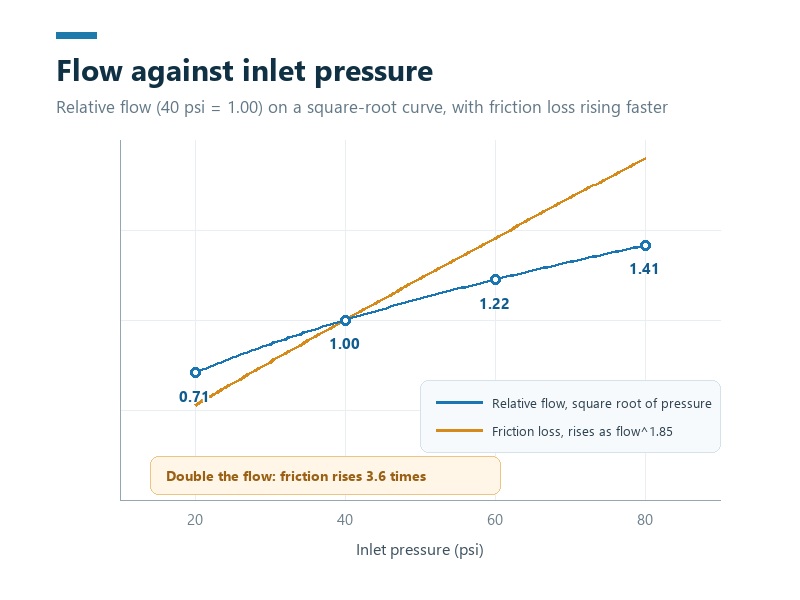
Pressure raises flow on a square-root curve. Relative to 40 psi: 20 psi 0.71, 40 psi 1.00, 60 psi 1.22, 80 psi 1.41.
The diminishing return on pressure is why a larger bore is usually a better investment than a higher-pressure supply.
What Residential Pressure Usually Is
Household water pressure commonly sits between 40 and 60 psi, with values outside that band in older systems or at high elevation. Pressure falls as water moves, and it falls further when several outlets run at once. A tap that reads 60 psi when closed may supply a flowing hose at 35 to 45 psi.
When the Tap Becomes the Limit
Above a certain diameter the hose stops being the constraint and the supply line takes over. A 3/4-inch or 1-inch hose can only deliver what the meter, the service line and the tap can pass. Report a garden hose flow rate gpm value together with the static pressure and the hose length, or the number cannot be compared with anything else.
Where to Measure Pressure
Static pressure is read at the tap with all outlets closed. Flowing pressure is read at the same point with the hose running, and the two numbers rarely match. The difference between them is the pressure that your plumbing and your hose are consuming, and it is usually larger than people expect.
Does a Regulator Change Flow?
A pressure regulator caps the pressure the hose sees, which protects a light hose or a drip line from surges. It does not add flow, and a regulator set below the pressure needed to push the required volume will reduce it, so expect delivery to stay the same or fall slightly.
What Happens When Several Outlets Run at Once
Household plumbing shares a common supply, so the pressure at one tap falls when another opens. A washing machine filling upstairs can noticeably slow a hose in the yard. If your watering matters, run it when other demand is low. Timing the job is often easier than buying a wider hose.
Typical Garden Hose Flow Rate on a Real Tap
The typical garden hose flow rate in a home is lower than a friction-only calculation suggests, because the tap rarely holds its static pressure while water is moving. The table below gives practical ranges for a 50-foot hose discharging to open air. Treat those ranges as planning values rather than guarantees.
Practical discharge range for a 50 ft hose on a residential tap, discharging to open air
| Nominal size | Typical flow (GPM) | Suited to |
|---|---|---|
| 1/2 in | 6 to 10 | short runs, containers, hand watering |
| 5/8 in | 10 to 14 | general lawn and garden watering |
| 3/4 in | 15 to 20 | long runs, washing, faster filling |
| 1 in | 22 to 30 | bulk transfer where the supply allows |
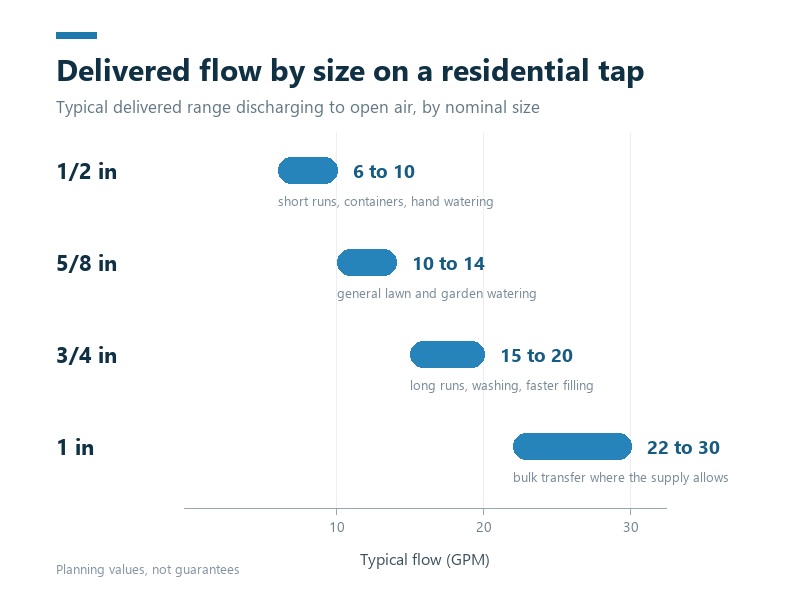
Typical delivered flow on a 50 ft hose at a residential tap: 1/2 inch 6 to 10 GPM, 5/8 inch 10 to 14 GPM, 3/4 inch 15 to 20 GPM, 1 inch 22 to 30 GPM.
The Supply Line Behind the Tap
The hose bib is the end of a chain that starts at the water main. Narrow service lines, long interior runs and old galvanized pipe all reduce what the bib can pass. A wide hose on a restricted supply simply cannot reach the flow its bore would allow, no matter what the label promises.
How Fittings, Reels and Nozzles Cut Flow
Every component between the tap and the outlet removes some pressure. Quick-connects with small internal bores, a partly closed valve and an undersized spray head are common culprits. A hose reel with a tight internal elbow can cost more flow than several extra feet of hose would.
Why Two Hoses of the Same Size Differ
Two hoses marked 5/8 inch can deliver noticeably different flow. The difference comes from the true bore, the smoothness of the inner wall and how well the hose resists kinking under pressure. A reinforced hose that stays round will outperform a thinner hose that flattens slightly on a bend.
What Does Elevation Cost at Eight Feet?
Raising water costs pressure, and it costs about 0.43 psi for every foot of vertical lift. Watering a raised bed eight feet above the tap therefore consumes roughly 3.5 psi before any friction is counted. On a long run uphill, that lift is a meaningful share of the pressure you started with.
Why Length Changes the Real Number
A typical garden hose flow rate figure quoted for a 50-foot hose will overstate what a 100-foot run delivers. Friction accumulates along the whole length, so doubling the run removes roughly twice as much pressure before the water reaches the outlet during watering.
Recovering Flow You Have Already Lost
Before buying anything, check the obvious restrictions in the line. A partly closed valve, a clogged screen washer or a corroded coupler can waste more pressure than a size step is worth. Replacing a restrictive quick-connect with a full-bore fitting is often the lowest-cost gain available.
Coil Hose Versus Reinforced Hose
A lightweight coil hose stores neatly and suits small tasks, but its narrow bore and thin wall limit both flow and durability. A reinforced hose holds its shape under pressure and keeps a steadier bore along the run. For anything beyond a balcony or a few pots, the reinforced hose is the more predictable choice.
How Garden Hose Diameter Changes Pressure and Delivery
Garden hose diameter is measured on the inside, and the nominal label is not always the exact bore. A hose sold as 5/8 inch may measure slightly under or over, and the difference shows up as a small but real change in flow. This section explains how diameter interacts with length and with your fittings.
How Does Run Length Affect Delivered Volume Over 100 Feet?
Friction depends on how many diameters of pipe the water must travel, not just on the raw length. A 100-foot run through a 5/8-inch bore covers 1,920 diameters, calculated as 100 feet divided by 0.625 inch, while the same run through 1 inch covers 1,200. The shorter ratio means less relative friction, which is why a larger bore travels distance more efficiently.
Which Garden Hose Diameter Should You Buy for a Run Over 50 Feet?
Choosing the right garden hose diameter matters more than fitting a higher-pressure tap. For runs over about 50 feet, dropping below 5/8 inch costs flow at the far end. The extra cost per foot is small compared with the time saved on every fill and every watering.
Why Does Friction Loss Grow Faster Than Flow?
Friction rises faster than flow does, not in step with it. In the common design relationship, friction loss varies with flow raised to the power of about 1.85, so doubling the flow multiplies friction by 3.6, calculated from that exponent. That is why the last increment of flow is always the most expensive in pressure terms.
When Does a Bigger Bore Stop Paying Off?
A larger bore pays off only while the tap and the plumbing can pass more water than the hose already does. Where the supply tops out at 12 gallons per minute, a wider hose simply runs partly full. In that case the money is better spent on a shorter run or on a smoother, kink-resistant hose.
Matching Bore to Your Tap
Start from what the tap can deliver while the water is running. If the flowing pressure holds up when the hose is open, a wider bore buys you flow. If it drops away, the wider bore only adds weight.
Why the Inside Measurement Is the One That Counts
Two hoses can look identical from the outside and move very different volumes. Outside diameter includes the jacket, the reinforcement and any foam layer, none of which carry water. The inside measurement is what the water actually passes through, so it is the number that decides how much reaches the outlet.
Matching Hose Size to the Job
Hose size should follow the task, not the other way around. The right choice depends on how much water the job needs, how far the water must travel and how often the hose has to be moved. The notes below cover the common cases.
What Hose Size Does a Lawn or a Garden Bed Need?
A 5/8-inch hose is the usual answer for a lawn, because it supplies a traveling sprinkler well and stays manageable on a reel. If the beds are far from the tap, move up to 3/4 inch and accept the extra weight. For a full comparison of hose types by material and use, see the guide to types of water hoses.
What Hose Size Do You Need for Washing a Car or a Deck?
Washing rewards flow, because a weak stream wastes both time and water. A 5/8-inch hose is a reasonable minimum, and 3/4 inch is better for long driveways. If you also run a pressure washer, the pressure washer supply hose limits performance just as much as the machine does, which the pressure washer hose guide explains.
Filling Pools, Troughs and Tanks
Filling is a pure volume task, so flow directly sets the time it takes. A 3/4-inch hose on a good tap will fill a tank far sooner than a 1/2-inch hose on the same tap. Where the volume is large and the tap is strong, a 1-inch hose can be justified. If you are unsure which bore suits your layout, the hose size selection guide walks through the trade-offs.
Agricultural and Light Commercial Use
Larger volumes, longer runs and multiple outlets push the requirement up. Growers and smallholders often run 3/4-inch or 1-inch lines and split them at a manifold rather than at the tap. Irrigation and agricultural hose built for those larger jobs, including lay-flat and reinforced types, is grouped in the agricultural hose range.
What Is the Simplest Hose Sizing Rule to Follow?
Match the bore to the length of the run before you match it to anything else. Under 25 feet, 1/2 inch is workable. From 25 to 50 feet, 5/8 inch is the sensible default. Beyond 50 feet, or wherever filling time matters, step up to 3/4 inch or more.
When You Need Two Hoses Instead of One
On a large property, two short hoses joined with a full-bore connector often beat one very long hose. Each leg keeps friction lower, and the pair is easier to handle and store. The connector must be generous inside, because a narrow coupling undoes the benefit of the two wider legs.
Weighing Flow Rate Against Weight, Cost and Life
More flow usually means more hose, and more hose means more weight, more cost and more storage space. The right balance depends on how often the hose is moved and how long each job takes. This section covers the trade-offs that never appear in a flow table.
Water Volume Is Also Weight
Water weighs about 8.34 pounds per US gallon, and a 50-foot 3/4-inch hose holds roughly 1.1 gallons while it is full. That is about 9 pounds of water alone, before the hose, the fittings and the water still standing in the line are counted. That weight is a practical limit for many users, especially on slopes.
Where a Smaller Hose Wins
A smaller hose is easier to carry, coils tighter, fits a smaller reel and costs less. For pots, hanging baskets and short runs it delivers plenty of water. The mistake is choosing small for a long run to save weight, then paying for it in time at the tap on every single use.
Coiling, Storage and Kinking
A hose that kinks loses flow at the kink, and a kink under pressure can stop the flow entirely. Hoses with a reinforced wall and a rounded cross-section resist kinking better than thin, flat-walled hoses. Storage matters too, because a hose left in tight loops takes a set that shortens its working life.
Cost Per Foot Versus Cost Per Fill
The price of a hose is only part of the cost of owning it. A larger bore costs more per foot but can cut the time spent filling and watering by a noticeable margin. For anyone filling large volumes regularly, the time saved quickly outweighs the extra purchase price of the wider hose.
Construction and Quality Control
Flow depends on the bore staying round and the inner wall staying smooth. Manufacturers control this with wall thickness tolerances, reinforcement lay and pressure testing before dispatch. HENGHUA states its garden and industrial hose production ranges and inspection methods on request, so a buyer can compare them against a specification.
Repair, Replacement and Long-Term Value
Couplings and washers fail long before a good hose body does, and they are cheap to replace. A hose that stays round, resists kinking and keeps its bore clear will deliver more usable water over its life than a cheaper hose that slowly collapses. Durability is therefore part of flow, not a separate subject.
Measured on a real tap, the garden hose flow rate you can expect from a 5/8-inch hose is 10 to 14 gallons per minute, and 3/4 inch reaches 15 to 20. Choose the bore for the job, keep the run as short as the layout allows, and keep the fittings generous. That combination does more for delivered flow than any single upgrade.
Häufig gestellte Fragen
Does a bigger hose always deliver more water?
A bigger hose delivers more water only up to the limit of your supply. A larger bore can carry more water, but it cannot create flow that the tap and the service line do not provide. Where delivery is capped upstream, a 1-inch hose will not beat a 3/4-inch hose by much. Check the flowing pressure before you buy a larger hose.
How many gallons per minute should you expect from a 50-foot 5/8-inch hose on a normal house tap?
A 5/8-inch hose that runs 50 feet delivers roughly 10 to 14 gallons per minute from an ordinary house tap. The figure depends on static pressure, the length of the run and the fittings in use. A short, high-pressure setup will comfortably beat a long, low-pressure one on the same hose.
What is the flow rate of a 3/4-inch hose?
A 50-foot 3/4-inch hose commonly delivers about 15 to 20 gallons per minute on a domestic tap. Its bore passes about 1.4 times the volume of a 5/8-inch hose at the same water speed. That extra capacity shortens filling times, but the hose is heavier and stiffer, so it suits long runs more than small gardens.
Will a 100-foot run to the beds cut the flow of a 5/8-inch hose?
Hose length does reduce flow, and the effect compounds with a narrow bore. Every extra foot of run takes a little more pressure out of the line. Doubling a run from 50 to 100 feet can cut the delivered flow noticeably on a 1/2-inch hose, while a 3/4-inch hose copes far better.
Can I increase the flow rate of an existing hose?
You can recover a little flow from an existing hose, but never beyond the limit of the supply. Removing unnecessary quick-connects, repairing kinks and opening the tap fully will all recover lost pressure. Beyond that, the only real gains come from a shorter run or a larger bore. Raising pressure at the tap increases flow only by the square root of the change.
Can a 1/2-inch hose you already own still drive an oscillating sprinkler on a long run?
A 1/2-inch hose can feed a sprinkler, but only if the run and the sprinkler demand allow it. Most oscillating sprinklers are rated for 5 to 8 gallons per minute, and a short 1/2-inch hose on a good tap supplies 6 to 10. On a long run the same hose may fall short and the spray pattern will collapse. A 5/8-inch hose gives more margin for very little extra weight.
Why does my hose flow drop when I add a nozzle?
A nozzle is a restriction, and a restriction converts pressure into velocity and spray. That is useful for cleaning, but it reduces the volume passing through the hose. A nozzle with a small orifice will lower the delivered flow far more than a wide-bore spray head will. The loss is greatest on low-pressure taps.
Does hose pressure drop in the evening when the washing machine is running?
Hose pressure drops when several fixtures run at once and rises overnight when demand is low. Municipal systems also vary with demand and with the height of the supply reservoir. Because flow follows the square root of pressure, a moderate pressure change produces a smaller change in flow.
Should you fit a regulator when your tap runs above ordinary household pressure?
Most garden hoses are made for ordinary household pressure in the region of 40 to 60 psi. Higher pressure increases wear on couplings and shortens hose life without adding much flow. If your tap runs above about 80 psi, a regulator protects the hose and the fittings. Flow gains above that point are small.
Does hose material affect flow?
Hose material matters far less for flow than bore, length or kinks do. A smooth inner wall adds a small advantage at the same size and pressure, while a ribbed or heavily textured bore gives some of it back. Material is a decision about weight, flexibility and kink resistance instead.
Should I use one long hose or two shorter ones?
Two shorter hoses joined properly usually flow better than one long hose of the same bore. The join must be full-bore, because a narrow connector adds back the restriction you removed. The pair is also easier to drain, coil and store between uses.
Does a hose swell when it is pressurized?
A pressurized hose does swell slightly. Pressure stretches the wall a little, and some hose materials expand more than others. A hose that swells a lot can lose bore consistency and grip its couplings less firmly over time. A reinforced wall limits that movement and keeps the bore nearer to its stated size.
About HENGHUA
HENGHUA manufactures hydraulic, industrial and garden hose for distributors, retailers and OEM programs. The corporate brand covers production of high-performance hydraulic hose under GLOBHOSE and flexible industrial hose under FLEXMAX. Garden and water hose lines are built to the same tolerance and inspection discipline as the industrial ranges.
OEM and private-label work is supported, including custom branding, cut-to-length runs and tailored fittings. Buyers can request bore, wall thickness, reinforcement and working pressure data for any product before placing an order. That information is what makes a fair comparison between two hoses possible, because the label alone rarely states the true bore.
To discuss a specification, a volume or an OEM program, contact the technical team. Ready-made garden and water hose lines are listed in the shop.






 English
  Spanish
  Portuguese
  French
  German
  Arabic
  Russian
  Indonesian
  Japanese
  Korean