
The best garden hose reel is the one whose capacity, drum diameter, swivel and mounting suit the hose you actually use, because the hose and the reel behave as a single system. Capacity decides what fits on the drum, and drum diameter decides the bend radius the hose sits at for months. The swivel is the pressure-carrying rotating joint, the leader hose is where kinks and leaks concentrate, and the wet mass of the loaded assembly decides what the mount must carry. This article works through that sequence, shows the arithmetic on stated inputs, and closes with the numbers worth comparing before you buy.
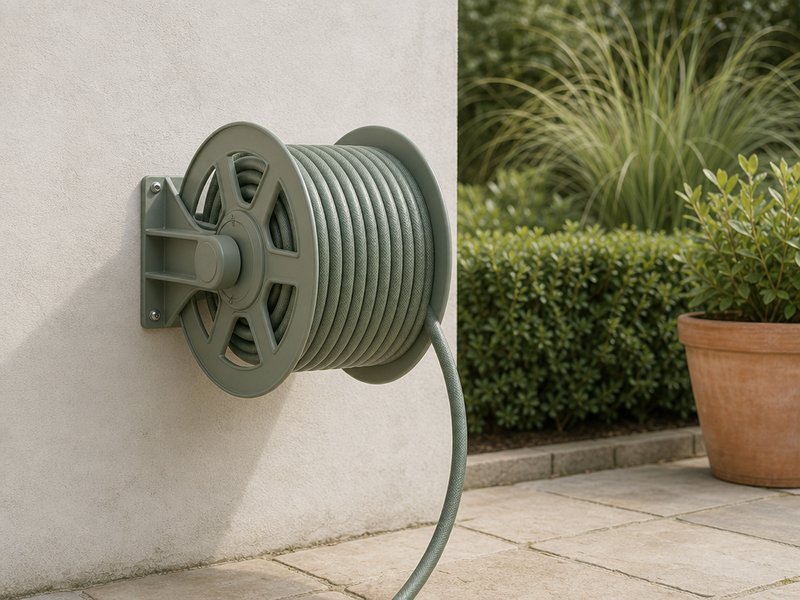
Wall-mounted reel holding hose
1. Why Is the Best Garden Hose Reel a System Decision?
A reel is a storage fixture with one job: hold a hose at a radius the hose tolerates, and pass water through a joint that rotates. Everything else — color, footprint, how the crank feels — follows from that. When a reel and a hose are mismatched, the failure usually appears in the hose or the seal rather than in the reel, which is why capacity quoted in feet is a weak way to compare two reels.
What Does the Hose Contribute to the Assembly?
The hose sets four constraints that the reel has to accept:
- Its outside diameter decides how many turns fit across the drum and how quickly layers build up.
- Its mass per meter, dry and wet, decides the load on the drum, the crank and the mount.
- Its minimum bend radius decides the smallest drum that will not crease it in storage.
- Its working pressure decides what the swivel and the leader hose have to seal and hold.
What Does the Reel Contribute?
The reel contributes barrel diameter, traverse width, winding height, the swivel assembly and the mounting interface. Those figures decide how much hose the envelope takes, which the worked example below puts into numbers.
Why Do Ratings in Feet Mislead?
A reel quoted as holding a stated footage holds that length of one particular hose. Length is a proxy for volume, and volume depends on outside diameter as well as length. A 30 m coil of 3/4 in hose occupies far more space than 30 m of 1/2 in hose at the same nominal length.
2. How Do You Calculate Hose Reel Capacity from Hose Length and Bore?
Capacity is a volume question, and the hose you already own answers most of it. The water inside the hose is a small part of the space the coil needs; the wall, the reinforcement and the voids between packed turns take the rest. Because a reel stores the hose in layers, the space needed grows with outside diameter rather than bore alone. A shopper comparing the best garden hose reel options usually starts from a stated length, yet what decides fit is a volume.
Which Measurements Belong in the Estimate?
The estimate needs four inputs, all of which you can measure on your own equipment:
- Hose outside diameter, measured across the wall at a straight section with the hose uncharged.
- Traverse width, the usable winding length between the drum flanges.
- Winding height, the radial depth from barrel surface to the outer flange edge.
- Barrel diameter, meaning the hose reel drum’s winding surface, measured across the drum itself rather than across the flanges.
What Does a Worked Example Show?
Take a barrel of 200 mm diameter, a 150 mm traverse and 60 mm of winding height. A 5/8 in hose with a 2 mm wall has an outside diameter of about 20 mm, so each layer holds seven turns and three layers fit (calculated: 150 ÷ 20 and 60 ÷ 20, rounded down). The mean winding diameter is 200 mm plus 60 mm, or 260 mm, giving a circumference of about 0.817 m (calculated).
Seven turns across three layers at the 260 mm mean winding diameter is about 17 m of hose (calculated: 3 × 7 × 0.817), and changing any of those four inputs changes the hose reel capacity figure with it.
How Much Does Bore Change the Same Envelope?
Bore changes the answer twice: once through the outside diameter that sets the packing, and once through the volume of water the coil holds when charged. The differences are easy to underestimate. A 3/4 in hose is only about 20 percent wider on the outside than a 5/8 in hose, yet it carries roughly 44 percent more water for the same length (calculated: 285 mm² ÷ 198 mm²).
Table 1 — Same reel envelope, two hoses; figures calculated from the stated barrel, traverse and winding height
| Item | 5/8 in bore, 2.0 mm wall | 3/4 in bore, 2.5 mm wall |
|---|---|---|
| Nominal bore | 15.9 mm | 19.1 mm |
| Inside area | 198 mm² | 285 mm² |
| Outside diameter | about 20 mm | about 24 mm |
| Turns per layer across a 150 mm traverse | 7 (calculated) | 6 (calculated) |
| Layers in 60 mm of winding height | 3 (calculated) | 2 (calculated) |
| Length at each column’s own mean winding diameter | about 17 m (calculated) | about 9 m (calculated) |
| Water held when charged | about 3.4 L (calculated) | about 2.7 L (calculated) |

Layers packing across the drum
Table 1 also shows why a longer hose in a smaller bore can be the better system: you carry more length for a similar volume of stored water, at the cost of higher friction loss along the run. Metric and imperial figures interconvert exactly, and the arithmetic for any bore is set out on the site’s millimeter to inch conversion page if you want to check a supplier’s stated dimensions against your own measurement.
3. How Does Hose Reel Drum Diameter Set Bend Radius and Kink Memory?
Hose spends most of its life in storage, not in use, so the radius it rests at matters more than the radius it sees while watering. Barrel diameter fixes that resting radius, and it is the figure most often missing from a best garden hose reel listing. A hose reel drum that is too small creases the hose every time it is wound, and a crease repeated a few hundred times becomes a permanent set.
Why Is the Barrel a Bend-Radius Fixture?
Bending around a barrel forces the inner surface to the barrel radius and the outer surface to the barrel radius plus the wall thickness, so barrel diameter and bend radius are linked by a factor of two. If a maker publishes a minimum bend radius of four times the outside diameter, a 20 mm hose needs a bend radius of at least 80 mm, which means a barrel of 160 mm (calculated: 4 × 20 × 2). A 150 mm barrel forces a tighter bend than that construction was designed for, every single winding.
What Happens to a Hose Stored Tighter Than It Bends?
A plasticized PVC hose sets in shape when held tight, and the effect accelerates below about 5 °C (41 °F), where the plasticizer stiffens and the material stops recovering. A rubber or hybrid construction tolerates the same radius far longer before it takes a set, because the compound is elastic rather than thermoplastic. Once a hose has taken a set, the flattened section reduces the inside area, and a reduced area means lower flow at the same supply pressure. A hose reel drum smaller than the hose tolerates is therefore a slow failure rather than a sudden one.
Table 2 — Barrel diameter, resting bend radius and bend ratio for two common outside diameters; ratios calculated
| Barrel diameter | Bend radius at the barrel | Hose outside diameter | Bend ratio |
|---|---|---|---|
| 150 mm | 75 mm | 20 mm | 3.75 to 1 (calculated) |
| 200 mm | 100 mm | 20 mm | 5.0 to 1 (calculated) |
| 250 mm | 125 mm | 20 mm | 6.25 to 1 (calculated) |
| 200 mm | 100 mm | 24 mm | 4.17 to 1 (calculated) |
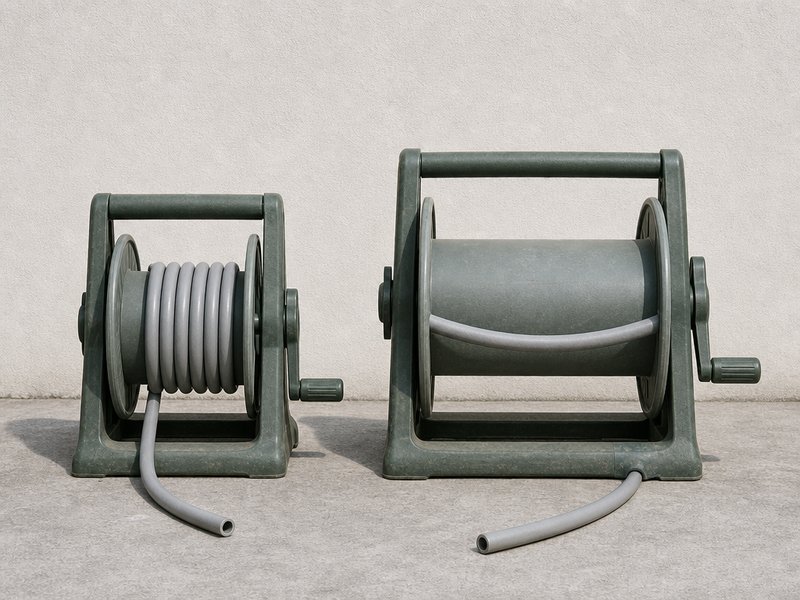
Barrel diameter sets bend radius
Which Drum Figures Should You Compare?
Compare these drum facts rather than a nominal size class, and ask for them before you buy:
- Barrel diameter at the winding surface, not the flange diameter.
- Traverse width, measured between the flange faces.
- Winding height, which sets how many layers fit before the hose touches the frame.
- Barrel surface finish and any radius at the flange corners, since a sharp corner bites the hose.
- Any end stop or layer stop that keeps the last turn clear of the flange edge.
A generous radius at the flange corners lasts longer than a slightly larger barrel with a sharp edge, because the hose never sees a localized pinch. Where a supplier cannot state the barrel diameter, the reel is being sold on a storage length rather than on hose life.
4. What Does a Hose Reel Swivel Seal, and Why Does It Leak?
The swivel is the only part of the assembly that has to hold pressure while it turns, and that single duty explains most reel failures. A static coupling can seal on metal-to-metal contact or a compressed washer. A swivel has to do the same job through a bearing surface that is constantly moving under load, with grit, sand and hard water arriving in the gap.
Where Does the Swivel Sit in the Water Path?
Most garden reels use two swivel points. The inlet swivel connects the supply leader hose to the hub, and the outlet swivel or hub port connects the stored hose to the water path through the barrel. Both are rotary joints on a pressurized line. The inlet joint sees full supply pressure whenever the tap is open, and the outlet joint sees it whenever the nozzle is closed, which is when a worn seal usually shows itself as a drip.
Why Is a Rotating Seal Harder to Hold Than a Static One?
A rotating joint seals across a moving surface, so it relies on a compressed elastomer element rather than on thread deformation. Published water-hose ratings used on this site are 150 psi working pressure with a burst band of 400 to 500 psi, a burst-to-working ratio of about 3 to 1 for general service.
The hose rating’s 3 to 1 figure describes the hose wall, and the 4 to 1 figure describes a joint rating chosen against the pressure that joint actually sees. General guidance calls for 4 to 1 where failure could injure someone or release a large volume, and a hose reel swivel at full tap pressure is exactly that case.
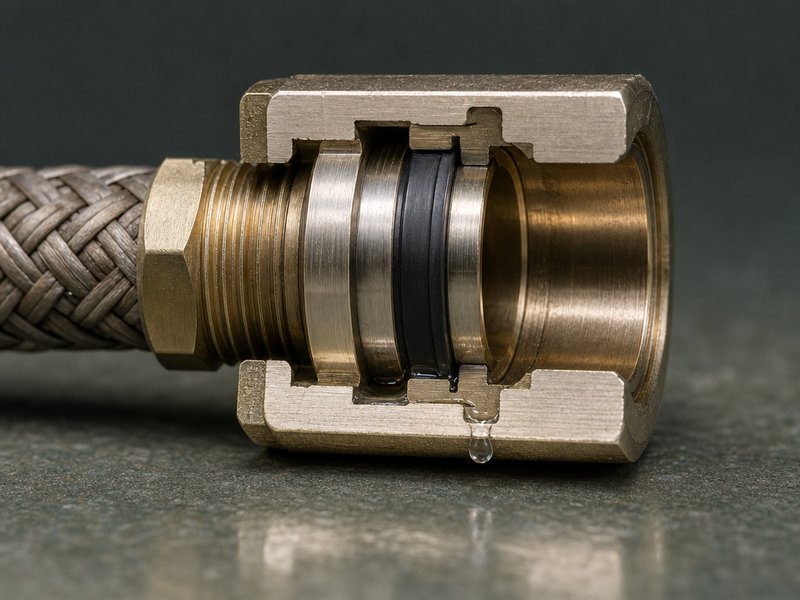
Swivel seal cut open
How Do You Test a Swivel Before You Trust It?
Check a new or rebuilt joint at the pressure it will actually see, with the outlet closed:
- Charge the line slowly with the nozzle shut and watch the swivel for two minutes for a film of water.
- Turn the reel through a full rotation under pressure and watch for a drip that follows the rotation.
- Dry the joint and repeat after an hour, because a slow weep often only shows when the seal relaxes.
- Check that the joint turns by hand without a gritty feel, which indicates sand in the seal.
When Should the Swivel Be Metal?
A metal-bodied swivel with a renewable seal element tolerates heat, UV and repeated tightening better than a molded plastic joint, and it can be rebuilt rather than replaced. That matters where the reel stays outside, or where supply pressure sits near the top of the 40 to 80 psi planning range for domestic lines. A plastic joint is adequate on a light hose at low pressure, provided the seal element is replaceable and the working pressure of the joint itself is stated.
5. Why Is the Leader Hose the Weak Point of the System?
The leader hose is the short length that connects the tap or the reel hub to the rest of the assembly, and it fails out of proportion to its length. It is short enough to be ignored in a flow calculation, exposed enough to be pulled and stepped on, and it bends at the hub where the radius is tightest. Most user complaints about a reel system trace back to this one component rather than to the drum.
What Does the Leader Hose Actually Do?
On a fixed reel, the leader runs from the supply point to the inlet swivel and stays charged whenever the tap is open. On a cart, a second short leader usually links the hub outlet to the working hose. Both carry full supply pressure, both see the tightest bends on the assembly, and both are replaced first.
Why Does a Short Hose Cause a Disproportionate Loss?
Friction loss in a hose rises steeply as bore falls: the published diameter exponent in the Hazen-Williams relationship is 4.87, so halving the bore raises friction loss by about 29 times at the same flow (calculated). If the leader is one bore size smaller than the working hose, a 1.5 m leader in 1/2 in bore costs about the same pressure as 4.5 m of 5/8 in hose (calculated: 1.5 m × 2.99). That is why a 15 m hose can feel weak at the nozzle when the fault sits in a 1.5 m stub.
How Do You Protect a Leader Hose?
Reduce the ways the short length can be abused:
- Fit a leader of the same bore as the working hose so the run has one friction characteristic.
- Add a strain relief or spring guard at the hub, where the bend radius is smallest.
- Use a coupling that matches the thread form rather than forcing a mismatched one, because a cross-threaded joint leaks under load.
- Keep the leader off the ground at the tap end so it is not crushed by foot traffic.
Thread and coupling details decide whether that joint seals at all. The site’s guide to hose coupling types and selection criteria explains how the straight garden hose thread (GHT) that seals on a washer differs from a tapered pipe thread (NPT) that seals on the threads.
6. How Much Does the System Weigh When the Hose Is Full?
Water is the part of the load that buyers forget. A hose that feels light in the shop can carry more than twice its dry mass once it is charged, and the mount, the crank and the frame all carry the difference. The calculation also settles whether the best garden hose reel for a job can stay on a wall bracket or has to become a cart.
How Do You Add Dry Mass to Water Mass?
Water weighs 1 kg per liter, so the water inside a hose follows from the inside area. A 5/8 in bore has an inside area of 198 mm², which is 0.198 L per meter, about 0.198 kg per meter when charged (calculated). Dry mass per meter varies with construction. At 5/8 in bore, the values used on this site are about 115 g for a 1.5 mm vinyl wall, 135 g for 2.0 mm EPDM rubber and 140 g for a 2.0 mm hybrid wall.
Table 3 — Wet mass of a 5/8 in bore hose by construction; dry mass per meter from the site’s reference values, water per meter and 30 m totals calculated
| Bauwesen | Dry mass per meter | Water per meter when charged | Wet mass per meter | Wet mass of 30 m |
|---|---|---|---|---|
| Vinyl, 1.5 mm wall | 115 g | 0.198 kg | about 0.313 kg | about 9.4 kg |
| EPDM rubber (ethylene propylene diene monomer), 2.0 mm wall | 135 g | 0.198 kg | about 0.333 kg | about 10.0 kg |
| Hybrid, 2.0 mm wall | 140 g | 0.198 kg | about 0.338 kg | about 10.1 kg |
| Reinforced multi-layer, 2.5 mm wall | 166 g | 0.198 kg | about 0.364 kg | about 10.9 kg |
What Load Does the Mount See?
The bracket carries the drum, the hose, the water and the reel frame, and it carries them with a lever arm, because the drum hangs away from the wall or post. The static load is the wet mass in Table 3 plus the empty reel; the working load is higher, because pulling the hose off the drum adds a sideways force that can exceed the static weight. A post or wall anchor should be selected for the working load, not the resting one, and the same reasoning applies to the axle and the crank handle.
When Is Weight a Handling Problem Rather Than a Mounting Problem?
Weight becomes a usability question as soon as the user has to lift the assembly. A 20 m hose in 3/4 in bore holds about 5.7 L of water (calculated: 20 × 0.285), and a portable cart with that hose charged is a two-hand lift. The answer is often a lighter construction rather than a stronger frame, provided the lighter hose still meets the working pressure and bend radius the job needs.
7. How Do You Match Hose Reel Size to the Job?
Hose reel size is not one number, and two reels sold as the same class can store very different lengths of the same hose. The useful comparison is a set of dimensions plus the hose the reel is intended to carry, which is why hose reel capacity should always arrive as a length at a stated bore and outside diameter. Large capacity means a longer traverse and more winding height, not a larger barrel. Measure the wall space, the hose you own, and the wet mass in that order.
Which Four Dimensions Define Hose Reel Size?
Four dimensions carry almost all of the meaning, and a supplier should be able to state all four:
- Barrel diameter at the winding surface, which sets the resting bend radius.
- Traverse width between the flanges, which sets turns per layer.
- Winding height from barrel to flange edge, which decides the layer count.
- Overall footprint and mounting centers, which decide whether the reel fits the wall or post.
How Do You Check the Reel Fits the Space?
Hose reel size should be checked as clearance all round, not as a bare footprint. Allow room for the hose to leave the drum without rubbing the wall, for the crank to complete a full turn, and for the leader hose to hang without a sharp bend at the hub. Wall reels also need their mounting centers to land on solid framing rather than on siding, because the working load is higher than the resting load. Where hose and plumbing must be reconciled first, the hose size selection guide shows how bore, length and flow rate trade off against each other.
Table 4 — Reel size classes by envelope, with capacity and wet mass calculated for a 5/8 in hose at about 20 mm outside diameter
| Envelope class | Barrel diameter | Traverse width | Winding height | Length at 5/8 in bore | Wet mass of hose, EPDM 2.0 mm wall |
|---|---|---|---|---|---|
| Compact wall reel | 150 mm | 100 mm | 40 mm | about 6 m (calculated) | about 2.0 kg (calculated) |
| Standard wall reel | 200 mm | 150 mm | 60 mm | about 17 m (calculated) | about 5.7 kg (calculated) |
| Large wall or cart reel | 250 mm | 200 mm | 80 mm | about 41 m (calculated) | about 13.8 kg (calculated) |
| Cart or box reel | 250 mm | 250 mm | 100 mm | about 66 m (calculated) | about 22.0 kg (calculated) |

Reel envelopes compared side-by-side
Why Size the Reel for the Hose You Have?
Sizing for the hose you have is the fairest way to compare the best garden hose reel candidates, because every option is measured against the same envelope. The practical rule is to choose the envelope for the hose on the drum now, and to allow one size class of headroom if a longer hose of the same bore is likely. A reel filled to its last millimeter of winding height also presses the outer turns against the frame, which shortens hose life where a kink starts.
8. How Do You Commission Hose and Reel as One Assembly?
Commissioning is the half hour that decides whether the assembly works for the next five years, and it costs nothing but attention. The checks below are the ones that catch a mismatch while it is still a nuisance rather than a leak. Do them with the hose empty first, then repeat the pressure checks with the line charged.
What Do You Check Before the First Charge?
Work through the assembly from the tap outward:
- Barrel diameter against the hose’s published minimum bend radius, measured rather than assumed.
- Swivel rotation by hand, with no gritty feel and no visible gap at the seal.
- Coupling threads engaged by hand for several turns before any tool or force is used.
- Mounting fixings landed on solid material, with the working load in mind rather than the dry weight.
How Do You Wind the First Layer?
Wind the first layer by hand, turn by turn, keeping a light tension so the turns sit side by side rather than crossing. Crossed turns trap a kink point in the middle of the coil, and that kink stays hidden until the hose is unwound under pressure. Once the first layer is even, the crank can take over, because the layers above it follow the pattern that the first one set.
What Should You Record?
Record the hose bore and outside diameter, the length on the drum, and the pressure the swivel was checked at. Those three facts turn a later problem into a comparison rather than a guess. A slow drip at the hose reel swivel, a length that no longer fits, or a hose that stiffened in a cold snap can all be traced against the baseline. The record therefore belongs with the reel rather than in a file indoors.
9. Which Numbers Should You Compare Before You Buy the Best Garden Hose Reel?
Comparing two reels has almost nothing to do with the reel alone. Two candidates should be compared as systems: their stated dimensions, the hose each is intended to carry, the wet mass the mount will see, and the pressure the joint must hold. The framework below applies to any 2026 listing; the notes under it say which claims you can check yourself and which ones you cannot.
Table 5 — Comparison framework for a hose reel purchase decision
| Number to compare | How a supplier states it | How you verify it |
|---|---|---|
| Hose reel capacity | Length in feet or meters, ideally at a stated bore | Ask for the bore and outside diameter the figure assumes |
| Hose reel drum | Barrel diameter and traverse width | Measure the barrel, not the flange |
| Hose reel swivel | Working pressure of the joint itself | Confirm the seal is replaceable and the joint is rated |
| Hose reel size | Footprint and mounting centers | Check against the wall space and the framing behind it |
| Wet mass | Rarely stated at all | Calculate from bore area plus dry mass per meter |
| Leader hose bore | Sometimes stated as a size | Match it to the working hose to avoid a step loss |
Which Claims Can You Verify Before You Buy?
Dimensions, thread form and stated pressure are all verifiable with a tape, a thread gauge and a pressure test at home, and mass is verifiable by arithmetic once the bore and wall are known. The consumer products range lists the hose and reel families this manufacturer supplies, with bore, wall and pressure data, so a buyer can compare like with like instead of comparing storage lengths. Anything you cannot measure before purchase is a claim, not a specification.
Which Claims Can Only Be Verified in Service?
Service life, UV performance and how a swivel behaves after two winters cannot be checked at the shelf. What can be checked in advance is whether the design allows renewal: replaceable parts, an accessible axle, and a leader hose that is a standard assembly rather than a molded part. If any of those three is unavailable, a long service life becomes a whole-reel replacement instead of a repair, and the effective cost of the product changes.
What Should a Supplier Be Able to Tell You?
A supplier working to a stated engineering basis should be able to state barrel diameter, working pressure of the joint, hose bore and wall, and the bend radius the hose tolerates. Those are the answers to bring to the inquiry before comparing the best garden hose reel options for a specific hose. HENGHUA supplies garden hose and reel assemblies through its shop and answers technical questions on those figures through the contact page, including OEM and private-label programs. Where a supplier cannot state the barrel diameter or the joint working pressure, that absence is itself the answer.
Häufig gestellte Fragen
What Does Hose Reel Capacity Mean When No Hose Is Supplied?
It means the envelope has been measured against one reference hose, which is why the figure is only meaningful with that hose named. A reel with a 250 mm barrel, 200 mm traverse and 80 mm winding height holds about 41 m of 5/8 in hose at about 20 mm outside diameter (calculated). The same envelope takes only about 24 m of 3/4 in hose at 24 mm outside diameter (calculated). Ask which hose the figure assumes.
How Do I Know If a Reel Is Big Enough for My Hose?
Measure the hose outside diameter and the reel’s traverse width, then divide: 150 mm of traverse with a 20 mm hose gives seven turns per layer (calculated). Divide the winding height by the same outside diameter for the number of layers. Multiply turns by layers by the mean winding circumference, and you have a length estimate you can compare against the hose you intend to store.
Does a Larger Barrel Always Mean a Better Reel?
A larger barrel stores the hose at a gentler bend radius, which is better for a stiff or reinforced construction. It also needs more space, more material and usually a stronger mount. For a light vinyl hose used at low pressure, a smaller barrel can be perfectly adequate. The question is not which barrel is larger, but whether the barrel exceeds the hose’s minimum bend radius.
Why Does My Hose Kink Right Next to the Reel?
Kinks cluster at the two points where the radius is smallest: the hub outlet and the last turn against the flange. Both force a bend tighter than the rest of the coil. A radiused flange corner, a leader hose of the same bore as the working hose, and a strain relief on the first meter of hose remove most of the problem before it starts.
How Often Should a Hose Reel Swivel Be Serviced?
Inspect it at the start of each season and after any period of very hard water use. Check for a gritty feel, a drip under pressure, or a stiff rotation, and renew the seal element if the manufacturer supplies one. A swivel that drips only when the nozzle is closed is showing a seal that cannot hold full static supply pressure, which sits in the 40 to 80 psi planning range for domestic lines.
Can I Use Any Leader Hose with Any Reel?
Fit a leader that matches the working hose bore and the reel’s inlet and outlet thread forms. A smaller leader adds friction loss out of proportion to its length. A thread mismatch is worse, because a joint that does not seat properly will weep under load regardless of how tightly it is turned.
How Much Does a Full Hose Reel Weigh on the Wall?
Add the wet hose mass to the empty reel mass. At 5/8 in bore, water adds about 0.198 kg per meter. A 30 m hose holds about 5.9 kg of water on top of roughly 4.0 kg of a 2.0 mm EPDM rubber wall (calculated). A full 30 m assembly therefore sits near 10 kg of hose alone, before the reel frame, and the mount should be chosen for the pull load as well.
Is a 3/4 in Hose Too Heavy for a Small Reel?
It is usually too bulky rather than too heavy. A 3/4 in hose has an outside diameter of about 24 mm with a 2.5 mm wall, so a compact 150 mm barrel takes only about 2 m of it (calculated). The weight is manageable; the volume is what runs out. If you need length in 3/4 in bore, step up to a larger envelope or accept two shorter coils.
What Pressure Should a Hose Reel Be Rated For?
Rate the joint for the highest pressure it sees, which is static supply pressure with the nozzle closed. Published water-hose ratings used on this site are 150 psi working and 400 to 500 psi burst, a ratio of about 3 to 1. Where a failure could injure someone or release a large volume, general guidance is a 4 to 1 ratio. A joint rating below the hose rating, or one stated without the pressure it was rated at, deserves a question.
Which Hose Reel Suits a Small Yard, a Long Run or Winter Storage?
Match the envelope to the job, not to a size class. A renter with one tap and a compact yard is served by the smallest wall envelope. A 20 m run in 5/8 in bore needs the wider traverse and the extra winding height. A hose left charged through winter needs the bend radius first, because a hose that takes a set kinks at the hub.
Which Single Measurement Should I Check First When Choosing the Best Garden Hose Reel?
Check the barrel diameter against the minimum bend radius of the hose you intend to store. That one comparison decides whether the hose survives storage or takes a permanent set, and it is the number most often left unstated. Everything else, including capacity in feet, can be negotiated once the bend radius fits.
About HENGHUA
HENGHUA is a hose manufacturer supplying garden hose, water hose and reel assemblies to distributors, retailers and OEM programs under the GLOBHOSE and FLEXMAX brands. The company’s consumer products range covers garden hose from 1/2 in to 3/4 in nominal bore, in vinyl, EPDM rubber, hybrid and reinforced multi-layer constructions, with production data supplied per batch.
Manufacturing positions relevant to a hose-and-reel system include a stated working pressure of 150 psi with a 400 to 500 psi burst band on the published water-hose ratings. Dimensional control on bore, wall and outside diameter keeps a stated capacity figure at a named hose true between batches. Couplings are supplied to the straight 3/4 in nominal garden thread with 11.5 threads per inch, which seals on a washer, and to tapered pipe thread on request.
OEM, custom branding and tailored assemblies are supported, including non-standard lengths, colors and packaging. Distributors and retailers can request bore, wall, mass per meter and pressure data for a specific program, and end users can ask the technical team to match a reel envelope to a hose they already own. Inquiries are handled through the contact page, and the full consumer range is listed in the shop.






 English
  Spanish
  Portuguese
  French
  German
  Arabic
  Russian
  Indonesian
  Japanese
  Korean