
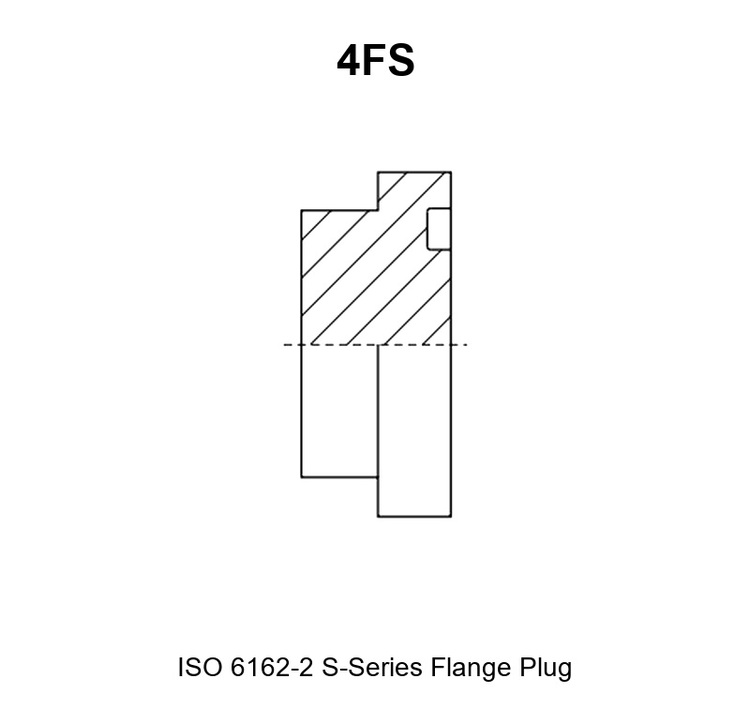
The 4FS adapter is a hydraulic plug adapter: a one-piece machined body that closes an unused, reserved or temporarily open ISO 6162-2 S series (code 62) four-bolt flange port. Its flanged head bolts directly to the flat port face and seals with an O-ring held in a groove, so the joint carries no thread and the port is terminated with zero through flow. Buyers specify the 4FS adapter by flange size first and by seal material second.
Core Advantages
- Four-bolt flange head with an O-ring groove, sealing on the flat port face rather than on a thread.
- Head and spigot dimensions follow the ISO 6162-2 S series (code 62) flange size, so the head lands on a standard port face.
- Machined from bar stock on CNC lathes and checked against the drawing batch by batch.
- Carbon steel with trivalent chromium zinc plating, or 304 / 316 stainless steel for corrosive and offshore service.
- NBR, FKM and EPDM O-ring options to match the system fluid and working temperature.
- No thread sealant, no taper engagement and no swivel in the sealing path, so assembly stays simple and repeatable.
1. What a 4FS Adapter Does
A 4FS adapter closes one ISO 6162-2 S series (code 62) four-bolt flange port. It is a blanking component: one end is a bolted flange head, the opposite end is a closed spigot, and there is no bore through the body, so nothing passes from one side to the other.
The dimensional match is the whole requirement. The flange head must agree with the mating port in flange size, in bolt pattern and in O-ring groove position, because that match is the precondition for eliminating leakage at the port. A plug that is one size out, or built to the L series (code 61) pattern instead of the S series (code 62) pattern, will not seat on the face.
The sealing principle of this series is a four-bolt flange joint. An elastomeric O-ring sits in a groove machined in the flange, four bolts clamp the flange against the flat port face, and the O-ring is compressed in that controlled gap. The bolts carry the load, the O-ring provides the seal, and the metal faces limit compression, which is why this is a face seal and not a thread seal.
A flange plug is not an adapter in the ordinary sense, because there is no second port and no flow path. In this range it is still specified, machined and inspected on the same terms as a flange adapter that carries two connections, and it uses the same numbering, materials and packaging as the rest of this range.
2. 4FS Specifications
2.1 Connection 1 – ISO 6162-2 S-series four-bolt flange head
- Thread standard and family: no thread on this connection. The interface follows the ISO 6162 four-bolt flange family, and this series uses the S series (code 62) pattern of ISO 6162-2, which is the higher-pressure pattern of the family. The lower-pressure L series (code 61) pattern is covered by ISO 6162-1 and by a separate series in this range.
- Size range: flange sizes 1/2″ through 2″, in six steps (08, 12, 16, 20, 24 and 32).
- Gender: male flange head, bolted to the port face with four bolts.
- Sealing method: O-ring in a groove in the flange face, energised by bolt clamping against a flat port face.
- Mating port standard: an ISO 6162-2 S series (code 62) four-bolt flange port. The head of the flange adapter occupies the same port face position that a bolted flange joint would otherwise use.
2.2 Connection 2 – Closed end, no second port
- Function: the second end of the body is closed. This series terminates a port; it does not join two ports.
- Geometry: a plain cylindrical spigot behind the head, with no thread, no bore and no seat. The spigot centres the plug in the port bore and keeps the flange face square to the port face.
- Sealing method on this end: none required, because a hydraulic plug adapter of this type has no second fluid path.
- Mating part: none. Nothing connects to the closed end.
2.3 Construction and Materials
As a hydraulic adapter manufacturer, HENGHUA machines the body from bar stock on CNC lathes as a single piece, turning the flange head, the O-ring groove and the spigot in one setup sequence so that the face and the spigot stay concentric. Carbon steel is the standard body material, with trivalent chromium zinc plating (Cr3+) for general hydraulic service and zinc-nickel plating available where a harder deposit is preferred. For corrosive, offshore and wash-down duty, 304 stainless steel and 316 stainless steel are the alternative body grades.
The O-ring is a separate elastomeric part and the only soft component in the joint. NBR, FKM and EPDM are the standard compound options, and the compound is what sets the temperature envelope of the assembly, so it is ordered with the plug rather than chosen afterwards.
No thread is cut on the body of this hydraulic adapter, so thread gauges do not apply. The flange head diameter, the spigot diameter, the overall length, the flange thickness and the O-ring groove are checked against the drawing, batch by batch, before packing.
2.4 Pressure and Temperature
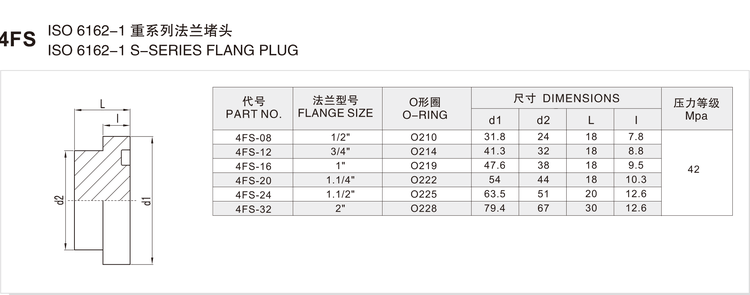
The printed catalogue gives one pressure grade for the whole 4FS series: 42 Mpa, printed as a single merged cell covering all six flange sizes. That is a series-level figure taken from the catalogue table, not a per-size rating, and it is the number to quote when the published grade of this plug is required.
Working pressure for a specific order is confirmed per order by HENGHUA engineering, based on the flange size, the bolt grade and tightening practice of the mating port, the selected body material and the selected O-ring compound. Size, head and wall thickness, sealing method and material combination all govern the result.
Temperature range follows the O-ring compound, as a material fact: NBR approximately -30°C to +100°C, FKM approximately -20°C to +200°C, and EPDM approximately -40°C to +120°C. Carbon steel with zinc plating suits general hydraulic service, while 304 and 316 stainless steel are selected for corrosive environments. Select the compound against the fluid and the temperature of the circuit, not against the pressure grade alone.
2.5 Part Number and Dimension Table
| PART NO. | FLANGE SIZE | O-RING | d1 | d2 | L | l | Mpa |
|---|---|---|---|---|---|---|---|
| 4FS-08 | 1/2″ | O210 | 31.8 | 24 | 18 | 7.8 | 42 |
| 4FS-12 | 3/4″ | O214 | 41.3 | 32 | 18 | 8.8 | – |
| 4FS-16 | 1″ | O219 | 47.6 | 38 | 18 | 9.5 | – |
| 4FS-20 | 1.1/4″ | O222 | 54 | 44 | 18 | 10.3 | – |
| 4FS-24 | 1.1/2″ | O225 | 63.5 | 51 | 20 | 12.6 | – |
| 4FS-32 | 2″ | O228 | 79.4 | 67 | 30 | 12.6 | – |
What each column means:
- PART NO. – the HENGHUA catalogue number of the plug. The series code
4FSis followed by the two-digit flange size code. - FLANGE SIZE – the nominal four-bolt flange size of the mating ISO 6162-2 S series port, from 1/2″ to 2″.
- O-RING – the O-ring callout used in the flange face groove of that size, from O210 for the 1/2″ size to O228 for the 2″ size.
- d1 – the printed diameter of the bolted flange head in mm, the dimension that has to match the port face and the bolt pattern.
- d2 – the printed diameter of the plain spigot behind the head in mm, which centres the plug in the port bore.
- L – the overall length of the plug from the flange face to the end of the spigot, in mm.
- l – the flange thickness of the head, in mm, from the flange face to the back of the head.
- Mpa – the pressure grade printed for the series. In the printed catalogue this is a single vertically merged cell covering all six rows, so the value 42 is printed once on the first row and marked
-on the continuation rows. It applies to the series as a whole, not to the first row alone.
Thread size and dash chart, read from the same table:
| Flange size code | Flange size | O-ring | d1 (mm) | d2 (mm) | L (mm) | l (mm) |
|---|---|---|---|---|---|---|
| -08 | 1/2″ | O210 | 31.8 | 24 | 18 | 7.8 |
| -12 | 3/4″ | O214 | 41.3 | 32 | 18 | 8.8 |
| -16 | 1″ | O219 | 47.6 | 38 | 18 | 9.5 |
| -20 | 1.1/4″ | O222 | 54 | 44 | 18 | 10.3 |
| -24 | 1.1/2″ | O225 | 63.5 | 51 | 20 | 12.6 |
| -32 | 2″ | O228 | 79.4 | 67 | 30 | 12.6 |
The size steps move in four-bolt flange increments, not in tube or hose dash increments, so always order by the flange size code of the port.
3. How to Read a 4FS Part Number
The part number is short because the plug has only one variable interface. 4FS-24 decodes as follows.
4FS is the series code. In the HENGHUA American Adapters numbering the leading digit identifies the plug family, the letter F identifies the flange interface and the letter S identifies the high-pressure S series (code 62) flange pattern. The L series (code 61) equivalent uses a different letter, so the two are never confused on a picking list.
24 is the size code, and it is the flange size code of the mating port, not a hose dash size. 24 means the 1.1/2″ four-bolt flange size. Reading that row in the table above returns the full specification of a 4FS adapter: flange size 1.1/2″, O-ring O225, head diameter d1 63.5 mm, spigot diameter d2 51 mm, overall length L 20 mm, flange thickness l 12.6 mm, and the series pressure grade of 42 Mpa.
If a size is not in the table, quote the flange size of the port plus the flange pattern, S series (code 62) or L series (code 61), and HENGHUA will confirm whether it can be machined to drawing.
4. Installation and Fitment
Torque practice for a four-bolt flange joint is a staged process rather than a single figure. Bring the four bolts up snug by hand in a cross pattern, then tighten in stages, still in a cross pattern, so the flange is drawn down evenly and the O-ring is compressed uniformly. The final figure depends on the bolt size and grade of the mating port, so it comes from the port or machine specification rather than from the plug size.
The O-ring is the sealing element and is treated as a single-use part. Fit a new O-ring at every assembly, check the groove for nicks, and lubricate the ring with a compatible fluid before the plug goes on. A ring that has been reused, cut during assembly or exposed to the wrong fluid will weep at the flange face even when the bolts are correctly tightened.
Contamination control matters because the flange face and the O-ring groove are both sealing surfaces. Cap the port while the plug is off, keep the spigot clean, and wipe the port face before assembly. Align the plug square to the face before starting the bolts, because a head started at an angle can pinch the O-ring on one side.
Assembly steps:
- Confirm the flange size code and the flange pattern of the port against the part number, S series (code 62) for this series.
- Clean the port face, the bolt holes and the O-ring groove, and inspect the spigot for damage.
- Fit a new O-ring of the specified callout and compound, lubricated with a compatible fluid.
- Offer the plug up square to the port face and start all four bolts by hand.
- Tighten the bolts in stages in a cross pattern until the flange is evenly seated, using the figure specified for the port.
- Wipe the joint, pressurise the circuit and check the flange face for weepage before returning the machine to service.
Common fitment errors and their symptoms:
- L series (code 61) plug offered to an S series (code 62) port. The head cannot seat and the bolts cannot draw the joint down.
- Missing or reused O-ring. Fluid appears at the flange face on pressurisation, or after the first thermal cycle.
- Uneven bolt tightening. One side of the flange lifts, the O-ring loses compression there and the joint weeps.
- Damaged sealing face or nicked O-ring. A steady drip that does not change with bolt torque.
- Size code taken from the hose size instead of the flange size. The head diameter does not match the port recess and the bolt holes do not line up.
- Thread sealant applied to the joint. There is no thread here, so sealant cannot help and loose sealant can enter the circuit.
Reuse policy: the body of a 4FS adapter may be cleaned and reused if the flange face, the groove and the spigot are undamaged. The O-ring is replaced at every assembly.
5. Applications and Industries
Application tags for the 4FS series: hydraulic systems, water jetting, oil and gas, industrial equipment, construction machinery, agriculture, marine and material handling.
Concrete scenarios where this hydraulic adapter manufacturer’s part is specified:
- Blanking reserved ports on a manifold. A manifold is often machined with more flange ports than the first build needs, so the plug closes the spare ports for commissioning, testing and shipping, and they can be opened later when the optional function is added.
- Repair and replacement. When a flange joint is removed for service, the port is capped so the rest of the circuit can still run without leaking at the open port.
- High-pressure test benches. Branches are opened and closed often on a bench, and a bolted plug is quick to fit and remove and seals on a face and an O-ring rather than on a taper thread, which keeps the port face in good condition for the next connection.
- OEM assembly lines and machine transport. Open flange ports are plugged for transport so the port faces stay protected until the machine reaches the customer.
- Storage and lay-up. Offshore and marine equipment that stands idle between campaigns is closed up to keep salt air and wash-down water out of the system.
6. Replacement and Cross-Reference Guide
Cross-reference for this hydraulic plug adapter is organised by standard, flange pattern and sealing method, never by brand. The questions to answer are which four-bolt flange standard the port follows, whether it is the L series (code 61) or the S series (code 62) pattern, and which head diameter and O-ring groove that pattern requires.
Measure these three things before ordering a replacement 4FS adapter:
- The flange size and the bolt pattern. Measure the bolt hole centre distance and the bolt hole diameter, count the bolts, then measure across the round part of the head for d1 and compare it with the table row.
- The spigot and the flange thickness. Measure the spigot diameter d2 and the flange thickness l. These separate a genuine S series head from a similar L series head, because the two patterns differ in head and flange thickness.
- The seal. Identify the groove position and the O-ring callout fitted in it, and confirm the compound suits the fluid and the temperature of the circuit.
A practical sequence: read the port marking or the machine drawing to establish the standard and the pattern, confirm the size code from the bolt pattern, confirm the head diameter with a caliper, then order by flange size code plus the series code. The 4FS series is the S series (code 62) part of the flange adapter and flange plug family in this range, and its L series counterpart is a separate series, because the two patterns are not interchangeable at the same nominal size.
7. Ordering, Packaging and Delivery
To order a 4FS adapter, give the series code, the full part number, the flange size, the O-ring callout, the seal material, the plating and the quantity. A complete line reads, for example: 4FS-24, 1.1/2″ flange size, O225 O-ring, FKM, carbon steel with trivalent chromium zinc plating, quantity 50 pieces.
Where the order is for a variant outside the printed table, send the flange pattern, the size, the required body material and a drawing reference if one exists, and HENGHUA will confirm feasibility before the line is accepted. Working with a hydraulic adapter manufacturer that machines to drawing keeps a special size traceable from quotation to packing.
Packaging is arranged to suit the route the parts take: bulk cartons with part number labels for distributor stock, and labelled bags or boxed kits for direct-to-line OEM delivery. Each carton carries the part number, the size code, the quantity and the batch reference, and the label format can follow customer numbering on request. Samples for validation are available so the fit on the port face can be proven before a production order, and lead time is confirmed per order, because it depends on the size code, the body material, the plating, the O-ring compound and whether the line is a catalogue size or a special.
8. FAQ
What is the difference between JIC 37° flare and ORFS, and which should I use?
A JIC 37° flare per SAE J514 seals metal to metal on a conical flare face, with a nut drawing the flare into the cone. An ORFS joint per SAE J1453 seals on a flat face against an elastomeric O-ring set in a groove. Match the fitting to the port: a 37° flare port takes a 37° flare fitting, an ORFS port takes an ORFS fitting. Neither applies to this flange plug, which seals with an O-ring on a bolted flange face.
Can NPT and BSPT be interchanged?
No. NPT is the general purpose taper pipe thread of ANSI/ASME B1.20.1, with the dryseal NPTF form covered by SAE J476, while BSPT is the taper pipe thread of ISO 7-1. Both are taper threads and both look similar, but the thread form and the pitch differ, so a mixed joint either stops before it seats or bears on the wrong flanks and leaks. This series has no thread at all, so the rule applies to the ports and lines around it.
How do I identify the correct 4FS size?
Identify the flange size of the port first, using the bolt pattern and the head recess, then read the size code from the table and confirm the head diameter d1 and the O-ring callout against that row. Do not select the size from the hose size on the other side of the system, because the two use different size steps.
What seal material should I select for my fluid and temperature?
Use NBR for general mineral hydraulic oil at moderate temperature, FKM where temperature or fluid chemistry calls for it, and EPDM where the fluid is not compatible with NBR or FKM. As material facts, NBR is rated approximately -30°C to +100°C, FKM approximately -20°C to +200°C, and EPDM approximately -40°C to +120°C. Confirm the compound against the actual fluid, not only the fluid family name.
How is the working pressure of this adapter determined?
The printed catalogue gives one series grade, 42 Mpa, shown as a merged cell across all six sizes, and the working pressure of this plug is confirmed per order by HENGHUA engineering. The governing factors are the flange size, the head and wall thickness, the bolt grade and tightening practice of the mating port, the body material and the O-ring compound. No single figure applies to every combination of size, material and fluid.
What is the minimum order quantity and can I get samples?
Minimum order quantity is confirmed per order, because it depends on the size code, the material and whether the line is a catalogue size or a special. Samples are available for validation so a buyer can check the fit and the sealing face before committing to a production quantity. Send the part number, the flange size and the intended fluid, and HENGHUA will quote the sample line and the production line together.
Does a 4FS flange plug have a thread anywhere in the joint?
No. The connection is bolted, not threaded. Four bolts pass through the flange into the port and clamp the plug to the face, and the seal is the O-ring in the flange groove. Thread sealant, thread tape and torque figures borrowed from taper-thread practice therefore do not apply to this series.
Can a 4FS plug be used on a code 61 flange port?
No. ISO 6162-1 covers the L series (code 61) connection and ISO 6162-2 covers the S series (code 62) connection, and the two patterns differ in head and flange dimensions at the same nominal size. The 4FS adapter is built to the S series pattern and must be used on an S series port; order the L series plug for a code 61 port.
HENGHUA is a hydraulic adapter manufacturer serving OEMs, distributors and maintenance organisations, and the 4FS adapter is available in six flange sizes with carbon steel or stainless steel bodies and NBR, FKM or EPDM O-rings. Send the flange size, the port pattern and the circuit fluid, and HENGHUA will confirm the part number, the seal material and the delivery schedule for your inquiry.
Related series in the same family: the 4FL adapter (flange) and the 4J adapter (plug). Browse the full Hydraulic Adapters range for the complete SAE J514 JIC, NPT, ORFS and ISO 6162 flange families.



 English
  Spanish
  Portuguese
  French
  German
  Arabic
  Russian