
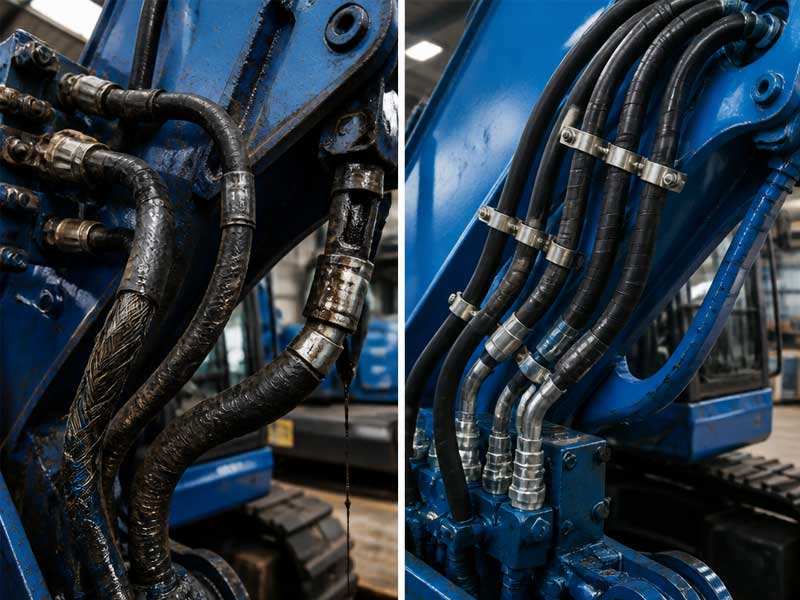
Why Does Improper Hydraulic Hose Routing Cause Failure?
Improper hydraulic hose routing causes failure by creating excessive mechanical stress, including bending fatigue, torsion, abrasion, heat damage, and fitting stress. The most common failures are hose cover wear, reinforcement damage, leakage, and hydraulic hose burst.
| Hydraulic Hose Routing Error | Why It Fails | Failure Result | Prevention |
|---|---|---|---|
| Sharp bending | Reinforcement fatigue and tube stress | Burst or leakage | Maintain minimum bend radius |
| Twisting | Reinforcement misalignment | Reduced pressure capability | Install without torsion |
| Abrasion | Cover wear exposes reinforcement | Burst failure | Use clamps and abrasion sleeves |
| Incorrect length | Excess tension or hose movement | Crimp leakage | Select correct assembly length |
| Heat exposure | Elastomer degradation | Cracking and hardening | Add heat protection |
Improper hydraulic hose routing is one of the most frequently reported causes of premature hydraulic hose failure, especially on mobile equipment where vibration and movement are common. Hydraulic hoses fail faster when they are twisted, bent below the minimum bend radius, exposed to abrasion, or installed under tension. For hydraulic equipment manufacturers, maintenance engineers, and operators, correct hose routing can extend service life, reduce downtime, and prevent dangerous burst failures.
This guide explains why hydraulic hose routing mistakes happen, how each mistake damages the hose assembly, the best practices used by professional hydraulic engineers to prevent failure, and what to look for when selecting a hydraulic hose assembly manufacturer.
1. What Is Improper Hydraulic Hose Routing?
Improper hydraulic hose routing refers to the installation of hydraulic hoses in a way that creates mechanical stress, friction, or excessive heat during operation. Common routing errors include sharp bending, twisting, inadequate clamping, insufficient length, and routing hoses near heat sources or moving parts.
Why Correct Routing Matters for Hydraulic Systems
Hydraulic hose assemblies are engineered to contain high-pressure fluid while accommodating machine movement. However, hoses are not designed to withstand:
- Twisting – misaligns reinforcement strands and reduces pressure capacity
- Sharp bending – exceeds the minimum bend radius and fatigues the reinforcement
- Abrasion – wears through the protective cover and exposes reinforcement
- Tension – puts constant stress on the fitting connection and reinforcement
Each of these routing errors creates distinct failure mechanisms. Severe routing errors can shorten hydraulic hose service life by more than 80% under extreme operating conditions.
2. Why Does Improper Routing Cause Hydraulic Hose Failure?
The root cause of routing-related failure is mechanical stress. Hydraulic hoses are designed to handle internal pressure, but they are not designed to handle external mechanical forces like twisting, sharp bending, or constant friction.
The Mechanical Stress Chain Reaction
A hydraulic hose consists of three layers:
- Inner tube – carries the hydraulic fluid
- Reinforcement layer – typically steel wire or textile braids that bear pressure loads
- Outer cover – protects against environmental and mechanical damage
When routing is incorrect, the reinforcement layer and tube wall are subjected to forces they were never designed to handle, creating fatigue that accumulates with each pressure cycle.
Why Routing Is Often Overlooked
System designers frequently treat hoses as an afterthought, focusing primarily on circuit design and component selection. However, field data consistently shows that improper routing – not component defects – is the leading contributor to hose failure in mobile and industrial equipment. Even the highest-quality assemblies will fail prematurely without proper routing.
3. Hydraulic Hose Failure After Installation: The 5 Main Causes
When hydraulic hoses fail after installation, the root cause is often related to routing or assembly quality. The five most common failure causes are:
| Failure Cause | Percentage Influence | Typical Sign |
|---|---|---|
| Abrasion | Most common field failure | Exposed reinforcement, cover wear |
| Incorrect routing | Major installation-related cause | Sharp bends, twisting, unsupported loops |
| Excessive bending | Reinforcement fatigue | Cracking at bend point, hose retains bent shape |
| Wrong assembly length | Fitting leakage | Tension at crimp, hose pulled from fitting |
| Heat exposure | Elastomer aging | Hardened, brittle, or discolored cover |
Why Hydraulic Hoses Fail After Installation
Most hydraulic hose failures occur not because of material defects, but because of installation errors:
- Abrasion is the most frequent cause – hoses rub against machine surfaces or other hoses
- Bending below the minimum radius creates stress concentrations
- Twisting reduces the hose’s ability to handle pressure
- Incorrect length puts constant stress on the crimp joint
- Heat accelerates elastomer aging and reduces flexibility
4. Hydraulic Hose Routing Failure Mechanisms
4.1 How Does Excessive Bending Ruin Hydraulic System Performance?
Exceeding the minimum bend radius is one of the most common routing errors. Each hose has a specified minimum bend radius – typically 4 to 10 times the hose outer diameter, depending on construction – that must be respected during installation.
What Happens When Bend Radius Is Exceeded?
When a hydraulic hose is bent too sharply:
- Reinforcement strands on the outside of the bend are placed under tension, while those on the inside are compressed
- The inner tube wall at the bend point becomes thinner due to stretching on the outer radius and compression on the inner radius
- Flow resistance increases at the bend, generating excess heat that accelerates elastomer breakdown
How to Prevent Bend-Related Wear:
- Use angled adapters or bent tube couplings to change direction
- Reference the manufacturer’s minimum bend radius specifications
- When space is restricted, choose a hose with a tighter bend radius
- Use 90° hose ends to support the bend
4.2 How Does Hose Abrasion Cause Hydraulic System Failure?
Abrasion is one of the most frequently reported causes of hydraulic hose failure in field applications, especially on mobile equipment where vibration and movement are common.
What Is Hydraulic Hose Abrasion?
Hydraulic hose abrasion is the mechanical wearing away of the outer cover caused by friction against another surface. Even minor vibration against a metal edge will abrade the hose cover over time.
Why Does Abrasion Cause Hose Failure?
- The cover is scuffed and thinned by repeated contact
- Once the cover is worn through, the reinforcement is exposed
- The reinforcement strands are abraded or rust due to moisture
- The compromised reinforcement can no longer contain system pressure
How to Prevent Hydraulic Hose Abrasion:
- Clamp hoses securely using properly sized clamps
- Bundle hoses carefully – only bundle hoses that flex in the same direction
- Use protective sleeves or spring guards when contact is unavoidable
4.3 How Does Twisting Cause Premature Hose Failure?
Twisting is a particularly destructive routing error because it misaligns the reinforcement layers without showing visible signs on the outside of the hose.
The Twist Damage Mechanism:
- Reinforcement strands are forced into a helical pattern under load
- The effective pressure rating of the hose is significantly reduced
- The hose ends experience concentrated stress at the fitting connection
<figure> <img src="”/images/twisted-hydraulic-hose-installation-error.jpg”" alt="”Twisted" hydraulic hose caused by incorrect installation routing” width="”800″" height="”450″"> <figcaption>Twisted hydraulic hose installation – the spiral pattern in the cover indicates a twist that misaligns the reinforcement.</figcaption> </figure>
Identifying and Avoiding Twist:
- Check for twist before pressurizing – look for rotation or spiral marks
- Bend in one plane only – break compound bends into multiple sections
- Use swivel joints for applications requiring rotation
4.4 What Role Does Hose Length Play in Hydraulic System Wear?
Both excessively long and excessively short hoses create conditions that accelerate wear.
Short Hoses – installed under tension, stressing the crimp joint
Long Hoses – create loops that rub against surfaces, causing abrasion
Calculating Correct Length:
Hydraulic hose can elongate up to 2% or contract up to 4% under pressure. Add 2-5% slack beyond the measured distance between ports at the most demanding position.
4.5 How Does Heat Exposure Damage Hydraulic Hoses?
Excessive heat – from routing near engines, exhaust, or hydraulic pumps – hardens the elastomer compounds in the hose tube and cover. Heat-damaged hoses become brittle and crack under pressure cycling.
Prevention: Use thermal shielding or reroute hoses away from heat sources.
5. Correct vs Incorrect Hydraulic Hose Routing Diagram
A correct hydraulic hose routing design should:
- ✓ Maintain minimum bend radius throughout the run
- ✓ Avoid twisting – fittings should align naturally
- ✓ Prevent hose-to-hose contact and abrasion
- ✓ Allow machine movement without tension or slack loops
- ✓ Keep clearance from heat sources and moving parts
An incorrect routing design typically shows:
- ✘ Tight bends that exceed the minimum bend radius
- ✘ Unsupported loops that vibrate and abrade
- ✘ Hoses rubbing against metal edges or other hoses
- ✘ Twisted fittings that indicate torsion in the assembly
- ✘ Excessive tension or compression at the connection points
6. 10 Hydraulic Hose Routing Best Practices Engineers Follow
Following established routing guidelines significantly extends hydraulic hose service life and reduces system downtime.
| Rule | Why It Matters | Implementation |
|---|---|---|
| 1. Respect minimum bend radius | Prevents reinforcement fatigue | Use adapters; consult manufacturer specs |
| 2. Avoid twisting | Prevents pressure rating reduction | Route in one plane; check before pressurizing |
| 3. Protect from abrasion | Most common failure cause | Use clamps, sleeves, or eliminate contact |
| 4. Specify correct length | Prevents tension and slack | Add 2-5% slack; allow for 2% elongation |
| 5. Keep hoses away from heat | Heat hardens elastomers | Use shielding or reroute |
| 6. Clamp hoses securely | Reduces vibration and abrasion | Use properly sized clamps |
| 7. Use adapters to change direction | Reduces sharp bends | Prefer straight adapter + bent tube |
| 8. Route parallel to machine contours | Minimizes bends | Coordinate with other systems |
| 9. Bundle hoses carefully | Prevents chafing | Only bundle hoses that flex in same direction |
| 10. Plan for movement | Prevents S-bends | Route through pivot points like a hinge |
7. Hydraulic Hose Inspection Checklist
A hydraulic hose is routed incorrectly when it shows any of these signs:
- Twisting or spiral markings on the cover
- Abrasion marks or flat spots on the cover surface
- Sharp bends that create kinking or flattening
- Unsupported loops hanging between connection points
- Tension at the fittings – the hose appears “stretched”
- Cover is cracked, checked, or hardened near bend points
- The hose retains a bent shape after removal
Recommended Inspection Frequency
| Equipment Type | Inspection Interval |
|---|---|
| Heavy-use equipment | Every 500 operating hours or quarterly |
| Light-use equipment | Every 1,000 operating hours or semi-annually |
| Safety-critical applications | Daily visual checks before start-up |
8. Real Hydraulic Hose Failure Examples
Example 1 – Excavator Boom Hose
In one excavator boom application reviewed by our engineering team, the customer reported repeated hose failures every 200–300 operating hours. The original routing had the boom hose contacting the boom structure during articulation, with no abrasion sleeve installed.
Correction applied:
- Added protective sleeve at the contact point
- Changed clamp position to hold the hose away from the boom structure
- Increased bend radius at the upper fitting connection
Result: Hose replacement frequency was reduced significantly, and operating costs decreased.
Example 2 – Injection Molding Machine
A manufacturing plant experienced fitting-end leakage on hydraulic hoses connected to an injection molding machine. The root cause was insufficient bend radius near the fitting – the hose was routed around a machine frame corner without an adapter.
Correction applied:
- Replaced the standard fitting with a 90° bent tube adapter
- Adjusted the routing to maintain a smooth radius
Result: Fitting-end leakage was eliminated.
Example 3 – Mining Haul Truck
A mining operation reported hose failure in bundled lines on a haul truck. Hose-to-hose rubbing had worn through the covers of multiple assemblies, causing downtime and fluid loss.
Correction applied:
- Installed hose dividers between bundles
- Added abrasion sleeves at contact points
- Re-routed lines to reduce bundle density
Result: Hose bundle failure rate was significantly reduced.
9. Cost Impact of Improper Hydraulic Hose Routing
Improper routing increases maintenance costs through:
| Cost Factor | Impact |
|---|---|
| Frequent hose replacement | Direct material cost |
| Hydraulic oil leakage | Fluid replacement + disposal |
| Equipment downtime | Lost production |
| Emergency repairs | Labor overtime + expedited shipping |
| Safety incidents | Potential injury + regulatory fines |
A correctly routed hose assembly often lasts significantly longer than an incorrectly installed assembly under the same operating conditions. The incremental cost of proper routing – clamps, sleeves, adapters – is minimal compared to the cost of repeated failures.
10. Hydraulic Hose Assembly Quality Standards
Proper routing can prevent many failures, but hose assembly quality determines the remaining safety margin. A high-quality hydraulic hose assembly should include:
- Correct hose and fitting compatibility
- Accurate crimp dimensions
- Pressure testing before shipment
- Clean assembly process
- Traceable production records
Even with perfect routing, a poorly manufactured hose assembly will fail prematurely. The crimp joint is particularly critical – an over-crimped fitting can cut into the reinforcement, while an under-crimped fitting can blow off under pressure.
HENGHUA Manufacturing Quality Control Process
Every HENGHUA hydraulic hose assembly follows a controlled manufacturing process:
- Hose and fitting compatibility verification – matched component systems
- Precision cutting – clean, square ends
- Professional skiving – when required for certain fitting types
- Controlled crimping – dimensions verified with gauges
- Pressure testing – every assembly tested before shipment
- Final inspection – visual and dimensional check
- Production traceability – batch records for quality assurance
This process reduces assembly-related failures and improves field reliability.
11. Hydraulic Hose Impulse Testing & SAE/ISO Standards
Pulse cycle testing (also called impulse testing) is the industry standard for validating hose assembly durability. At HENGHUA, we conduct extended pulse cycle testing beyond minimum production verification requirements.
What Is Hydraulic Hose Impulse Testing?
Impulse testing subjects hose assemblies to repeated pressure cycles that simulate real-world operating conditions. A sample assembly is pressurized to working pressure (often with pressure spikes beyond working pressure) and cycled until failure occurs.
Hydraulic Hose Impulse Testing Standards
| Standard | Purpose |
|---|---|
| SAE J343 | Hydraulic hose test methods |
| ISO 6803 | Rubber hose impulse testing |
| ISO 18752 | Hydraulic hose performance requirements |
HENGHUA Internal Pulse Testing Example
| Test Parameter | Value |
|---|---|
| Hose Type | SAE 100R2AT (steel wire braid) |
| Test Pressure | 3,000 PSI (working pressure) |
| Spike Pressure | 4,500 PSI (1.5x working) |
| Temperature | 100°C (212°F) |
| Cycle Frequency | 30 cycles per minute |
| Cycles Achieved | 1,000,000 cycles before failure |
Test results are based on internal testing conditions and specific hose assembly configurations. Actual service life depends on operating pressure, temperature, environment, routing, and maintenance practices.
Why Extended Cycle Testing Matters
Hose assemblies that pass extended pulse testing at the factory have greater margin to withstand the additional stresses of field routing:
- The crimp joint remains secure, preventing leaks at the fitting connection
- The reinforcement layers maintain integrity under cyclic pressure
- The tube resists erosion and cracking from high-velocity flow
12. Minimum Bend Radius Guide for Hydraulic Hoses
The minimum bend radius varies by hose construction and manufacturer specification. Many hydraulic hoses fall within approximately 4 to 10 times the outside diameter.
Common Minimum Bend Radius Values by Hose Type
| Hose Type | Typical Minimum Bend Radius |
|---|---|
| Textile braid (low pressure) | 4x OD |
| Steel wire braid (SAE 100R1/100R2) | 5-8x OD |
| Spiral wire (high pressure, SAE 100R9/100R12) | 6-10x OD |
| Thermoplastic (compact construction) | 3-5x OD |
Always refer to the manufacturer’s published specifications – bend radius depends on construction, reinforcement type, and pressure rating.
13. Why Global OEM Customers Choose HENGHUA
HENGHUA brings over two decades of hydraulic component manufacturing experience to every hose assembly we produce. Our commitment to quality – combined with rigorous pulse cycle testing – ensures our products deliver reliability even in challenging routing conditions.
Our Engineering Advantage
- Extended Pulse Testing: Our internal test program routinely achieves 1,000,000 cycles before failure
- Premium Materials: Wire reinforcement and elastomer compounds from qualified suppliers
- Precision Crimping: Tight tolerances to ensure fitting connection integrity
- 100% Pressure Testing: Every assembly verified before shipment
Our Product Range
- Working pressures up to 4,000 PSI (higher upon request)
- Sizes from ¼” to 2″ I.D.
- Multiple fitting configurations (straight, 45°, 90°, bent tube)
- Abrasion-resistant and heat-shield cover options
OEM and Bulk Supply Capabilities
HENGHUA supports OEM customers with:
- Custom hose lengths – manufactured to your exact specifications
- Fitting configurations – choose from standard or custom options
- Private labeling – your branding on our quality assemblies
- Inspection reports – documentation for quality assurance
- Production traceability – batch records for every assembly
- Bulk production – consistent quality at scale
- Export experience – reliable shipping for global customers
Why Customers Choose HENGHUA
- Application Engineering Support for your specific requirements
- Custom Lengths manufactured to exact specifications
- Fast Turnaround for standard and custom orders
Explore our capabilities:
- SAE 100R2 steel wire braided hydraulic hose
- Custom hydraulic hose assemblies
- Hydraulic hose impulse testing per SAE standards
- Hydraulic fittings and adapters
14. Frequently Asked Questions
Q: What is the most common cause of hydraulic hose failure?
A: Abrasion is one of the most common causes of hydraulic hose failure in field applications. Incorrect routing, lack of clamping, and hose-to-surface contact allow the outer cover to wear through and expose reinforcement layers.
Q: How should hydraulic hoses be routed on excavators?
A: Route hoses parallel to the boom and arm contours. Use clamps to prevent movement, maintain minimum bend radius at pivot points, add abrasion sleeves at contact areas, and allow enough slack for articulation.
Q: Can hydraulic hose routing affect machine downtime?
A: Yes. Incorrect routing leads to premature hose failure, which causes unplanned downtime for repairs. Proper routing reduces failure frequency and improves equipment availability.
Q: What is the correct distance between hydraulic hoses and heat sources?
A: Maintain at least 4 inches (100 mm) of clearance from heat sources such as engine manifolds and exhaust systems. Use heat shields or reroute hoses if clearance is insufficient.
Q: How do you select the right hydraulic hose assembly?
A: Select based on operating pressure, temperature range, hose size, fitting type, bend radius requirements, abrasion environment, and routing constraints. Consult your manufacturer’s application engineering team for guidance.
Q: What causes hydraulic hose failure near fittings?
A: Fitting-end failures are often caused by routing errors that create tension or torsion at the crimp joint. Common causes include insufficient hose length, improper installation angle, and twisting that transfers torque to the fitting connection.
Q: Can hydraulic hose routing affect pressure rating?
A: Yes. Twisting misaligns the reinforcement strands, reducing the hose’s ability to contain internal pressure. Sharp bending also creates stress concentrations that can lower effective pressure capacity.
Q: How do you prevent hydraulic hose vibration failure?
A: Secure hoses with properly spaced clamps to reduce vibration amplitude. Use protective sleeving where hoses pass through bulkheads. Avoid long, unsupported spans.
Q: Should hydraulic hoses touch each other?
A: No. Hoses that rub against each other will eventually wear through their covers. Separate hoses with dividers or route them with adequate clearance between lines.
Q: What is the correct hydraulic hose installation method?
A: The correct method includes: verifying minimum bend radius, eliminating twist, securing with clamps, providing adequate length, protecting from abrasion and heat, and pressure-testing before commissioning.
Q: How often should hydraulic hoses be replaced?
A: There is no universal replacement interval – it depends on operating conditions, pressure, temperature, and equipment use. Replace hoses when visual inspection shows cover damage, cracking, or hardening, or according to your preventive maintenance schedule (typically 12-24 months for critical applications).
Q: Can hydraulic hose bend radius be reduced with special hoses?
A: Yes. Some hoses are designed with tighter bend radii – thermoplastic hoses and certain spiral-wound constructions can bend more tightly than standard wire braid hoses. Always check the manufacturer’s specifications.
Q: What is hydraulic hose impulse testing?
A: Impulse testing subjects hose assemblies to repeated pressure cycles to verify durability. It is required for SAE and ISO certifications and is used by quality manufacturers to validate assembly performance.
Q: What are the SAE and ISO standards for hydraulic hose testing?
A: Key standards include SAE J343 for hydraulic hose test methods, ISO 6803 for rubber hose impulse testing, and ISO 18752 for hydraulic hose performance requirements.
Improper hydraulic hose routing ruins hydraulic systems by introducing mechanical stress, abrasion, and heat that accelerate wear far beyond normal service limits. The damage mechanisms are well understood: bending too tightly fatigues reinforcement; twisting reduces pressure capacity; and abrasion compromises the cover, leading to exposed reinforcement and eventual burst.
By following established routing practices – respecting minimum bend radius, avoiding twist, using clamps and protective sleeves, and ensuring correct hose length – system designers and maintenance professionals can dramatically extend hose life and improve equipment uptime.
However, even the best routing cannot compensate for substandard hose assembly quality. HENGHUA’s extended pulse cycle testing to 1,000,000 cycles validates the durability of our assemblies and provides the data customers need to make informed purchasing decisions. When you choose HENGHUA, you receive hose assemblies engineered to perform reliably – even when routing conditions are far from ideal.
Need help selecting the right hydraulic hose assembly?
Send us your operating pressure, hose size, temperature range, and routing conditions. Our engineers can recommend the correct hose construction, fitting configuration, and protection method for your application.

 English
  Spanish
  Portuguese
  French
  German