
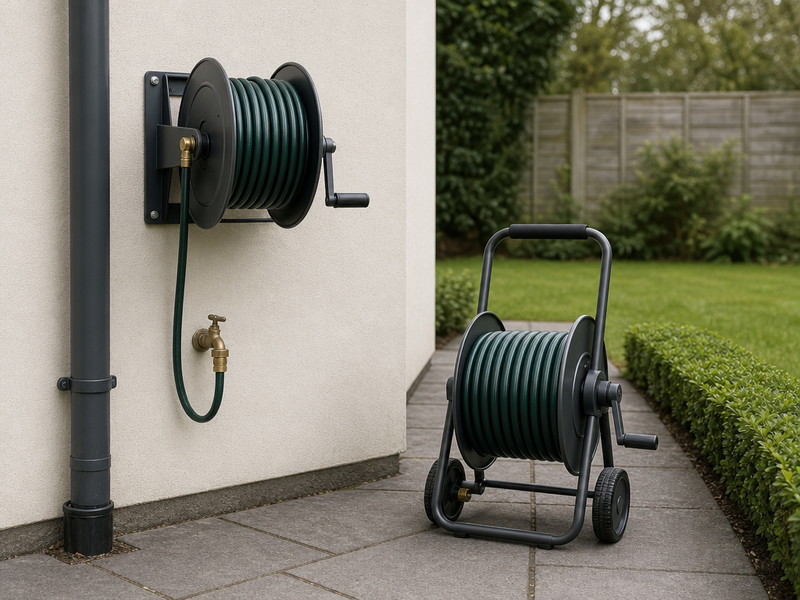
Wall mount or portable? Neither type wins outright: a wall mount hose reel wins where the tap or spigot, the layout and the wall all line up, and a portable reel wins where they do not. Reach geometry decides most of the question, the substrate decides whether a fixed mount is even possible, and the way you move around the garden decides the rest. This article works through the distance arithmetic first, then the load a bracket places on a wall. It covers post and ground alternatives, moving a reel between zones, frost and storage, and a decision sequence that ends in a clear recommendation per yard layout.
1. Why Does Reach Decide the Wall Mount Hose Reel Question First?
Reach is a distance problem, not a preference. A fixed drum (the wall mount hose reel type) pays hose out from one point, so the farthest plant you can water sits within one hose length of that point, measured along the path the hose follows. A reel that travels can be parked nearer the work, which shortens the hose needed and lengthens the ground covered. Before comparing brackets, posts and carts, measure the two distances that settle the argument: the path from the tap to the farthest bed, and the path from your best parking position to that same bed.
Reach arithmetic for a stated example layout, calculated from two stated offsets
| Reading | Example value | What it tells you |
|---|---|---|
| Straight line from tap to far corner | 10.8 m, calculated from stated 9 m and 6 m offsets | A lower bound only; a hose cannot run through a planting bed |
| Path length along the wall, then across the lawn | 15 m | The length the hose must actually cover |
| Hose needed on a fixed drum | 20 m, calculated | Covers the 15 m path plus working slack at the nozzle |
| Hose needed on a reel parked 3 m from the bed head | 12 m, calculated | The same bed is reached with less hose, because the drum travels |
| Working slack at the nozzle | 3–5 m | Stops the drum pulling on the last plant you water |
What does the tap-to-bed measurement actually tell you?
It tells you the minimum hose length, and it is the number most buyers skip. A hose that reaches the far corner in a straight line is not the hose that reaches it around a wall, through a gate or past a raised bed. Measure along the route, add slack, and compare that figure with the drum capacity you can buy. If the path is longer than any drum you would accept, the mount type is no longer the question.
How do you measure a path rather than a radius?
Walk the route the hose will take and pace it out, or run a tape along the wall and then across the ground. Sum the segments: the wall run, the turn, the crossing and the final approach. Two perpendicular offsets of 9 m and 6 m give a straight-line distance of 10.8 m, calculated as the square root of the sum of their squares, but the path over the same ground is 15 m. The difference of more than 4 m is the reason path length governs the purchase.
When does a fixed point become the problem?
A fixed point fails when the route from it crosses something you will not drag a hose over. A bed of seedlings, a freshly laid lawn, a driveway you keep clear, or a hedge that hides the hose all turn one fixed drum into a daily compromise. It also fails when the tap sits at the wrong end of the garden, because every job then begins with a long walk under load. Two or more zones usually mean the drum should move or the site needs a second outlet.
How much does an extra hose length cost you?
Length adds friction loss and mass, so a longer hose is not free. Friction loss rises roughly in proportion to length and with the 4.87th power of diameter, the exponent used in the Hazen-Williams relationship. Mass rises linearly: a 5/8 in EPDM hose with a 2.0 mm wall adds 135 g per meter, so 10 m adds 1.35 kg. Both figures are calculated from the stated wall thickness and an assumed compound density. Extra length is a cost, not a neutral fix for reach, and the hose size selection guide sets out how bore and length trade off against flow.
2. What Changes When the Hose Pulls Straight Instead of Sweeping?
A hose leaves a drum in a line, and that line is fixed for a wall mounted hose reel. If the drum points at open ground, the hose runs straight and you walk it out with almost no side load. If the drum points across a bed, every pull drags the hose sideways through the planting. This is a geometry effect, and it is often what makes a buyer choose a portable reel even when the wall would take a bracket.
What does a radial pull look like on the ground?
A radial pull means the hose leaves the drum and travels roughly in the direction the drum faces. The hose crosses the ground once, along a line you can choose, and the drum sees almost no side load. Set the drum to face a path, a lawn edge or a hard-standing strip and the whole run stays out of the beds. Radial pulls also rewind more easily, because the hose returns along the line it left on.

The hose leaves the drum in the direction the drum faces, so the run stays on the paving.
What does a sweeping pull cost you?
A sweeping pull drags the hose across whatever lies between the drum and the work. The consequences are practical: flattened plants, a hose that cuts into soft ground, and a drum that collects the lateral load every time you pull. The hose also kinks more readily when it is dragged sideways across a bed edge, and a kinked hose at the drum face is the most common reason a coil rewinds badly.
Can you correct the pull direction after mounting?
Sometimes, and cheaply. A bracket that turns on a pivot or a drum that rotates on a housing lets the hose leave at a different angle, and a hose guide can re-aim the line over a short distance. What you cannot correct is a wall that faces the wrong way: a bracket on a house wall facing a terrace will always pay hose across that terrace. Where the pull direction cannot be fixed, the honest answer is a post, a stand or a reel that travels.
3. What Does a Wall Mount Hose Reel Demand From the Wall?
A fixed reel demands two things from a wall: a substrate that will hold an anchor, and fixings that will carry a load which is larger than most buyers expect. The mass of the wet hose hangs on the bracket, and the pull at the nozzle adds a lever effect that turns a modest tug into a much larger force at the upper fixing. Read the load first, then decide whether the wall in front of you is the right place to drill.
Bracket load arithmetic for a stated example, calculated from published hose data and assumed fixings
| Item | Value | Basis |
|---|---|---|
| Hose retained on the drum | 30 m of 5/8 in hose | Stated example |
| Hose mass | 135 g per meter, so 4.05 kg | EPDM, 2.0 mm wall, assumed compound density |
| Retained water | 0.198 L per meter, so 5.94 kg | 198 mm² inside area, water at 1.000 kg per liter |
| Wet hose total | 9.99 kg | Calculated sum of hose and water |
| Planning pull at the nozzle | 100 N (about 10 kgf) | Stated planning assumption |
| Offset from wall to the pull line | 0.20 m | Stated planning assumption |
| Moment at the wall | 20 N·m | Calculated as 100 N multiplied by 0.20 m |
| Vertical separation of the two main fixings | 0.20 m | Stated planning assumption |
| Tension in the upper fixing | 100 N | Calculated as 20 N·m divided by 0.20 m |

A 100 N pull 0.20 m off the wall makes a 20 N·m moment; two fixings resist it.
The drum, bracket and any housing add their own mass on top of these figures, and a lead or concrete anchor carries a manufacturer’s stated working load that you should compare against the total. Nothing in this calculation replaces the anchor maker’s data.
Substrates and what a reel fixing needs from each. Substrates not listed here require the same confirmation before an anchor is chosen.
| Substrate | What the fixing engages | Main risk | Check before drilling |
|---|---|---|---|
| Solid masonry: brick, block, concrete | The masonry unit itself | Cracking near an edge, or a fixing lost in a mortar joint | Drill the unit face where possible, and stay away from corners |
| Rendered wall (stucco or cement render) | The render only, unless the anchor is long enough to reach the structure behind | Render pulling away under load | Confirm the anchor reaches the structural layer |
| Timber frame with cladding (wood frame with siding) | The studs or the sheathing | A screw in cladding alone cannot carry the lever load | Locate the studs and fix into the frame |
| Fence post or panel | The post, if the panel is ignored | Panels are not structural and will flex | Fix to the post only, or use a ground post instead |
| Metal post or pier | The post section | Thin walls distort and the fixing loosens | Spread the load with a backing plate |
What load does a full reel place on the fixings?
On a wall mounted hose reel the static load is the wet hose plus the reel itself, and the worked example puts the wet hose alone near 10 kg of mass. Static load is not the number that matters most, because pulling the hose adds a lateral force with a lever arm. That lever arm is the distance between the wall and the line along which you pull, so a bracket with a long standoff loads its fixings harder than a flat-back bracket for the same hose.
Which substrates will hold a bracket?
Any substrate that can accept an anchor sized for the calculated load will hold it, provided the anchor reaches sound material. Solid masonry and structural timber perform predictably when the fixing is long enough. Render (stucco) and insulated render systems hold only when the anchor reaches the structure behind them. Fence panels are not structural. Where you cannot confirm what is behind the face, treat the wall as unsuitable until an anchor supplier confirms otherwise. A listing that says heavy duty means only two checkable things: an anchor class rated for the calculated load, and a drum rated for the hose you will fill.
What height and clearance should the bracket have?
Plan the mounted position around these four checks:
- Height that lets you turn the crank or pull the hose without stooping, and without lifting the coil above shoulder level.
- Clearance below the drum for the hose to fall away without rubbing the wall, which keeps the coating out of contact with rough render.
- Refuge for the leader hose where it leaves the drum, so the drum can rotate without pulling the leader taut.
- Distance from door swings, gate posts and paths, because a hose paying out across a doorway is a trip hazard every day.
How do fixings get loaded when the hose is pulled?
The load is a couple, not a straight pull. A pull applied away from the wall creates a turning force that pushes the lower fixing into the wall and pulls the upper fixing out of it. In the stated example, a 100 N pull at a 0.20 m offset produces a 20 N·m moment, which a pair of fixings 0.20 m apart must resist as a 100 N tension in the upper fixing. That is why two small screws in a single line are the wrong answer for a bracket that stands off the wall.
4. What Are the Alternatives When a Wall Is Unsuitable for a Reel?
Where the wall is unsuitable, the alternatives fall into three groups: a post that replaces the wall, a stand that replaces both the wall and the fixing, and a reel that travels. Each has a different failure mode and a different cost of installation. The three alternatives are compared before the detail, because the cheapest option and the most reliable option are rarely the same one.
Post, stand and traveling alternatives to a wall fixing
| Alternative | How it is fixed | Where it suits | Failure mode to watch |
|---|---|---|---|
| Hose reel mounting post, driven or concreted | Embedded in the ground | Bed heads and boundaries with no suitable wall | Ground that softens, so the post leans under load |
| Hose reel stand with a base plate | Ballast or ground anchors on a plate | Decks, patios and short runs | Ballast too light, so the stand walks when the hose is pulled |
| Ground stake or spike | Pushed or driven into soil | Light hoses on firm ground | Loose soil and lateral load, which bends the spike |
| Reel that travels: cart, wheeled frame or carry handle | Not fixed at all | Multiple zones and level routes | Wheels that sink, and no parking space near the work |
How does a hose reel mounting post work?
A hose reel mounting post puts the drum at the bed head, where the pull direction is radial rather than across the planting. The post is either driven into the ground and cross-braced, or set in a concrete collar and left to cure before the reel goes on. The advantage is placement: you choose the point, and it does not have to be a wall. The limitation is the ground, which must resist the same moment the wall would have resisted.
What is a hose reel stand for?
A hose reel stand is a freestanding support with a base plate, holding the drum at working height without any wall fixing. It suits decks, terraces and rented gardens where drilling is not allowed or not wanted. Ballast or ground anchors hold the base down, so the stand’s stability is a function of its base mass, not of any structure. Keep the base out of the hose’s own path, or you will pull the stand toward you.
How deep should a hose reel mounting post be set?
Depth is set by the load and by the soil, and the arithmetic gives the starting point, not the answer. A 100 N horizontal pull applied 1.2 m above ground creates a 120 N·m moment at ground level, calculated from the stated 100 N pull at 1.2 m. The soil must resist that moment through the embedded length, so a deeper embedment in soft ground is doing the same job as a shallower one in firm ground. Confirm the local guidance for post foundations before you dig.
Are ground stakes or spikes ever enough?
A spike suits a light hose on firm, well-drained ground; a heavy wet hose on soft soil needs a post or a stand. A spike relies on soil friction and on the stiffness of the spike itself, so it has no way to resist a large side load at the top. Use a spike where the pull is radial, and move to a post or a stand as soon as the hose bore or the length increases.
5. What Changes When the Reel Has to Move Between Zones?
Movement changes the arithmetic, not the hardware. A wall mount hose reel pays out from one point all season, while a reel that travels trades a fixed reach for the effort of relocating it. The real question is how often you would genuinely move it, and how much the hose weighs when it is full of water. Answer both honestly before choosing the traveling option, because a reel that never moves is just a heavy fixture with no wall.
How much does a charged hose weigh to carry?
Water is the heavy part, and it is easy to underestimate. A 5/8 in bore has an inside area of 198 mm², so every meter retains 0.198 L of water weighing 0.198 kg at a density of 1.000 kg per liter. Over 30 m that is 5.94 kg of water, plus 4.05 kg of EPDM hose at 135 g per meter for a 2.0 mm wall, both calculated from the stated values. About 10 kg of mass therefore moves with you each time.
What surface does a portable hose reel need?
Wheels need a route. A portable hose reel suits paving, decking and firm, dry turf. Gravel, loose sand, wet clay and steps need a fixed drum or a second reel. Wheel diameter matters less than load per wheel, so a heavy wet hose on small wheels digs in first. Test the route with a loaded barrow before you buy, because a route that suits a barrow will usually suit a reel.
Should you move the reel or buy a second one?
Move the reel when the zones share a tap and the route is firm ground. Keep a fixed drum and its own hose at each end when the route is poor, the distances are long, or the zones are watered on different days. The comparison is not between two reels and one reel; it is between one reel plus daily effort and two reels plus one extra connection. For most gardens with two distinct zones, one drum per zone wins.
6. How Do Frost, Sun and Storage Change the Mount Choice?
Storage is where mount type stops being neutral, because a fixed reel stays exactly where the frost can reach it. Any reel that holds water through a hard frost puts its own hose, swivel and inlet at risk, since water expands by about 9 % by volume as it turns to ice, a published property of water. Sun is the slower problem, because direct light degrades garden hose compounds over seasons, not weeks. Two habits cover both risks: a hose reel cover for light and debris, and a drain routine for water.
Does a hose reel cover stop freezing?
It does not, and it should not be bought as if it did. A cover blocks light and keeps debris out of the drum, which helps the hose, but it adds very little thermal insulation and it can hold water against the coil. Insulation slows heat loss; it does not stop water reaching 0 °C through a long cold night. If freezing matters, drain the hose and the drum, or bring the reel indoors. Treat a cover as a light and dirt measure.
What should a cover actually do?
Choose a hose reel cover against the hose’s geometry and the reel’s moving parts. It must clear the crank or handle through a full turn, clear the outlet and the nozzle, and clear the point where the leader enters the drum. It should be open enough at the base for water to leave, and it should sit loosely enough for a wet hose to dry underneath it. A cover that must be removed before you can rewind the reel will be removed and then lost. A self-winding drum adds one check: its cover must clear the return mechanism, not only the crank.
How should a reel be stored over winter?
Drain first, decouple second, store third. Disconnect the hose from the tap and from the drum, walk the water out along a slope, and coil the hose loosely for the cold months. Take the drum and any spring mechanism indoors where the maker allows it, because a spring stored under tension for a season loses more tension than one stored relaxed. A bracket can stay on the wall, since it holds no water.
7. How Does the Connection Point Differ Between Fixed and Portable?
The mechanical difference between mount types is smaller than most buyers expect, because the connection question is identical for both: does the tap use the same thread form as the reel inlet, and does anything need an adapter. This section stays with that question. Confirm the thread at the tap and the thread at the reel inlet, and the connection side of a wall mount hose reel purchase is settled.
What thread do taps and reel inlets use?
Garden hose thread, also called NH, is 3/4 in nominal with 11.5 threads per inch, straight, not tapered, and it seals on a rubber or fiber washer. Where both the tap and the reel are cut to that form, the two join with a washer and hand tightening. The 3/4 in figure is a nominal size rather than a measured diameter, and the thread is defined by its pitch and form, not by any across-flats reading.
When do you need an adapter?
You need an adapter whenever one side of the connection is not garden hose thread. Tapered pipe thread, known as NPT, is cut at a 1:16 taper and seals on the threads themselves, so it will not match a straight thread and cannot be sealed by tightening harder. An adapter or a purpose-made tap connector converts between the two. Two references cover this in full: the GHT measurement and adapter guide and the thread size chart for GHT, NPT, BSPP, BSPT and NPSH.
Does the leader hose change with the mount type?
The leader hose changes in length, not in kind. A fixed drum beside the tap needs a short leader, because the two points are close and the drum must rotate without pulling it taut. A portable reel needs a leader long enough to reach the tap from wherever the reel is parked, which is why buyers end up with a longer leader than planned. Keep the leader bore at least equal to the main hose bore, since a leader one size down is a permanent restriction.
8. Which Configuration Fits Which Yard Layout?
Layout decides whether a wall mount hose reel can do the job at all, and layout is measurable. Work through the five checks, then read your layout off the layout table. The checks remove options in order, and the table names the options that survive them for each common layout. Where a layout fits two rows, the harder route decides, because a route that fails once will fail again every week.
Work through the checks in this order:
- Measure the path from the tap to the farthest bed, and the path from your best parking position to that same bed.
- Check the pull direction from each candidate mount point, and judge whether the hose leaves radially or sweeps across planting.
- Confirm the substrate at the wall or the ground at the post position, and confirm the anchor can carry the calculated load.
- Count the zones you water and how often you would actually relocate a portable reel between them.
- Confirm the frost and storage routine you are willing to keep, then match the mount type to it.

A fixed drum on a sound wall; a mounting post at the bed head when the pull crosses a bed.
Yard layout, the configuration it points to, and the reason
| Layout | Configuration indicated | Reason |
|---|---|---|
| One tap on a sound wall, every bed within one hose length, radial pull over paving or lawn | Fixed drum on a bracket at the wall | Shortest hose, least daily effort, no relocation |
| Tap on a wall, but the pull crosses a planting bed or the bed head lies beyond one hose length | Post at the bed head, or a reel that travels | Puts the drum where the hose can leave radially |
| Two or more zones separated by a driveway, a wall or a slope | One fixed drum per zone, or a portable reel on a firm route | Removes daily relocation and shortens each run |
| Deck, terrace or rented property where drilling is not permitted | Freestanding support with ballast or ground anchors | Holds the drum at working height without a wall fixing |
| Light hose, firm ground, radial pull, seasonal use only | Ground spike or stake | The cheapest option that still resists a small side load |
| Open or wind-exposed site with a hose left out for the season | Any mount type with a base-open cover and a drain routine | Limits light and debris without trapping water |
For most gardens the fixed drum is the right answer. Where the wall is sound, the pull is radial, and every bed sits within one hose length, fit the wall mount hose reel to that wall and keep the hose short. Where any one of those three fails, stop trying to make the wall work, and put the drum where the hose needs it to be instead. The five checks and the layout table are read together, so each common layout narrows to named options. Buyers comparing those configurations can review the wall-mounted and portable reel configurations before ordering.
FAQ
Is a wall mount hose reel better than a portable one?
Neither is better in general, and one is better for a given garden. A fixed drum wins where the tap is on a sound wall, the pull is radial, and every bed sits within one hose length of that point, because it removes the effort of relocation. A reel that travels wins where a planting bed or a driveway sits between the tap and the work. Weigh reach geometry first and preference second.
How far will a wall mount hose reel reach?
A fixed drum reaches one hose length from its mounting point, measured along the path, not as a straight line. In the Section 1 example, 20 m of hose covers a 15 m path with slack to spare, while the straight-line distance over the same ground is only 10.8 m. That gap is why path measurement, not radius, decides the length you buy.
What wall can I fix a hose reel to?
Find out what the wall is made of first, because the fixing has to reach it. Tap the face and listen for a hollow ring, and check how deep an existing fixing goes. Solid masonry, brick and structural timber hold predictably. Render (stucco), insulated render and fence panels hold only when the anchor passes through to the structure behind. Treat any wall you cannot identify as unsuitable until an anchor supplier confirms otherwise.
How do I fix a bracket to a post that is already leaning?
A leaning post is judged before it is used, not after. Hold a spirit level against it and watch the gap at the top as you push the post: a post that moves out of true will keep moving once the hose load pulls on it. Where the post is suspect, set a new driven or concreted post beside it instead of loading the old one.
How do I choose a post for a hose reel?
Choose it by the load it has to resist and by the ground it stands in. A 100 N horizontal pull applied 1.2 m above ground creates a 120 N·m moment at ground level. That figure follows from the stated 100 N pull at 1.2 m, and the soil must resist it. Firm, well-drained ground supports a shorter embedment than soft clay. Confirm local guidance for post foundations before digging.
What is a hose reel stand used for?
A hose reel stand keeps a drum at working height with no wall fixing at all, which makes it the one alternative you can reposition after the fact. It suits decks, terraces and rented property where drilling is not permitted. Stability comes from base mass, and a light base lets the stand walk toward you when the hose is pulled.
Does a hose reel cover prevent freezing?
No. A cover reduces light and debris, and it adds very little insulation, so it cannot stop water in the drum reaching 0 °C through a cold night. Water expands by about 9 % by volume as it freezes, and that expansion is what splits hoses, swivels and inlet fittings. Drain the hose and the drum, or bring the unit indoors, if freezing is a real risk where you live.
How do I move a reel between zones?
Pick the route before the reel. Decks and paving roll well; loose sand, wet clay, gravel and steps are where a second reel earns its place. Drain the hose before moving it where you can. Retained water adds 0.198 kg per meter at a 5/8 in bore, calculated from the 198 mm² inside area, so a charged hose turns a simple move into a heavy lift.
Will a portable reel fit a standard tap?
It will if the inlet is cut to garden hose thread, which is 3/4 in nominal with 11.5 threads per inch and straight, not tapered. A portable hose reel made for garden taps joins the tap with a washer and hand tightening. If either the tap or the reel inlet is tapered pipe thread, you need an adapter, because a straight thread cannot be sealed by force.
Which type is easier to store for winter?
The type that is not fixed to a wall, because it can be drained and carried indoors in one move. A fixed drum can also be wintered safely: disconnect it, drain it, and leave the bracket in place, since the bracket holds no water. The risk sits with the hose and the swivel, not with the bracket, so the storage routine matters more than the mount type.
About HENGHUA
HENGHUA is a hose manufacturer supplying distributors, retailers and OEM or private-label programmes from its own production lines. The consumer range covered on this site includes garden hoses in vinyl, rubber, hybrid and reinforced multi-layer constructions, with the fittings, leaders, brackets and reels that complete a watering system. Published figures on this site use a working pressure of 150 psi and burst ratings of 400–500 psi, quoted with those conditions, not as universal limits.
The technical content here states the limits of each product type as well as its range. Where a calculation appears, it is arithmetic on stated inputs, and where a value comes from a published reference it is quoted with the condition that applies to it. No product on this site is ranked, and no test data is claimed.
Trade buyers who need a specific bore, a specific outside diameter or a particular inlet thread for a reel project can request a quotation against their own measurements. Send dimensions through the contact form. The shop lists the configurations available for direct order.






 English
  Spanish
  Portuguese
  French
  German
  Arabic
  Russian
  Indonesian
  Japanese
  Korean