
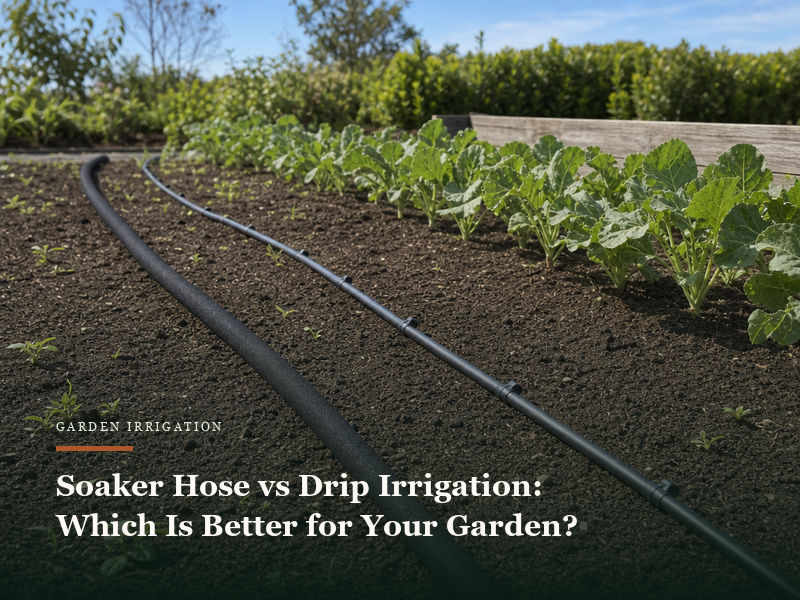
For most gardens the answer is bed by bed: a soaker hose wins on short, densely planted beds with steady pressure, and drip irrigation wins on long runs, rows, containers and variable pressure. Bed type and run length decide, and the supply pressure decides whether either system holds its uniformity. The soaker hose vs drip irrigation difference starts at the emission mechanism, and every other difference follows from it.
Each system is a mechanism, and the mechanism decides uniformity, pressure needs, filtration, clogging and winter handling. Work through those five consequences and the choice usually makes itself.
1. Soaker Hose vs Drip Irrigation: The Two Variables That Decide It
The soaker hose vs drip irrigation decision comes down to bed type and run length. Bed type decides the pattern: a continuous wetting strip suits dense planting, a metered point suits rows and containers. Run length decides uniformity: a soaker loses emission as pressure falls along the run, while compensated emitters hold theirs.
Table 1. Soaker hose and drip irrigation compared on the factors that decide the result
| Factor | Soaker hose | Drip irrigation |
|---|---|---|
| Emission | Continuous seepage along the whole length | Discrete emitters at fixed spacing |
| Uniformity | Falls as pressure falls along the run | Held near the rated value when pressure-compensating (PC) |
| Pressure needed | Low and steady | Low, but from a regulated and filtered supply |
| Filtration | Helpful; pores are fine and many | Essential; emitter passages are narrow |
| Layout | Rows, loops, dense beds | Rows, containers, trees, long runs |
| Clogging | Pores clog gradually and evenly | Single emitters clog one at a time |
| Winter | Drain and store flat | Drain, and lift the line if it lies on soil |
| Best for | Short, even, dense planting | Rows, containers and mixed beds |
Treat Table 1 as a set of trade-offs. A soaker needs no emitters, a filter or a regulator, and its tube costs less per meter. Emitter tubing costs more per meter and needs both accessories, and in exchange it holds its output steady over a longer run.
When a Soaker Hose Wins
A soaker hose wins when the bed is planted densely and the run is short. The wall wets a continuous strip of soil, so there are few dry gaps between plants. There are no emitter orifices to align with individual plants, which makes the layout quick. For a tightly planted flower border on a short run, that simplicity is the main advantage.
When Drip Irrigation Wins
Drip irrigation wins when the run is long, the planting is in rows, or the plants sit in separate containers. Pressure-compensating emitters hold their output across a range of inlet pressures, so the last plant on the run receives close to what the first one receives. Container and tree watering also favor a single emitter placed at each root zone.
2. How Each System Emits Water
In this article, drip irrigation means the emitter-based system, whether the maker calls it tubing, a line or a hose.
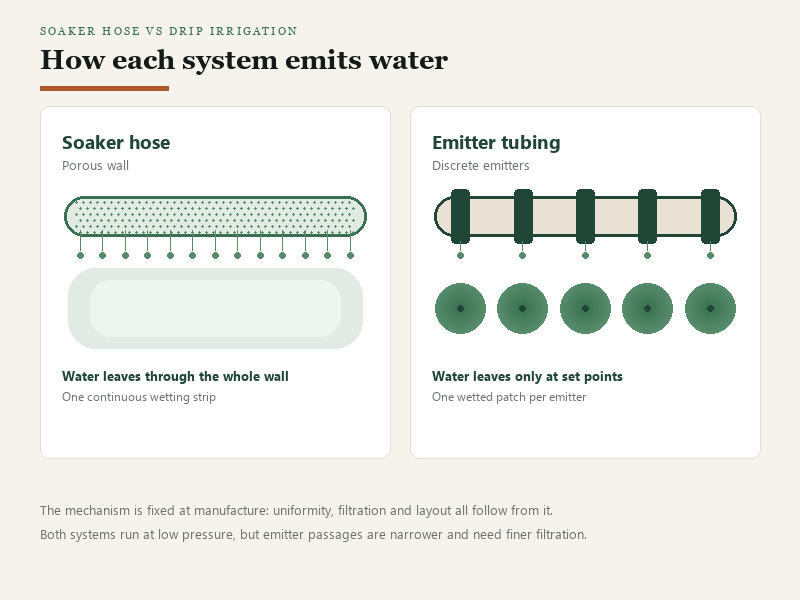
A porous wall seeps along its whole length, while emitters release water only at set points.
A soaker hose and emitter tubing differ in one respect that explains everything else: where the water leaves the tube. A soaker hose emits from the whole surface of its wall. Emitter tubing emits only from points spaced along it. The soaker hose vs drip irrigation difference is one of mechanism, and that mechanism is fixed at manufacture.
The Porous Wall of a Soaker Hose
A soaker hose is made from a porous material, often a recycled rubber or a porous plastic, that lets water seep through the wall along its entire length. Pressure inside the tube drives the water out through thousands of fine passages. Because the emission is distributed, no single point carries all the flow, which spreads the effect of any local blockage. The wider types of water hoses guide describes how porous and solid walls differ.
The Discrete Emitters of a Drip Line
A drip line carries water to emitters placed at set intervals along the tube. Each emitter is a small passage or a labyrinth that meters water to a fixed rate. In a pressure-compensating design, a flexible membrane inside each emitter adjusts the passage so the flow stays near its rated value as inlet pressure changes. That regulation is what a porous wall cannot offer.
Why the Mechanism Decides Everything Else
Uniformity, filtration and layout all follow from the emission mechanism. A porous wall tolerates a partial blockage but is sensitive to pressure loss along the run, because its output falls as internal pressure falls. A compensated emitter holds its rated flow across its stated pressure range, but one blocked emitter leaves one plant dry.
3. Distribution Uniformity and Pressure Along a Run
Uniformity is the measure that most often decides which system suits a bed. It describes how evenly water reaches the first plant compared with the last. Both systems lose pressure along a run, but they respond to that loss in very different ways.
Why Pressure Falls Along a Run
Water loses pressure to friction as it travels through a tube. The loss grows with length and with flow, and it falls sharply as the bore increases. The friction-loss diameter exponent is 4.87 under the Hazen-Williams relationship, so doubling the bore cuts friction loss by about 29 times (calculated). A larger bore therefore helps both systems, and the hose size selection guide shows the bores and their inside areas side by side.
Why a Soaker Reacts More Than Pressure-Compensating Drip
On a soaker hose, emission falls as the internal pressure falls, so the far end of a long run seeps less than the near end. The result is a wet-to-damp gradient along the bed. Pressure-compensating (PC) emitters hold their rated flow from the stated minimum pressure up to the stated maximum, so the same pressure loss changes nothing until the pressure drops below that minimum. Below that minimum, PC emitters behave like non-compensating emitters, which react to pressure much as a porous wall does.
Checking Uniformity in Your Own Bed
Measure uniformity yourself with a trowel, without instruments:
- Run the system for a fixed time.
- Push the trowel into the soil at the start, middle and end of the run.
- Compare how far the moisture reaches at each point.
- Treat a clear difference between the two ends as pressure loss, then shorten the run, widen the bore or fit compensated emitters.
The Effect of Run Length on Each System
Run length exposes the difference between a porous wall and a PC emitter more clearly than any other variable. A short run keeps internal pressure high along its whole length, so a soaker wets almost evenly from end to end. As the run lengthens, pressure at the far end drops and the soaker’s emission falls with it, so the longer run suits the compensated line.
4. Emission Arithmetic: Soaker Hose vs Drip Irrigation by the Numbers
Numbers make the soaker hose vs drip irrigation comparison concrete, but only if the inputs are stated. The rates below are the stated inputs of one worked example, not universal values. Any emission rate depends on the product, the pressure and the water temperature, so treat these figures as an illustration of the method.
Worked Example: Liters per Hour per Meter
Suppose the soaker in this example is stated by its maker at 4 liters per hour per meter (about 0.32 US gallons per hour per foot, calculated). Suppose the drip line uses emitters stated at 2 liters per hour, spaced 0.30 m apart (about 1 ft, calculated). The line then delivers 2 ÷ 0.30 = 6.7 liters per hour per meter (calculated). For the same emission as the soaker, the emitter spacing would be 2 ÷ 4 = 0.50 m (calculated).
Scaling to a Bed
Take a bed 20 m long (about 65 ft, calculated). The soaker delivers 4 × 20 = 80 liters per hour (calculated). A line with emitters every 0.30 m carries 67 emitters, or 67 × 2 = 134 liters per hour (calculated).
The bed is 1 m wide, so its area is 20 m². Applying 10 mm of water over that area needs 200 liters, because 1 mm over 1 m² is 1 liter (calculated). That takes 200 ÷ 80 = 2.5 hours on the soaker and 200 ÷ 134 = 1.5 hours on the tubing (calculated).
Table 2. Emission arithmetic for a 20 m bed, from the stated inputs above (calculated)
| Item | Stated input | Result |
|---|---|---|
| Soaker emission | 4 liters per hour per meter | 80 liters per hour over 20 m |
| Emitter rate and spacing | 2 liters per hour at 0.30 m | 6.7 liters per hour per meter |
| Equivalent emitter spacing | Matching 4 liters per hour per meter | 0.50 m |
| Water for 10 mm depth | 20 m² bed area | 200 liters |
| Run time, soaker | 200 liters at 80 liters per hour | 2.5 hours |
| Run time, drip | 200 liters at 134 liters per hour | 1.5 hours |
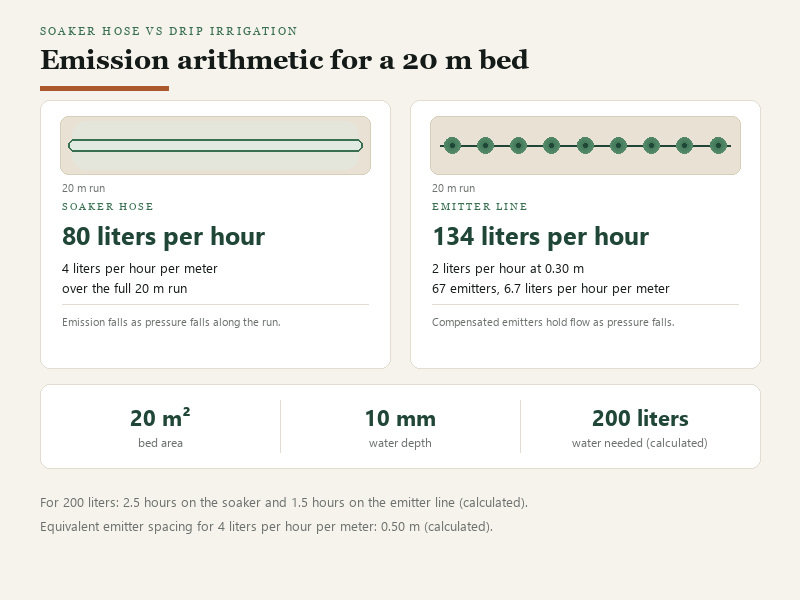
A 20 m bed compared: the soaker spreads 80 liters per hour; 67 emitters deliver 134 liters per hour.
Reading the Result
In the worked example, the emitter line delivers 134 liters per hour against 80 liters per hour from the soaker, so it applies the same 10 mm depth in less time. The soaker delivers less per hour but along a continuous strip. Neither is more efficient in the sense of liters applied; the difference is the pattern and the run time. Match the run time to the soil, because a sandy soil takes water faster than a clay soil.
5. Operating Pressure, Filtration and Regulation
Both systems run at low pressure, and both benefit from a filter. The difference is how critical each item is. A soaker tolerates a modest pressure swing and a moderate filter. Emitter tubing with narrow passages needs regulated pressure and finer filtration to keep its emitters open. In garden irrigation, that pressure and filtration pairing is the single most useful addition to either system.
What Pressure Each System Wants
Domestic supply is commonly planned in the 40–80 psi range, which is a planning range rather than a guarantee. Both systems therefore usually need a regulator to bring the supply down. As a stated input, a regulator set to 15 psi, which is about 103 kPa, suits many soaker runs (calculated). Compensated emitter lines typically run on a regulator matched to the emitter range.
Filtration and the Clogging Trade
Both systems can clog, but they clog in different ways. A soaker blocks when fine silt and organic matter lodge in the pores of its wall, and that blockage spreads over a large area. A drip emitter blocks when a particle or a mineral deposit fills its single passage, and one plant then goes dry.
A filter rated at 120 mesh, taken as a stated input here, removes most of the particles that would block a narrow emitter passage.
Regulation and Timers
A regulator holds the outlet pressure steady so that emission stays where the calculation expects it. A timer then turns that steady supply on and off. Together they remove the two most common errors, which are over-pressure at the inlet and a run time chosen by guesswork. Set the run time from the arithmetic above rather than from habit, and review it when the season changes.
Choosing a Filter and a Regulator
Match the filter to the narrowest passage in the system, which is always the emitter, not the tube. A finer filter blocks sooner and needs more frequent cleaning, so there is a trade-off between protection and maintenance. For the regulator, choose one that holds a steady outlet. A fixed restrictor lets the outlet pressure drift as the supply changes, so it does not hold emission steady. Fit both parts at the tap, where they are easy to reach.
6. Layout Options by Bed Type
Layout is where the two systems diverge fastest, because a continuous source suits one planting geometry and a point source suits another. Think of garden irrigation as a routing problem: the planting tells you where water must arrive, and the mechanism tells you how finely you can place it.
Table 3. Layout options by bed type
| Bed type | Suitable system | Why |
|---|---|---|
| Dense border, short run | Soaker hose | Continuous wetting suits mixed, close planting |
| Vegetable rows | Drip line | Emitters place water at each row of plants |
| Raised bed | Either; drip preferred | Drip holds uniformity across the box |
| Containers and pots | Drip hose with small emitters | One emitter per pot meters each plant |
| Trees and shrubs | Drip line | Emitters placed at the root zone |
| Loop around a bed | Either | A loop equalizes pressure at both ends |
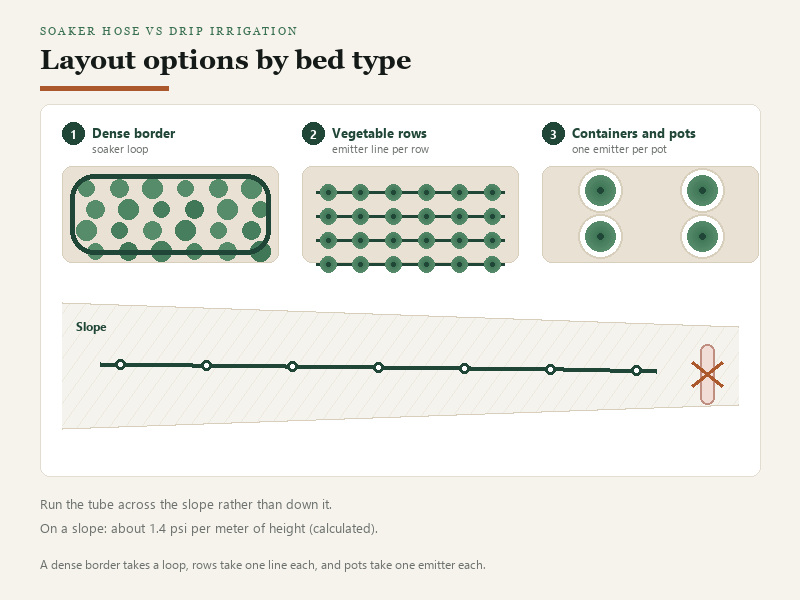
Zoning a garden: a soaker loop for the dense border, emitter lines for rows and pots, and a run across the slope.
Rows and Loops
For rows, run the tubing along each row so every plant sits beside an emitter. Where one line must serve two rows, a multi-outlet emitter splits the flow. For a soaker, lay the hose along the row and let the wall wet the strip on both sides. A loop, meaning a line that returns to its start, equalizes pressure at the two ends and improves uniformity for either system.
Raised Beds
A raised bed dries faster than ground soil because it drains on all sides, so even delivery matters more there. Either system can work, though drip spreads water more evenly across the box; keep the tubing clear of the plant stems and cover it with mulch or soil. Cover also slows surface evaporation and reduces the ultraviolet exposure that ages a soaker wall. Check moisture at the corners, which dry first.
Containers and Pots
Containers suit point emission rather than a porous wall, because each pot is a separate volume of soil. A drip hose with small emitters, or tubing with one emitter per pot, meters each container separately. A soaker strung through pots wets unevenly and is awkward to route from pot to pot. Water containers more often and for shorter periods than beds.
Trees and Shrubs
Trees and shrubs have deep, widely spaced root zones that a flat soaker strip does not reach. Tubing with two emitters placed on opposite sides of each trunk delivers water where the roots take it up. Run the line along a row of shrubs and place an emitter at each plant. Run times are longer than for a bed because the volume of soil is larger.
Can a Soaker Hose Water a Foundation?
Yes, and it is one of the few jobs where a soaker has no emitter-based equivalent. A foundation needs a slow, even release along a straight line, which is exactly what a porous wall produces. Run the hose parallel to the wall a short distance out, and keep the supply low so the water soaks in instead of running off.
Loops, Manifolds and Multi-Zones
Where one line cannot serve the whole garden, split the supply into zones with a manifold, and run each zone for its own time. Use a soaker on the damp beds and a drip hose on the dry ones, so each zone gets its own schedule. Keep every zone within the flow the supply can sustain, then check uniformity as described in section 3.
Planning Zones Before You Buy
Plan the zones on paper before buying any parts. Mark the tap, then group plants that need similar water and similar run times into one zone. Note the longest run in each zone, because that run sets the uniformity of the whole zone. A simple sketch prevents most of the ordering mistakes that follow an impulse purchase.
Which System Is Easier to Install?
A soaker is faster to lay out, because it needs no emitter spacing and no punch tool. Emitter tubing takes longer: you position the tube, punch a hole at each plant and insert an emitter, then flush the run. Budget the extra time against the uniformity the emitters hold over a long run.
7. Clogging, Maintenance and Water Quality
Clogging is the long-term risk for both systems, and water quality decides how quickly it arrives. The practical difference is how visible a blockage is. A soaker wall clogs gradually, so it fails slowly, while a drip emitter fails abruptly and only at one place.
How Each System Clogs
A soaker hose is tolerant of sediment, because a partly blocked patch of wall still passes water through its neighbors. A drip emitter is less tolerant, because its entire output passes through one narrow labyrinth. Where the water carries iron, calcium or fine silt, plan for cleaning on both. Where the water is clean, both systems run for years with little attention.
Flushing and Cleaning Routine
Flush the lines at the start and end of the season by opening the far end and running water through at full pressure. Flushing pushes sediment out of the tube before it settles. On a soaker, a light scrub of the outer wall removes surface algae. On drip, inspect the emitters at the far end of each run, where pressure is lowest and clogging appears first.
Matching Water Quality to Each System
Test the water before you commit to a layout. Water with visible sediment or iron suits a soaker better, because the blockage is spread and the system keeps working. Hard water that leaves scale suits neither, but it damages narrow emitter passages fastest, so filter it more finely and flush more often. Clear water lets you use the finer filtration that emitters prefer.
8. Winter Handling
Freezing water expands and splits tubes, emitters and fittings, so both systems need the same shutdown before the first hard freeze. Run this sequence: 1) Disconnect the supply. 2) Open the far end of every run. 3) Lift the tubing clear of the soil. 4) Store emitters and filters indoors. Water left in a closed line has nowhere to expand, so the weakest part cracks first.
Draining a Soaker Hose
Disconnect the soaker and unroll it on a slope so the water runs out of both ends. Lift it clear of the soil and let it dry in the sun, then store it flat in a shed or a bin. Coiling a wet soaker traps water in the pores, and that water can split the wall at the first freeze. A drip hose left outdoors needs the same treatment.
Draining the Tubing
Open the far end of each run so the tube drains under gravity. Raise the line clear of the soil where that is easy, because tubing frozen to wet ground is harder to remove later. Store the emitters and the filter indoors, since small parts crack sooner than the tube. A drip emitter left full of water is the first part to fail in a cold snap.
9. A Decision Sequence for Garden Irrigation: Tie-Breakers and Cost
Use a short sequence to choose between the two systems for each bed. It takes the bed type first, then the run length, and it checks the supply pressure as a condition on both. Applied bed by bed, it gives a consistent answer rather than a single verdict for the whole garden.
Applying the Sequence
Work through these steps in order for each bed:
- Name the bed type: dense border, row, raised bed, container, or tree root zone.
- Measure the run length from the supply to the far end of the bed.
- Check the pressure you can supply and whether it stays steady through the day.
- Choose continuous emission for dense short planting and point emission for rows and containers.
- Add a filter and a regulator either way, then set the run time from your own bed volume and the stated emission rate.
Choosing When Both Would Work
Where both systems would work, choose on maintenance and layout. A soaker needs almost no upkeep but wets unevenly on a long run. Emitter tubing needs seasonal flushing and a filter service, while it holds its uniformity across the bed. The soaker hose vs drip irrigation choice is therefore a question of which routine you can keep up with.
Is a Soaker Hose Cheaper Than Drip Irrigation?
Cost depends on the parts each system needs, not on the tube alone. A soaker needs a hose, a filter and a regulator. Emitter tubing needs tubing, an emitter at every plant, a filter and a regulator, and the emitters are the extra item. Compare the two lists for your own bed before comparing prices.
FAQ
Which is better, a soaker hose or drip irrigation?
As a general rule, choose a soaker hose for short, dense beds and drip irrigation for long runs, rows and pots. Check three things: the pressure you can hold steady, the distance from the tap to the last plant, and whether the planting is continuous or in rows. A steady supply with continuous planting suits a soaker. A long run with rows or pots suits compensated emitters.
Is a soaker hose more efficient than drip?
No, not as a single number. What you can compare is the wetted area against the planted area. A soaker wets one continuous strip, so its waste concentrates in the gaps of a row. Emitters wet isolated circles, so their waste concentrates between plants in a dense bed. Match the pattern to the planting and either system wastes little.
Does a soaker hose work on low pressure?
Yes, and it prefers it. A soaker runs on a steady low pressure, so a regulator between the tap and the hose is normal. Very low pressure reduces emission and narrows the wetted strip, while high pressure can rupture the wall. Set the supply to the pressure the maker states for that hose.
How long should I run a soaker hose?
Take the volume your own bed needs, then divide it by the emission your product states. A 20 m² bed at 10 mm depth needs 200 liters, and a hose stated at 4 liters per hour per meter delivers 80 liters per hour, so allow 2.5 hours (calculated).
How far apart should emitters be placed?
Spacing depends on the soil and the plant. On loamy soil, water spreads sideways from an emitter, so wider spacing can still join up into a wetted strip. On sandy soil it spreads less, so spacing should be closer. A spacing of 0.30 m yields 6.7 liters per hour per meter from 2 liter per hour emitters (calculated).
Do I need a filter for a soaker hose?
Yes. A filter helps a soaker as much as it helps drip, because fine pores block with silt. Clean or replace the screen before the first watering of the season, and again whenever you draw from a surface source such as a rain barrel or a pond. Clean water is the least expensive way to extend the life of either system.
Can I use a soaker hose in containers?
For a container, one emitter per pot is the practical option: every pot is a separate volume, so a single metered point suits it better than a wall that waters whatever it touches. With a soaker, check moisture at the rim as well as the middle, because the wall wets the side nearest the hose first.
Will drip irrigation work on a slope?
Drip handles a slope better than a soaker, because PC emitters hold their flow as elevation changes. A soaker on a slope seeps less at the top than at the bottom. Run the tube across the slope rather than down it, and measure the height difference from the supply to the last plant. One meter of that height changes the pressure by about 1.4 psi: a drop adds it and a rise removes it (calculated).
How do I stop the tubing from clogging?
Treat clogging as a water-quality problem before it becomes a cleaning problem. Test the water for sediment, iron and hardness, because each one blocks in a different way. Flush at both ends of the season and check the far end of each run, where deposits appear first.
What is the best soaker hose vs drip irrigation choice for a vegetable garden?
For a vegetable garden planted in rows, drip irrigation usually works better, because emitters place water beside each row and pressure compensation keeps the far end even. A soaker suits a closely sown bed where rows are hard to define. Try one zone of each and compare moisture at both ends before committing.
Can a soaker hose and drip irrigation be combined in one garden?
Yes, and combining the two is often the most practical route, because each system then covers only the beds it suits. Draw the zone map first: dense borders on a soaker zone, rows, pots and long runs on an emitter zone, each with its own run time. The soaker hose vs drip irrigation choice becomes a decision made bed by bed.
How long do these systems last?
Both last several seasons with flushing and winter draining. A soaker wall degrades in sunlight and clogs with silt over time. A drip emitter and the filter need occasional replacement, while the tubing itself outlasts them. Storing either system out of direct sun and draining it before winter extends its service life.
About HENGHUA
HENGHUA is a hose manufacturer serving distributors, retailers, OEM and private-label programs, and end users who research before buying. The range covers garden, agricultural and industrial hose, and the product brands GLOBHOSE and FLEXMAX cover high-performance hydraulic and flexible industrial hose. OEM, custom branding and tailored product solutions are supported on request.
The agriculture range covers field, orchard and greenhouse irrigation, and the wider consumer products range covers garden use. For any soaker hose vs drip irrigation decision, the figures that matter are the emission rate, the operating pressure and the bore, and each is published with the condition under which it applies. Browse the range in the shop or send a specification question through the contact page.






 English
  Spanish
  Portuguese
  French
  German
  Arabic
  Russian
  Indonesian
  Japanese
  Korean