

Chemical hose couplings decide whether a transfer line survives the fluid it carries. This comparison sets stainless steel 316, polypropylene and aluminum side by side, adds brass as a short reference, and reads each material on media compatibility boundaries, temperature window, pressure capability, weight, cost position and typical failure mode.
In practice, a coupling material selection starts from the fluid and its temperature, not from the fitting type. The useful question is not which material is strongest. It is which material stays inside its own limits for one fluid, one temperature and one pressure on one line. Read every material as a set of boundaries, then match those boundaries to the duty in front of you.
About a 13-minute read at 250 words per minute; a three-way comparison of coupling bodies by media, temperature, pressure, weight, cost and failure mode.
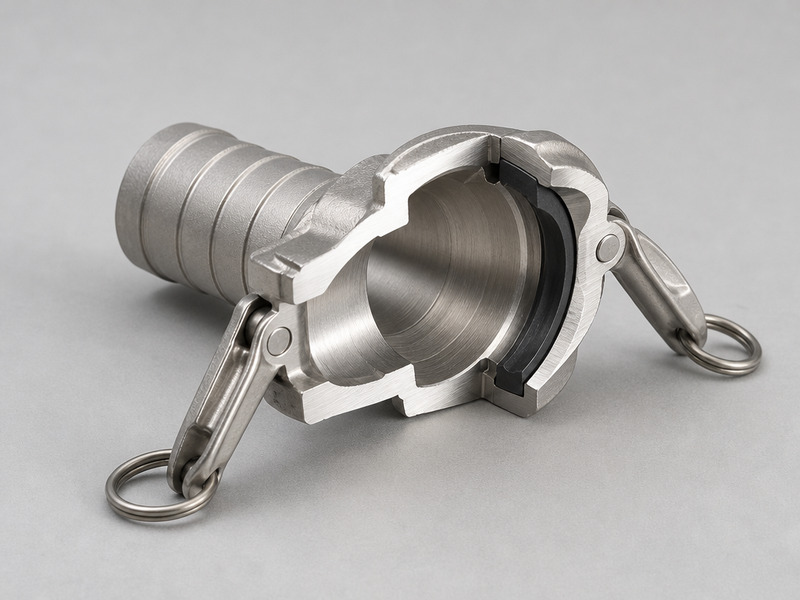
Figure 1. A stainless steel 316 coupling has a machined body and a defined gasket seat, so the seal depends on the gasket and the seating surface rather than on the metal alone.
What Chemical Hose Couplings Do in a Transfer Line
A coupling joins the hose to the pump, tank, valve or manifold, and it has to carry the same fluid, temperature and pressure as the hose itself. A body that suits general water service can still be the wrong choice for a strong acid line.
Any selection among chemical hose couplings starts from four jobs. The coupling must hold the fluid without swelling, cracking or permeating the body, and it must keep the seal tight across the working temperature window. It must also carry the rated pressure without distorting at the threads or the cam arms, and survive the mechanical abuse of daily connect and disconnect. A coupling material selection that treats those four jobs as one problem avoids most early failures.
The end fitting broadens the list, but the material underneath sets the boundary. Camlock, flange, threaded and clamp ends all exist in several materials, so the type map and the material map are two separate decisions. The type map lives in the guide to hose coupling types and selection criteria, and the camlock branch is set out in camlock fittings for chemical hose (planned URL — publish before linking).
The Three-Way Shortlist: Stainless Steel 316, Polypropylene and Aluminum
The three shortlisted materials solve the same problem from different directions. Stainless steel 316 brings strength and a wide chemical spectrum. Polypropylene brings low cost and broad acid, base and salt tolerance. Aluminum brings light weight and naturally non-sparking behavior. Brass joins them as a fourth reference, while nylon and PVDF widen the range for special cases.
Weight and cost often settle a line before chemistry does, and there aluminum leads. Strength and chemical reach settle hostile service, and there stainless steel 316 leads. Low cost with good acid and base coverage favors polypropylene, provided the temperature and pressure ceilings stay below the duty. For chemical hose couplings of every bore, the order to apply is fluid first, then temperature and pressure, then weight and cost.
Table 1 reads the shortlist across the factors that decide most transfers:
Table 1. Coupling materials compared on media boundaries, temperature, pressure, weight and cost position.
| Material | Serves best | Keep away from | Temperature window | Pressure capability | Weight | Cost position |
|---|---|---|---|---|---|---|
| Stainless steel 316 | Wide chemical spectrum with high strength | Chloride-rich service without a review | Within the assembly window of −20 °C to +65 °C | Metal body, above a plastic body of the same bore | Heaviest of the three | Higher |
| Polypropylene (PP) | Wide acid, base and salt spectrum at low cost | Strong oxidizers; some aromatic and halogenated solvents | Lower ceiling than the metals; confirm on the data sheet | Below a metal body of the same bore | Light | Low |
| Aluminum | Light, lower-cost, non-sparking service | Strong alkalis and some strong acids | Resistance falls as temperature rises | Metal body, above a plastic body of the same bore | Lightest | Lower |
| Brass (reference) | General water and fuel duty | Ammonia and ammonium compounds | General duty within the assembly window | Metal body for small and mid bores | Moderate | Moderate |
| PVDF or nylon (reference) | Wider chemical range than polypropylene; higher purity | Depends on the grade; confirm each fluid | PVDF holds a higher ceiling than polypropylene | Below a metal body of the same bore | Light | Higher than polypropylene |
Media Compatibility Boundaries by Material
Stainless steel 316 handles a wide chemical spectrum and keeps its strength, but chlorides are its weak point. In chloride environments it can pit and suffer stress corrosion cracking, so hydrochloric acid media call for caution. Brass suits general water and fuel duty, yet ammonia and ammonium compounds attack it. Aluminum is light and naturally non-sparking, but it is an amphoteric metal, so strong alkalis and some strong acids sit outside its range.
Polypropylene covers a wide acid, base and salt spectrum at low cost, but it is not for strong oxidizers or for some aromatic and halogenated hydrocarbon solvents. Nylon handles many chemicals and solvents. PVDF goes wider than polypropylene, holds a higher purity and a higher temperature ceiling, and costs more. Choosing among chemical hose couplings means reading these boundaries in order, because one fluid can sit inside a window that another fluid in the same plant breaks.
Group fluids by family rather than by product name, because the family decides the material:
Table 2. Fluid families matched to a first-choice coupling material and the reason.
| Fluid family | First choice | Avoid on this duty | Reason |
|---|---|---|---|
| General water and fuel | Brass | Ammonia and ammonium compounds | Ammonia attacks brass |
| Strong alkalis | Polypropylene couplings | Aluminum | Aluminum is amphoteric and reacts with strong alkalis |
| Wide acid spectrum | Stainless steel couplings | Chloride-rich service without a review | 316 can pit and crack in chlorides |
| Strong oxidizers | Stainless steel 316 or PVDF | Polypropylene | Polypropylene is not for strong oxidizers |
| Aromatic and halogenated solvents | Stainless steel 316 or PVDF | Polypropylene | Some aromatic and halogenated hydrocarbons attack polypropylene |
| Hydrochloric acid | PVDF or PP couplings | Stainless steel 316 without a review | 316 needs caution with hydrochloric acid media |
Temperature and Pressure Windows for Chemical Hose Couplings
The outer window is set by the standard that governs the assembly, then narrowed by the material. EN 12115:2021 covers rubber and thermoplastic chemical hose and assemblies with a service window of −20 °C to +65 °C at a 10 bar working pressure. For cam locking couplings, EN 14420-7:2022 sets a working range of −0.8 bar to 16 bar and −20 °C to +65 °C, and it excludes liquefied gas and steam.
Inside those limits the material narrows the safe band. Polypropylene gives up temperature and pressure headroom earlier than either metal. Aluminum loses chemical resistance as temperature rises. Stainless steel 316 holds its strength across the same band, but chlorides stay a limit rather than temperature.
Pressure capability also changes with size. Camlock pressure capability typically decreases with bore size, and a plastic coupling sits below a metal coupling of the same bore. Common bores run 3/4 in, 1 in, 1-1/4 in, 1-1/2 in, 2 in, 3 in and 4 in, while camlock covers 1/2 in to 8 in. Treat burst pressure as roughly three to four times the working pressure as a planning figure.
Table 3. Planning temperature and pressure behavior by coupling material; the cam locking range follows EN 14420-7:2022 and the hose assembly window follows EN 12115:2021.
| Material | Planning temperature window | Pressure behavior | Governing reference |
|---|---|---|---|
| Stainless steel 316 | Within the assembly window of −20 °C to +65 °C | Metal body, above a plastic body of the same bore | EN 12115:2021 and EN 14420-7:2022 |
| Polypropylene | Lower ceiling than the metals; confirm on the data sheet | Below a metal body of the same bore | EN 14420-7:2022 |
| Aluminum | Resistance falls as temperature rises | Metal body, above a plastic body of the same bore | EN 14420-7:2022 |
| Brass | General duty within the assembly window | Metal body for small and mid bores | EN 14420-7:2022 |
Weight, Cost Position and Typical Failure Mode
Weight and cost pull against strength. Aluminum is the lightest of the three and sits at a lower cost position, which suits portable and dock work where a coupled hose is moved by hand. Stainless steel 316 is heavier and sits higher on cost, which is accepted where chemical reach and strength matter. Polypropylene is light and low cost, though its ceilings are lower than the metals.
Failure mode follows the boundary that was crossed. Aluminum that meets a strong alkali or a hot acid corrodes at the wetted surface. Stainless steel couplings that meet chlorides can pit and crack. Polypropylene couplings that run above their temperature ceiling creep, crack or strip at the thread. Brass that meets ammonia or ammonium compounds is attacked and loses thread integrity.
Gasket failure is the quiet mode across all materials. A gasket chosen for the wrong fluid or temperature leaks long before the body fails, so the gasket belongs in the same decision as the body.
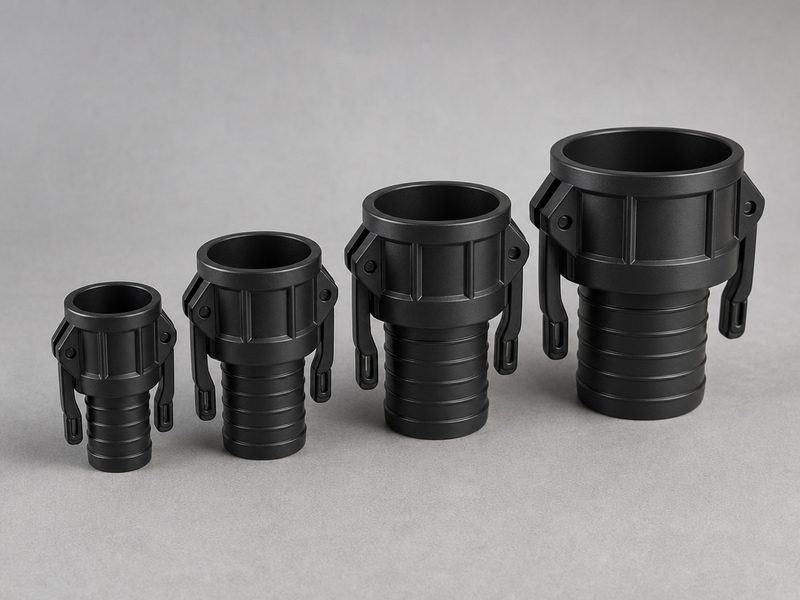
Figure 2. A set of PP couplings in several bore sizes resting on a plain work surface, with the smooth molded finish of the plastic body in view.
Table 4. Typical failure mode, inspection cue and mitigation by coupling material.
| Material | Typical failure mode | Inspection cue | Mitigation |
|---|---|---|---|
| Stainless steel 316 | Pitting and stress corrosion cracking in chlorides | Pits, discoloration or fine cracks on the wetted surface | Review the chloride level or move to a plastic body |
| Polypropylene | Creep and thread stripping above the pressure and temperature ceilings | Deformed threads, a loose seat or a cracked body | Reduce the duty or step up to a metal body |
| Aluminum | Corrosion at the wetted surface in strong alkalis and some strong acids | Pitting, deposits and a rough seat | Move to polypropylene or stainless steel 316 |
| Brass | Attack by ammonia and ammonium compounds | Discoloration and a weakening thread at the body | Move to stainless steel 316 or polypropylene |
Brass, Nylon and PVDF as Short References
Brass is the general water and fuel reference. It machines easily and suits small and mid bores, but ammonia and ammonium compounds rule it out. Nylon handles many chemicals and solvents and is often used for small couplings and fittings. PVDF covers a wider chemical range than polypropylene, holds a higher purity and a higher temperature ceiling, and carries a higher cost, which places it above polypropylene for aggressive or high-purity duty.
The reference materials set the edges of the shortlist. When a line is marginal for polypropylene, PVDF is the plastic step up. When a line is marginal for stainless steel 316, a plastic body may remove the chloride risk entirely. The rule stays the same: state what the material is for and what it is not for.
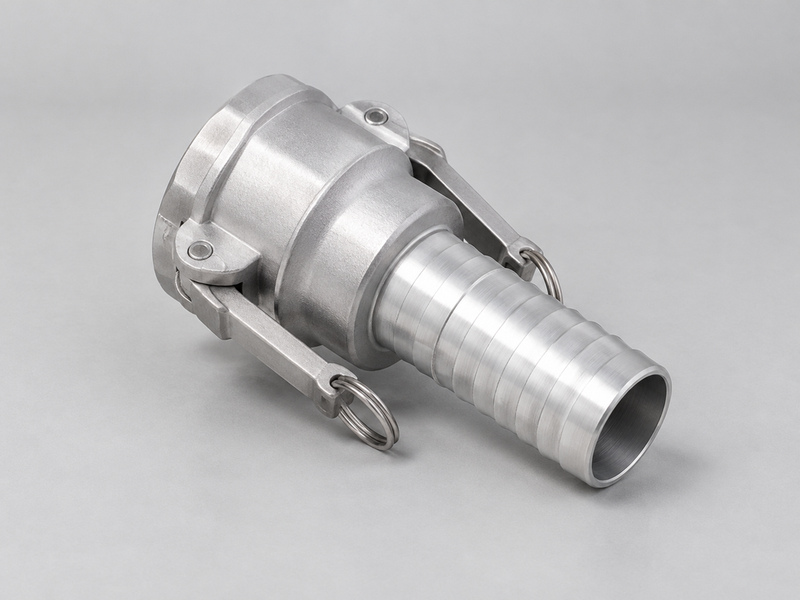
Figure 3. An aluminum camlock coupling on a bench, shown with its cam arms and hose tail; the soft bright metal tone is the tell.
Running a Coupling Material Selection Review
A coupling material selection review turns the three-way comparison into a decision. Write down the exact fluid, its concentration and its normal and peak temperature, then record the working pressure and whether the line also sees vacuum. Remove every material that is not suitable for that fluid at that temperature, and check the temperature and pressure window of the survivors against the duty. Weigh the survivors on weight, cost position and expected failure mode, then match the gasket and the end connection to the material you keep. Confirm the choice against the supplier’s data sheet before you order.
Two habits keep the review honest. First, never let a familiar fluid name stand in for the chemical identity, because process water and rinse water carry very different contamination loads. Second, treat the data sheet as the deciding document and the catalog line as a starting point.
Table 5. End connections and gasket match by coupling material.
| Material | Common end connections | Recommended gasket | Flange system to match |
|---|---|---|---|
| Stainless steel 316 | Camlock (cam and groove), flange, threaded and clamp ends | PTFE envelope, EPDM or FKM by fluid and temperature | EN 1092-1 (PN) or ASME B16.5 (Class, NPS 1/2 to 24) |
| Polypropylene | Camlock (cam and groove), threaded and clamp ends | EPDM or FKM by fluid and temperature | A flange end is outside the polypropylene range. |
| Aluminum | Camlock (cam and groove), flange, threaded and clamp ends | EPDM or FKM by fluid and temperature | EN 1092-1 (PN) or ASME B16.5 (Class) |
| Brass | Threaded and clamp ends | EPDM or PTFE envelope by fluid and temperature | A flange end is outside the brass range. |
The system view of matching hose, coupling, flange, clamp and gasket is set out in a complete system approach to chemical hose and fittings (planned URL — publish before linking). The clamp side is covered in hose clamp selection, and thread systems are compared in NPT vs BSP threads.
Chemical Hose Couplings: What to Specify and What to Avoid
A specification that names the material, the gasket and the end connection closes most of the risk before an order is placed. Write down the fluid, its concentration and its normal and peak temperature, the working pressure and any vacuum duty, and the bore and end connection on the pump, tank or valve. Add the body material and the gasket material, the governing standard such as EN 12115:2021 or EN 14420-7:2022 for cam locking couplings, and the electrical class for a flammable fluid, judged under EN ISO 8031.
The avoid list is shorter and just as important. Do not use aluminum for strong alkalis or some strong acids. Do not use brass with ammonia or ammonium compounds. Do not use polypropylene for strong oxidizers or for some aromatic and halogenated hydrocarbon solvents. Do not use stainless steel 316 in chloride service without a review for pitting and stress corrosion cracking.
A three-way comparison is not a ranking. It is a boundary map, and the map decides the material once the fluid, the temperature and the pressure are known. For chemical hose couplings, set the boundaries and the coupling lasts; cross one and the failure shows up as a corroded body, a stripped thread or a leaking gasket.
For the wider picture, the guide to chemical hose products and the acid and alkali matrix in hose selection for acids and alkalis (planned URL — publish before linking). Both extend the same logic to the hose body itself. The chemical hose complete guide covers liner chemistry and construction in more depth.
Chemical Hose Couplings FAQs
Which coupling material suits general chemical transfer?
For a mix of acids, bases and salts at moderate temperature, polypropylene is the first body to check, because it covers that duty at a low cost position. Where strength or a wide chemical spectrum matters more, stainless steel 316 takes over. Aluminum only enters when light weight or non-sparking behavior drives the choice. Brass stays a water and fuel reference. Confirm the fluid against a data sheet before you commit a line.
What are chemical hose couplings made of?
Chemical hose couplings are made from metals such as stainless steel 316, aluminum and brass, or from plastics such as polypropylene, nylon and PVDF. The body material, the gasket and the end connection are chosen together so the coupling matches the fluid, temperature and pressure of the line. The metal or plastic carries the load, while the gasket carries the seal.
Are stainless steel couplings suitable for every chemical?
No. Stainless steel couplings handle a wide chemical spectrum and strong duty, but chlorides are their limit. In chloride environments 316 can pit and suffer stress corrosion cracking, and hydrochloric acid needs caution. Below that ceiling they remain a strong choice. Above it, move to a plastic body such as polypropylene or PVDF, which sidesteps the chloride mechanism.
When should aluminum be avoided?
Avoid aluminum with strong alkalis and some strong acids, because it is an amphoteric metal that reacts with both. Its chemical resistance also falls as temperature rises, so hot service narrows its range further. Where those fluids or temperatures apply, polypropylene or stainless steel 316 is the safer body. Aluminum still fits dry, light, non-sparking duty.
What are polypropylene couplings used for?
Polypropylene couplings are used for a wide acid, base and salt spectrum at low cost, including caustic soda, often on plant transfer, dosing and rinse lines. They are not for strong oxidizers or for some aromatic and halogenated hydrocarbon solvents, and their temperature and pressure ceilings sit below the metals. Confirm the fluid, its concentration and the duty temperature before you specify them.
Is brass an option for chemical service?
Brass suits general water and fuel duty, and it machines easily for small and mid bores. It is not suitable for ammonia or ammonium compounds, which attack the metal. For a narrow water and fuel service, brass remains a practical and familiar choice. For anything more aggressive, step up to a plastic body or to stainless steel 316.
Does coupling material change the pressure rating?
Yes. Camlock pressure capability typically decreases with bore size, and a plastic body sits below a metal body of the same bore. The assembly window for cam locking couplings follows EN 14420-7:2022, which spans −0.8 bar to 16 bar. EN 12115:2021 sets a 10 bar working pressure for rubber and thermoplastic chemical hose and assemblies. Treat burst pressure as roughly three to four times the working pressure as a planning figure.
What temperature limit applies to a coupling?
The outer window comes from the governing standard. EN 12115:2021 covers a service window of −20 °C to +65 °C, and EN 14420-7:2022 uses the same range for cam locking couplings and excludes liquefied gas and steam. Inside that window the material narrows the band: polypropylene gives up headroom earlier than the metals, and aluminum loses chemical resistance as temperature rises.
Which coupling gasket material should I specify?
Match the gasket to the fluid and the temperature as carefully as the body. PTFE envelope, EPDM and FKM gaskets cover most chemical duty, and each has its own limits. A gasket chosen for the wrong fluid or temperature leaks long before the body fails, so the gasket belongs in the same decision as the material. Confirm it on the same data sheet as the body.
What is the most common coupling failure?
The most common failure follows the boundary that was crossed, and the mode points to the limit that was passed. A pitted wetted surface points to chlorides, a deformed thread to a pressure or temperature ceiling, and an attacked body to the wrong fluid family. Gasket failure is the quiet mode across every material, so inspect the seal as often as the body.
About HENGHUA and How to Order
HENGHUA manufactures hose and hose assemblies for chemical duty, supplying global distributors, retailers and OEM brands. The chemical hose line covers UHMWPE (UPE), XLPE and PTFE liners alongside rubber constructions in EPDM and oil-resistant synthetic rubber, with high-tensile textile reinforcement and a steel helix for suction service.
On the coupling side HENGHUA offers camlock (cam and groove), flange, threaded and clamp ends, plus factory-crimped assemblies, custom lengths, jacket printing, private label and OEM/ODM work. Commercial terms follow factory-direct pricing, short bulk lead times and warranty.
Send the fluid, its concentration, its temperature, the working pressure and the bore, and HENGHUA will match the coupling material and quote against it.





 English
  Spanish
  Portuguese
  French
  German
  Arabic
  Russian
  Indonesian
  Japanese
  Korean