
A chemical hose leak rarely announces itself as a drip. Most chemical hoses first move small amounts of the medium straight through the tube wall by diffusion — permeation — driven by a concentration gradient rather than a hole. That transport shows up as odor, a damp or darkened cover and repeated top-ups long before a fitting fails.
This article explains what permeation is at the polymer level, where it appears on working transfer hose, which variables accelerate it, how to detect it without instruments, and what waiting costs in product loss, exposure complaints and shortened assembly life. It also separates permeation from pressure rating, and sets out when a damaged assembly can be repaired and when it must be retired.
All pressure and temperature figures are working ratings at ambient temperature unless a cited standard states otherwise; standard designations are given by title only. About 13 min read.

Figure 1. A chemical hose can look sound from the outside while the tube behind the cover is already moving medium through the wall. Odor and a damp cover are usually the first visible evidence.
What a Chemical Hose Leak Through the Wall Really Is
Permeation is transport, not rupture. The wetted face of the tube absorbs a small amount of the liquid it carries; those molecules dissolve into the polymer, diffuse across the wall along a concentration gradient, and leave on the air side. There is no crack, no pinhole and no spray, so ordinary visual checks find nothing wrong.
The transport path is the entire wetted surface rather than a single defect. That is the key difference between permeation and a hole, and it explains why permeation grows with wetted area, contact time and temperature instead of with the size of a crack. A long, large-bore line in continuous service presents far more transport area than a short jumper.
The sequence is always the same:
- Absorption — medium dissolves into the tube compound on the wetted side.
- Diffusion — dissolved molecules migrate across the wall along the concentration gradient.
- Desorption — molecules leave the outer surface and enter the surrounding air or the cover.
- Accumulation — the cover, the cover-to-reinforcement interface and any cavity behind a ferrule collect what the wall releases.
Permeation is a normal property of every polymer, not a manufacturing defect. The engineering question is never whether a wall permeates, but whether it permeates at a rate and in a direction the installation can tolerate. A hose carrying water in an open yard is unremarkable; the same construction carrying a volatile solvent in a confined pump room is a different problem entirely.
Table 1. Permeation compared with a through-wall hole in a chemical hose
| Property | Permeation | Through-wall hole |
|---|---|---|
| Driving force | Concentration gradient across the wall | Internal pressure against a defect |
| Location | Whole wetted surface | One localized point |
| First sign | Odor, damp or stained cover, slow level loss | Drip, weep or spray at a visible spot |
| Pressure behavior | Often holds rated pressure | Usually loses pressure under load |
| Rate controlled by | Temperature, wall thickness, medium, tube compound | Defect size, pressure, fluid velocity |
| Correct response | Review duty, construction and ventilation | Isolate, repair or replace the assembly |
Why a Damp or Sweating Hose Wall Is Not Cosmetic
On a hose that has carried a solvent or an aggressive chemical, a damp, darkened or slightly tacky cover is often dismissed as housekeeping. It should be read as a diagnostic finding, because the cover is the first place the diffusing medium accumulates. The outer cover is normally the last barrier, and it is frequently a different compound from the tube.
What looks like a surface film is usually the beginning of a chain of damage inside the wall. The medium that collects at the cover interface plasticizes the cover compound, softens the adhesive bond to the reinforcement and carries aggressive species into the textile or wire layer. From the outside the hose can still look serviceable for a considerable time while that process runs.
The consequences follow a predictable order:
- Cover swelling and loss of gloss, sometimes with a solvent smell that lingers after washdown.
- Blistering where desorbed gas or vapor collects faster than it can escape.
- Adhesion loss between cover and reinforcement, felt as slack cover on a cut section.
- Reinforcement degradation — corrosion of wire, or weakening of textile — that reduces the pressure capability of the assembly.
- Tube swelling that narrows the bore, raises pressure drop and slows the transfer.

Figure 2. A cut-open section of a permeation-damaged assembly. The inner tube is swollen and spongy, and the cover has begun to separate from the reinforcement.
In our own factory cut-open inspections, permeation-damaged tubes typically show a swollen inner wall, a soft and spongy texture rather than a firm rubber feel, and a visible boundary between sound compound and saturated compound. The reinforcement underneath is often the part that decides whether the assembly is still safe, because the wall that holds pressure is the one being softened by the medium.
What Drives Hose Permeation: Temperature, Wall Thickness, Medium and Tube Material
Four variables govern how quickly a wall transports medium, and they explain why hose permeation differs so much between two lines carrying the same product. They interact, so changing one rarely gives a proportional result, but each moves the outcome in a consistent direction.
Temperature is the strongest single lever. Diffusion speeds up as the polymer chains gain mobility, so a line that is quiet at ambient temperature can become a persistent odor source once the product arrives warm from a process stream or a heated tank. The effect is not linear, which is why duty that was signed off in cool weather needs re-checking in summer.
Wall thickness sets the path length. Doubling the tube gauge lengthens the diffusion distance and, all else being equal, reduces transport, but it also stiffens the hose and changes bending behavior. Thickness alone cannot compensate for a compound that the medium attacks chemically.
Medium aggressiveness and concentration decide how much material dissolves into the tube in the first place. A pure, volatile solvent in a low-flash application is a harder permeation case than a dilute aqueous solution, and raising concentration increases the gradient that drives transport.
Tube compound determines the affinity between medium and polymer. Two hoses of identical dimensions can behave very differently because one compound has a low solubility for the medium and the other does not. That is a materials question, and it is answered by the manufacturer’s chemical resistance chart against the specific medium, concentration and temperature.
Table 2. Variables that change the rate of hose permeation and what to do about each
| Variable | Effect on transport | Practical action |
|---|---|---|
| Temperature | Higher temperature accelerates diffusion strongly | Confirm the real product temperature, not the ambient rating |
| Wall thickness | Thicker tube lengthens the diffusion path | Specify a heavier tube where bends allow it |
| Concentration | Higher concentration steepens the gradient | Check the worst case, not the nominal mix |
| Medium aggressiveness | Swells and plasticizes the compound | Match compound and liner to the medium |
| Tube compound | Sets how much medium dissolves in the polymer | Use the resistance chart and a liner where needed |
| Contact time | Longer wetted time means more total transport | Drain and flush idle lines instead of leaving them full |
Where a Chemical Hose Leak Shows Up First: Hose Leak Detection Without Instruments
Most plants notice permeation long before any instrument does, because the human nose is a sensitive hydrocarbon and solvent detector. What is missing is a routine that converts a smell into a record and a decision. In practice, hose leak detection in chemical service works from smell, touch, paperwork and operator reports.
Work the line in this order while it is running:
- Smell at flanges, bends, low points and anything inside a cabinet or enclosure where vapor collects.
- Wipe a dry white cloth along the cover at bends and under clamps; color or solvent odor on the cloth is a recorded finding.
- Look for darkening, tackiness, blistering and cover that has ballooned away from the reinforcement.
- Reconcile the product level and top-up records against the batch sheet; a line that is repeatedly topped up is paying for itself in lost product.
- Ask operators about smell, headache or eye irritation toward the end of a shift near the transfer area.
- Cut open one retired assembly of the same build and duty; the tube cross-section confirms what the outside only hinted at.
None of this replaces a programmed pressure test. Where transfer falls under the U.S. Coast Guard rules for oil and hazardous material, 33 CFR 156.170 already requires that a nonmetallic transfer hose have no defect that could let product escape through the hose material. A wall that transports medium outward sits in that category whether or not it ever drips.
Table 3. Field clues that a hose wall has started to transport product
| Clue | Where it appears | What it usually means |
|---|---|---|
| Persistent odor | Near bends, clamps and enclosed runs | The wall is desorbing vapor on the air side |
| Damp or stained cover | Anywhere along the wetted length | Medium has accumulated at the cover interface |
| Tacky or swollen cover | Cover surface, often at the hottest section | The cover compound is being plasticized |
| Soft tube on cut open | Tube cross-section of a retired sample | The compound has absorbed medium and lost hardness |
| Repeated top-ups | Transfer records and level logs | Product is leaving the system without a visible leak |
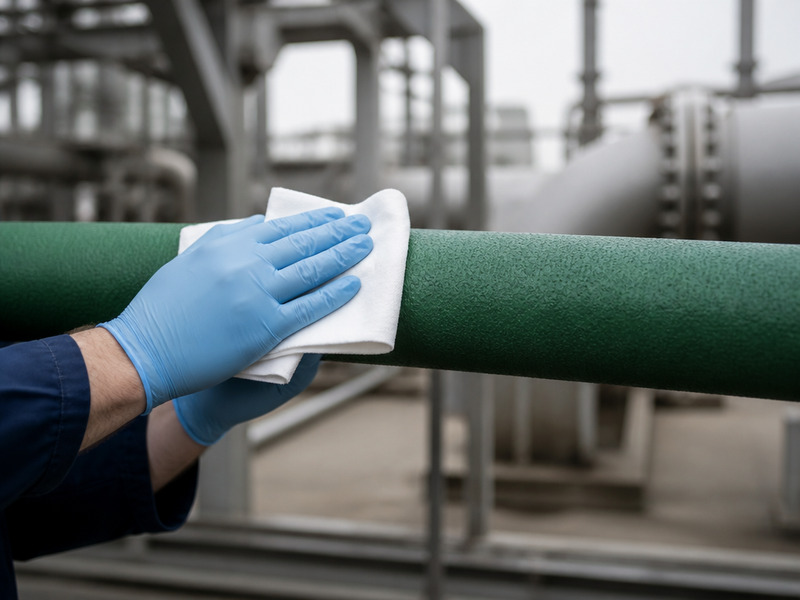
Figure 3. Hose leak detection in practice: a dry cloth wipe at bends and under clamps turns a faint smell into a dated record that can be tracked over time.
Choosing Chemical Hose Material to Slow Permeation
Construction choices change how much medium travels through the wall, and they are the main engineering lever after temperature. Choosing a chemical hose material for a permeating duty means weighing the tube or liner compound, which sets how readily the medium dissolves into the polymer, against wall thickness, which sets the length of the diffusion path. Slow hose permeation is designed in, not inspected out.
Common options behave differently by duty. A rubber tube in a compound selected for the medium is the workhorse for aqueous and moderate chemical service. A UHMWPE or PTFE-lined tube gives a much less permeable contact surface for aggressive solvents, acids and high-purity product, at higher cost and with tighter bending limits. Thermoplastic composite builds use several bonded layers to combine a chemically resistant inner wall with a strong reinforcement.
Practical guidance for selection:
- Match the tube compound to the specific medium, concentration and temperature using the manufacturer’s resistance chart.
- Where permeation, not chemical attack, is the limiting factor, specify a lined or composite build rather than a thicker plain rubber tube.
- Keep product temperature inside the rated window; a compound that is adequate at ambient may not be at process temperature.
- Drain and flush idle lines so the wetted contact time is as short as the process allows.
Our chemical hose range covers rubber, UHMWPE, PTFE-lined and thermoplastic composite constructions, and the chemical hose collection sets out the builds we assemble against each duty. For the compatibility method behind tube selection, the inner tube selection guide explains how to read a compound against a medium before ordering.
Table 4. Tube and liner options against transport behavior
| Tube or liner | Typical duty | Transport behavior | Watch-out |
|---|---|---|---|
| Rubber compound | Aqueous and moderate chemicals | Moderate; strongly temperature dependent | Confirm compound against the medium |
| UHMWPE | Acids and general chemical transfer | Low on the wetted face | Lower temperature ceiling than rubber |
| PTFE lined | Aggressive solvents and high purity | Lowest of the common contact surfaces | Handling care; liner damage at the end |
| Thermoplastic composite | Bulk solvent and hydrocarbon transfer | Low, with a barrier layer in the build | Correct end termination is critical |
Chemical Hose Pressure Rating Is Not a Permeation Rating
A chemical hose pressure rating tells you what the reinforcement can hold. It says nothing about how much medium permeates the tube wall. The two are measured by different methods, and conflating them wastes product and time.
Table 5. Pressure rating versus permeability
| Property | Measures | Method |
|---|---|---|
| Pressure rating | Load the reinforcement holds | Hydrostatic test |
| Permeability | Medium crossing the wall | EN ISO 4080 (permeability to gas) |
EN 12115:2021 covers rubber and thermoplastics hoses and hose assemblies for liquid or gaseous chemicals. It defines two assembly types, Type D and Type SD, and four grades based on electrical properties, with metal fittings, a service window of −20 °C to +65 °C and a working pressure of 10 bar or less. Electrical resistance is tested by the method in EN ISO 8031.
EN 13765 covers thermoplastic multi-layer composite hoses for hydrocarbons, solvents and chemicals, in bores from 25 mm to 250 mm. Working pressures run from 4 bar to 14 bar and temperatures from −30 °C to +160 °C, with Annex A addressing inner-wall selection against the chemical conveyed.
Permeability is a separate measurement; the standard series names EN ISO 4080 as the method for determining permeability to gas, and any quoted permeability figure needs its temperature and medium attached to be meaningful. A hydrostatic test to the rated working pressure, which every HENGHUA assembly passes before shipment, proves that the wall holds pressure. It does not measure how much medium crosses the wall, which is why a hose can pass its pressure test and still be a poor choice for a volatile solvent. For the wider distinction between working and burst ratings, see working pressure versus burst pressure.
What Waiting for a Chemical Hose Leak Really Costs
The expensive part of permeation is not the medium that escapes; it is the decisions that get delayed while it escapes. Because nothing drips, the cost is rarely attributed to the hose at all. It arrives instead as complaints, housekeeping hours and unplanned changeouts.
The recurring cost lines look like this:
- Product loss that no meter captures, spread across every wetted hour of the line.
- Odor and exposure complaints from operators, neighbors and inspectors, with ventilation or engineering controls added to compensate.
- Housekeeping time spent washing a cover that keeps coming back damp.
- Bore loss as the tube swells, raising pressure drop and slowing the transfer cycle.
- Reinforcement degradation that turns a slow material problem into a sudden failure at a joint.
- Premature replacement of assemblies that still pass a pressure test but no longer suit the duty.
- Remedial hose leak repair spending on assemblies that should have been retired, because a cover repair cannot undo transport through the wall.
HENGHUA distributes to plants in petrochemical and general chemical service, and the pattern we see in distributor programs is consistent: the assemblies retired late are the ones that consumed the most unplanned labor. Building the money side of this into a maintenance budget is a separate exercise, covered in our guide to hose lifecycle and cost in chemical plants.
When a Chemical Hose Leak Can Be Repaired — and When It Cannot
Repair is a question about where the damage sits. If the problem is external wear, a damaged end or a mechanical injury that has not reached the reinforcement, an assembly shop can often restore the hose by re-terminating it and re-testing to the rated working pressure. That is genuine hose leak repair, with a new pressure test behind it and a new record on the tag. Wall damage is not repairable.
If the problem is the wall itself, repair is not available. A tube that has absorbed medium and swollen will keep transporting medium. Re-terminating the ends, retaping a cover or adding a sleeve changes appearance and nothing else. The right move is to retire the assembly, cut a section open to confirm the diagnosis, and fix the duty that caused it.
Table 6. Repair or retire decision for a damaged chemical hose assembly
| Condition found | Decision | Reason |
|---|---|---|
| Cover scuff or gouge not into reinforcement | Repair or continue with monitoring | Pressure path is intact |
| Damaged coupling, sound body | Re-terminate and retest | The wall is unaffected |
| Swollen or softened tube | Retire | The compound has absorbed medium |
| Blistered or separating cover | Retire | Interface and reinforcement are affected |
| Unknown or long unaudited history | Retire or re-certify fully | Duty cannot be confirmed |
When the pattern repeats across several lines, the question shifts from one hose to a plant-wide cause, which is the territory of hose failure analysis in petrochemical plants.
A Practical Response Plan When a Wall Starts Transporting Product
A written response keeps a smell from becoming an argument. The sequence below is short enough to use on a normal shift, and it produces a record a later investigation can rely on:
- Isolate and tag the line, and note the date, shift and exact location of the finding.
- Wipe the cover dry and re-check after a few hours of service to see whether the dampness returns.
- Record the product, concentration and measured product temperature at the time of the check.
- Compare the duty against the manufacturer’s chemical resistance chart and the assembly’s rated window.
- Check the surrounding installation for heat sources, abraded supports and trapped vapor pockets.
- Decide repair, retire or monitor, and write the decision next to the finding.
- If the finding repeats on the same duty, cut open one retired sample and review the specification with the supplier.
Our hose inspection checklist shows how these findings are logged and trended so that the second occurrence is caught faster than the first.
Chemical Hose Leak and Permeation FAQs
What is permeation in a chemical hose?
Permeation is the movement of the carried medium through the solid wall of the hose. Molecules dissolve into the tube compound on the wetted side, diffuse across the wall along a concentration gradient, and leave on the outside. No hole, crack or defect is required, and the process continues for as long as the line holds product. It is a normal property of polymers rather than a manufacturing fault.
Why does my chemical hose smell of product but never drip?
Odor without a drip is the classic permeation signature. The medium desorbs from the outer surface and evaporates into the air, so you smell it while the wall itself stays continuous and holds pressure. A fitting leak usually shows wetness or a spray at one point; permeation produces a broad, faint smell along the whole wetted length and a cover that stays slightly damp.
Is a damp or sweating chemical hose cover dangerous?
It is a warning rather than an immediate hazard. The dampness shows that medium has reached the cover interface, where it plasticizes the cover, weakens the bond to the reinforcement and can degrade wire or textile. The safety question is not the film on the surface but what the same transport is doing to the reinforcement and to the local atmosphere, especially in a confined space.
How do I carry out hose leak detection without instruments?
Use smell, touch and records; smell the line at bends, clamps and enclosed runs while it is running. Wipe a dry white cloth along the cover and note any color or odor; look for darkening, tackiness and blisters. Reconcile level and top-up records against the batch sheet. Ask operators about odor or irritation at the end of a shift, and cut open one retired assembly to confirm the pattern.
Which chemical hose material resists permeation best?
There is no single best compound, because the answer depends on the medium, the concentration and the temperature. A PTFE-lined or UHMWPE-lined tube usually transports less than a plain rubber tube for aggressive solvents and acids, and thermoplastic composite builds add a barrier layer for bulk solvent service. The correct method is to check the manufacturer’s resistance chart against the exact duty, then choose the build.
Does a higher chemical hose pressure rating stop permeation?
No. The chemical hose pressure rating describes the pressure the reinforcement can hold, while permeation is a property of the tube compound and the medium. A high-rated assembly with the wrong tube can transport more medium than a lower-rated assembly with the right liner. Always confirm the tube and liner against the medium first, then check that the pressure rating covers the duty.
Does temperature change how fast a hose wall transports product?
Yes, and temperature is usually the strongest single factor. Warmer product increases the mobility of the polymer chains and speeds diffusion, so a line that is quiet at ambient temperature can become a persistent odor source once warm process product arrives. Duty approved in cool weather should be re-checked at the highest product temperature the line will actually see.
Can a permeating hose be repaired, or must it be replaced?
A hose whose wall is transporting product cannot be repaired, because the tube compound has already absorbed the medium and will keep releasing it. Options such as re-terminating the ends, taping a cover or fitting a sleeve change appearance only, and hose leak repair addresses ends and external damage, never a saturated wall. Retire the assembly, cut a section open to confirm the diagnosis, and correct the duty that produced the condition.
Does permeation damage the reinforcement layer?
It can, and that is what makes permeation more than a nuisance. Medium that collects at the cover interface reaches the reinforcement, where it can soften the bond between layers, corrode wire and weaken textile cords. Because the pressure capability of a hose rests on that reinforcement, degraded layers turn a slow material problem into a sudden failure, often at a coupling where stresses concentrate.
Final Verdict: Stop Waiting for a Chemical Hose Leak to Announce Itself
The cost of permeation is paid mainly in the time spent deciding what to do about it. A wall that transports product never presents a clean failure point, so it is easy to leave in service until a complaint, a smell or a joint failure forces a decision. By then the assembly has usually consumed more than its replacement value in product, labor and disruption.
The working rules are short:
- Treat odor and a damp cover as data, not housekeeping.
- Confirm tube and liner against the medium at the real product temperature before buying.
- Keep pressure rating and permeability as two separate questions.
- Retire wall damage; repair only external and end-connection damage.
- Record every finding so the next occurrence is caught earlier.
About HENGHUA. HENGHUA is a professional manufacturer of chemical hoses, chemical hose assemblies, industrial hoses and hose fittings, supplying distributors, EPC contractors and OEM brands worldwide. Chemical hose construction covers rubber compounds including EPDM, UHMWPE, PTFE-lined and thermoplastic composite builds. Assemblies are terminated with crimped, swaged or banded hose ends, flanged ends to ASME or EN patterns, and cam and groove couplings, in carbon steel, 304/316 stainless steel, aluminum, brass and PP/PVDF where the medium demands it. Every assembly is hydrostatically tested to its rated working pressure before shipment and marked with its maximum allowable working pressure, size and identification code. Commercial terms include factory-direct pricing, short lead times on bulk orders, private labeling, custom packaging, OEM and ODM branding, and warranty support.
If you are specifying against a medium that currently causes odor or top-up problems, send us the product, concentration and temperature and we will propose a construction. Request a quote or samples and we will confirm the tube, liner, pressure rating and end connections for your duty.
About the author. Prepared by the HENGHUA engineering and testing team, which designs chemical hose assemblies for transfer, loading and process duty and runs the factory hydrostatic test bench that clears every assembly before shipment. The team writes from assembly records, distributor programs and cut-open inspection findings rather than from published marketing material.






 English
  Spanish
  Portuguese
  French
  German
  Arabic
  Russian
  Indonesian
  Japanese
  Korean