


A vapor recovery hose from HENGHUA handles the return leg of a fuel terminal: the line that takes hydrocarbon vapor from a truck, a barge or a loading arm back to a recovery unit. It is rated 10 bar (150 psi) working pressure, supplied in bores from 25 mm to 254 mm (1 in to 10 in), and holds -40°C to +150°C. Every assembly is crimped, continuity checked and marked in our plant. Send the medium, temperature and end connection to our sales engineers.
Product Overview
A vapor recovery hose is a non-vulcanised, multi-layer thermoplastic hose built to move hydrocarbon vapor rather than liquid. In the EN 13765:2018 classification it sits in Type 1, the vapor service type. Its wall is thinner than a liquid hose of the same bore: there is no liquid column to hold, so the carcass can be tuned for flexibility and low permeation instead of hoop strength alone.
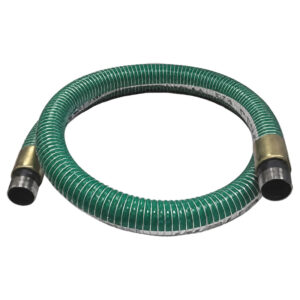
The vapor recovery hose build is a polypropylene film liner with polyester vapor barriers, a fabric-reinforced carcass, an inner helix in galvanised or 316 stainless steel, an outer helix in high-tensile galvanised steel or SS316L, and a coated fabric cover. Layers are compressed mechanically, never vulcanised.
Three numbers define it. Working pressure is 10 bar (150 psi) across the full size range. Burst pressure is 40 bar (600 psi), a 4:1 margin. The window is -40°C to +150°C, covering a cold terminal in January and a hot line above a rack in summer.
Four advantages stand out on this vapor recovery hose. A 51 mm line weighs about 1.6 kg per metre, so a jumper is a one-handed lift. The 25 mm size bends to 25 mm. Barrier plies hold permeation down better than a thicker wall would. And a conductive build carries continuity from fitting to fitting.
The users are oil terminals, road tanker fleets, rail gantries, barge and ship loading points, and petrochemical plants with vapor balance. Equipment includes loading arms, vapor manifolds, VRU skids and tank truck vapor adapters.
The problem is small but expensive. Vapor displaced during filling has to go somewhere; released to atmosphere it means lost product, an emission failure and a flammable cloud at the rack. A dedicated vapor recovery hose closes that loop, and it must be light enough that operators connect it every time.
On quality, incoming film, fabric and wire are inspected for every vapor recovery hose, helices are formed to drawing, and every assembly is proof tested, continuity checked and marked with a batch number, with crimp data stored against it. Approvals on file: ISO 9001, ISO 18752, MSHA, CE, CCS, ABS, DNV, GOST-R, API and MA, plus RoHS and Proposition 65 declarations.
Product Advantages of the Vapor Recovery Hose
- Light enough for one-person handling at the rack.
- Polyester vapor barriers cut hydrocarbon loss through the wall.
- End-to-end conductive build gives static a path to earth.
- Bend radius from 25 mm follows short routings without kinking.
- 10 bar across every bore simplifies spares and training.
- Crimped fittings with digital records trace each assembly to its batch.
Applicable users: terminal operators, tank truck fleets, barge and rail loading facilities, VRU integrators and hose distributors.
Detailed Technical Specifications
| Hose code | ID mm (in) | OD mm (in) | Bend radius mm (in) | Рабочее давление | Давление при разрыве | Weight kg/m (lb/ft) | Length |
|---|---|---|---|---|---|---|---|
| VRCH-01 | 25 (1) | 38 (1.5) | 25 (1) | 10 bar (150 psi) | 40 bar (600 psi) | 0.74 (0.5) | 15 m |
| VRCH-02 | 38 (1.5) | 51 (2) | 46 (1.8) | 10 bar (150 psi) | 40 bar (600 psi) | 1.04 (0.7) | 15 m |
| VRCH-03 | 51 (2) | 64 (2.5) | 76 (3) | 10 bar (150 psi) | 40 bar (600 psi) | 1.64 (1.1) | 15 m |
| VRCH-04 | 76 (3) | 102 (4) | 102 (4) | 10 bar (150 psi) | 40 bar (600 psi) | 2.38 (1.6) | 15 m |
| VRCH-05 | 102 (4) | 127 (5) | 140 (5.5) | 10 bar (150 psi) | 40 bar (600 psi) | 3.42 (2.3) | 15 m |
| VRCH-06 | 152 (6) | 178 (7) | 178 (7) | 10 bar (150 psi) | 40 bar (600 psi) | 8.33 (5.6) | 15 m |
| VRCH-07 | 203 (8) | 241 (9.5) | 203 (8) | 10 bar (150 psi) | 40 bar (600 psi) | 12.50 (8.4) | 15 m |
| VRCH-08 | 254 (10) | 292 (11.5) | 280 (11) | 10 bar (150 psi) | 40 bar (600 psi) | 15.92 (10.7) | 15 m |
- Temperature -40°C to +150°C, published for the polypropylene and polyester liner.
- Burst 600 psi against a 150 psi rating, a 4:1 margin consistent with EN 13765.
- EN 13765 asks for a 4:1 burst margin and a 1.5x proof test; we test at 15 bar (218 psi) unless your specification says otherwise.
- Vacuum is outside the published rating. Where a VRU pulls the line into vacuum, specify the suction and discharge composite hose.
- Standard length 15 m; other lengths cut and crimped to drawing. Tolerances to EN ISO 1307 unless agreed tighter.
Structure and Materials
- Inner helix: galvanised or 316 stainless wire, formed on a mandrel against the liner.
- Liner: polypropylene film plies with polyester vapor barriers, overlapped and compressed.
- Carcass: woven fabric plies carrying axial load and holding the liner against pressure.
- Обложка: PVC-coated abrasion-resistant fabric, red or blue for circuit identification.
- Outer helix: high-tensile galvanised or SS316L wire, spiralled over the cover.
Why the composite build holds up
Three load paths share the work. The inner helix resists collapse, keeps the bore open when the line bends around a rack post, and stops the liner wrinkling, which is where a thermoplastic hose usually starts to leak. The outer helix carries hoop load and takes the abrasion that would otherwise reach the carcass when the hose is dragged over concrete. Between them, the fabric plies take axial load, so pulling on the hose loads fabric rather than film.
The liner is where chemical resistance lives. Because the layers are compressed rather than vulcanised, each ply can be a different material: resistance in one, permeation barrier in another, strength in a third. A rubber hose has one homogeneous wall and has to compromise. The cover is sacrificial, PVC-coated fabric with good abrasion and fuel spill resistance, and because it is not structural a scuffed cover is a maintenance note rather than a pressure failure.
Safety factor, proof pressure and burst margin
The published burst figure is 600 psi against a 150 psi rating. That is 4:1, which is what EN 13765:2018 asks of multi-layer thermoplastic hose, and it is the number to put in a tender document. The same standard sets a routine proof test at 1.5 times working pressure, so an assembly leaving our plant has been taken to 15 bar and held there.
Buyers should ask three questions. What is the burst figure per bore, not just the smallest size? Is the proof test on every assembly or on a sample? Is there a record linking the test to the film and wire lots? The margin is also a maintenance tool: a line run over or exposed outside its rating has spent it, so retire and rebuild. A proof test verifies a hose, it does not recover one.
Chemical Compatibility and Media Guide
Ratings describe the liner in vapor or intermittent liquid contact at ambient to moderate temperature. They start a conversation; they are not an approval.
| Medium | Rating | Note |
|---|---|---|
| Mineral hydraulic oil | Good | Vapor and splash only |
| Diesel | Good | Standard fuel duty |
| Gasoline | Excellent | Core application |
| Kerosene | Excellent | Barrier plies help |
| Crude oil | Good | Sweet crude preferred |
| Lubricating oil | Good | No swelling expected |
| Vegetable oil | Ограниченный | Fatty acid attack |
| Biodiesel B100 | Ограниченный | Confirm blend in writing |
| Ethanol E100 | Ограниченный | Alcohol permeates PP |
| Methanol | Not recommended | Use PTFE liner |
| Toluene | Ограниченный | Vapor peaks need PTFE |
| Xylene | Ограниченный | Aromatic attack at temperature |
| MEK | Ограниченный | Short contact only |
| Acetone | Not recommended | Ketone attack on PP |
| Ethyl acetate | Ограниченный | Ester duty needs PTFE |
| Dichloromethane | Not recommended | Chlorinated solvent |
| Trichloroethylene | Not recommended | Chlorinated solvent |
| Sulphuric acid 30% | Good | Aqueous, ambient |
| Sulphuric acid 98% | Not recommended | Oxidising, use PTFE |
| Hydrochloric acid 35% | Good | Aqueous duty |
| Sodium hydroxide 50% | Good | Caustic duty |
| Ammonia 10% | Good | Aqueous ammonia |
| Sodium hypochlorite 12% | Ограниченный | Oxidiser, short contact |
| Hydrogen peroxide 30% | Not recommended | Strong oxidiser |
| Phosphoric acid 85% | Good | Confirm temperature |
| Nitric acid 65% | Not recommended | Oxidiser, use PTFE |
| Acetic acid 99% | Ограниченный | Glacial acid attacks PP |
| Ethylene glycol | Excellent | Coolant and de-icer |
| Propylene glycol | Excellent | Low swell |
| Water | Excellent | Washdown and condensate |
| Sea water | Excellent | Marine deck exposure |
| Steam condensate | Good | Below 100°C |
| MTBE | Good | Common gasoline additive |
| Benzene | Ограниченный | Aromatic, vapor only |
| LPG vapor | Good | Vapor phase, not liquid |
Three rules for reading the chart. Derate for temperature: a rating earned at 20°C does not transfer to 120°C. Concentration matters more than family: 30% and 98% sulphuric acid behave like different chemicals. Contact time decides the answer: a splash at the rack is not a month of standing solvent.
Request the full compatibility chart as a PDF before you commit a line to a new medium, and send the concentration and temperature with the enquiry.
Applications and Industries
- Fuel terminals: vapor jumpers on bottom loading arms, manifolds and VRU skids.
- Road tankers: tank truck vapor adapters and overfill return lines.
- Marine and barge loading: ship-to-shore vapor balancing lines on loading arms.
- Rail gantries: vapor collection headers on railcar loading spots.
- Petrochemical plants: breather lines, inert gas blankets, solvent vapor headers.
- OEM builders: private-label vapor recovery hose for loading arm manufacturers.
Selection Guide for Vapor Recovery Hose
Sizing the return line starts with the vapor volume the recovery unit can take, not with the liquid line bore. Where a terminal also loads trucks, the bottom loading hose covers the liquid side, and the tanker composite hose covers smaller bore rack work.
Size, flow and pressure drop
Vapor lines are sized on volume, not on liquid throughput. A recovery line carries roughly one to one and a half times the vapor volume of the liquid it displaces, at close to atmospheric pressure, so a 50 mm liquid line often needs a 76 mm vapor line to avoid back pressure at the tank. Undersizing shows up as a slow load, a hissing vent or a pressure switch that trips at the end of the fill. If the rack is already built, go up one size on the vapor jumper before adding a booster.
End fittings and hose assembly
The couplings on this range are specified by material combination: carbon steel or stainless NPT male with a carbon steel or stainless ferrule and seal, and polypropylene NPT male variants for the lightest assemblies. The seal material matters more than the body, because a vapor line runs dry and a dry seal hardens. Every assembly is crimped in house with the ferrule matched to the cover, and continuity is checked end to end when a conductive build is ordered.
Buy the finished hose assembly. A vapor jumper is short, handled constantly and coupled and uncoupled several times a shift, so the crimp is the wear point. A factory assembly arrives tested, with the length set to the arm geometry rather than cut on the rack.
How it compares
| Build | Рабочее давление | Typical use | Trade-off |
|---|---|---|---|
| Vapor recovery hose | 150 psi (10 bar) | VRU lines, vapor balancing, tank truck return | Light, flexible, low permeation |
| Bottom loading hose | 200 psi (14 bar) | Liquid distillate loading | Higher pressure, heavier wall |
| Petroleum suction and discharge hose | 370 psi (25 bar) | Full-vacuum liquid transfer | Much heavier, over-specified for vapor |
| Rubber vapor hose | Varies | General vent service | Heavier, permeation higher, stiffer |
The case for the composite build is weight and permeation. A 4 in vapor jumper is handled one-handed at the rack, and the composite wall is light enough that an operator does not drag it across the deck. The polyester vapor barrier in the liner is there for the second reason: a vapor line that weeps hydrocarbon through its wall defeats the recovery system it is part of.
What drives the price
Bore, liner barrier plies, helix material and coupling material set the cost. A stainless NPT male with a stainless ferrule costs more than the carbon steel equivalent and is specified where the rack is washed down. Polypropylene couplings are the cheapest option and suit light duty. Length is short by nature, so fittings are a larger share of the assembly price than on a 15 m liquid hose: ask for the pair price with the hose rather than assuming it is included.
Common selection mistakes
- Sizing the vapor line to the liquid line and creating back pressure at the tank.
- Mixing carbon steel and stainless couplings on one rack and getting galvanic corrosion at the joint.
- Buying a non-conductive hose for a line that bonds to the rack.
- Ignoring permeation and treating the vapor line as an accessory rather than part of the recovery system.
Installation, Operation and Maintenance
Installation
Keep the run as short and as straight as the arm allows, support the hose so its weight does not hang on the crimp, and keep the bend radius above the published figure for the bore. Bond the assembly to the rack where the system relies on continuity, and check the resistance after installation rather than assuming the factory value survives a field coupling change. Use a protective sleeve where the hose crosses a steel edge or a hot surface.
Inspection and retirement
Check the cover for cuts and the couplings for looseness before each shift, because a vapor jumper is coupled and uncoupled many times a day and the ferrule takes the abuse. Retire on evidence: a leak at the crimp, a cracked cover that exposes the helix, a hose that has gone stiff, or a continuity reading outside specification. A documented review at four to five years is sensible in continuous rack duty.
Cleaning, storage and service life
Purge and drain after use, cap the ends and store coiled off the ground. Vapor lines collect condensate, and a standing heel of hydrocarbon inside a hose is both a permeation source and a fire risk. Do not store a jumper hanging from one end: the crimp is not a lifting point. Service life in rack duty typically runs four to six years, shorter where the hose is dragged across concrete.
Quality Assurance and Test Data
Production covers incoming inspection of film, fabric and wire, liner lay-up with the polyester barrier plies counted against the drawing, carcass build, cover application and crimping. Because a vapor line is a dry line, the liner seam is inspected closely: a pinhole that would be harmless in liquid service becomes a permeation path in vapor service.
Testing includes a proof test on every assembly, burst testing on lot samples, continuity measurement end to end on conductive builds, and dimensional checks on bore and length. Each assembly carries a batch number and its test record is retrievable, which is what a terminal audit asks for.
Standards and Certifications
| Стандартный | What it covers | What it means for the buyer |
|---|---|---|
| EN 13765:2018 | Thermoplastic multi-layer hose for hydrocarbons and chemicals; Type 1 is the vapor class | The construction and test framework for this product |
| EN ISO 1402 | Hydrostatic pressure testing | Basis for proof and burst testing |
| EN ISO 8031 | Electrical resistance of assemblies | Applies to conductive vapor builds |
| EN ISO 1307 | Dimensions and tolerances | Bore and cut length tolerance |
| EN 1765 | Rubber oil suction and discharge assemblies | The rubber comparison, not this product |
| API RP 1004 / terminal practice | Bottom loading and vapor recovery procedure | The operating context the jumper is built for |
Company certifications: ISO 9001 and ISO 18752 quality systems, plus CE, CCS, ABS, DNV, MSHA, GOST-R and MA listings and California Proposition 65 compliance. Certificate scope is supplied with the quotation.
Часто задаваемые вопросы
Most questions concern permeation, ullage and coupling fit; the composite hose range lists the sister builds.
What is a vapor recovery hose used for?
It returns hydrocarbon vapor from a tank to a recovery unit or back to the delivery tanker, on bottom loading racks, tank truck lines and ship-to-shore vapor balancing systems. It is a dry line, not a liquid transfer hose.
What pressure does it carry?
150 psi, or about 10 bar, at every bore, with a 600 psi burst on the published sheet. Vapor service rarely approaches the rating; the figure matters for surge and for mis-application.
Why is the liner different from a fuel hose?
The liner combines polypropylene film with polyester vapor barrier plies. The barrier is what slows hydrocarbon migration through the wall, which is the whole point of a recovery line.
Does it need to be conductive?
Where the system bonds the hose to the rack, yes. We build conductive assemblies with the helix bonded to the fittings and measure continuity end to end before dispatch.
What temperature can it take?
-40°C to +150°C on the published sheet. The warm limit is generous for vapor service and covers hot ambient racks and steam-adjacent piping.
What sizes are available?
25 mm to 254 mm bore, 1 in to 10 in, in 15 m standard lengths, with shorter jumpers cut to the arm geometry.
Which couplings are standard?
Carbon steel or stainless NPT male with a matching ferrule and seal, plus polypropylene NPT male variants for light duty. Stainless is the usual choice on a washed-down rack.
What is the minimum order and lead time?
Standard bores ship against the confirmed assembly drawing, with sampling available in 48 hours on request and bulk turnaround around seven days for standard specification.
How do I get a quote and the datasheet?
Give us the medium, temperature, working pressure, bore, length, connection, quantity and discharge port.
Why Source Composite Hose from HENGHUA
HENGHUA manufactures in an 18,000 m2 facility with eight high-speed lines and 25 million metres of annual output, supplying more than 70 countries. Vapor jumpers are a small part of that volume but a demanding one, because they are handled every shift and judged on leaks rather than on burst pressure.
Quality is certified to ISO 9001 and ISO 18752, with CE, CCS, ABS, DNV, MSHA, GOST-R and MA listings. Every assembly is proof tested and carries a batch number, and continuity results travel with the delivery documents when a conductive build is ordered.
As a manufacturer and exporter we supply to drawing. OEM and ODM work covers private-label covers, custom coupling combinations, non-standard lengths and colour coding by product line, with sampling in 48 hours and bulk turnaround around seven days on standard specification. Distributors and wholesalers get a consistent specification between shipments, which matters when a rack is standardised across several terminals.
Technical support answers the questions a vapor recovery hose raises: which barrier ply count suits the vapor, which coupling material survives the wash-down, and where continuity has to be proven. Send the rack layout with the enquiry.
Запросить расценки
Give us the medium, temperature, working pressure, bore, length, connection, quantity and discharge port. Our sales engineers will confirm the barrier build and the coupling combination, then return a quotation with a drawing and the specification as a PDF. Ask for the compatibility chart, the certification pack or a sample jumper for a trial rack. Tell us whether the line needs a conductive build and how the rack is bonded, because that decides the assembly rather than the hose.


 English
 Spanish
 Portuguese
 French
 German
 Arabic
 Russian
 Indonesian
 Japanese
 Korean