
An industrial steam hose is only as good as the three numbers printed on it: bore, working pressure and steam temperature. Those values decide whether a hose survives a full shift or fails on the plant floor. This guide works through the full range from 3/8 inch to 4 inch bore, explains the gap between a 250 psi (17 bar) working rating and a 2,500 psi (172 bar) burst figure, and maps the duties that pick the grade. It then covers testing, inspection and the safety boundary that tells you when a hose must be withdrawn.
What Counts as an Industrial Steam Hose?
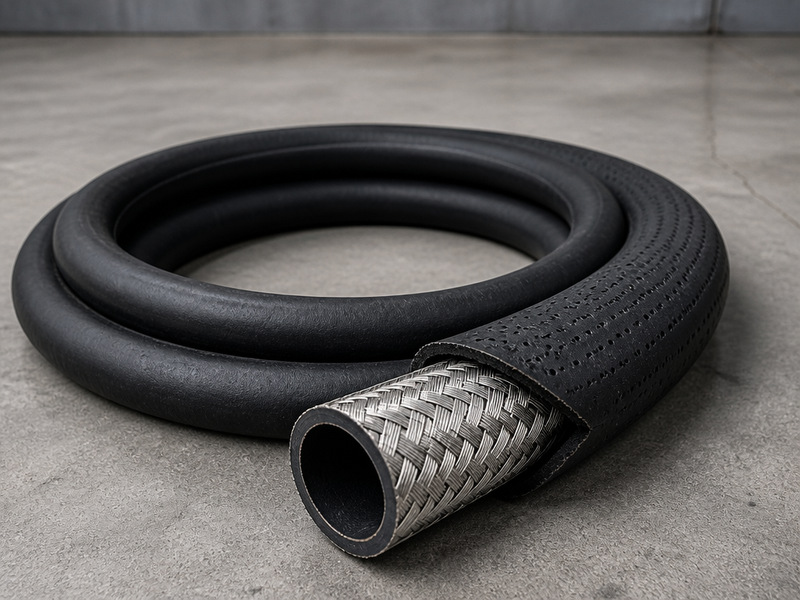
A steam hose is a flexible rubber hose engineered to carry saturated steam under pressure without collapsing, blistering or delaminating. Three features separate it from a general-purpose water hose.
- Tube — an EPDM compound that resists hot condensate, where a general-purpose tube hardens and cracks.
- Reinforcement — steel wire braid that carries the hoop load internal pressure creates, which textile-only constructions cannot hold.
- 표지 — a pin-pricked cover that vents the gas permeating through the tube wall instead of blistering.
ISO 6134:2024 (EN ISO 6134 in Europe), the international standard for saturated-steam hose, defines two types. Type 1 is rated to 6 bar at 164 °C with textile reinforcement. Type 2 is rated to 18 bar at 210 °C with steel wire reinforcement. The standard also sets cover classes and electrical suffixes, and it requires end connections that let you adjust clamp force. Quick-release couplings are prohibited for that reason, because a coupling that cannot be tightened cannot be made safe.
Most steam hose safety problems trace back to a specification that ignored one of those three features. A hose can look correct from the outside and still fail early if the tube, the reinforcement or the venting does not match the duty.
Two more features decide whether a hose lasts. The first is the compound itself, because a peroxide-cured EPDM holds up where a sulfur-cured rubber softens. The second is the finish, because a wrapped cover is smoother and more abrasion-resistant than an open one. Neither feature is visible in a photograph, which is why the standard and the data sheet matter more than a picture.
An industrial steam hose built from EPDM carries saturated steam and hot condensate. Mineral oil, diesel and gasoline attack that tube, so those duties call for an NBR/PVC or FKM hose instead. A steam pressure washer hose is a different product.
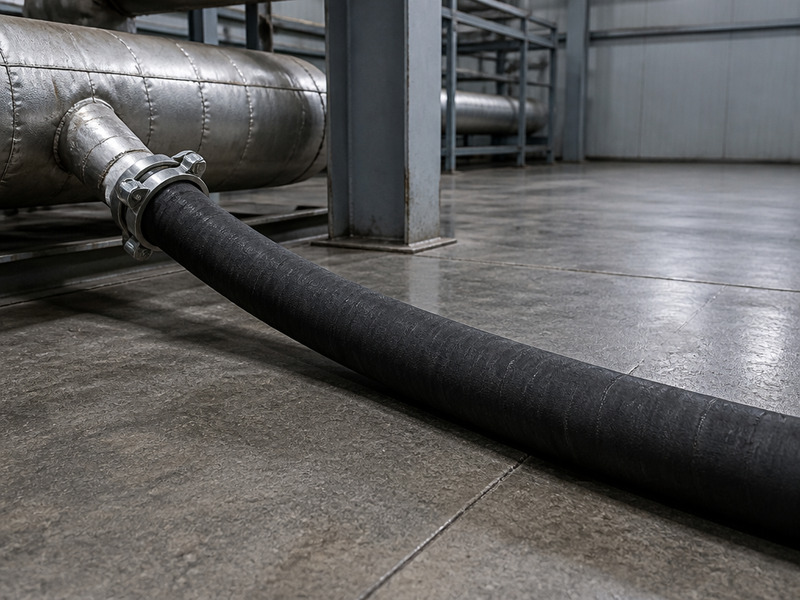
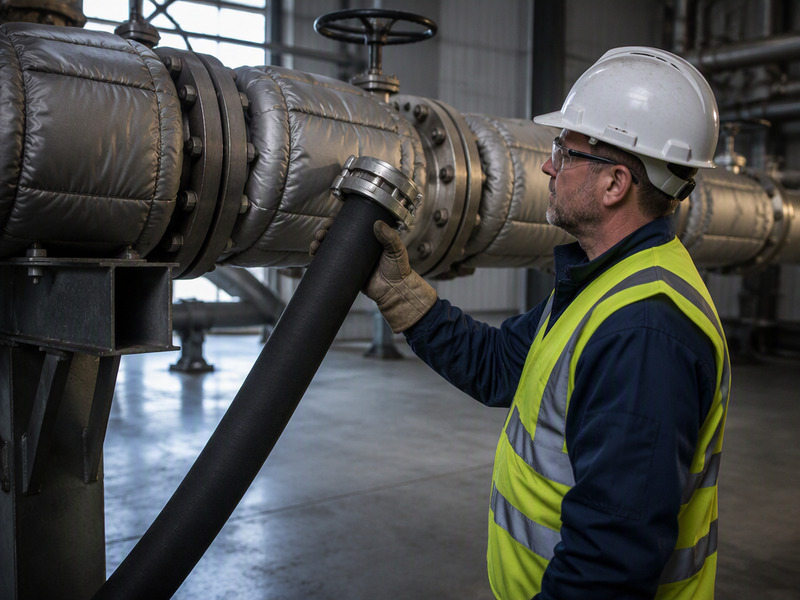
Figure 1. A steam hose clamped to a header on a plant floor.
Industrial Steam Hose Sizes: 3/8 Inch to 4 Inch and What Each Bore Carries
Bore size is the first number a buyer fixes, because it sets flow and pressure drop. The range runs from 3/8 inch to 4 inch bore, which covers roughly 10 mm to 102 mm inside diameter. Small bores feed steam lances and cleaning guns, where flexibility matters more than volume. Large bores supply headers, tank heating coils and vulcanizing presses, where flow matters more than handling.
| Bore (inch) | Inside diameter (mm) | Outside diameter (mm) | Minimum bend radius (mm) | Typical duty |
|---|---|---|---|---|
| 3/8 | 10 | 21 | 50 | Steam lances and cleaning guns |
| 1/2 | 12 | 25 | 60 | Light cleaning and small tools |
| 3/4 | 19 | 32 | 80 | Cleaning guns and portable units |
| 1 | 25 | 39 | 110 | Process lines and tank heating |
| 1-1/2 | 38 | 54 | 180 | Tank heating and vulcanizing |
| 2 | 51 | 67 | 245 | Header drops and transfer lines |
| 3 | 76 | 95 | 400 | Bulk transfer and storage heating |
| 4 | 102 | 124 | 600 | Stub ends and main header connections |
The bore, inside diameter, outside diameter and bend radius values in the table are for the 230 °C grade, measured on the finished hose. The same 3/4 inch bore bends to 80 mm in that grade, but the 170 °C version of the same bore needs roughly 70 mm. Read every bend radius with its grade attached, because the compound and the reinforcement differ between the two.
Flow follows the square of the bore, so a small step up in diameter buys a large step up in capacity. That is why a 1 inch bore moves far more steam than a 3/4 inch bore at the same pressure. Pressure drop over a long run is the counterweight: the smaller the bore and the longer the run, the more pressure you lose before the steam reaches the tool.
A bolted safety clamp on every end is part of good steam hose safety practice, and it is also the cheapest insurance against a blow-off. For a table of every construction detail, see the steam hose types, sizes and specifications guide. For the ends themselves, the steam hoses and fittings page covers couplings and clamps.
Industrial Steam Hose Pressure and Temperature Ratings
Two ratings matter most. Working pressure is the highest gauge pressure the hose should see in service. Burst pressure is the point at which it fails, and the safety ratio links the two.
A steam hose pressure rating of 250 psi (17 bar) with a 2,500 psi (172 bar) burst gives a 10:1 ratio. That is a wider margin than hydraulic hose, which is typically 4:1, or pneumatic hose, which is typically 3:1. Steam carries far more stored energy, so the margin is deliberate. The hydraulic hose temperature rating page shows how the two families compare.
How to Read a Steam Hose Rating
Temperature is the other half of every steam hose rating, and the two values travel together. Saturated steam at 10 bar sits at 184 °C. At 18 bar it reaches 210 °C, the ceiling for a Type 2 hose. A rating printed without a temperature is incomplete, because a hose loses pressure capacity as temperature climbs.
When you compare suppliers, compare the steam hose rating at a stated temperature, not a headline number. A steam hose pressure rating written for 250 psi belongs to one temperature band and not to all of them. Read every value as a pair.
Store and handle these hoses inside their temperature band as well. A steam hose that sits in freezing weather and then takes full pressure is more likely to crack at the fitting. Warm the line up gradually, and open it slowly so condensate can drain instead of hammering the tube.
A steam hose rating covers saturated steam only. Superheated steam is heated above its saturation temperature at the same pressure, so it exceeds the rubber envelope. That duty needs a PTFE-lined hose or a corrugated metallic hose, not a heavier rubber one.
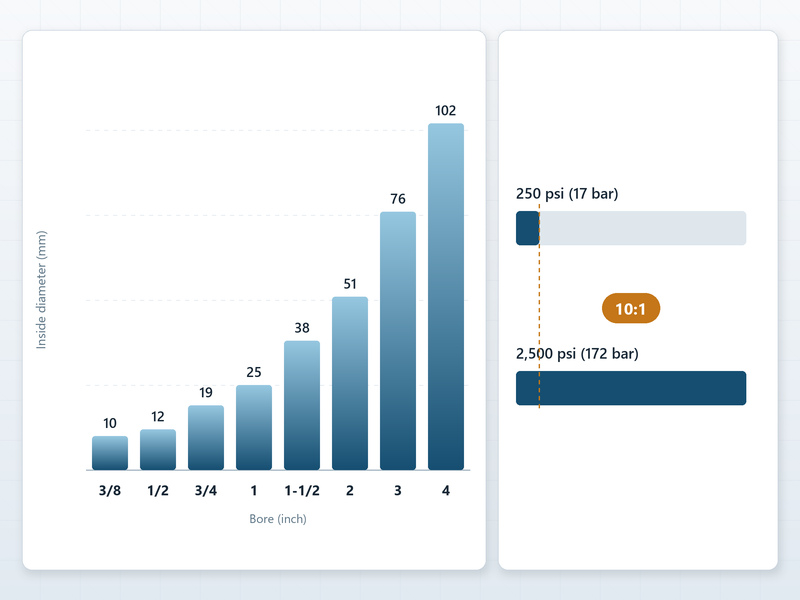
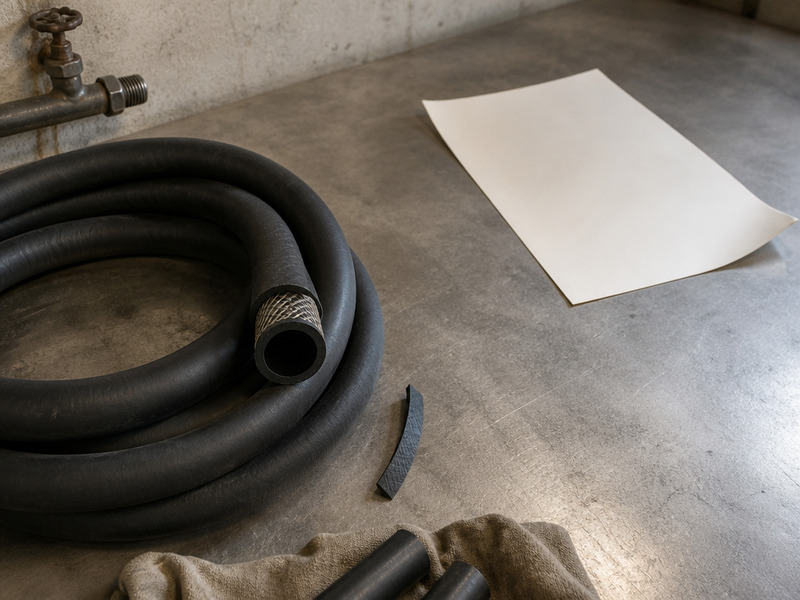
Figure 2. Bore sizes with working and burst pressure ratings.
Industrial Steam Hose by Application
Steam hose applications divide into three families: cleaning, process and transfer. Each one pushes a different limit, and that limit decides the grade and the fittings.
- Steam cleaning — lances and guns that strip grease, tar and residue from tanks, floors and equipment. Small bore, high flexibility, constant handling.
- Vulcanizing and process heating — presses, jacketed vessels and concrete curing chambers that hold a fixed temperature for a long cycle. Higher pressure, longer runs, little movement.
- Transfer and tank heating — header drops and coils that move steam around a plant. Large bore, long length, low flexibility.
| 의무 | Typical bore | Working pressure | Steam condition | Recommended grade |
|---|---|---|---|---|
| Steam cleaning | 3/8 to 3/4 inch | 250 psi (17 bar) | Saturated, 184 °C or below | 170 °C grade to 7 bar g, 230 °C grade above 7 bar g |
| Vulcanizing presses | 1 to 1-1/2 inch | 250 psi (17 bar) | Saturated, up to 210 °C | 230 °C |
| Process steam lines | 1 to 2 inch | 250 psi (17 bar) | Saturated, up to 184 °C | 170 °C grade to 7 bar g, 230 °C grade above 7 bar g |
| Tank car, tank and coil heating | 2 to 4 inch | 250 psi (17 bar) | Saturated, 184 °C or below | 170 °C grade to 7 bar g, 230 °C grade above 7 bar g |
These steam hose applications look similar on paper, but the duty cycle differs. A cleaning hose is dragged and coiled all day. A press hose sits still for hours at temperature. Buy for the harder of the two lives, because that is the life the hose will actually live.
Applicability: set the grade from the saturation temperature that belongs to your working pressure.
For the wide view of how hose families compare, see what industrial hoses are used for.
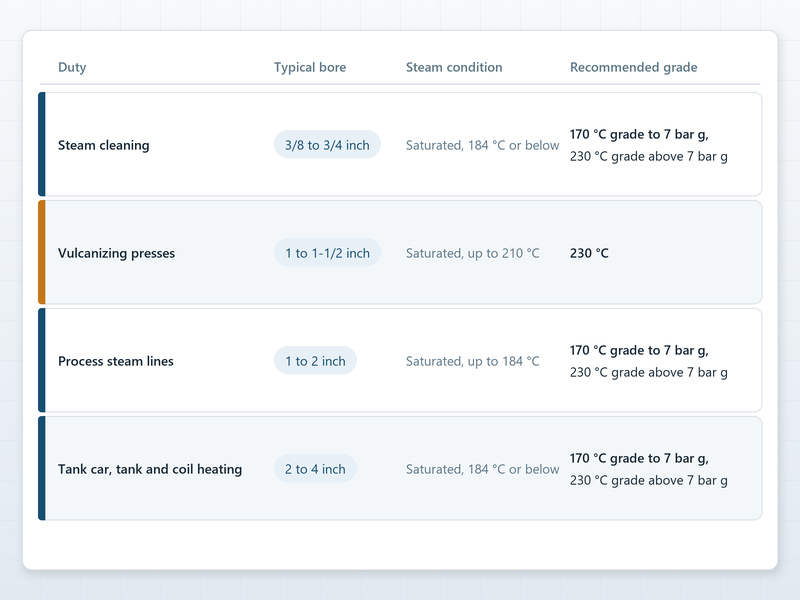
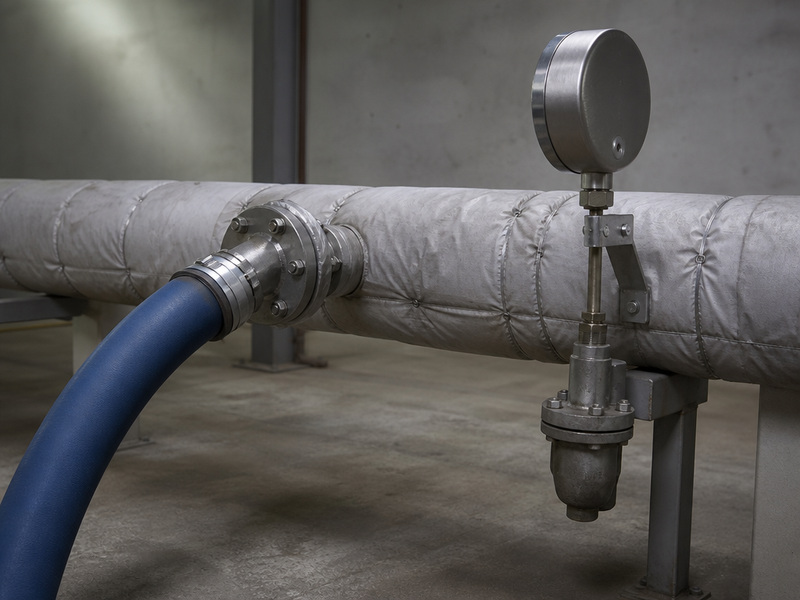
Figure 3. Duty, bore and grade for the common steam duties.
Steam Cleaning, Vulcanizing and Process Steam: Three Different Duties
Steam hose cleaning is the lightest of the three duties and the hardest on the hose. A steam hose cleaning gun cycles hot and cold many times a shift, so the hose flexes, kinks and drags across concrete. Choose the smallest bore that still delivers the volume you need, and accept a little more pressure drop in exchange for easier handling.
A steam hose cleaning whip also benefits from a short, light section at the gun, so the operator is not fighting the full weight of a long run. That single detail decides whether the tool gets used or parked in a corner.
Vulcanizing and press duty is the opposite. The hose sits in a fixed position, often lagged, and holds the same pressure and temperature for hours. Here the tube compound is the limit, not flexibility. The 230 °C grade exists for this duty, and the EPDM steam hose construction page shows why. Where saturated steam stays at 170 °C or below, which is about 7 bar g, the 170 °C grade is the right choice. At 10 bar g, which is 184 °C, specify the 230 °C grade instead.
Process steam lines fall between cleaning duty and press duty. Flow and pressure drop decide the bore, and the run length decides whether you use a single length or a joined assembly. Unlike steam hose cleaning, this duty rarely demands a flexible whip, so a stiffer, larger hose is often the better fit.
A third duty pattern sits between cleaning, process and transfer: a line that is moved only for maintenance. Treat it as a fixed installation, but keep the bore a size larger than the calculation suggests, because a hose that runs hot and slow lasts longer than one that runs at its limit.
One check ties the three together. List the highest temperature, the highest pressure and the longest continuous run for each point on the plant. That short list, not a catalog, picks the grade.
Steam Hose Length, Reels and Handling on Site
Bulk steam hose is supplied in long lengths, but a working whip is rarely the full length. Standard bulk lengths run to a maximum of 100 m, with large bore sizes capped at 40 m or 20 m because the coil becomes too heavy to handle safely.
A steam hose reel keeps the coil off the floor, protects the cover from abrasion and lets one operator pay out and retrieve the length. For the steam hose applications that involve movement, a steam hose reel pays for itself in cover life alone. For a fixed press connection it adds little, because the hose never moves.
- Fixed installations — a single cut length, clamped at both ends, with no reel.
- Mobile cleaning — a steam hose reel mounted on the unit or on a wall, with a short whip at the gun.
- Mixed duty — two hoses rather than one: a long supply length and a flexible whip.
Coiling a hose over a sharp edge is a steam hose safety risk that a reel removes. It is also the fastest way to put a permanent kink in a cover.
Cut Length, Ready Assembly or Steam Hose Kit
A ready-made assembly saves the fitting work, and a steam hose kit bundles the hose, the couplings and the clamps in one box. A steam hose kit is the fastest route to a correct assembly when a line is down, because the parts are matched before they arrive.
For condition and cost over the life of the asset, see hose maintenance and lifecycle cost.
Testing and Inspection: What an Industrial Steam Hose Must Pass
Steam hose testing starts at the factory and continues on site. Every length is proof-tested hydrostatically at 1.5 times its working pressure before it ships. That proof test catches a bad braid or a poor crimp while the hose is still in the plant that made it.
On site, steam hose testing is mostly visual and documentary. Check the date code, the printed pressure and temperature, and the condition of the cover. Then pressure-test the assembly after any new crimp, because a fitting is only as good as the work that joined it.
Steam Hose Testing in Three Steps
- Before first use — confirm the steam hose pressure rating matches the line, and check the clamp force.
- Routine inspection — look for cover blisters, hardening, cracks and exposed wire.
- After any repair or re-crimp — repeat the 1.5 times proof test on the whole assembly.
Steam hose safety depends on that routine more than on any single specification. A hose that passed at the factory can still fail after a season of drag, heat and chemical contact. The steam hose category page lists the clamps and couplings that keep an assembly sound.
Keep a written record for every hose. Note the date code, the service point, the pressure and the temperature it sees, and the result of each inspection. When a hose is finally withdrawn, that record tells you whether the failure came from age, from abuse or from the wrong grade.
When an Industrial Steam Hose Must Be Withdrawn
Withdraw a hose the moment any of these appear: a cover blister, a bulge, a kink that stays after the pressure is released, cracked or hardened rubber, or exposed reinforcement.
Replace, never repair. A field repair on a steam hose hides the fault instead of removing it, and the next failure happens under pressure. Steam hose safety practice treats every one of those findings as a replacement decision, because a burst steam hose releases far more energy than a hydraulic leak.
A hose past its expected life comes out of service even when it still looks sound.
Expected life depends on duty. A hose in continuous service is typically retired after 2 to 4 years, and a hose in intermittent service after 5 to 7 years. Those figures are a site convention, not a guarantee, so the inspection record matters more than the calendar.
Cold shock is another reason to withdraw a hose early. Condensate hammer can damage a tube that is already stiff with age, and the damage often shows up first at the crimp. If a hose has survived several winters outdoors, inspect the ends closely before the next heating season.
Industrial Steam Hose FAQs
What sizes does a steam hose come in?
Bore runs from 3/8 inch to 4 inch, roughly 10 mm to 102 mm inside diameter. Small bores suit cleaning lances, and large bores suit header drops and tank coils. Check the outside diameter too, because a clamp is sized on the outside of the hose, not on the bore.
What is a steam hose pressure rating?
It is the highest gauge pressure the hose should see in service, and it is meaningful only with a temperature. A 250 psi (17 bar) rating and a 2,500 psi (172 bar) burst give a 10:1 ratio. Gauge pressure is measured above atmospheric pressure rather than against a vacuum.
Can one hose handle steam cleaning and process steam?
Often, yes, if the bore suits both duties. Cleaning wants flexibility, while process lines want flow, so many plants keep a short flexible whip for cleaning and a larger hose for the line itself. The whip takes the handling, and the larger hose takes the pressure drop.
How often should I replace a steam hose?
Continuous service is usually retired after 2 to 4 years, and intermittent service after 5 to 7 years. Replace rather than repair, and pull any hose that shows a blister or exposed wire. Both windows assume the hose runs inside its temperature grade and inside its pressure rating.
Do I need a steam hose reel?
Only for mobile duty. A steam hose reel protects the cover and helps one operator handle a long length, but a fixed press connection needs no reel at all. Add one wherever the hose is dragged, coiled or left across a walkway.
What is in a steam hose kit?
A steam hose kit usually pairs a cut length with matched couplings and clamps, so the assembly is correct before it reaches the line. The parts are matched by bore and thread at the factory, so the fit is settled before the box is opened.
How is steam hose testing done?
Every length is proof-tested at 1.5 times working pressure at the factory. On site, steam hose testing is visual, plus a repeat pressure test after any new crimp or repair. Steam damage usually shows up as a trend rather than as a single failed test.
Industrial Steam Hose in Bulk and as Assemblies
Buying a steam hose is a choice between a cut length and a finished assembly. A cut length suits a plant that crimps its own ends and holds the tooling. A finished assembly arrives ready to fit, which shortens downtime and removes the risk of a poor crimp. Most plants that keep a spare kit on the shelf prefer the assembly, because it needs no preparation.
This split matters most when a line is critical. A plant that keeps assemblies ready can swap one in minutes, while a plant that crimps its own ends needs the tooling, the couplings and a trained operator on hand. For a single odd length, crimping in house can win. For a fleet of cleaning whips and process runs, ready assemblies usually win, because the risk is carried by the supplier instead of the shift.
Every assembly is proof-tested, so testing is complete before the hose leaves the plant. Ask for the steam hose pressure rating and the temperature band together, and check that the kit includes matched couplings and clamps. Match the steam hose applications on your line to the grade, and the rest of the choice follows.
HENGHUA manufactures reinforced industrial hose and complete hose assemblies for plants, distributors and OEM brands. Our EPDM steam hose range covers 3/8 inch to 4 inch bore, rated 250 psi (17 bar) working pressure with a 10:1 burst safety factor.
The construction is a smooth steam-resistant EPDM tube, one or two layers of high-tensile steel wire braid, and a pin-pricked cover that vents permeating gas instead of blistering. Every length is proof-tested at 1.5 times working pressure before it leaves the plant, and each batch is date-coded. Because compounding, extrusion, braiding, vulcanization and crimping all happen in one plant, bulk lead times stay short. Send us the working pressure, the steam temperature, the bore and the end connection, and we will quote against them.
We supply cut lengths, crimped ends, protective sleeves, colour coding and OEM branding. 견적 및 무료 샘플 받기
Final Verdict: Rate the Industrial Steam Hose for the Hardest Duty It Sees
Size, rating and application are not three separate decisions. They are one decision, and the hardest duty usually sets it.
List the steam hose applications on the plant first, then score each against the worst condition it meets. Where a hose cleans tanks all day, treat flexibility and cover abrasion as the priority, because steam hose cleaning punishes a stiff hose. Where a hose feeds a press, treat temperature and the tube compound as the priority.
A single steam hose rating cannot cover every point in a plant. The safe habit is to write down the worst case, not the average: the worst temperature, the worst pressure and the worst handling decide the grade. A hose that meets the easy duty and misses the hard one will still fail.
Write the worst case on the line card, next to the bore and the grade. A number on a card is what a new operator reads at three in the morning, when the hose is hot and the decision is quick. Vague guidance gets ignored; a stated limit gets followed.
Rate every hose against the hardest duty it sees, not the one it sees most often. Tell us the duty and the working conditions, and we will match the bore, the grade and the ends to it.
Written by the HENGHUA engineering team, with input from plant maintenance and steam-system reliability teams across North America, Europe and South East Asia. HENGHUA manufactures reinforced industrial hose and hose assemblies, including an EPDM steam hose range from 3/8 inch to 4 inch bore. Those assemblies are rated 250 psi (17 bar) working pressure with a 10:1 burst safety factor, and are supplied as cut lengths or as fully crimped assemblies. Fittings, protective sleeves, colours and OEM branding are available on request.

 English
  Spanish
  Portuguese
  French
  German
  Arabic
  Russian
  Indonesian
  Japanese
  Korean