
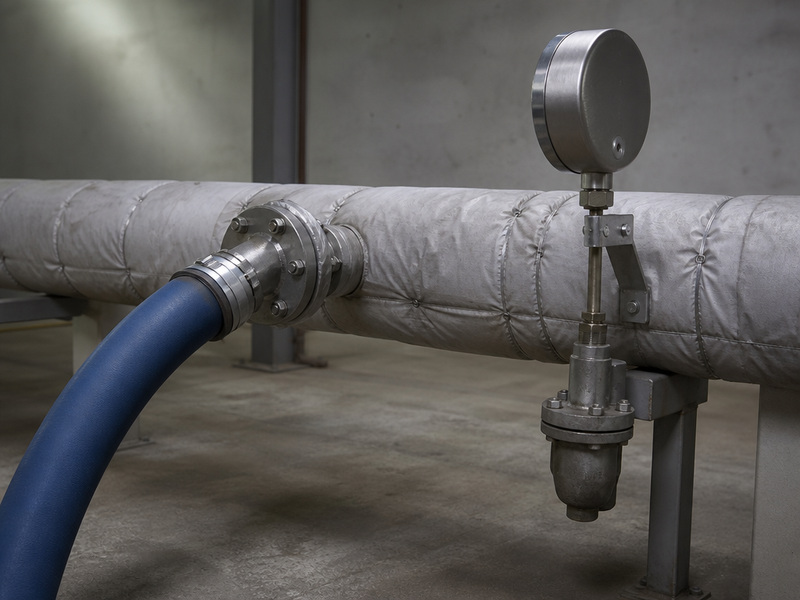
For saturated duty a correctly rated rubber steam hose is enough, while a superheated duty calls for a superheated steam hose with a non-rubber core. The split that decides this choice is whether the steam is sitting at its boiling point for the pressure, or has been heated past that point at the same pressure.
For saturated steam the temperature comes with the pressure, so a hose rated to that pair is the whole answer. In the superheated case the condition sits above the saturation temperature at the same pressure, outside the rubber envelope.
This guide separates the two duties, gives the saturation pressure–temperature table, and shows when to move to a PTFE-lined or corrugated metallic hose.
Short Answer: Saturated Steam Is a Pressure–Temperature Pair; Superheated Steam Leaves the Rubber Envelope
Saturated and superheated duty are two different things, not two grades of one product. In saturated duty, every part of the vapor sits at the boiling point for its pressure, so one gauge reading gives you the temperature. Heat the same vapor further at constant pressure and it becomes superheated, with a temperature set by the heater rather than the gauge. A rubber steam hose is designed and rated for the saturated duty.
A superheated duty is where rubber stops being the right envelope, and the answer is a superheated steam hose with a PTFE lining or a corrugated metallic hose.
- Saturated duty — temperature is fixed by gauge pressure, so it fits a rubber hose rated to that pair.
- Superheated duty — temperature is set by the superheater and rises above saturation, so the wall runs hotter than any saturated case.
- Mixed duty — design the hose for the hottest continuous condition it will ever see, not for the average.
- Unknown duty — measure pressure and temperature together, then match the pair against the saturation table below.
If you need the general range first, the page on steam hose types, sizes and specifications covers bore, reinforcement and standard markings in one place.
What Makes Superheated Steam Different
Superheating means adding heat to steam after it has boiled, at constant pressure. A boiler makes vapor at its saturation point, and a superheater or a pressure-reducing station then raises its temperature above that point. Superheat is measured as the number of degrees above the saturation value.
Superheating produces dry, hotter vapor carrying more energy per unit mass. That is exactly why superheat is used for turbine work and for process heating where wet steam is unwelcome. It is also why the steam hose material has to change. In this guide that condition is called superheated duty, and the hose built for it has to leave the rubber envelope.
Why the Two Duties Behave Differently at the Wall
The practical difference comes down to how each duty behaves at the wall. In the saturated case, the vapor condenses against the cooler tube and releases latent heat, which tempers the surface and limits how hot the tube wall actually gets. The superheated vapor carries no such buffer and delivers its heat straight into the compound.
Dry steam also matters. A steam trap and a separator keep condensate out of the line, so the duty at the hose stays close to the saturation value in the table. Wet, slugging steam delivers a hotter, heavier load than the pressure suggests, and it shortens life even inside the rubber envelope.
A gauge cannot see any of this, which is why a plant should confirm the steam condition in writing before it orders. A supplier who knows the duty can point to the right construction in one step. A supplier who only receives a pressure figure has to guess.
An unknown steam condition is a steam hose material problem before it is a pressure problem. A rubber compound that stays flexible in wet service loses its properties quickly once the wall runs continuously hotter than its rated limit. The elastomer hardens first, then cracks at the braid line, then releases steam. None of that shows on a pressure gauge, which is why the steam condition matters more than the steam hose working pressure alone.
Saturated Steam Temperature by Gauge Pressure
The table below lists saturation temperature against gauge pressure, rounded to whole degrees. The values follow the IAPWS-IF97 formulation, with absolute pressure taken as gauge pressure plus one atmosphere. Read each row as the temperature a rubber hose must survive in that duty, and remember that the steam hose working pressure on a label is only half the story. The pressure–temperature pair decides the grade. The same idea, applied across a whole range, is set out in pressure versus temperature derating.
| Gauge pressure (bar g) | Saturation temperature (°C) | What it usually means for a hose |
|---|---|---|
| 1 | 120 | Light process and tracing duty |
| 3 | 144 | General plant steam |
| 5 | 159 | Typical cleaning steam |
| 6 | 165 | At the ISO 6134 Type 1 ceiling |
| 7 | 170 | Top of the 170 °C continuous grade |
| 8 | 175 | Already above the 170 °C grade |
| 10 | 184 | Common saturated process steam |
| 12 | 192 | Higher-pressure saturated duty |
| 14 | 198 | Heavy saturated duty |
| 16 | 204 | Approaching the Type 2 ceiling |
| 17 | 207 | Needs the 230 °C continuous grade |
| 18 | 210 | At the ISO 6134 Type 2 ceiling |
| 20 | 215 | Above Type 2, rubber limits apply |
| 25 | 226 | Still inside the 230 °C grade ceiling |
A cleaning line that runs at 6 bar g sees about 165 °C at the hose, which keeps it inside the Type 1 envelope and well below both EPDM grades. ISO 6134 prints 164 °C at that same 6 bar Type 1 point, so the two figures describe one operating point rather than a disagreement. A process line at 10 bar g sees about 184 °C, which still fits the 230 °C grade with margin. Steam hose selection starts with the steam condition, not the pressure, and this table is how you confirm both.
Two further rows matter more than the rest. At 17 bar g the temperature is 207 °C, which is above the 170 °C grade and inside the 230 °C grade. At 18 bar g it is 210 °C, the top of the ISO 6134 Type 2 envelope. Read the steam hose rating as a pair, never as a single figure.
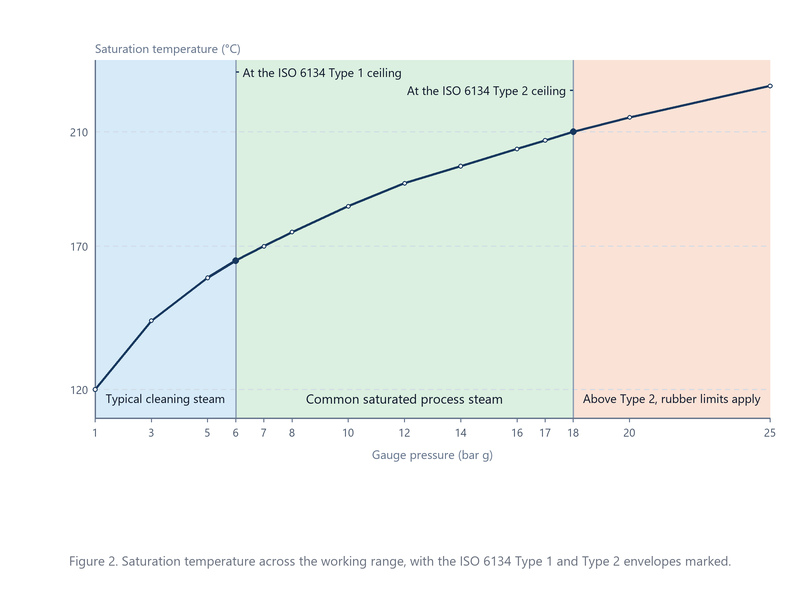
Figure 2. Saturation temperature across the working range, with the ISO 6134 Type 1 and Type 2 envelopes marked.
When a Superheated Steam Hose Stops Being a Rubber Hose
A rubber steam hose has a temperature ceiling set by its compound and a pressure ceiling set by its reinforcement. ISO 6134:2024 sets the framework with two types: Type 1, textile-reinforced, for a maximum steam hose working pressure of 6 bar and 164 °C, and Type 2, steel-wire-reinforced, for 18 bar and 210 °C.
HENGHUA builds two EPDM grades to ISO 6134, and you can see the 170 °C and 230 °C EPDM grades compared side by side. The 170 °C grade is continuous to 170 °C and covers the duty to roughly 7 bar g. The 230 °C grade is continuous to 230 °C and reaches roughly 26 bar g.
A superheated steam hose is what you specify once the duty sits above both the Type 1 and Type 2 ceilings. There is no rubber grade left to trade up to, because the vapor is hotter than any compound in the range can hold continuously. The question stops being which rubber and becomes which system: a PTFE-lined hose or a corrugated metallic hose. Steam hose selection at that point is a steam hose material decision, not a price comparison.
Corrugated metallic hose and PTFE-lined hose need the same honesty about upkeep, and they fail differently. A corrugated metallic hose fatigues at the corrugation and gives warning through stiffness and leakage long before it bursts. A PTFE liner rarely fails from heat; it fails from mechanical abuse, such as a sharp bend or a crushed line. Both behave best when the route matches the published bend radius.
Superheated Steam Hose Options: PTFE-Lined and Metallic
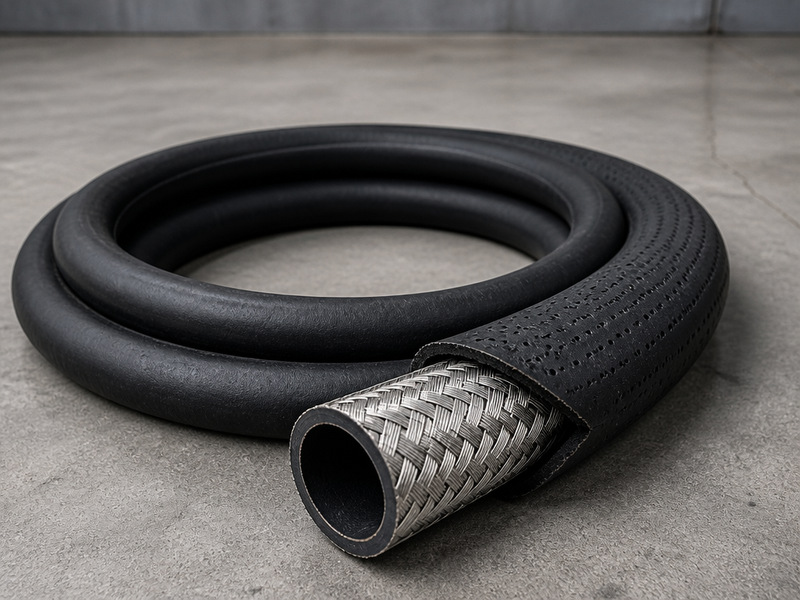
Above the rubber envelope, two constructions take over. A PTFE-lined hose keeps a flexible rubber carcass but separates the steam from it with a fluoropolymer liner that is good to about 260 °C. The liner carries the steam, while the rubber carcass provides flexibility and a surface to crimp the end fitting onto. A corrugated metallic hose replaces rubber altogether, using a stainless annular corrugation and a stainless braid. A high pressure steam hose in rubber still has its place, but only inside the saturated envelope.
| 건설 | Typical continuous limit | Best suited to | Main limit |
|---|---|---|---|
| Rubber steam hose (EPDM) | 170 °C or 230 °C by grade | Saturated duty inside the grade ceiling | Saturated service only |
| PTFE-lined hose | About 260 °C | Superheated duty, steam cleaning and chemical steam | Lower pressure capability than metal |
| Corrugated metallic hose | Set by the alloy and braid | Highest superheated temperatures and hot media | Stiffer, tighter bend radius, needs support |
Superheated service turns on three facts: how dry the vapor is, the highest continuous temperature the wall will see, and the pressure at that temperature. The first two decide the construction on their own.
The steam hose selection question here is which non-rubber system fits, not which rubber grade. A 17 bar figure says nothing about heat on its own. The steam hose working pressure describes only what the reinforcement holds, while a high pressure steam hose sold on that number may still sit outside its temperature envelope. For plants weighing both options against their existing lines, industrial steam hose ratings and applications shows how the duties map onto each construction.
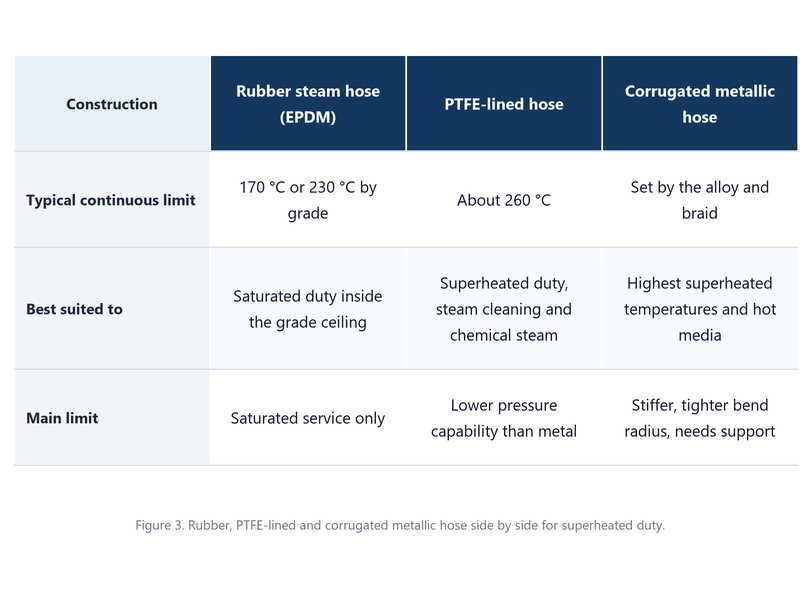
Figure 3. Rubber, PTFE-lined and corrugated metallic hose side by side for superheated duty.
Why a Higher Datasheet Temperature Is Not a Superheated Steam Hose Rating
A datasheet can list several temperatures, and they do not mean the same thing. On the HENGHUA 230 °C grade, the continuous limit is 230 °C and the intermittent peak is 250 °C. On the 170 °C grade, the continuous limit is 170 °C and the intermittent peak is 210 °C. Read those peaks as survival limits, and treat the continuous figure as the only working limit.
Continuous Versus Intermittent Numbers
Continuous duty is what most process lines actually run, and it is the number a specification should quote. An intermittent figure describes a short surge, such as a cleaning cycle or a warm-up, and it assumes the hose then returns to a cooler state. Treating a surge figure as a continuous limit is one of the most common ways a rubber hose is pushed past its envelope.
The same confusion surrounds a single temperature that looks like a rating. A peak figure tells you how hot the compound can survive for a moment, and nothing about how long a superheated duty will last.
Steam hose ratings are pressure and temperature pairs, not one number, and a steam hose rating taken from marketing text is no substitute for the pair on the printed label. A steam hose rating must name both the pressure and the temperature it is valid at. When a supplier quotes a single temperature, ask for the duty cycle behind it. This is the same discipline that applies to hose selection for extreme temperatures in other service.
Choosing Between Saturated and Superheated Service in Five Questions
Choosing a superheated steam hose comes down to five questions. A sound steam hose selection process answers them in order, and the construction follows.
- Is the steam saturated or superheated? — Confirm it at the header, not from memory or from an old drawing.
- What is the highest continuous temperature? — Use the continuous value, never the intermittent peak.
- What is the pressure at that temperature? — Compare the pair against the grade ceiling, not the pressure alone.
- Does the line ever run closed or under vacuum? — Closed ends and vacuum cause popcorning and lining separation.
- What is the environment? — Oil, chemicals and outdoor UV all change the steam hose material you need.
If two answers point in different directions, design for the harder one. Steam hose selection is not a vote; the worst continuous condition wins.
Pressure alone never settles the construction. A high pressure steam hose is the right call for the pressure figure; the temperature question has its own answer, and that answer is the one that moves the specification. When temperature is the binding constraint, the specification moves out of rubber altogether. For lines that mix low-temperature and high-heat duties, sourcing hose for low-temperature and high-heat duties sets out how to keep both limits honest.
Two readers usually arrive with different problems. A plant commissioning a new process line has to settle the construction before the pipe route is fixed, so the five answers belong on paper first. A maintenance team chasing a hose that fails early usually finds one answer was never checked, most often the closed-valve case. Same list, different order.
Superheated Steam Hose Safety: Reduced Life and Popcorning
ISO 6134:2024 carries its own warning that superheated steam shortens service life, and the standard is right to say so. Dry, hot vapor removes the condensing film that cushions saturated steam, so the tube meets the full temperature directly. Life falls, and it falls faster as the superheat rises.
The second mechanism is mechanical. If both ends of a hose are closed while it cools, the condensing vapor creates a vacuum inside. That vacuum pulls the tube away from the reinforcement and produces popcorning, the blistering and separation the standard describes.
Leave one end of the hose open as it cools after isolation, so air enters instead of a vacuum forming. Steam hose maintenance therefore has to include checking for soft spots, blisters and loose ends after any cooling cycle, not only after visible damage.
On a superheated line, steam hose maintenance follows the same inspection list, with shorter intervals than the saturated schedule in EPDM steam hose guidance for saturated service.
Steam hose maintenance has one definite end point: the moment the tube or the reinforcement is compromised. A blistered or delaminated tube, a cover split through to the braid, a fitting that has slipped, or any steam leaking at a coupling all mean the hose is finished. Replace, never repair: any superheated steam hose that has been patched, taped or re-clamped has no verified rating left, and the 10:1 safety factor applies only to an intact, factory-tested assembly.
Steam Hose FAQs
What is the difference between saturated and superheated steam?
Saturated steam sits at the boiling point for its pressure, so pressure fixes its temperature. A superheated vapor has been heated above that point at the same pressure, so a gauge reading no longer tells you the temperature. That single difference decides whether a rubber hose is suitable or whether the duty needs a different construction.
Can a rubber hose handle a superheated duty?
Generally, no. Rubber compounds are rated for a continuous limit, and a superheated duty runs above the saturation temperature that the standard envelope assumes. ISO 6134:2024 itself warns that superheat shortens service life. If the duty is genuinely superheated, the steam hose material must change, and a PTFE-lined or corrugated metallic hose is the answer.
What is the highest pressure a rubber steam hose can cover?
ISO 6134 Type 2 is rated to 18 bar and 210 °C, and a 230 °C grade reaches roughly 26 bar g in saturated service. A 170 °C grade covers the duty to about 7 bar g. The steam hose working pressure ceiling is set by the reinforcement, not by the tube, so above those limits you need a corrugated metallic hose rather than a thicker rubber hose.
Is a higher temperature on a datasheet a steam hose rating?
No. A datasheet can list a continuous limit and a short intermittent peak, and only the continuous value is a working limit. A steam hose rating is a pressure and temperature pair, so one number cannot describe it. Always ask whether a quoted temperature is continuous, intermittent or a spike.
What causes popcorning in a steam hose?
Popcorning is the blistering and lining separation that appears when the tube pulls away from the reinforcement. Closing both ends of a hot hose and letting it cool forms a vacuum inside, and that vacuum does the damage. Steam hose maintenance should include a check for blisters before the hose returns to service.
How long does a steam hose last?
Typical service life is about two to four years in continuous steam duty and five to seven years in intermittent use. A superheated line sits at the short end of that range, because dry heat ages the compound faster. Steam hose maintenance and storage both affect how long that range holds, so keep hoses off the floor, out of sunlight, and never coil them tight against a sharp bend.
Does a high pressure steam hose automatically suit a superheated duty?
Pressure and temperature are two separate decisions, and the temperature comes first. A hose can hold 17 bar and still be wrong for a superheated line. The reason is that a high pressure steam hose is built for a pressure ceiling, while the heat limit comes from a different part of the assembly. Match the steam condition first, then confirm the pressure, the bore and the end connection.
Specify the Duty, Not Just the Temperature
Two duties that look similar on a purchase order can need completely different hardware. That is why a steam inquiry should describe the steam condition, the continuous temperature, the pressure at that temperature, the bore and the end connection, rather than a single number. A hose that was sold as a general steam hose may be perfectly sound and still be the wrong choice for a superheated line.
HENGHUA manufactures reinforced industrial hose and complete hose assemblies for plants, distributors and OEM brands. Our EPDM steam hose range covers 3/8 inch to 4 inch bore, rated 250 psi (17 bar) working pressure with a 10:1 burst safety factor.
The construction is a smooth steam-resistant EPDM tube, one or two layers of high-tensile steel wire braid, and a pin-pricked cover that vents permeating gas instead of blistering. Every length is proof-tested at 1.5 times working pressure before it leaves the plant, and each batch is date-coded. Because compounding, extrusion, braiding, vulcanization and crimping all happen in one plant, bulk lead times stay short. Send us the working pressure, the steam temperature, the bore and the end connection, and we will quote against them.
We supply cut lengths, crimped ends, protective sleeves, colour coding and OEM branding. 견적 및 무료 샘플 받기
Final Verdict: Match the Steam Condition to the Construction
Match the steam condition to the construction and the rest of the specification falls into place. Saturated duty belongs in a rubber steam hose rated to the right pressure and temperature pair. A superheated duty needs a superheated steam hose in a PTFE-lined or corrugated metallic construction, because no rubber grade covers it. Send the duty first and the numbers that follow from it, and HENGHUA will match the construction to that statement rather than to a single gauge reading.
Written by the HENGHUA engineering team, with input from plant maintenance and steam-system reliability teams across North America, Europe and South East Asia. HENGHUA manufactures reinforced industrial hose and hose assemblies, including an EPDM steam hose range from 3/8 inch to 4 inch bore. Those assemblies are rated 250 psi (17 bar) working pressure with a 10:1 burst safety factor, and are supplied as cut lengths or as fully crimped assemblies. Fittings, protective sleeves, colours and OEM branding are available on request.

 English
  Spanish
  Portuguese
  French
  German
  Arabic
  Russian
  Indonesian
  Japanese
  Korean