

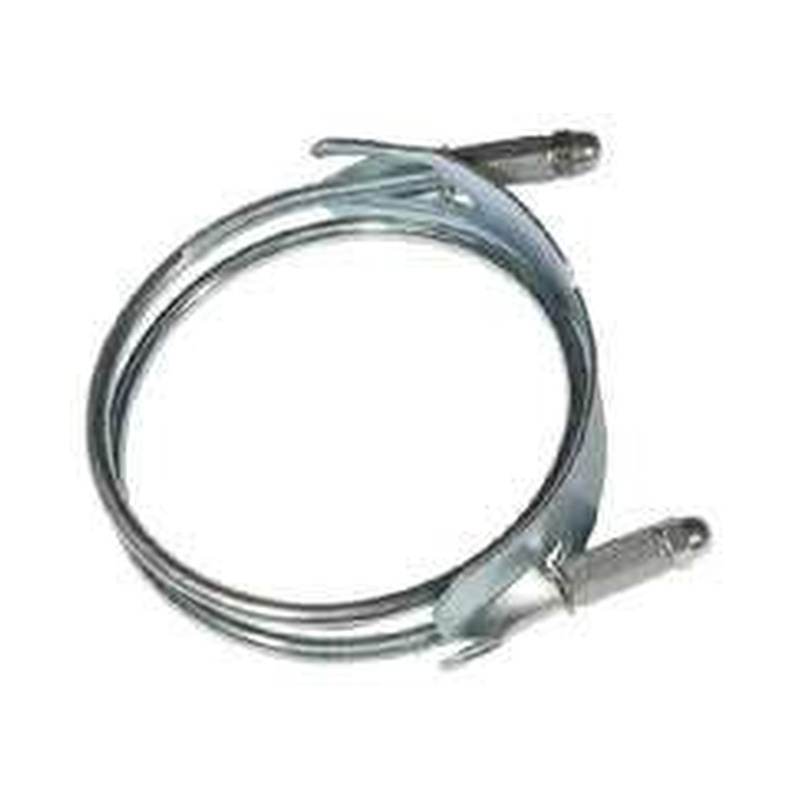


Worm drive and spiral clamps are the everyday band clamps: a screw housing tightens a perforated or slotted band round the hose. The worm drive is the standard single-band clamp; the spiral is a fully banded clamp with no perforations, so it spreads load over the whole circumference. Both are supplied in galvanised steel and stainless, and both are selected by clamping range in millimetres.
|
|
|
|
|
Worm drive against spiral
| Jenis | Band | Load path | Best for |
|---|---|---|---|
| Worm drive | Slotted or perforated single band | Through the screw housing to the band | General water, air and light hose |
| Spiral | Fully banded, no perforations | Even round the full circumference | Soft hose, thin wall, and where a slot would tear |
| Mini worm drive | Narrow band, small housing | Concentrated under the housing | Small bore lines and tight access |
The difference that matters is the band. A perforated band has slots that concentrate stress and can cut a soft hose cover; a spiral band has no slots, so the pressure is continuous and the hose is less likely to be damaged. On thin-wall or silicone hose the spiral is the right choice for that reason, not because it clamps harder.
Worm drive and spiral clamps: left hand and right hand
| Hose size | Left hand, counter clockwise | Right hand |
|---|---|---|
| 1-1/2 in | SPC-150-L | SPC-150-R |
| 2 in | SPC-200-L | SPC-200-R |
| 2-1/2 in | SPC-250-L | SPC-250-R |
| 3 in | SPC-300-L | Ask |
| 4 in | SPC-400-L | SPC-400-R |
| 5 in | SPC-500-L | SPC-500-R |
| 6 in | SPC-600-L | SPC-600-R |
| 8 in | SPC-800-L | SPC-800-R |
| 10 in | SPC-1000-L | SPC-1000-R |
| 12 in | SPC-1200-L | SPC-1200-R |
The hand of the clamp has to match the lay of the spiral in the hose: a spiral-reinforced hose has a direction, and a clamp wound the other way crosses the reinforcement instead of seating in it. That is why the same size is listed twice, and why the L and R are not interchangeable.
The 3 in right-hand cell reads Ask because that entry was not legible on the source page; it is not a size the range omits.
Sizing by range
A clamp is ordered by the diameter it closes on, and the range marked on the band is the specification. The same nominal bore can sit in two different clamps depending on the cover thickness, so measure the hose with a calliper over the cover at the point the clamp will sit. A clamp at the bottom of its range has the most adjustment left; a clamp that only just reaches the diameter has none.
Materials and where each fails
Galvanised steel is the economical choice indoors. It fails at the screw housing first: the plating wears as the screw turns, the exposed steel rusts, and the band seizes before it snaps. Stainless, in 304 or 316, is the choice for washdown, outdoor and marine work; 316 where chlorides are present, 304 elsewhere.
The band material and the housing material are not always the same on cheap clamps, which is why a stainless band can still rust at the screw. On this range the material applies to the whole clamp.
No pressure rating
No working pressure is published for these clamps, and none should be inferred from a hose table. A clamp is a fixing, not a pressure part: the joint is limited by the hose, the shank and the medium. A worm drive on a 10 bar line and the same clamp on a 2 bar line are the same part; what changes is the hose and the shank.
Where each type fails first
A worm drive fails at the screw housing: the slots deform, the screw loses its bite and the band goes slack without anything looking broken. A spiral clamp has no slots to deform, so it fails at the housing weld instead, and usually after far more cycles.
Worm drive and spiral clamps are also sold by range rather than by bore, so the same clamp covers several hose sizes and the range is what the order is built on.
That is the practical way to choose between them on a line that is re-made often. Worm drive and spiral clamps both do the same job; the spiral survives more re-tensioning, which is why it is specified on hose that is taken off and put back.
Ordering information
- Type: worm drive, spiral or mini
- Clamping range in millimetres
- Band width
- Material: galvanised steel, SS304 or SS316
- Quantity per range
- Screw type, if a socket head is needed
Frequently asked questions
Which is stronger, worm drive or T-bolt?
The T-bolt. A worm drive is adequate for general hose but develops less band tension, which is why heavy duty joints use a bolted clamp.
Why use a spiral clamp?
Because it has no slots, so it will not tear a soft cover and it spreads load evenly round the hose.
How tight should a worm drive be?
Until the hose is gripped and no more. Over-tightening cuts the cover or strips the band, and neither is visible until the joint leaks.
Do worm drive and spiral clamps have a pressure rating?
No. The hose, the shank and the medium set the limit of the joint.
What is the minimum order, and can I get samples?
MOQ, samples and lead time are confirmed per line with the price, because each range is a separate run.
Related reading
- Hose clamps and whipchecks
- Heavy duty hose clamps
- Whipchecks
- Industrial hose couplings
Worm drive and spiral clamps are quoted by type, range, width and material.
Send the six fields and we come back with the price.


 English
 Spanish
 Portuguese
 French
 German
 Arabic
 Russian
 Indonesian
 Japanese
 Korean