
High Temperature Composite Hose
High Temperature Composite Hose for Hot Oil to 177 °C
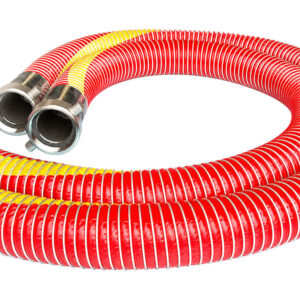
A high temperature composite hose is the build for petroleum and solvent service above the 100 °C ceiling of a standard grade. The liner is PTFE backed with polypropylene film, the carcass is polyamide fabric, and the cover is double PVC. Bore runs 25 to 250 mm at 14 bar working pressure, -30 to +177 °C, with a 5:1 safety factor to 100 mm bore and 4:1 above, proof tested at 1.5 times working pressure. It is not a steam hose and not a hydraulic hose.
Menampilkan hasil tunggal
What Actually Limits a Hose at Temperature
Three layers fail in a known order as temperature climbs, and knowing which one is limiting tells you whether a higher rated hose will help or just cost more.
- The liner softens and permeates faster. PTFE holds its properties far above 177 °C; the polypropylene backing plies behind it do not, and they carry the bond.
- The carcass loses tensile strength in the fabric plies, so the same ply stack that holds 14 bar at ambient holds less at 150 °C. This is why pressure and temperature cannot be specified independently.
- The cover hardens and cracks first on the outside, where you can see it. A cracked cover exposes fabric, and exposed fabric wicks product.
That order is why a hose rated to +177 °C is not simply a standard hose with a different label: the ply architecture changes with the temperature, not only with the pressure.
Konstruksi
| Layer | Material | Why it is chosen for heat |
|---|---|---|
| Inner helix | SS304, SS316 or hot dip galvanized mild steel | Holds the bore at the top of the range where the film stack is softest |
| Liner | PTFE with polypropylene film backing | PTFE faces the product; the backing carries the bond to the carcass |
| Carcass | Polyamide fabric and film | Retains strength higher than polyester or polypropylene fabric |
| Sampul | Double layer abrasion resistant PVC coated fabric | Two PVC layers slow the heat reaching the carcass from outside |
| Outer helix | SS304, SS316 or galvanized | Protects the cover and anchors the flange collar |
Specification
| Parameter | Nilai |
|---|---|
| Bore | 25 to 250 mm (eight sizes) |
| Working pressure | 14 bar |
| Proof pressure | 1.5 times working pressure |
| Safety factor | 5:1 up to and including 100 mm; 4:1 above 100 mm |
| Temperature | -30 to +177 °C continuous |
| Vacuum | 0.9 bar |
| Elongation at proof pressure | 6 % or less below 100 mm; 10 % or less at 100 mm and above |
| Electrical resistance | 1 ohm/m or less below 100 mm; 2 ohm/m or less at 100 mm and above |
| Standard length | 15 m |
Size Table
| Bore (mm) | Outside diameter (mm) | Bend radius (mm) | Working pressure (bar) | Panjang (m) |
|---|---|---|---|---|
| 25 | 38 | 100 | 14 | 15 |
| 38 | 50 | 150 | 14 | 15 |
| 50 | 68 | 180 | 14 | 15 |
| 75 | 98 | 240 | 14 | 15 |
| 100 | 120 | 450 | 14 | 15 |
| 150 | 175 | 570 | 14 | 15 |
| 200 | 240 | 790 | 14 | 15 |
| 250 | 290 | 990 | 14 | 15 |
The 5:1 to 4:1 step at 100 mm is the same hoop-stress rule that governs every composite build: above 100 mm the ply stack would have to grow beyond a practical wall thickness to hold 5:1, so the factor drops and the wall stays workable. A 250 mm assembly at 4:1 is still a heavier, more expensive hose than a 3:1 plant hose of the same bore.
Hot Oil or Hot Solvent: Two Different Duties
Both are “hot” and they are not the same specification.
- Hot oil and heat transfer fluid — the concern is long-term attack on the polymer at the top of the range, and the fluid brand matters because formulations differ. Give us the brand and the bulk temperature.
- Hot solvent — the concern is permeation at temperature, which rises sharply with heat. A solvent that is acceptable at 40 °C can fail a permeation limit at 120 °C even though the liner is chemically suitable.
- Hot acid or alkali — concentration and temperature have to be read together. A medium that a PTFE liner handles cold can still be outside the range where the backing plies survive.
Applications
- Hot petroleum transfer — dockside, ship to ship, ship to shore, loading platforms and rail tanker service
- Heat transfer fluid — thermal oil circuits, hot oil unloading and filling lines
- Chemical processing — hot solvent and hot process media where a standard liner would soften
- Bitumen and heavy oil — heated transfer where the product has to stay above its pour point
- Asphalt and roofing plants — hot product transfer at the loading point
Installation, Inspection and Service Life
Installation
Support long runs every 1.5 to 2 m and keep the bend radius at the bore centreline under pressure. Allow for thermal expansion along the length: a 15 m run at the top of the range is longer than it was on the pallet, and a hose pulled tight when cold is under compression when hot. Use a swivel or elbow at the equipment, and fit protective sleeves wherever the hose crosses a walkway or a hot surface.
Inspection
Check the cover for hardening, cracking and exposed fabric — on hot duty the cover is the first thing to show age and the first thing to fail. Check the outer helix for flattening, the fittings for loose collars and hardened seals, and continuity after any repair. Retire the assembly when the cover cracks, when the bore has softened, or when a kink does not recover.
Service life
Three to five years with correct handling; shorter where the line runs continuously near +177 °C or cycles between hot and cold. Heat ageing is cumulative, so a hose that has been to the top of the range a few hundred times has less margin left than one that has only ever seen 140 °C.
Customization, MOQ and Price
- Length — 15 m standard; cut lengths and longer assemblies to order with ±1 % tolerance
- Bore — 25 to 250 mm from stock tooling; derated pressure builds on request
- Ends — flange to EN 1092 or ANSI B16.5, camlock, threaded adapters, protective sleeves and guards
- Marking — cover colour, printed brand, batch code, medium and temperature text
- MOQ — standard sizes from 100 m; custom length, flange pattern and OEM marking from 500 m per size
- Lead time — 7 to 15 days after order confirmation for standard builds
Price is set by bore, ply count, liner and end connection. A high temperature build costs more than a standard chemical hose of the same bore because the carcass and the cover both change; paying that premium on a line that never exceeds 60 °C is waste.
Manufactured in Hengshui on 12 production lines across 18,000 m², supplying 70 countries since 2010. Every assembly is proof tested and the test pressure is recorded on the assembly record.
Where This Build Is the Wrong Answer
- Saturated steam is a steam hose duty. A thermoplastic liner softens and the plies separate; no composite grade is a steam hose.
- Fuel at ambient temperature belongs to the petroleum category; paying for a 177 °C build on a 40 °C line is waste.
- Cryogenic service below -30 °C goes to the cryogenic build.
- Above 40 bar, specify a wire spiral hose regardless of temperature.
Product in This Category
Part of the composite hose range, which covers six families from 25 to 254 mm.
Frequently Asked Questions
What temperature can a composite hose reach?
Standard grades run to +100 °C, PTFE grades to +120 °C, and this high temperature build to +177 °C continuous. Light oil grades reach +200 °C but are a different construction for a different duty.
Can I use it for steam?
No. Saturated steam carries latent heat that softens the thermoplastic liner and separates the plies. Steam needs a dedicated steam hose with a suitable tube compound.
Why is the safety factor lower above 100 mm?
Hoop stress rises with diameter. Holding 5:1 at 250 mm would need a wall thickness that no handling crew can move, so the factor is 4:1 above 100 mm and the wall stays practical.
Does temperature reduce the pressure rating?
Yes, and that is why the two are specified together. The 14 bar figure is a continuous ambient rating; at the top of the temperature range the ply stack has less headroom. State both numbers and the build is checked against them rather than against the table alone.
Is it conductive?
Electrical resistance is 1 ohm/m or less below 100 mm and 2 ohm/m or less at 100 mm and above, measured end to end. On flammable duty the assembly still has to be bonded to the vessel and to earth before transfer.
Can it handle vacuum?
Yes, to 0.9 bar. The inner helix prevents collapse and the plies are checked for separation after a 10 minute vacuum hold. Above that, ask before ordering: a deeper vacuum changes the helix specification.
Why does the cover matter more on hot duty?
Because it fails first and it is visible. Heat hardens the PVC, the cover cracks, fabric becomes exposed and the carcass starts to wick product. A cover inspection tells you more about remaining life than a pressure test does.
What are the order quantity and lead time?
Standard sizes start at 100 m, and 15 m is the standard assembly length. Custom length, flange pattern and OEM marking start at 500 m per size. Standard builds ship 7 to 15 days after order confirmation.
Give us the fluid, the bulk temperature and the pressure together. One number without the other two cannot be answered honestly — send all three through the quotation form.
- Selang Hidraulik2323 Produk
- Selang Industri7575 Produk
- Selang Udara99 Produk
- Selang Air1111 Produk
- Selang Minyak1616 Produk
- Selang Kimia66 Produk
- Composite Hose1616 Produk
- Chemical Composite Hose33 Produk
- Marine Composite Hose55 Produk
- Petroleum Composite Hose55 Produk
- High Temperature Composite Hose11 Produk
- PTFE Composite Hose11 Produk
- Cryogenic Composite Hose11 Produk
- Selang Uap33 Produk
- Selang Serbaguna22 Produk
- Food & Beverage Hoses44 Produk
- Selang Beton44 Produk
- Selang Semen22 Produk
- Selang untuk Penanganan Material1111 Produk
- Selang Pengerukan44 Produk
- Hydraulic Fittings166166 Produk
- Reusable Hose Fittings66 Produk
- Socketless Hose Fittings88 Produk
- JIC Hydraulic Fittings1616 Produk
- Metric Hydraulic Fittings4141 Produk
- NPT Hydraulic Fittings66 Produk
- BSP Hydraulic Fittings2626 Produk
- SAE Hydraulic Fittings3030 Produk
- Banjo Hydraulic Fittings44 Produk
- ORFS Hydraulic Fittings1111 Produk
- Ferrule1111 Produk
- Flange Fittings2626 Produk
- One Piece Fittings2424 Produk
- Adaptor Hidraulik149149 Produk
Why HENGHUA is Your Trusted Partner in Power
HENGHUA: Your Global Water Hose Solution Partner
For over 15 years, HENGHUA has evolved from a regional rubber hose producer into a top-tier china-based manufacturer serving 70+ countries. Our water hose division combines German engineering standards, American testing protocols, and Chinese manufacturing efficiency to deliver High Pressure Hose solutions that rival Parker, Gates, and Eaton at 30-40% lower cost.
Why Industry Leaders Choose HENGHUA:
Vertical integration: We control every step – from rubber mixing to final hose assembly. No hidden defects, no quality variations.
Certification readiness: All products meet SAE, ISO, EN, and GB standard with pdf specification available for audit.
Flexible supply: Bulk orders, just-in-time delivery, or wholesale distribution – we scale with your business.
Technical support: Our 25-person engineering team provides application engineering, failure analysis, and custom solution design.
One-stop shopping: fittings, adapters, flanges, protective sleeves – complete fluid connection source.
Commitment to Partnership: HENGHUA doesn’t just supply hoses. We become your reliability partner. Request a sample, visit our factory, or audit our lab. Experience the HENGHUA difference.
Contact us for discount harga quotes and OEM ODM collaboration.
Send a Mail
henghua@hhgpipe.com
Make a Call
+15822925523
86-22-83859963
Mon - Sun: 09:00 am - 22:00 pm
Main Office
Tianjin, China
Hezhong Building, Youyi North Road
 English
 Spanish
 Portuguese
 French
 German
 Arabic
 Russian
 Indonesian
 Japanese
 Korean