
A Parker steam hose in the Steam-Lance 250 family is published at a 250 psi maximum working pressure, with a saturated pair of 261 psi at 406 °F and a superheated pair of 250 psi at 450 °F. The 7263C is the compact member: 1/2 in and 1 in bores, with 7 in and 12 in minimum bend radii.
Three numbers settle the order before price does: the bend radius the drawing allows, the 250 psi mark on the cover, and the saturated or superheated pair you will run. What follows gives the published figures as the manufacturer states them, shows what compactness buys in routing terms on a dense skid, and sets out how to specify an equivalent compact steam hose against the same numbers. The drain routine a steam lance hose needs closes the guide.
About a 14-minute read at 250 words per minute; every rating below is the manufacturer’s published figure as of October 2026 and should be re-checked against the current datasheet before ordering.
Why the Parker Steam Hose Fits Compact Steam Service
The Steam-Lance 250 family is published as a compact, slim-profile construction for long-term steam service. That positioning is the reason the range exists. On a modern washdown skid, hoses are bundled with cable, conduit, valve blocks and pump housings. A smaller outside diameter buys routing freedom that a heavier build cannot deliver.
The steam hose series is published as one family with shared pressure and temperature pairs. The letters and digits in each part number describe the bore and the reinforcement build rather than a different chemistry. A Parker steam hose rated 250 psi therefore shares the same tube and cover concept across the range, which keeps spares and training simple.
Table 1. Manufacturer-published ratings and limits for the Steam-Lance 250 family.
| Parameter | Published value | Notes |
|---|---|---|
| Maximum working pressure | 250 PSI MAX WP | Marked on the hose |
| Saturated steam | 261 psi at 406 °F | 261 psi = 18 bar; 406 °F = 208 °C |
| Superheated steam | 250 psi at 450 °F | 250 psi = 17 bar; 450 °F = 232 °C |
| Rentang suhu | −40 °F to +406 °F saturated; +450 °F superheated | Same range in °C: −40 °C to +208 °C and +232 °C |
| Design factor | 20:1 (10:1 above 1 in on the 7264 line) | Burst relative to working pressure |
| Standard | ISO 6134 Type 2 | High-pressure steam hose class |
Specifications quoted for the named product are those the manufacturer publishes; confirm them against the maker’s current datasheet before you order.
HENGHUA is not affiliated with, and does not distribute, the named brand.
Table 1 shows how differently the two steam duties are treated. The saturated pair is published at the higher pressure and the lower temperature, while the superheated pair trades pressure for temperature. The marked 250 PSI MAX WP figure is the one maintenance staff will check first.
Two pressure figures sit side by side in the table, and each governs a different question. The 250 psi marking is printed on the hose and describes the hose itself; an assembly built with clamps or bands can carry a lower limit.
The 261 psi figure is the published saturation pair, a pressure quoted at the temperature that goes with it. An order written against 261 psi fails a goods-in check on a cover marked 250 psi, so name both figures.
The family keeps its ISO 6134 Type 2 duty split and its 20:1 design factor at every 7263C and 7264C bore. Write the specification against those two numbers and a substitute has to match them, whatever its outside diameter turns out to be.

Figure 1. A slim-profile steam hose routed past the pump housing and cable trays on a crowded washdown skid.
What “Compact” Buys You on a Crowded Washdown Skid
Compactness shows up in measurable numbers, and Table 2 carries them by bore. Read it as a routing table rather than a size list. The three sizes form a ladder: bore, outside diameter and minimum bend radius all rise, though not at the same rate, so a tighter skid trades bore for clearance.
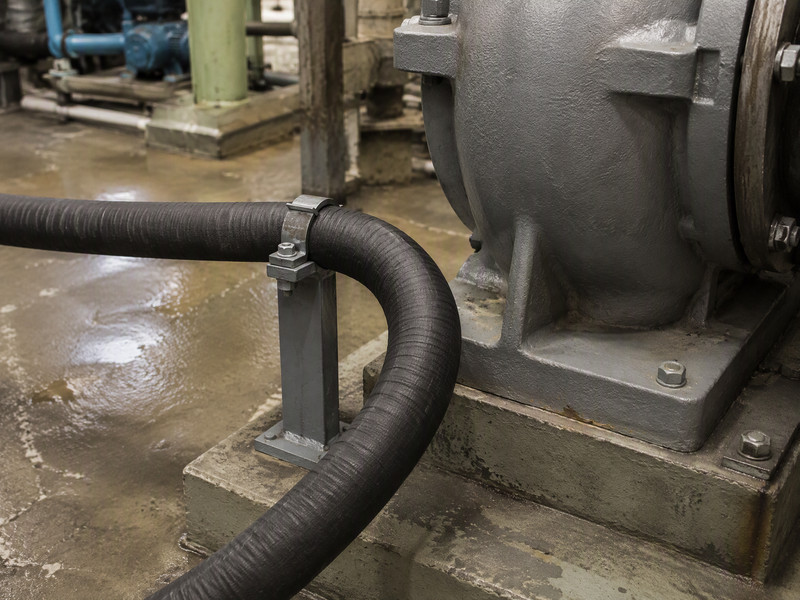
Figure 2. The run bends tight beside the pump, with a clamp under the bend carrying the load.
On a crowded washdown skid, a fraction of an inch of outside diameter changes the whole layout. A smaller outside diameter passes through tighter cable trays and around pump housings without chafing. A tighter bend radius removes the need for an extra elbow or a longer loop. A compact steam hose is what makes a Parker steam hose practical on a narrow skid.
Table 2. Published outside diameter, minimum bend radius and standard pack for the 7263C and 7264C.
| Part | Bore | Penguatan | Outside diameter | Minimum bend radius | Standard pack |
|---|---|---|---|---|---|
| 7263C | 1/2 in | 2 layers | 1.0 in (24.1 mm) | 7 in | 50 ft |
| 7264C | 3/4 in | Multiple | 1.2 in (30.5 mm) | 9 in | 50 ft |
| 7263C | 1 in | Multiple | 1.5 in (37.3 mm) | 12 in | 50 ft |
The standard pack for these sizes is 50 ft, which matches a typical skid run and still leaves one spare on the shelf. If your run is shorter, the ±1% length tolerance under ISO 1307 also applies to a cut length, so order the number you need with that tolerance in mind.
Routing is not the only gain. A slimmer hose also weighs less per foot, so a long lance run is easier to drag across a deck by hand. A tighter bend radius lets a maintenance crew coil the hose into a smaller locker. Both effects reduce the chance that the hose is dragged over a sharp edge instead of being lifted clear.
A compact hose also drops into a skid built around a heavier one, where the bore and the end fittings already match, because only the space the run needs changes.
How the Parker Steam Hose Is Built
Every steam hose in this class shares the same three-part build. A heat-resistant tube carries the steam, a wire reinforcement holds the pressure, and a cover protects the braid. The detail that separates a steam hose from a hot water hose is the cover venting: steam hose uses a perforated cover, while a hot water hose does not.
The 7263C and 7264C use a black EPDM tube, while the 7285 uses chlorobutyl. Reinforcement is multiple wire braids, and the count of layers rises with bore. A Parker steam hose in this class is therefore specified by bore, pressure, temperature and bend radius together, not by one number alone.
Table 3. Steam hose construction layers and how to recognize each one.
| Layer | Material | Function | How to recognize it |
|---|---|---|---|
| Tube | Black EPDM (chlorobutyl on the 7285) | Carries steam and resists heat aging | Smooth black bore |
| Penguatan | Multiple wire braids | Holds pressure and restrains the tube | Visible wire at a cut end |
| Sampul | Black or red EPDM, perforated wrapped finish | Sheds permeated steam and shields the braid | Fine pinholes and a wrapped texture |
| Marking | Printed or embossed cover text | Names the pressure and temperature pair | 250 PSI MAX WP and ISO 6134 Type 2 |
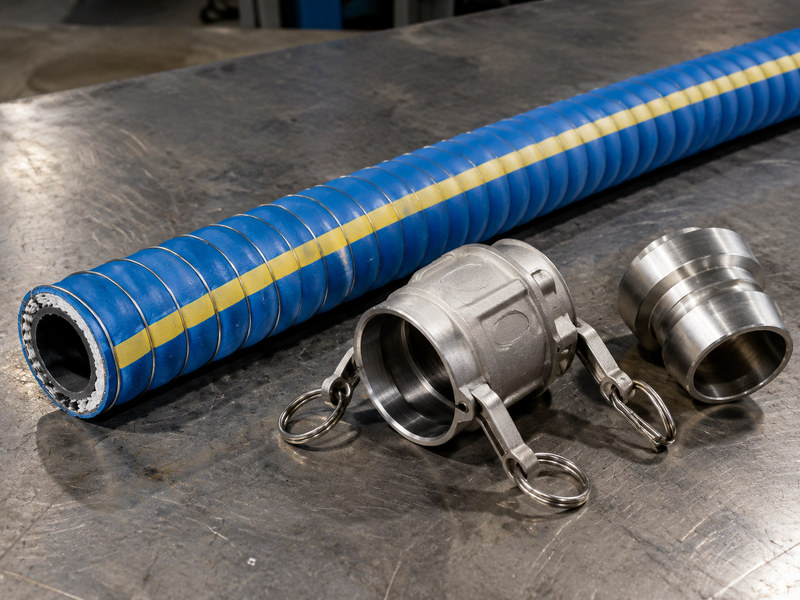
Reading a cut end confirms the build. You should see a black tube, one or more wire braid layers, and a cover with fine pinholes. A steam lance hose with a smooth, unvented cover is not a steam build, whatever the print on the jacket says.

Figure 3. Three layers show at the cut end; the pin-holed cover is the visible difference from a closed jacket.
A cover print carries more than the two headline figures. The usual sequence names the duty type, the pressure and temperature pair, an electrical grade where one applies, and the quarter and year of manufacture. The date code is the field most often skipped at goods-in, and it tells a storeman how long a 50 ft pack has sat in stores. Log it against the purchase order.
Bore size changes the number of braid layers, not the chemistry. A 1/2 in 7263C uses two layers, and larger bores use more. That is why the outside diameter grows faster than the bore itself. A buyer who reads only the bore will misjudge how much space the finished hose needs.
Saturated and Superheated Duty on the Parker Steam Hose
Saturated and superheated steam are not interchangeable duties. Saturated steam carries entrained condensate and holds a steady temperature for a given pressure. Superheated steam carries no liquid but puts a higher thermal load on the tube. The published ratings for the family reflect both: 261 psi at 406 °F saturated, and 250 psi at 450 °F superheated.
The ISO 6134 Type 2 class sits at 18 bar and 210 °C, two degrees Celsius above the saturated pair the maker publishes. That overlap matters when you compare a hose against a standard rather than against a catalog page. For more on saturated duties, see the note on EPDM steam hose for saturated steam. A range built in two pressure steps maps onto those classes differently, as a two-step steam range shows (planned URL — publish before linking).
Table 4. Saturated and superheated duty and the corresponding published ratings.
| Duty | Published rating | Conversion (calculated) | What it changes |
|---|---|---|---|
| Saturated steam | 261 psi at 406 °F | 18 bar at 208 °C | Continuous condensate load |
| Superheated steam | 250 psi at 450 °F | 17 bar at 232 °C | Higher thermal load on the tube |
| ISO 6134 Type 2 | 18 bar at 210 °C | 261 psi at 410 °F | Recognized high-pressure steam class |
Applicable range: saturated duty at 261 psi and 406 °F, superheated duty at 250 psi and 450 °F, and a working pressure at or below the marked 250 psi throughout, further limited by the finished assembly. A duty that falls between the two pairs is planned on the hotter pair. The superheated pair limits tube life, so a line that alternates between duties is planned as superheated.
Condensate is the practical difference on the shop floor. Saturated steam arrives wet, so the line carries liquid that must be drained. Superheated steam arrives dry but hotter, so the tube sees a higher thermal load with no liquid present. Drain the line either way, because any trapped condensate will blister the tube.
Sizing, Couplings and Working Pressure for a Steam Lance Hose
Bore choice sets the pressure drop and the steam flow the hose can deliver. A 1/2 in line suits a short run at the nozzle. A 1 in line carries more steam to a longer manifold without a large pressure loss. The published outside diameters in Table 2 show how much the jacket adds on top of the bore.
The hose is one part of a lance assembly, and the other parts set limits the hose cannot fix. A lance tube, a holder and a nozzle each add pressure loss and each carries its own inlet thread, so the hose end matches the holder rather than the pump. Confirm the holder inlet and the nozzle flow before fixing the bore, then check the coupling selection guide when the thread is the constraint.
When a Parker steam hose assembly is made up with clamps or bands rather than a crimped coupling, the assembly working pressure can fall below the hose rating. The NAHAD Industrial Hose Assembly Guidelines make this point explicitly. Universal quick-acting couplings must not be used on steam hose at all, because they are not designed to hold a hot, pressurized line.
A completed assembly should be tested as a unit. The hose rating describes the hose, not the crimped ends, so the finished assembly carries its own limit.
For sizing rules and the tolerance on a cut length, see the hose size selection guide. For the difference between an assembly’s working pressure and its burst pressure, see working pressure vs burst pressure.
Specifying an Equivalent Compact Steam Hose Against the Same Numbers
Specifying an equivalent to this steam hose series means matching published numbers rather than copying a part code. Start with the working pressure and the saturated and superheated pairs. Then fix the bore, the bend radius your drawing allows, and the standard the hose must meet.
A compact steam hose from another maker should state the same design factor and the same duty class on a datasheet. A design factor of 20:1 means the burst pressure is published as twenty times the working pressure. Above 1 in on the 7264 line the factor is published as 10:1, so check the size as well as the family. Some ranges publish the same comparison by braid count instead, as a braid-count steam range does (planned URL — publish before linking).
Table 5. Equivalence checklist for matching a steam hose to the same published numbers.
| Parameter | Value to specify | Source convention |
|---|---|---|
| Tekanan kerja | 250 psi maximum, matched to the cover print | Manufacturer marking |
| Saturated pair | 261 psi at 406 °F | Manufacturer datasheet |
| Superheated pair | 250 psi at 450 °F | Manufacturer datasheet |
| Bore | 1/2 in, 3/4 in or 1 in | Match the pump outlet and the holder thread |
| Bend radius | 7 in to 12 in by bore | Installation drawing |
| Design factor | 20:1 as published | Manufacturer datasheet |
| Standard | ISO 6134 Type 2 duty split | Recognized class |
| Sampul | Perforated EPDM cover | Required for steam |
| Length | 50 ft standard pack, cut to ±1% under ISO 1307 | Datasheet and order |
| End fitting | Crimped steam coupling, assembly rated as a unit | NAHAD assembly guidelines |
Line the checklist up against any quote you receive. If a supplier cannot name the temperature pair, the design factor, the duty class and the assembly rating, the comparison is incomplete. Price should also follow the specification, because two hoses with the same bore can differ in design factor, duty class and cover venting.
For the category overview, see the steam hose category. A high-temperature example from HENGHUA’s own range is the EPDM high temperature steam hose 230.
Parker Steam Hose Maintenance, Drain and Storage
Drain after every use. Residual liquid left in a Parker steam hose boils on the next start-up and blisters the tube, a failure called popcorning. Blow the line clear, then store the hose straight or in a loose coil with both ends open so moisture can escape.

Figure 4. Hung from a wall bracket between shifts, water still running from the open ends onto the floor.
Inspect a steam lance hose before each shift. Look for cover blisters, exposed braid, kinked sections and coupling movement. The ARPM IP-11-1 guide covers the use, testing and inspection of steam hose, and it is the reference most shops follow. Abrasion resistance can be checked to ISO 4649 when a cover rubs against a deck edge.
Keep the hose off hot surfaces and out of standing water between jobs. A hose that is coiled wet and left closed traps moisture inside the tube, which is the same condition that causes popcorning later.
Storage temperature matters as much as storage position. Keep the hose away from direct sun and from ozone sources such as electric motors, because an EPDM cover ages faster under both. A dry, shaded rack is enough. Label the hose with its rating so the next crew does not reach for it on a lower-pressure job.
On a plant that runs two shifts, the handover is where a hose set aside as suspect gets put back into service. Record the inspection result where the next fitter will see it.
Parker Steam Hose Series FAQs
What does compact steam service mean?
Compact refers to the build, not the pressure class. The Steam-Lance 250 family keeps a tighter outside diameter and a smaller bend radius than a conventional steam build, so the hose fits dense skids and short routing loops. It is still a high-pressure steam hose, published for 250 psi working pressure and ISO 6134 Type 2 duty. Compact describes the envelope, not a downgrade in rating.
What pressure and temperature does the 7263C carry?
For saturated steam the published rating is 261 psi (18 bar) at 406 °F (208 °C). For superheated steam the published rating is 250 psi (17 bar) at 450 °F (232 °C). The hose is also marked 250 PSI MAX WP. Confirm the pair you need against the maker’s current datasheet before you order, because the two duties do not share a single pressure figure.
Why is the 7263C offered in 1/2 in and 1 in?
The two bore options cover different duties. A 1/2 in bore suits a short lance run where flow is modest. A 1 in bore feeds longer runs or several nozzles with less pressure loss. The published outside diameters are 1.0 in (24.1 mm) and 1.5 in (37.3 mm), with minimum bend radii of 7 in and 12 in respectively.
Which bore bends tighter, the 7263C or the 7264C?
The 1/2 in 7263C bends tightest; the 3/4 in 7264C and the 1 in 7263C need progressively wider radii, as Table 2 lists. Bending tighter than that minimum loads the braid unevenly, and the damage appears later as a cover crack on the outside of the bend. Support the hose within one bend radius of the fitting, and let the run take up its own length instead of pulling a bend straight between two fixed points.
Is this hose suitable for superheated steam?
Yes, within the published limits. The family is rated to 450 °F (232 °C) for superheated steam at 250 psi (17 bar). Keep the duty inside that pair, drain the line after use, and allow for the shorter tube life that comes with the hotter duty.
Why is the cover perforated?
Steam permeates slowly through the tube wall and collects under the cover. A perforated, pin-pricked cover lets that vapor escape instead of building pressure between the layers. Without venting, the cover can blister and then delaminate. The Steam-Lance 250 cover uses a perforated wrapped finish for exactly this reason, and the pinholes should be visible on close inspection.
Can this hose be used on vacuum service?
No. This range is published as not recommended for vacuum. Wire braid reinforcement is built to hold internal pressure, and it does not resist collapse under a vacuum as a spiral or a dedicated suction build would. If a line must also pull a vacuum, choose a hose designed for that duty instead of the steam build.
What happens if the line is not drained after use?
Popcorning is what follows a hose put away wet: residual condensate boils on the next start-up and lifts the inner layer in small blisters. The first sign is usually a soft, uneven feel near the low end of the run, often before the cover shows anything. A hose at that stage is normally retired rather than patched, because the tube wall has already separated from the braid.
Can I use quick-acting couplings on steam hose?
Universal quick-acting couplings must not be used on steam hose. They are not built for a hot, pressurized line. Crimped steam couplings are the normal choice, and the assembly must then be rated as a whole. Ask for the assembly rating in writing rather than assuming the hose figure carries over to the finished joint.
What should an equivalent to the 7263C state on its datasheet?
Match the numbers, not the part code. Ask for a 250 psi working pressure, an ISO 6134 Type 2 duty split and a perforated EPDM cover. Then add the saturated rating near 261 psi at 406 °F and the superheated rating near 250 psi at 450 °F, plus the bend radius your drawing allows. HENGHUA publishes its own steam range for comparison and supply.
About HENGHUA
HENGHUA is a hose and fittings manufacturer that supplies distributors, retailers and OEM brands worldwide. Its steam line is built with an EPDM or CR tube, one to two wire braids or four to six wire spirals, and a pin-pricked cover. Bore sizes run from 3/8 in to 4 in. Saturated steam duties reach 210 °C, and superheated duties reach 230 °C. A separate food-grade hose line serves food and beverage work.
The factory covers 35,000 m² with 95 production lines and exports to more than 70 countries. Quality systems follow ISO 9001, IATF 16949 and ISO 14001. An in-house laboratory runs hydrostatic testing to ISO 1402 and impulse testing to ISO 6803.
The company offers factory-direct pricing, short lead times for bulk orders and a warranty. It also supports OEM/ODM work, custom lengths to ±1%, cover printing and private label. Send the duty, working pressure, temperature, bore and end fitting with the enquiry. Get a quote and free samples.
 English
 Spanish
 Portuguese
 French
 German
 Arabic
 Russian
 Indonesian
 Japanese
 Korean