
BS 5842 is the 1980 British Standard for thermoplastic hose assemblies used at docks, on road tankers and on ships, and it has been withdrawn. EN 13765 is the European specification that now governs the same field, with the 2018 edition classifying hose into four types by pressure and temperature. A buyer holding a BS 5842 reference should quote EN 13765 and attach the type and test values the old reference implied.
This comparison sets out what each document covers, why the 1980 text still appears in terminal manuals and tenders, and how to handle a specification that names both. It also covers the “equivalent” claims that distributors make, the checks that establish a standard’s status, and the wording that keeps traceability without leaving the technical requirement vague.
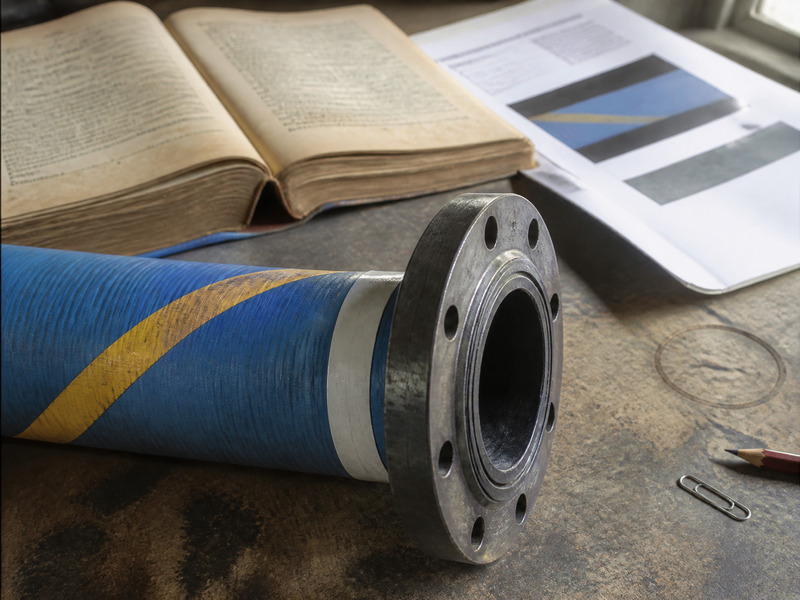
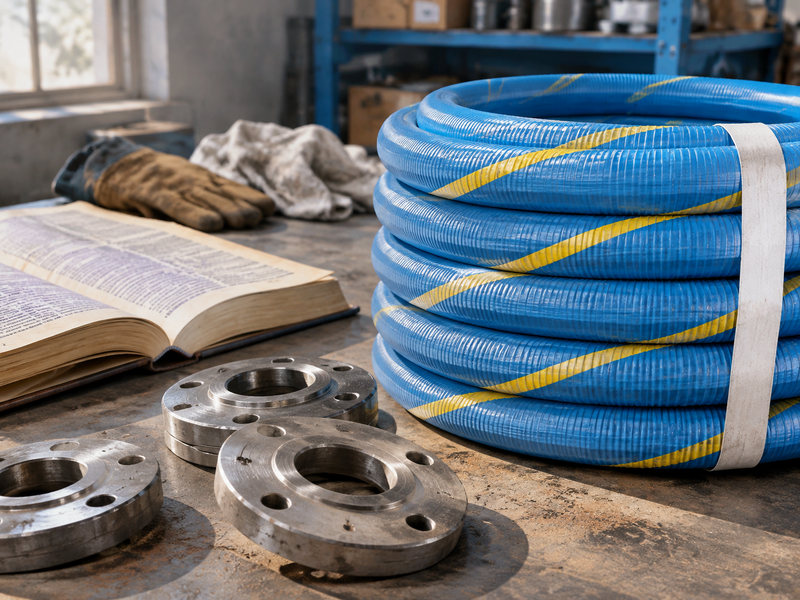
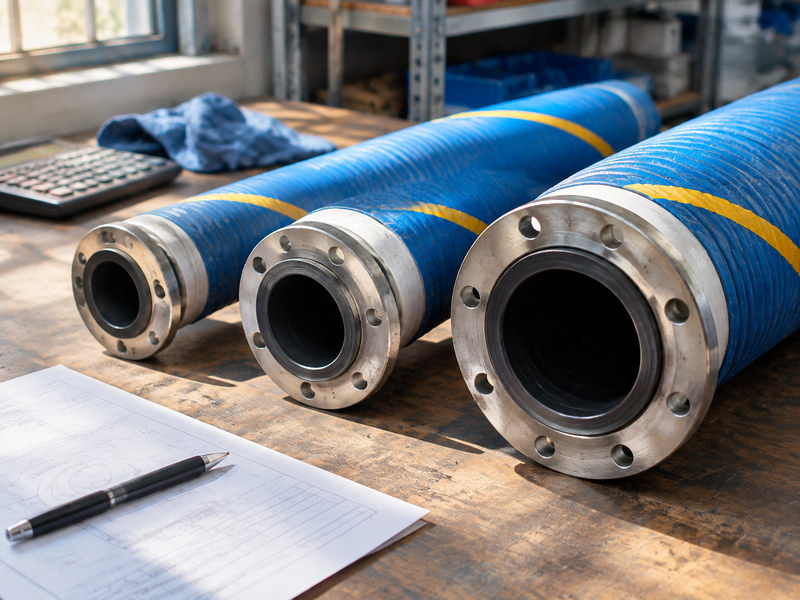
Figure 1. A withdrawn British standard opened beside a current composite hose assembly with flanged ends.
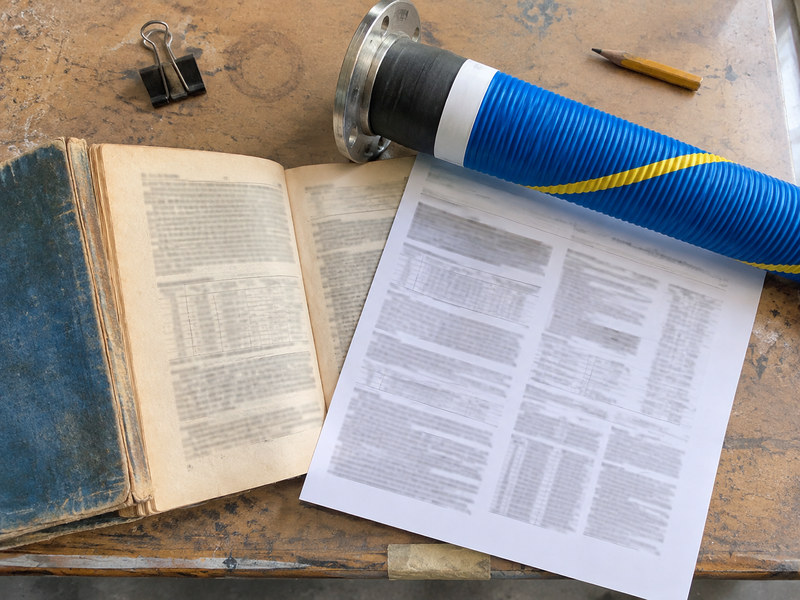
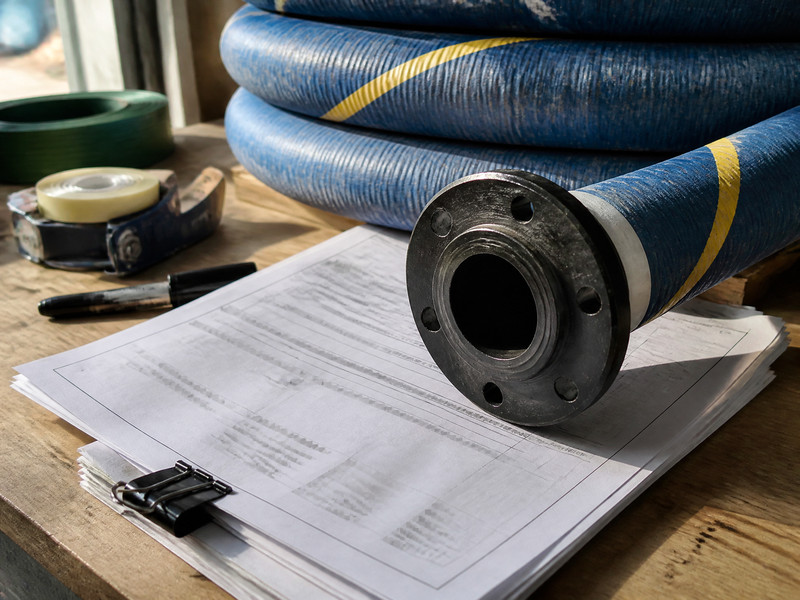
Figure 2. The older British specification sits on the left as a bound book and the current European table as a loose sheet on the right. Nothing converts one into the other by arithmetic, so the mapping has to be written down, as in Table 2.
What Does BS 5842:1980 Cover?
The document is titled “Specification for thermoplastic hose assemblies for dock, road and tanker use”. It was prepared under BSI committee CPE/5, published on 29 August 1980, and confirmed without revision in December 1986. Its scope names three service settings rather than one industrial category, which is why a single reference has been quoted across berths, road tankers and ships.
Those three settings are where composite hose is still bought. A berth line, a road tanker unloading arm and a ship-to-shore connection are the duties the European type table now describes. The 1980 text treated them as one family of thermoplastic assemblies, and that breadth is part of why it stayed in circulation.
The 1980 standard is of its period, written before the European type classification existed. Read it as a historical reference unless a contract explicitly keeps it alive.
For anyone buying a BS 5842 hose today, the practical question is narrower than the scope suggests. Which of those three settings does the line serve, at what pressure, and at what temperature? Those three answers decide the type, and the old reference only tells you that the duty is dock, road or tanker work.
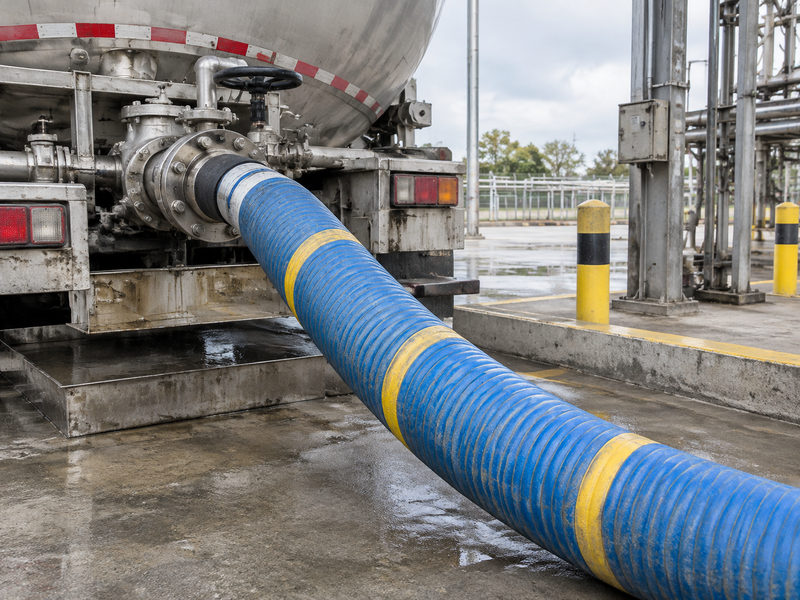
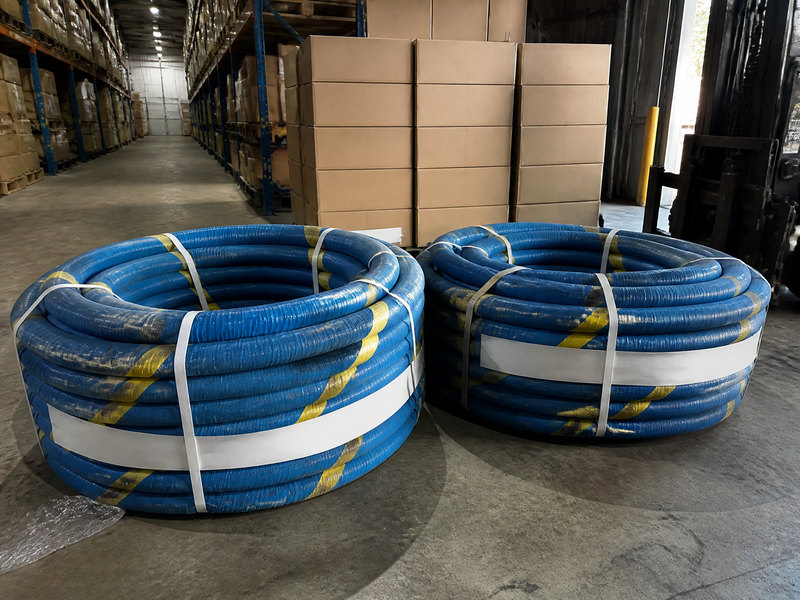
Figure 3. A road tanker transfer is one of the duty settings the older document named, and the hose doing the work here would once have been ordered by that name. The current standard replaces duty names with type, and Table 2 gives the mapping.
What Replaced It?
The 1980 British Standard was written for dock, road-tanker and ship assemblies, and it has since been withdrawn. EN 13765 replaced that field with a four-type classification by pressure and temperature, and the two documents do not map clause for clause. The 2018 edition supersedes EN 13765:2010+A1:2015 and covers bore from 25 mm to 300 mm, with working pressures from 4 bar to 14 bar. Working temperature runs from −30 °C to +150 °C across four types.
The replacement changed the method, not just the number. EN 13765:2018 classifies hose by type, with a table giving maximum working pressure, proof pressure, minimum burst and vacuum rating. A buyer can specify a type and know which test values follow. The 1980 text classifies by duty, so an old designation maps to a duty. Converting that duty to an EN 13765 type needs the pressure and temperature written down, because the two schemes do not share a scale.
Edition control matters. A quotation that says “to EN 13765” without a year may be built to the 2010 text. Ask for the edition on the certificate and on the hose marking, and compare both with the purchase order.
What Did the 1980 Text Require That Buyers Still Ask For?
Three themes recur when a terminal asks us to work from old paperwork: pressure integrity, marking and end connections. Those themes are not unique to the British document, and the European standard addresses each of them in its own way. The difference is that the current text states the values, while the old one has to be read clause by clause.
Pressure integrity is the first theme. A dock or tanker line is sized against the relief valve setting and the static head, and the hose has to hold a defined margin above both. The European type table gives that margin as proof and burst values, so a buyer can compare offers without opening a 1980 document.
Marking is the second theme. Terminals need to identify a hose at the rack, not in the office, and a marking that carries bore, working pressure and date of manufacture does that. Any composite hose standard that leaves marking optional creates an inspection problem later, which is why the marking line belongs in the purchase order regardless of which document is cited.
End connections are the third theme. Flange drilling, bolt pattern and the fixed versus floating decision determine whether an assembly fits a berth without stress at the flange face. Those details sit outside the type table and have to be written into the specification.
Side by Side: What Actually Changed
| Attribute | BS 5842:1980 | EN 13765:2018 |
|---|---|---|
| Publisher and region | British Standards Institution, United Kingdom | CEN, adopted nationally across Europe |
| Subject | Thermoplastic hose assemblies for dock, road and tanker use | Thermoplastic multi-layer hose and assemblies for hydrocarbons, solvents and chemicals |
| Classification | Set by the 1980 text | Four types, each with pressure, proof, burst and vacuum values |
| Bore coverage | Set by the 1980 text | 25 mm to 300 mm, with tolerances and bend radii |
| Temperature basis | Set by the 1980 text | −30 °C to +150 °C, type by type |
| Wire materials | Set by the 1980 text | Stainless steel grades, galvanised or sheathed carbon steel, aluminium |
| Status | Confirmed 1986, withdrawn since | Current edition, supersedes the 2010 text |
Table 1. What can be stated from the documents themselves, and what has to be read in the original clause. Rows marked “set by the 1980 text” are not gaps in this article; they are points where only the standard can answer.
The honest reading is that the two documents are not interchangeable at clause level. Where a buyer needs a specific requirement from the 1980 text, such as a test sequence or a marking format, the document has to be read. The European standard is the one that supplies a type table, and a type table is what a modern specification can enforce.
How Do Dock, Road and Tanker Duties Map to the Type Table?
The mapping is straightforward once the duty is described in pressure and temperature terms. A vapour return line at a berth maps to Type 1. A road tanker discharge or a rail car connection usually maps to Type 3, at 14 bar with a stainless bore where the product demands it. A hot product line maps to Type 4, and the temperature, not the pressure, is the deciding value.
The duty mapping transfers; the paperwork does not. A specification written around a BS 5842 hose assembly often names the berth, the tanker and the ship in one breath, with a single pressure figure for all three. A 1980 certificate names a duty and a test, while an EN 13765 declaration names a type, a bore range and a proof value. The European scheme separates them by type, and the separation is useful: a berth line that runs at 6 bar does not need the same build as a tanker discharge at 14 bar.
Our advice is to map the duty, then write the type. Keep EN 13765:2018 as the technical reference, and treat the older wording as evidence of where the line sits in the terminal.
Why Does BS 5842 Still Appear in Tenders?
Because terminal documentation ages slowly. Operating manuals written when a berth was commissioned keep their original hose references, and those references are copied into procurement templates year after year. In markets that bought British equipment in the 1980s, the wording survives in local specifications too.
There is a commercial reason as well. A distributor holding stock described by the old number can quote without re-testing, and a buyer who accepts the wording avoids the work of writing a type specification. That shortcut is where the risk sits: the buyer inherits a reference without the test values behind it.
The practical answer is not to delete the old line but to translate it. Keep it for traceability, and add the type, bore, pressure and test values the line was meant to deliver.
How Do You Handle a Specification That Names Both?
Treat the European line as the technical requirement and the British line as a legacy reference. Write three things into the enquiry: the EN 13765 type, the test values you will witness or receive, and a note that the older reference is retained for document continuity only.
If a tender insists on compliance with the 1980 text, ask which clauses are being invoked and why. Most such tenders repeat a template, and the clause list usually reveals that the intent is pressure integrity, marking or end connections, all of which the current standard also addresses. A clarification at tender stage costs less than a rejected shipment.
Where both genuinely apply, for example a berth that must satisfy an insurer’s legacy wording, ask for a document pack covering both. The pack should carry the type declaration under EN 13765 and the specific values the old clause required.
Is “Equivalent” a Valid Claim?
Only with a document behind it. “Equivalent” is not a defined term in either standard, and no clause states that a type is equivalent to an old designation. A supplier using the phrase is making a commercial claim, not a technical one.
A claim becomes usable when three things are attached. The first is the EN 13765 type and edition. The second is the proof and burst results for the bore in question. The third is a statement of which requirements the assembly is compared against. Without the third item the comparison has no reference point.
In our enquiries the phrase usually means “this hose is the modern replacement for what you used to buy”. That may be true, but it should be demonstrated with test data rather than asserted in a quotation.
What Does a Modern Specification Look Like?
| Requirement | Write this | Avoid |
|---|---|---|
| Vapour recovery at a berth | EN 13765 Type 1, bore, length, continuity clause | “The old type, as before” |
| Chemical tanker discharge | EN 13765 Type 3, MAWP, relief valve setting, stainless bore | “Equivalent to the 1980 standard” |
| Hot product transfer | EN 13765 Type 4, service temperature, derated pressure | A type number with no temperature |
| Legacy template | Type plus a clause note on what the old reference required | Deleting the old reference without a note |
Table 2. Specification wording that keeps traceability while making the technical requirement enforceable.
A composite hose standard is only useful if the clause it invokes can be tested. Every row ends in a value somebody can measure: a pressure, a temperature, a continuity figure or a bore.
How Do You Check a Standard’s Status?
Check the publisher, not a distributor datasheet. BSI maintains the status of British Standards, and CEN national members maintain the European editions. A status line will read current, superseded or withdrawn, and that line is what counts in a contract dispute.
Status is not the whole story, because a current standard can still be quoted wrongly. Three checks prevent most problems. Confirm the edition year rather than the number alone. Confirm the edition is current at the date of the purchase order. Confirm the certificate you receive names the edition you specified.
If a supplier cannot state the edition, treat the compliance claim as unverified. This is not a technicality: hose built to a superseded edition is a different product from hose built to the current text, even when the hardware looks identical. Any credible composite hose standard claim should survive those three questions.
Which Standard Should You Quote?
Quote EN 13765:2018 for new work, and reference BS 5842 only where a legacy specification requires it. A tender that asks for the old reference should be answered with a type declaration and test values, not a discount. That answer holds for chemical, petroleum and dock duties across the composite hose range.
Two exceptions are worth knowing. A contract governed by an old insurance or terminal specification may need the British reference to stay on the paperwork; keep it as a documentary line and buy to the European type. A market that has not adopted the European scheme may still ask for the old document by name; there, supply both declarations rather than choosing.
For readers working out which type applies to a duty, the EN 13765 type selection guide sets out the four columns. Buyers checking what a certificate covers should read the type approval walkthrough, and the glossary defines the terms that appear on both documents.
Frequently Asked Questions
Is BS 5842 still valid?
No. It is a withdrawn British Standard, and new work should be specified to EN 13765:2018. Verify the status with BSI before quoting the old number in a contract.
When was BS 5842 replaced?
The replacement happened in stages. EN 13765 was published as the European specification for the same field, and its current edition dates from 2018, superseding the 2010 text.
Can an old-design hose be certified to EN 13765?
Only by testing against the European requirements. A hose that has not been type tested to EN 13765 has no type declaration, whatever its construction.
Does EN 13765 cover dock hose?
It covers hose and assemblies for hydrocarbons, solvents and chemicals, which includes berth lines. The dock, road and tanker wording came from the older document, and the duty is now expressed as a type with pressure and temperature.
Should a BS 5842 hose be inspected differently?
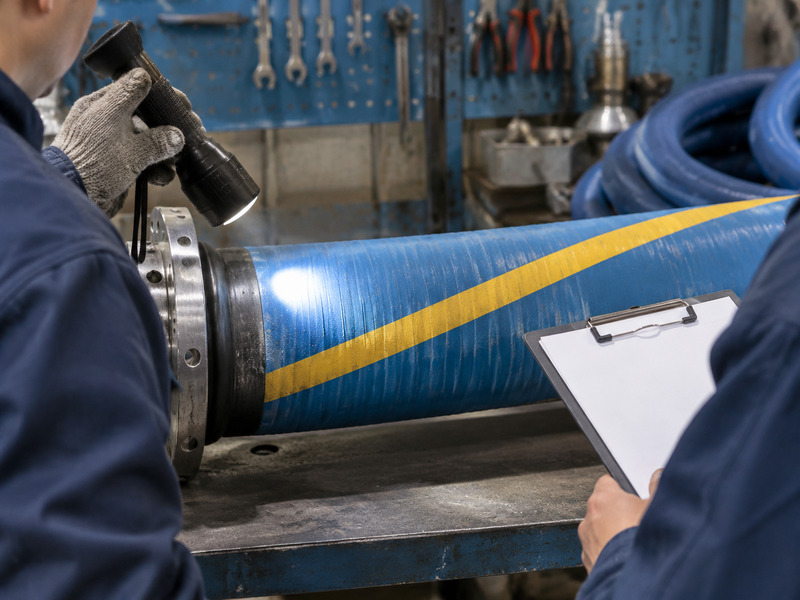
No. Inspection follows the duty and the site regime, not the standard cited on the paperwork. Look for cover damage down to the reinforcement, corrosion at the helix and any bulge that suggests the film has separated. A modern composite hose standard adds test values, not a different inspection method.
What is the difference between a type and a class?
A type is defined in the classification table and carries pressure, proof, burst and vacuum values. Class language comes from older documents and has no row in that table.
Which edition should appear on a purchase order?
EN 13765:2018. Naming the year stops a supplier delivering against the superseded 2010 text while quoting the same standard number.
Does a withdrawn standard still have legal force?
Only if a contract or regulation names it. A withdrawn standard is not automatically illegal, but it no longer represents current practice, and the buyer relying on it carries the technical risk.
About HENGHUA
HENGHUA builds composite hose and hose assemblies for docks, road tankers, rail cars and plant transfer, with PTFE, UHMWPE, XLPE and polypropylene linings over a woven fabric carcass. Assemblies are built to the bore, pressure class and temperature range you specify, with stainless or coated carbon steel helixes and flanged or crimped ends. Marking carries the bore and pressure, and the test record for each assembly is supplied with the order. The full range sits in our composite hose range, and the construction detail is covered in the multi-layer build guide. If your paperwork still names the 1980 standard, send it with the duty and we will map it to a type and quote against the test values.
 English
 Spanish
 Portuguese
 French
 German
 Arabic
 Russian
 Indonesian
 Japanese
 Korean