
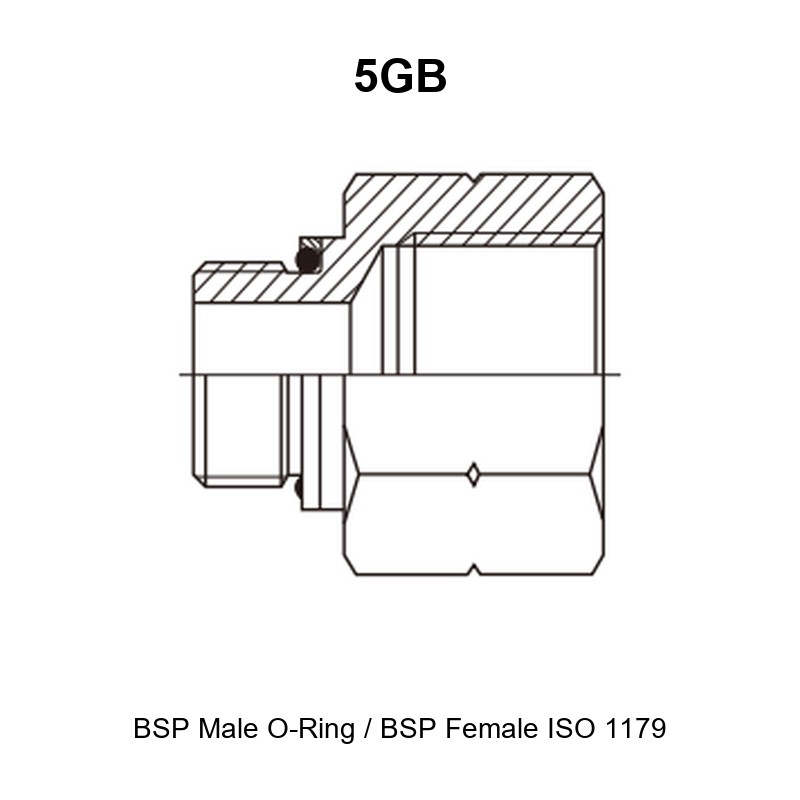
1. Fungsi Adaptor 5GB
Adaptor 5GB merupakan sambungan konversi lurus tipe jantan ke betina. Sambungan 1 berupa ujung baut jantan BSP yang disegel dengan cincin-O, sedangkan Sambungan 2 berupa port betina BSP yang dirancang sesuai standar ISO 1179 dengan dudukan kerucut 60 derajat. Adaptor ini mengubah port jantan BSPP yang disegel dengan cincin-O menjadi port betina BSPP, atau sebaliknya, dalam satu bagian utuh.
Nilai inti: kedua ujungnya harus pas persis dengan port pasangannya. Ujung jantan harus dilengkapi dengan O-ring yang tepat dan berukuran sesuai pada permukaan port yang rata, sedangkan ujung betina harus dapat menerima ujung jantan berbentuk stud dengan ulir dan kerucut yang sesuai. Itulah syarat utama untuk mencegah kebocoran pada titik sambungan.
Prinsip penyegelan: ujung jantan disegel oleh cincin-O yang terpasang pada permukaannya, yang akan tertekan ke permukaan datar port saat adaptor dikencangkan. Ujung betina disegel oleh dudukan kerucut 60 derajat yang ditetapkan dalam ISO 1179. Tidak ada ujung yang disegel pada sisi ulir, karena ISO 228-1 merupakan ulir paralel.
2. Spesifikasi 5 GB
Blok-blok di bawah ini menampilkan kedua ujung adaptor 5GB dalam bentuk cermin, sehingga pembeli dapat mengetahui port mana yang dilayani oleh masing-masing ujung dan metode penyegelan apa yang diterapkan pada masing-masing ujung.
2.1 Sambungan 1 — BSP jantan, segel permukaan O-ring (ujung E)
- Standar ulir: ISO 228-1, ulir pipa yang sambungannya tidak dirancang untuk kedap tekanan pada bagian ulirnya.
- Keluarga ulir: British Standard Pipe Parallel (BSPP / G).
- Jenis kelamin: laki-laki.
- Rentang ukuran: G1/4″x19 hingga G1″x11.
- Metode penyegelan: O-ring ditekan ke permukaan port yang datar.
- Port sambungan: Port BSPP dengan permukaan datar yang dapat dipasangi segel O-ring. Pastikan desain permukaan port sesuai dengan gambar teknis Anda, karena kedalaman permukaan dan jari-jari sudut menentukan apakah diperlukan port dengan segel O-ring atau segel yang direkatkan.
- Posisi O-ring: terpasang pada permukaan ujung jantan, dijaga agar tetap konsentris oleh alur yang diolah secara mesin, sehingga tidak bergeser saat adaptor diputar masuk.
2.2 Sambungan 2 — BSP betina, dudukan kerucut 60 derajat sesuai ISO 1179 (ujung F)
- Standar ulir: ISO 228-1.
- Keluarga ulir: British Standard Pipe Parallel (BSPP / G).
- Jenis kelamin: perempuan.
- Rentang ukuran: G1/4″x19 hingga G1″x11.
- Metode penyegelan: dudukan kerucut 60 derajat.
- Standar sambungan: ISO 1179 (sambungan BSPP dan ujung ulir dengan dudukan kerucut 60 derajat).
- Catatan: Karena kedua ujung tersebut diurutkan berdasarkan kode ukuran, ujung betina dapat memiliki ukuran yang sama dengan atau lebih besar daripada ujung jantan pada ukuran-ukuran yang tercantum.
2.3 Konstruksi dan Bahan
Badan komponen ini diproses dari batang logam menggunakan mesin bubut CNC sebagai satu kesatuan utuh, sehingga tidak ada sambungan yang dilas atau disolder pada jalur tekanan. Pilihan bahan badan komponen meliputi baja karbon, baja tahan karat 304, baja tahan karat 316, dan kuningan. Badan dari baja karbon disuplai dengan lapisan seng krom trivalen (Cr3+) atau lapisan seng-nikel, sedangkan badan dari baja tahan karat disuplai tanpa lapisan.
Alur cincin-O, ulir jantan, dan permukaan segel datar diproses dalam satu pengaturan, sedangkan dudukan kerucut betina dibor dalam rangkaian pengaturan yang sama, sehingga cincin-O menempel tegak lurus terhadap permukaan port. Badan komponen ini memiliki satu lubang hexagonal di antara sisi-sisi datar, yang ditunjukkan sebagai S1 dalam tabel.
O-ring merupakan elemen penyegel pada ujung jantan, sehingga bahan pembuatnya dipilih sesuai dengan jenis fluida dan suhu sistem: NBR, FKM, atau EPDM. Ujung betina tidak mengandung elastomer, karena penyegelannya dilakukan secara logam-ke-logam pada bagian kerucut. Pengukuran ulir dan pemeriksaan dimensi dilakukan per batch sebelum dikemas.
2.4 Tekanan dan Suhu
Tekanan kerja untuk ukuran-ukuran ini dikonfirmasi oleh tim teknik HENGHUA sesuai pesanan, berdasarkan metode penyegelan, ukuran ulir, dan bahan yang dipilih. Penyegelan permukaan dengan cincin-O dan dudukan kerucut 60 derajat tidak memiliki kapasitas tekanan yang sama pada setiap desain port, sehingga konfirmasi tersebut dikeluarkan berdasarkan port yang sebenarnya dan cincin-O yang dipilih.
Baja karbon dengan lapisan seng cocok untuk aplikasi hidraulik umum, sedangkan baja tahan karat 304 atau 316 merupakan pilihan untuk aplikasi yang bersifat korosif dan lepas pantai. Cincin-O pada ujung jantan menentukan batas suhu sambungan tersebut:
| Bahan segel | Rentang suhu |
|---|---|
| O-ring NBR atau segel terikat | sekitar -30°C hingga +100°C |
| FKM (tipe Viton) | sekitar -20°C hingga +200°C |
| EPDM | sekitar -40°C hingga +120°C |
Ujung betina adaptor, yang menyegel pada kerucut 60 derajat, mengikuti sifat bahan bodi dan fluida, bukan batas elastomer.
2.5 Tabel Nomor Bagian dan Dimensi
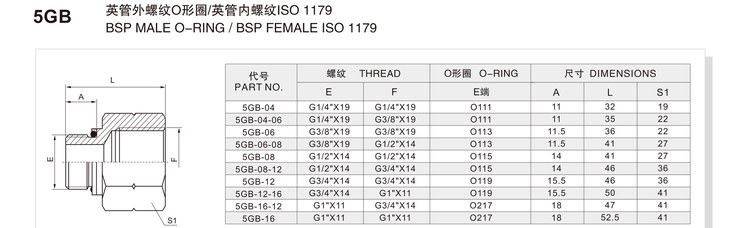
E adalah keterangan ulir jantan pada Sambungan 1, F adalah keterangan ulir betina pada Sambungan 2, dan kolom O-ring menunjukkan kode ukuran cincin yang dipasang pada permukaan ulir jantan. A adalah panjang ujung jantan, L adalah panjang keseluruhan badan, dan S1 adalah ukuran hex (bidang kunci pas), semuanya dalam milimeter dan diambil dari gambar di atas.
| NOMOR BAGIAN. | ULIR E (jantan) | ULIR F (betina) | Ujung O-RING E | A | L | S1 |
|---|---|---|---|---|---|---|
| 5GB-04 | G1/4″ x 19 | G1/4″ x 19 | O111 | 11 | 32 | 19 |
| 5GB-04-06 | G1/4″ x 19 | G3/8″ × 19 | O111 | 11 | 35 | 22 |
| 5GB-06 | G3/8″ × 19 | G3/8″ × 19 | O113 | 11.5 | 36 | 22 |
| 5GB-06-08 | G3/8″ × 19 | G1/2″ x 14 | O113 | 11.5 | 41 | 27 |
| 5GB-08 | G1/2″ x 14 | G1/2″ x 14 | O115 | 14 | 41 | 27 |
| 5GB-08-12 | G1/2″ x 14 | G3/4″ × 14 | O115 | 14 | 46 | 36 |
| 5 GB-12 | G3/4″ × 14 | G3/4″ × 14 | O119 | 15.5 | 46 | 36 |
| 5GB-12-16 | G3/4″ × 14 | G1″x11 | O119 | 15.5 | 50 | 41 |
| 5GB-16-12 | G1″x11 | G3/4″ × 14 | O217 | 18 | 47 | 41 |
| 5 GB–16 | G1″x11 | G1″x11 | O217 | 18 | 52.5 | 41 |
Kode ukuran O-ring berdasarkan ulir jantan, sebagaimana tercantum di atas: O111 dipasang pada G1/4″x19, O113 pada G3/8″x19, O115 pada G1/2″x14, O119 pada G3/4″x14, dan O217 pada G1″x11.
3. Cara Membaca Nomor Bagian Adaptor 5 GB
Awalan 5GB menunjukkan seri produk ini: badan lurus, ujung jantan BSP dengan O-ring, dan ujung betina BSP sesuai standar ISO 1179. Awalan tersebut diikuti oleh satu atau dua kode ukuran yang menunjukkan tingkatan ukuran BSP pada ujung jantan, kemudian pada ujung betina.
Kode tunggal berarti kedua ujungnya memiliki ukuran ulir yang sama, sehingga 5GB-08 adalah ulir jantan G1/2″x14 ke ulir betina G1/2″x14 dengan cincin O115. Kode ganda berarti kedua ujungnya berbeda, dan urutannya penting: kode pertama selalu merupakan ujung jantan (E), sedangkan kode kedua selalu merupakan ujung betina (F).
Contoh perhitungan dari tabel: 5GB-08-12 memiliki ujung jantan (E) berukuran G1/2″x14 dengan cincin O (O-ring) tipe O115, ujung betina (F) berukuran G3/4″x14, dimensi A sebesar 14 mm, dimensi L sebesar 46 mm, dan hex S1 sebesar 36 mm. Nomor bagian terbalik 5GB-12 tidak ada sebagai cerminan dari kombinasi tersebut, jadi selalu cantumkan kedua ukuran dalam urutan E lalu F.
4. Installation and Fitment
Before assembly, check the O-ring on the male end and confirm it is the size listed for that thread, undamaged and free of grit. Fit a new O-ring where the existing one is cut, flattened or hardened, because an O-ring is a service item and not a permanent part of the adapter.
Thread the male end into the port by hand until the O-ring touches the port face, then tighten snug and apply the tightening angle specified for the size and material. The O-ring seals on the flat face, so the joint does not need high torque to be tight, and over-tightening only loads the threads and the hex. For the female end, follow the 60 degree cone procedure: clean the cone, thread in by hand until contact, then tighten to the specified angle.
Common fitment errors and their symptoms: an O-ring left out of the face leaks immediately at the port face, even when the adapter is tight; an O-ring of the wrong thickness holds the male end off the face and the joint weeps; a cut O-ring produced by a sharp port corner leaks at the first pressure cycle; and a BSPT male end fitted into the female end of this adapter leaks because a taper thread cannot register on a 60 degree cone.
5. Applications and Industries
Application tags for the 5GB adapter are hydraulic systems, water jetting, oil and gas equipment, industrial equipment, construction machinery, agriculture, marine and material handling. It is the part to use where a BSPP male port is O-ring sealed, or where the assembly must be dismantled and reassembled often without replacing a bonded seal each time.
Concrete scenarios: a mobile machine with O-ring sealed BSPP ports, where the adapter converts the port to a female connection for a hose assembly; a repair workshop that keeps the common sizes on the shelf so a damaged O-ring port can be re-terminated without re-machining the housing; a test bench where the male end is opened and closed repeatedly, because an O-ring reseals on its face after each refit far more reliably than a deformed bonded seal; and an OEM assembly line where the O-ring face seal gives a repeatable tightening result with less operator judgement.
6. Replacement and Cross-Reference Guide
Identify a replacement for a 5GB adapter by standard and sealing method, never by brand. This is a BSPP male to BSPP female part with ISO 228-1 parallel thread, an O-ring face seal at the male end and an ISO 1179 60 degree cone seat in the female end.
Measure these three things before ordering: first, the male thread outside diameter and threads per inch, to confirm an ISO 228-1 G thread at 19, 14 or 11 threads per inch in the sizes offered; second, the port face at the male end, checking that it is a flat face that accepts an O-ring and measuring the face depth; third, the female end thread size and the seat inside it, confirming a 60 degree cone.
| Mating port at the male end | Thread standard | Sealing method to use | Fits |
|---|---|---|---|
| BSPP female port with flat face for an O-ring | ISO 228-1 | O-ring face seal | Yes |
| BSPP female port with 60 degree cone | ISO 228-1 / ISO 1179 | Cone seat | No, this male end has no cone nose |
| BSPP female port with flat face for a bonded seal | ISO 228-1 | Bonded seal | Possible in some face depths, confirm with the drawing |
| BSPT female port (Rc thread) | ISO 7-1 | Taper thread on the flanks | Tidak |
| Metric port with O-ring | ISO 6149-3 | O-ring | No, the thread is not an ISO 228-1 G thread |
| Mating component at the female end | Thread standard | Sealing method | Fits |
|---|---|---|---|
| BSPP male stud end with 60 degree cone | ISO 228-1 / ISO 1179 | 60 degree cone seat | Yes |
| BSPP male stud end with flat face and bonded seal | ISO 228-1 / ISO 1179 | Bonded seal | Only if made to the correct face depth |
| BSPT male end (R thread) | ISO 7-1 | Taper thread on the flanks | Tidak |
7. Ordering, Packaging and Delivery
To order a 5GB adapter, give the series code with the full part number, both thread sizes in the order E then F, the body material, the plating, the O-ring material and the quantity. For example: series 5GB, part number 5GB-08-12, male E end G1/2″x14 with O115 O-ring in NBR, female F end G3/4″x14, carbon steel with trivalent chromium zinc plating, 500 pieces.
State the O-ring material even where NBR is assumed, because the fluid and temperature of the system decide the correct compound and the O-ring is fitted to the order. Packaging is arranged for distributor shelves and for direct-to-line delivery, with thread protection in transit and labels carrying the part number and both thread sizes. Samples are available for validation, and lead time is confirmed per order once thread sizes, material and quantity are fixed.
8. FAQ
Q1. What is the difference between BSPP and BSPT, and can they be interchanged? BSPP is the parallel pipe thread defined in ISO 228-1, which is the thread used at both ends of this series. BSPT is the taper thread defined in ISO 7-1, which seals on the thread flanks and needs a sealant. They are not interchangeable, and a taper male end fitted into the female end of this adapter cannot reach the cone seat, so the joint leaks and both threads are damaged.
Q2. What is the difference between a 60 degree cone seat and a bonded seal, and which should I choose? A 60 degree cone seat is a metal-to-metal seal between the cone on a male stud end and the cone inside this adapter female end, and it uses no elastomer. A bonded seal is a metal washer with a bonded elastomer ring that seals between two flat faces. This series uses an O-ring on the male face instead, and a 60 degree cone seat in the female end, so choose the mating components to match those two sealing methods.
Q3. How do I identify the correct 5GB size? Read the thread callout of the port the male end enters, then the thread of the male stud end the female end receives. The first size code is the male end and the second is the female end, so 5GB-08-12 is a G1/2″x14 male end into a G3/4″x14 female end. Where both connections are the same size, the part number carries one code, for example 5GB-08 with an O115 O-ring.
Q4. What seal material should I select for my fluid and temperature? The O-ring on the male face is the elastomer to select: NBR covers approximately -30°C to +100°C, FKM approximately -20°C to +200°C, and EPDM approximately -40°C to +120°C. The female end has no elastomer and follows the body material and the fluid. Body options are carbon steel with trivalent chromium zinc plating, 304 or 316 stainless steel, and brass.
Q5. How is the working pressure of this adapter determined? Working pressure for these sizes is confirmed per order by HENGHUA engineering, based on the sealing method, thread size and material selected. The O-ring face seal at the male end and the 60 degree cone seat at the female end do not carry the same capability in every port design, so the confirmation is issued against the actual port, the actual O-ring compound and the expected system pressure that you send with the inquiry.
Q6. What is the difference between this O-ring male end and the double use male end on other BSPP adapters? The double use male end carries a 60 degree cone that seats metal-to-metal, and can also seal with a bonded seal on its flat shoulder. The male end on this series has no cone nose and seals with an O-ring in its face against a flat port face. Choose the O-ring version where the port is designed for an O-ring face seal, and the double use version where the port has a 60 degree cone or takes a bonded seal.
Q7. Can I change the O-ring size or material myself? Fit the O-ring size listed for the male thread, because the groove and the face are machined to that size and a ring of the wrong thickness will hold the adapter off the port face. The material can be selected within the NBR, FKM and EPDM options to suit the fluid; state the choice when ordering so the correct compound is fitted and supplied as a spare with the parts.
Q8. What is the minimum order quantity and can I get samples? Minimum order quantity depends on the size, the material, the plating and the O-ring compound selected, and is confirmed with the quotation. Samples are available for validation, and for a part number such as 5GB-08-12 a sample is the normal way to confirm that the male face seal closes correctly on the actual port before a production order. Lead time is confirmed per order.
Browse the full Adaptor Hidraulik range for the complete family, or contact us to request a quote, mill test reports, and samples.


 English
 Spanish
 Portuguese
 French
 German
 Arabic
 Russian
 Indonesian
 Japanese
 Korean