
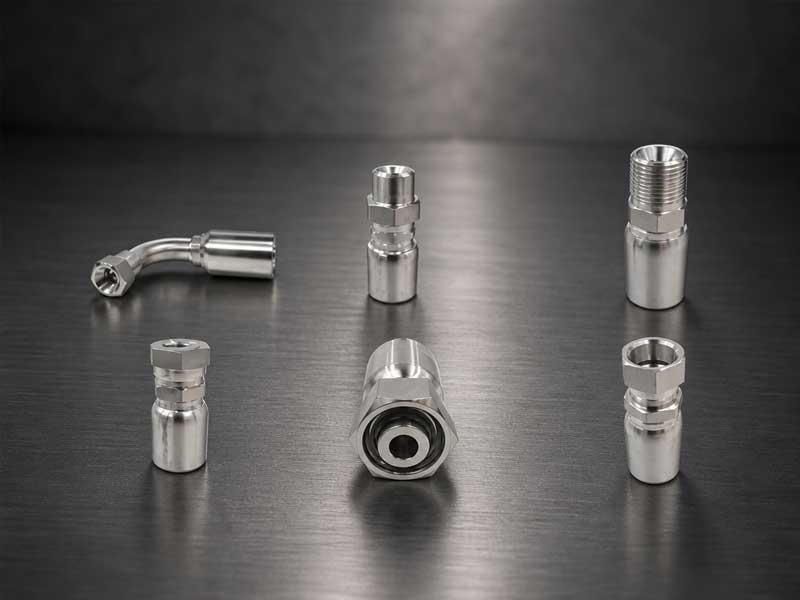
Reusable vs Crimped Hydraulic Fittings
Permanent crimped hydraulic fittings are the preferred choice for high-pressure and safety-critical hydraulic systems because they provide higher pressure ratings, better vibration resistance, and more consistent assembly quality.
Reusable hydraulic fittings are better suited for emergency repairs, mobile maintenance, and low-to-medium pressure applications where portability and fast field installation are more important than maximum durability.
Comparison at a Glance
| Factor | Winner |
|---|---|
| Maximum pressure capability | Crimped fittings |
| Field repair convenience | Reusable fittings |
| Vibration resistance | Crimped fittings |
| Installation equipment required | Reusable fittings |
| Production efficiency | Crimped fittings |
| Remote maintenance suitability | Reusable fittings |
| Long-term reliability | Crimped fittings |
| Per-assembly cost | Crimped fittings |
What Is the Difference Between Reusable and Crimped Hydraulic Fittings?
The main difference between reusable and crimped hydraulic fittings is the attachment method.
Reusable fittings are mechanically installed using threaded sockets and inserts, allowing field replacement without a crimping machine. The socket threads onto the hose cover while the insert fits inside the hose bore, creating a mechanical grip and seal through manual tightening.
Crimped fittings are permanently attached using hydraulic crimping equipment, which compresses a ferrule onto the hose with controlled force, creating a uniform, permanent connection that cannot be disassembled.
In simple terms:
- Reusable fittings = flexibility and field repair capability
- Crimped fittings = maximum strength, consistency, and reliability
1. What Are Reusable Hydraulic Fittings?
Reusable hydraulic fittings—also known as field-attachable or field-installable fittings—are two-piece connectors that can be assembled onto a hydraulic hose using only hand tools, without requiring a crimping machine.
1.1 How Reusable Fittings Are Constructed
A reusable fitting consists of two main components:
- Socket (outer sleeve): Grips the outer cover of the hose, creating mechanical strength by threading down over the hose cover and compressing it for a secure hold.
- Insert (inner nipple): Fits tightly inside the hose bore, with barbs or serrations that grip the inner tube and create a seal against fluid leakage.
These two components are joined via a threaded connection. The installer slides the socket over the hose, inserts the nipple into the hose bore, and tightens the two together using wrenches. The compression between socket and insert creates both a mechanical grip and a seal.
1.2 Common Types of Reusable Fittings
| Fitting Type | Assembly Method | Typical Pressure Range | Common Applications |
|---|---|---|---|
| One-piece push-on / barb fittings | Pushed onto hose; may use clamp | Up to ~20 bar (300 psi) | Return lines, suction lines, pneumatic circuits |
| Two-piece screw-on reusable fittings | Insert + socket, tightened with wrenches | Up to ~210 bar (3,000 psi) | Field repairs on mobile equipment, tractors |
| R5 reusable hose ends | Threaded assembly with hand tools | Typically up to 210 bar for SAE 100R5 hose | Agriculture, transport, fleet maintenance |
1.3 Key Characteristics of Reusable Fittings
Advantages:
- Field repair capability: Quick repairs without specialized equipment, reducing downtime for tractors, excavators, and mobile equipment.
- No crimping machine required: Only standard wrenches and basic hand tools needed.
- Reusability: Fittings can be removed from worn hoses and installed on new ones if undamaged.
- Cost-effective for small shops: Eliminates the need for expensive crimping equipment investment.
Limitations:
- Lower pressure rating: Generally limited to medium-pressure applications.
- Higher fitting cost: Reusable fittings typically cost more per unit than crimped fittings.
- Slower assembly: Installation takes longer than machine crimping.
- Requires careful installation: Proper torque and assembly technique are critical for reliable sealing.
2. What Are Permanent Crimped Hydraulic Fittings?
Permanent crimped hydraulic fittings—also called one-piece or crimp-style fittings—are single-unit connectors that are permanently attached to hydraulic hoses using a specialized crimping machine. The crimping process compresses an outer ferrule onto the hose with precise force, creating a permanent, leak-proof bond.
2.1 The Crimping Process
The assembly process for a one-piece fitting involves several steps:
- Cut the hose squarely using a hose saw designed for hydraulic lines.
- Insert the fitting stem into the hose bore until fully seated.
- Place the assembly in the crimping machine with the correct die set for the specific hose and fitting size.
- Activate the crimper, which compresses the ferrule to a pre-determined diameter, permanently deforming it and creating a 360-degree seal.
The entire process typically takes less than 30 seconds per end.
2.2 Key Characteristics of Crimped Fittings
Advantages:
- Higher pressure capability: Engineered for extreme pressures, often 350–700 bar (5,000–10,000 psi).
- Superior vibration resistance: Uniform compression creates a more reliable connection under dynamic conditions.
- Consistent quality: Machine-controlled crimp diameter eliminates human error in assembly.
- Lower per-unit cost: Fittings themselves are less expensive; tooling investment is the main cost factor.
- Compact design: Takes less space than reusable fittings, fitting better in tight areas.
Limitations:
- Single-use: Fitting and ferrule are discarded when the hose assembly fails.
- Requires crimping machine: Specialized equipment and trained operators needed for installation.
- Cannot be serviced in the field: Failed assemblies must be replaced entirely.
3. Reusable vs. Crimped Fittings: Complete Comparison
3.1 Comprehensive Comparison Table
| Factor | Reusable Fittings | Permanent Crimped Fittings |
|---|---|---|
| Typical pressure rating | Up to ~210 bar (3,000 psi) for R5 assemblies; lower for push-on | Often 350–700 bar (5,000–10,000 psi) |
| Assembly location | Field or shop; no crimper needed | Shop or with portable crimper |
| Tooling cost | Low—wrenches only | High—crimping machine and dies |
| Vibration resistance | Moderate; may require torque retention checks | Excellent; uniform compression provides superior reliability |
| Best use case | Emergency repair, low-pressure returns, fleet maintenance | OEM assembly, high-pressure, safety-critical circuits |
| Reusability | Can be moved to a new hose | Fitting and ferrule are single-use |
| Cost per assembly | Higher fitting cost, no tooling | Lower fitting cost, requires tooling investment |
| Assembly speed | Slower—requires manual installation | Fast—often <30 seconds per end |
| Size/weight | Bulkier, takes more space | Compact, better for tight areas |
| Failure risk under impulse | Higher due to thread relaxation | Lower due to permanent compression |
3.2 Pressure and Temperature Limitations
Reusable fittings always carry a lower pressure rating than the same-size crimped assembly:
- One-piece push-on reusable fittings: Typically limited to approximately 20 bar (300 psi).
- Two-piece R5 reusable fittings: Typically handle up to approximately 210 bar (3,000 psi) for smaller sizes; derate for larger sizes and higher temperatures.
- Plage de températures : Standard assemblies with Buna-N seals are typically limited to -40 °C to +100 °C. Viton or PTFE seals can extend the range but must match the hose tube material.
- Dynamic service: Reduce the rated pressure by 25–50% if the hose experiences impulse, vibration, or flexing.
Critical Safety Note: Never assume a reusable fitting can match a crimped fitting just because the thread size is the same. Always use the manufacturer’s published pressure rating for the specific hose-and-fitting combination.
3.3 Total Cost of Ownership Comparison
Although reusable fittings have lower equipment requirements, their total cost may be higher in high-volume operations because of higher fitting prices and slower assembly.
Cost Factors to Consider:
| Cost Component | Reusable Fittings | Crimped Fittings |
|---|---|---|
| Fitting cost per unit | Higher | Lower |
| Equipment investment | Low (wrenches only) | High (crimping machine + dies) |
| Assembly labor cost | Higher (manual installation) | Lower (machine-assisted) |
| Replacement frequency | May be higher in demanding applications | Typically lower |
| Training requirements | Moderate | Moderate to high |
| Inventory flexibility | High (fittings can be reused) | Low (fittings are single-use) |
Guidelines:
- For occasional repairs and small shops: Reusable fittings may be more economical.
- For continuous production and fleet operations: Crimped fittings usually provide lower total ownership cost.
- For safety-critical applications: The additional reliability of crimped fittings often justifies the investment.
4. Hydraulic Hose and Fitting Compatibility
Hydraulic fittings must always be selected according to hose construction, reinforcement type, pressure rating, and manufacturer compatibility recommendations. A fitting designed for SAE 100R2 hose may not be suitable for SAE 100R12 or SAE 100R13 hose even when the thread size is identical.
Compatibility Factors to Verify
| Factor | Why It Matters |
|---|---|
| Hose reinforcement type | Wire braid, spiral, or textile require different fitting designs |
| Hose inner tube material | Must be compatible with fitting insert and seal materials |
| Hose outer cover material | Affects socket grip and environmental resistance |
| Fitting manufacturer compatibility | Mixing brands can void warranties and compromise safety |
| Crimp specifications | Specific die sets and crimp diameters required for each hose-fitting combination |
Important: Always refer to the hose and fitting manufacturer’s compatibility chart before selecting components for a new assembly or replacement.
5. Safety Considerations
5.1 Reusable Fitting Safety Checklist
Before using a reusable hydraulic fitting, verify these critical points:
- The fitting is listed by the manufacturer for the exact hose type and dash size.
- The assembly pressure rating meets or exceeds system working pressure including pressure spikes.
- The hose is cut square and free of debris.
- The correct insert and socket are used together; do not mix brands.
- The assembly is lubricated during installation.
- Torque is applied with calibrated wrenches to the published value.
- The hose cover is not cut, bulged, or pushed out of the socket.
- A pressure test is performed before returning equipment to service.
5.2 Common Mistakes to Avoid
With Reusable Fittings:
- Using on high-pressure systems beyond rating: Can lead to hose separation, fluid leaks, or complete system failure.
- Reusing damaged fittings: Stripped threads, deformed barbs, or cracks create weak points that compromise sealing.
- Skipping thread seal checks: Loose sockets may appear sealed but allow fluid to escape under load.
With Crimped Fittings:
- Using the wrong die size: Results in uneven compression, leading to weak joints or crushed hose reinforcement.
- Under- or over-crimping: Under-crimping causes loosening or leaking; over-crimping damages reinforcement and shortens hose life.
- Failing to pressure-test: Hidden defects may remain undetected until the hose is under pressure in the field.
5.3 Industry Standards Reference
| Standard | Purpose |
|---|---|
| SAE J343 | Hydraulic hose testing methods |
| SAE J517 | Hydraulic hose specifications and types |
| SAE J514 | Hydraulic tube fittings—37° flared and flareless types |
| ISO 18752 | Rubber hose and hose assemblies—hydraulic impulse test |
| ISO 6803 | Rubber or plastics hoses—hydraulic pressure impulse test |
Testing methods referenced in industry standards include:
- Hydrostatic burst testing: Verifies the fitting can withstand maximum expected pressures.
- Impulse testing: Evaluates performance under pressure cycling conditions.
- Dimensional verification: Ensures threads and components meet specifications.
6. Hydraulic Fitting Selection Decision Guide
Decision Flowchart
Choose REUSABLE fittings if:
 ↓
Pressure requirement < 210 bar (3,000 psi)
 ↓
Field repair and on-site maintenance are needed
 ↓
No crimping machine available at service location
 ↓
Low to moderate production volume
 ↓
Flexibility for system modifications is required
Choose CRIMPED fittings if:
 ↓
Pressure requirement > 210 bar (3,000 psi)
 ↓
Safety-critical hydraulic circuit
 ↓
High vibration or impulse environment
 ↓
OEM production or consistent assembly quality required
 ↓
Long-term reliability is the primary concern
6.1 When to Choose Reusable Fittings
Reusable fittings are most appropriate when:
- System pressure is low to medium (below 210 bar / 3,000 psi).
- Equipment operates in remote locations where crimping equipment cannot be transported.
- Frequent field repairs are anticipated and quick installation with hand tools is essential.
- Budget is limited and purchasing a crimping machine is not feasible for the operation.
- Flexibility is needed for system modifications or prototyping.
Typical applications:
- Agricultural equipment (tractors, sprayers, low-pressure hydraulic machinery)
- Construction equipment in remote locations
- Maintenance shops and mobile service vehicles
- Fleet maintenance for transport and logistics
- Light industrial applications with moderate pressure requirements
6.2 When to Choose Permanent Crimped Fittings
Permanent crimped fittings are required when:
- System pressure is high (above 210 bar / 3,000 psi).
- Safety is critical and the consequences of fitting failure are severe.
- Vibration and dynamic loads are present in the application.
- Consistency and reliability are paramount for continuous operations.
- High-volume production of hose assemblies is required.
Typical applications:
- Industrial manufacturing (assembly lines, heavy machinery, hydraulic presses)
- Construction equipment (hydraulic excavators, bulldozers)
- Oil and gas operations with high-pressure requirements
- Mining equipment and drilling rigs
- Offshore drilling platforms
- Marine applications requiring corrosion resistance and high-integrity connections
7. Performance Testing Data
The following data represents typical results from hydraulic hose assembly qualification testing conducted in accordance with industry standards including SAE J343 and ISO 6803. Values are representative of test programs performed on production-grade assemblies under controlled laboratory conditions.
Impulse Test Comparison
| Test Parameter | Reusable Fitting Assembly | Crimped Fitting Assembly |
|---|---|---|
| Test pressure | 280 bar (4,000 psi) | 630 bar (9,100 psi) |
| Impulse cycles achieved | 250,000 cycles | 1,000,000+ cycles |
| Primary failure mode | Thread relaxation under cycling | None observed within test limits |
| Leakage after cycling | Observed at 200,000+ cycles | None detected |
| Recommended maximum working pressure | 210 bar (3,000 psi) | 420 bar (6,000 psi) |
Test conditions: SAE 100R2AT hose, -40°C to +100°C temperature cycling, 0–100% pressure impulse at 1 Hz frequency. Testing protocols follow SAE J343 hydraulic hose testing standards.
The impulse test data demonstrates that while reusable fittings can provide adequate service in lower-pressure applications, crimped fittings deliver significantly higher impulse resistance and longer service life under demanding conditions. Higher impulse cycle capability is generally associated with improved hydraulic hose assembly durability. Actual performance depends on hose construction, fitting design, crimp specifications, operating pressure, temperature, and application conditions.
Impulse Test Data Summary
Reusable Assembly Test Results:
- 0 - 100,000 cycles: No leakage
- 100,000 - 200,000 cycles: Minor thread relaxation observed
- 200,000 - 250,000 cycles: Leakage detected at fitting interface
- Failure point: 250,000 cycles
Crimped Assembly Test Results:
- 0 - 500,000 cycles: No leakage, no deformation
- 500,000 - 1,000,000 cycles: No leakage, assembly intact
- 1,000,000+ cycles: Test concluded - no failure observed
8. Frequently Asked Questions
Q: Are reusable hydraulic fittings safe?
A: Reusable fittings can be safe when properly selected and installed within their rated limits. However, crimped fittings generally provide higher reliability for high-pressure, vibration, and safety-critical applications.
Q: What pressure can reusable hydraulic fittings handle?
A: Two-piece R5 reusable assemblies typically handle up to approximately 210 bar (3,000 psi). One-piece push-on fittings are generally limited to 20 bar (300 psi). Actual pressure capability varies by hose size, manufacturer, temperature, and service conditions. Always confirm with the manufacturer’s rating for the specific combination.
Q: Can I reuse a reusable fitting on a different hose?
A: Yes, but only after careful inspection. Fittings showing visible wear, thread damage, stripped threads, deformed barbs, or cracks should be discarded. Reusing damaged fittings creates weak points that compromise sealing performance.
Q: Which fitting type costs less?
A: Reusable fittings have a higher upfront cost per fitting but eliminate the need for crimping equipment investment. Permanent crimped fittings have a lower per-unit cost but require investment in a crimping machine and dies. The overall cost depends on production volume and tooling needs.
Q: Do reusable fittings require special tools?
A: No. They can be installed with standard hand tools like wrenches. This makes them practical for on-site or emergency repairs where carrying a crimper is impractical.
Q: Why are permanent crimped fittings preferred for high pressure?
A: Crimped fittings use a permanent mechanical lock that creates uniform compression around the hose reinforcement. This design handles extreme pressure and impulse loads more reliably and reduces the risk of leaks or hose blowouts.
Q: Can I replace a crimp fitting with a reusable fitting?
A: No. A reusable fitting cannot automatically replace a crimp fitting because hose compatibility, pressure rating, reinforcement type, and manufacturer specifications must all match. Always consult the fitting manufacturer’s compatibility chart.
Q: Which hydraulic fitting lasts longer?
A: Crimped hydraulic fittings usually provide longer service life in high-pressure, vibration, and impulse applications due to their permanent, uniform compression design.
Q: Are hydraulic crimp fittings better than reusable fittings?
A: For industrial and mobile hydraulic systems operating at high pressure, crimp fittings are generally preferred because they provide higher reliability and consistent assembly quality. For low-pressure field repairs, reusable fittings offer practical advantages.
Q: How do I select the right hydraulic fitting for my application?
A: Consider working pressure, hose type, temperature range, vibration conditions, maintenance requirements, and production volume. When in doubt, consult the fitting manufacturer’s engineering team or technical support.
9. Final Verdict: Which Hydraulic Fitting Should You Choose?
Choose Reusable Hydraulic Fittings When:
- You need fast field repairs without specialized equipment
- Equipment operates below medium pressure (under 210 bar / 3,000 psi)
- Portability and on-site maintenance are important
- Production volume is low and crimping equipment investment is not justified
Choose Crimped Hydraulic Fittings When:
- System reliability is critical for safety and operations
- Pressure exceeds 210 bar (3,000 psi)
- Equipment operates under vibration and impulse conditions
- Consistent assembly quality is required for OEM or production applications
- Long-term durability is the primary concern
For professional hydraulic systems, crimped fittings remain the industry standard for maximum safety and durability. Reusable fittings serve a valuable role in maintenance and field repair but should not be substituted for crimped fittings in safety-critical, high-pressure applications without thorough engineering review.
About HENGHUA Hydraulics
HENGHUA manufactures hydraulic fittings and hose assemblies for industrial applications including construction equipment, agriculture, manufacturing, and mobile hydraulic systems.
Our Capabilities
Quality Assurance:
Our manufacturing facility operates under quality control systems that include comprehensive testing on production batches. Testing includes pulse testing, hydrostatic burst testing, and dimensional verification to ensure each fitting meets or exceeds industry standards including SAE J514, SAE J517, and ISO 18752.
Technical Expertise:
With extensive experience in hydraulic fitting design and manufacturing, our engineering team provides guidance on fitting selection, application requirements, and installation best practices. We work with customers to develop solutions for specific application needs.
Product Range:
We offer a complete range of both reusable and permanent crimped hydraulic fittings, including:
- SAE J514 37° flared fittings
- SAE J1453 O-ring face seal (ORFS) fittings
- NPT, BSPP, JIC, and metric thread configurations
- Standard and custom hose assemblies
Testing Capability:
Our in-house testing facility performs impulse testing to evaluate product performance under controlled conditions. This testing capability supports our quality assurance process.
Global Reach:
Our products are used worldwide in hydraulic applications. We maintain consistent quality across all production runs.
Commitment to Standards:
We adhere to relevant industry standards. Our fittings are designed and tested to deliver reliable service throughout their operational life.
Need Help Selecting the Right Hydraulic Fitting?
Our team can help you choose between reusable and crimped fittings based on:
✓ Working pressure requirements
✓ Hose type and compatibility
✓ Temperature range
✓ Application environment
✓ Vibration and impulse conditions
✓ Required service life
✓ Maintenance and repair considerations
Request a hydraulic fitting recommendation from our engineering team.
[Contact our technical support team] for guidance on your hydraulic fitting requirements.

 English
  Spanish
  Portuguese
  French
  German