

Looking for the best lightweight garden hose? The lightest hose is rarely the lightest number on the label, because most of the weight you lift is water rather than tube. This guide gives you the arithmetic to find the lightest hose that still holds your working pressure and keeps its shape, and it says plainly when a heavier wall is the better buy.
Weight is set by three inputs you can check before you pay: bore, wall thickness and compound density. At a 5/8 in bore (inside diameter), a 1.5 mm vinyl wall runs at about 115 g per metre. A 2.5 mm reinforced wall runs at about 166 g per metre. The water inside adds a further 0.198 kg per metre, and no construction removes it. Sections 1 to 4 build those figures, sections 5 to 8 turn them into handling loads, and sections 9 and 10 list the numbers to confirm and the cases where a heavier hose wins.
A lightweight vinyl hose beside a reinforced hose, the lightest and heaviest constructions in this guide
1. Why Is Mass per Metre the Right Way to Judge Hose Weight?
A garden hose is sold by length, and most handling problems scale with length. A hose that feels light at 15 m can become a burden at 30 m, because both the wall material and the water inside it double. Mass per metre is the single figure that lets you compare a short hose and a long hose on equal terms, whatever lengths the two products are sold in.
Mass per metre also separates the two things that marketing language tends to merge: the weight of the tube and the weight of the water the tube will carry. The tube is under the manufacturer’s control, because wall thickness and compound are chosen at the factory. The water is set by bore alone, and no construction can remove it.
How Do You Measure Mass per Metre at Home?
Weigh a known length of hose on a kitchen scale, then divide the grams by the number of metres. Three metres is usually enough, because the result is linear along the length of an extruded hose. Weigh the hose dry, fill it with water, and weigh it again to separate the tube mass from the water mass. Run the test at room temperature, because a cold hose is stiff and hard to lay flat on a scale.
Why Does Length Multiply Every Handling Problem?
Double the length and you double three things at once: the dry mass, the mass of the water inside, and the area of hose that drags on the ground. Handling effort therefore grows faster than the package looks like it should. Compare two products at the length you actually intend to use.
Is “Lightweight” a Standard or a Description?
Lightweight is a description rather than a standard. No standard fixes a maximum mass per metre for a garden hose, so two makers can both call a product lightweight while their figures differ by a wide margin. The only useful comparison is arithmetic: grams per metre, at a stated bore and a stated wall thickness. Ask for both numbers before you accept the word, and treat a claim without them as unverified.
Which Construction Gives the Lowest Mass?
The lowest mass comes from the thinnest wall, and the thinnest wall is normally a plain vinyl extrusion. A single-layer vinyl hose has no reinforcing braid and no rubber cover, so there is simply less material in the tube. The trade is that the same thin wall kinks more easily and usually carries a lower pressure band.
2. How Do You Calculate the Mass of a Hose per Metre?
The wall of a round hose is close to an annulus, so its mass per metre follows from wall thickness, bore and the density of the compound. Manufacturers state wall thickness and bore, and the density of each common family of plastics and rubbers is known within a narrow band, so multiplying the wall volume by that density gives grams per metre.
What Are the Reference Masses at a 5/8 Inch Bore?
For a 5/8 in (15.9 mm) bore, the reference values used on this site are calculated from the stated wall thickness and an assumed compound density. They are comparison figures rather than a guarantee for any single production run, and they are given in the table below so that every article on this site uses the same numbers.
Reference mass per metre at a 5/8 in bore, calculated from stated wall thickness and assumed compound density
| Construction | Typical wall | Mass per metre | Mass of 15 m | Mass of 30 m |
|---|---|---|---|---|
| Vinyl (plasticised PVC) | 1.5 mm | about 115 g | 1.73 kg | 3.45 kg |
| EPDM rubber (ethylene propylene diene monomer) | 2.0 mm | about 135 g | 2.03 kg | 4.05 kg |
| Hybrid blend | 2.0 mm | about 140 g | 2.10 kg | 4.20 kg |
| Reinforced multi-layer | 2.5 mm | about 166 g | 2.49 kg | 4.98 kg |
How Do I Scale Those Figures to My Own Length?
Multiply mass per metre by the length you need. A 20 m run in vinyl weighs 115 g per metre × 20 m = 2,300 g, which is 2.3 kg. That result is calculated from the reference figure, not weighed on a scale. Feet convert first: 1 ft = 0.3048 m, so a 75 ft hose is 22.9 m and its vinyl wall weighs 115 g per metre × 22.9 m = 2.63 kg.
Why Are There Two Common Lengths in Feet and Metres?
Catalogues mix the two systems, so it is worth converting before you compare. A 25 ft hose is 7.6 m, a 50 ft hose is 15.2 m, a 75 ft hose is 22.9 m, and a 100 ft hose is 30.5 m. A 50 ft and a 100 ft hose are slightly longer than the 15 m and 30 m runs used in section 3. Once both products sit in one system, the mass comparison becomes a single multiplication per product instead of an estimate by feel.
Charged mass by catalog length at a 5/8 in bore, calculated from 115 g per metre, 166 g per metre and 0.198 kg of water per metre; charged totals add the unrounded parts and round the sum once
| Catalog length | Metric length | Water only | Charged vinyl | Charged reinforced |
|---|---|---|---|---|
| 25 ft | 7.6 m | 1.50 kg | 2.38 kg | 2.77 kg |
| 50 ft | 15.2 m | 3.01 kg | 4.76 kg | 5.53 kg |
| 75 ft | 22.9 m | 4.53 kg | 7.17 kg | 8.34 kg |
| 100 ft | 30.5 m | 6.04 kg | 9.55 kg | 11.10 kg |
Where Does the Calculation Stop Being Reliable?
The estimate assumes a uniform wall and a uniform compound. Real hose is extruded, so wall thickness varies slightly along the length, and each coupling adds a fixed mass that the per-metre figure ignores. Treat a calculated mass as accurate to a few percent.
3. How Much Does the Best Lightweight Garden Hose Weigh When It Is Full?
Water usually outweighs the hose itself. At a 5/8 in bore the inside area is 198 mm², so each metre holds 0.198 kg of water. Over any useful length that water is a larger load than the wall material, which is why even a light hose becomes heavy once it is charged.
How Do You Add the Water Weight to the Hose Weight?
Water mass depends on bore and length only, so it can be added to the dry mass metre by metre. The table below does that for a 5/8 in bore in the lightest and heaviest constructions, so you can see how much of the total each part contributes.
Charged mass at a 5/8 in bore, calculated from 0.198 kg of water per metre
| Length | Water only | Vinyl hose (115 g/m) | Charged vinyl total | Charged reinforced total (166 g/m) |
|---|---|---|---|---|
| 15 m | 2.97 kg | 1.73 kg | 4.70 kg | 5.46 kg |
| 30 m | 5.94 kg | 3.45 kg | 9.39 kg | 10.92 kg |
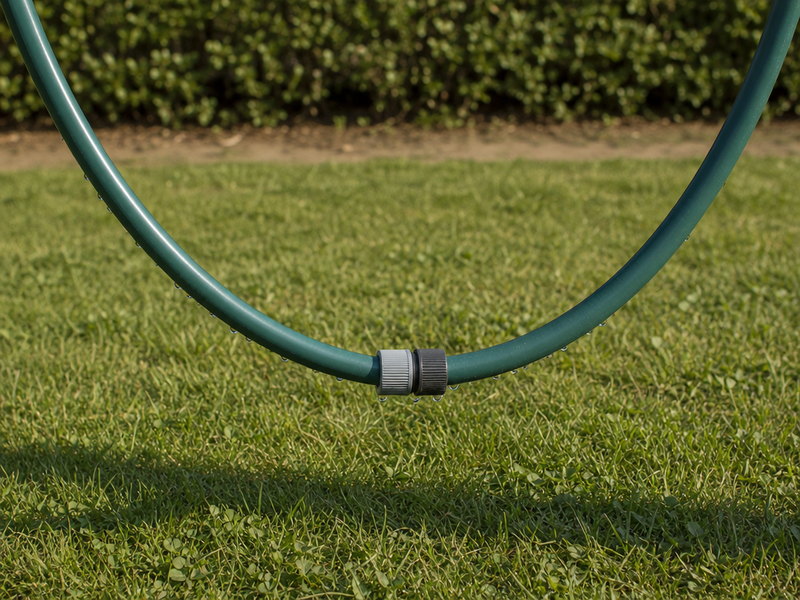
A charged hose lifted in a loop, showing how much of the handling load is water
Why Does the Water Term Not Change With the Wall?
Two hoses of the same bore and the same length hold the same volume of water, whatever their walls are made of, so a thin wall reduces only the smaller part of the total. Even the best lightweight garden hose still carries about 3 kg of water in every 15 m at a 5/8 in bore.
Does a Smaller Bore Reduce the Water Load?
A smaller bore does reduce the water load, and the effect is easy to calculate. The inside area falls from 198 mm² at 5/8 in to 127 mm² at 1/2 in, so the water per metre falls from 0.198 kg to about 0.127 kg. The catch is flow: at equal velocity the relative flow of a 5/8 in bore is 1.56 against 1.00 for 1/2 in. A lighter water load and a lower flow arrive together.
4. What Do You Trade for a Lower Wall Thickness?
A garden hose wall does three jobs at once: it contains the internal pressure, it resists buckling when the hose bends, and it supplies the material that rubs against the ground. Thinning it lowers mass and weakens all three jobs at the same time.
How Does Wall Thickness Affect Kink Resistance?
Kinking is a buckling failure, and a thin supple wall buckles more easily than a thick one. That is why kink resistance and low mass pull in opposite directions. Compound selection and a reinforcing layer can restore stiffness without a thick wall, which is how a non kinking garden hose is built when the maker wants to keep it light. Our flexible hose materials guide sets out how those layers change the hose’s behaviour.
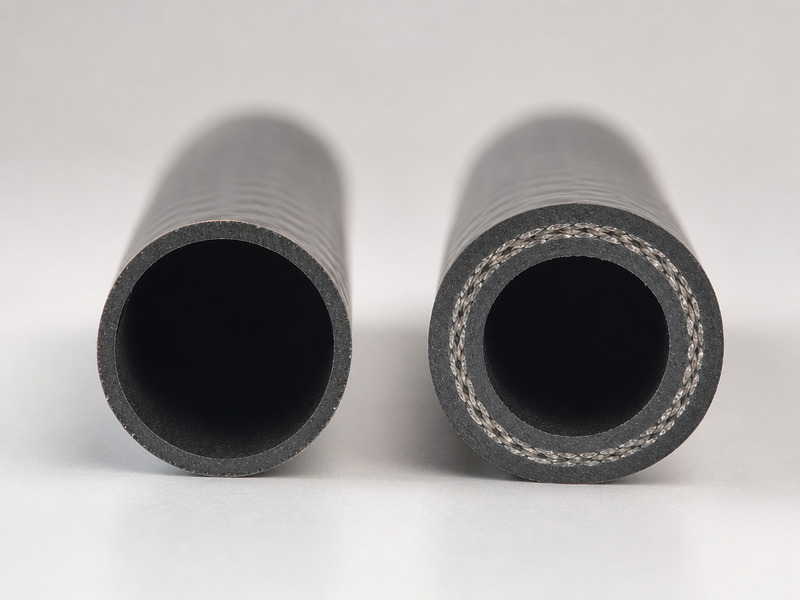
Cut hose ends side by side, showing a thin single-layer wall against a thick reinforced wall
How Does Wall Thickness Affect the Pressure Rating?
In a garden hose at a fixed bore and a fixed internal pressure, hoop stress rises as the wall gets thinner. The water-hose ratings used on this site are 150 psi (about 1,034 kPa) working and 400 to 500 psi (about 2,758 to 3,448 kPa) burst, a burst-to-working margin of about 3:1 for general service. Where a failure could injure someone or release a large volume, plan on 4:1 instead. A rating is only as strong as the weakest element in the assembly, and that element is often the coupling rather than the tube.
Does a Thinner Wall Always Mean a Shorter Service Life?
Service life depends on abrasion, ultraviolet exposure, water temperature and storage as much as on wall thickness. A thin hose kept coiled in the shade can outlast a thick one left across a path in full sun. When material choice matters more than a few grams per metre, compare the polymer families in our PVC versus rubber comparison.
How Much Mass Does a Reinforcement Layer Add?
A reinforcing braid and a protective cover add roughly 50 g per metre at a 5/8 in bore, a 44 percent increase in dry wall mass over a 1.5 mm vinyl wall. It buys abrasion resistance, a higher pressure band and better kink behaviour.
What About Cold Weather Handling?
Plasticised PVC stiffens below about 5 °C (41 °F), so a light vinyl hose becomes hard to coil in winter and is more likely to kink when it is forced. A rubber or hybrid wall keeps more flexibility, but no non kinking garden hose design removes that risk entirely at low temperature. In a cold climate the heavier compound may therefore be the easier hose to handle for part of the year.
5. What Do Light, Medium and Heavy Duty Actually Promise?
Duty labels are not standardised units. In practice they describe a package of wall thickness, reinforcement and the pressure band a maker is prepared to publish. A light duty garden hose is built for occasional hand watering, a medium duty garden hose for regular use with a reel or cart, and a heavy duty hose for long runs and rougher ground.
How Do the Duty Classes Compare?
The duty table below sets the common labels against the reference wall and mass figures for a 5/8 in bore, together with the typical use and the main limit of each class.
Common duty labels compared with the reference wall and mass figures at a 5/8 in bore
| Duty label | Typical wall | Mass per metre | Utilisation courante | Main limit |
|---|---|---|---|---|
| Light duty | 1.5 mm vinyl | about 115 g | Containers and short runs | Kinks easily; lowest pressure band |
| Medium duty | 2.0 mm rubber or hybrid | about 135 to 140 g | Regular garden watering | Heavier when charged |
| Heavy duty | 2.5 mm reinforced | about 166 g | Long runs and rough ground | Highest carrying mass |

Three hose constructions on one reel, from the thinnest wall to the thickest
Which Class Should You Buy?
Choose the lightest class whose limits you will not cross. A light duty garden hose is the right answer for short runs, containers and light watering where the hose is turned on and off by hand. Step up to a medium duty garden hose when the hose is used most days or stored on a reel under tension. Choose heavy duty when the run is long, the ground is rough, or the supply pressure sits near the top of the planning range of 40 to 80 psi.
Can a Heavy Duty Hose Be Lightweight?
A heavy duty hose cannot also be the lightest hose in a range, because reinforcement and extra wall add mass, and that mass is what resists abrasion and bursting. The best lightweight garden hose sits in the light or medium class, and it should be bought as such rather than expected to perform like a heavy duty product.
How Do the Labels Relate to a Warranty?
A warranty is a commercial promise rather than a construction grade, and its length often reflects the market rather than the wall. If a light duty garden hose carries a long warranty, read the exclusions before you rely on it, because most exclude freeze damage, abrasion and use above the rated pressure.
Which Duty Class Suits a Hose Reel?
A reel stores the hose under a permanent bend, so kink behaviour matters more than it does on a loose hose on the ground. A medium duty garden hose is usually the sensible minimum for a reel, because its stiffer wall holds the coil without collapsing. A very thin light hose can flatten at the drum and then kink as soon as it is pulled out again.
6. What Loads Does a Hose Put on the Person Using It?
Three loads matter during normal use: drag, lift, and the load of carrying the whole hose from one tap to another. All three are proportional to total mass, and total mass is mass per metre multiplied by the length in use.
How Big Is the Drag Load?
Drag is a fraction of the hose weight, set by the surface the hose rests on. Take a friction coefficient of 0.5 as a round working number for damp turf, and treat it as an assumed input for this example rather than a measured value. A charged 30 m vinyl hose then drags at about 9.39 kg × 0.5, or 4.7 kg of pull, which is calculated from the mass figures in section 3.
How Big Is the Lift Load?
Lift is the full mass of the section you raise, with no friction discount. A 10 m loop of charged vinyl hose is 1.15 kg of tube plus 1.98 kg of water, or 3.13 kg in total, and you repeat that lift every time you move the hose along the bed.
How Big Is the Carry Load?
Carrying is where length punishes you most. A 30 m charged hose in the reinforced construction weighs 10.92 kg against 9.39 kg for the same length in vinyl. Coiling that mass adds bending resistance, so the effort of moving it is greater than the number alone suggests.
Can a Non Kinking Garden Hose Reduce Handling Effort?
A hose that resists kinking lets you pull it in a straighter line, so you make fewer stops to clear a fold, and each stop costs both time and a fresh pull. That reduces the number of pulls rather than the mass of each pull. A non kinking garden hose therefore helps handling, but it does not change the arithmetic of mass per metre.
Does Pressure Change the Handling Load?
Pressure changes stiffness rather than weight. A hose at 60 psi is firmer than the same hose at 20 psi because the pressurised water supports the wall, so the hose is harder to fold into a tight coil. The mass you lift is unchanged, since water is close to incompressible.
7. Who Gains Most From the Best Lightweight Garden Hose?
Some users gain far more than others from a lower mass per metre. The size of the gain depends on how much of the hose has to be moved, how often it is moved, and how much grip or shoulder strength the user has available for the task.
Which Users Feel the Difference Most?
For these users, a lighter hose changes a task from difficult to routine:
- Older gardeners and anyone with limited grip or shoulder strength.
- People watering containers, hanging baskets and raised beds on short runs.
- Users who carry the whole hose to a tap that sits far from the beds.
- Anyone who winds a hose onto a reel by hand at the end of a session.
- Gardeners on balconies and rooftops, where every kilogram is lifted twice.
Do Seniors and Elderly Gardeners Gain More From a Lighter Hose?
Seniors and elderly gardeners feel the largest change from a lower mass per metre, because the hose is lifted rather than dragged. At a 5/8 in bore, a 30 m hose with a 166 g per metre reinforced wall is 1.53 kg heavier in dry mass than the same length in vinyl at 115 g per metre. Grip and shoulder strength set the limit here, not the size of the garden.
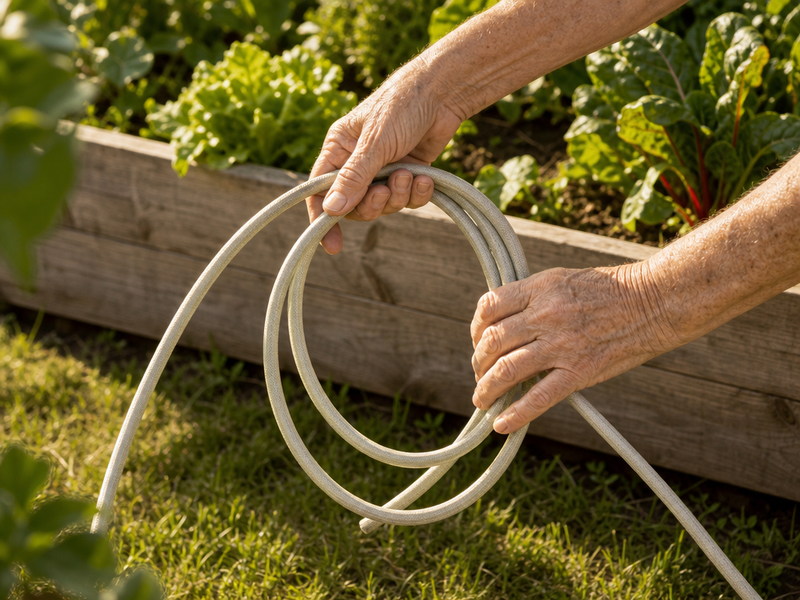
An older gardener’s hands coiling a light hose loosely at the end of a session
Who Gains Least From Low Mass?
If your hose stays connected at one tap and you drag only a few metres, the difference between 115 g per metre and 166 g per metre at a 5/8 in bore rarely decides anything. Pressure behaviour, kink resistance and fitting quality will matter more to you than mass.
Is the Benefit Only About Strength?
Lower mass also reduces the effort of storing the hose, because coiling and hanging depend on the same figures. It also reduces the chance that a dragging loop pulls a pot or a young plant out of place. These are mechanical effects of mass rather than medical claims about any condition.
Does Low Mass Help in a Small Garden?
Small gardens usually mean long walks with the hose rather than long hose runs. On a balcony or in a courtyard the hose may be only 10 m long. It is picked up, moved and hung several times in one session, so saving 50 g per metre saves about 0.5 kg per lift.
8. How Do You Compare Hoses of Different Lengths?
Comparing by feel is misleading, because a longer hose carries more material and more water. Convert both to mass per metre and to charged mass per metre, then compare at a length you actually use.
What Is the Fair Comparison Figure?
Use charged mass per metre, which is the dry mass per metre plus the water per metre for the stated bore. At a 5/8 in bore the water term is a constant 0.198 kg per metre, so the charged figures are 0.313 kg for vinyl and 0.364 kg for reinforced.
How Do You Compare Hoses of Different Bores?
Compare flow first and mass second. At equal velocity the relative flow is 1.00 at 1/2 in, 1.56 at 5/8 in, 2.25 at 3/4 in and 4.00 at 1 in. If two hoses deliver the flow you need, choose the lighter construction.
Where Can You See the Constructions Side by Side?
Our types of water hoses guide sets out the main constructions and where each one is normally used, which is the quickest way to narrow the field before you compare figures. Once the construction is fixed, only the wall thickness and the length remain as variables, and both are decided by the arithmetic above.
9. How Do You Check the Best Lightweight Garden Hose Before You Buy?
You check the best lightweight garden hose the way an engineer would: from the stated numbers rather than the label. Five figures decide whether a hose will feel light in use, and all five are normally published before you pay.
What Should You Confirm Before You Pay?
Confirm this short list against the product data:
- The stated mass per metre, or a dry weight and a length you can divide.
- The bore and the wall thickness, so constructions can be compared fairly.
- The published working and burst pressure, with the condition each was measured under.
- The minimum bend radius, or a specific statement about kink resistance.
- The thread and fitting: 3/4 in nominal GHT (garden hose thread), 11.5 threads per inch, sealing on a washer.
What Can You Check at Home?
Fill the garden hose with water, lift the last 10 m and pull it across your own surface. That tells you the working load better than any label, and it costs nothing. A kitchen scale and a tape measure are enough to confirm the mass per metre of a hose you already own.
How Should You Store a Light Hose to Keep It Manageable?
Drain the hose, coil it loosely to a diameter well above its minimum bend radius, and keep it out of direct sun. A drained hose weighs only its dry mass, which makes lifting and hanging far easier. Storing it under tension or in a tight coil sets a curve, and a set curve is where the first kink usually forms.
Where Can You Find the Range?
If you already know your bore, length and duty, the numbers do most of the buying for you. Review the constructions in our consumer product range, browse current lengths in the shop, or contact the technical team with your figures. The best lightweight garden hose is simply the lightest product that still holds your pressure and keeps its shape at your working temperature.
10. When Is a Heavier Hose the Better Choice?
A heavier hose is the better choice when its extra mass buys something you need. The usual reasons are a higher pressure band, better abrasion resistance on rough ground, and a wall stiff enough to resist kinking in a permanent bend. In each case the gain is measurable and the added mass is the price you pay for it.
When Does Pressure Outrank Weight?
The 150 psi working and 400 to 500 psi burst ratings matter more than a few grams per metre when the supply sits near the top of the planning range of 40 to 80 psi. They matter even more when a pressure washer is involved. Buy the rating first and the lightest wall second.
When Does Kink Resistance Outrank Weight?
When the hose turns corners or is stored on a reel, kink resistance decides how often you stop watering to clear a fold. The saving from a thinner wall is real, but it is smaller than the time lost to a fold in the middle of a task.
When Does Abrasion Outrank Weight?
On gravel, paving and concrete edges, abrasion removes material with every drag. A reinforced multi-layer wall at 2.5 mm and about 166 g per metre resists that wear far better than a 1.5 mm vinyl wall. If the hose crosses a rough surface daily, the heavier construction usually outlasts the lighter one and pays back its extra mass over the season.
What Is the Honest Summary?
Mass per metre is a real, calculable property, and it matters in proportion to how often you lift and drag the hose. A low-mass hose is a sensible choice for short, frequent, hand-held watering. For long runs, high pressure or rough ground, a heavier construction is the better engineering answer, and the extra mass is what buys the performance.
FAQ
Is the Best Lightweight Garden Hose Suitable for a Pressure Washer?
A pressure washer pushes far more water than a garden tap, and most garden hoses are not rated for it. The ratings used on this site are 150 psi (about 1,034 kPa) working and 400 to 500 psi (about 2,758 to 3,448 kPa) burst. Check the working figure against the washer and keep a 4:1 margin where a failure could injure someone or release a large volume.
How Much Does a 100 ft Hose Weigh When It Is Full of Water?
A 100 ft hose is 30.5 m long. At a 5/8 in bore it holds 0.198 kg of water per metre, so about 6.04 kg of water. In vinyl at 115 g per metre the wall adds 3.51 kg, giving roughly 9.55 kg charged. In the reinforced construction at 166 g per metre the total is about 11.10 kg.
Does a Lower Mass per Metre Always Mean a Shorter Service Life?
Mass is a consequence of wall thickness and compound density, not a direct measure of life. A thin hose in a mild climate, stored out of the sun, can last as long as a heavier one. Two hoses can share a mass per metre from opposite directions: a thin wall in a dense compound, a thicker wall in a light one.
What Is the Difference Between Light Duty and Medium Duty Garden Hose?
The labels are descriptive rather than standard. A light duty garden hose usually pairs a thin wall with a low pressure band and suits occasional hand watering. A medium duty garden hose adds wall thickness or reinforcement for regular use. Neither label replaces a stated working pressure, so compare the figures rather than the words.
Can the Best Lightweight Garden Hose Also Be Non Kinking?
A lightweight hose can also resist kinking, up to a point. Kink resistance comes from wall stiffness, a reinforcing layer or a ribbed profile, and each of those adds mass. A non kinking garden hose that stays genuinely light usually relies on construction rather than extra thickness. If a product claims both, check its mass per metre and its stated minimum bend radius.
Does a Smaller Bore Make a Hose Lighter and Easier to Handle?
Yes, but the gain is modest and it costs flow. A 1/2 in bore holds about 0.127 kg of water per metre against 0.198 kg at 5/8 in, so the water load falls by roughly a third. At equal velocity the relative flow is 1.00 at 1/2 in against 1.56 at 5/8 in. Choose the bore for flow first, then pick the lightest wall that suits the duty.
How Do I Stop a Lightweight Hose From Kinking at the Tap?
Support the first metre so the hose leaves the tap in a straight line, and avoid a sharp bend right at the fitting. A kink forms where the wall is forced to bend tighter than its minimum radius. Fittings that swivel let the hose hang straight instead of twisting, which removes one common cause of a fold.
Are Hybrid Hoses Lighter Than Rubber Hoses?
The two are close at the same wall thickness. The reference figures are about 140 g per metre for a hybrid and about 135 g per metre for EPDM rubber at a 5/8 in bore, a difference of about 5 g. Cold flexibility, surface feel and price usually decide the choice long before those few grams do.
What Temperature Makes a Lightweight PVC Hose Too Stiff to Use?
Plasticised PVC stiffens below about 5 °C (41 °F), so coiling becomes difficult and kinking becomes more likely. Rubber and hybrid compounds keep more flexibility at low temperature. Drain the hose before the first hard frost, because a charged hose left out below 0 °C (32 °F) is where cold-weather damage starts.
How Should I Choose Between Two Similar Hoses?
Compare the four figures that decide use: bore, mass per metre, working pressure and minimum bend radius. Where two products are close, choose the one whose stated pressure condition matches your supply. When a maker does not publish a figure, treat the missing number as a reason to look further rather than as a neutral detail.
How Do You Fix a Kink Once the Hose Has Folded?
Straighten the hose and open the tap at low pressure until the fold releases, then run your hands along the length to take out the twist that caused it. A fold that stays creased with the water off has taken a set, and that section becomes the place where the next kink forms. Where the coupling can be refitted, cut out the set section rather than forcing the hose straight.
About HENGHUA
HENGHUA manufactures hose for distributors, retailers, OEM and private-label programmes, and sells under the corporate HENGHUA brand alongside the GLOBHOSE and FLEXMAX product lines. Garden and water hose production covers vinyl, rubber, hybrid and reinforced multi-layer constructions in the bores and wall thicknesses quoted in this article. Working pressure and burst pressure are established by hydrostatic testing during production, and the test conditions are written on the specification rather than implied. OEM and custom branding are supported, including private-label programmes. For technical data or a quotation, use the enquiry form on the contact page.






 English
  Spanish
  Portuguese
  French
  German
  Arabic
  Russian
  Indonesian
  Japanese
  Korean