
The best hose reel for your yard is the one whose drum, frame and fittings survive your local weather, and whose moving parts are still available years after purchase. Four things separate a strong reel from a weak one: the drum and frame material, the fittings and finish at the two leak paths, the stability of the base under a loaded hose, and the supply of spare parts.
If you are deciding which hose reel to buy, the two joints to check first are the swivel and the inlet: both can be tested by hand in a shop, and both are the parts that need replacing first.
This article works through your four checks in order, shows where each published number comes from, and closes with a checklist you can apply at the shelf. It covers manual crank reels, including wheeled and free-standing designs; retractable and air reels use a different mechanism. It does not rank products, and it does not name brands or report any test that this site has not run.
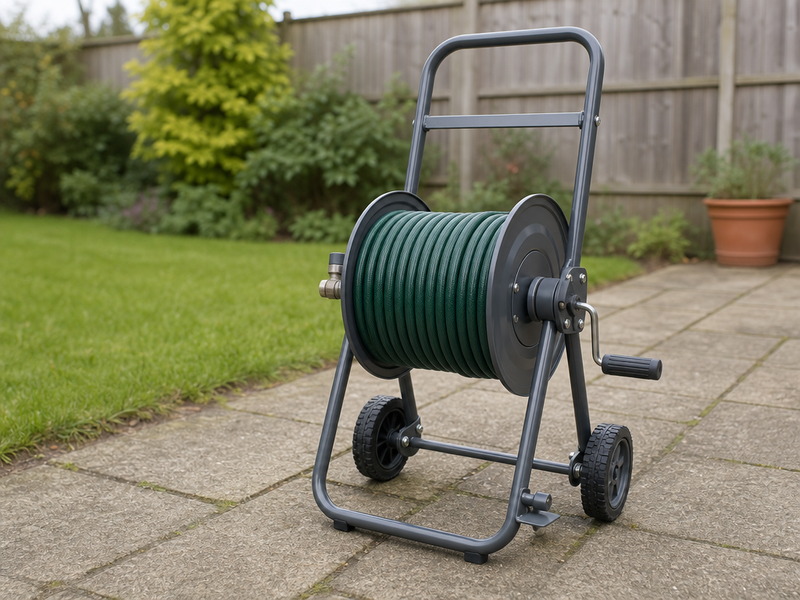
A wheeled hose reel standing ready in a garden, with the hose wound evenly across the drum
1. What Separates the Best Hose Reel From a Weak One?
A hose reel is six parts working as one system: the hose reel drum, the frame, the swivel, the inlet connection, the crank and the base. A weak reel fails at one of those joints, most often the swivel or the inlet. A durable reel is built so that every joint can be inspected before purchase and replaced once it wears.
Table 1 lists the six inspection points on a hose reel and what each one tells you about service life.
Table 1. Six inspection points that separate the best hose reel from a short-lived one
| Point | What to inspect | Why it matters |
|---|---|---|
| Drum | Metal or polymer; wall thickness at the hub | The hub carries the whole load of a charged hose |
| Frame | Wall thickness, weld quality, surface coating | The frame resists pull force, sunlight and frost |
| Swivel | Material, seal type, freedom of rotation | The swivel is the first of the two common leak paths |
| Inlet | Thread form, fitted adapter, strain relief | The inlet is the second common leak path |
| Crank | Gear ratio, crank handle grip, bearing or bush | The ratio sets how many turns one retract takes |
| Base | Footprint, wheel size, lock or brake | The base resists tipping when the hose is pulled |
Strength costs money at three points: the drum hub, the swivel and the frame coating. Two reels that look identical on the shelf can differ substantially in wall thickness at those three points, and the difference first shows up as wobble at the hub rather than as a leak.
Which Joint Fails First on a Hose Reel?
Inspection starts with the swivel, because it is the one part that moves under pressure every time the drum turns. The inlet comes second, because it fails where a rigid adapter meets a soft hose tail without strain relief. The drum and frame come last in that order, and they fail only where a reel is left outdoors through repeated freeze cycles.
Why Do Three Failure Modes Stay Hidden at the Shelf?
Three failure modes stay hidden no matter how carefully you look at the shelf:
- How the swivel seal behaves after hundreds of turns under pressure.
- Whether the polymer used in the drum resists ultraviolet light for a decade.
- Whether the maker will still stock the swivel three years from now, which no shelf check can settle; only the seller can answer it.
2. Materials: The Metal and Polymer Choices in the Best Hose Reel
Reels are built from one of a few material combinations. Understanding them helps you predict how a reel ages, not just how it looks on day one. The material decides how the reel responds to sun, water and load over a decade. The same material logic runs through the wider consumer products range.
How Does a Steel Drum and Frame Age Outdoors?
A steel drum with a powder-coated frame handles heavy hose and long runs, and it tolerates sun better than most polymers. The trade-off is weight and corrosion at any scratch. Where the coating is cut, rust starts and spreads under the paint film. Metal suits a reel that is fixed in place and rarely moved.
How Does a Polymer Drum and Frame Age Outdoors?
A polymer drum with a molded frame is light, never rusts and is cheap to replace. It survives sun by using a UV-stabilized compound, and it fails by becoming brittle rather than by corroding. Polymer suits a reel that is carried often, moved between yards or stored out of direct sun in winter. Check that the drum hub is thick enough to hold the crank bearing without flexing.
Which Combination Lasts Longest?
Material alone does not decide service life: a thin steel frame with a poor coating can rust faster than a thick polymer frame cracks. Judge wall thickness and hub design first, then material. The joints covered next decide whether either material survives past the first few seasons.
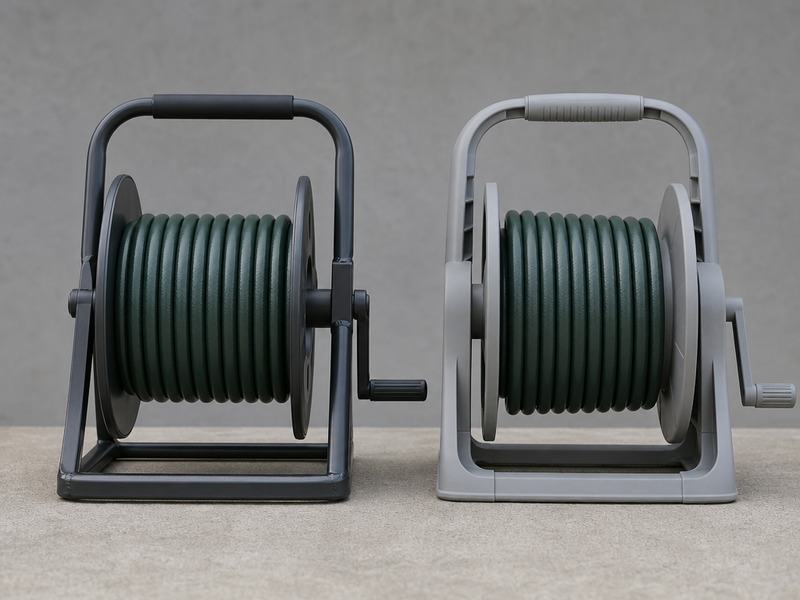
A powder-coated steel frame beside a molded polymer frame, the two routes a reel can take
3. Fittings and Finish: Where Hose Reels Actually Leak
Water escapes a reel at exactly two leak paths, the swivel and the inlet. The drum itself almost never leaks. Fittings and their finish therefore deserve more attention than the drum, and the complete guide to hose couplings covers the same hardware in more depth. Table 2 sets out the common materials and how each one behaves outdoors.

A close view of the swivel at the drum center and the inlet, the two joints that leak first
Table 2. Fitting materials at the swivel and inlet
| Matériau | Corrosion resistance | Thread durability | Utilisation courante |
|---|---|---|---|
| Plated steel or zinc alloy | Moderate; fails at scratches | Good until the plating wears | Light use, sheltered storage |
| Brass | Good; resists most tap water | Very good, and self-lubricating | General outdoor use |
| Stainless steel | Very good in fresh and salt spray | Very good; can gall if tightened dry | Coastal and hard-water areas |
Note the thread form as well as the material. Garden hose thread (GHT, also called NH) is 3/4 in nominal, with 11.5 threads per inch, a straight thread that seals on a washer. Pipe thread (NPT) is tapered at 1:16 and seals on the threads themselves. A reel inlet that expects a washer seal will drip if a buyer forces a tapered fitting into it.
Why Does the Swivel Leak First?
A hose reel swivel lets the drum turn while the supply hose stays still. Every design uses a seal, either an O-ring or a packed gland, and that seal is the wear part. Test it by turning the drum through a full rotation under pressure and watching for a bead of water. A drip means the seal face is scored or the spring tension has gone. This section treats the swivel as a leak path; the seal construction itself is covered elsewhere on this site.
Why Does the Inlet Leak Second?
The hose reel inlet is where the supply hose joins the reel. It leaks when the adapter is the wrong thread form, when the washer is missing, or when the hose tail is pulled sideways without support. A molded strain-relief collar at the inlet removes the third cause and costs almost nothing to include.
In What Order Should You Check the Fittings?
Work through the fittings in this order:
- Match the thread form first, garden hose straight thread or tapered pipe thread.
- Choose brass or stainless for anything that stays outdoors all year.
- Confirm the swivel seal is a replaceable part, not a sealed throwaway assembly.
4. Weather Survival: UV, Frost and Time Outdoors
Outdoor reels face two slow attacks and one fast one. Sunlight degrades polymer and paint over years. Freeze and thaw works on trapped water seasonally. A single hard frost can split a fitting in one night if water is left inside it.
What Ultraviolet Light Does to a Reel
Ultraviolet light breaks polymer chains at the surface, so the drum and frame chalk, then craze, then crack. UV-stabilized compounds slow this, and paint protects metal. The honest position is that no polymer reel is immune, because stabilization only lengthens the interval. Shade and a cover both extend it further.
What Frost Does to a Reel
Water expands when it freezes, and a sealed fitting gives it nowhere to go. A swivel or inlet that holds a drop of water can crack at the first hard freeze. Draining the reel and the hose before winter removes the risk almost entirely. This is a handling habit, not a product feature you can buy.
How Cold Affects the Hose, Not Just the Reel
Cold also stiffens the hose itself. Plasticized PVC becomes stiff below about 5 °C (41 °F), which makes winding harder and strains the crank. A reel that pairs with a hose staying flexible below freezing removes most of that strain, and the crank ratio then matters more than usual.
5. Stability: Does a Hose Reel on Wheels Tip Over?
A full hose is heavy, and tipping risk peaks at the end of a pull, when the hose is fully unwound and the pull force sits furthest from the base. Stability depends on three things: the footprint, the wheelbase (the distance between the wheels) and how low the drum sits. A reel on wheels needs enough spread that a sideways tug does not rotate the base about a wheel.
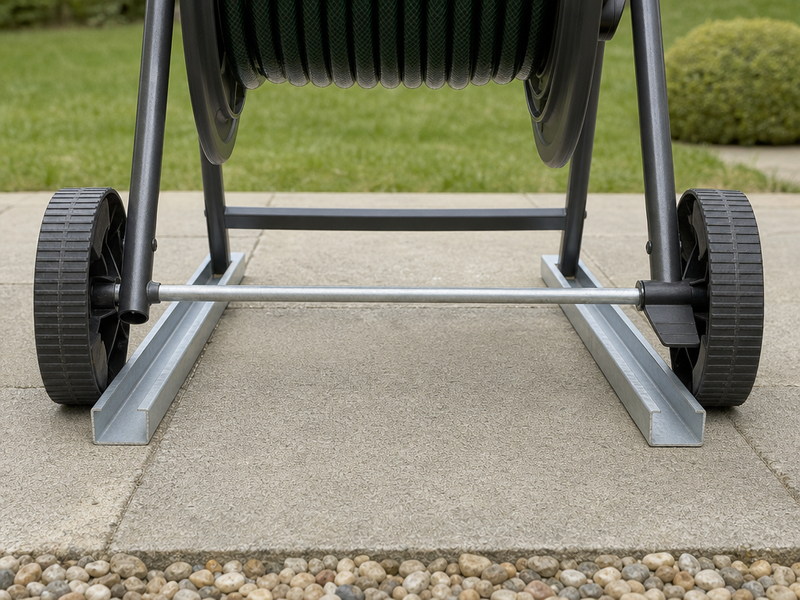
The base of a wheeled reel: wide footprint, two wheels on one axle, and the brake engaged
How Wide Must the Footprint and How Low the Drum Be?
Widen the footprint and lower the drum, and the force needed to tip the reel rises. Keep the pull direction inside the footprint wherever possible. If you habitually pull the hose at an angle, a wheeled base with a wider stance resists it better than a narrow frame. The best hose reel on wheels is judged on that stance first.
Do the Wheels Lock, and What Size Do They Need to Be?
Large wheels roll over grass and gravel, while small wheels catch and drag. A locking wheel or brake stops the base creeping while the hose is pulled, and it also keeps the reel parked on a slope. Confirm the wheel axle is a metal pin, because a plastic stub axle is a common weak point on a hose reel on wheels.
6. How Many Turns Does a Crank Ratio Add to a Rewind?
The crank converts your effort into rotation of the drum. Two numbers set that effort: the drum diameter at the winding layer and the gear ratio between crank handle and drum. A larger drum winds more hose per turn but demands more torque. A reduction gear trades extra turns for less effort in the other direction.
A drum with an effective winding diameter of 200 mm moves the hose about 0.628 m per revolution, because the circumference is pi times the diameter (calculated). Rewinding 30 m of hose therefore takes about 48 drum revolutions (calculated). A direct-drive crank needs about 48 turns, while a 3:1 reduction crank needs about 144 turns but each turn is lighter (calculated). If you prefer to work in millimeters, the mm-to-inch conversion chart and calculator turns any diameter you measure into the units the arithmetic above uses.
How Do the Crank Numbers Compare?
The table compares the same 30 m wind at three ratios, so you can see what each extra gear stage costs in turns.
Table 3. Crank turns for a 30 m wind at a 200 mm winding diameter (calculated)
| Drive | Drum turns | Crank turns | Effort per turn |
|---|---|---|---|
| Direct drive | About 48 | About 48 | Highest |
| 2:1 reduction | About 48 | About 96 | Lower |
| 3:1 reduction | About 48 | About 144 | Lowest |
Why Does the Ratio Matter More as the Hose Loads?
Hose builds up in layers on the drum, so the effective winding diameter grows and each later turn moves more hose while needing more torque. A clean, even winding keeps the layers predictable. A crossed layer changes the effective diameter from turn to turn and makes the effort jump. Lay the hose in even passes and the arithmetic above stays close to reality.
7. What Should a Cover, Nozzle Box and Spare-Parts List Include?
A reel is a storage device, so the small accessories decide whether it is convenient or frustrating. A cover, a nozzle box and a published spare-parts list cost little to include and are expensive to retrofit later.
Does a Reel Need a Cover?
A cover shields the drum, the swivel and the hose from direct sun, which slows UV damage on all three. An integrated hinged lid is more durable than a fabric slip cover, but either one beats leaving the reel open. If the design has no cover, plan to store the reel in shade.
What Should a Nozzle Box Hold?
A nozzle box or a molded tray keeps the spray head and spare washers with the reel, so you are not walking back to the tap every time. It also keeps small fittings off the ground, where they are easily lost. Check that the tray drains, because trapped water is what freezes first.
Which Spare Parts Should You Confirm Before You Buy?
Ask whether these four hose reel parts are sold separately:
- The swivel assembly, including its seal or O-ring.
- The inlet adapter and its washer.
- The crank handle and the bearing or bush behind it.
- The wheels and axle pins, on a fixed frame as well as a hose reel on wheels.
8. The Shelf Checklist: What to Check in Two Minutes
If you are comparing two reels side by side on the shelf, apply the same short checklist to each candidate in turn. The checklist does not tell you which reel to buy; it removes the reels that cannot be repaired or that will leak within a season. A practical route to the best hose reel for your yard is elimination rather than selection. These checks still apply to reels sold in 2026, because none of them depends on a model year.
Candidate reels can be compared in the aisle by checking the parts, the numbers and the fit against your own hose. Before you commit, confirm your hose bore against the hose size selection guide.
Table 4. Five questions to settle at the shelf, and where to confirm each answer
| Question | What to confirm |
|---|---|
| Will the swivel turn smoothly? | Turn the drum by hand and feel for grit or a stiff spot |
| Is the drum hub thick enough? | Wall thickness at the hub and at the frame joints |
| Will the parts be replaceable? | Swivel seal and inlet adapter listed as spare parts today |
| Will the base stay put? | Footprint wider than the drum, and metal axles |
| Will my hose fit and connect? | Stated hose capacity and length against your own hose, and the inlet thread form against your supply outlet |
How Do You Work Through the Two-Minute Checklist?
Move through these five points in order:
- Turn the drum by hand and feel for a smooth swivel with no grit.
- Look at the drum hub and frame for wall thickness, not just finish.
- Check that the swivel seal and the inlet adapter are listed as spare parts today.
- Confirm the base footprint is wider than the drum and the axles are metal.
- Read the stated hose capacity against your own hose length, and match the inlet thread form to your supply outlet.
What Signals Should Make You Walk Away?
Walk away from a reel whose swivel is sealed and throwaway, whose inlet lacks strain relief, or whose base is narrower than its drum. Those three signs predict the faults that make a reel uneconomical to repair. A lower price rarely compensates, because the repair is a whole new reel rather than a new part. If the reel in front of you does not publish its inlet thread form, that is the one question to ask before you pay.
9. How Do You Read Hose Reel Reviews and Ratings?
Hose reel reviews vary more in method than in conclusion. Some measure water loss at the swivel, some measure pull force, and some only describe features. A rating is useful only when you know what was measured and under what condition. The reliable approach is to read the method, then apply the same method yourself.
What Can a Review Measure?
A thorough review reports the four conditions of each measurement: supply pressure, hose length, cycle count and whether the swivel seal was replaced. Without those conditions, a number cannot be reproduced by anyone else. Where two reviews disagree, the difference usually sits in the test condition rather than in the reel.
What Does a Rating Leave Out?
No single rating captures how a reel ages in your yard. Ultraviolet exposure, freeze cycles and water hardness differ by location, and none of them appears in a short test. Treat any headline score as one input, and treat the swivel seal, the inlet thread and the spare-parts list as the others.
How Do You Read a Top Rated Hose Reel Claim?
When a source describes a reel as a top rated hose reel, ask for the same four figures: supply pressure, hose length, cycle count and seal replacement. A claim that reports all four is useful evidence. A claim that answers none of them is a marketing line.
How Should Homeowners Use Reviews?
For most homeowners, the useful part of a review is the failure list rather than the winner. Read what broke, how soon it broke, and whether a spare part fixed it. Then check those same parts on the reel in front of you. A top rated hose reel that nobody can repair is still a short-lived purchase.
10. How Do You Judge Build Quality You Cannot See at the Shelf?
Some quality signals are visible at the shelf, and some appear only after a season. This section covers the parts you can check by eye and by hand, in the order a manufacturer inspects them. None of these checks needs a tool beyond your hands and a short tape measure, and together they add up to the best hose reel worth keeping.
How Do You Judge Welds, Moldings and Tolerances?
A welded steel frame should show a continuous bead at every joint rather than a series of tacks. A molded frame should show uniform wall thickness with no sink marks near the load points. Where the crank meets the drum, spin it and feel for lateral play, because side-to-side movement there predicts a wobbly wind and a strained bearing.
How Do You Judge Finish and Coating Quality?
Look at the edges and the inside corners, where coatings are thinnest. A powder coat that thins at a cut edge will rust inward from that edge. A brass or stainless fitting needs no paint at all, which is one reason it is preferred at the swivel and the inlet. Run a fingernail along a frame edge, because a coating that flakes under light pressure will not survive many seasons.
What Does the Weight of a Reel Tell You?
Within one material, a heavier reel usually carries more metal in the drum and the frame, which raises stiffness. Between materials the comparison breaks down, because a polymer frame can weigh more than a thin steel one without being stronger. Use weight only to compare two reels built from the same material.
What Should You Ask the Seller?
Ask the seller these four questions before you buy:
- What is the drum and frame material, and is the drum reinforced at the hub?
- What thread form does the inlet use, and is an adapter included?
- Which spare parts are stocked, and for how many years?
- What hose bore and length does the reel hold in normal use?
11. What Changes After the First Few Seasons?
A reel does not fail all at once. Wear follows a predictable order, and each symptom points to one part. Knowing that order decides whether a hose reel for homeowners needs a repair or a replacement. Start from Table 5 and work down it: the top rows are part swaps, and only the last row ends the reel.
Table 5. Wear symptoms on a hose reel, from the first sign to the end of life
| Symptom | Order of appearance | Likely part | Action |
|---|---|---|---|
| Slow drip at the drum center | First | Swivel seal | Replace the seal or the swivel assembly |
| Weep where the hose joins the reel | Second | Inlet adapter or washer | Refit with a new washer and the correct thread form |
| Crank handle hard to turn | Later | Crank bearing or bush | Clean and lubricate, or replace the bush |
| Wheeled base creeps while pulling | Later | Wheel lock or axle | Engage the brake or replace the axle pin |
| Cracks near the drum hub | End of life | Drum structure | Replace the reel, because the load path has failed |
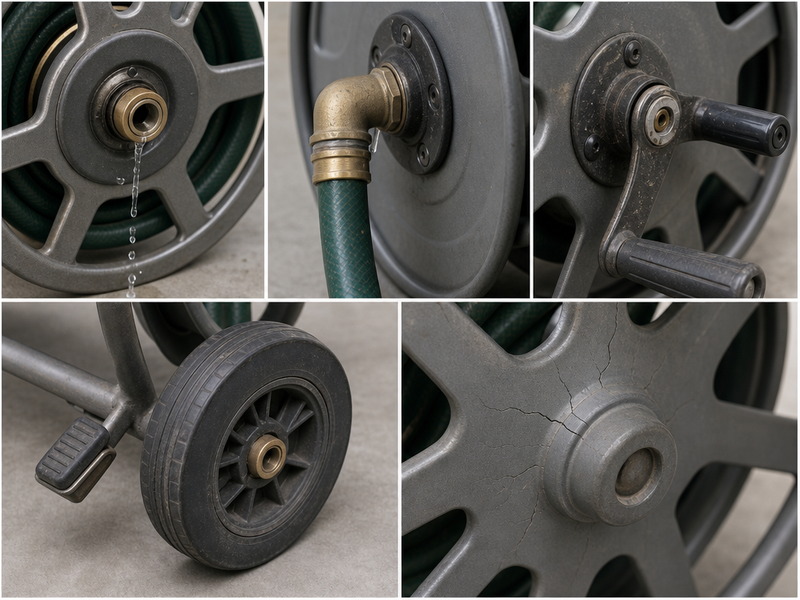
Five wear symptoms side by side, from a drip at the swivel to cracks at the hub
What Routine Keeps a Reel Working?
Rinse the reel at the end of the season to remove grit from the swivel and the wheels. Dry it before storage so no water is left in the inlet or the swivel. Store it under cover, and hang the hose without tension so the drum does not carry a standing load through winter. These steps cover both slow attacks described in section 4, and the trapped water that makes the first hard freeze dangerous.
When Has a Reel Reached the End of Its Life?
A reel has reached the end of its life when the drum or the frame itself cracks. Until then, every common fault is a part that can be swapped. That is why the spare-parts list is the single most useful thing to settle before buying the best hose reel for your yard. A reel with spare-parts support can outlast two reels without it.
Should You Repair the Reel or Replace It?
Compare the cost of the worn part with the cost of a whole new reel, and weigh that against the age of the drum and frame. If the structure is sound, the part is almost always the cheaper path. If the structure has cracked, the reel is finished regardless of how good its fittings are.
FAQ
What should I check first when choosing the best hose reel?
Start with the two joints that carry a moving seal, the swivel and the inlet. Turn the drum by hand under pressure and watch for a bead of water, then look at the inlet for a washer seat and strain relief. Finish by confirming that both parts appear on the spare-parts list, because a reel you cannot repair will not last.
Is a metal hose reel better than a polymer one?
Metal and polymer reels are equal at the same wall thickness; they fail in different ways. Metal resists sun well but corrodes at scratches and adds weight. Polymer never rusts but becomes brittle under ultraviolet light. Judge wall thickness at the drum hub and frame first, then pick the material that suits where you store the reel.
How can I tell whether a swivel will leak?
A swivel leak shows up as a bead of water at the joint while the drum is under pressure. Freedom of rotation, with no drip, is the good sign. A stiff swivel or a slow weep points to a scored seal face. Confirm the seal is a replaceable part before you buy.
How many turns should it take to rewind a hose?
Crank turns depend on the drum winding diameter, not on the brand. A 200 mm winding diameter moves about 0.628 m per revolution (calculated), so 30 m takes about 48 drum turns (calculated). A reduction crank multiplies that: about 96 turns at 2:1 and about 144 at 3:1 (calculated).
Do I need a hose reel with a cover?
Outdoors, a cover slows ultraviolet damage to the drum, the swivel and the hose, so store the reel covered or in shade. An integrated hinged lid lasts longer than a fabric slip cover. If your chosen reel has no cover, storing it in shade achieves most of the same benefit. A cover does not replace draining, because water left in the inlet or the swivel still splits a fitting at the first hard freeze.
Do hose reel on wheels designs stay stable on a sloped yard?
A reel on wheels stays stable on a sloped yard when the footprint is wider than the loaded drum and at least one wheel locks. Keep the pull direction inside the footprint and lock the wheels before pulling. On a slope, a locking brake also stops the base creeping downhill. A narrow base with plastic stub axles is the design most likely to tip.
What makes a hose reel top rated?
A rating is only as good as its stated method. A real top rated hose reel claim reports the four conditions: supply pressure, hose length, cycle count and whether the swivel seal was replaced. If none of those conditions is given, the rating describes features rather than performance. Read the method before the score.
What should a hose reel for homeowners in a cold climate include?
For a cold climate, a practical hose reel for homeowners starts with a replaceable swivel seal, an inlet with strain relief and a base wider than its drum. Confirm the reel and the hose drain completely, because trapped water splits a fitting at the first hard freeze. The spare-parts support then decides how long the reel lasts.
How do hose reel reviews help me choose?
Hose reel reviews help most through their failure lists, because those name the parts that broke and how soon they broke. Check which part the writer replaced, and whether the review states its test conditions at all. Then confirm those parts are sold separately for the reel you are considering.
When should I replace a reel rather than repair it?
Replace the reel when the drum or frame itself has cracked, because the load path is compromised. Repair the reel when only the swivel, the inlet adapter, the washer or the crank handle has worn. That distinction is the reason spare-parts support matters more than a slightly lower purchase price.
Does a heavier hose reel mean better quality?
Only within one material. A steel reel that weighs more than another steel reel usually carries more metal in its drum and frame, and stiffness rises with it. Between materials the comparison fails: a molded frame can be heavier than a thin steel one and still flex more. Judge the joints and the wall thickness instead, and treat weight as a tie-breaker.
How long should a hose reel last?
There is no single figure, because sun, frost, water hardness and winding frequency all move the number. The order is fixed even though the timing is not: the swivel seal and the inlet washer wear first. The drum and frame decide the end of life, and while both stay sound, even the best hose reel stays repairable and worth keeping.
About HENGHUA
HENGHUA is a hose manufacturer serving distributors, retailers, OEM and private-label programs, and end users who research before buying. The range covers garden, agricultural and industrial hose, and the product brands GLOBHOSE and FLEXMAX cover high-performance hydraulic and flexible industrial hose. OEM, custom branding and tailored product solutions are supported on request.
Every published figure — bore, thread form, working pressure and burst pressure — is given with the condition under which it applies. For a hose reel, the parts that fail first are the parts to confirm as available before buying. Browse the hose range or send a specification inquiry.






 English
  Spanish
  Portuguese
  French
  German
  Arabic
  Russian
  Indonesian
  Japanese
  Korean