
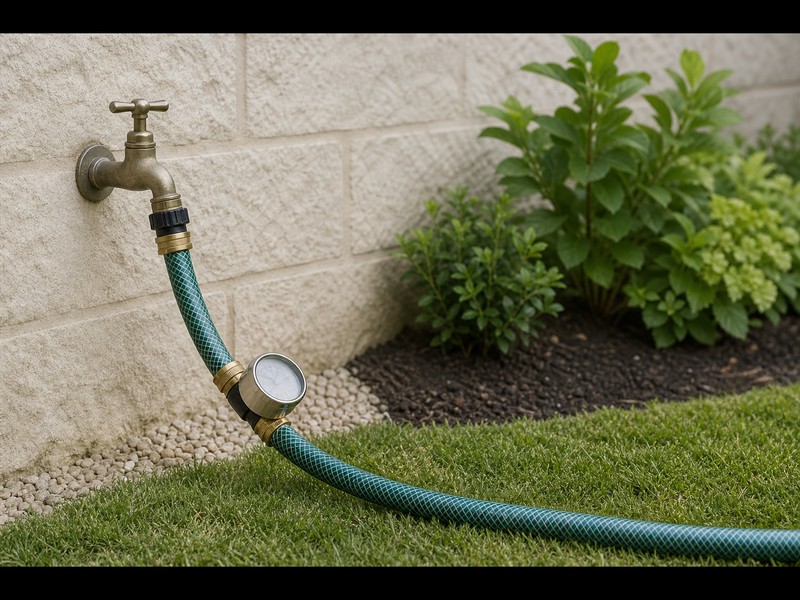
A garden hose pressure rating is the highest pressure a hose is designed to carry continuously, and it is quoted as a working pressure rather than a failure pressure. Behind that single number sit three separate values: working pressure, proof or test pressure, and burst pressure. The gaps between them are deliberate safety margins, and they explain why a hose that bursts at 300 psi may still be sold as a 100 psi product. Most home taps hold under 80 psi, so a hose rated 100 psi working pressure covers ordinary garden duty with margin.
The same three-level logic appears in every flexible hose family, from a garden tap to a hydraulic power unit. The rest of this article sets out the ratios, the supply pressures, the label claims, and the derating rule.
A gauge at the tap shows the pressure the hose actually meets.
What Is a Garden Hose Pressure Rating?
A garden hose pressure rating describes the highest pressure at which the hose is engineered to run without shortening its expected service life. Manufacturers derive the figure from destructive testing, then divide the result by a safety factor. Everyday use then sits well below the point of failure, which is the whole purpose of the exercise. The published number is a working limit rather than a strength claim.
A water hose pressure rating means the same thing and counts only when tied to a temperature, a fluid, and a test method. Change any one of those three and the number that applies to your task changes with it. A datasheet for a reinforced hose normally lists three connected values, and reading them together is what tells you whether the hose suits your supply.
Working Pressure: the Continuous Service Limit
Working pressure is the pressure a hose is expected to hold continuously at its rated temperature without a measurable loss of service life. It is the figure you use when you match a hose to a tap, a pump, or a sprayer. A working pressure of 100 psi means the hose is intended to run at or below 100 psi for its whole service interval. Nothing in that statement suggests the hose will fail the moment the pressure reaches 101 psi.
Proof (Test) Pressure: a Short, High Check
Proof pressure, also called test pressure, is a higher value applied briefly to confirm that an assembly is sound. It is held for a short time and is never a pressure you may use in normal operation. A common convention places proof pressure at 1.5 to 2 times the working pressure. That level is high enough to expose a weak wall or a poor joint, and short enough to leave a sound sample undamaged.
Burst Pressure: the Failure Point
The hose burst pressure is the pressure at which the hose actually ruptures during a hydrostatic test. It is a minimum value taken from destructive testing of samples, and it carries the widest margin above service. Many reinforced hoses are built so that burst pressure reaches at least three times the working pressure. Once the wall opens, the sample is scrap, so this value can only be established by destroying hose.
Table 1. The three pressure levels on a hose datasheet and how each one is used.
| Level | What it measures | Duration held | Typical relation to working pressure |
|---|---|---|---|
| Pression de service | Continuous service limit | Continuous | 1.0, the baseline |
| Proof (test) pressure | Soundness of the assembly | Seconds to about a minute | 1.5 to 2.0 times |
| Burst pressure | Destructive failure point | Until the wall fails | 3.0 times or more |
Read Table 1 from top to bottom and the same pattern repeats across a garden hose, an air line, and a hydraulic circuit. The working value is the one you design around, the proof value is a checkpoint, and the burst value is a limit that only a test should reach. A hose driven near its burst pressure keeps no margin for a surge, a kink, or a hot afternoon. The margin exists to be spent on the unexpected, not on routine operation.
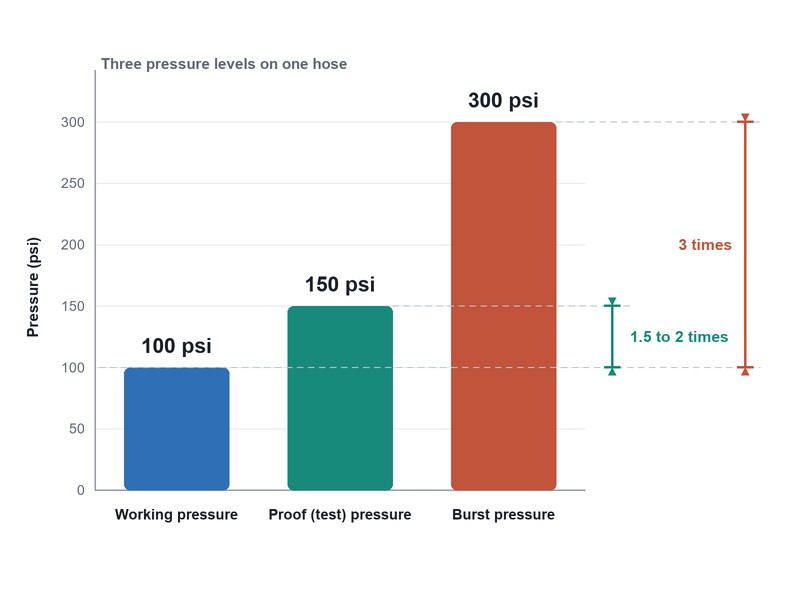
Figure 1. Burst-to-working factor: a 300 psi burst value and a 3:1 factor give a 100 psi working pressure.
How Do the Safety Ratios Between the Ratings Work?
The Burst-to-Working Factor
The burst-to-working factor is the multiple that separates a failure point from a service limit. A 3:1 factor means the wall can take three times the working pressure before it opens. Hydraulic hose commonly uses a 4:1 factor, and the wider margin reflects the energy stored in a pressurized oil circuit. For a garden hose, a product with a published hose burst pressure of 300 psi and a 3:1 factor has a calculated working pressure of 100 psi, which is about 6.9 bar.
The factor is not one universal constant that suits every product. It reflects the material, the reinforcement, the size of the bore, and the consequence of a failure. A small bore line feeding a hand sprayer holds far less stored energy than a large line on a hydraulic machine. The design margin tends to follow the risk, so the riskier duty usually carries the wider gap.
The Proof-to-Working Factor
The proof-to-working factor is the smaller gap that a quality check uses. Holding a 100 psi hose at 150 psi for a short interval proves that the wall, the reinforcement, and the end connection are all intact. The same idea governs other flexible lines, and the hydraulic version of it is set out in detail in this explanation of working pressure versus burst pressure in high-pressure hydraulic hoses.
A proof test is a pass-or-fail check rather than a measurement. A sample either survives the interval or it does not, and a failure points to a defect in the wall or in the joint. Because the check is quick, it can be applied across a production lot rather than to a single specimen.
Where Do the Safety Factors Come From?
Burst and proof values are produced under published hydrostatic test methods. ISO 1402 and ASTM D380, for example, fix how quickly pressure is raised and how long it is held. Two makers testing to the same method therefore report comparable numbers. When two datasheets appear to disagree, the cause is usually the test condition rather than the hose itself. One sheet may quote a value at 70 degrees Fahrenheit and another at 120 degrees, and the warmer sample will always post the lower number.
One Hose, Three Numbers
The working pressure is 100 psi at 70 degrees Fahrenheit, the proof pressure is 150 psi held for about a minute, and the burst pressure is 300 psi. Raise the temperature to the top of the range and the working figure falls to 50 psi, and the proof and burst values fall with it. A buyer who reads only the largest number learns less than a buyer who reads the whole chain, because the largest number is the least useful of the three.
What Pressure Does a Home Water Supply Actually Deliver?
Static Versus Flowing Pressure
Static pressure is what a gauge reads at a closed tap with no water moving. Flowing pressure is lower, because friction in the pipe, the meter, the valve, and the hose consumes energy as the water travels. The loss grows with flow rate and with length, so a long hose delivers less garden hose water pressure at the far end than a short one. Two taps fed from the same line can show different readings for exactly that reason.
Typical Garden Hose Pressure: Where Does a Typical Home Sit?
Plumbing references commonly quote residential service pressure between 40 and 80 psi, and many codes treat 80 psi as the ceiling for a home supply. A typical target for a well-adjusted system is 50 to 60 psi. An ordinary garden hose therefore meets a supply that is often below 80 psi, which is far under the working pressure of a reinforced hose.
Table 2. Reference supply pressures commonly published for residential water systems.
| Point of measurement | What it represents | Commonly published range |
|---|---|---|
| Municipal service entry | Pressure entering the home | 40 to 80 psi |
| Well or booster system | Pressure held by a pump | 30 to 60 psi |
| Outdoor tap, static | Pressure with no flow | A little below the service entry |
| Outdoor tap, flowing | Pressure while a hose runs | Lower, and falling with flow |
Treat the table as planning guidance rather than as a measurement of your own system. A gauge fitted to the tap while a sprinkler runs is the only figure that describes your garden hose water pressure in its real duty. The reading will often sit nearer 50 psi than 80 psi, and it will sag further with every extra length and every fitting in the run.
What Does a Hose Label Actually Guarantee?
What the Label States
The garden hose pressure rating printed on a label states the material, the internal diameter, and a pressure figure. That figure is usually a burst pressure, and sometimes a working pressure as well. Some labels add a garden hose psi rating for the working limit, along with a temperature range and a warranty period. Every one of those claims describes a new hose measured under a stated test condition.
What the Label Does Not Cover
Scope of the claim: the hose wall only. The claim covers the wall, and several things sit outside it:
- The end fittings, clamps, and couplings.
- Aging from sunlight, ozone, and repeated flexing.
- Kinks, abrasion, and crushing under a wheel.
- Water left inside the hose through a freeze.
- Pressure lost along the hose length.
Why the Fittings Usually Fail First
A hose assembly carries one pressure boundary from the tap to the nozzle, and its weakest point is often the connection rather than the tube. A sharp barb, a loose clamp, or a cracked coupling concentrates stress and starts a leak long before the wall gives way. That is why a hose should be rated as an assembly, and why threads and fitting standards matter as much as the tube. A wall rated at 300 psi joined to a fitting that leaks at 60 psi is a 60 psi hose in practice.
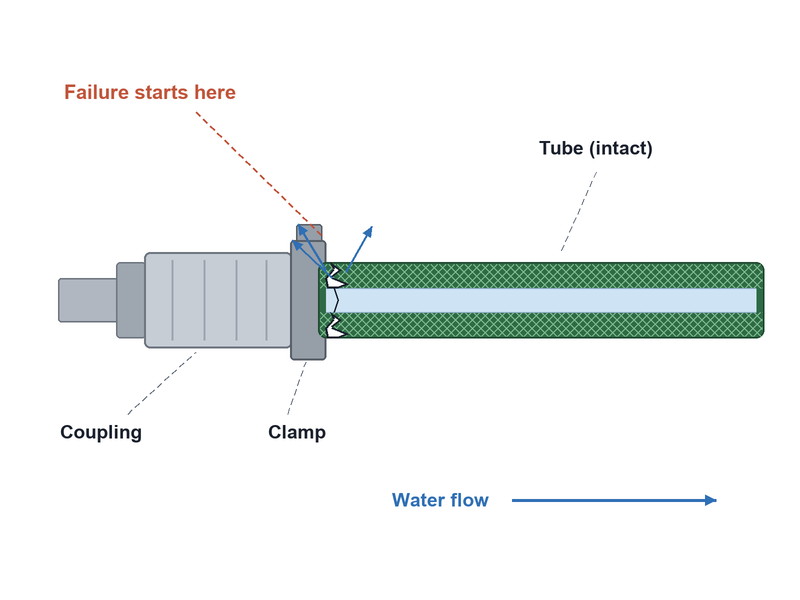
Figure 2. A burst test usually fails at the coupling or clamp, not in the middle of the tube.
What a Warranty Adds and What It Excludes
A warranty is a commercial promise about defects, and it is not a garden hose pressure rating. Most hose warranties exclude damage from freezing, from cutting, from vehicle traffic, and from use above the stated temperature range. Read the exclusions before you treat a warranty as proof of strength. A conservative pressure rating and a clear temperature range together say more about a product than a long warranty period alone.
How to Compare Two Labels Fairly
Compare like with like before you judge two products. Check whether each garden hose psi rating is a working pressure or a burst pressure, and check the temperature at which it was measured. A lower burst value measured at a higher temperature can represent the stronger hose. If a label does not state the level or the condition, treat the number as incomplete rather than as a basis for comparison.
Why Does a Garden Hose Pressure Rating Change With Temperature?
How Heat Softens the Hose Wall
A flexible hose wall is a polymer, plus a textile or wire layer in a reinforced design. As temperature rises, the polymer softens and the reinforcement carries a larger share of the load. The pressure the wall can hold therefore falls as the hose warms, even though the material itself has not changed. Warm water accelerates the effect from the inside as well as from the outside.
How Cold Changes the Same Wall
Cold raises the short-term strength of many polymers, but it also stiffens them. A stiff wall resists bending and cracks when it is forced, so a hose that was coiled wet and then froze can split at a fold. Cold ratings are therefore usually stated as a temperature at which the hose stays flexible, not as an extra allowance of pressure. Flex a cold hose before you pressurize it.
Derating in Practice
Material data for thermoplastic hose commonly shows that the hose working pressure you may use falls as the water and the surface get hotter. Some grades retain only about half their room-temperature capability near the top of their service range. In direct sun with warm water inside it, the usable working pressure of a 100 psi hose falls to about 50 psi. Choose a hose whose published temperature range covers the duty, then select the rating to suit.
A Worked Example of Derating
Suppose a hose carries a working pressure of 100 psi at 70 degrees Fahrenheit, and its product data shows half that capability at the top of its temperature range. The calculated working pressure at that upper temperature is 50 psi. If the tap supplies 55 psi, the hose is already over its limit in that condition, even though the label looked generous when read at room temperature. The temperature line on a datasheet is therefore not decoration.
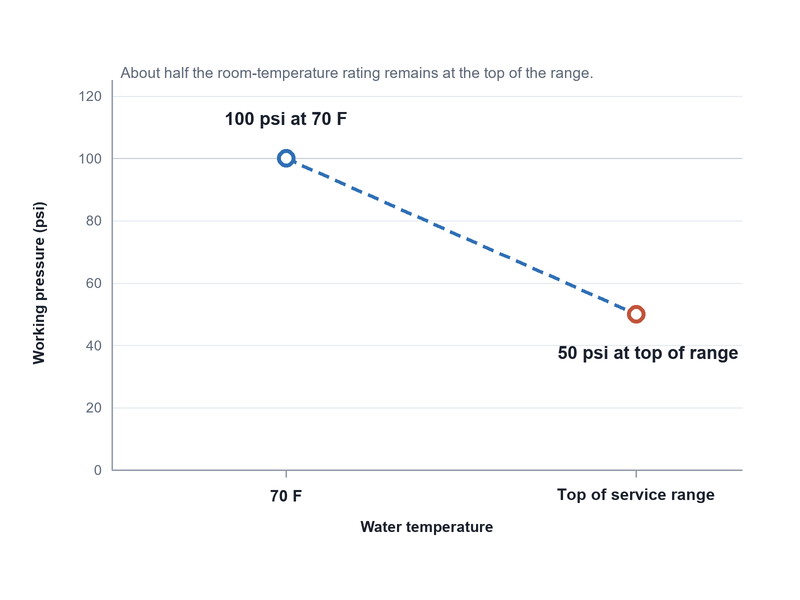
Figure 3. Derating with temperature: 100 psi at 70 F falls to about 50 psi at the top of the range.
Why Is a Burst Rating Not an Operating Limit?
Margin for Surges and Water Hammer
A burst rating is a single steady failure value, but real plumbing is never steady. Closing a valve or a nozzle quickly stops moving water and converts its momentum into a short pressure spike, an effect called water hammer. A spike can multiply the static line pressure several times over. A hose that sits comfortably at working pressure can still see a peak close to its burst figure.
Fatigue, Not Just Force
A wall that survives one high pressure is not necessarily a wall that survives ten thousand modest cycles. Repeated flexing, pulsation, and temperature swings work on the same reinforcement, and the damage accumulates over the life of the hose. A garden hose psi rating describes a fresh sample on a test bench, not the number of cycles an aged hose can still take. A hose that has stiffened with age loses margin before it loses integrity.
The Rating You Should Design Around
Treat the working pressure as the ceiling for normal use, the proof pressure as a factory checkpoint, and the burst pressure as a value that only a controlled test should reach. A garden hose pressure rating is written this way for a reason, because the margin between working and burst is what absorbs the surge you did not plan for. Spend that margin and you leave the hose with nothing left to absorb an ordinary bad afternoon.
What Do the Numbers Mean in Bar and MPa?
Converting psi, bar, and MPa
Pressure appears in pounds per square inch, bar, and megapascals, and a hose sold across several markets may carry all three. One bar equals 14.5 psi, and one megapascal equals 145 psi. A working pressure of 100 psi is therefore about 6.9 bar, or about 0.69 megapascal. These conversions are simple arithmetic on stated inputs, so you can check them on any calculator.
Table 3. Converted values for four common working pressures.
| Pounds per square inch | Bar | Megapascals |
|---|---|---|
| 50 psi | about 3.4 bar | about 0.34 MPa |
| 100 psi | about 6.9 bar | about 0.69 MPa |
| 150 psi | about 10.3 bar | about 1.03 MPa |
| 300 psi | about 20.7 bar | about 2.07 MPa |
Why Two Units Appear on One Label
A product made for one market may be marked in bar while the catalog lists psi. A buyer who reads the wrong line can misjudge the rating by a wide margin. When a label carries two units, convert both and confirm that they describe the same level. A working pressure in one unit and a burst pressure in another look deceptively close, and mixing them is a common source of error. A 300 psi burst rating, for instance, appears as about 20.7 bar on the same line of a label.
How Do Kinks, Length, and Fittings Change the Pressure You Get?
Pressure Loss Along the Hose
Every length of hose adds friction, and friction lowers the pressure that reaches the far end. The loss rises with flow and with roughness, and it is larger in a small bore than in a wide one. A long run of small hose can therefore deliver a weak spray even when the tap reads a healthy static pressure. Length and diameter work together rather than separately.
What a Kink Does to the Wall
A kink pinches the bore and stops the flow, and the pressure behind the kink has nowhere to go. A short restriction can raise the local pressure at that point and stress the wall where it is already folded. Storing a hose in tight coils trains it to kink at the same spot every time. A gentle coil around a reel reduces that risk.
Where the Fitting Sets the Limit
Where the rating applies: the finished assembly, not the tube alone. A fitting is a pressure part, and it often fails before the tube does. A barb that is too small, a clamp that is too loose, or a thread that does not seal will leak at a modest pressure. The hose working pressure that counts is therefore the rating of the weakest part, not the highest number on the package. Match the fitting to the hose, and test the assembly rather than the tube alone.
How Do Other Hose Families Use the Same Ratings?
The Rule Travels With the Application
Working, proof, and burst values appear in every flexible hose family, but the factors change with the consequences of failure. Hydraulic hose shows the same pattern with a wider margin. Air hose risks a sudden release and is rated for a working pressure well below its burst. The same concept appears in hydraulic hose pressure rating, working versus burst pressure. Air lines set their own limits in this note on air hose working pressure versus burst pressure.
Fittings and Fluids Change the Margin
The oil-transfer family adds a chemical dimension, because the inner tube must resist the fluid as well as the pressure. The same working-and-burst logic for that family is set out in this guide to oil hose working pressure versus burst pressure. A pressure rating also stops at the connection, because the assembly is only as strong as its weakest joint. The measurement rules for the most common garden thread are covered in this garden hose fitting size and GHT measurement guide.
Table 4. How the same three-level rating looks across hose families.
| Family | Service priority | Common burst-to-working factor | Main derating risk |
|---|---|---|---|
| Reinforced garden hose | Steady low-pressure flow | 3:1 or higher | Heat and sunlight |
| Hydraulic hose | High stored energy | 4:1 | Heat and impulse cycling |
| Air hose | Sudden release potential | 4:1 | Heat and oil mist |
| Oil transfer hose | Pressure plus a hostile fluid | 4:1 or higher | Heat and chemical attack |
One Concept, Many Applications
The table shows a pattern rather than a fixed rule. Each family keeps a wide gap between the pressure it may run at and the pressure that opens the wall, and each narrows that gap for a different reason and compensates with a different construction. The one constant is that the working value, not the burst value, is the number you design around.
Common Mistakes When Reading a Garden Hose Pressure Rating
Treating Burst Pressure as an Operating Target
The most common mistake is to read the largest number on the label and treat it as the pressure to run at. A burst figure is a failure point, not a service level, and running near it removes every margin the design provides. Use the working value for service and leave the burst value where it belongs, in the test report.
Comparing Ratings Measured at Different Temperatures
A second mistake is to compare two hoses without checking the temperature behind each number. A rating at 70 degrees Fahrenheit and a rating at 120 degrees describe different conditions. The cooler figure will usually be higher for the same construction, so the hotter rating can point to the stronger design. Ask for the test condition before you rank two products.
Judging the Tube and Forgetting the Fitting
A third mistake is to judge a hose by its tube alone. The ends are part of the pressure boundary, and a coupling that weeps sets the real limit of the system. Pressure-test the finished assembly, and inspect the ends as carefully as you inspect the wall.
Ignoring the Effect of Sun and Age
A fourth mistake is to assume that a rating holds forever. Sunlight, ozone, and repeated flexing age the wall, and an old hose no longer matches its condition when new. Inspect for stiffness, cracks, and bulges, and replace a hose that has lost its flexibility. A rating describes a product when it was made, not the state it is in today.
How Do You Choose a Rating for a Specific Job?
Start With the Supply Pressure
Begin with the pressure the supply actually delivers at the point where the hose connects. Measure it with a gauge while the water flows, because a static reading overstates what the hose will see in service. Add the length of the run, since friction grows with distance. Only after that should you look at a garden hose pressure rating on a specification sheet.
Add an Allowance for Surges
Next, leave room for the pressure spikes that valves and nozzles create. A quick shut-off sends a short surge through the line, and the hose must absorb it without touching its proof level. A working pressure well above the steady supply is the simplest way to hold that reserve. If a job involves frequent valve cycling, allow more headroom rather than less.
Check the Temperature and the Fluid
Temperature and fluid decide how much of the published rating you may actually use. Warm water softens the wall, and a hot surface under a hose does the same from outside. A fluid that swells the inner tube reduces the strength of the whole wall. Pick a hose whose temperature range and material compatibility both cover the duty.
Confirm the Fittings and Threads
The ends must be rated with the tube, not chosen afterwards from whatever is on the shelf. Confirm the thread form, the barb size, and the clamp type, then check that the assembly holds the same working pressure as the tube. The Garden Hose Thread (GHT) form differs from a machine thread, and an adapter that does not match will leak before it bursts. Confirm the joint before you confirm the hose.
Order the Assembly as One Rated System
Order the hose, the couplings, and the clamps together so that one working pressure covers the whole assembly. Ask the supplier for a proof pressure and a burst pressure for the finished assembly rather than for the tube alone. That single change removes the gap where most real failures begin. An assembly rating turns three separate components into one accountable product.
Write the Numbers Down
Put the four figures side by side before you buy, and write each one in psi so that the comparison is direct. The supply may sit at 60 psi, the working pressure may be 100 psi, the proof pressure may be 150 psi, and the burst pressure may be 300 psi. Against a working pressure of 80 psi it leaves only 20 psi of margin, and a spike of twice the static pressure would reach 120 psi.
How Long Does a Pressure Rating Last?
Ratings Describe New Hose, Not Aged Hose
A published rating is a statement about a new, undamaged product under a stated condition. Once a hose has spent seasons in the sun, the polymer has aged and the reinforcement has cycled. The rated margin shrinks even though nothing on the label has changed.
How Do You Know a Hose Has Lost Its Margin?
Inspect a hose for stiffness, surface cracks, flat spots, and bulges near the fittings. A wall that has hardened will not flex with the same ease, and a bulge marks a spot where the reinforcement has already given way. Any of those signs means the hose has left its rated condition. Replace it before a test finds the weak point for you.
Storage and Service Life
Loosely coiled storage, full drainage, and shade all slow the aging process. Water left inside a hose expands when it freezes and stresses the wall from within. Ultraviolet light breaks polymer bonds over time, and a hose left in the open ages faster than one kept on a shaded reel.
FAQ
What is a garden hose pressure rating?
A hose pressure rating is the maximum pressure the product may carry continuously in normal use. It is stated as a working pressure and is supported by two test values, a proof pressure and a burst pressure. The rating applies at a stated temperature and for a stated fluid, so it changes if either condition changes. Read it as an operating ceiling rather than as a measure of raw strength.
What is the difference between working pressure and proof pressure?
Working pressure is the level a hose may hold continuously, while proof pressure is a higher value applied briefly to prove the assembly is sound. Proof pressure is usually 1.5 to 2 times the working pressure, and it must never be used as an operating target. The pairing exists so that a weak wall or a poor joint shows up during a controlled factory check.
What is a garden hose psi rating, and does it match working pressure?
The psi figure is the pressure printed in pounds per square inch, and on most products it matches the working limit. Some labels quote only a burst pressure, which is several times higher than the value you may use. If a label shows a single figure without naming the level, ask the supplier which one it is before you rely on it.
What is a typical garden hose water pressure at the tap?
For a typical municipal service, a static reading at an outdoor tap sits inside the 40 to 80 psi band quoted above. Once water is moving, some of that pressure is spent overcoming friction, so the flowing figure is the lower of the two readings. That flowing value is the garden hose water pressure your hose actually works against, so it is the number to compare with the rating.
Is a higher hose burst pressure always better?
A higher burst pressure is not automatically better, because the burst figure only defines the failure point. What matters is the working pressure and the margin above it. A thicker wall that raises the burst value also adds weight, stiffness, and cost, and it can reduce flexibility. Choose the rating that fits the duty rather than the largest number on the shelf.
How is a hose burst pressure measured?
Burst pressure is measured by filling a sample with water and raising the internal pressure steadily until the wall fails, following a published hydrostatic method such as ISO 1402. The result is a minimum value for the production lot, not a guarantee for one individual hose. Testing with water rather than air keeps the stored energy low and the test safe.
I leave my garden hose out in the sun all summer – does the pressure rating still hold?
The rating still applies to a hose at its stated condition, but a hose left in the sun runs hotter than that, so the pressure it can hold drops. Warmth softens the polymer wall, so the usable pressure falls as the water and the surface get hotter. Cold raises the short-term strength but makes the material stiff and brittle, so a frozen hose cracks easily. Store hose out of the sun and drain it fully before a freeze arrives.
Where does a burst test usually fail?
A burst test usually fails at the weakest point in the assembly, and that point is often the coupling rather than the middle of the tube. A barb, a clamp, or a crimp concentrates stress, so failures cluster there. A test report that names where the sample failed is therefore more useful than one that quotes only a pressure.
How do I measure the pressure at my own outdoor tap with a gauge?
Fit a simple pressure gauge to the outdoor tap and read it twice. Note the static value with all outlets closed, then open the hose and read again while water flows. The difference between the two numbers is the loss caused by flow, and the flowing value is the pressure your hose actually experiences during a watering session. A tap that reads 70 psi with the water off can fall well below that once a sprinkler runs.
Can I use a garden hose for a pressure washer?
A garden hose feeds water into a pressure washer but does not carry the washer’s output pressure. The pump raises pressure after the inlet, and the high-pressure line is a separate reinforced hose. A standard garden hose belongs on the low-pressure supply side only, and its working pressure should stay well above the supply it receives.
How should I store a hose to keep its rating?
Coil the hose loosely, drain it fully, and keep it out of direct sun and away from sharp edges. Standing water freezes and expands, and ultraviolet light ages the wall over time. A hose stored this way keeps its published rating for longer, because the two most common causes of early failure have been removed from the picture.
About HENGHUA
HENGHUA is a hose manufacturer that supplies distributors, retailers, and OEM or private-label programs. The company builds its hydraulic range under the GLOBHOSE name and its flexible industrial range under the FLEXMAX name, and it supports custom branding and tailored product solutions. Production is backed by hydrostatic and burst testing, so a hose ships with a stated working pressure and a stated burst margin rather than a single marketing figure.
Buyers who need a specific garden hose pressure rating for a private-label program can review the standard range on the Browse the product range. Send the duty conditions, including fluid, temperature, and flow, through the Request a quote form. The technical team quotes a working pressure, a proof pressure, and a burst pressure for each candidate construction, so the choice is made on data rather than on a label alone.






 English
  Spanish
  Portuguese
  French
  German
  Arabic
  Russian
  Indonesian
  Japanese
  Korean