
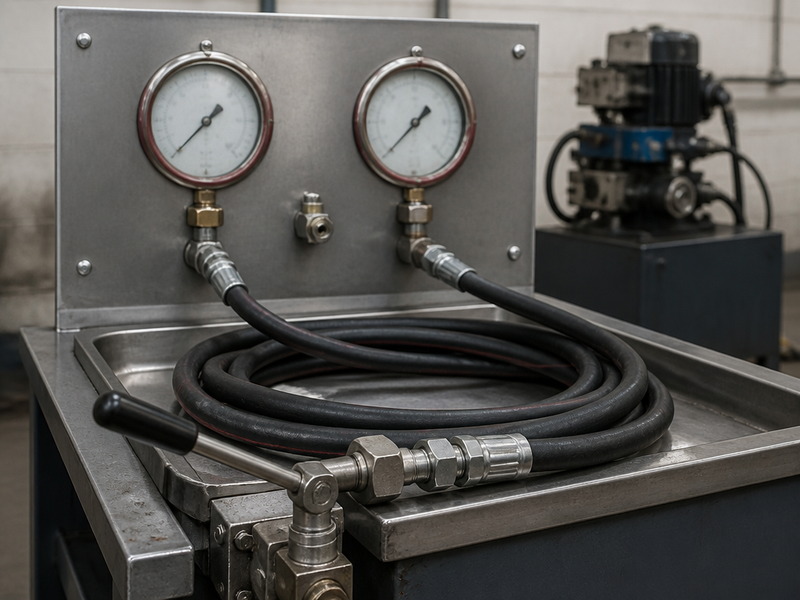
The hydraulic hose pressure rating that governs whether a line is safe to run is its working pressure — the highest pressure the hose is designed to see continuously in normal service.
Burst pressure is a different number: it is the destructive test result at which the hose actually ruptures, and SAE J517 requires a hose’s minimum burst pressure to be at least four times its working pressure, with EN 853 specifying the same minimum burst pressure of four times the maximum working pressure for 1SN and 2SN, and EN 857 for 2SC. Between the two sits proof pressure — the non-destructive factory check applied at twice working pressure before an assembly ships. Working pressure is the design limit you operate inside; burst pressure is a qualification figure you verify once and then never approach.
This guide explains what each rating means, how the minimum burst requirement is applied, how working pressure, proof pressure and burst pressure relate to one another, how the rating changes with bore size and temperature, how to read the numbers printed on a hose, and the five-step sequence our engineers use to match a rating to a real system — for a replacement line on an excavator, a fleet standardization program, or an OEM build.
The Short Answer: What a Hydraulic Hose Pressure Rating Tells You
Every hydraulic hose carries three pressure numbers: working pressure (the operating limit), proof pressure (a non-destructive check at 2×) and burst pressure (a destructive minimum at 4×). Mixing them up is one of the most common causes of premature failure and of over-specified, over-priced hose.
Table 1. Working pressure, proof pressure and burst pressure on a hydraulic hose compared
| Rating | What it means | How it is established | Can you operate at it? |
|---|---|---|---|
| Working pressure (WP) | Maximum continuous pressure the hose is rated for in normal service | Published design rating for that construction and bore | Yes — this is the limit you design to |
| Proof pressure | Non-destructive factory test pressure applied to the finished assembly | Hydrostatic test at 2× working pressure, the proof requirement of SAE J517 and EN 853 | No — test condition only |
| Burst pressure (BP) | Pressure at which the reinforcement ruptures | Destructive test; minimum is 4× working pressure per SAE J517 and EN 853 | No — never approach it |
The rule that follows from this table is simple and absolute: select the hose on working pressure, verify the burst pressure as a safety floor, and never use the gap between them as operating room.
Start Here: Find Your Job
Where to start, by the job in front of you. This is a navigation aid, so it carries no Table number in the sequence above.
| If you are… | Start at | Fix this first |
|---|---|---|
| Replacement technician on an excavator or loader | Table 4 and the layline chapter | the bore and construction read off the cut sample |
| Buyer or distributor comparing quotes | Table 4 and the construction-family chapter | which standard basis the quote uses — SAE J517 or EN 853 |
| OEM engineer specifying a new circuit | Table 5 and the five-step sequence | the maximum system pressure including surge, then the bore from flow |
| Machine owner investigating a burst below rating | Why Hydraulic Hoses Fail Below the Pressure Rating | abrasion and bend radius before pressure |
What Is Hydraulic Hose Working Pressure?
Working pressure is the maximum pressure a hose assembly is rated to contain continuously, at its rated temperature, in normal hydraulic service. It is a published property of the hose construction and bore size — not a measured property of an individual hose — and it assumes the assembly is correctly made with matched fittings, routed within its minimum bend radius, and used with a compatible fluid.
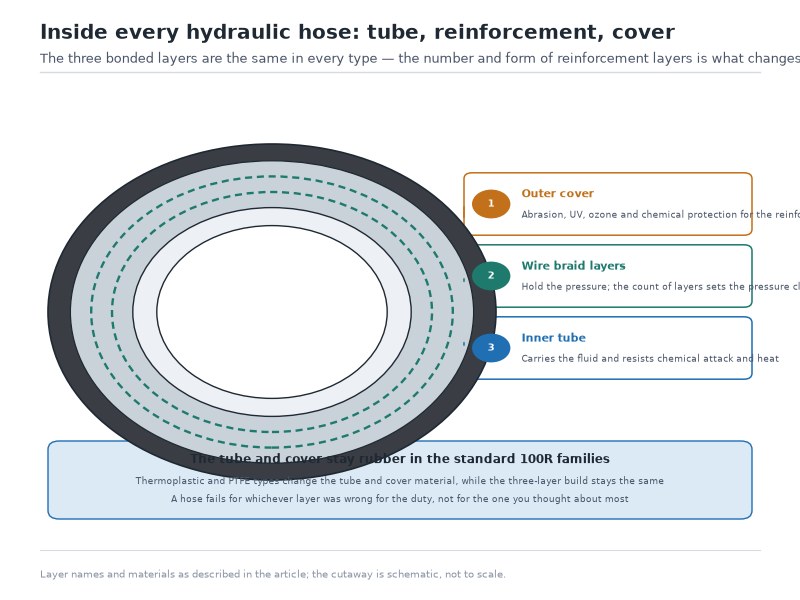
The number is set by the reinforcement. A single layer of braided steel wire holds less than two layers, which holds less than four or six spiral-wound layers, which is why a 3/8-inch single-wire hose is rated 2,280 PSI on the SAE J517 100R1AT basis, while the EN 853 1SN metric rating for the same bore is 2,610 PSI, and a spiral hose of the same bore can be rated above 5,000 PSI.
Working Pressure Is a Continuous Limit, Not a Peak Limit
Working pressure assumes steady-state operation. Real hydraulic systems produce short pressure spikes every time a valve closes, a cylinder stalls, or a relief valve cracks open, and those spikes can lift peak pressure well above the gauge reading an operator sees.
Three practical consequences follow:
- Size the hose so that maximum system pressure, including normal spikes, stays at or below the working pressure rating. The pump’s relief valve setting is the best available proxy for that maximum.
- Many buyers apply a selection margin on top of that: 1.25 to 1.5 times the relief valve setting. That margin is industry practice rather than a fixed standard requirement — neither SAE J517 nor EN 853 fixes a selection margin, and it exists so the hose is not sitting at 100 percent of its rating for its whole life.
- If a circuit genuinely produces frequent, high-amplitude spikes, the answer is usually a higher-impulse construction rather than a higher single-number rating. Impulse rating, not burst pressure, is the variable that predicts life in those systems.
What Is Hydraulic Hose Burst Pressure?
Burst pressure is the pressure at which the hose fails catastrophically and the reinforcement ruptures. It is determined by test, not by calculation, and it is published as a minimum — a floor that every production hose must exceed, not a typical value. Individual hoses usually burst above the stated minimum, and the margin varies with bore, manufacturing tolerance and temperature.
Because it is a destructive figure, burst pressure says nothing about how long a hose will last. A hose that survives a 16,000 PSI burst test in a short, controlled test has proven a static strength floor; it has not proven anything about fatigue life at 4,000 PSI.
How Burst Pressure Is Measured
Burst testing follows a defined hydrostatic method (ISO 1402 for rubber and plastic hose, with SAE J343 covering the SAE 100R test procedures). The sequence is consistent across manufacturers:
- A straight sample of finished hose, fitted with end couplings, is filled with water or hydraulic fluid and vented of air.
- The sample is pressurised at a controlled rate — slow enough that the failure is a genuine strength measurement rather than a shock effect.
- Pressure is increased until the reinforcement ruptures. The peak pressure is recorded as the burst value.
- The burst sample is scrapped. A burst-tested hose is never returned to service.
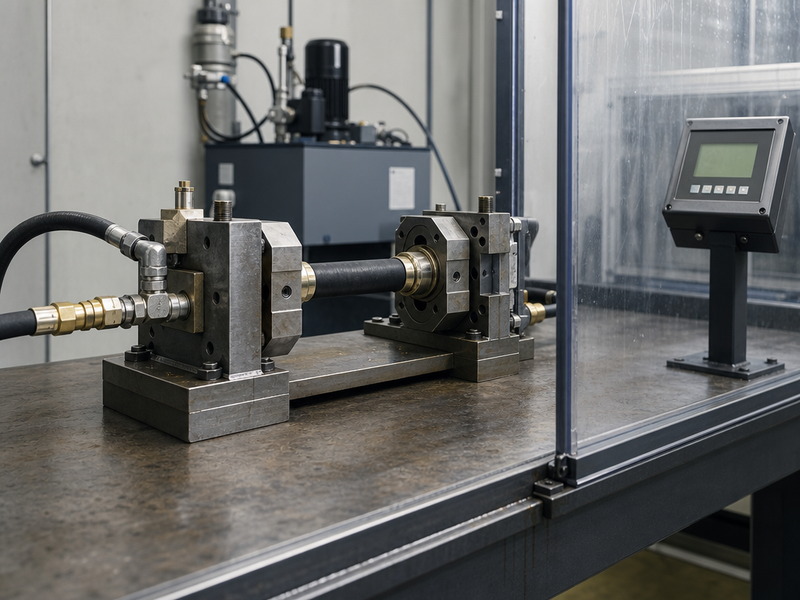
Figure 1. A hydrostatic burst test pressurises a straight hose sample until the reinforcement ruptures. The recorded peak is a strength qualification figure — the sample itself is destroyed and never returned to service.
Why the Four-Times Figure Is Not Operating Room
Read as a fixed multiple, a four-times ratio looks like a comfortable cushion. It is not, because the four-times figure is consumed by effects that appear in service rather than in a short laboratory test:
- Impulse fatigue. Impulse testing to EN ISO 6803 cycles the hose at 133 percent of working pressure with the fluid at +100 °C, and the SAE J517-type requirement is a minimum of 200,000 cycles; wire braid fatigues over that cycle count, and fatigue failure occurs far below burst pressure.
- Temperature. Reinforcement-to-tube bond strength and rubber tensile strength both fall as temperature rises, so the burst figure measured at ambient temperature does not represent performance in a hot engine compartment.
- Installation stress. A hose bent tighter than its minimum bend radius, twisted during installation, or abraded against a machine structure has already spent part of its strength before it sees pressure.
- Dynamic surge. Rapid valve closure can generate surge pressures several times the steady-state value for a fraction of a second — exactly the kind of event the four-times minimum exists to absorb.
Hydraulic Hose Pressure Rating: The Three Numbers on Every Hose
Working pressure, proof pressure and burst pressure are linked by fixed multipliers, which is why a datasheet can quote three numbers for the same hose without contradiction.
- Minimum burst pressure = four times the maximum working pressure. SAE J517 specifies this for the standard 100R1 and 100R2 families, EN 853 for 1SN and 2SN, and EN 857 for 2SC. It is a qualification floor, not an operating range.
- Proof pressure = working pressure × 2. The proof test is a non-destructive quality check applied to finished assemblies; the hose must hold it without leakage, weeping or permanent deformation.
- Minimum burst pressure = working pressure × 4 — the published figure is a minimum for new, straight, unused samples and is reached only on a test rig.
Table 2. Worked examples of the three pressure numbers: proof pressure at 2× working pressure and minimum burst pressure at 4× working pressure
| Pression de service | Proof pressure (2× WP) | Minimum burst pressure (4× WP) | Typical construction |
|---|---|---|---|
| 1,000 PSI | 2,000 PSI | 4,000 PSI | 100R1 single wire braid, large bore |
| 2,000 PSI | 4,000 PSI | 8,000 PSI | 100R1, 1/2-inch bore |
| 3,000 PSI | 6,000 PSI | 12,000 PSI | 100R2 double wire braid, 5/8-inch bore |
| 4,000 PSI | 8,000 PSI | 16,000 PSI | 100R2, 3/8-inch bore |
| 6,000 PSI | 12,000 PSI | 24,000 PSI | 100R15 six-spiral, small bore |
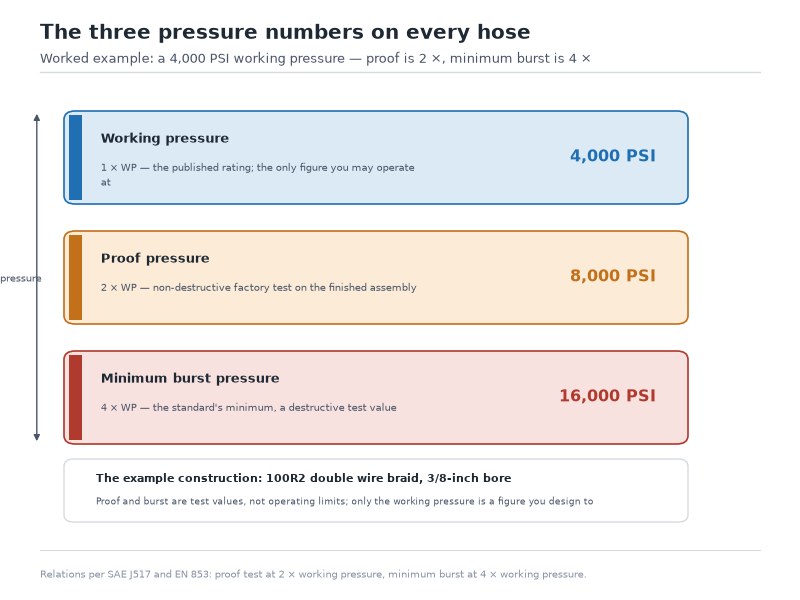
Figure 2. The three ratings sit on one ladder. Working pressure is the only rung an operator may stand on; proof and burst pressures are test conditions used to qualify the hose before it ships.
What Does Four Times Maximum Working Pressure Actually Mean?
What the trade calls a hydraulic hose safety factor is defined by the standards — SAE J517, EN 853 and EN 857 — as a minimum burst pressure of four times the maximum working pressure; it is a qualification floor, not a reserve you may operate inside. For the SAE 100R1 and 100R2 families, SAE J517 specifies a minimum burst pressure of four times the maximum working pressure; EN 853 sets the same requirement for 1SN and 2SN, and EN 857 for 2SC — a hose rated 4,000 PSI working pressure must withstand at least 16,000 PSI before it ruptures.
Why the Ratio Is Four and Not Two
The four-times figure is not an allowance for sloppy operation: it is a composite reserve that absorbs several independent effects at once:
- Pressure spikes that exceed the steady-state reading, including surge from rapid valve closure.
- Impulse fatigue over the hose’s service life, where wire braid progressively loses strength.
- Manufacturing variation between reels and production batches, since the rating is a minimum rather than a measured value.
- Age and environmental attack — cover cracking, ozone, UV and abrasion all reduce the strength of the reinforcement the number was measured on.
- Minor field damage that would otherwise be immediately critical, such as a shallow cut in the cover or a scuffed braid.
Spikes, fatigue, batch variation, ageing and field damage each take a share of the four-times figure. Once all five are subtracted, a nominal four-times ratio leaves almost nothing usable, which is why the burst figure is a verification number rather than a usable pressure.
Where the Four-Times Figure Does Not Apply
Four times the maximum working pressure is the norm for rubber hydraulic hose built to SAE J517 and EN 853, but it is not universal, so the relationship should be confirmed rather than assumed:
- Spiral constructions (SAE 100R12, 100R13, 100R15) are also specified with a minimum burst pressure of four times the working pressure, but they carry a substantially higher impulse-cycle requirement, which is what distinguishes them in service.
- Thermoplastic hose in the 100R7 and 100R8 families is commonly rated with a lower minimum burst multiple than rubber wire-braid hose; where a low-pressure thermoplastic type is quoted near 3:1, that is an industry practice rather than a fixed standard requirement, so confirm the factor on the manufacturer’s datasheet.
- Suction and discharge hose is rated for vacuum and external load rather than internal pressure. Pressure-rated classes of oil suction and discharge hose are often specified with a lower minimum burst multiple than four times the working pressure, which is an industry practice rather than a fixed standard requirement; EN 1765 is the reference for that family, so take the factor from the datasheet for the specific class.
- Fitting and coupling ratings are separate. A hose rated 4,000 PSI paired with a coupling rated lower than that has an assembly rating equal to the lower of the two.
The practical instruction is to read the minimum burst requirement from the standard the hose is built to, and to check that the end fittings carry an equal or higher rating than the hose. For a construction-by-construction comparison of where the four-times requirement applies and where a lower figure governs, see our companion guide to working pressure vs burst pressure explained.
How Do Working Pressure, Burst Pressure and Proof Pressure Differ?
Working pressure is the operating limit, proof pressure is a non-destructive factory check at twice working pressure, burst pressure is the destructive minimum at four times working pressure, and impulse pressure measures fatigue life. The three terms are often used interchangeably in conversation and never interchangeably in engineering. Table 3 is the shortest accurate summary of how they differ.
Table 3. Working pressure vs burst pressure vs proof pressure vs impulse pressure: the key differences
| Parameter | What it measures | Test type | Multiplier | Set by | Purpose |
|---|---|---|---|---|---|
| Pression de service | Continuous safe operating limit | None — a published design rating | 1× (reference) | The standard the hose is built to | Prevents failure in normal service |
| Proof pressure | Integrity of the finished assembly | Non-destructive hydrostatic | 2× working pressure (proof test requirement) | Manufacturer, to SAE J517 and EN 853 | Catches assembly and material defects before shipment |
| Burst pressure | Ultimate static strength | Destructive hydrostatic | Minimum 4× working pressure | SAE J517 / EN 853 | Establishes the required minimum burst pressure |
| Impulse pressure | Fatigue life under cycling at +100 °C | Destructive cyclic test | 133% of working pressure, 200,000 cycles minimum | SAE J517 / EN ISO 6803 | Predicts service life in high-cycle systems |
What a Hydraulic Hose Proof Pressure Test Proves
A hydraulic hose proof pressure test is applied to the finished assembly, not to the hose alone, and it is non-destructive. The assembly is pressurised to the proof value and held for the period the test procedure specifies — commonly 30 to 60 seconds in published procedures, then inspected for leakage at the couplings, weeping through the cover, and permanent deformation. A hose that passes is shipped; a hose that fails is scrapped.
What this proves is narrow but valuable. A hydraulic hose proof pressure test confirms that the crimp or coupling attachment is sound at twice the pressure the hose will see in service, and that no gross material defect survived into the finished assembly. It does not test fatigue, heat resistance or field life — proving those requires separate impulse and temperature testing.
Working Pressure vs Burst Pressure: The One-Line Rule
If only one line survives from this guide, it should be this: operate to working pressure, qualify to proof pressure, and treat burst pressure as a laboratory floor. A hose running at its burst pressure has no reserve left for a surge, a hot day, or a fatigue cycle.
Why Does the Hydraulic Hose Pressure Rating Fall as the Bore Rises?
A larger bore does not make a hose stronger — it makes it weaker for the same construction. The reinforcement has to contain hoop stress that grows in proportion to both pressure and internal diameter, so as bore increases, the same amount of wire carries a higher load per strand and the published working pressure falls.
That single principle explains the pattern every experienced technician recognises: a 1/4-inch two-wire hose is rated far higher than a 2-inch two-wire hose, even though both are built to the same SAE family.
Table 4. SAE 100R2AT working pressure and minimum burst pressure by dash size, with the EN 853 1SN single-wire metric rating alongside for comparison (typical published values — confirm the exact figure for your bore and manufacturer on the datasheet)
| Taille des tirets | Inside diameter | Working pressure (SAE J517 100R2AT, psi as published) | Working pressure (EN 853 1SN metric rating; the SAE 100R1AT equivalent construction publishes different values) | Minimum burst pressure (4× WP) |
|---|---|---|---|---|
| -4 | 1/4 in | 5,000 PSI (345 bar / 34.5 MPa) | 3,260 PSI (225 bar) | 20,000 PSI |
| -6 | 3/8 in | 4,000 PSI (276 bar) | 2,610 PSI (180 bar) | 16,000 PSI |
| -8 | 1/2 in | 3,500 PSI (241 bar) | 2,320 PSI (160 bar) | 14,000 PSI |
| -10 | 5/8 in | 3,000 PSI (207 bar) | 1,885 PSI (130 bar) | 12,000 PSI |
| -12 | 3/4 in | 2,500 PSI (172 bar) | 1,520 PSI (105 bar) | 10,000 PSI |
| -16 | 1 in | 2,000 PSI (138 bar) | 1,280 PSI (88 bar) | 8,000 PSI |
| -20 | 1-1/4 in | 1,500 PSI (103 bar) | 910 PSI (63 bar) | 6,000 PSI |
| -24 | 1-1/2 in | 1,250 PSI (86 bar) | 725 PSI (50 bar) | 5,000 PSI |
| -32 | 2 in | 1,000 PSI (69 bar) | 580 PSI (40 bar) | 4,000 PSI |
The dash-size chart below is the pressure rating table most often requested in day-to-day work, and it repays being read correctly:
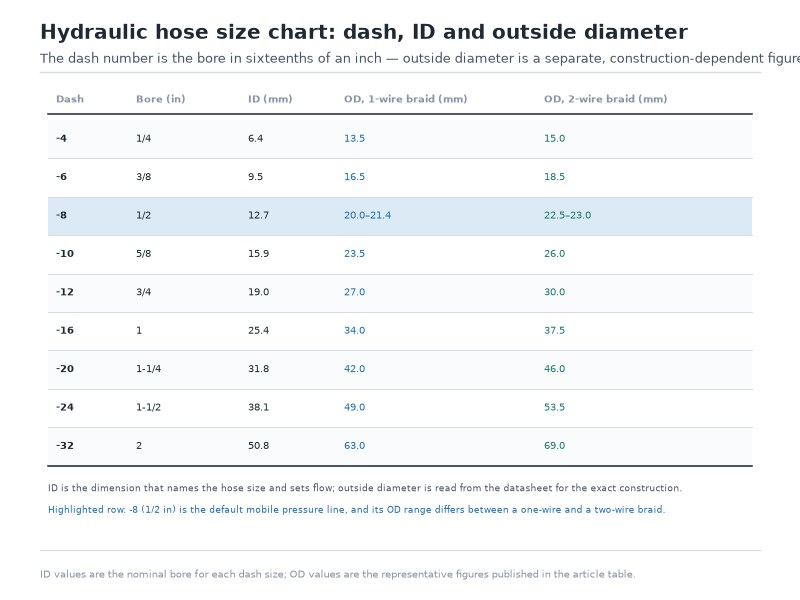
- The dash size is the inside diameter in sixteenths of an inch, so a -8 hose has a 1/2-inch bore. Pressure is rated against inside diameter, never outside diameter.
- Minimum burst pressure is a floor: four times the working pressure for that bore, and never a service pressure.
- Values differ slightly between standards for the same bore. EN 853 2SN and SAE 100R2AT describe essentially the same two-wire construction, yet the published metric rating for a DN12 bore is 275 bar while the SAE publication lists 3,500 PSI (241 bar) for a -8. Both are correct for the standard they belong to, which is why the datasheet, not a generic chart, governs ordering.
- Ratings also differ between manufacturers at the same bore because cover thickness, wire grade and braid angle vary within the standard’s tolerances. Use this chart to understand the pattern and to sanity-check a quote; use the manufacturer’s datasheet to place the order.
- The single-wire column is the EN 853 1SN metric rating, not an SAE J517 figure; the same nominal bore is published differently by the two standards, which is also why EN 853 2SN and SAE 100R2AT differ at -8. The 100R2AT column is the SAE J517 rating. EN 853 2SN is the equivalent European family and publishes 5,800 / 4,000 / 3,500 / 3,000 / 2,750 / 2,250 / 1,625 / 1,500 / 1,250 psi for the same dash sizes, so confirm the figure and the standard on the datasheet before ordering.
The same -4 rating appears on metric-first datasheets as 35 MPa. That is the rounded metric equivalent of 345 bar / 34.5 MPa, not a different hose; confirm the figure your supplier publishes on the datasheet.
Which Hydraulic Hose Pressure Rating Applies to Each Construction Family?
Construction, not brand, sets the ceiling. Table 5 summarises the working pressure band and duty of the families that cover almost all hydraulic service.
Table 5. Working pressure band and temperature range by hydraulic hose construction family (typical published values — confirm the exact rating for the specific dash size on the datasheet)
| SAE family | Renfort | Typical working pressure range | Temperature range | Typical duty |
|---|---|---|---|---|
| 100R1AT | 1 steel wire braid | 1,000-3,000 PSI (69-207 bar) | -40°C to +100°C | Medium-pressure supply, pilot and lubrication lines |
| 100R2AT | 2 steel wire braids | 2,000-5,000 PSI (138-345 bar) | -40°C to +100°C | General mobile and industrial pressure lines |
| 100R16 | 2 compact wire braids | 2,500-5,800 PSI (172-400 bar) | -40°C to +100°C | R2 pressure in a smaller outside diameter |
| 100R17 | Compact 1- or 2-wire braid | 3,000 PSI (207 bar) | -40°C to +100°C | Pilot lines, off-road equipment |
| 100R12 | 4 spiral steel layers | 2,500-4,000 PSI (172-276 bar) | -40°C to +121°C | High-impulse mining and construction |
| 100R13 | 6 spiral steel layers | to 5,000 PSI (345 bar) | -40°C to +121°C | Extreme pressure, heavy mining |
| 100R15 | 6 spiral steel layers | to 6,000 PSI (414 bar) | -40°C to +121°C | Ultra-high pressure, offshore |
| 100R7 / 100R8 | Thermoplastic, fibre or wire | 1,000-6,000 PSI (69-414 bar) | -40°C to +93°C | Hydraulic tools, low-conductivity circuits |
| 100R14 | PTFE core, stainless braid | 600-1,500 PSI (41-103 bar) | -54°C to +204°C | High temperature and aggressive fluids |
| 100R3 / 100R6 | Textile braid | 300-1,500 PSI (21-103 bar) | -40°C to +100°C | Low-pressure return and drain lines |
| 100R4 | Textile plus wire helix | 35-300 PSI (2.4-21 bar) | -40°C to +100°C | Suction and vacuum lines |
> Values above are typical published bands for each family and vary with bore and manufacturer. Confirm the exact rating for the specific dash size on the datasheet before ordering.
Two patterns hold across the construction families, and they drive most specification decisions:
- Pressure capability rises with reinforcement complexity, but flexibility and bend radius move the other way. If a circuit needs 4,000 PSI in a tight installation, the answer is often a compact two-wire hose (100R16) rather than a spiral hose, because spiral hose of that rating will not bend into the available space. The trade-off between braided and spiral construction decides pressure capability and impulse life at the same time.
- The lowest rating in an assembly governs. A 5,000 PSI hose with 3,000 PSI couplings is a 3,000 PSI assembly. See our hydraulic hose assemblies range for how hose and coupling ratings are matched at the factory.
How Does Temperature Change the Pressure Rating?
Every working pressure rating is published for a reference operating temperature, and it is valid inside the hose’s rated temperature band — not outside it.
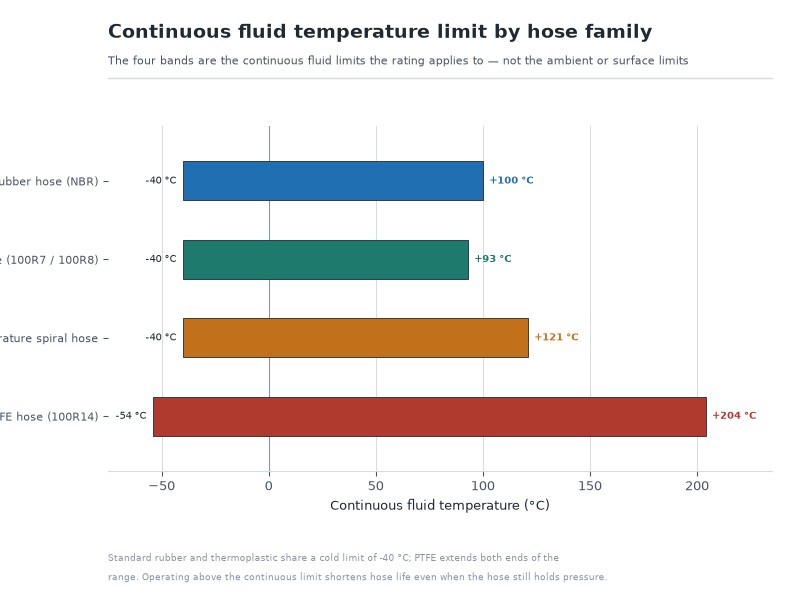
- Standard rubber hydraulic hose (the 100R1, 100R2, 100R16 and 100R17 families) is rated to about +100°C (+212°F) continuous, with short intermittent excursions to +120°C (+248°F) normally allowed for no more than about 10% of operating time.
- Spiral families (100R12, 100R13, 100R15) are rated higher, commonly to +121°C (+250°F).
- Thermoplastic hose generally tops out near +93°C (+200°F), which is the practical limitation of an otherwise excellent construction.
- PTFE hose (100R14) reaches +204°C (+400°F), which is why it is specified for hot, chemically aggressive circuits.
Above the rated temperature the hose is outside its specification, and the published working pressure no longer applies. Two effects cause this. Rubber tensile strength and reinforcement-to-tube bond strength both fall as temperature rises, and hot oil accelerates ageing of the tube compound. Because different compounds derate at different rates, manufacturers publish their own temperature correction tables rather than a single industry percentage — which means derating is a datasheet exercise, not a rule of thumb.
Fluid selection compounds the temperature question, because an incompatible tube compound degrades faster at exactly the temperatures where the rating band is already narrowest — the fluid compatibility chart for NBR, EPDM and FKM tubes shows where each compound is the correct answer.
In the field, the hot end of the band is where impulse life shortens most noticeably. On a machine running return oil near 90°C, hoses that comfortably exceed their impulse-cycle requirement in a cool climate can fail early in a hot one. The fix is rarely a higher pressure rating; it is a hotter-rated construction, a larger bore, or better routing away from exhaust and manifold heat.
How to Read the Pressure Numbers Printed on a Hydraulic Hose
The working pressure rating is printed on the hose cover, in a line called the layline. Reading it correctly takes about ten seconds and prevents the most expensive mistake in hose replacement — fitting a lower-rated hose than the one removed.
Read a layline like this one on a SAE 100R2AT 1/2-inch hose:
`SAE 100R2AT 1/2 WP 3500 PSI / 241 BAR 2Q26`
Decoded:
- SAE 100R2AT — the construction family, in this case a two-wire braid hose to SAE J517.
- 1/2 — the nominal inside diameter in inches, equivalent to dash size -8.
- WP 3500 PSI / 241 BAR — the working pressure, in both units.
- 2Q26 — the manufacturer’s date and plant code.
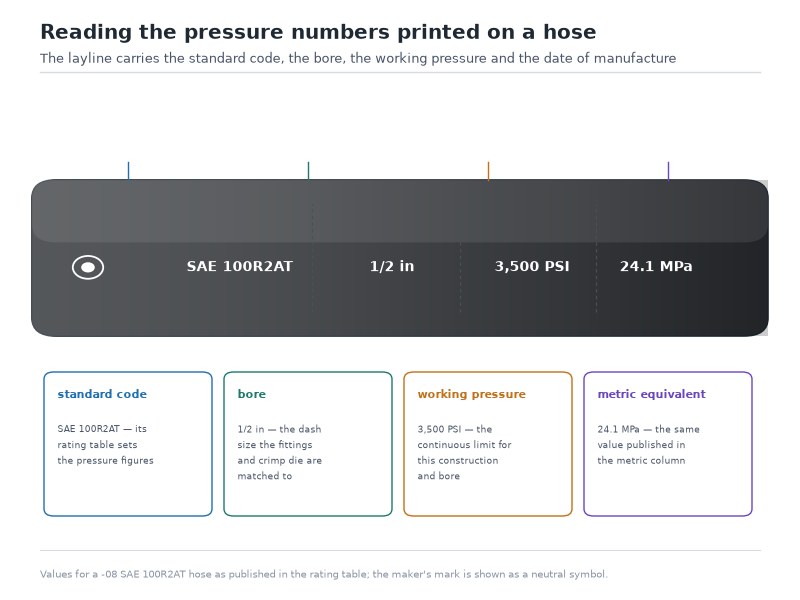
Figure 3. The layline is the authoritative pressure rating for the hose in your hand. If the printing is worn, painted over or unreadable, measure the bore and treat the hose as unrated rather than guessing from appearance.
Four rules make layline reading reliable:
- Burst pressure is normally not printed on the cover. If only one pressure appears, it is the working pressure.
- The bore on the layline must match the bore you install. A hose marked 1/2 is not a 1/2-inch hose if the layline is from a different reel.
- Older hoses may carry an obsolete designation. Type A and Type B hoses were superseded by the AT (thin cover) types in the current revision of the standard; treat an obsolete code as a signal to replace rather than to re-specify.
- An unreadable layline is a rejection. Without a legible rating there is no way to confirm the hose meets the circuit’s requirement. Our guide to how to read a hydraulic hose layline covers the full marking set, including temperature and standard codes.
Why Two Datasheets Quote Different Working Pressures for the Same SAE 100R2 Dash Size
The same nominal two-wire hose can carry two different published hydraulic hose pressure ratings without either figure being wrong, and the reason is the standard the hose is built to. SAE J517 and EN 853 are equivalent families rather than identical tables: each rounds its metric and imperial figures differently, so the published number for a given dash size moves by a few percent between them.
The practical effect is that a -12 two-wire hose carries 2,500 PSI in the SAE J517 column of Table 4 and 2,750 PSI in the EN 853 2SN set quoted in the reading notes below it. Both are correct for their own standard. What is not acceptable is a quotation that mixes the two — one dash size read from an SAE table and the next from an EN table, in the same bill of materials, on a drawing whose hydraulic hose pressure rating was set against one standard.
Two habits prevent this. Ask which standard the quote is built to, and check that the same standard runs down every row of the comparison. Where a machine was designed around one standard, keep the replacement on that standard, because the family limits published in our hydraulic hose temperature rating guide and the pressure figures here are written per family, not per brand.
Which Pressure Rating Do You Need? Five Steps to a Correct Answer
Rating selection fails most often because the wrong quantity is used as the input. These five steps take the correct inputs in order.
- Establish maximum system pressure, including spikes. Use the relief valve setting as the anchor and add the surge produced by rapid valve or cylinder movement. If the circuit has a pressure-reducing valve downstream, rate the hose for the pressure it actually sees, not for the pump’s maximum. If you are still gathering the inputs, the STAMPED method for hose selection gives them a fixed order.
- Apply a selection margin of 1.25 to 1.5 times the relief valve setting. For continuous duty, choose a construction whose hydraulic hose working pressure sits above the maximum system pressure rather than exactly at it; the margin is a purchasing convention rather than a value fixed by the standard the hose is built to, and it costs little at the specification stage.
- Check the rating at the actual bore size. Bore is chosen for flow, not pressure, and the working pressure at that bore is often lower than the headline figure for the family. Confirm the specific dash size, not the family range.
- Check the impulse requirement. High-cycle circuits (boom cylinders, presses, rock drills, injection moulding) should be specified on impulse life, not on a static rating. A hose with an adequate hydraulic hose working pressure can still be the wrong choice if it is not built for the cycle count — impulse life testing is the measurement that predicts it.
- Confirm the rating applies at your temperature and fluid. A rating is valid only inside the rated temperature band and with a compatible tube compound. Confirm both before the order is placed.
Selection Checklist: What to Send a Supplier
Send these six items and most suppliers can quote a correct assembly without a second round of questions:
- Maximum system pressure in PSI or bar, including the relief valve setting and any known surge
- Line function — pressure line, return line or suction line
- Required bore (dash size) or the flow rate and line type, if size is still open
- Fluid type and the maximum continuous and peak fluid temperatures
- Operating environment — abrasion, UV exposure, potential flexing or tight bends
- End fittings at both ends, plus the assembly length measured to the fitted length
> Hose enquiry — maximum system pressure ___ PSI / ___ bar (relief setting ___); line function: pressure / return / suction; bore ___ (or flow ___ GPM); fluid ___ at ___°C continuous, ___°C peak; environment: abrasion / UV / tight bend?; fittings ___ at both ends, fitted length ___ mm. Please confirm the construction, the working pressure at that bore, and the proof and burst figures.
Those six items are enough for us to confirm a construction, a rating and an impulse class without a second round of questions. Send them to our engineering team and we will come back with the construction, the rating at your bore, and the proof and burst figures we will test the assembly against. Bore is chosen for flow first, as set out in the STAMPED selection sequence, and then confirmed against the rating that bore actually carries.
What Do the Hydraulic Hose Testing Standards Prove?
Hydraulic hose testing standards exist to make a pressure rating verifiable rather than promotional. Each one answers a different question, and a supplier that can produce results for all of them is doing more than printing a number on a cover.
Table 6. Hydraulic hose testing standards and what each one proves about a pressure rating
| Standard | What it covers | What it proves |
|---|---|---|
| SAE J517 | Construction and rating of the SAE 100R hose families | The hose class, working pressure, proof and minimum burst requirements |
| SAE J343 | Test and test procedures for SAE 100R series hose | The method behind the ratings and how conformity is demonstrated |
| ISO 1402 | Hydrostatic testing of rubber and plastic hose | Burst and proof pressure results obtained by a defined procedure |
| ISO 6803 | Impulse testing without flexing | Fatigue life under cyclic pressure at 133% of working pressure |
| EN 853 (1SN / 2SN) | European equivalent of the single- and two-wire braid families | Metric ratings in bar for the same constructions |
| EN 856 (4SP / 4SH) | European spiral families | Higher-pressure spiral ratings and impulse classifications |
| ISO 18752 | Alternative hose classification by pressure and flexibility grade | A grade-based route to ratings above the classic families |
| EN 1765 | Rubber hose assemblies for oil suction and discharge service | The pressure class and minimum burst multiple for the oil suction and discharge family |
For the oil suction and discharge family, a lower factor than four times the working pressure is the accepted industry practice rather than a fixed standard requirement, so take the factor from the datasheet for the specific class.
Two practical points follow from the standards that govern hydraulic hose testing:
- Ask for proof test records, not just a certificate of conformity. A proof test at twice working pressure — the 2× proof requirement of SAE J517 and EN 853 — is a per-assembly check and can be documented per batch; a general certificate often is not.
- Ask how burst testing is sampled. A hydraulic hose burst pressure figure is established by destructive test on a sample, so a supplier tests per production batch rather than per hose — an industry practice rather than a fixed standard requirement. The frequency of that sampling is a fair question in a supplier audit and a meaningful difference between factories.
Both questions have a documented answer here: proof test records are filed against the assembly serial number, and burst sampling follows a published per-batch schedule. Request a quote and free samples.
Where a project is governed by more than one regional standard, the SAE, DIN, ISO and GB comparison guide maps which families are equivalent and where the numbers legitimately differ.
Why Hydraulic Hoses Fail Below the Pressure Rating
Almost no hydraulic hose fails for the reason its rating suggests. In practice, hoses burst well below the hydraulic hose burst pressure published for their construction, because one of the failures below has consumed the reserve first.
Table 7. Why hydraulic hoses fail below the rated burst pressure: mechanism and prevention
| Failure cause | Mechanism | Prevention |
|---|---|---|
| Abrasion through the cover | Reinforcement exposed, then corroded or worn | Sleeving, clamping, re-routing away from structure |
| Bending tighter than minimum bend radius | Concentrated stress in the reinforcement | Re-route; use a compact construction or a 45°/90° fitting, and check the minimum bend radius before assembly |
| Twist during installation | Torque loads the braid continuously | Hold the hose to resist rotation while tightening; use the layline as an alignment mark |
| Heat | Tube and bond strength fall with temperature | Hotter-rated construction, heat shielding, larger bore |
| Incompatible fluid | Tube swells, hardens or delaminates | Verify the tube compound against the fluid |
| Surge and water hammer | Repeated transient peaks exceed the continuous design point | Slower valve actuation, accumulator, higher-impulse hose |
| Fitting pull-off or crimp failure | The attachment is the weak point, not the hose | Rating-matched couplings, verified crimp dimensions |
| Ageing | Cover cracks, tube hardens, reinforcement corrodes | Scheduled replacement before the service-life limit |
In our own field work, the most frequent single cause is abrasion that has been visible for months — a scuffed cover over a mining or earthmoving hose — followed by a bend radius violation at the fitting. Both are installation problems, and both are cheap to fix before failure and expensive after. The rating itself is rarely the root cause.
Foire aux questions
What is the difference between working pressure and burst pressure in a hydraulic hose?
The two numbers answer different questions. Working pressure is the highest pressure the assembly may hold continuously, and it is the only number you design to. Burst pressure is a destructive laboratory result taken from a new straight sample, published as a minimum, and reached only in a test rig — SAE J517 and EN 853 both set that minimum at four times working pressure. Put those two sentences on an enquiry and the supplier cannot quote the wrong one.
How do I find the hydraulic hose pressure rating if the layline has worn off?
You cannot recover the rating from an unmarked hose. Cut a clean cross-section and measure the bore with calipers to establish the dash size, identify the construction from the reinforcement visible in the cut (one braid, two braids, textile, or spiral), and then replace the hose with a new one whose rating you can document. Do not re-use an unmarked hose on a pressure line.
What is a hydraulic hose pressure rating chart and how should I use one?
A hydraulic hose pressure rating chart lists working pressure for each construction family against each dash size, and often shows the minimum burst pressure as four times the working pressure. Use it to compare families and to sanity-check a quote, then confirm the exact figure for your bore and construction on the manufacturer’s datasheet, because published values differ slightly between standards and between factories.
Is a hydraulic hose safety factor the same for all hydraulic hose?
No. A hydraulic hose safety factor is the trade name for a standard requirement: rubber hydraulic hose built to SAE J517 or EN 853 is normally specified with a minimum burst pressure of four times the working pressure — a qualification floor, not a reserve available for operation — and the spiral families carry a much higher impulse-cycle requirement in addition. Thermoplastic types and some low-pressure constructions use a lower factor, and oil suction and discharge hose is often quoted at 3:1; that lower multiple is an industry practice rather than a fixed standard requirement, so take the factor from the datasheet for the class. Always take the factor from the standard the hose is built to.
How is the minimum burst pressure calculated?
Minimum burst pressure is four times the working pressure for the SAE J517 100R1 / 100R2 families and for EN 853 1SN / 2SN, so a hose rated 3,000 PSI working pressure carries a 12,000 PSI minimum burst figure. That multiplier is a qualification floor set by the standard, not a usable pressure. The factor is a design reserve that absorbs pressure spikes, fatigue, heat and minor damage — it is not available as extra operating pressure.
Can I run a hydraulic hose at a pressure between working and burst pressure?
The space between the two numbers already belongs to something else. Surge from a fast valve closure, impulse fatigue over the service life, batch variation, ageing and minor field damage all draw on the same reserve, so a line held above its working pressure has no margin left for any of them. If a circuit genuinely needs more, the answer is a higher-rated construction, a check on whether the correct bore is fitted, or a closer look at why the peak is that high.
How do I calculate the proof pressure for a hydraulic hose?
Proof pressure is normally twice the working pressure for the standard SAE 100R families. A hose rated 2,000 PSI is proof-tested at 4,000 PSI and must hold it, without leakage or permanent deformation, before it ships. Proof pressure is a quality-control condition applied to the finished assembly and is not an operating pressure.
Does a bigger hydraulic hose have a higher pressure rating?
Within one construction family the bigger bore is the weaker line, because hoop stress rises with internal diameter while the wire count stays the same. That is why a 1/4-inch two-wire hose can be rated 5,000 PSI and a 2-inch two-wire hose of the same family around 1,000 PSI. Choose the bore from the flow and velocity the circuit needs, then confirm the working pressure that bore actually carries.
Does temperature change the working pressure rating of a hydraulic hose?
Yes. Ratings are published for a reference temperature and are valid within the hose’s rated temperature band — about +100°C for standard rubber hose, +121°C for spiral constructions, +93°C for most thermoplastic hose and +204°C for PTFE. Above the rated band the published rating no longer applies, and the manufacturer’s temperature correction table governs.
What is the working pressure of a 1/2 inch hydraulic hose?
A 1/2-inch bore is dash size -8, and the construction decides the number. Two-wire braid to SAE J517 is published at 3,500 PSI with a 14,000 PSI minimum burst; the single-wire 100R1AT figure is published lower — 2,280 PSI (15.7 MPa) under SAE J517 100R1AT and 2,320 PSI (160 bar) under EN 853 1SN; compact and spiral families of the same bore carry their own figures again. Quote the bore and the construction together, or the answer will be wrong.
How often should hydraulic hose assemblies be pressure tested?
New assemblies are proof-tested at manufacture. In service, testing is normally governed by an inspection and replacement schedule rather than by periodic pressure testing, because a pressure test does not reveal internal fatigue. Replace on condition — cover abrasion to the reinforcement, cracking, kinking, leakage at a fitting, or a hose that has exceeded its service interval.
Why does my hydraulic hose burst below its burst pressure rating?
Because something else consumed the reserve: abrasion that exposed the reinforcement, a bend tighter than the minimum bend radius, twist loaded into the hose during installation, sustained high temperature, incompatible fluid, or repeated surge. The hydraulic hose burst pressure is a static laboratory floor measured on a new, straight, undamaged sample — and any real installation is less ideal than that sample.
Final Verdict: Design on Working Pressure, Verify on Burst Pressure
The hydraulic hose pressure rating that matters for safe operation is always the working pressure. Burst pressure is the number that proves the standard’s requirement is behind the hose — for rubber hose built to SAE J517 and EN 853 it is a minimum of four times the maximum working pressure — and it should be verified at the point of purchase, then respected from a distance. Proof pressure sits between the two as a factory check that the finished assembly, including its couplings, is sound at twice the operating limit.
Three habits follow from that structure, and they are what separate a reliable hydraulic system from one that fails on the worst possible day:
- Specify the hose on working pressure at the actual bore size, with a selection margin over the relief valve setting.
- Confirm the minimum burst requirement and the impulse requirement with the supplier rather than assuming them.
- Treat abrasion, bend radius and temperature as rating problems, because in the field they behave exactly like one.
HENGHUA manufactures hydraulic hose across the SAE 100R1, 100R2, 100R12, 100R13, 100R15, 100R16, 100R17 and 100R14 families, together with oil suction and discharge, oil transfer and fuel hose, supplying distributors, workshops and OEM brands worldwide. Because we mix our own compounds, braid and spiral our own wire reinforcement, extrude tube and cover, crimp the assemblies and proof-test them in-house, the working pressure and burst pressure we publish are measured values supported by test records that ship with the order. Our engineers will confirm the correct construction and rating for your circuit from the six-point checklist above, and we will send the test data with the sample.
Request a quote and free samples at our contact page, or review the full range of hydraulic hose by construction family and the SAE 100 hydraulic hose standards behind every rating we publish.
Written by the HENGHUA engineering team — hose application engineers supporting hydraulic, oil transfer and industrial hose users across more than 40 export markets.
Rating basis reviewed against the SAE J517 and EN 853 published ratings; every dash-size value on this page is taken from the current datasheet for its family.
 English
  Spanish
  Portuguese
  French
  German
  Arabic
  Russian