
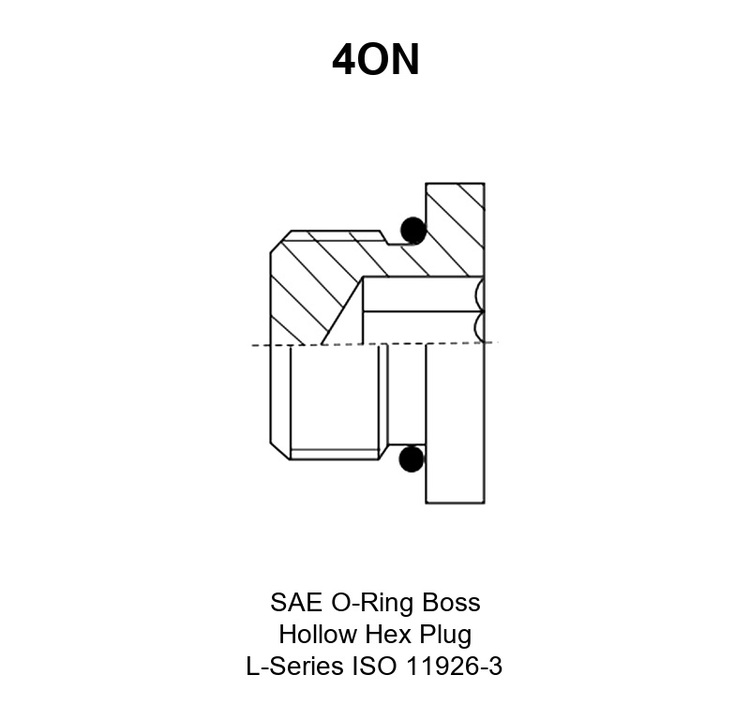
The 4ON hollow hex plug is a SAE O-ring boss blanking plug with a single male stud end made to the light duty L series of ISO 11926-3, and it is driven from an internal hex recess in its closed end rather than from external flats. An O-ring in a groove behind the straight inch thread seals in the port recess, while the thread only clamps the part down. Because the plug has no external hex, it sits low over a SAE straight thread O-ring boss port to ISO 11926-1 and needs only axial access for a hex key.
Core Advantages
- SAE O-ring boss L series stud end to ISO 11926-3 for ports machined to ISO 11926-1 / SAE J1926-1.
- Internal hex drive in the closed end gives a short body and a low profile across the port face.
- O-ring in the stud end groove is the pressure barrier, and the straight thread is only the clamp.
- Eight printed sizes from 7/16″X20 to 1.5/8″X12 in one range, each with its own O-ring code.
- No external hex corners, so the blanked port stays clear of hoses, harnesses and neighbouring parts.
- Carbon steel with trivalent chromium zinc plating, or 304 / 316 stainless steel, with NBR, FKM or EPDM seals.
1. What a 4ON Hollow Hex Plug Does
A 4ON hollow hex plug is a single-ended blanking plug for a SAE straight thread O-ring boss port. Its male stud end is produced to ISO 11926-3, the light duty L series SAE O-ring boss stud end that is also published as SAE J1926-3, and it is designed to enter a port machined to ISO 11926-1, published as SAE J1926-1.
Once the plug is seated, the body terminates the port. This port plug has no second thread, no through bore and no outlet, so it closes a connection instead of continuing it. The only duty of the closed end is to carry the drive feature: a hex recess machined inside the body that a hex key engages to turn the plug into the port.
The sealing principle is the same one used by every straight thread O-ring joint. The O-ring is compressed into the machined recess on the port face and the straight thread pulls the stud end down onto that recess, which is what fixes the squeeze on the elastomer. The thread does not seal anything, and for that reason a thread sealant is never a substitute for the O-ring on a 4ON hollow hex plug. The identical principle is used by the ISO 6149 metric family, the ISO 11926 adapter family and the ISO 1179 BSP family, each with its own thread form and recess dimensions.
The difference between this part and the external hex version of the same SAE O-ring boss plug is the drive. An external hex body needs radial clearance around the port for a wrench to swing, and it adds height above the port face. The 4ON version replaces that with an internal hex, so the body can be short and the assembly stays inside a tight envelope. On a stacked manifold or a compact power unit, that saving in both height and swept space is often the reason this hydraulic plug is specified.
2. 4ON Specifications
2.1 Connection 1 – SAE O-ring boss male stud end, ISO 11926-3 L series
Connection 1 is a SAE straight thread O-ring boss male stud end machined to ISO 11926-3, the light duty L series, which is the same geometry published as SAE J1926-3. The printed range runs from 7/16″X20 through 1/2″X24, 9/16″X18, 3/4″X16, 7/8″X14, 1.1/16″X12, 1.5/16″X12 and 1.5/8″X12.
The thread is a straight inch thread with the pitch printed as threads per inch, and it is not a tapered pipe thread. Behind the thread, the stud end carries a groove that holds an O-ring, listed row by row in the printed chart as O904 through O920. The O-ring is the sealing element of the joint, and the stud length printed as A positions that O-ring in the port recess when the plug is seated.
The mating port is a SAE straight thread O-ring boss port to ISO 11926-1, published as SAE J1926-1. That ISO 11926 adapter port provides a straight thread and a machined recess on the face, and the recess has to be undamaged for the joint to seal. The port family is what fixes the part family: an ISO 11926 port takes an ISO 11926 stud end, and a metric or G port takes its own.
2.2 Connection 2 – Closed end with internal hex drive
Connection 2 is a closed end, not a port. The body ends shortly after the stud end and this port plug has no second connection of any kind, so it cannot join two lines and contributes nothing to flow.
The drive feature is an internal hex recess machined into that closed end, printed in the chart as S1. The figures run from 5 mm at the two smallest sizes to 19 mm at the largest printed row, so the recess grows with the thread and the key size stays proportionate to the tightening load. A hex key that fills the recess distributes the turning force across the full width across flats, which is what protects the drive from rounding out.
This internal drive is the whole reason the part is shorter than an external hex plug of the same port size. With no flats on the outside of the body, the wall thickness between the stud end and the drive becomes the governing dimension, and the overall length L printed in the chart reflects that.
2.3 Construction and Materials
The plug is machined from bar stock on CNC lathes as one piece. The stud end is turned to the L series profile, the O-ring groove is cut to the standard position behind the thread, the internal hex recess is formed in the closed end, and the inch thread is produced to the printed designation. Thread gauges and dimensional checks are applied batch by batch against the drawing before the parts are packed, which is the standard discipline for a SAE adapter stud end produced to a published standard.
Body material options are carbon steel, 304 stainless steel, 316 stainless steel and brass. Carbon steel is the general hydraulic choice and is supplied with trivalent chromium zinc plating; zinc-nickel plating is available where a higher corrosion class is required. Stainless steel bodies are normally supplied unplated for marine, offshore and process duty.
Seal material options are NBR for mineral hydraulic oil, FKM for higher temperature and aggressive fluids, and EPDM for water, steam and many brake fluid applications. Since the O-ring on the stud end is the only pressure barrier, the compound has to be chosen for the fluid and the temperature before the part number is fixed.
2.4 Pressure and Temperature
The printed dimension chart for this series has no pressure column and no per-size pressure rating is printed. Working pressure for these sizes is confirmed per order by HENGHUA engineering, based on the thread size, sealing method and material selected. The service pressure of the machine must also remain inside the pressure class of the light duty boss port that the plug closes.
Temperature capability is a property of the seal material. NBR covers approximately -30°C to +100°C, FKM covers approximately -20°C to +200°C, and EPDM covers approximately -40°C to +120°C. Carbon steel with zinc plating suits general hydraulic service, and 304 or 316 stainless steel is selected where the environment is corrosive.
One installation factor sits alongside the material limits. The internal hex must be turned with a key that fits properly, because a loose key concentrates the load on the corners of the recess and can damage the drive before the plug reaches its seat.
2.5 Part Number and Dimension Table
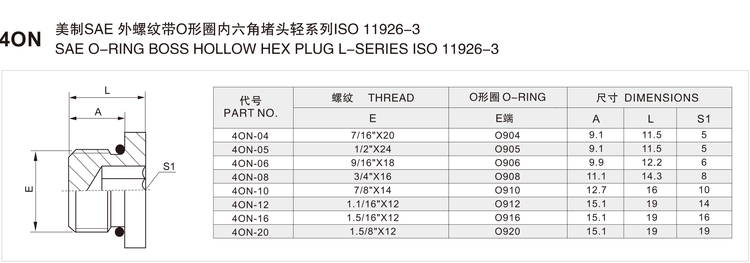
The table below is reproduced from the printed dimension chart for this series.
| PART NO. | E | O-RING E | A | L | S1 |
|---|---|---|---|---|---|
| 4ON-04 | 7/16″X20 | O904 | 9.1 | 11.5 | 5 |
| 4ON-05 | 1/2″X24 | O905 | 9.1 | 11.5 | 5 |
| 4ON-06 | 9/16″X18 | O906 | 9.9 | 12.2 | 6 |
| 4ON-08 | 3/4″X16 | O908 | 11.1 | 14.3 | 8 |
| 4ON-10 | 7/8″X14 | O910 | 12.7 | 16 | 10 |
| 4ON-12 | 1.1/16″X12 | O912 | 15.1 | 19 | 14 |
| 4ON-16 | 1.5/16″X12 | O916 | 15.1 | 19 | 16 |
| 4ON-20 | 1.5/8″X12 | O920 | 15.1 | 19 | 19 |
What each column means:
- PART NO. – the full part number to quote, built from the 4ON prefix and the dash size code.
- E – connection 1, the SAE straight thread O-ring boss stud end, printed as nominal size and threads per inch, for example 3/4″X16.
- O-RING E – the O-ring that belongs on the E end of that row, printed as the O-ring code O904 through O920.
- A – the stud length from the end face of the stud to the body face, in millimetres.
- L – the overall length of the plug, in millimetres.
- S1 – the width across flats of the internal hex drive, in millimetres.
Dash size and thread chart for the printed range:
| Taille des tirets | SAE straight thread | O-ring code | Internal hex S1 (mm) |
|---|---|---|---|
| -04 | 7/16″X20 | O904 | 5 |
| -05 | 1/2″X24 | O905 | 5 |
| -06 | 9/16″X18 | O906 | 6 |
| -08 | 3/4″X16 | O908 | 8 |
| -10 | 7/8″X14 | O910 | 10 |
| -12 | 1.1/16″X12 | O912 | 14 |
| -16 | 1.5/16″X12 | O916 | 16 |
| -20 | 1.5/8″X12 | O920 | 19 |
3. How to Read a 4ON Hollow Hex Plug Part Number
The part number has two elements. The prefix 4ON identifies the family: a blanking plug with a SAE O-ring boss L series stud end to ISO 11926-3 and an internal hex drive. The dash code that follows identifies the boss size, and the two digits correspond to the SAE dash number rather than to a millimetre value.
Read the printed row 4ON-08 as a worked example. The prefix 4ON places the part in the SAE O-ring boss hollow hex plug range. The dash code 08 gives a stud end thread of 3/4″X16, an O-ring of O908 on that end, a stud length A of 11.1 mm, an overall length L of 14.3 mm and an 8 mm internal hex drive. A buyer blanking a size 8 SAE O-ring boss port can therefore order 4ON-08 and know both the seal code and the key size for this hydraulic plug in advance.
The dash numbering follows the SAE sizing convention, so -04 is a 7/16″ boss, -06 is a 9/16″, -08 is a 3/4″, -10 is a 7/8″ and -12 is a 1.1/16″ boss. The same dash numbers appear across the ISO 11926 adapter family, which makes it straightforward to keep a manifold with mixed boss sizes in one consistent series of part numbers.
Two families sit close to this one and are worth separating at the part number stage. The external hex version of the same SAE O-ring boss plug shares the stud end and the O-ring codes but uses a different prefix and a body hex instead of an internal hex, which is the practical difference between the two SAE adapter plug types. The metric hollow hex plug shares the internal hex concept but uses a metric thread and a different prefix, because its thread form and O-ring are metric.
4. Installation and Fitment
The O-ring is the seal on this series and the thread is only the clamp. That rule decides every step of the installation, because the O-ring forms its seal in the port recess and the thread never carries the sealing duty. A thread sealant, PTFE tape or a bonded washer must never be used in place of the O-ring on this plug.
Assembly steps:
- Confirm the port is a SAE straight thread O-ring boss port to ISO 11926-1 and that the dash size matches the part number on the drawing.
- Clean the port thread and the recess, and remove swarf, old sealant and any remains of the previous O-ring.
- Fit a new O-ring of the correct code and compound into the stud end groove, and check that it is fully seated and not twisted.
- Lubricate the O-ring and the thread lightly with clean system fluid so the elastomer slides into the recess rather than rolling out of the groove.
- Start the plug by hand, keeping it square to the port, and turn it in until it is finger tight.
- Tighten with a hex key that fills the internal recess, and bring the plug down until the body face lands evenly on the port face. Torque is described in words rather than quoted as a number: a key of the correct size is used to seat the plug firmly and steadily, and the body is never forced past the point where the shoulder stops.
Common fitment errors and their symptoms:
- O-ring missing or rolled out of the groove: the port weeps along the thread and further tightening makes no difference.
- Sealant used instead of the O-ring: the plug stops short of full engagement and the joint still leaks, now with sealant debris in the system.
- Undersized or worn hex key: the internal recess rounds at the corners and the drive is damaged before the plug is seated.
- Wrong series or dash size: the stud end enters but the shoulder bottoms early, or the thread feels slack and never holds.
- Damaged port recess: the O-ring has no sound surface to seal against, so seepage appears as soon as the system is pressurised.
The steel body can be reused if the thread, the shoulder and the groove are undamaged, but the O-ring is replaced every time the port plug is removed.
5. Applications and Industries
The 4ON hollow hex plug is used where a SAE O-ring boss port has to be blanked in a space too tight for an external hex. Application tags for the series are hydraulic systems, water jetting, oil and gas, industrial equipment, construction machinery, agriculture, marine and material handling.
Four scenarios set out the range. On a compact hydraulic power unit, several SAE boss ports on the manifold are reserved for options, and the internal hex drive lets the plugs sit inside the envelope of the unit without a spanner swing. On construction machinery, a valve block with unused SAE ports is blanked for shipment, keeping the internal passages clean and the machine ready for an attachment that will use that port later. In industrial equipment, a manifold shared across machine variants is configured by fitting or removing plugs instead of stocking separate castings. In offshore and marine duty, a 316 stainless steel body with an FKM O-ring blanks a boss that sees washdown, salt atmosphere and a wide temperature swing.
The part also suits service work where a gauge or test point is removed from a SAE boss port, which is one of the most common uses of a SAE adapter fitting. The low profile of the internal hex plug keeps the connection clear of the hose runs that often pass directly over a manifold face.
6. Replacement and Cross-Reference Guide
Cross-reference for this series is organised by standard and sealing method, never by brand. A replacement 4ON hollow hex plug is the part whose thread, seal type and seat geometry match the port being closed, and those three facts are established by measurement rather than by comparison to any catalogue brand.
Measure these three things:
- The thread. Measure the stud end outside diameter and count the threads per inch, or read the dash size from the port drawing. A 3/4″X16 marking is a size 8 SAE straight thread, and the pitch of 16 threads per inch distinguishes it from metric and G threads of a similar nominal diameter.
- The seal. Confirm that the port face has a machined recess and that the part carries an O-ring in a groove behind the thread. Match the O-ring code printed for that row, O904 through O920, to the port series.
- The seat and the drive. Check the stud length A and the overall length L against the port depth, and confirm the internal hex S1 so the correct key is available for installation and removal.
Two cross-reference rules matter in this family. First, the light duty and heavy duty SAE boss stud ends are different parts: ISO 11926-3 is the light duty series used here, and a heavy duty SAE boss stud end has a longer stud and a different groove position, so the two are not interchangeable in the same port. Second, an ISO 11926 SAE O-ring boss plug will not seal an ISO 6149 metric port or an ISO 1179 G port, because the thread form, the pitch and the recess all differ. Match the standard before matching the size.
There is also a practical difference to note when replacing an external hex plug with this version, or the reverse. The stud end and the O-ring are the same, so the sealed connection is unchanged, but the tightening method and the clearance around the port are not. If the port has to be accessed from the side only, the external hex version is the correct choice; if the port is reached from directly above, the internal hex version is.
7. Ordering, Packaging and Delivery
To order a 4ON hollow hex plug, quote the series code, the full part number, the thread size, the seal material, the body material and plating, and the quantity. A complete line reads: series 4ON, part number 4ON-08, thread 3/4″X16, NBR O-ring, carbon steel with trivalent chromium zinc plating, quantity required. Where the port comes from a drawing, attach it so the stud length and the internal hex are confirmed against the print.
Packaging is arranged for both routes to market. Distributor orders ship in labelled cartons with the part number and the dash size on the outside, so a box can go straight onto a shelf or into a bin. Direct-to-line OEM orders ship in the sequence the customer consumes them, so the parts can be issued to assembly without re-sorting.
Samples are available for validation and are produced with the same body material and seal compound as the intended production order. Lead time is confirmed per order and stated on the order acknowledgement, because the material, the plating and the seal compound each affect the schedule.
8. FAQ
What is the difference between a straight-thread O-ring seal and a tapered pipe thread?
A SAE O-ring boss joint, such as the port closed by a 4ON hollow hex plug, seals on an O-ring compressed in a machined recess on the port face, and the straight thread only clamps the stud end against that recess. A tapered pipe thread seals by interference between the thread flanks and relies on a sealant. The two need different port preparations, and a straight thread boss can never be sealed by wrapping the thread.
Can BSP and NPT be interchanged?
No. G (BSPP) threads to ISO 228-1 and NPT threads have different thread forms, flank angles and pitches, so they will not seal against one another at the same nominal size. The same rule applies between the O-ring families: a SAE ISO 11926 boss port takes a SAE O-ring boss stud end, a metric ISO 6149 port takes a metric stud end, and a G ISO 1179 port takes a G stud end. Always decide from the thread designation, not from the nominal diameter.
How do I identify the correct 4ON size?
Read the dash size from the port drawing or measure the stud end outside diameter and count the threads per inch, then match the pair to the E column of the printed chart. Confirm the port has a recessed O-ring seat, which identifies a SAE O-ring boss port. Then read across the row for the O-ring code, the stud length A, the overall length L and the internal hex S1.
What seal material should I select for my fluid and temperature?
NBR is the default for mineral hydraulic oil and covers approximately -30°C to +100°C. FKM covers approximately -20°C to +200°C and many aggressive fluids, which suits high temperature duty. EPDM covers approximately -40°C to +120°C and is used with water, steam and many brake fluids, but it is not compatible with mineral oil. On this series the O-ring is the seal, so this decision governs the joint.
How is the working pressure of this fitting determined?
The printed chart carries no pressure column and no per-size rating is printed for this series. Working pressure for these sizes is confirmed per order by HENGHUA engineering, based on the thread size, sealing method and material selected. The service pressure must also stay within the pressure class of the light duty port being blanked.
What is the minimum order quantity and can I get samples?
Minimum order quantity is confirmed per part number and material combination with the quotation. Samples are available for validation, and they are produced with the same material and seal compound as the production order so the validation carries over. Include the part number, the material and the seal choice with the sample request.
Do I need a special tool for the internal hex?
No. A standard hex key of the width across flats printed in the S1 column fits the drive. The key must fill the recess properly, because an undersized or worn key concentrates the load on the corners of the hex and can damage the drive. Sizes in this range take a 5 mm key at the two smallest rows and up to a 19 mm key at the largest printed row.
Is a 4ON hollow hex plug interchangeable with the external hex plug of the same series?
The sealed connection is the same, because both use the ISO 11926-3 stud end, the same thread and the same O-ring code for a given dash size. What differs is the drive and the clearance needed. The 4ON version is turned with a hex key from directly above the port and leaves no external hex, while the external hex version needs radial room for a wrench. Choose the hydraulic plug version according to the access around the port, not the sealing performance.
HENGHUA manufactures the 4ON hollow hex plug range in SAE O-ring boss L series ISO 11926-3 geometry, from 7/16″X20 to 1.5/8″X12, with carbon steel, stainless steel and brass body options and NBR, FKM or EPDM seals. Send the dash size, the material, the seal compound and the quantity you need, and we will confirm the part number and the lead time for your programme.
Related series in the same family: the 4O plug and the 10-OG plug. Browse the full Hydraulic Adapters range for the complete ISO 1179 BSP, ISO 6149 metric, ISO 11926-3 SAE O-ring boss and SAE J513 cone families.

 English
  Spanish
  Portuguese
  French
  German
  Arabic
  Russian