
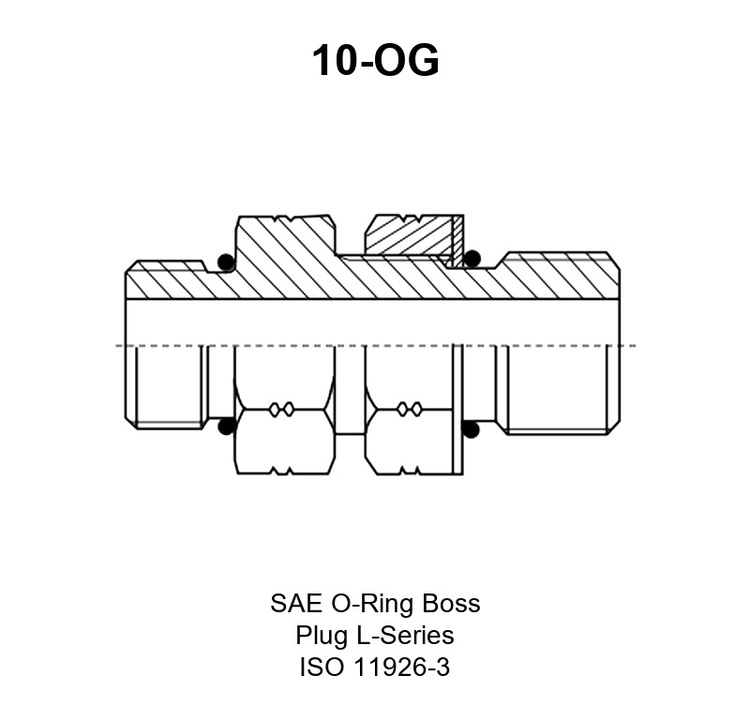
The 10-OG plug is a double-ended SAE O-ring boss plug made to the light duty L series stud end of ISO 11926-3, the same stud end published as SAE J1926-3. Unlike a single-ended blanking plug, the part carries two O-ring sealed stud ends, printed as the E end and the F end, and two body hexes printed as S1 and S2. It closes two SAE straight thread O-ring boss ports to ISO 11926-1 at the same time, or, used as an ISO 11926 adapter, it joins a size 04 port to a size 06 port where the part number carries two size codes.
Core Advantages
- Two SAE O-ring boss L series stud ends to ISO 11926-3 in one part, E and F, each sealed by its own O-ring.
- Straight sizes and reducing sizes in one printed range, from a size 04 to size 04 plug up to a size 24 to size 24 plug.
- Two body hexes S1 and S2, so each end is tightened independently and each stud length A and B is set for its own port.
- O-ring in the stud end groove seals in the port recess while the straight inch thread clamps only.
- Carbon steel with trivalent chromium zinc plating, or 304 / 316 stainless steel for corrosive duty.
- NBR, FKM and EPDM seal options, selectable per end where the two ports see different fluids.
1. What a 10-OG Plug Does
A 10-OG plug is a double-ended SAE O-ring boss part. It has a male stud end at each side, both machined to ISO 11926-3, the light duty L series SAE O-ring boss stud end, and both made to enter a port machined to ISO 11926-1, the SAE straight thread O-ring boss port. One part therefore closes or connects two boss ports at once, so it works both as a port plug and as a short link between two ISO 11926 adapter ports.
Two build patterns appear in the printed chart. The single-code rows such as 10-040G carry the same size at both ends, so the part blanks two ports of the same size, and it can be used as a through connector between two identical boss ports. The two-code rows such as 10-04-060G carry a different size at each end and act as a reducing connection between two boss ports of different sizes.
The 10-OG plug seals on the same principle as every other straight thread O-ring joint. Each stud end has an O-ring in a groove behind the thread, the O-ring is compressed in the machined recess on the mating port face, and the straight thread pulls the stud end down onto that recess. The thread does not seal anything on either end. This is why a thread sealant is never a substitute for an O-ring on a SAE adapter or plug of this family, and why both O-rings have to be present for the part to hold two ports closed.
The body hexes printed as S1 and S2 sit between the two stud ends. Having two hexes means each end can be tightened without loading the other end, and it means a different wrench is used at each side on most rows.
2. 10-OG Specifications
2.1 Connection 1 – SAE O-ring boss male stud end E, ISO 11926-3 L series
Connection 1 is the E end, a SAE straight thread O-ring boss male stud end machined to ISO 11926-3, the light duty L series published also as SAE J1926-3. The printed size range on the E end runs from 7/16″X20 through 9/16″X18, 3/4″X16, 7/8″X14, 1.1/16″X12, 1.5/16″X12, 1.5/8″X12 and 1.7/8″X12.
The thread is a straight inch thread with the pitch printed as threads per inch, not a tapered pipe thread. The sealing element is an O-ring held in a groove behind the thread and listed row by row in the printed chart as O904 through O924. The stud length printed as A fixes how far the E end enters its port, and therefore the position of the O-ring inside the port recess.
The mating port for the E end is a SAE straight thread O-ring boss port to ISO 11926-1, published as SAE J1926-1. The recess on that port face is what receives the O-ring, so the port family and the stud end family must match.
2.2 Connection 2 – SAE O-ring boss male stud end F, ISO 11926-3 L series
Connection 2 is the F end, and it is a second SAE straight thread O-ring boss male stud end to the same ISO 11926-3 light duty standard. It is a real stud end, not a closed end, and it carries its own O-ring in its own groove, printed in the chart as O904 through O924. The stud length printed as B fixes how far the F end enters its port.
On a single-code row, the F end is the same thread size as the E end, so 10-040G has a 7/16″X20 stud at both sides with an O904 O-ring at each end. On a two-code row, the F end is smaller or larger than the E end, so 10-04-060G pairs a 7/16″X20 E end with an O904 O-ring to a 9/16″X18 F end with an O906 O-ring.
Because both ends are stud ends, this hydraulic plug is symmetric in principle and asymmetric in detail. The stud lengths A and B differ on most rows, so the part has a defined E end and a defined F end.
2.3 Construction and Materials
The 10-OG plug is machined from a single piece of bar stock on CNC lathes. Both stud ends are turned to the L series profile, an O-ring groove is cut to the standard position behind the thread at each end, the two body hexes are milled, and both threads are produced to the printed designation. Thread gauges and dimensional checks are applied batch by batch against the drawing before packing.
Body material options are carbon steel, 304 stainless steel, 316 stainless steel and brass. Carbon steel is the general hydraulic choice and is supplied with trivalent chromium zinc plating; zinc-nickel plating is available where a higher corrosion class is required. Stainless steel bodies are normally supplied unplated for marine, offshore and process service.
Seal material options are NBR, FKM and EPDM, and the choice applies to both O-rings. Where the two ports of a reducing part carry different fluids or different temperatures, state the requirement per end on the inquiry, because the two seals are separate parts in separate grooves. The external hexes are the tightening points on this series; there is no internal drive, and the width across flats printed for S1 and S2 is the wrench size for each end.
2.4 Pressure and Temperature
The printed dimension chart for this series carries no pressure column. Working pressure for these sizes is confirmed per order by HENGHUA engineering, based on the thread size, sealing method and material selected. Because both ends are stud ends, the working pressure of the assembly is governed by the lower rated port of the two that the part connects, and it must stay within the pressure class of the light duty boss ports involved.
Temperature capability follows the O-ring material as a material fact. NBR covers approximately -30°C to +100°C, FKM covers approximately -20°C to +200°C, and EPDM covers approximately -40°C to +120°C. Carbon steel with zinc plating is suitable for general hydraulic service, and 304 or 316 stainless steel is selected where the environment is corrosive.
2.5 Part Number and Dimension Table
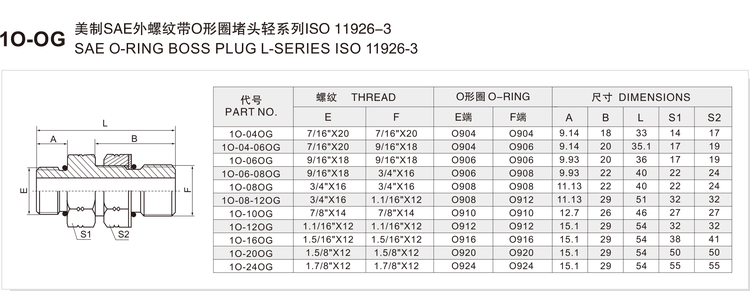
The table below is reproduced from the printed dimension chart for this series.
| PART NO. | E | F | O-RING E | O-RING F | A | B | L | S1 | S2 |
|---|---|---|---|---|---|---|---|---|---|
| 10-040G | 7/16″X20 | 7/16″X20 | O904 | O904 | 9.14 | 18 | 33 | 14 | 17 |
| 10-04-060G | 7/16″X20 | 9/16″X18 | O904 | O906 | 9.14 | 20 | 35.1 | 17 | 19 |
| 10-060G | 9/16″X18 | 9/16″X18 | O906 | O906 | 9.93 | 20 | 36 | 17 | 19 |
| 10-06-080G | 9/16″X18 | 3/4″X16 | O906 | O908 | 9.93 | 22 | 40 | 22 | 24 |
| 10-080G | 3/4″X16 | 3/4″X16 | O908 | O908 | 11.13 | 22 | 40 | 22 | 24 |
| 10-08-120G | 3/4″X16 | 1.1/16″X12 | O908 | O912 | 11.13 | 29 | 51 | 32 | 32 |
| 10-100G | 7/8″X14 | 7/8″X14 | O910 | O910 | 12.7 | 26 | 46 | 27 | 27 |
| 10-120G | 1.1/16″X12 | 1.1/16″X12 | O912 | O912 | 15.1 | 29 | 54 | 32 | 32 |
| 10-160G | 1.5/16″X12 | 1.5/16″X12 | O916 | O916 | 15.1 | 29 | 54 | 38 | 41 |
| 10-200G | 1.5/8″X12 | 1.5/8″X12 | O920 | O920 | 15.1 | 29 | 54 | 50 | 50 |
| 10-240G | 1.7/8″X12 | 1.7/8″X12 | O924 | O924 | 15.1 | 29 | 54 | 55 | 55 |
What each column means:
- PART NO. – the full part number to quote, built from the 10 prefix, one or two size codes and the 0G suffix.
- E – connection 1, the SAE straight thread O-ring boss stud end at the E end, printed as nominal size and threads per inch.
- F – connection 2, the SAE straight thread O-ring boss stud end at the F end, printed in the same form.
- O-RING E – the O-ring that belongs on the E end of that row, printed as the O-ring code O904 through O924.
- O-RING F – the O-ring that belongs on the F end of that row, printed as the same style of code.
- A – the E end stud length, in millimetres.
- B – the F end stud length, in millimetres.
- L – the overall length of the part from end to end, in millimetres.
- S1 – the width across flats of the body hex at the E side, in millimetres.
- S2 – the width across flats of the body hex at the F side, in millimetres.
Dash size and thread chart for the printed range, with the matching O-ring code:
| Size code | SAE straight thread | O-ring code |
|---|---|---|
| 04 | 7/16″X20 | O904 |
| 06 | 9/16″X18 | O906 |
| 08 | 3/4″X16 | O908 |
| 10 | 7/8″X14 | O910 |
| 12 | 1.1/16″X12 | O912 |
| 16 | 1.5/16″X12 | O916 |
| 20 | 1.5/8″X12 | O920 |
| 24 | 1.7/8″X12 | O924 |
3. How to Read a 10-OG Plug Part Number
The 10-OG plug part number is built from four elements: the fixed prefix 10, the first size code, an optional second size code, and the fixed suffix 0G. The printed pattern is 10 + first size code + optional “-” + second size code + 0G.
The first size code is the size of the E end, written as a two-digit SAE dash number, and the second code, when printed, is the size of the F end of this SAE adapter. When only one size code appears, both ends are the same size, so 10-040G is a size 04 plug at both ends. When a second size code appears after a hyphen, the part is a reducing plug, so 10-04-060G is a size 04 at the E end and a size 06 at the F end. The 0G suffix closes every part number in the series and marks the family on the page.
Read the printed row 10-06-080G through the pattern. The prefix 10 places the part in this double-ended range. The first size code 06 gives the E end a stud thread of 9/16″X18 with an O906 O-ring. The second size code 08 gives the F end a stud thread of 3/4″X16 with an O908 O-ring. The row then prints the E end stud length A as 9.93 mm, the F end stud length B as 22 mm, the overall length L as 40 mm and the two body hexes S1 and S2 as 22 mm and 24 mm.
A worked same-size example reads as follows. The row 10-120G has one size code, 12, so both ends are 1.1/16″X12 with an O912 O-ring at each end. The E end stud length A and the F end stud length B both print 29 mm, the overall length L prints 54 mm and both body hexes print 32 mm.
When a two-code part number is written on an order, the first code is always the E end and the second code is always the F end, so the part has a defined orientation.
4. Installation and Fitment
This part closes two ports, so it seals on two O-rings, one at each end, and the threads only clamp. Both ends must be treated as straight thread O-ring joints, and a thread sealant, PTFE tape or a bonded washer must never be used on either end in place of the O-ring. The two ends also have to be brought to their seats in a sequence that does not load the body between them.
Assembly steps:
- Confirm both ports are SAE straight thread O-ring boss ports to ISO 11926-1, and check that the E end and the F end of the part number match the two port sizes.
- Clean both port threads and both recesses, and remove swarf, old sealant and any remains of the previous O-rings.
- Fit new O-rings of the correct code and compound into the groove at each stud end, and check that both are fully seated and not twisted.
- Lubricate both O-rings and both threads lightly with clean system fluid, so each elastomer slides into its recess instead of rolling.
- Start the port plug by hand into the first port, keeping it square, and turn it in until it is finger tight. Then start the second end into its port in the same way.
- Tighten each end at its own hex, S1 for the E side and S2 for the F side, bringing the part down until both stud ends are seated and the body sits square to both port faces. Torque is judged in words rather than quoted as a figure: a wrench that fits S1 and S2 is used to seat each end firmly and steadily, with no forcing and no driving of the body past the point where the shoulders stop.
Common fitment errors and their symptoms:
- Only one O-ring fitted: the unsealed end weeps along its thread, and tightening that end makes no difference.
- Sealant used on either end: the stud end stops short of its recess, the shoulder never seats, and the joint leaks.
- Ends fitted the wrong way round on a reducing part: one stud end is too small or too large for its port, so the threads do not engage correctly.
- One end tightened before the other is started: the second thread can cross, and the body is loaded off square.
- Damaged recess in either port: the affected O-ring cannot seal on a scored face, so seepage appears as soon as the system is pressurised.
The steel body may be reused if both threads, both shoulders and both grooves are undamaged, but both O-rings are replaced every time this hydraulic plug is removed and refitted.
5. Applications and Industries
The 10-OG plug is used where two SAE O-ring boss ports have to be closed or connected with one part, Application tags for the series are hydraulic systems, water jetting, oil and gas, industrial equipment, construction machinery, agriculture, marine and material handling.
Three scenarios illustrate the range. In industrial equipment, a manifold with two adjacent SAE boss ports is blanked with a two-code 10-OG plug, so a single part closes both openings and saves the height of two separate plugs in a tight enclosure. In hydraulic power units, a reducing plug pairs two different boss sizes on the same block, avoiding an extra adapter in the stack and one more potential leak path. In marine and oil and gas service, a 316 stainless steel body with an FKM O-ring at each end connects two boss ports on a skid that sees washdown and a wide temperature swing.
The double-ended form also suits test benches and service work where a joint between two machined blocks has to be restored without pulling either block, and this hydraulic plug can be stocked as one line item instead of two.
6. Replacement and Cross-Reference Guide
Cross-reference for this series is organised by standard and sealing method, never by brand. Because this blanking plug has two different ends on most rows, a replacement has to match both ends separately: the E thread and its O-ring, and the F thread and its O-ring.
Measure these three things at each end:
- The thread. Measure the stud end outside diameter and count the threads per inch at both ends, or read both dash sizes from the port drawing. A 9/16″X18 marking is a size 06 SAE straight thread.
- The seal. Confirm that both ports have a machined recess on the face and that the part carries an O-ring in a groove behind each thread. Match the printed O-ring codes, O904 through O924, to the two ends.
- The seat and the hexes. Check the stud lengths A and B against the depths of the two ports, and confirm the body hex widths S1 and S2 so both wrench sizes are available.
Three cross-reference rules apply. First, the light duty and heavy duty SAE boss stud ends are different parts: ISO 11926-3 is the light duty series used here, and a heavy duty SAE boss stud end has a longer stud and a different groove position, so the two are not interchangeable in the same port. Second, a SAE adapter will not seal an ISO 6149 metric port or an ISO 1179 G port, because the thread form, the pitch and the recess differ. Third, a double-ended part suits two ports that are aligned and within reach of the body length printed as L, so check the centre distance between the two ports before ordering a replacement.
When a reducing part is replaced, the orientation matters as much as the size. The first size code is the E end and the second size code is the F end of the ISO 11926 adapter part number, so a 10-04-060G is not interchangeable with a 10-06-040G in a manifold where the two ports are fixed.
7. Ordering, Packaging and Delivery
To order a 10-OG plug, quote the series code, the full part number with both size codes where applicable, the thread at each end, the seal material, the body material and plating, and the quantity. A complete line reads: series 10-OG, part number 10-04-060G, E end 7/16″X20, F end 9/16″X18, NBR O-rings, carbon steel with trivalent chromium zinc plating, quantity required. Add the orientation when the part is a reducing type, and note that the first size code is the E end.
Packaging for this port plug is arranged for both routes to market. Distributor orders ship in labelled cartons with the part number and both size codes on the outside, so a double-ended part can be identified at the shelf without opening the box. Direct-to-line OEM orders ship in the consumption sequence agreed with the customer.
Samples are available for validation and are produced with the same body material and seal compound as the intended production order. Lead time is confirmed per order and stated on the order acknowledgement, because the material, the plating and the seal compound each affect the schedule.
8. FAQ
What is the difference between a straight-thread O-ring seal and a tapered pipe thread?
Both ends of this part are straight thread O-ring joints. The joint seals on an O-ring compressed in a machined recess on the port face, and the straight thread only clamps the stud end down onto that recess. A tapered pipe thread instead seals by interference between the thread flanks and needs a sealant. The two are different port preparations, and a straight thread boss cannot be sealed by wrapping the thread.
Can BSP and NPT be interchanged?
No. G (BSPP) threads to ISO 228-1 and NPT threads differ in thread form, flank angle and pitch, so they will not seal together at the same nominal size. The same rule separates the O-ring families: a SAE ISO 11926 boss port takes a SAE O-ring boss stud end, a metric ISO 6149 port takes a metric stud end, and a G ISO 1179 port takes a G stud end. Decide from the thread designation on the drawing, not the nominal diameter.
How do I identify the correct 10-OG size?
Read the size codes from the part number or from the two port drawings. The first size code is the E end and any second size code is the F end, and each maps to a SAE dash size in the printed chart. Confirm that both ports have a recessed O-ring seat, then read across the row for the two O-ring codes, the stud lengths A and B, the overall length L and the body hexes S1 and S2.
What seal material should I select for my fluid and temperature?
NBR suits mineral hydraulic oil over approximately -30°C to +100°C and is the usual default. FKM covers approximately -20°C to +200°C and many aggressive fluids. EPDM covers approximately -40°C to +120°C and is used with water, steam and many brake fluids, but it is not compatible with mineral oil. Since this part has two independent O-ring seals, the compound can be specified per end when the two ports see different fluids.
How is the working pressure of this fitting determined?
No pressure column is printed for this series and no per-size rating is stated on the page. Working pressure for these sizes is confirmed per order by HENGHUA engineering, based on the thread size, sealing method and material selected. For a double-ended part the assembly is also governed by the lower rated of the two ports it connects, and both must be light duty boss ports of the correct class.
What is the minimum order quantity and can I get samples?
Minimum order quantity is confirmed per part number and material combination with the quotation. Samples are available for validation and are made with the same material and seal compound as the production order, so the validation carries over. Include the full part number with both size codes, the material and the seal choice in the request.
What does the 0G suffix in the part number mean?
The 0G suffix is the fixed family marker that ends every part number in this series. It follows the first size code, or the second size code when the part is a reducing type, so the pattern reads as 10 + first size code + optional second size code + 0G. It is not a size code and does not change with the blanking plug size on the row.
HENGHUA manufactures the 10-OG plug range in SAE O-ring boss L series ISO 11926-3 geometry, with both single-code and reducing size combinations from a size 04 up to a size 24 boss. Send the two port sizes, the material, the seal compound and the quantity you need, and we will confirm the part number and the lead time for your programme.
Related series in the same family: the 4O plug and the 4ON hollow hex plug. Browse the full Hydraulic Adapters range for the complete ISO 1179 BSP, ISO 6149 metric, ISO 11926-3 SAE O-ring boss and SAE J513 cone families.

 English
  Spanish
  Portuguese
  French
  German
  Arabic