goodheart786@gmail.com

A professional multi-line hydraulic hose testing rig connected to an industrial impulse pressure test bench in a high-tech stainless steel laboratory environment.

Complete Guide to Hydraulic Hose Testing: Hydrostatic, Impulse and International Standards (GB/T, ISO, SAE)

What Are the Main Hydraulic Hose Assembly Tests? Hydraulic hose assemblies are primarily validated through four core test methods to ensure safety and performance before deployment in OEM equipment: Test Method Primary Purpose Typical Reference Standard Hydrostatic (Proof) Pressure Test Verify pressure resistance and detect leakage under specified static pressure SAE J343, ISO 6605:2017, GB/T […]
Complete Guide to Hydraulic Hose Testing: Hydrostatic, Impulse and International Standards (GB/T, ISO, SAE) Read More »

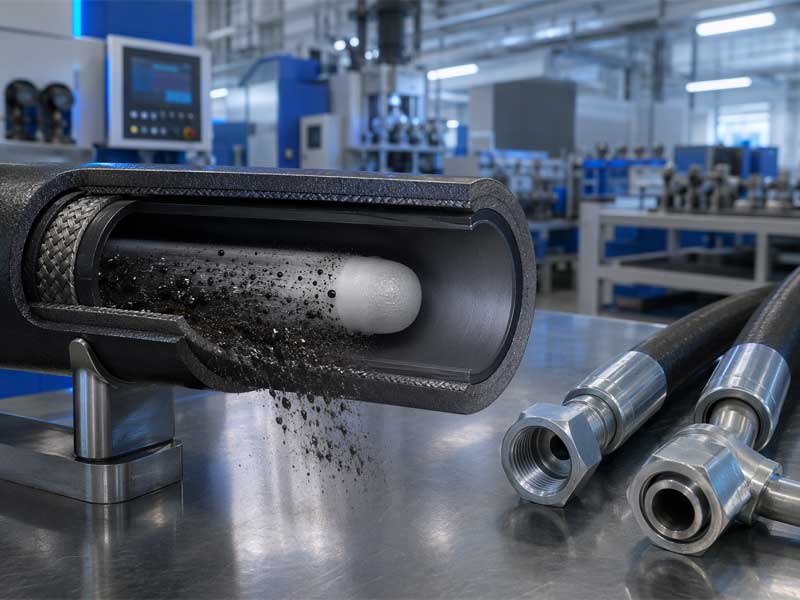
3D cutaway illustration of a hydraulic hose cleaning process using a white foam projectile to remove debris and contamination for ISO cleanliness control.

How to Clean Hydraulic Hose Assemblies: Methods, Procedure & ISO 4406 Guide

How Do You Clean a Hydraulic Hose Assembly Before Installation? A hydraulic hose assembly is cleaned by removing internal contaminants using foam projectile cleaning, fluid flushing, or filtered compressed air. The most effective method is foam projectile cleaning, performed before fitting installation, because it physically wipes the tube wall to remove rubber particles, cutting debris, and manufacturing

How to Clean Hydraulic Hose Assemblies: Methods, Procedure & ISO 4406 Guide Read More »

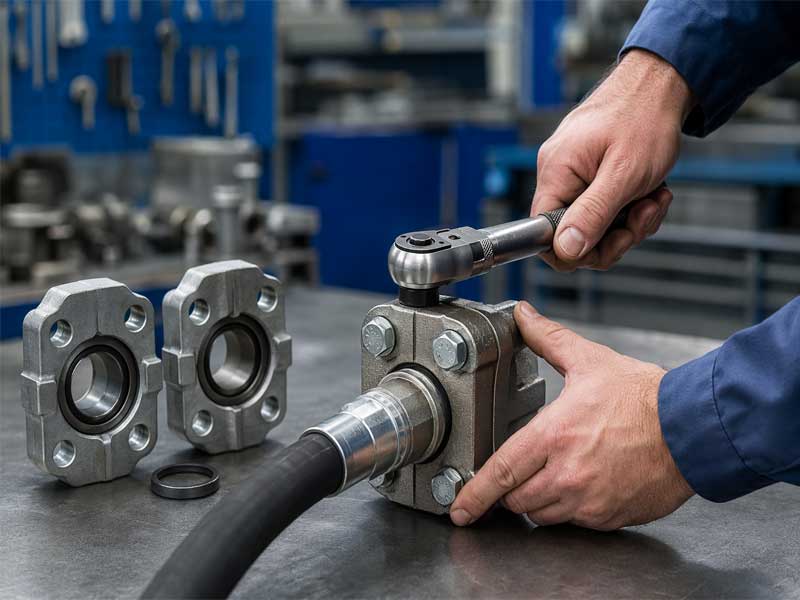
Professional technician installing SAE J518 split flange hydraulic fitting with torque wrench, featuring Code 61 and Code 62 design comparison.

Code 61 vs Code 62 Split Flange Installation Guide: Torque Chart, Procedure & Leak Prevention

How to Install Code 61 and Code 62 Split Flange Hydraulic Fittings Installing Code 61 and Code 62 split flange hydraulic fittings requires five steps: Never mix Code 61 and Code 62 components because their dimensions and pressure ratings are different. 1. What Are Code 61 and Code 62 Split Flanges? Split flange fittings, also

Code 61 vs Code 62 Split Flange Installation Guide: Torque Chart, Procedure & Leak Prevention Read More »

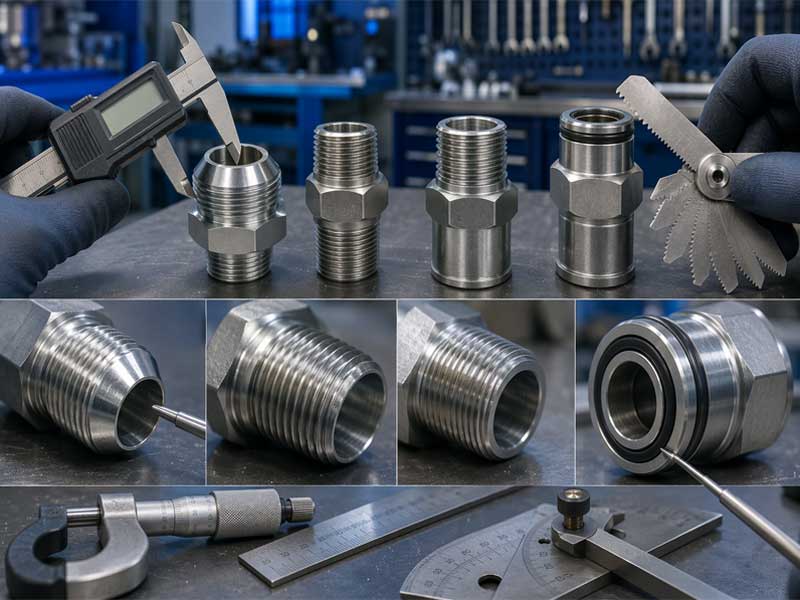
Technical illustration of JIC, NPT, BSPP, and ORFS hydraulic fittings with digital caliper and thread gauge measurement in a professional workshop.

Hydraulic Fitting Thread Identification Guide: How to Identify JIC, NPT, BSPP, and ORFS Fittings

How Do You Identify Hydraulic Fitting Threads? Hydraulic fitting threads are identified by checking four factors: the sealing method (flare, O-ring face seal, or thread seal), the thread shape (tapered or parallel), the thread diameter, and the thread pitch. JIC fittings use a 37° flare, NPT uses tapered 60° threads, BSPP uses parallel 55° threads with

Hydraulic Fitting Thread Identification Guide: How to Identify JIC, NPT, BSPP, and ORFS Fittings Read More »

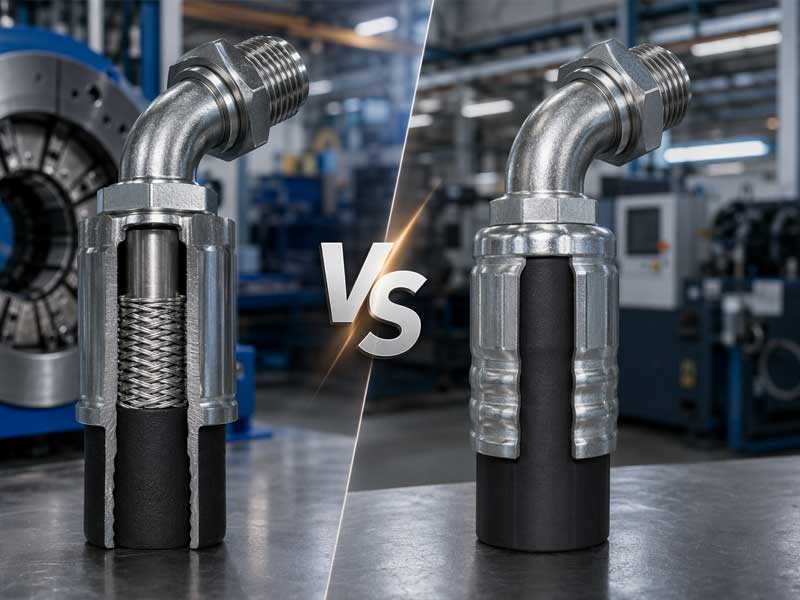
Technical split-screen cross-section comparison between skive and no-skive hydraulic hose fitting assemblies in an industrial manufacturing setting.

Skive vs No-Skive Hydraulic Hose Fittings: Differences, Advantages, Cost & Selection Guide

Skive vs. No-Skive Hydraulic Hoses Skive and no-skive hydraulic hoses differ mainly in how the fitting grips the hose reinforcement. No-skive fittings are faster to assemble because the hose cover remains intact and no skiving step is required. They are ideal for low and medium-pressure applications. Skive fittings remove part of the hose cover to expose the reinforcement wire,

Skive vs No-Skive Hydraulic Hose Fittings: Differences, Advantages, Cost & Selection Guide Read More »

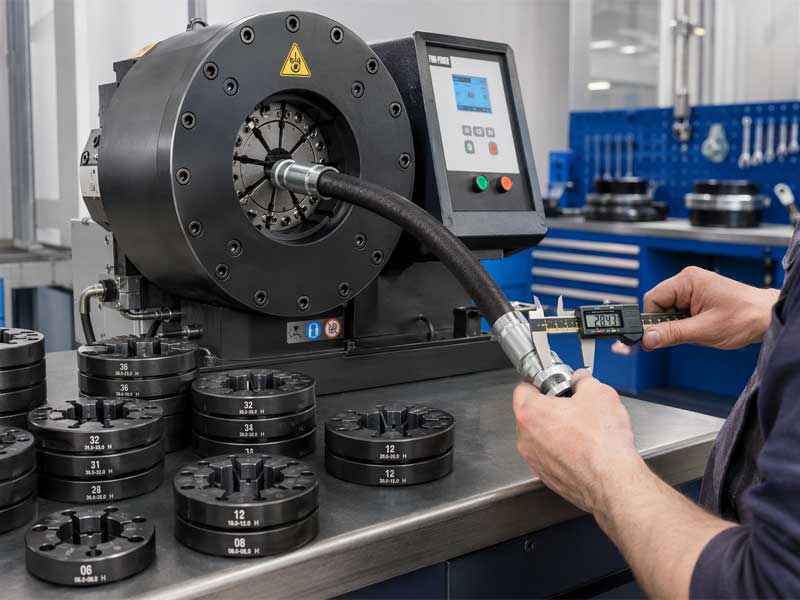
Professional hydraulic hose crimper machine with interchangeable die sets and digital caliper measurement on a metal workshop table.

Hydraulic Hose Crimper Die Size Chart: Crimp Diameter Chart & How to Select the Correct Die

What Size Hydraulic Hose Crimper Die Do I Need? The correct hydraulic hose crimper die size is determined by: A hydraulic hose die size is NOT equal to hose inside diameter. Always select dies according to the specified finished crimp diameter, not the hose ID alone. Verify the final crimp diameter using a calibrated caliper. The Golden

Hydraulic Hose Crimper Die Size Chart: Crimp Diameter Chart & How to Select the Correct Die Read More »

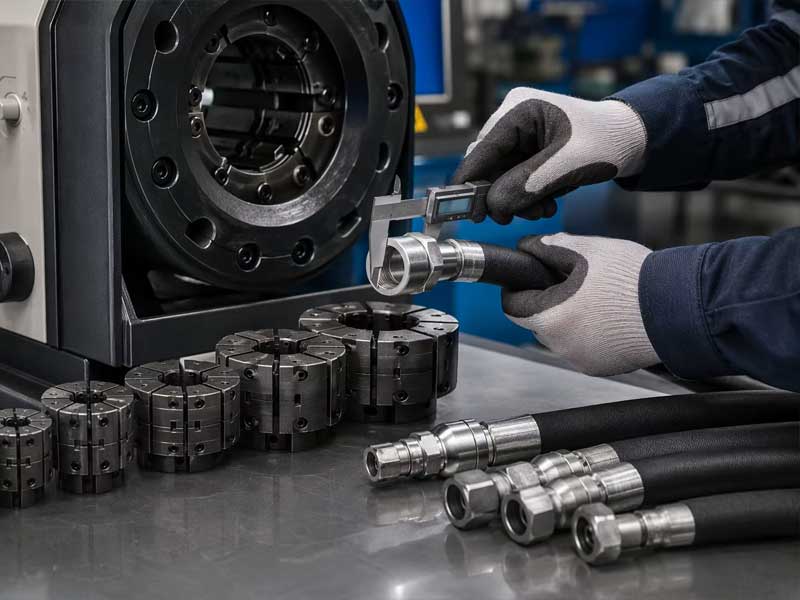
Professional engineer measuring hydraulic hose fitting diameter with digital caliper near various precision crimping die sets in a modern workshop.

Hydraulic Hose Crimper Die Selection Guide | Size Chart & Tips

How Do You Select a Hydraulic Hose Crimper Die? Selecting the correct hydraulic hose crimper die requires matching three factors: the hose inner diameter (ID) and construction type (e.g., 1-wire braid, 4-spiral), the fitting manufacturer’s specified finished crimp diameter, and the compatibility with your specific crimper model. The die size is not chosen by the hose ID alone; you

Hydraulic Hose Crimper Die Selection Guide | Size Chart & Tips Read More »

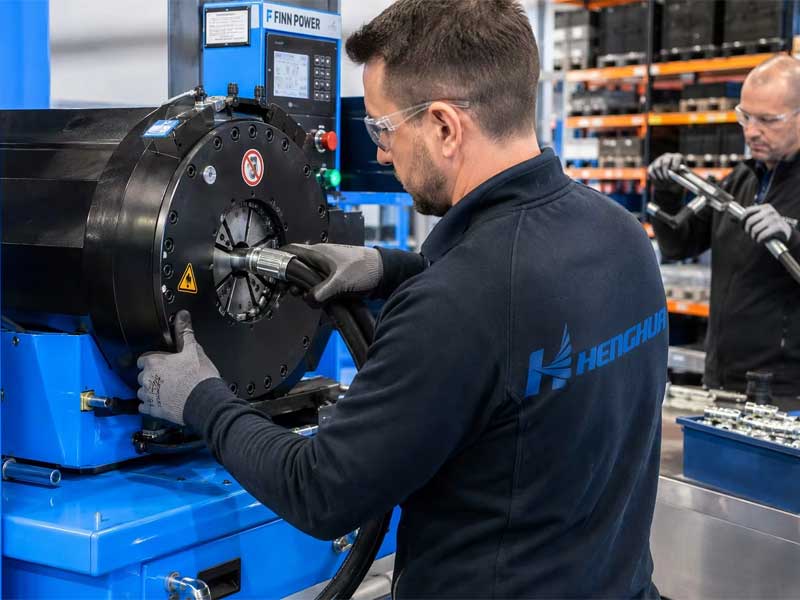
Professional engineer operating a high-precision hydraulic hose crimping machine in a modern manufacturing facility with clean, organized component shelves.

Guía para el prensado de conjuntos de mangueras hidráulicas: selección de racores, proceso de prensado, normas de ensayo y configuración del taller

Hydraulic hose assembly crimping is a cold-forming process that uses radial compression to permanently attach a metal ferrule to a hose end, creating a pressure-rated, leak-proof connection for hydraulic fluid transmission. The process requires precise control of crimp diameter, die selection, and insertion depth—each specific to the hose and fitting combination. A correctly crimped assembly

Guía para el prensado de conjuntos de mangueras hidráulicas: selección de racores, proceso de prensado, normas de ensayo y configuración del taller Read More »

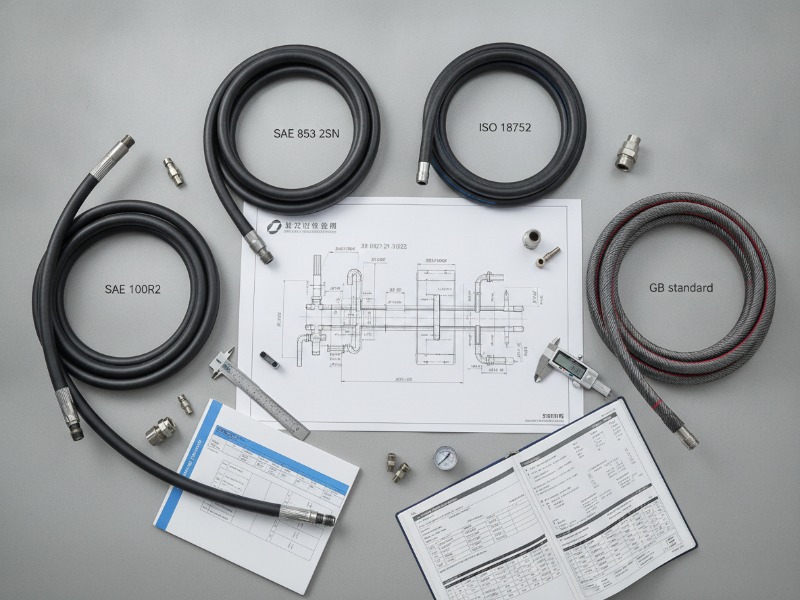
Four coiled black hydraulic hoses (SAE, ISO, GB standards), metal fittings, technical drawings, and measurement tools displayed on a gray engineering workspace.

Hydraulic Hose Standards Comparison Guide: SAE vs DIN vs ISO vs GB

What Are the Major Hydraulic Hose Standards? The four major hydraulic hose standards are SAE J517, DIN EN 853/856, ISO 18752, and GB/T 3683. For international equipment manufacturers exporting to multiple regions, ISO 18752 is often considered the most globally compatible standard because it eliminates regional specification conflicts and provides a single, performance-based benchmark. Hydraulic Hose Standards

Hydraulic Hose Standards Comparison Guide: SAE vs DIN vs ISO vs GB Read More »

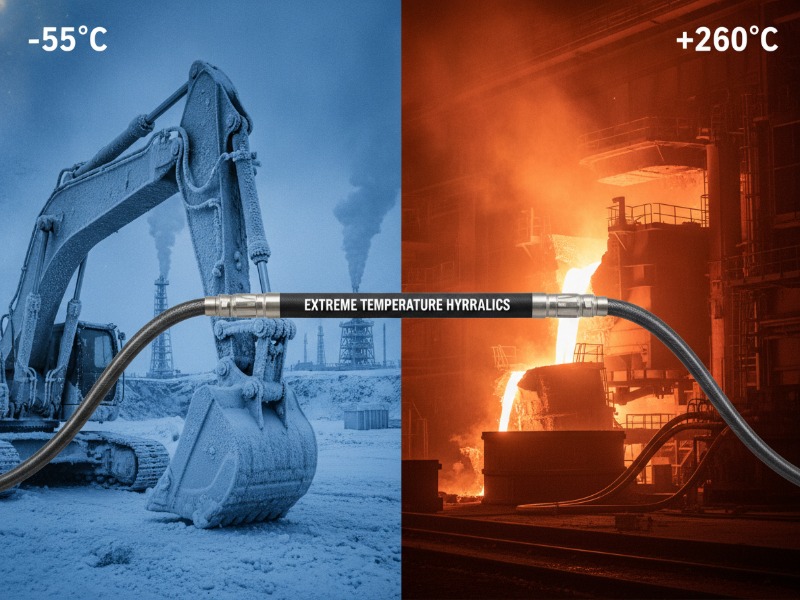
Black industrial hydraulic hose connects a frozen excavator in an arctic -55°C environment to a glowing hot steel mill at +260°C.

Sourcing Hydraulic Hoses for Extreme Temperatures: Low-Temp vs High-Heat Applications

A low-temperature hydraulic hose is designed to remain flexible and crack-resistant below -40°C, while a high-heat hydraulic hose is engineered to resist thermal aging and pressure loss above +100°C. The correct choice depends on the lowest ambient temperature, maximum fluid temperature, pressure rating, and hose material compatibility. Selecting the right hydraulic hose for extreme temperature

Sourcing Hydraulic Hoses for Extreme Temperatures: Low-Temp vs High-Heat Applications Read More »