
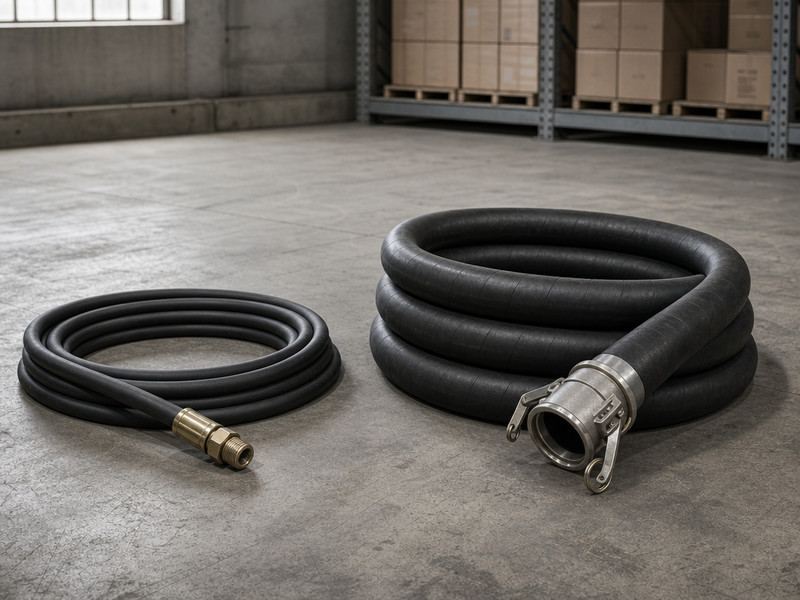
Oil hose vs petroleum hose is not a choice between two competitors; it is a choice between a broad fluid-compatibility category and a narrower transfer duty. The short answer: an oil hose is defined by its tube material, while a petroleum hose is defined by the duty it performs. An oil hose is any flexible line whose inner tube is compounded to resist oil-based fluids, which is why the same catalogue word covers a 4,000 PSI hydraulic line on an excavator and a 150 PSI tank-truck unloading line.
A petroleum hose is the subset of that family built to move refined petroleum products in bulk, where the tube must also limit permeation, the assembly often has to carry static charge to earth, and the hose is frequently rated for suction as well as delivery. In this guide, oil hose means the family of hoses with an oil resistant tube, and petroleum hose means the bulk-transfer duty; neither term is a synonym for hydraulic hose or fuel hose.
Four factors settle it: the fluid, the way it is moved, the standard that governs the purchase, and whether flammable vapour makes static a hazard. This guide works through all four — materials, pressure and temperature limits, use cases, bonding and standards — and closes with five questions that select the right hose in one pass.
1. What Is the Actual Difference Between an Oil Hose and a Petroleum Hose?
The distinction decides which specification you write: a materials specification for anything that circulates oil inside a closed circuit, and a duty specification for anything that moves product between storage points. The oil hose category is set by the tube compound, because the tube is the layer that decides whether mineral oil, diesel or lubricating oil will swell, soften or contaminate the fluid inside it. The petroleum hose category is set by the duty, because moving refined product in bulk adds requirements that have nothing to do with oil resistance on its own: permeation control, electrical continuity, suction capability and large bore.
That single distinction explains most of the confusion in this market. Every petroleum hose is an oil hose, because it still needs an oil resistant tube. Far fewer oil hoses are petroleum hoses. A hydraulic power line is the clearest example: it carries mineral oil, it is an oil hose, and no engineer would call it a petroleum hose, because it moves oil inside a closed machine circuit rather than moving product between two storage points.
1.1 Is “petroleum hose” a formal standard term?
No. There is no single standard with that name, and that absence is the reason buyers get conflicting answers from different suppliers. What exists instead is a set of standards written around duties, each of which a petroleum hose may need to satisfy:
- Oil suction and discharge service — EN 1765:2016 and the corresponding international standard ISO 1823 cover rubber hose assemblies for oil suction and discharge, with a stated usable temperature range of -20 °C to 82 °C and nominal bores from 50 mm to 500 mm.
- Fuel-truck delivery — EN 1761 governs rubber hose and hose assemblies for fuel truck delivery, the standard behind tank-truck loading and unloading assemblies.
- 10 bar and 20 bar classes — DIN 20023 sets the German national classes for the same suction and discharge family, commonly specified in Central European and OEM enquiries.
- Marine fuel lines — SAE J1527 and the United States Coast Guard type designations (A1, A2, B1, B2) govern small-craft fuel feed and vent hose, where fire resistance and low permeation are the controlling properties.
- Automotive fuel lines — SAE J30 is the long-standing family for fuel and oil hose on vehicles, covering multiple resistance classes.
- Dispensing assemblies — UL 330 applies to hose and hose assemblies used for dispensing flammable and combustible liquids, and it is the standard behind forecourt dispenser hose.
So “petroleum hose” behaves as a commercial and catalogue category rather than a pressure class, while “oil hose” behaves as both. That is why this comparison is written around duty and materials instead of around a single label. For the wider picture of how the oil hose category is organised, see our oil hose types, applications and selection guide.
1.2 Where the two names overlap in practice
Three situations let either term be used without anyone being wrong, and it helps to recognise them:
- Low-pressure lubricating and hydraulic oil transfer inside a plant, where the fluid is a mineral oil, the pressure stays below a few hundred PSI, and no flammable vapour is present.
- Workshop waste-oil service, such as oil changers and extractors, where the hose is rated for vacuum and the tube compound is the only thing that decides whether the hose survives.
- General industrial supply catalogues, where a supplier may group hydraulic, suction and transfer lines under one “oil hose” heading because the stock buyer searches by fluid rather than by duty.
Low-pressure plant oil transfer, workshop waste-oil service and general industrial catalogue listings all accept an oil resistant hose with an NBR tube, and none of those three duties requires static bonding. The moment the fluid becomes a fuel, the vapour space exists, or the transfer happens between a tank and a vehicle, the duty description takes over and the specification tightens.
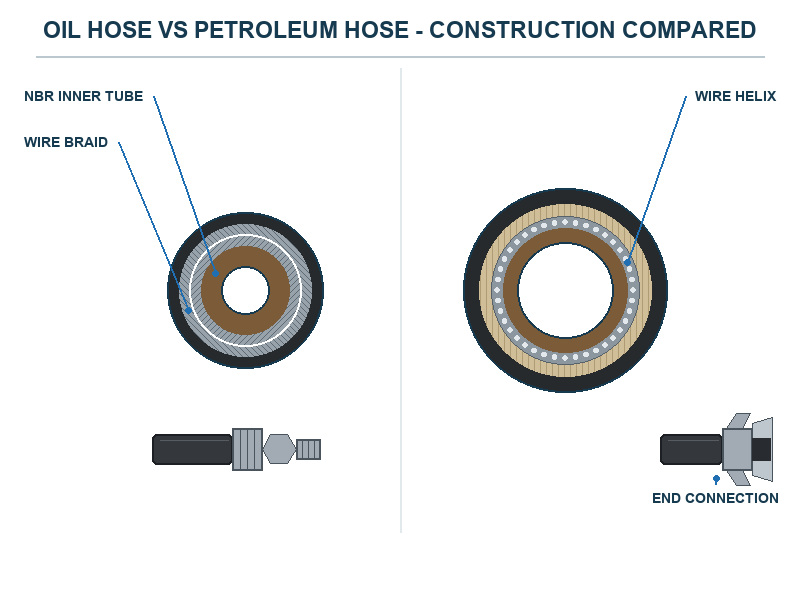
Figure 1. The two categories diverge on bore and pressure rather than on oil resistance: a hydraulic oil hose is small-bore and high-pressure, while a petroleum transfer hose is large-bore and close to atmospheric duty, but both rely on an oil-compatible tube.
Table 1. Oil hose and petroleum hose compared by definition, construction band and governing standard
| Aspect | Oil hose | Petroleum hose |
|---|---|---|
| What defines it | Tube compound compatibility with oil-based fluids | Service duty of moving refined petroleum products in bulk |
| Typical tube | NBR (nitrile), with CR for general service and FKM for hot oil | NBR or conductive NBR, often with a low-permeation barrier |
| Typical reinforcement | Steel wire braid or spiral for pressure; textile braid for return lines | Textile plies plus a wire helix for suction and crush resistance |
| Pressure band | 300 PSI to 6,000 PSI in hydraulic service | 150 PSI to 600 PSI in transfer and suction service |
| Bore range | 3/16 inch to 4 inches (5 mm to 102 mm) | Commonly 3/4 inch to 20 inches (DN 20 to DN 500) |
| Electrical requirement | Not normally required in a closed hydraulic circuit | Continuity or dissipation usually required for flammable product |
| Governing standards | SAE J517, EN 853, EN 856, ISO 1436, ISO 18752, ISO 3862 | EN 1765, ISO 1823, EN 1761, DIN 20023, SAE J1527, SAE J30, UL 330 |
| Example use | Excavator boom circuit, press hydraulic, lube return | Tank-truck unloading, bunkering, forecourt dispensing |
2. Materials: What Each Hose Is Built From and Why It Matters
Materials decide compatibility, and compatibility decides service life. A hose can be perfectly rated for pressure and still fail within weeks if the tube compound is wrong for the fluid, which is why the material conversation comes before the pressure conversation in any serious specification. The table below compares the compounds you will meet in oil and petroleum service.
Table 2. Tube compounds used in oil hose and petroleum hose, with the duty each one fits
| Compound | Oil and fuel resistance | Temperature note | Where it belongs |
|---|---|---|---|
| NBR (nitrile) | Excellent against mineral oil, diesel, lubricating oil and greases | Standard oil hose rating of -40 °C to +125 °C in our range | The default tube for oil hose and most petroleum hose |
| CR (chloroprene) | Good general oil resistance, better ozone and weather resistance | Fits general oil service rather than hot circulating oil | Covers and general-purpose oil lines |
| FKM (fluorocarbon) | Resists hot oil and aggressive additive packages | Takes over where oil runs hotter than about 120 °C | High-temperature and special-media tubes |
| PTFE (polytetrafluoroethylene) and thermoplastics | Chemically inert to a very wide fluid list | Chosen for heat and aggressive fluids rather than cost | Specialty and chemical-adjacent lines |
| EPDM (ethylene propylene diene monomer rubber) | Poor against hydrocarbon oil, which makes it swell and soften | Excellent for water, steam and brake fluid | Water, steam and glycol circuits only |
| Conductive NBR | As NBR, plus a controlled discharge path for static | Same temperature envelope as the base compound | Petroleum transfer where static is a hazard |
2.1 Is “oil resistant” a fixed property, or does it depend on the fluid?
Nitrile butadiene rubber is the standard tube for mineral oils, diesel, gasoline and lubricating oil, and it is what most oil hose and petroleum hose share. The trap is treating oil resistance as a fixed property. Aromatic content in the fluid, additive packages, oxygen exposure and temperature all shift how a given NBR compound behaves, so two hoses that both say “oil resistant” on the layline can perform very differently in the same line.
When the duty is unusual or the fluid is not a plain mineral oil, ask for immersion data instead of a general claim. A product described as an oil resistant hose is only as good as the fluid it was tested against. Volume swell and hardness change from an immersion test are the two numbers that matter. Those measurements are made to recognised methods — ASTM D471 for the effect of liquids on rubber, and ISO 1817 for vulcanised or thermoplastic rubber resistance to liquids — so the data is comparable between suppliers when it is reported properly.
2.2 Why EPDM has no place in an oil line
EPDM is a genuinely good rubber: it handles hot water, steam and brake fluid better than NBR, and it weathers well outdoors. It is also incompatible with petroleum products and mineral oils, and it will swell and soften in contact with them.
A hose that has been upgraded to EPDM because it needed better heat or weather performance will fail in an oil line for a completely different reason. If a line carries hydrocarbon, the tube must be NBR, CR, FKM or a thermoplastic, and EPDM stays in water, steam and glycol service. Our NBR vs EPDM vs FKM inner tube selection guide sets out the full comparison.
2.3 FKM, PTFE and the temperature ceiling
The material choice often changes partway up the temperature scale rather than at the start. Mineral oil at moderate temperature is NBR territory. Once circulating oil runs hotter than about 120 °C, the NBR tube approaches the limit of what it tolerates well and FKM becomes the practical answer, at a higher material cost.
For chemically aggressive or highly aromatic streams, PTFE and thermoplastic constructions take over, because their resistance comes from the polymer backbone rather than from compounding. In our own range, a standard oil hose is rated from -40 °C to +125 °C, high-temperature variants reach +150 °C continuous, and low-temperature compounds hold flexibility down to -55 °C.
2.4 How do the reinforcement and cover differ between the two families?
Materials for the tube converge between the two categories; the load-carrying layers do not:
- Steel wire braid or spiral carries pressure in hydraulic oil hose, up to 6,000 PSI working pressure in our range, and absorbs the pressure cycles that define a hydraulic duty.
- Textile plies plus an embedded wire helix carry the bulk-transfer duty, because a petroleum hose on the suction side of a pump must resist collapse rather than carry high pressure.
- A pin-pricked CR or synthetic rubber cover is standard on oil hose, letting gas that permeates the tube escape instead of blistering the cover.
- Abrasion and ozone resistance sit in the cover, and on petroleum hose the cover also takes the mechanical abuse of being dragged across concrete, grating and dockside edges.
One pattern is consistent in the hoses returned to us for review, and it is rarely a burst. Busted hoses make noise and get investigated; the quiet returns are hoses whose tube swelled, shed particles into the circuit and plugged a filter, or whose cover cracked and exposed the reinforcement. Both failure patterns trace back to a material decision rather than a pressure decision.
2.5 Which tube compound handles high-aromatic fuels and biofuel blends?
NBR is a family of compounds, and the acrylonitrile (ACN) content is the dial that sets aromatic resistance. Diesel, fuel oil and lubricating oil sit at the low-aromatic end, where a standard NBR tube is the right answer and the lowest-cost one. Gasoline, high-aromatic solvents and rising biodiesel or ethanol blends move the fluid to the high-aromatic end, where a higher-ACN compound or a barrier construction carries the duty instead.
Oil hose material recommendations are only valid against a named fluid. The family name on the cover will not tell you which compound you have, so the question to put to any supplier stays the same: give me the immersion result for this fluid at this temperature, rather than a general statement of oil resistance.
3. Oil Hose vs Petroleum Hose: Pressure, Temperature and Size Compared
The two categories sit at opposite ends of the pressure scale, and that single fact drives most of the hardware differences. A hydraulic oil hose is small-bore and high-pressure because it transmits force through a closed circuit, while a petroleum hose is large-bore and low-pressure because its job is to move volume into and out of storage. Materials converge between the two; geometry does not.
Table 3. Oil hose and petroleum hose compared by working pressure, temperature, bore and end connections
| Property | Oil hose in hydraulic service | Petroleum hose in transfer service |
|---|---|---|
| Working pressure | 2,250 PSI for a 3/8 inch SAE 100R1 line, 4,000 PSI for 100R2, and 4,000 to 6,000 PSI for spiral constructions | 150 PSI for tank-truck oil service, 300 PSI for fuel suction and discharge, up to 600 PSI for petrol suction |
| System temperature | -40 °C to +125 °C standard, +150 °C for high-temperature variants, -55 °C for low-temperature compounds | -20 °C to +82 °C for EN 1765:2016 oil suction and discharge assemblies, -20 °C to +80 °C for ISO 1823 |
| Bore range | 3/16 inch to 4 inches (5 mm to 102 mm) | Nominal bore 50 mm to 500 mm under EN 1765, with smaller transfer sizes from 3/4 inch |
| Vacuum duty | Closed circuits only, which stay above atmospheric pressure, so vacuum capability sits outside the hydraulic specification | Required on the suction leg, which is why a wire helix is built into the wall |
| End connections | Crimped fittings to JIC, ORFS, BSP, metric or SAE flange | Camlock couplings, flanges, hammer unions and threaded adapters |
| Typical failure if misapplied | Collapse or kinking on a suction leg; hose too stiff to route | Tube swelling from the wrong compound; fitting pull-off at pressure |
3.1 Why the pressure ratings differ so much
A hydraulic circuit converts pressure into force, so the hose wall has to contain several thousand PSI continuously and survive pressure spikes on top of that. The reinforcement is therefore steel: wire braid for the lower pressure classes and spiral-wound wire for the higher ones, with impulse testing that confirms hundreds of thousands of pressure cycles before release. A transfer hose never sees those loads, so its wall is optimised for a different problem — holding a vacuum without collapsing and resisting crushing when a truck rolls over it, which is what the embedded helix does.
Reading across an oil hose vs petroleum hose comparison, the practical consequence is that you cannot substitute one for the other on the strength of the tube compound alone. A petroleum transfer hose with excellent NBR chemistry will still fail on a 4,000 PSI hydraulic circuit, and a hydraulic oil hose will collapse on the suction leg of a fuel transfer pump. Our oil hose working pressure vs burst pressure guide explains how to read the two pressure ratings before ordering.
3.2 Temperature limits come from the standard, not from the compound
Compound chemistry sets what the rubber can survive, and the standard sets what the manufacturer is allowed to claim. That is why a hydraulic oil hose built to SAE J517 or EN 853 is commonly rated from -40 °C to +125 °C in a standard construction, while an EN 1765:2016 petroleum hose is stated for -20 °C to +82 °C. The petroleum figure is not a materials limit; it is the envelope the standard declares as usable for oil suction and discharge assemblies, and it reflects the fluids and climates that service normally involves.
The practical test is to compare the standard on the layline with the worst-case temperature at the point of use, not the average. Hot oil returning from a machine can run far above ambient air temperature, and a hose sitting on a dock in direct sun can exceed the ambient reading by a wide margin.
3.3 Will a pressure-rated hose work on the suction side of a pump?
Suction is where most wrong-hose purchases land, because a suction line looks like a simple hose until it is commissioned. Select for these three conditions:
- The line is on the inlet side of a pump, so the internal pressure drops below atmospheric and the hose must resist collapse.
- The hose can be drained and left open to atmosphere, which lets it flatten under its own weight and kink at the bends.
- The line handles large solids or high viscosity product, which adds crushing and handling loads in the field.
A helix-reinforced suction hose meets all three conditions above: it resists collapse, it does not flatten when drained, and it tolerates crushing in the field. A braided pressure hose is built for the discharge side only, so it belongs on the outlet rather than the inlet, and it will look perfectly serviceable on the shelf.
3.4 What happens to the pump when a suction hose collapses?
A collapsed suction hose damages the pump, not the hose. Restriction on the inlet raises the pressure drop across the line, the inlet pressure falls below the fluid’s vapour pressure, and the pump draws vapour instead of liquid, a condition called cavitation. Those bubbles collapse against the impeller and casing, and each collapse erodes metal. The hose still looks serviceable; the damage lands somewhere expensive.
Two checks prevent it: confirm the hose is rated for full vacuum at the bore you are ordering, and confirm the helix reaches the fittings. A helix that stops short of the coupling leaves the weakest point exactly where the bend is tightest.
4. Where an Oil Hose Is the Right Choice
Choose an oil hose when oil is circulating inside a machine rather than moving between storage points. The duty is defined by pressure, impulse cycles and routing, and the fluid is usually mineral hydraulic oil, lubricating oil or a light lubricant that never sees a vapour space. In those conditions the oil hose bill of materials is complete without permeation controls or static bonding.
Typical duties in this group:
- Hydraulic power lines on mobile equipment, where excavators, loaders and cranes run 2,250 to 6,000 PSI at high cycle counts.
- Machine-tool and press circuits, including injection moulding machines where the hose is short, hot and cycled continuously.
- Lubrication and grease lines, where high pressure is needed to force lubricant through a centralised system.
- Oil return and oil cooler lines, where textile braid carries 250 to 500 PSI and the tube still has to tolerate hot oil.
- Engine and transmission oil circuits on vehicles and stationary plant, where tight bend radius matters more than ultimate pressure.
For the pressure classes, standards and construction options behind those duties, our SAE 100R hydraulic hose standards guide covers the full series in one place.
What we see across the machines we supply is that the oil hose failures that reach a warranty conversation are rarely caused by the pressure rating. They are caused by routing: a bend below the minimum radius, a hose clamped hard against a hot manifold, or a line sized too small so the oil runs hot for its whole life. Those are installation decisions, not material decisions, and they cost less to correct before commissioning than after.
5. Where a Petroleum Hose Is the Right Choice
Choose a petroleum hose when the duty involves flammable product, bulk volume, a suction leg or a regulated transfer point. The duty adds three requirements on top of oil resistance: permeation control so the tube does not shed vapour or lose product, electrical continuity so static charge does not build up, and a construction that survives being handled in the open rather than bolted permanently into a machine.
Duties that fall to the petroleum hose family:
- Tank-truck loading and unloading, where a tank truck oil hose rated to 150 PSI runs at oil service and is handled several times a day.
- Terminal and depot transfer, including loading arms and pump discharge lines moving diesel, heating oil and fuel oil.
- Marine bunkering and dock transfer, where a large-bore dock oil transfer bunkering hose runs through a bonded connection between ship and shore.
- Forecourt dispensing, where the dispenser assembly is governed by a flammable-liquid standard and is checked for electrical continuity.
- Oilfield service, where fuel discharge hose feeds generating and fracturing equipment at pressures up to about 400 PSI.
- Suction duty on tank farms, where the hose must hold vacuum while draining tanks or filling road tankers.
The catalogue of duties above is the reason the petroleum hose family splits further at the point of sale. A tank-truck line, a bunkering line and a dispenser line all share an oil resistant tube, and they share almost nothing else. Our petroleum transfer hose guide and the oil suction and discharge hose guide break the family down by duty, while the marine oil hose guide and the tank truck hose guide cover the two services that carry the strictest handling requirements.
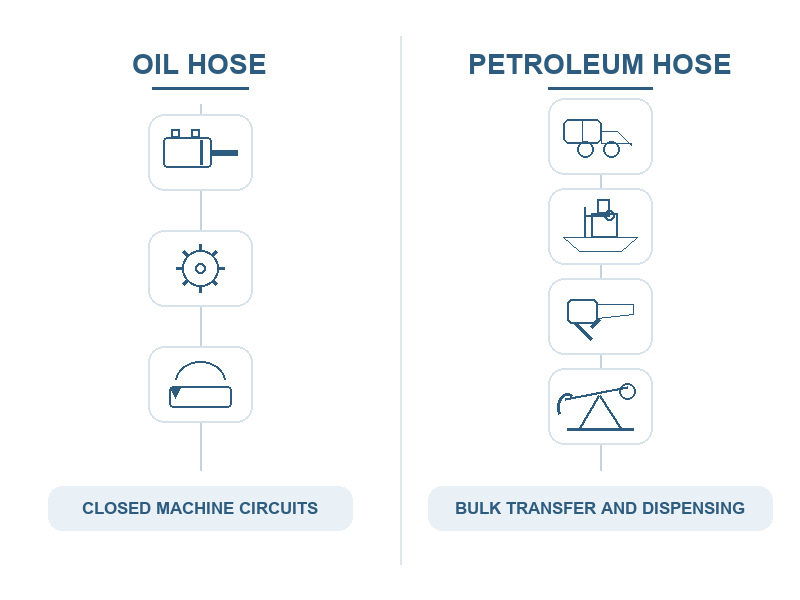
Figure 2. Use cases separate cleanly once the fluid path is drawn: closed machine circuits belong to the oil hose family, while every duty that moves product between storage points and adds a vapour space belongs to the petroleum hose family.
Table 4. Petroleum hose duties mapped to the property that decides the purchase
| Duty | Typical working pressure | Deciding property |
|---|---|---|
| Tank-truck oil transfer | 150 PSI | Oil-resistant tube with abrasion-resistant cover and a bonded end connection |
| Fuel suction and discharge | 300 PSI | Wire helix for vacuum and crush resistance with low-permeation tube |
| Petroleum and petrol suction | 400 to 600 PSI | Reinforcement strength plus suction rating in a large bore |
| Dock and bunkering transfer | Set by the terminal procedure | Electrical continuity through the assembly and fitting to the bonded pipeline |
| Forecourt dispensing | Dispenser-side, low pressure | Flammable-liquid standard compliance and continuity retained after every recoupling |
| Oilfield fuel discharge | About 400 PSI | Pressure and abrasion performance in continuous outdoor service |
5.1 How do you size a transfer hose for flow rate rather than pressure?
Transfer lines are sized by velocity, not by the pressure figure on a catalogue page. Flow rate follows bore area and velocity, so the same 30 m³/h (about 130 GPM) leaves a 2-inch bore (DN 50) far faster than a 4-inch one (DN 100). In our range oil transfer lines are sized for 1.5 to 4 m/s (about 5 to 13 ft/s): below that band solids settle out, above it the tube wears faster and pump energy is wasted.
Read the bore from the flow rate first, then confirm the working pressure and the standard at that bore. Dash sizes state the inside diameter in sixteenths of an inch, so -16 is 1 inch and -32 is 2 inches.
6. Static Electricity: The Requirement a Petroleum Hose Adds
A petroleum hose usually has to conduct, and an oil hose usually must not be asked to. Flowing hydrocarbon generates static charge, and a hose handling flammable product is the last place you want that charge to accumulate. The same requirement appears in specifications under two names: a static conductive hose and an electrically continuous hose. Both describe an assembly that carries charge from one end fitting to the other, and a petroleum hose specification normally names one of them rather than treating continuity as an optional extra.
How the requirement is written and verified:
- ISGOTT, the International Safety Guide for Oil Tankers and Terminals, sets a resistance of 0.75 ohm per metre or less for an electrically continuous cargo hose, measured between end fittings. This limit applies to tanker and shore cargo hose, while other duties set their own continuity requirements.
- For dispensing assemblies, UL 330 governs hose and hose assemblies used for flammable and combustible liquids and requires the assembly to remain continuous, which is why the dispenser hose is checked after any recoupling or fitting replacement.
- The conductive element is either a conductive NBR compound through the tube wall or a copper wire bonded to both end fittings; either way, the path has to reach the metal of the fitting, not stop at the rubber.
- In service, the assembly is bonded to the equipment it serves, and continuity is verified with an ohmmeter before transfer rather than inferred from the markings on the cover.
An oil hose and a petroleum hose diverge most clearly on continuity. A hydraulic circuit holds mineral oil under pressure with no vapour space and no open surface, so there is nothing for a spark to ignite and no reason to make the hose conductive. Asking for a conductive hydraulic oil hose adds cost and solves a problem that does not exist, while omitting conductivity on a petroleum transfer line leaves a known ignition source in place. This is the clearest case where the two categories must not be treated as interchangeable.
7. Oil Hose vs Petroleum Hose: How Do You Choose in Five Questions?
Work through five questions in order and the correct family selects itself. The sequence runs from fluid, to duty, to standard, to hazard, to geometry, and stopping early is what produces the wrong purchase. Running the sequence is what turns an oil hose vs petroleum hose question into a specification. Each question has a decisive answer, not a preference.
The five questions, in order:
- Does the fluid stay inside a machine, or does it move between storage points and stand in an open vessel with a vapour space above it?
- Will the line ever be on the suction side of a pump, or left drained and open to atmosphere?
- What standards must the purchase satisfy, and does the cover marking match the duty rather than the pressure?
- Is flammable vapour present in normal operation or during a spill, which makes static an ignition source?
- What bore and working pressure does the duty need, and do they fall inside the band the family supports?
Table 5. Decision matrix for choosing between an oil hose and a petroleum hose
| Question | Answer pointing to an oil hose | Answer pointing to a petroleum hose |
|---|---|---|
| Where does the fluid go? | Stays inside a closed machine circuit | Moves between tank, vehicle or vessel and stands under a vapour space |
| Will it see vacuum? | No, the circuit stays pressurised | Yes, on the suction leg or when the line is drained |
| Which standard applies? | SAE J517, EN 853, EN 856, ISO 1436, ISO 18752 or ISO 3862 | EN 1765, ISO 1823, EN 1761, DIN 20023, SAE J1527, SAE J30 or UL 330 |
| Is static an ignition source? | Vapour space absent, so the hose carries product inside a sealed circuit and continuity sits outside the specification | Yes, so a conductive path and bonding are mandatory |
| What geometry does the duty need? | Small bore, high pressure, tight bend radius | Large bore, low pressure, crush and vacuum resistance |
One warning about the sequence: never let bore and pressure override the fluid path or the ignition hazard. A large-bore fuel transfer hose and a small-bore hydraulic oil hose can carry similar-looking pressure figures on a supplier catalogue page, and the pressure figure alone will not tell you which one belongs on a bunkering line. Fix the duty and the hazard first, then size the hose, then confirm the standard.
8. Standards and Markings: How to Verify What You Are Buying
The standard on the cover is the only reliable statement of what a hose was tested to. Catalogue descriptions, colour and general appearance are not evidence, and supplier terminology shifts between regions. A buyer who can read the layline can settle an oil hose vs petroleum hose question in the warehouse without a data sheet.
Table 6. Standards that govern oil hose and petroleum hose, and the property each one fixes
| Standard | Covers | Property it fixes |
|---|---|---|
| SAE J517 | Hydraulic hose, including the 100R series | Construction, working pressure and minimum burst per size |
| EN 853 / EN 856 | Wire braid and spiral hydraulic hose (1SN, 2SN, 4SP, 4SH) | European pressure and impulse classes by size |
| ISO 1436 / ISO 3862 / ISO 18752 | Hydraulic hose families, including compact constructions | International equivalents with alternative pressure classes |
| EN 1765:2016 / ISO 1823 | Rubber oil suction and discharge hose assemblies | Usable temperature range, bore range and vacuum-capable construction |
| EN 1761 | Rubber hose and hose assemblies for fuel truck delivery | Construction for loading and unloading liquid hydrocarbon fuels |
| DIN 20023 | Oil suction and discharge hose in 10 bar and 20 bar classes | German national pressure classes for the same suction and discharge family |
| SAE J1527 | Marine fuel feed and vent hose | Fire resistance and permeation for small-craft fuel service |
| SAE J30 | Automotive fuel and oil hose | Resistance classes for vehicle fuel lines |
| UL 330 | Dispensing hose and hose assemblies | Continuity and construction for flammable and combustible liquids |
| GB/T 3683 / GB/T 10544 | Chinese national hydraulic hose standards | Domestic equivalents of the wire braid and spiral classes |
8.1 How to read the layline on a hose in your hand
Every fielded hose carries its own specification, and six fields are enough to identify it:
- The standard or standard family, which tells you the construction class rather than a marketing name.
- The bore, printed as a dash size or a metric inside diameter, which is the number that sets flow.
- The working pressure for that size, which is the number to design to, not the burst figure.
- The temperature class or compound note when the construction is outside the standard envelope.
- The quarter and year of manufacture, which sets the storage and service clock.
- The manufacturer and any approval marks, which is the field you trace if the hose fails.
A hose that carries a petroleum standard will also be marked for its permeation or continuity class where the standard requires it. A hose that carries only a hydraulic standard is an oil hose, whatever its cover looks like. The oil resistant hose guide walks through the marking fields in detail, and the flexible hose materials guide compares the compounds behind them.
8.2 What do you do when the hose in stock does not carry the required standard?
Sourcing pressure pushes buyers towards whichever hose is in stock, and that is where oil hose material choices get compromised. If the required standard is EN 1765:2016 and the available hose carries only a hydraulic standard, order the standard-carrying hose and wait for it. The missing property — a declared usable temperature envelope for oil suction and discharge, in that example — is exactly the property that the duty depends on. When a substitute is unavoidable, ask the supplier to state in writing which requirement the substitute satisfies and which it does not.
9. What Does Choosing the Wrong Hose Cost, and How Do You Spot It Early?
A mismatch normally shows up as a slow failure rather than an incident. The hose that was specified on pressure alone usually passes its first commissioning test and then degrades in the tube, which is the least visible place to lose performance. Catching the pattern early is what turns a warranty claim into a planned replacement.
Table 7. Field symptoms that indicate the wrong hose family for the duty
| Symptom | What it indicates | Correct answer |
|---|---|---|
| Tube swollen or softened, flow restricted | Compound not matched to the fluid, or EPDM used in hydrocarbon service | Re-specify the oil hose material against the actual fluid |
| Hose flattened or kinked on the inlet leg | Pressure-rated construction used where vacuum exists | Helix-reinforced suction construction |
| Cover cracked and reinforcement exposed | Abrasion, ozone or sunlight beyond the cover specification | Cover matched to the environment, or protective sleeving at wear points |
| Fitting pulled from the hose under pressure | Crimp or coupling class below the duty | Assembly rated for the working pressure at that bore |
| Continuity lost on a fuel transfer hose | Conductive path broken at a recoupled end fitting | Remake and re-verify the conductive assembly before further transfer |
| Cover blistered with gas trapped underneath | Permeated vapour with no escape path | Low-permeation tube with a pin-pricked or vented cover |
The arithmetic behind this table is blunt. A premature hose failure costs the replacement hose plus the labour to change it plus whatever the machine or transfer point was doing at the time, and a contamination failure adds filters, flushing and possibly a pump. Against that, the price difference between the correct construction and the nearest substitute is a small fraction of one hose. On transfer lines the calculation is even more one-sided, because the discharge side of a transfer pump is where a blowout happens next to a spill. Our oil transfer pump discharge hose guide covers the discharge-side specification in detail.
Lifespan differs as much as the construction: a hydraulic oil hose in a fixed circuit is expected to last the life of the machine, while a handled transfer hose is a consumable item.
Three duty profiles decide the answer faster than any catalogue comparison does:
- If you run a single tank truck and unload twice a day, the hose that matters is a 150 PSI assembly with a bonded end fitting and an abrasion-resistant cover.
- If you are replacing one lubrication line inside a plant, an oil hose with an NBR tube and a textile braid is the complete specification.
- If you sign off a terminal or bunkering transfer procedure, the two numbers to record are the working pressure at the bore and the continuity reading taken before each transfer.
If your duty sits between the two families, send the fluid, the working pressure, the temperature at the hose and the bore, and ask for a written compatibility statement before the order.
10. Frequently Asked Questions
Is a petroleum hose the same thing as an oil hose?
No. An oil hose is defined by its oil resistant tube and covers a very wide duty range, while a petroleum hose is defined by the job of moving refined petroleum products in bulk. Every petroleum hose has an oil resistant tube, so it is a type of oil hose. The reverse is not true, and a hydraulic oil hose that carries mineral oil at 4,000 PSI is the standard counter-example.
Can I use a hydraulic oil hose to transfer diesel?
A hydraulic oil hose carries diesel inside a closed circuit only. It has the correct tube chemistry for diesel, but it is built for pressure rather than for vacuum, permeation control or electrical continuity. On a pump inlet it can collapse, and as an open transfer line it has no declared permeation performance. For open transfer or a suction leg, specify a dedicated fuel transfer hose.
Can I use an EPDM hose for oil?
No. EPDM is incompatible with hydrocarbon oils and fuels, and it will swell and soften on contact with them. EPDM is an excellent choice for water, steam and glycol circuits, and it is the wrong choice for anything in the oil family. If a line needs both heat resistance and oil resistance, the tube should be FKM or a thermoplastic rather than EPDM.
What oil hose material should I specify for hot oil?
Specify NBR up to the point where circulating oil runs hotter than about 120 °C, then move to FKM. In our range a standard oil hose covers -40 °C to +125 °C, high-temperature variants reach +150 °C continuous, and low-temperature compounds stay flexible to -55 °C. Confirm the actual worst-case temperature at the hose rather than the machine’s nominal rating, because return oil and radiant heat from nearby equipment both raise it.
Does a fuel transfer hose have to be conductive?
Yes, whenever the product is flammable. ISGOTT, the International Safety Guide for Oil Tankers and Terminals, sets a resistance of 0.75 ohm per metre or less for an electrically continuous cargo hose, and dispensing assemblies are governed by UL 330 for continuity. A static conductive hose is therefore a design requirement rather than an accessory, and it must be bonded to the equipment and re-verified after any end fitting is replaced.
Is an oil suction and discharge hose also a petroleum hose?
Usually yes, when the product is a petroleum product. EN 1765 and ISO 1823 cover rubber hose assemblies for oil suction and discharge, and those assemblies are the standard answer for terminal, tank-farm and marine transfer duty. The same construction can also move non-petroleum liquids, which is the point at which the label “petroleum hose” stops describing the application even though the hose is unchanged.
How do I check oil hose material compatibility before ordering?
Ask for immersion test data rather than a general oil resistance claim. Volume swell and hardness change measured to ASTM D471 or ISO 1817 give numbers you can compare between suppliers, and a 72-hour soak at the working temperature is enough to expose an obviously wrong compound. If the supplier cannot produce immersion data for the actual fluid, treat the product as general-purpose until proven otherwise.
How often should a petroleum hose be inspected?
At every transfer for the visible checks, and on a documented schedule for the rest. Look for cover cracks, soft spots, fitting slippage and any blistering, and verify electrical continuity on conductive assemblies before product is moved. Because rubber ages in storage as well as in service, respect the manufacture date on the layline and inspect any hose that has been in the rack for several years before returning it to duty.
11. Oil Hose vs Petroleum Hose: The Final Verdict
Treat the two names as a question about duty, not as two competing products. An oil hose answers “what will this tube tolerate”, and it is the right answer for every closed circuit that circulates mineral oil, lubricating oil or lubricant under pressure. A petroleum hose answers “how is this product moved”, and it is the right answer for every duty that puts flammable product in bulk through a suction leg, an open transfer point or a bonded connection.
The decision order is fixed and short. Confirm the fluid, confirm whether the fluid leaves the machine, confirm whether flammable vapour makes static an ignition source, then let the standard on the cover decide the rest. Everything the two families genuinely share — an NBR tube at the centre of the construction, an abrasion-resistant cover over the reinforcement, a minimum burst pressure of four times the working pressure (a 4:1 safety factor) — is downstream of those answers. Everything they genuinely do not share, from a 6,000 PSI spiral reinforcement to a continuity requirement of 0.75 ohm per metre or less, follows from them.
If a specification is still uncertain, the cheapest test is a written one: send us the fluid, the working pressure, the temperature at the hose, the bore and any required standard, and ask for a compatibility statement in writing. That single request resolves more wrong-hose purchases than any catalogue page.
About this guide and about HENGHUA
This guide was prepared by the HENGHUA hose engineering team and last updated on 19 September 2026. We are a hose manufacturer based in Hebei, China, with a 35,000 square metre plant that produces oil hose, petroleum transfer hose, hydraulic hose and fittings, exporting to more than 65 countries.
Our oil hose range is built on NBR, CR and FKM tube compounds with wire braid and spiral reinforcement, in bores from 5 mm to 102 mm. Static conductive options are available for petroleum transfer service, and pressure performance is verified by 100 percent proof testing on every batch, with impulse testing per the relevant standard.
Scope of this guide: rubber oil hose and rubber petroleum transfer hose, in the constructions we manufacture. Food-grade, chemical, LPG and steam hose each need their own compatibility review, which we run separately.
Ratings scope: every figure quoted here is a rating of the constructions we manufacture. A hose from another source may be built to a different class, and it should be judged by the standard printed on its own cover.
Warranty terms, return conditions and the documentation package for each order are confirmed in writing on the quotation, so that nothing depends on a verbal understanding. Every shipment leaves with a specification sheet and traceability codes, and sample lengths are available before a bulk order is placed.
If you are choosing between an oil hose and a petroleum hose for a live project, or you need a static conductive hose built and tested for a specific transfer duty, send us the duty conditions and we will come back with the construction, the standard and a written quotation. You can reach the technical team through our contact page, or browse the current oil hose product range to see the constructions and pressure classes we hold in production.






 English
  Spanish
  Portuguese
  French
  German
  Arabic
  Russian
  Indonesian
  Japanese
  Korean