

Selecting a high temperature hydraulic hose comes down to one rule: match the hose’s continuous fluid-temperature limit to the hottest oil temperature your circuit actually reaches, and confirm the cold end is covered as well. What temperature can a hydraulic hose actually handle in your circuit? The five figures below answer that before the catalogue does.
The short answer. Standard rubber hydraulic hose is rated -40 °C to +100 °C (-40 °F to +212 °F) continuous, with intermittent excursions to about +120 °C; above +121 °C you need a spiral family or a modified compound, and above roughly +150 °C the efficient answer is PTFE. Which of the five temperatures has been crossed decides the fix: a compound change for oil temperature, a cover change for external heat, mechanical protection where the oil is fine but a hot surface is close. What temperature a hydraulic hose can handle, whether you need a cold weather hydraulic hose, and whether a heat shield is cheaper than upgrading the hose to a higher temperature class are the three questions this page settles in that order; the standards, the derating and the verification checklist follow. If your question is about buying rather than specifying — quantities, sourcing routes and supplier comparison — our guide to sourcing hydraulic hoses for extreme temperatures covers that side of the decision.
What this guide covers. This guide covers selecting hydraulic hose for circuits whose fluid, ambient or surface temperature falls outside the standard -40 °C to +100 °C window of rubber hydraulic hose — the hot case from +100 °C upward, and the cold case from -40 °C downward. It applies to mineral hydraulic oil and to water-based, coolant and phosphate-ester duties, and it applies to both new specifications and replacements.
Three neighbouring duties follow different rules, and each has its own treatment elsewhere: hydraulic fluid power circuits where pressure is the binding constraint rather than temperature, hose assemblies at the end of their service life, and hose that has not yet been put into service.
Which Five Temperatures Decide an Extreme-Temperature Hose?
Temperature is not one number. It is five, and a hose that satisfies four of them can still fail in the first season. The table below sets out each value, the figure a standard rubber hose publishes for it, and where to verify the figure — because the hydraulic hose temperature range printed on a catalogue page is rarely the limit that actually governs a hot or cold installation.
In this guide, a high temperature hydraulic hose means a hose whose published continuous fluid-temperature limit sits above the -40 °C to +100 °C window of standard rubber hydraulic hose. Covered in the same scope are the cold-side case and the families that extend the window, including PTFE.
Table 1. The five temperature values that decide whether a hose survives extreme service.
| Value | What it describes | Typical value, standard rubber hydraulic hose | Where to verify it |
|---|---|---|---|
| Continuous fluid temperature | Oil temperature inside the tube, sustained indefinitely | -40 °C to +100 °C (-40 °F to +212 °F) | Datasheet for the standard family (SAE 100R1, 100R2, EN 853 2SN) |
| Intermittent fluid temperature | Short excursions, normally defined as up to about 10% of operating time | +120 °C (+248 °F) | Datasheet footnote |
| Ambient temperature | Air temperature around the hose, which controls how fast it sheds heat | -40 °C to +100 °C, cover-dependent | Cover compound specification |
| External / surface exposure | Radiant or contact heat reaching the outer cover | Set by the cover and any protection fitted | Routing review and cover specification |
| Cold-flex limit | The temperature below which the hose must not be bent or flexed | -40 °C (-40 °F) for standard rubber | Low-temperature flexibility data or cold-bend test report |
The continuous fluid-temperature limit decides which hose you buy; the other four temperature values decide how long it lasts. Those four are the intermittent fluid limit, the ambient air temperature, the cover surface temperature and the cold-flex limit (Table 1). A hose carrying 90 °C oil 100 mm from an exhaust manifold works in a different thermal environment from the one its datasheet describes, so specifying on the continuous limit alone leaves the cover unprotected.
In practice, an extreme temperature hydraulic hose is simply a hose whose published hydraulic hose temperature range covers all five values for your machine. That is why two hoses from the same standard family can be right for one duty and wrong for another, and why the hydraulic hose temperature range figure should be read from a datasheet rather than inferred from the family name.
Two industry rules of thumb are worth knowing, and both come from hose-maker and seal-vendor guidance rather than a fixed standard requirement:
- Running 10 °C above the recommended maximum can cut expected hose life by roughly half.
- The same 10 °C overshoot can cut seal life by 80% or more.
Treat those as a direction of travel, not a measured curve for your machine. The damage is chemical: rubber hardens, plasticisers migrate out, and the bond between tube and reinforcement weakens faster than any visual inspection will reveal.
Which User Situation Are You In?
The same engineering answer lands differently depending on who is asking. Five profiles cover most of the traffic this page receives, and each one changes the starting point rather than the physics.
- If you maintain mobile equipment in a cold climate: start from the cold-flex limit rather than the continuous one. Standard rubber covers -40 °C, low-temperature rubber grades are published from -50 °C and extended arctic grades from -60 °C, and the cold-start rules further down this page matter more to service life than the family you buy.
- If you run a hot duty cycle in a steel mill, foundry or die-casting plant: start at the +121 °C spiral families and treat everything above +150 °C as either a PTFE decision or a protected-routing decision. Measure the cover surface temperature as well as the oil, because in these plants external heat usually reaches the hose before the oil does.
- If you are a distributor building a range: three lines cover most workshop demand — a standard -40 °C to +100 °C braided hose, one +121 °C spiral-reinforced line, and one -50 °C low-temperature grade. Hold those three, and make the compounds that sit between them to order rather than in stock.
- If you are replacing a hose that has already failed on temperature: read the symptom before you change the specification. A hard, crazed cover points to external heat, a soft or blistered tube points to oil temperature, and seepage at a cold crimp points to the fitting, so identify which limit you crossed and re-measure the three temperatures from step 1 rather than moving one family up the table.
- If you are writing a purchase specification: turn the supplier verification questions into clauses and require the documents with the delivery. Ask for the continuous limit, the layer it applies to, the derating factor above that limit, the cold-flex limit, the impulse test data at temperature, and warranty terms that cover temperature-related failure.
What Temperature Can Each Hydraulic Hose Family Handle?
Hose families are defined by standard, and each standard carries its own temperature window. This is the selection chart to work from, and it is the fastest way to establish whether a standard high temperature hydraulic hose covers your duty or whether you need a specialist family. Temperature is the axis this chart carries; pressure is a second, separate axis, and under a hot duty the hose has to clear both — which is why a high temperature high pressure hose is specified from two figures rather than one.
Standard editions. SAE J517, EN 853, EN 854, EN 856, EN 857 and ISO 18752 are cited throughout this guide to their current editions rather than to a fixed year, because each is revised on its own cycle. Test-method standards such as ISO 6803 and SAE J343 are cited to their current editions as well. Confirm the edition printed on the product datasheet, and write that edition into the purchase specification, before you rely on a standard number in an order.
Table 2. Typical published temperature limits by hydraulic hose family. Confirm against the specific datasheet or layline before ordering.
| Family | Bauwesen | Continuous | Intermittent |
|---|---|---|---|
| SAE 100R1 / 100R2, EN 853 1SN / 2SN, EN 857 1SC / 2SC | NBR tube, one or two steel wire braids | -40 °C to +100 °C | +120 °C |
| SAE 100R16 / 100R17 | NBR tube, compact wire braid | -40 °C to +100 °C | +120 °C |
| SAE 100R3 / 100R6, EN 854 1TE / 2TE / 3TE | NBR tube, textile braid | -40 °C to +100 °C | +120 °C |
| SAE 100R12 / 100R13 / 100R15, EN 856 4SP / 4SH | NBR tube, four or six wire spirals | -40 °C to +121 °C | Short excursions only; confirm with the maker |
| ISO 18752, classes AS / AC / BS / BC | NBR tube, braided or spiral | -40 °C to +100 °C | Per class |
| ISO 18752, classes CS / CC / DC | Peroxide-cured NBR tube | -40 °C to +120 °C | Per class |
| SAE 100R7 / 100R8 | Thermoplastic hose, fibre braid | -40 °C to +93 °C | +100 °C |
| SAE 100R14 | PTFE (polytetrafluoroethylene) tube, stainless steel braid | -54 °C to +204 °C | High-temperature grades to +260 °C |
| Low-temperature / arctic rubber grades | NBR tube, wire braid or spiral | -50 °C to +100 °C | -55 °C cold side |
Table 2 is the hydraulic hose selection chart for temperature: it establishes which hose family is even eligible, before pressure, bore or fittings are considered. The table is organised by standard family, so the continuous and intermittent columns show each family’s published temperature window rather than one maker’s claim.
Two cautions apply to every number in that chart. First, these are typical published values across manufacturers, not a legal maximum — the datasheet for the exact product overrides the chart. Second, some makers publish a wider window than the base standard for the same SAE or EN designation, because they run a modified compound; that is legitimate, but it must come with test evidence rather than a catalogue claim. For the full SAE J517 family structure behind this table, see our SAE hydraulic hose standards guide, and for the ISO 18752 classes specifically, see ISO 18752 vs SAE.
Which family covers both -40 °C and +120 °C in one hose? The peroxide-cured NBR families — ISO 18752 classes CS / CC / DC and the SAE 100R12-class spirals — are published across that whole window in one construction, so a single family can cover -40 °C to +120 °C provided the datasheet confirms both the continuous limit and the cold-flex limit.
Which Tube Compound Sets the Limit
The inner tube touches the oil directly, so it sets the continuous temperature ceiling. Changing the compound without changing the reinforcement is the cheapest way to move a hose from a 100 °C duty to a 150 °C duty.
Table 3. Typical continuous temperature range by tube compound. Compound limits describe the tube material; family limits in Table 2 describe the finished hose and are the figure to order against. PTFE appears in both tables because one PTFE tube is one material; Table 2 gives the published range of a finished SAE 100R14 hose, Table 3 the tube material’s own capability. The two are not interchangeable.
| Compound | Typical continuous range | Notes |
|---|---|---|
| NBR (nitrile) | -40 °C to +100 °C | Standard for mineral hydraulic oil; the economic default |
| Peroxide-cured NBR | -40 °C to +120 °C | Used in the ISO 18752 C-class and R12-class families |
| HNBR (hydrogenated nitrile butadiene rubber) | Published ranges vary by cure system; confirm the datasheet figure | Better heat and oil ageing, higher compound cost |
| EPDM (ethylene propylene diene monomer) | -50 °C to +150 °C | Water-based fluid, coolant and steam. For mineral hydraulic oil, specify NBR, peroxide-cured NBR, HNBR or PTFE. |
| PTFE | -54 °C to -60 °C at the cold end, grade-dependent; +260 °C at the hot end. This cell is the PTFE tube material’s own capability — the finished SAE 100R14 hose is published from -54 °C, and Table 2 gives that family figure. | For phosphate ester, high heat and chemical duties. Confirm the datasheet figure for the product you are ordering. |
| Thermoplastic elastomer (TPE) tube | -54 °C to +100 °C | Not the same product as the SAE 100R7 / 100R8 thermoplastic hoses in Table 2. Good low-temperature flexibility, lightweight |
Compound choice also has to satisfy the fluid, not only the temperature. A compound that survives 120 °C but swells in the fluid in the circuit is the wrong compound, so check tube compatibility for the medium as well — our hydraulic hose fluid compatibility chart sets NBR, EPDM and FKM against the common hydraulic media.
Compound choice is where buyers most often over-specify. A heat resistant hydraulic hose buys extra service life only where the measured oil temperature requires it: at a measured oil temperature of 70 °C, a peroxide-cured or HNBR compound adds cost per metre and no additional service life in the circuit. Buy the compound that the measured temperature requires.
I need one specification that covers -40 °C in winter and +120 °C in summer on the same machine. One peroxide-cured NBR family can hold both ends — ISO 18752 classes CS / CC / DC are published to +120 °C continuous with a -40 °C cold-flex limit — but the two figures come from different tests, so the datasheet has to state the cold-flex limit as well as the continuous limit before one hose can be treated as a year-round specification.
Why the Cover Often Fails Before the Tube
On a hot machine, the outer cover is usually the first layer to show damage. Radiant heat from an exhaust, manifold or furnace hardens the cover until it crazes and cracks; those cracks then admit water and grit to the wire reinforcement.
The practical consequence is that a high temperature rubber hose with excellent tube chemistry can still fail early if the cover compound is not matched to the external environment. Cover selection at temperature extremes comes down to three asks: heat and ozone resistance (EPDM, CSM or silicone-based covers), cold flexibility, and abrasion resistance where the hose drags over steel. A heat resistant hydraulic hose judged only on its tube compound has been judged on half the problem.
How Do You Choose a High Temperature Hydraulic Hose?
Hot service is the more common extreme, and the more solvable one. Work through three decisions in order.
Decision 1 — Is Standard Rubber Enough?
If the measured continuous oil temperature stays at or below +100 °C, a standard steel wire braided hydraulic hose is the correct and cheapest answer. Typical oil temperatures in mobile hydraulic systems sit well inside this window. The pump, reservoir and coolers are usually sized to hold oil between 50 °C and 80 °C, so a standard hose has genuine margin.
Use the hottest local oil temperature as the selection input. Read it at the return line, at the relief valve and at the hydrostatic drive: oil leaving a relief valve, a torque converter or a hydrostatic drive can be tens of degrees hotter than the tank, and that local reading is the figure the hose is specified against.
My press return line reads 130 °C at the relief valve but the tank gauge says 65 °C — which temperature do I select the hose against? Select against the 130 °C reading: the tank gauge describes the reservoir, the relief-valve reading describes the oil passing the hose, and at 130 °C both a standard NBR hose and the +121 °C spiral families are out, so the specification moves to a modified high-temperature compound or to PTFE with the pressure derated at that service temperature.
Decision 2 — When You Need +121 °C or +150 °C
Above +100 °C, move to a spiral-reinforced family. The SAE 100R12, 100R13, 100R15 and EN 856 4SP / 4SH families are built with a heavier, multi-spiral reinforcement and typically published to +121 °C continuous. This is where a high temperature hydraulic hose and a high temperature rubber hose stop being the same purchase: the reinforcement carries the pressure, but the compound still carries the heat.
For duty above +121 °C, look for a specifically designated high-temperature construction. Some manufacturers publish wire-braid hoses with a modified NBR compound rated around +135 °C continuous with short peaks near +155 °C, and specialist grades that reach +150 °C. Treat those ratings as compound-dependent, not family-dependent, and ask for the heat-ageing data behind the figure. Our steel wire spiralled hydraulic hose and 2-wire braid vs 4-wire spiral comparison cover the reinforcement side of this step.
Several real duties sit in this band: steel mills and foundries, die-casting and injection-moulding machines, hydraulic presses with poor heat rejection, and offshore or marine machinery where a hot manifold shares a compartment with the hose. Mobile machines reach it too — an excavator working a hot duty cycle can push return-line oil well above tank temperature. In all of them heat arrives on two fronts at once, because the oil is hot while the line is still under load, so the specification has to be written as a high temperature high pressure hose rather than as a temperature upgrade.
Decision 3 — Above +150 °C: PTFE and Protected Routing
Once you are consistently above roughly +150 °C, rubber compounds stop being the efficient answer. The two viable routes are PTFE and mechanical protection.
- PTFE (SAE 100R14) carries a typical continuous range of -54 °C to +204 °C, with high-temperature grades published to +260 °C. It also handles phosphate-ester fluid, which destroys NBR; see Figure 1 for the family-by-family spread behind both steps.
- Protected rubber routing keeps a rubber hose in play where the *oil* is cool but a *hot surface* is nearby. A heat shield or fire sleeve lets a steel wire spiralled hydraulic hose run beside an exhaust that would otherwise cook its cover.
Where a duty is both hot and highly pressurised, the answer is a high temperature high pressure hose: a multi-spiral reinforcement carries the pressure while a heat-resistant compound and cover carry the temperature. Those two requirements are met by different layers of the same hose, which is why the datasheet has to state them separately.
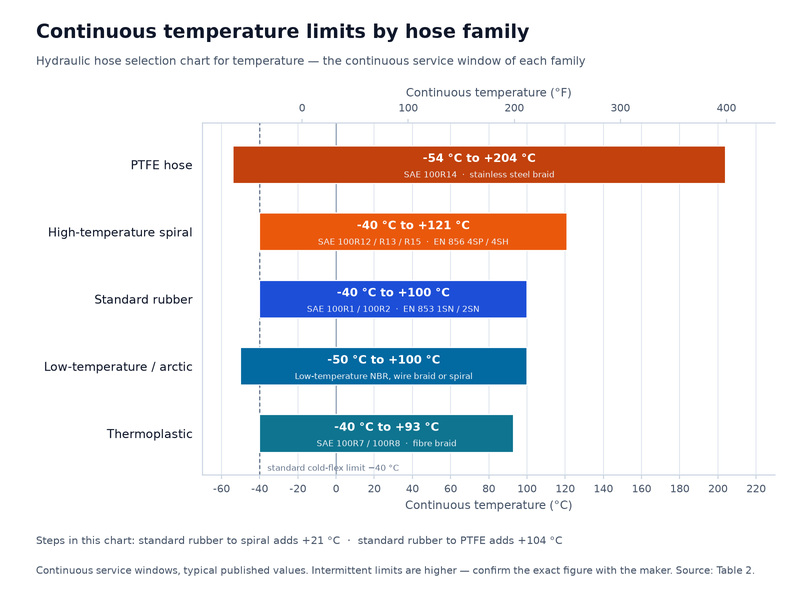
Figure 1. Continuous temperature limits by family. The step from standard rubber to spiral construction buys about 21 °C; the step to PTFE buys more than 100 °C. Data source: Table 2.
When Do You Need a Cold Weather Hydraulic Hose?
Cold is the extreme that gets ignored, because the hose still looks fine in the yard. It fails on the first cold start, under load, at the crimp or at a bend.
What -40 °C Does to a Hose
Rubber compounds stiffen as they approach their glass-transition region. As the hose stiffens, three things happen at once:
- Bending the hose at the wrong moment cracks the cover and, in bad cases, the tube.
- Cold oil becomes viscous, so the pump pulls harder and system pressure spikes on startup.
- Surge and pressure-spike loading arrives at a hose that is simultaneously at its least flexible.
Cold-start failures cluster in the first ten minutes because two things happen at once: the hose is at its stiffest, and the pressure spike is at its highest. Rubber stiffens as it approaches its glass-transition region, and cold oil is viscous enough that the pump pulls harder on startup. A hose that is fine at -40 °C while straight can crack at -40 °C when bent around a sharp fitting.
Arctic and Low-Temperature Grades
If your machinery genuinely runs below -40 °C, specify a low-temperature construction rather than buying a standard hose and hoping. A cold weather hydraulic hose is normally built with a low-temperature NBR or a thermoplastic tube and a cover that stays flexible in the cold.
Note what the labels are worth. A low temperature hydraulic hose and an arctic hydraulic hose are often the same family sold under different market names, so compare the published cold-flex limit rather than the wording on the catalogue page.
Typical published windows for this class:
- Low-temperature rubber grades: -50 °C continuous, with intermittent service to about -55 °C — the most widely available form of low temperature hydraulic hose.
- Extended arctic grades: some arctic hydraulic hose ranges are published from -60 °C, typically with a reduced bend radius so the hose can be routed tightly inside a cold compartment.
- Low-temperature thermoplastic hose: a construction rather than a compound, and not the same product as the SAE 100R7 / 100R8 rows in Table 2 or the thermoplastic elastomer (TPE) material in Table 3 — certain thermoplastic hydraulic hose constructions are published to around -57 °C and are used in cold storage and refrigerated equipment. For arctic duties this often beats a heavy rubber low temperature hydraulic hose, because the lighter construction is easier to route inside an insulated compartment.
What you are buying is flexibility, not strength. An arctic hydraulic hose usually keeps the same working pressure as its standard-temperature counterpart, so a cold-climate project gains nothing on the pressure side by specifying one.
I run a cold-storage forklift fleet that starts at -25 °C — will a standard 2SN hose survive the first cold start? At -25 °C the hose is still inside the standard -40 °C cold-flex limit, so 2SN is eligible and the risk is not the material but the startup: cold oil raises system pressure while the hose is at its least flexible, so idle the machine for two to five minutes and stroke each function slowly before applying load, and only step up to a -50 °C low-temperature grade if the fleet is also stored below -40 °C.
Cold-Start Rules for Hydraulic Machinery
Selection gets you a hose that can survive cold. Operating practice is what keeps it alive.
- Let the machine idle and circulate before loading it. Two to five minutes of low-load circulation warms the oil and removes the pressure spike from the critical first moments (see Figure 2).
- Keep a flow path open whenever the pump runs on cold oil. Deadheading — holding full pressure against a closed valve on cold, viscous oil — is the highest-stress event a hydraulic hose ever sees. Open the return path before the pump starts and leave it open until the oil warms.
- Warm up cylinders slowly. Stroke each function through part of its travel a few times before working the machine hard.
- Expect the first bend to be the damaging one. Where a hose must follow a moving joint, confirm the minimum bend radius is still respected at the coldest ambient temperature the machine will see — not at the temperature in the workshop.
- Check the crimps after the first cold week of the season. Cold-related failures usually start as seepage at the fitting, which is easy to catch early.
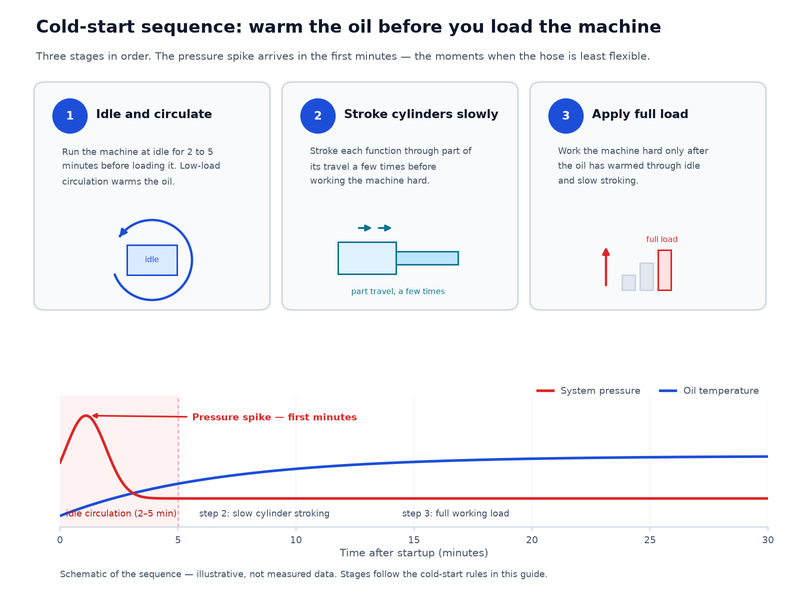
Figure 2. The cold-start sequence. The pressure spike arrives in the first minutes after startup — the same moments when the hose is at its least flexible.
Our hose works fine in summer and seeps at the crimp every January — is that a hose problem or a fitting problem? It is usually a fitting problem: rubber and metal contract at different rates, so the crimp can lose its seal at -25 °C and reseal as the machine warms, and the answer is to inspect and re-crimp the assembly or move to a cold-rated assembly rather than replace the hose, checking the crimps after the first cold week of the season because that seepage is the earliest visible sign.
Heat Shield or Higher-Rated Hose: Which Do You Need?
Protection is often cheaper and faster than upgrading the hose itself. Where the oil is within limits but a hot surface is close, mechanical protection solves the problem directly. A hydraulic hose heat shield is the standard answer, and on a machine with several exposed runs it is usually cheaper than moving the whole fleet to a high temperature hydraulic hose specification.
Table 4. Typical heat-protection options for hydraulic hose, with published temperature capability.
| Protection | Typical construction | Typical capability | Best used for |
|---|---|---|---|
| Silicone-coated fibreglass fire sleeve | Braided fibreglass with a silicone coating | -54 °C to +260 °C continuous; short-term exposure far higher | Hose passing near exhausts, manifolds and furnace heat |
| Aluminised glass sleeve | Glass fabric with an aluminium layer | Around +260 °C, radiant-heat dominant | Reflecting radiant heat from a hot surface |
| Reflective wrap tape | Aluminised tape or foil wrap | Depends on the substrate | Retrofit protection on an existing run |
| Steel standoff and heat shield plate | Mechanical separation | Not temperature-limited | Where an air gap is possible and physical separation is safer |
| Plastic spiral guard | Polypropylene or nylon spiral | Low-temperature and abrasion protection only | Abrasion protection only. For external heat, specify a silicone-coated fibreglass sleeve or an air gap instead. |
A hydraulic hose heat shield is usually a sleeve or wrap fitted around the hose, and silicone-coated fibreglass is the most common hydraulic hose insulation used for the duty. It works on one of two principles: reflecting radiant heat away from the cover, or insulating the cover from it. A silicone-coated sleeve does both. What a heat shield does not do is change the fluid temperature inside the tube, so it cannot rescue a hose whose rating is already exceeded by the oil itself. For sleeve materials, fitment and abrasion-versus-heat trade-offs, see our hydraulic hose protection sleeve selection guide.
My hose passes 150 mm from an exhaust manifold but the oil is only 70 °C — do I need a different hose or a heat sleeve? Oil at 70 °C is inside the standard -40 °C to +100 °C window, so the hose does not need a compound upgrade; the 150 mm gap is the problem to solve, so measure the cover surface temperature at that routing with the machine at working temperature and fit a silicone-coated fibreglass sleeve over the full exposed length if the reading approaches the cover’s rating.
Two installation points decide whether protection works:
- Fit the sleeve over the full exposed length of the run. Cover it from end to end plus a margin at each end, and secure it so it stays in place while the hose moves.
- Leave an air gap. A shield that touches the hot surface conducts heat into the hose instead of blocking it (see Figure 3).
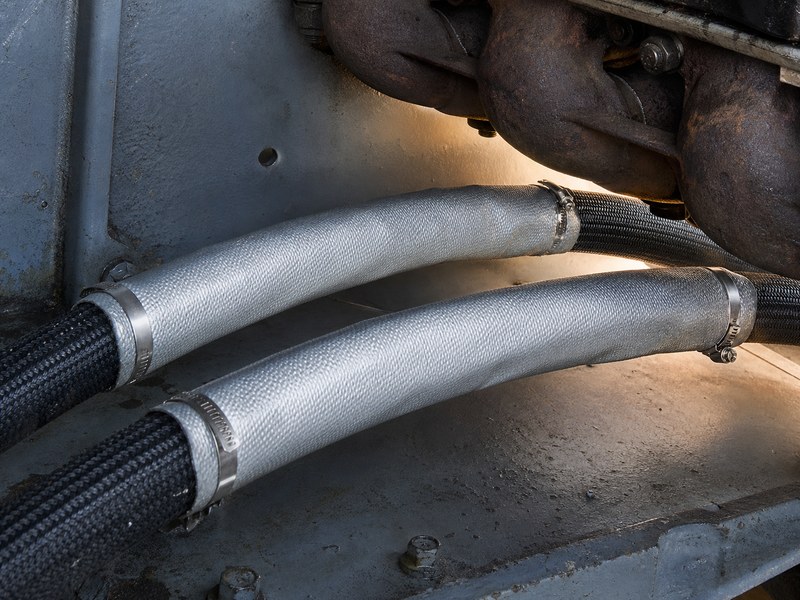
Figure 3. Correct heat-shield installation: the sleeve covers the full exposed run, is secured at both ends, and stands off the hot surface so an air gap remains.
Is a heat shield cheaper than upgrading the hose to a higher temperature class? It is, whenever the oil itself is still inside the hose’s rated range and the problem is an external hot surface — a sleeve costs a fraction of moving a fleet to a higher-temperature compound, and it solves a case that a compound change does not touch.
Does Temperature Reduce Working Pressure? Derating Explained
Yes. A hose’s working pressure is established at a reference temperature, and the practical pressure capability falls as the temperature rises. A hydraulic hose pressure rating is therefore always a two-part figure — a pressure at a stated temperature — and this is the mechanism most often missed by buyers comparing two hoses on burst pressure alone.
Table 5. Illustrative pressure derating above the continuous temperature limit. Industry practice from published manufacturer tables, not a fixed standard requirement — confirm the factor for your exact product.
| Service temperature relative to the continuous limit | Illustrative pressure capability | Action |
|---|---|---|
| At or below the continuous limit | 100% of rated working pressure | Use the published rating |
| Above the continuous limit, and not more than +120 °C absolute | Commonly reduced to about 85–90% of rating | Apply the maker’s table; recheck safety margin |
| Above +120 °C absolute, or above the continuous limit of a family whose own limit is +120 °C or higher | Case-by-case | Written confirmation from the manufacturer is required |
Scope of this table. The percentage figures come from published guidance for the standard -40 °C to +100 °C rubber families. For the +121 °C spiral families and the peroxide-cured NBR families in Table 2, derating is defined by the manufacturer’s own table, because their continuous limit already sits above the +120 °C band shown here.
Three pressure facts sit underneath the derating:
- Burst pressure is typically four times working pressure. The 4:1 ratio is the standard safety factor across the families in Table 2, and the difference between the two figures is examined in our working pressure vs burst pressure guide. On a high temperature high pressure hose the two have to be quoted together, because the pressure side of the rating is valid only at the temperature it was established at.
- Rated pressure should clear the system maximum with margin. Published selection guidance commonly calls for the hose rating to sit 30–50% above the highest system pressure, so pressure spikes and relief-valve events are covered.
- Impulse testing is where high-temperature performance is proven. The test method is defined by SAE J343, with ISO 6803 covering the static-bend procedure: hoses are impulse-cycled at 133% of working pressure with the fluid held at +100 °C or +120 °C. The cycle count depends on grade rather than being one universal figure — published qualification levels run from 200,000 cycles at entry level to 1,000,000 for the higher ISO 18752 classes — so ask for the figure that applies to the grade you are buying. A high temperature hydraulic hose should come with impulse data at the operating temperature, not just a heat-ageing claim — background on why impulse life testing determines durability is worth reading before you accept a figure.
If you select a high pressure hydraulic hose on working pressure and ignore the temperature at which that pressure is rated, the number on the layline can be optimistic by a meaningful margin. Always quote a hydraulic hose pressure rating back to the supplier together with the service temperature, and ask them to confirm the pair rather than the pressure alone.
I have a 350 bar circuit that runs at 115 °C — what pressure can I actually use? Published derating tables commonly allow 85–90% of the rated figure in that band, which puts a 350 bar hose at roughly 298–315 bar, and the manufacturer has to confirm that number in writing for the exact product before you rely on it.
How Do You Select an Extreme-Temperature Hose in 8 Steps?
Follow the sequence in order. Each step produces one output you can hand to a supplier, and taken together the eight outputs are the specification for an extreme temperature hydraulic hose that will survive the duty rather than the season.
Table 6. The eight-step extreme-temperature selection procedure.
| Step | What you do | Output |
|---|---|---|
| 1. Measure, do not estimate | Record fluid temperature at the return line, ambient air beside the hose, and cover surface temperature near the hottest component | Three temperatures, in writing |
| 2. Identify the worst case | Take the hottest reading and the coldest startup ambient, not the average | Design temperature window |
| 3. Choose the tube compound | Match compound to fluid type and the hot limit from Table 3 | Compound and continuous limit |
| 4. Choose the reinforcement | Size the braid or spiral to the pressure at that temperature, after derating | Family and working pressure |
| 5. Choose the cover | Heat, ozone, UV, abrasion and cold flexibility for the installation | Cover compound |
| 6. Size the bore and verify margins | Flow-based inner diameter, plus the 30–50% pressure margin and the 4:1 burst ratio | Bore, length, pressure class |
| 7. Add protection and route it | Heat shield where needed, air gap, correct bend radius, correct clamping | Routing drawing |
| 8. Verify with the supplier | Request layline confirmation, impulse data at temperature and warranty terms | Signed specification |
Tube compound and cover compound are two separate decisions on this eight-step list, at steps 3 and 5. Switching tube compound fixes an oil-temperature problem; switching cover compound fixes a radiant-heat problem. Treating them as one purchase is the most expensive mistake in the list.
Step 4 is where a high pressure hydraulic hose gets mis-sold. Working pressure is only meaningful alongside the temperature at which it is rated, so the reinforcement decision and the derating check belong in the same conversation. Where both pressure and temperature are high, the family that satisfies one rarely satisfies the other without a compound change.
I am specifying a hose for a snowplough that is stored outdoors at -35 °C and works hot in the same shift. That is a worst-case-at-both-ends duty, so the selection inputs are the coldest storage ambient combined with the hottest measured fluid reading: a -35 °C storage temperature is inside the standard -40 °C cold-flex limit but demands a cover that stays flexible, and the hot end has to be handled with the derating rules rather than assumed to be covered by the same number.
What Does Extreme-Temperature Failure Look Like?
Failure modes at the two ends of the range look different, which is useful: the symptom usually tells you which limit you crossed.
Table 7. Extreme-temperature failure symptoms and the correct response.
| Symptom | End of the range | Likely cause | Action |
|---|---|---|---|
| Cover hard, crazed or cracked along its length | Hot | Radiant heat or sustained overtemperature ageing the cover | Replace; add a heat shield or upgrade the cover |
| Tube soft, blistered or spongy; oil seeps through | Hot | Fluid temperature exceeded the compound limit | Replace; move to a higher-temperature compound |
| Delamination or bubbling between tube and reinforcement | Hot | Thermal expansion breaking the adhesion bond | Replace immediately; re-specify the family |
| Seepage at the crimp on a cold machine, stopping once warm | Cold | Different contraction rates of rubber and metal at the fitting | Inspect; re-crimp or switch to a cold-rated assembly |
| Cracks that appear only when the hose is bent cold | Cold | Hose flexed below its cold-flex limit | Replace; specify a low-temperature grade and re-route |
| Repeated pressure-spike damage shortly after startup | Cold | Viscous cold oil raising startup pressure | Change the warm-up procedure before changing the hose |
We replaced the same hose three times on one machine and the cover keeps cracking — what should we check first? Check the cover surface temperature and the routing before changing the hose: a hard, crazed or cracked cover is a radiant-heat symptom, so measure the cover at the hottest point, confirm the air gap, and look for a clamp or guide holding the run against a hot surface — if the cover reading is inside its rating, the cause is the installation, and a fourth hose will fail the same way.
Safety rule for a failed extreme-temperature hose: replace the assembly, and do not repair it. A bulge, a soft spot or a crack at the crimp means the reinforcement has already failed, and a hose in that condition can burst at its rated pressure. Fit a new assembly. Our hydraulic hose failure causes guide covers the other failure modes that look similar but have different root causes.
Which Installation Rules Decide Hose Service Life?
A correctly specified hose can still be destroyed by installation. These rules matter more in extreme-temperature service than in ordinary duty, because the hose has less margin to absorb mistakes.
- Respect the minimum bend radius at the coldest temperature, not the workshop temperature. Cold flexibility is a selection property; cold bend damage is an installation property.
- Add slack for thermal expansion. A hot hose grows in length and shrinks when it cools. A run installed tight will pull on its fittings through every cycle.
- Clamp the hose firmly enough to stop it rubbing. Leave enough freedom for the hose to slide as it expands hot, and keep clamps off any hydraulic hose insulation, because clamping crushes its air gap and takes away the insulation value.
- Keep hoses off hot surfaces rather than against them. Contact heat transfers far faster than radiant heat, and a heat sleeve pressed to a manifold is far less effective than one with an air gap. Where a gap is impossible, treat the run as a heat-shield-critical location and specify a proper hydraulic hose heat shield rather than a plastic spiral guard.
- Route away from exhaust components where the design allows. Protection should be the second choice, not the first.
- In extreme-temperature service, inspect on condition and shorten the interval. The warning period before failure is shorter than in mild service, so work from a written hydraulic hose inspection checklist and record each reading rather than relying on a visual glance.
Does a heat sleeve change the fluid temperature inside the tube? No — a sleeve protects the cover from external heat and leaves the fluid temperature unchanged, which is why it can solve a cover problem and can never rescue a hose whose oil is already above its rating.
What Drives the Cost of an Extreme-Temperature Hose?
Extreme-temperature capability is bought with compound chemistry and test evidence, and both carry a cost. A high temperature rubber hose with a modified compound and a documented impulse rating costs more per metre than a standard one, but the premium is usually modest compared with the consequence of a field failure — which is downtime on the machine that the hose is fitted to.
What drives the price difference:
- The tube compound. Modified NBR, HNBR, EPDM and PTFE all cost more than standard NBR, and any extreme temperature hydraulic hose built on them carries that premium through the whole order.
- The cover compound. Heat- and ozone-resistant covers are a smaller cost item but a decisive one.
- Testing. Impulse testing at temperature is expensive to run and is the main reason a rated hose costs more than an unrated one.
- Volume and configuration. Non-standard bore sizes, lengths and end fittings reduce the benefit of volume pricing.
For procurement, the market context is straightforward: the global hydraulic hose market was estimated at about USD 12.24 billion in 2025 and is projected to reach roughly USD 19.96 billion by 2035 (Precedence Research market sizing; other analysts scope the market more narrowly and publish figures roughly half this size), so capacity is not the constraint — specification discipline is.
Buying well at this end of the market means buying on documentation:
- Ask for the temperature rating and the test it is based on.
- Ask whether the rating applies to the tube, the cover, or both.
- Ask for the derating table if your duty sits above the continuous limit.
- Ask about minimum order quantity, lead time and warranty before committing to a non-standard compound, because those three items move most when a compound is special.
I buy hose for a distributor range and need three bores that cover most hot and cold workshop demand. A three-line range does the job: a -40 °C to +100 °C standard rubber braided hose for general workshop duty, a +121 °C spiral-reinforced line for hot mobile and plant work, and a -50 °C low-temperature grade for cold-climate customers — those three cover the bulk of enquiries, and the compounds between them can be made to order without holding stock in every variant.
What Should You Ask a Supplier Before You Order?
A high-temperature claim is only as good as the document behind it. Anyone can describe a high temperature hydraulic hose as suitable for hot service; the useful conversation starts when you ask what the number is, which layer it applies to and what test produced it. These are the answers that separate a verified rating from a catalogue figure.
Table 8. Supplier verification questions for extreme-temperature hose.
| Ask | A verifiable answer sounds like | A red flag sounds like |
|---|---|---|
| What is the continuous fluid temperature limit? | A single figure tied to a named standard family or compound | “High temperature” with no number |
| How was the rating established? | Heat-ageing and impulse test data at that temperature | No test reference at all |
| Is the figure for the tube, the cover, or both? | A clear separation, especially where external heat is present | A single number covering everything |
| What is the derating above the continuous limit? | A published factor or a written case-by-case confirmation | “No derating needed” — a hydraulic hose pressure rating quoted without a temperature is not a rating |
| What is the cold-flex limit? | A number supported by low-temperature flexibility testing | “Same as our standard hose” |
| What does the layline say? | Standard designation, bore, pressure and temperature, printed on the hose | Unmarked product — see our guide to reading a hydraulic hose layline for what each code should contain |
| What does the warranty cover? | Defined terms, including temperature-related failure | Verbal assurance only |
Turn these seven questions into seven purchase clauses. Write each one into the specification you send out, and require the written answer with the quotation rather than at delivery: the continuous limit and the layer it applies to, the test method and test temperature behind it, the cold-flex limit, the derating factor above the continuous limit, the impulse cycle count for the grade you are buying, the layline content, and the warranty terms that cover temperature-related failure. Every clause you write for a high pressure hydraulic hose should name the temperature at which the pressure applies, because a pressure without a temperature is not a rating. For a buyer’s view of the same trade-offs, including volume and supplier comparison, our sourcing hydraulic hoses for extreme temperatures guide takes the purchasing angle.
I want a hose rated +135 °C and my supplier only quotes “+100 °C or high temperature” — what document should I ask for? Ask for the heat-ageing report and the impulse test data behind the figure, at that temperature, together with a written statement of which layer the rating applies to; a rating with no test method and no test temperature cannot be checked, and a supplier publishing a figure above the base standard for a family should be able to produce both documents rather than a catalogue entry.
Frequently Asked Questions
How do I use a hydraulic hose selection chart?
Work it in three passes. First, use the family chart to eliminate every construction whose continuous temperature limit sits below your measured fluid temperature. Second, use the tube compound table to check the fluid is compatible with what remains. Third, apply the pressure derating at your service temperature and confirm the margin. A hydraulic hose selection chart is a filter, not a lookup — it tells you which families are still eligible, not which one to buy.
What temperature can a hydraulic hose handle?
Standard rubber hydraulic hose handles -40 °C to +100 °C (-40 °F to +212 °F) continuously, with intermittent service to about +120 °C. Above that, spiral-reinforced families are typically published to +121 °C, some manufacturers publish modified high-temperature compounds at roughly +135 °C to +150 °C, and a finished PTFE (SAE 100R14) hose is published from -54 °C to +204 °C, with high-temperature grades to +260 °C. The datasheet for the exact product always overrides the general figure.
What is the difference between continuous and intermittent temperature?
Continuous temperature is the fluid temperature a hose can carry indefinitely. Intermittent temperature is a short excursion, normally defined as up to about 10% of operating time, and it is typically 20 °C higher. Design your circuit around the continuous figure and use the intermittent figure only for genuine transient events — not for a duty that reaches that temperature every cycle.
Is a high temperature hydraulic hose more expensive than a standard one?
Yes, though the premium is usually modest relative to machine downtime. The cost sits in the tube compound, the cover compound and the impulse testing that supports the rating. Where your oil temperature is genuinely inside the standard window, buying a high temperature rubber hose wastes money; where it is outside, buying a standard hose wastes a machine.
Do I need a cold weather hydraulic hose in a cold climate?
Specify a low-temperature grade when the machine is started or stored below -40 °C, or when the hose has to be handled and bent at low temperature. Low-temperature rubber grades published from -50 °C, extended arctic grades published from around -60 °C, and low-temperature thermoplastic constructions published to roughly -57 °C cover the genuinely cold applications. These grades normally share the pressure rating of the standard construction, so select them for cold flexibility rather than for extra pressure capacity.
Can I bend a hydraulic hose at low temperature?
No. Bending or flexing a hose below its cold-flex limit cracks the cover and can damage the tube, even if the hose is perfectly serviceable at that temperature when left straight. Either warm the machine before moving it, or specify a hose whose cold-flex limit sits below your worst-case ambient temperature.
Does high temperature reduce a hose’s pressure rating?
Yes. Working pressure is established at a reference temperature and falls as service temperature rises. Published manufacturer tables commonly reduce allowable pressure to around 85–90% of the rated value between the continuous limit and +120 °C, and where the family’s continuous limit already sits at or above +120 °C that band does not exist, so the manufacturer must confirm the figure in writing. This is why two hoses with identical burst pressures can have very different safe working pressures in a hot circuit, and why a high pressure hydraulic hose should always be specified with a temperature alongside the pressure rating.
Do I need a heat shield or a different hose?
A heat shield and a higher-temperature hose solve two different problems. A hydraulic hose heat shield protects the outer cover from external radiant or contact heat, and it leaves the fluid temperature inside the tube unchanged. A higher-temperature hose handles hotter oil. Where the oil itself is above the hose limit, the answer is a higher-temperature hose; where the oil is fine and a hot surface is close, protection is the cheaper and faster fix. The test is simple: measure the cover surface temperature and the fluid temperature. Hydraulic hose insulation addresses the first; a compound change addresses the second.
How close can a hydraulic hose run to an exhaust?
The safe distance from an exhaust is set by measurement. Run the machine to working temperature, then read the cover surface temperature at the proposed routing point with a contact or infrared thermometer, and compare that reading with the cover’s published limit. Where the reading approaches that limit and the routing leaves no air gap, fit a silicone-coated fibreglass heat sleeve over the full exposed length and re-measure.
Which hose material is best for extreme heat?
NBR is the standard choice to +100 °C and the most economical. Peroxide-cured NBR and HNBR extend the range further. EPDM handles water-based fluid, coolant and steam to around +150 °C but is not for mineral hydraulic oil. PTFE covers the widest range at the material level — a PTFE tube is published from about -60 °C to +260 °C for high-temperature grades — while a finished SAE 100R14 hose is published from -54 °C to +204 °C, so the two figures describe different things and the datasheet decides which applies to your order. There is no single best heat resistant hydraulic hose: the right answer depends on which of oil temperature and surface heat binds first. A high temperature rubber hose with an EPDM cover, for example, solves a radiant-heat problem that an upgraded tube compound would not touch.
How do I know if a hose has been overheated?
Look for a hard, crazed or cracked cover, a soft or blistered tube with oil seepage, and bubbling or delamination between the tube and the reinforcement. Internal damage is the dangerous part, because a hose can look intact and still have a degraded tube-to-reinforcement bond. Where a heat resistant hydraulic hose has been run above its limit, replace on suspicion rather than waiting for a visible failure.
Should I derate pressure for cold service as well?
Cold service raises a different problem. Cold oil is more viscous, so pressure spikes on startup can be higher than in warm operation, and the hose is at its least flexible at that moment. The fix is operational as much as specification: circulate oil at low load before working the machine, avoid deadheading a cold system, and confirm the cold-flex limit of the hose you fitted.
How long does a high temperature hydraulic hose last?
Service life depends far more on how far above the continuous limit you run than on the calendar. Industry guidance suggests that running about 10 °C above the recommended maximum can halve expected life, so a hose at 110 °C in a 100 °C design will not reach the service interval of the same hose at 90 °C. Reduce the temperature, protect the cover, and shorten inspection intervals — those three actions extend life more than any single product upgrade, and they cost less than replacing a heat resistant hydraulic hose across a whole fleet.
What Must You Confirm Before You Order?
Extreme-temperature selection is a sequence, not a product. Measure the three temperatures, take the worst case at each end of the range, choose the tube compound for the oil and the cover compound for the environment, verify the pressure margin at the temperature that actually applies, add protection where a hot surface is close, and then confirm every figure against test data before the hose reaches the machine. A high temperature hydraulic hose bought on a claim rather than a test report is a temporary fix, and the failure will show up at the worst possible moment — the first cold start or the hottest shift.
HENGHUA builds hydraulic hose and hose assemblies in the four constructions this guide is organised around — steel wire braided, steel wire spiralled, textile reinforced and thermoplastic — with the fittings and adapters that close the assembly. The tube compounds are mixed, the reinforcement braided or spiralled, the cover extruded and the assemblies crimped and tested in our own plant, so a temperature class can be traced to production records rather than asserted on a catalogue page. If your circuit runs hot, runs cold, or runs both across a season, send the fluid type, the oil and cover-surface temperatures you measured, the working pressure and the fittings at both ends; our engineers will confirm the family, the temperature class and the derating that applies. Request a quote and free samples.
Written by the HENGHUA engineering team, with input from maintenance and field-service engineers working in cold-climate and high-ambient operations. HENGHUA manufactures hydraulic hose and hose assemblies in steel wire braided, steel wire spiralled, textile reinforced and thermoplastic constructions, with crimped or reusable fittings, custom lengths and OEM/ODM branding.






 English
  Spanish
  Portuguese
  French
  German
  Arabic
  Russian
  Indonesian
  Japanese
  Korean