
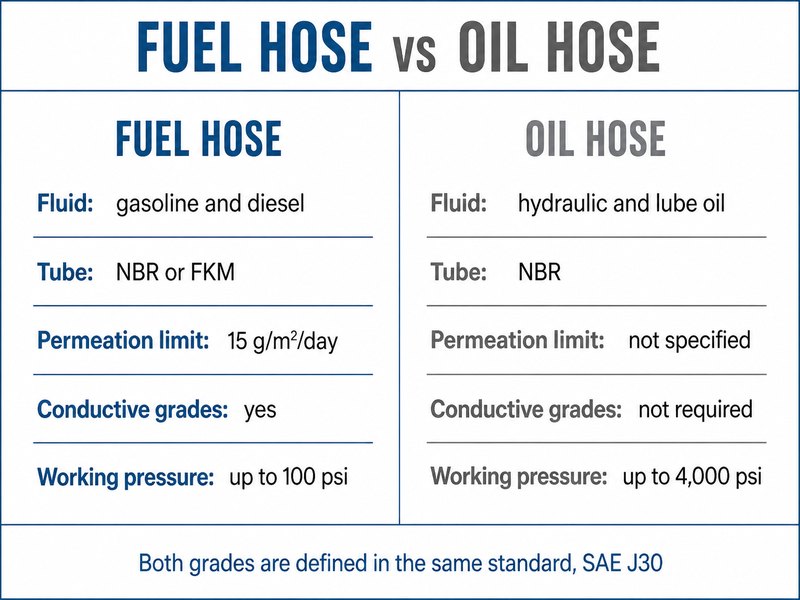
The short answer to fuel hose vs oil hose is that a fuel hose is an oil hose with two extra requirements — low fuel permeation and, in flammable service, static dissipation. Both carry hydrocarbon through the same three-layer rubber construction, and in North America both are governed by the same document: SAE J30 (the Society of Automotive Engineers’ *Fuel and Oil Hoses* standard).
The rule that decides most cases runs in one direction only: a fuel-rated hose will normally serve an oil line, but an oil hose is not automatically rated for fuel. This guide is written for maintenance engineers, fleet buyers and parts counter staff holding two similar-looking hoses and having to pick one.
This guide sets the two products side by side across the properties that decide a specification: inner tube compound, permeation rate, electrical conductivity, working and burst pressure, temperature ceiling, sizing convention, and the fuel-chemistry cases. Ethanol, E85, biodiesel and methanol are where the choice stops being free. It then answers the cross-use questions that bring most readers here, works through the marine and bulk transfer duties where the rating is not optional, and closes with a nine-point checklist you can work down at the counter.
Figure 1. The same three-layer construction, two different service envelopes: what separates a fuel hose from an oil hose is permeation, conductivity and the fluid chemistry on the inside.
What Is the Difference Between a Fuel Hose and an Oil Hose?
A fuel hose is specified against a fuel standard and must control vapor loss and static charge. An oil hose is specified against an oil or hydraulic standard and must control swelling, extraction and pressure. Everything else — the rubber tube, the textile or wire reinforcement, the abrasion-resistant cover, the crimped ends — is common ground. Stated that way, the difference between fuel hose and oil hose is a difference in what each product was required to prove, not in how it was built.
The practical consequence is a one-way substitution rule. A hose built and marked as a fuel hose will normally serve an oil line, because fuel is the more aggressive of the two fluids and the fuel rating already covers oil resistance. A hose built only as an oil hose will usually not serve a fuel line, because nothing in its specification required it to hold vapor inside the wall or to drain static charge to earth.
The table below condenses the fuel hose vs oil hose difference into the eight rows that matter when you are standing at a counter with two similar-looking hoses in your hands.
Table 1. Fuel hose compared with oil hose, property by property
| Property | Fuel hose | Oil hose |
|---|---|---|
| Fluid carried | Gasoline, diesel, ethanol blends, methanol, kerosene, fuel oil (heavy fuel oil — the residual grades such as No. 2 and No. 6 bunker fuel, not gasoline or diesel) | Mineral hydraulic oil, lubricating oil, engine oil, gear oil, diesel |
| Governing document | SAE J30 series; SAE J1527 or ISO 7840 in marine service; EN 1761 or UL 330 in bulk transfer | SAE J517 or EN 853 and EN 856 for hydraulic duty; EN 1765, DIN 20023 or DIN 73379 for oil suction, discharge and tubing |
| Typical inner tube | Nitrile (NBR) for low pressure; fluoroelastomer (FKM) or a laminated barrier layer where permeation and ethanol resistance are required | Nitrile (NBR) as the default; chloroprene (CR) for general oil service; FKM above roughly 120 °C |
| Permeation limit | Specified: 600 g/m²/day (SAE 30R6) down to 15 g/m²/day (SAE 30R9, SAE 30R14) depending on grade | Not specified |
| Static dissipation | Specified for conductive grades, with a defined resistance window and a marking suffix | Available on transfer and suction constructions, but not required by the base oil hose specification |
| Working pressure band | Low: 50 psi for general low-pressure hose; 100 psi for fuel injection grades; 1.0 MPa (145 psi) for the low-permeation feed and return grade; higher on supplier-published SKUs | Very wide: from a few bar on return and transfer lines to 4,000 psi and above on wire-braided hydraulic hose |
| Rated temperature band | 100 °C to 125 °C for low-pressure grades; 135 °C continuous and 150 °C intermittent for fuel injection grades | About -40 °C to +100 °C for standard NBR; above that, a high-temperature compound is required |
| Sizing convention | Inner diameter in inches or millimeters, in fractional steps such as 5/16, 3/8 and 1/2 inch | Dash number for hydraulic hose, where each dash is 1/16 inch; plain inches for transfer and suction hose |
Why does one standard cover both fuel hose and oil hose?
Because the standard’s authors treated fuel and oil as a single service family with a graduated set of requirements rather than as two unrelated products. The scope of SAE J30 states that it covers fuel, oil or emission hose for use with gasoline, oil, diesel fuel, lubrication oil, or the vapors present in either the fuel system or the crankcase of an internal combustion engine. The document was first issued in 1946 and the revision that most current datasheets reference dates from December 2008.
That single scope sentence is the whole answer to the comparison. The same standard family that defines a 50 psi carburetor feed line also defines a 100 psi fuel injection line, and both are written against fluids that include lubrication oil. What changes between grades is not the fluid category but the test severity: permeation rate, oxygenate exposure, temperature ceiling and burst pressure.
The low-pressure grade that most people actually meet is described in the standard as hose for use with gasoline, diesel fuel, lubrication oil, or the vapor present in either the fuel system or the crankcase. That is a fuel hose and an oil hose described in one breath, by the same clause.
What is the one-line rule for substitution?
Match the rating to the harder fluid, never to the easier one. If a single line has to handle both fuel and oil, specify the fuel-rated hose and confirm its oil resistance rather than specifying an oil hose and hoping it tolerates fuel vapor. A tank truck compartment wash-down line, a workshop waste-oil extractor that also pulls gasoline, and a farm bowser that carries diesel one week and hydraulic oil the next are all cases of that pattern. On a mixed-duty line, that single rule resolves the difference between fuel hose and oil hose without needing the fluid sequence to be known in advance.
What Are the Four Layers of a Fuel or Oil Hose?
Both products are built as a tube, a reinforcement, an optional barrier and a cover, and each layer answers a different failure mechanism. Reading a datasheet row by row is much easier once the layer stack is clear.
- Inner tube is the only layer that touches the fluid, so it decides chemical compatibility. Nitrile is the default for mineral oils, gasoline and diesel; fluoroelastomer takes over where temperature, ethanol content or permeation limits exceed what nitrile can deliver.
- Reinforcement carries the pressure. Textile braid for low-pressure fuel and oil lines, steel wire braid for medium and high-pressure hydraulic service, and a wire helix for suction hose that must hold vacuum without collapsing.
- Barrier layer is the thin laminated film that sits inside or immediately behind the tube on low-permeation constructions. It is what makes a 15 g/m²/day permeation figure possible in a rubber hose.
- Outer cover absorbs the environment: abrasion against a frame, ozone from nearby motors and welders, UV, oil splash and heat radiation.
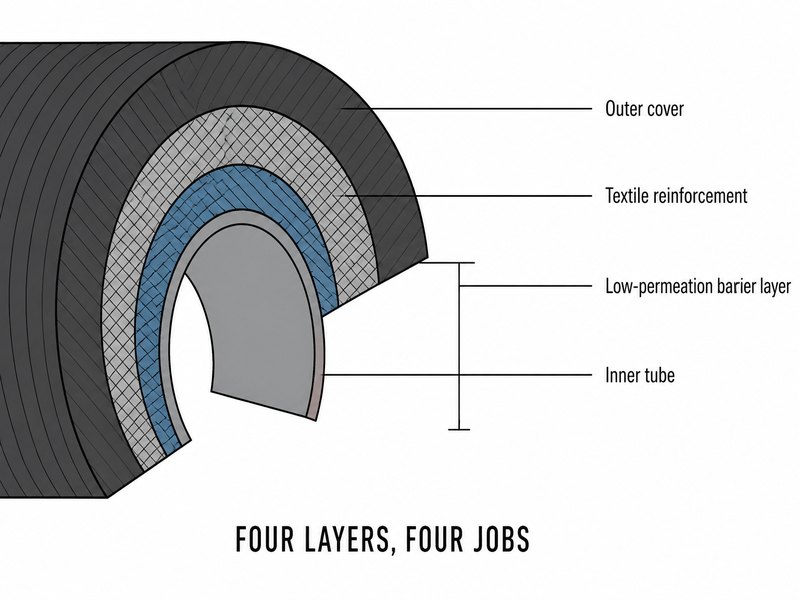
Figure 2. Four layers, four jobs: the tube carries the chemistry, the barrier carries the permeation limit, the braid carries the pressure, and the cover carries the abuse.
Which layer fails first?
In our compounding and returned-goods reviews, the tube and the barrier fail first and the reinforcement fails last. A hose that has been chemically attacked looks intact from the outside; the cover and braid are still sound while the bore (the inner diameter) has swollen, hardened or begun shedding particles into the fluid.
That order of failure is why a visual inspection is not sufficient evidence that a hose is compatible with what it is carrying. A fuel hose used on the wrong fluid can pass every external check and still be depositing rubber debris into a filter or an injector. The same pattern appears in oil service, where the returned parts we see most often are not burst hoses but hoses whose compound was matched to the pressure rating instead of to the fluid.
Which Inner Tube Compound Belongs in a Fuel Hose and Which in an Oil Hose?
Fuel hose material and oil hose material are frequently the same base compound — nitrile rubber — so the difference between fuel hose and oil hose is not the chemical name on the label but how far that compound has been pushed. The tube compound is the single decision that determines whether the hose lives or dies, and the four compounds that cover almost all industrial and automotive work are nitrile, fluoroelastomer, chloroprene and EPDM (ethylene propylene diene monomer rubber). Their differences are not marginal: two of the four are actively unsuitable for one of the two fluids in this comparison.
The candidates differ on four axes at once — fuel chemistry, temperature, alcohol tolerance and cost — so choosing a fuel hose material is a trade between them rather than a single winning answer.
Table 2. Inner tube compounds compared for fuel and oil service
| Compound | Best for | Typical temperature band | Ethanol and methanol | Oil resistance |
|---|---|---|---|---|
| NBR — nitrile | Gasoline, diesel, mineral hydraulic oil, lubricating oil | About -40 °C to +100 °C | Fair up to roughly E10; swells and hardens at higher alcohol content | Yes — the default for oil service |
| FKM — fluoroelastomer | Hot oil above about 120 °C, E85, methanol, aggressive additives | Well above the nitrile ceiling | Yes, including high-alcohol and alcohol-extended fuels | Yes |
| CR — chloroprene | General oil service, weathering-exposed covers | Below the FKM band | Limited | Yes, generally between NBR and EPDM in behavior |
| EPDM | Water, steam, hot air, coolant, brake fluid | Wide, including steam duty | Not for fuel service | No — softens and swells in contact with oil |
| PTFE liner (polytetrafluoroethylene) | E85, methanol, race fuel, solvents, wherever a rubber tube is not inert enough | Very wide at both ends | Effectively inert | Yes, plus near-zero permeation |
Why does EPDM hose fail where nitrile lasts?
EPDM is an excellent rubber — it resists water, steam, ozone and weather better than nitrile, which is exactly why it is the standard coolant and steam hose compound. Its weakness is hydrocarbon. EPDM has no chemical affinity for non-polar fluids, so oil and fuel are absorbed into the rubber instead of being repelled, and the tube swells, softens and loses tensile strength.
This is the mechanism behind the most common substitution mistake in small-engine and automotive work: a hose that looks right, fits the barb, and is sold as general-purpose rubber, used on a fuel or oil line because nothing on the cover says otherwise. The failure is not immediate. The tube dissolves from the inside over weeks or months, sheds particles into the fuel system and then weeps at the clamp. That is why a heater hose is never a fuel line, and why the printed rating matters more than the diameter.
Which compound survives ethanol and methanol?
Fluoroelastomer and PTFE do; nitrile does not, once the alcohol content rises. Ethanol attacks rubber by two routes at once. It is absorbed into the compound, which swells the tube and narrows the bore, and it extracts plasticizers and stabilizers out of the compound, which hardens the tube until it cracks. The two effects are the reason a hose can fail in a way that looks like old age after a single season on a high-ethanol blend.
There is a written threshold in the standard rather than only a rule of thumb. The low-pressure grades are qualified against gasoline and diesel. SAE J30 notes that exposure to fuel containing more than 5 % by volume of oxygenates — ethanol, methanol or MTBE — may produce significantly higher permeation rates than the figures those grades are published with. In practice that means a general low-pressure fuel and oil hose is inside its qualification envelope up to about E10 and outside it beyond that, and the correct response is to move to a barrier-layer or fluoroelastomer grade rather than to shorten the replacement interval.
For methanol and for E85, the answer in our own order book is consistent: fluoroelastomer tube or PTFE liner, every time. Standard nitrile is not a compromise position at those alcohol levels, it is a scheduled failure. Where the duty is a vehicle fuel line rather than an industrial transfer line, the same fork appears in thermoplastic fuel hose form, where a nylon or polymer tube carries the fuel and the rubber hose is reserved for the joints.
Not sure which grade your fuel chemistry requires? Send us the fluid, its alcohol content and the maximum system pressure, and we will confirm the grade and the tube compound for you. Request a grade recommendation and free samples.
Permeation: The Limit Only Fuel Standards Set (600 down to 15 g/m²/day)
Permeation is the rate at which fluid vapor migrates through the hose wall rather than along the bore. It is measured in grams per square meter of exposed tube area per day, and it is the property that separates fuel hose grades from each other more sharply than pressure or temperature do. An oil hose has no permeation requirement at all, because an oil line that smells faintly of oil is a housekeeping problem, while a fuel line that weeps vapor inside an engine bay or a boat bilge is a fire and emissions problem.
What do the SAE J30 permeation figures actually say?
The standard’s application selection guide publishes a permeation figure against each grade, and the spread across grades is far wider than most buyers expect. The table below brings the standard’s own figures together with the pressure and temperature limits that apply to the same grade.
Table 3. SAE J30 grades by permeation, working pressure and temperature
| Grade | Permeation limit, g/m²/day | Maximum working pressure | Rated temperature | Typical duty |
|---|---|---|---|---|
| SAE 30R6 | 600 | 50 psi (0.34 MPa) up to 3/8 inch bore; 35 psi (0.24 MPa) above; 16 psi (0.11 MPa) above 1 inch | 100 °C | Carburetor feed and return, general low-pressure fuel and oil lines |
| SAE 30R7 | 550 | 50 psi (0.34 MPa) up to 3/8 inch bore; 35 psi (0.24 MPa) above | 125 °C | The general-purpose fuel and oil hose most counter stock is |
| SAE 30R8 | 200 | 50 psi (0.34 MPa) up to 3/8 inch bore; 35 psi (0.24 MPa) above | 135 °C continuous, 150 °C intermittent | Hotter under-hood low-pressure lines |
| SAE 30R9 | 15 | 100 psi (0.69 MPa) up to 1/2 inch bore | 135 °C continuous, 150 °C intermittent | Fuel injection feed and return on EFI, TBI and EFM systems |
| SAE 30R10 | Not required | 100 psi (0.69 MPa) up to 1/2 inch bore | 100 °C, intermittent to 125 °C | In-tank, uncoupled hose submerged in the fuel tank |
| SAE 30R14 | 15 maximum, measured on Fuel CE10 | 50 psi (0.34 MPa) up to 3/8 inch bore; 16 psi (0.11 MPa) above 1 inch | 100 °C or 125 °C depending on heat class | Low-permeation small-engine fuel lines |
| SAE 30R11 | 100 maximum | 14.5 kPa, about 2 psi, in liquid or vapor service | 100 °C for heat class T1; 125 °C for T2 | Low-permeation fuel fill, vent and vapor lines |
| SAE 30R12 | Under 100 (SAE J1737, CM15 fuel at 60 °C) | 1.0 MPa, about 145 psi | 100 °C (T1), 125 °C (T2), 135 °C (T3) or 150 °C (T4) | Low-permeation fuel feed and return, including fuel injection systems |
Two SAE J30 rows carry the whole comparison. A general-purpose low-pressure fuel and oil hose (SAE 30R7) is permitted to permeate at 550 g/m²/day, while an SAE J30R9 fuel injection hose is held to 15 g/m²/day — a limit roughly 37 times tighter. Neither figure is a manufacturer’s claim. Both are qualification limits written into the standard, and the spread between them is the clearest technical statement of the difference between fuel hose and oil hose that appears anywhere on a datasheet.
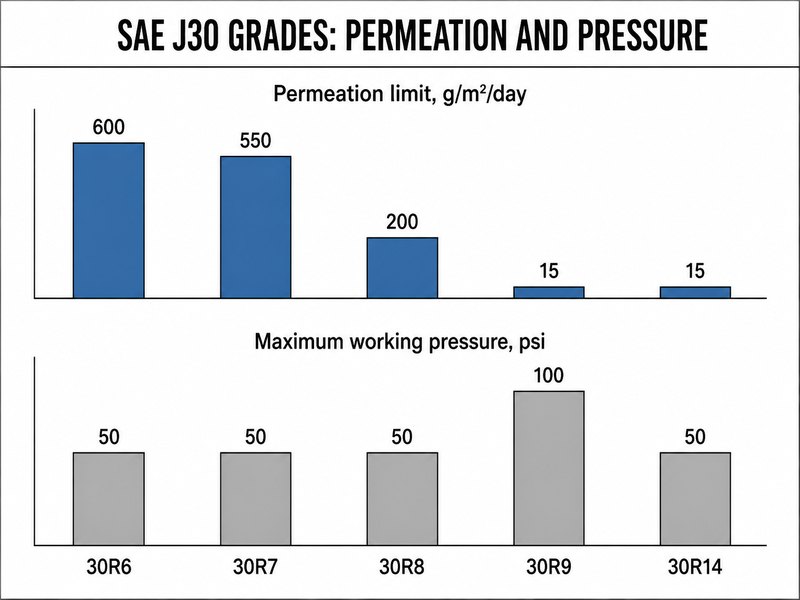
Figure 3. Permeation falls from 550 g/m²/day (SAE 30R7) to 15 (SAE 30R9), a factor of roughly 37, while the working pressure ceiling doubles from 50 psi to 100 psi.
What does a 37-fold difference in permeation mean in service?
A 37-fold permeation difference changes what a hose is permitted to be used for, not merely how much it smells. In an open, vented system the vapor that leaves through the wall disperses and is a nuisance. In a sealed modern fuel system the same vapor accumulates and is measured. Evaporative emission rules in North America are enforced against the whole vehicle, and a hose that passes 550 g/m²/day can put a vehicle outside them regardless of how well the tank and canister perform.
That is why OEM automotive fuel systems stopped specifying the general low-pressure grade. The direct consequence for anyone buying replacement hose is that the grade printed on the cover is the only reliable statement of what the hose is for, and the size printed next to it says nothing about it. A 5/16 inch hose can be a 550 g/m²/day general line or a 15 g/m²/day injection line, and the two are not interchangeable.
There is a second, quieter consequence. A high-permeation hose in a hot engine bay loses its lighter fractions continuously, which is the same extraction mechanism that stiffens the tube. The standard’s own note on high-oxygenate fuel points in the same direction: more permeation, faster aging, shorter service life.
Which grades carry the permeation limit in their marking?
The low-permeation fill, vent and feed grades do, and that marking is a compact specification in itself. For those grades the suffix after the grade number encodes three facts in three positions. The first position gives the permeation band: A for 0 to 25 g/m²/day, B for 26 to 50, and C for 51 to 100. The second gives conductivity: E for electrically conductive and N for non-conductive. The third gives the heat class, written as the letter T followed by a digit: T1 for 100 °C, T2 for 125 °C, T3 for 135 °C and T4 for 150 °C.
The E and N positions state a measured result, not a construction claim. In the standard, E denotes a hose whose conductivity test returns less than 10 megohms and N denotes a hose with no conductivity requirement, so the single letter tells a buyer which side of the acceptance line the construction was built to.
So a hose marked with an A, an E and a T2 is stating that it permeates 25 g/m²/day or less, that it is electrically conductive, and that it is rated to 125 °C. The standard’s own worked examples for that construction are SAE 30R11AET2 for the conductive version and SAE 30R11ANT2 for the non-conductive one.
The full four-position suffix applies to SAE 30R11 and SAE 30R12, and is printed as SAE J30RAAXYTz: the two-letter type position, then the permeation band, the conductivity letter and the heat class. SAE 30R14 carries only the heat-class position and is printed as SAE J30R14Tz, because its permeation limit is fixed by the grade itself rather than stated in the marking. There is no suffix system at all on the plain low-pressure fuel and oil grades, which is precisely why a bare grade number on a general-purpose hose tells you almost nothing about its vapor loss.
Static Dissipation: The Conductivity Window Only Fuel Standards Require
Flowing hydrocarbon generates static charge, and a hose with an insulating wall holds that charge instead of draining it. Every refueling and transfer operation is therefore a controlled static event, and the hose is one link in a chain that also includes the tank, the pump, the vessel and the bonding cables. This is the second requirement that separates a fuel hose from an oil hose, and it is the one most often missed because a non-conductive hose and a conductive hose look identical from the outside.
How does the standard define a conductive hose?
By a measured resistance window rather than by a construction claim. SAE J30 specifies an electrical conductivity test in which an ohmmeter capable of measuring resistance from 10⁻¹ to 10³ megohms at 550 volts DC is applied across a hose length of up to 610 mm. The hose rests on a non-conductive surface, with plugs or fittings close to the bore diameter, at each end.
Two design decisions follow from that. The first is that conductivity is a property of the finished assembly, not of the rubber compound alone, so a conductive tube bonded to non-conductive end fittings does not give you a conductive hose. The second is that the length matters: a longer hose presents a longer path and a higher resistance, which is why the test is defined on a bounded length rather than on a whole reel.
The conductivity result is encoded in the middle position of an SAE 30R11 or SAE 30R12 suffix: E means electrically conductive, N means non-conductive. General-purpose low-pressure grades carry no suffix, so their conductivity is unstated and should be treated as absent unless the supplier publishes a resistance figure.
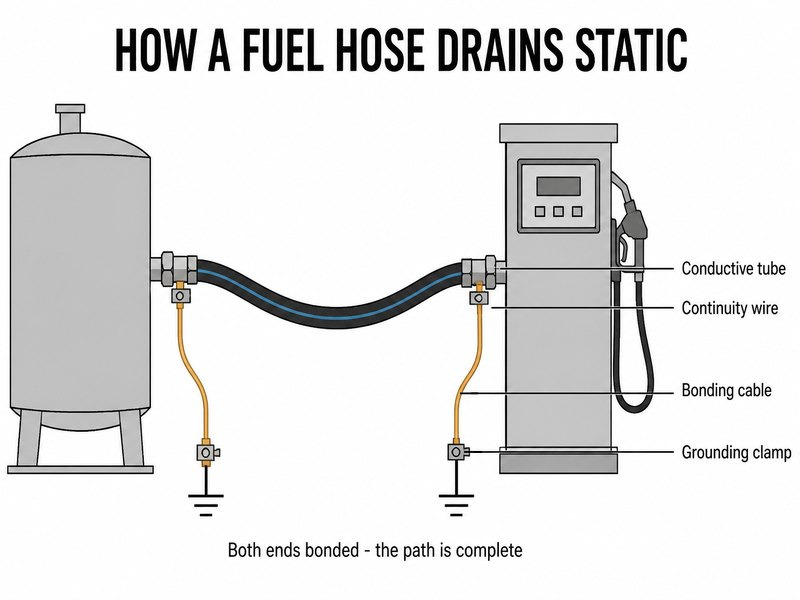
Figure 4. A conductive hose only works as a complete circuit: the tube, the continuity wire, both end fittings and the bonded equipment all have to be part of the same grounded path.
How do you ground a fuel hose in practice?
Four actions, in this order, cover almost every transfer and dispensing installation:
- Specify a conductive or static-dissipative construction and ask for the resistance figure, not the word “antistatic” on its own.
- Verify the continuity path with a multimeter between the two coupling halves during every inspection, not only at installation.
- Bond the hose ends to the equipment so the charge has somewhere to go: the end fittings to the tank, and the tank to the receiving vessel or the pump.
- Keep flow velocity moderate, because charge generation rises with velocity and with the length of the run.
For bulk loading and dispensing operations, the accepted practice is set out in recognized guidance for static control in flammable liquid handling. The installation detail — bonding, grounding, and the order in which connections are made and broken — is covered there rather than in the hose standard itself. A conductive hose with ungrounded ends performs no better than an insulating one, which is the single most common error we see in installed transfer systems.
Fuel Hose vs Oil Hose: How Do the Pressure Ratings Compare?
This is the part of the comparison where the two products genuinely diverge, and where the divergence surprises people. The fuel hose grades in this standard are low-pressure products. The oil hose family includes the entire hydraulic pressure range, from a few hundred psi on return lines to several thousand psi on wire-braided and spiral constructions.
A 3/8 inch hydraulic hose in a two-wire-braid construction is rated at 4,000 psi working pressure, and four-and-six-spiral constructions reach 4,000 to 6,000 psi. Against those numbers the SAE J30 fuel grades are low-pressure products. An SAE J30R9 fuel injection hose is rated to 100 psi. The ceiling sits at 1.0 MPa — about 145 psi — for the low-permeation feed and return grade SAE 30R12. The general low-pressure and small-engine grades stay at 50 psi or less, and the fill and vent grade sits at 14.5 kPa, about 2 psi. The two are not alternatives at the same pressure level.
Table 4. Working pressure ceilings across the fuel and oil hose families
| Product | Bauwesen | Typical working pressure | Minimum burst pressure |
|---|---|---|---|
| General low-pressure fuel and oil hose | Textile braid, NBR tube | 50 psi (0.34 MPa) up to 3/8 inch bore | 1.72 MPa, about 250 psi, at that bore |
| Fuel injection hose | Laminated tube with barrier, textile braid | 100 psi (0.69 MPa) up to 1/2 inch bore | 6.2 MPa, about 900 psi, up to 3/8 inch bore |
| Low-permeation small-engine fuel hose | Barrier construction, textile braid | 50 psi (0.34 MPa) up to 3/8 inch bore | 1.72 MPa, about 250 psi, at that bore |
| Low-pressure hydraulic return hose | Single textile braid, oil-resistant tube | About 400 psi at 3/8 inch bore | About 1,650 psi at that bore |
| Hydraulic hose, single wire braid | One steel wire braid (SAE 100R1 type) | About 2,250 psi at 3/8 inch bore | About 9,000 psi at that bore |
| Hydraulic hose, two wire braid | Two steel wire braids (SAE 100R2 type) | About 4,000 psi at 3/8 inch bore | About 16,000 psi at that bore |
| Hydraulic hose, four and six spiral | Spiral wound wire | 4,000 to 6,000 psi | Four times the working pressure at a 4:1 design factor |
| Oil suction and discharge hose | Fabric plies plus helical wire | 10 bar and 20 bar classes | Four times the working pressure at a 4:1 design factor |
Why is the burst-to-working ratio different for the low-pressure and injection fuel grades?
Because the two ratios are set by different clauses of the same standard, and because the low-pressure ratio is limited by the smallest bore band. Take the standard’s own published minimums:
- The low-pressure grade at 3/8 inch bore or below carries a maximum working pressure of 0.34 MPa — 50 psi — and a minimum burst of 1.72 MPa, about 250 psi. That is a ratio of roughly 5.1 to 1.
- The fuel injection grade up to 3/8 inch bore carries a maximum working pressure of 0.69 MPa — 100 psi — and a minimum burst of 6.2 MPa, about 900 psi. That is a ratio of roughly 9 to 1.
The injection grade is therefore not simply a low-pressure hose with a stronger braid. Its working pressure doubles while its required burst pressure rises by a factor of more than three and a half, so the safety reserve above the working rating is roughly twice as large. That extra reserve is what pays for the pressure pulses a fuel injection system delivers — the rapid valve events and pump pulsations that a carburetor feed line never sees.
Above 3/8 inch bore the low-pressure grade steps down to 35 psi working pressure, and the injection grade’s burst requirement steps down to 3.4 MPa while its working pressure stays at 100 psi. In both cases the pattern to remember is that the narrow bores carry the higher ratings within a grade, and that the burst figure is a qualification floor rather than a service value.
If you are comparing a working pressure with a burst pressure on a datasheet and the ratio looks unfamiliar, the working pressure versus burst pressure relationship is explained together with proof testing and safety factors in our dedicated guide.
Does a fuel hose ever need a high pressure rating?
Only in specific machinery, and rarely in the fuel grades themselves. The cases we quote most often are these:
- Common-rail and unit-injector diesel systems run at pressures above 2,000 bar, and those lines are steel, never hose. Hose appears only on the low-pressure side of the system, upstream of the high-pressure pump.
- Returnless electronic fuel injection regulates to about 58 psi and return-style systems to about 43.5 psi, both comfortably inside the 100 psi ceiling of the injection grade, leaving room for hot-fuel and pulsation margin.
- Carburetor systems run mechanical pumps at 4 to 7 psi, which is why the general low-pressure grade is entirely adequate there and why using an injection hose on a carburetor feed line buys cost and stiffness rather than safety.
- Performance and race builds with high-volume pumps are the exception where hose carries real pressure. Those installations use braided PTFE or reinforced fluoroelastomer hose with mechanical fittings rather than clamped rubber, because the peak flow and the fuel chemistry together exceed what a clamped low-pressure line can hold.
Fuel Hose vs Oil Hose: How Do the Temperature Ratings Compare?
On temperature the two families overlap far more than they do on pressure, and the practical question is not which product is hotter-rated but which class inside the grade you have ordered. The fuel grades publish a rated external temperature that steps up with grade: 100 °C for the entry low-pressure grade, 125 °C for the general-purpose grade, and 135 °C continuous with 150 °C intermittent for the high-temperature low-pressure grade and the fuel injection grade.
Oil hose temperature is a question of compound rather than class. A standard nitrile hose operates from about -40 °C to +100 °C. Above roughly 100 °C the compound choice has to change, and above about 120 °C sustained, fluoroelastomer becomes the realistic answer in continuous service. Hot engine oil returning from a turbocharger, oil cooler circuits on engines and transmissions, and hydraulic systems with poor heat rejection all sit in that range, and a standard nitrile return hose is the wrong specification for them even though the pressure is trivial.
The comparison to carry away is this: temperature does not tell you whether a hose is a fuel hose or an oil hose, but it does tell you whether the tube compound you have selected is still valid.
Fuel Hose vs Oil Hose: How Is Each One Sized?
Size means the bore, the inner diameter, in both families: it sets flow capacity, and the outer diameter follows the reinforcement. What differs is the language used to describe it, and mixing the two languages is a routine source of wrong orders.
How is a fuel hose sized?
The fuel hose sizes that matter in automotive and small-engine work are quoted in fractions of an inch, and a short list of them does most of the work. Small engines such as trimmers and chainsaws take 3/16 inch; lawn mowers and carburetor return lines take 1/4 inch; older OEM carburetor feed lines and some injection return lines take 5/16 inch. Modern electronic fuel injection feed lines take 3/8 inch, which is also the common metric 8 to 10 millimeter size.
Metric sizes are quoted in millimeters on many non-North-American machines, and the nearest practical equivalents are 4 mm, 6 mm, 8 mm, 10 mm, 12 mm and 16 mm across that range. The bore also sets the flow rate the line can pass, so oversizing adds weight and stiffness while undersizing starves the engine.
Performance plumbing uses a third language, the AN dash system, where each dash is 1/16 inch of nominal size. A -6 line is therefore 3/8 inch and a -8 is 1/2 inch. That convention is the same arithmetic as hydraulic dash sizing, and it is the only place where the fuel and oil sizing systems converge.
When you are replacing a hose rather than designing a system, the reliable reference is the old hose: the size printed on the cover, or a caliper reading taken on a clean square-cut end. Most fuel hose sizes are confirmed a second time by the barbed fitting the hose slides onto, which is more dependable than a visual estimate.
How is an oil or hydraulic hose sized?
By dash number for hydraulic hose, where each dash is 1/16 inch, so a dash -8 is 8/16 inch, or 1/2 inch. Transfer, suction and discharge hose is usually quoted in plain inches or millimeters instead — a 1 inch fuel transfer hose, a 3 inch suction hose — because those products are sold by bore rather than by system dash.
Fuel hose sizes, hydraulic dash numbers and transfer bore ranges all describe the same physical property in three different languages, and mixing them up is the most common source of a wrong order.
The size chart for fuel line hose sizes — the fractional, metric and AN equivalents and the flow each bore supports — is set out in our fuel line hose sizes, materials and applications guide. The transfer and suction bore ranges are covered in the oil transfer hose selection guide and the oil suction and discharge hose guide.
Table 5. Sizing language by duty
| Duty | Sizing language | Common values |
|---|---|---|
| Automotive fuel line | Fraction of an inch, or millimeters | 3/16, 1/4, 5/16, 3/8 inch |
| Performance fuel system | AN dash | -4, -6, -8, -10 |
| Hydraulic oil line | Dash number | -4 through -32 |
| Fuel and oil transfer | Plain inches or millimeters | 3/4, 1, 1-1/2, 2 inch and above |
| Oil suction and discharge | Plain inches or millimeters | 3/4 inch to 4 inch |
One caution that applies to both families: never size by outer diameter. Two hoses with the same bore can differ by several millimeters outside because one has an extra braid, a helix wire or a heavier cover, and sizing to the outer surface produces a hose that fits the space and starves the flow.
Can You Use Fuel Hose for Oil?
Usually yes, with one qualification. A hose rated for fuel service already satisfies an oil-resistance requirement, because the tube compounds and barrier layers used for gasoline and diesel are selected precisely because they resist hydrocarbon attack. Running lubricating oil, hydraulic oil or diesel through a fuel-rated hose is the safe direction of substitution.
The limit on can you use fuel hose for oil is pressure and temperature rather than chemistry. A low-pressure fuel hose is a low-pressure product: 50 psi or 100 psi working pressure depending on grade, and a rated temperature of 100 °C to 135 °C. If the oil line you are replacing carried 2,000 psi or ran above the hose’s temperature rating, the fuel rating does not help you, because the failure would be mechanical or thermal rather than chemical.
The matrix below answers can you use fuel hose for oil and the reverse substitution side by side, reading the rating printed on the cover rather than the label on the shelf.
Table 6. Cross-use matrix, reading the rating rather than the label
| The hose you have | The fluid you want to carry | Verdict | Why |
|---|---|---|---|
| Fuel hose, low pressure | Lubricating or hydraulic oil at low pressure | Normally acceptable | The tube is oil-resistant by construction and the fluid is less aggressive than fuel |
| Fuel hose, low pressure | Oil at hydraulic pressure | Not acceptable | The working pressure ceiling is far below hydraulic system pressure |
| Fuel injection hose | E10 or E85 gasoline | Acceptable at the rated pressure | Barrier tube plus 100 psi working pressure covers injection pressures |
| Oil hose, nitrile | Gasoline or diesel, vented system | Temporary, vented low-pressure use only | No permeation limit is specified, so vapor loss and alcohol attack are unmanaged; not acceptable in a sealed system, under evaporative-emission rules, or in enclosed or marine spaces |
| Oil hose, nitrile | E85 or methanol | Not acceptable | Nitrile swells and hardens; no fuel chemistry was qualified |
| Oil hose, nitrile | Diesel fuel | Common and acceptable | Diesel is a listed fluid for the low-pressure fuel and oil grades |
| Hydraulic hose, wire braid | Gasoline | Not acceptable | No permeation limit and no conductivity requirement; manufacturers state it is not for gasoline or diesel fuel |
| Hydraulic hose, wire braid | Hydraulic or lubricating oil | Acceptable | This is the design duty |
| Heater or coolant hose, EPDM | Fuel or oil | Not acceptable | EPDM swells and softens in hydrocarbon service |
Can You Use an Oil Hose or Hydraulic Hose for Fuel?
Not as a specification, though the answer has more nuance than a simple no. Diesel is a listed fluid for the low-pressure fuel and oil grades, so a nitrile oil hose carrying diesel at low pressure in a vented system is a common and defensible arrangement. Gasoline is a different question, and can hydraulic hose be used for gasoline is settled by three missing requirements rather than by pressure alone.
What Does a Gasoline Line Require That a Hydraulic Hose Does Not Provide?
- Permeation limit: required, and absent. A gasoline line must be held to a published permeation limit — 15 g/m²/day for an SAE J30R9 fuel injection hose. Standard hydraulic hose states no such limit, so a gasoline line built from it loses fuel continuously and fails an evaporative emission check by design.
- Conductivity: required, and absent. A flammable-fluid line in transfer or marine service must declare a resistance window, written as the E or N position of an SAE 30R11 or SAE 30R12 suffix. Hydraulic hose declares none, and a wire-braided or thermoplastic line may even be deliberately non-conductive, which is the opposite of what a flammable fluid line needs.
- Pressure class: mismatched. A 4,000 psi hose used on a 5 psi line is heavy and stiff, and stiffness works against you: tight routing on a hose that does not want to bend concentrates stress at the fittings, which is where most premature failures start.
Manufacturer datasheets for the low-pressure textile-braided hydraulic grades state the position plainly: they carry petroleum-based hydraulic oils, water, glycol antifreeze solutions, engine lubricating oils and air, and are not for use with gasoline or diesel fuels. When a datasheet says that, it is not describing a preference, it is describing the qualification envelope — so anyone asking can hydraulic hose be used for gasoline is asking a question the datasheet has already answered.
The correct product for a fuel-duty line is a hose built and marked to a fuel standard. Where the line is a hydraulic line that happens to touch fuel oil or diesel on a return path, the hydraulic rating governs; where the line actually carries a flammable fuel, the fuel standard governs. The two duties are separated in our oil hose types and applications guide, and the compound-level matching rules are worked through in the inner tube selection guide covering nitrile, EPDM and fluoroelastomer.
Fuel Hose vs Oil Hose: What About Heater, Transmission and Coolant Hose?
Three adjacent substitutions come up often enough to deserve their own answer, because all three involve hoses that fit the fitting and fail in service.
- Heater hose. Usually EPDM, built for hot coolant. It swells and softens in contact with gasoline or oil, so it is the wrong material for either. It is also unrated for fuel permeation and static, which makes it a fire risk in a hot engine bay rather than merely a poor choice.
- Transmission fluid hose. Often a nitrile-based hose similar in construction to a low-pressure fuel and oil hose, and frequently sold as suitable for automatic transmission fluid and power steering fluid. That is a legitimate use. Substituting it for a fuel line is only defensible if the hose itself carries a fuel rating, which transmission fluid coolers do not require.
- Coolant hose. Same material problem as heater hose. Beyond compatibility, coolant systems are typically unpressurized or lightly pressurized compared with fuel injection circuits, so the burst margins are different even where the fluid chemistry happened to be tolerable.
The unifying rule is that the printed standard, not the fluid you intend to use, decides whether a substitution is valid. A hose carrying a fuel standard is a fuel hose; a hose carrying a coolant or automatic transmission fluid standard is not, whatever its diameter. The same rule is what makes can hydraulic hose be used for gasoline a question about the standard rather than about how the hose looks.
Does the Answer Change With the Fuel? Ethanol, E85, Biodiesel and Methanol
Yes, and this is where the fuel hose vs oil hose comparison stops being a materials question and becomes a fuel-chemistry question. Four fuels change the specification, and each does so for a different reason.
Ethanol and the oxygenate threshold written into the standard
The standard’s own note sets the boundary: exposure to gasoline containing more than 5 % by volume of oxygenates such as ethanol, methanol or MTBE may produce significantly higher permeation rates than the figures the low-pressure grades are published with. E10 sits at the boundary. E15 and E85 sit outside it. The response is to move up the grade ladder — to a barrier-layer or fluoroelastomer tube — rather than to accept a shorter replacement interval.
Biodiesel and hot diesel return lines
Biodiesel blends up to B20 are handled by standard nitrile constructions, but the fluid is more aggressive to some cover compounds and degrades faster in storage than mineral diesel, so a hose marked for biodiesel service is the safer order. Diesel is also the one fuel in this comparison where temperature usually matters more than chemistry: return lines on modern engines run hot, and a standard nitrile hose at its temperature ceiling will age out quickly regardless of how well it resists the fuel.
Methanol and E85
Methanol and high-ethanol blends are the end of the range where rubber stops being the right answer. Fluoroelastomer tube or a PTFE liner is the specification, and the reinforcing and fitting system needs to match — braided PTFE hose is assembled with mechanical fittings rather than clamped barbs, which changes both the tooling and the installation procedure.
For a diesel fuel line the practical decision is usually still NBR, and for E85 it usually is not. That single fork is the most useful thing to carry into a counter conversation.
Marine and Bulk Transfer: Two Duties Where the Rating Is Not Optional
Both duties add a requirement that has nothing to do with oil resistance, and in both the requirement is a legal or certification matter rather than a performance preference.
What rating does a boat fuel line need?
Marine gasoline installations in enclosed compartments require a fire-rated fuel hose. In North America the classes are defined under SAE J1527, and the US Coast Guard requires A1-15 hose for that duty. The fire-resistance requirement for a Type A hose is a 2.5-minute burn test, and the trailing -15 in a Type A1-15 marking denotes a permeation limit of 15 g/m²/day rather than a fire rating. ISO 7840 Type A1 is the international equivalent of the Type A fire class, and the installation side is covered by the recognized boat and yacht council standards for fuel systems and ventilation.
The practical point is that no automotive fuel hose carries that rating. A hose marked 30R9 is a legal automotive fuel line and not a legal marine one, and substituting it because the diameter matches is an inspection failure at best. Our marine oil hose guide covers the saltwater, UV and deck-transfer side of the same duty.
What does a bulk fuel transfer hose need that a fuel line does not?
A conductive path and a continuity wire. Bulk transfer and dispensing hose is larger-bore, higher-flow and handled in the open, so static generation is higher and the hose is the main conductor between two vessels that may be at different potentials. The construction therefore adds a conductive tube and a copper continuity wire bonded end to end. The recognized standards for this duty — the European fuel delivery hose standard for tanker service and the dispenser hose standard in North America — require that continuity rather than merely allowing it.
Two installation rules follow. Verify the continuity wire with a multimeter between the two coupling halves at every inspection, and treat a failed continuity check as a replacement trigger even when the hose looks new. A nondestructive visual inspection cannot detect a broken continuity wire.
If your requirement is moving fuel between a tank, a truck and a machine rather than feeding an engine, the selection logic changes completely. The fuel transfer hose guide and the petroleum transfer and bulk loading hose guide are the relevant starting points, and the dock and bunkering hose range covers the marine loading case.
How Do You Read the Marking on a Fuel or Oil Hose?
The printed line on the cover is the specification, and it is the only part of the hose that survives the counter, the shelf and the installation. Three blocks of information are worth looking for in order.
- The standard and grade. A fuel standard reference followed by the grade number — SAE 30R7 for the general low-pressure fuel and oil grade, or SAE 30R9 for the fuel injection grade. That single token states the permeation limit, the working pressure ceiling and the temperature class.
- The size. Usually the inner diameter, written as a fraction of an inch or a dash number. Read it as bore, not as outer dimension.
- The date code and batch. Rubber ages on the shelf as well as in service, and a date code is what lets a supplier trace a failure back to a production batch.
Where the grade supports a suffix, the suffix is worth decoding on the spot: permeation band, conductivity and heat class, in that order. A hose with no marking, or with only a size and a colloquial description such as fuel hose, is an unrated hose. In our inspection work that category is usually general-purpose rubber, and it fails the permeation and ethanol checks the first time they are applied.
Two marks are commonly confused with ratings and are not ones. A temperature printed alone says nothing about permeation or conductivity. A pressure printed alone says nothing about the fluid the hose was qualified for.
Fuel Hose vs Oil Hose Selection Checklist
Nine checks, in the order that decides the answer. Work down the list and the correct product selects itself.
- Fluid identity and alcohol content. Gasoline with the actual ethanol percentage, diesel, E85, methanol, hydraulic oil, lubricating oil, or a mix. Oxygenate content above 5 % moves you to a barrier or fluoroelastomer grade.
- Maximum working pressure of the system, not the normal operating pressure. Include pump pulsation and surge margin.
- Continuous fluid temperature at the hottest point, not the ambient air temperature. This decides whether nitrile is still valid.
- Bore size from the required flow and the port, never from the outer diameter of the old hose.
- Static requirement. Flammable fluid in transfer, dispensing or marine service needs a conductive construction and a verified continuity path.
- Permeation requirement. Sealed systems and any application subject to evaporative emission rules need the low-permeation grade, which on a modern injection engine means an SAE J30R9 fuel injection hose rather than the general low-pressure grade.
- Standard and grade marking, plus the suffix where the grade supports one.
- End connections and clamps. Fuel-rated clamps rather than general worm-gear clamps on pressurized injection lines, and mechanical fittings on braided PTFE.
- Environment. Abrasion, UV, ozone and hot surfaces, plus a routing allowance so the hose is not stretched between two rigid points.
If you can send those nine items, the specification is unambiguous, and the remaining decisions — cover color, printing, length, packaging — are commercial rather than technical.
Frequently Asked Questions
What is the difference between a fuel hose and an oil hose?
A fuel hose meets an additional set of requirements that an oil hose does not: a specified permeation limit that controls vapor loss through the wall, and, for conductive grades, a defined electrical resistance window for static dissipation. Both products use the same three-layer construction and, in North America, the same standard family.
Can you use a fuel hose for oil?
Yes, in most low-pressure cases — that is the everyday answer to can you use fuel hose for oil. A hose rated for gasoline or diesel is oil-resistant by construction, so lubricating oil, hydraulic oil and diesel are the safe direction of substitution, provided the oil line’s pressure and temperature stay inside the hose’s published working pressure and temperature ratings.
Can you use an oil hose for fuel?
Only within limits, and never for high-alcohol fuel. Diesel is listed as a service fluid for the low-pressure fuel and oil grades, so a nitrile oil hose on a vented diesel line is common practice. Gasoline is a different question, because no permeation limit or conductivity requirement applies to an oil hose, and E85 or methanol is outside what a standard nitrile tube can hold.
Can hydraulic hose be used for gasoline?
No. Hydraulic hose is qualified against pressure and impulse rather than permeation and conductivity, and manufacturers of the low-pressure textile-braided grades state explicitly that the hose is not for use with gasoline or diesel fuel. A 4,000 psi hydraulic line is also heavy and stiff, which makes it harder to route safely in an engine bay.
Is a fuel hose the same as a fuel line?
Not exactly. A fuel line is the complete path from tank to engine, which is mostly rigid metal or nylon tubing with short flexible hose sections at the joints. A fuel hose is the flexible section that absorbs vibration and connects parts that move relative to each other. When people say fuel line in a parts conversation, they usually mean the flexible hose.
What does SAE 30R7 mean?
It is the general-purpose low-pressure fuel and oil grade. It carries a maximum working pressure of 50 psi up to 3/8 inch bore and 35 psi above that, a rated temperature of 125 °C, and a permitted permeation of 550 g/m²/day. It is the grade most counter stock is.
What is the difference between 30R7 and 30R9?
Two differences dominate. The injection grade is held to 15 g/m²/day permeation against 550 for the general grade, a limit roughly 37 times tighter, and its working pressure ceiling is 100 psi against 50 psi. The injection grade also carries a larger burst-to-working ratio, about 9 to 1 against about 5 to 1, which pays for injection pressure pulses.
What is SAE J30R9 fuel injection hose rated to?
A maximum working pressure of 100 psi (0.69 MPa) up to 1/2 inch bore, a rated temperature of 135 °C continuous with 150 °C intermittent, and a minimum burst pressure of 6.2 MPa — about 900 psi — up to 3/8 inch bore. Individual suppliers publish higher working pressures on specific SKUs, so the standard figure is the floor rather than the ceiling.
Is SAE 30R10 the same as 30R9?
No. The in-tank grade is a separate specification for uncoupled hose that is submerged inside the fuel tank, so both the tube and the cover have to resist continuous fuel immersion. A submersible application is the one place where the hose is attacked from the outside as well as the inside. Using a non-submersible injection hose inside a tank is a scheduled failure.
What is SAE 100R6 hose used for?
It is a low-pressure hydraulic hose with a single textile braid, used for return, drain and low-impulse lines. At 3/8 inch bore it carries roughly 400 psi working pressure and a minimum burst of about 1,650 psi at a 4:1 design factor, over a temperature band of about -40 °C to +100 °C.
Can I use a fuel hose for diesel?
Yes. Diesel is a listed fluid for the low-pressure fuel and oil grades and for the selected fuel injection grades, and diesel is generally easier on nitrile than gasoline is. The thing to watch on a diesel line is heat rather than chemistry, especially on engine return lines.
Is fuel hose oil resistant?
Yes. Oil resistance is a prerequisite for fuel service rather than an alternative to it, because the tube compounds and barrier layers used for gasoline and diesel are chosen for hydrocarbon resistance first.
Can I use a fuel hose for transmission fluid?
Frequently yes at low pressure, because automatic transmission fluid is a hydrocarbon fluid and nitrile-based hose handles it. Confirm the temperature rating before using a fuel line hose on a transmission cooler circuit, where the fluid runs hot.
What fuel hose do I need for E85?
A fluoroelastomer or barrier-layer tube, or a PTFE liner. The standard notes that fuel containing more than 5 % by volume of oxygenates may permeate significantly faster than the published figures for the low-pressure grades, and E85 is far beyond that threshold. Standard nitrile is not a compromise position at E85 concentrations.
How do I know whether a hose is conductive?
Look for the conductivity position in the grade suffix, where E means the conductivity test returns less than 10 megohms and N means no conductivity requirement applies, or ask the supplier for the resistance figure. On grades that carry no suffix, conductivity is unstated and should be treated as absent. Confirm the installed assembly with a multimeter across the two coupling halves rather than relying on the marking alone.
Does a fuel hose need a special clamp?
On pressurized injection lines, yes. Fuel-rated spring or constant-tension clamps hold their load as the rubber ages, while general worm-gear clamps cut into the hose wall and lose clamping force over time. High-pressure and performance lines use mechanical fittings rather than clamps at all. The torque and material data for the common clamp types is set out in our hose clamp selection guide.
What fuel hose sizes fit most machines?
Three sizes cover most small-engine and automotive work. Use 1/4 inch for carburetor feed and return lines, 5/16 inch for older OEM carburetor feed lines and some injection return lines, and 3/8 inch for modern electronic fuel injection feed lines. Metric machines use 6 mm, 8 mm and 10 mm for the same duties, and performance plumbing expresses the same bores as AN dash numbers.
What is the best fuel hose material for E85?
Fluoroelastomer or a barrier-layer tube, or a PTFE liner. Nitrile rubber swells and hardens once alcohol content passes roughly E10, so it is not a viable fuel hose material for a high-ethanol blend. The barrier layer is the part that holds permeation down; the fluoropolymer is the part that survives the chemistry.
HENGHUA: Fuel Hose and Oil Hose From the Same Standard Family
HENGHUA manufactures the fuel and oil hose families this comparison describes, and publishes the ratings that let a buyer check the claim. The fuel range covers the low-pressure, injection and low-permeation small-engine grades, plus marine-certified constructions and factory-crimped assemblies. The oil range covers hydraulic hose across the braided and spiral families, oil suction and discharge hose in the 10 bar and 20 bar classes, oil transfer hose, and fuel oil hose with conductive options.
On the fuel side, the catalog lines most often specified against the duties in this article are the general fuel delivery hose and the wrapped-surface fuel oil hose rated 300 psi for transfer and discharge work. The stainless steel braided fuel hose covers higher-pressure and higher-temperature installations.
Dispensing equipment is a separate construction again. The fuel and gasoline dispenser pump hose covers that duty, and the fuel suction and discharge hose covers the suction and discharge side of the same range.
Because we compound the tube and cover, braid the reinforcement, extrude the hose, crimp the ends and pressure-test finished lines in our own plant, the numbers on our datasheets come from our own process rather than from a reseller’s copy of someone else’s table. Every assembly leaves with a proof test at 1.5 times its working pressure, and each production batch is burst-tested so the margin behind the working pressure is measured rather than assumed. Low-permeation and conductive grades are supplied with the permeation class and resistance requirement stated on the order rather than left to inference from the grade number.
Where we add most value is in exactly the cases this article treats as conflicts. If a line has to carry fuel on one shift and oil on the next, that is a mixed-duty question. If a diesel return line runs hotter than the standard nitrile band, that is a compound question. If a transfer bay needs a conductive construction with a verified continuity wire, that is a construction question.
All three are answered from the service conditions rather than from a catalog page. Where the honest answer is that a rubber hose is the wrong product and a PTFE or thermoplastic construction belongs in the line, we say so.
Two limitations worth stating plainly. Our published working pressures describe a new hose inside its rated temperature band, so a damaged, kinked or heat-aged hose has no reliable rating left and should be replaced rather than re-rated. And a conductive hose performs its function only when both ends are bonded and the assembly is grounded; we will specify the hose, but the installation has to complete the circuit.
Send us the fluid with its alcohol content, the maximum system pressure, the continuous fluid temperature, the bore and the end connections. Our engineers will confirm the grade, the tube compound and the conductivity requirement for your duty, then quote with lead time and samples for qualification. Request a quote and free samples.
Final Verdict: Match the Hose to the Service, Not the Label
The difference between fuel hose and oil hose comes down to three properties and one direction of substitution. The properties are permeation, which only the fuel standards cap; conductivity, which only the fuel standards require in flammable service; and the fuel chemistry itself, where oxygenate content above 5 % by volume moves the specification to a barrier or fluoroelastomer tube. The direction of substitution is one way: a fuel-rated hose will normally serve an oil line, and an oil hose will not automatically serve a fuel line. Those three properties also settle can hydraulic hose be used for gasoline, and they settle which fuel hose material any given blend requires.
Everything else — the three-layer construction, the nitrile tube, the textile braid, the abrasion-resistant cover, the fractional or dash sizing — is common to both, which is why the two look identical on a shelf. The printed grade is the only thing that separates them. Read the grade, check the permeation and conductivity positions, confirm the working pressure against the system rather than against the old hose, and the fuel hose vs oil hose comparison stops being ambiguous.
If you would rather not work through the grade tables yourself, send us the fluid with its alcohol content, the continuous temperature and the bore, and we will write the specification for the duty.
The compound-level matching rules for nitrile, EPDM and fluoroelastomer inner tubes are worked through in the flexible hose materials guide, and the sizing, working pressure and transfer selection questions each have a dedicated guide on this site.
About the author. The HENGHUA Engineering Team writes the technical content on this site from production and test-bay records covering hydraulic hose, oil suction and discharge hose, fuel hose and crimped assemblies, across the SAE, EN, ISO and DIN standards referenced above.






 English
  Spanish
  Portuguese
  French
  German
  Arabic
  Russian
  Indonesian
  Japanese
  Korean