
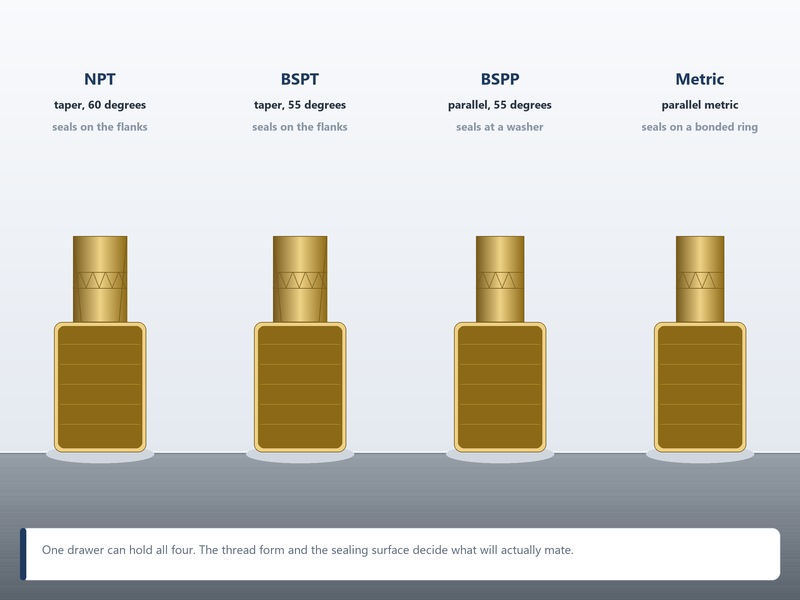
Pipe thread types are defined by two governing ideas: the thread form, meaning the flank angle and profile cut into the metal, and the sealing method, meaning whether the joint stops air on the thread flank or on a separate seat, washer or O-ring. Nominal size describes neither of them.
That distinction is the spine of this reference. It maps the pipe fitting thread types used on compressors, hose ends, regulators and air tools, family by family. It then sets out which combinations thread together and seal, which thread together but leak, and which bind or gall. It closes with adapter selection, the two-adapter rule for crossing between standards, and the corrosion notes that matter where stainless meets aluminium.
Thread form angles and taper figures follow ASME B1.20.1, ISO 7-1 and ISO 228-1; thread dimensions are named by standard rather than quoted here. About 17 min read.
Why Pipe Thread Types Exist: Thread Form and Sealing Method
Every pipe thread type is a compromise between two jobs: holding the parts together, and closing the gap between them. A thread is a helical wedge. Cut on a taper, that wedge closes the gap as it advances and can seal on its own flanks. Cut parallel, the wedge still holds the parts together but cannot close the gap, so a seat, washer or O-ring has to finish the job.
That is why the families never merged into one global standard. Two traditions of tooling settled on different flank angles, and the difference is visible on the bench.
A 60 degree form and a 55 degree form look similar in a photograph and behave differently in a port. The table below separates the ideas so you can tell which one a given failure belongs to.
Table 1. Thread form, sealing method and taper
| Governing idea | What it decides | Examples | Symptom when mismatched |
|---|---|---|---|
| Thread form | The flank angle and profile cut into the metal | NPT and NPTF at 60 degrees; BSPT and BSPP at 55 degrees | The male crosses about one turn, then binds |
| Sealing method | Whether the joint seals on the flank or on a separate surface | Taper threads seal on the flank; parallel threads seal at a washer or O-ring | The joint threads up smoothly and then weeps |
| Taper | How fast the diameter closes along the threaded length | NPT and BSPT taper at 1/16 in per inch, or 3/4 in per foot | The joint tightens early and leaks where threads are shallow |
Taper deserves separating from form, because the two are often confused. NPT and BSPT both taper at 1/16 in per inch, which is 3/4 in per foot over the threaded length. BSPP and NPSM do not taper at all; they run true to the axis and seal somewhere other than the flank.
A taper thread forced into a parallel port is the most expensive common mistake in air work. The male thread starts, because thread starts are forgiving, and then loads the port wall in a direction the port was never designed to take.
Pipe Fitting Thread Types for Air Work, Family by Family
The next two tables cover the families you are most likely to meet on a compressor outlet, a filter-regulator, a hose end, an air tool or a quick coupler stem. Each row gives the family, its designation, how it seals, where it is standard, and the pairing it must never be forced into.
Table 2. Inch-pattern families you will meet on air equipment
| Family | Designation | How it seals | Where it is standard | Never mate with |
|---|---|---|---|---|
| NPT | ASME B1.20.1 | Taper, 60 degrees, seals on deformed flanks | North America: compressor ports, tools, regulators | BSPT or BSPP without an adapter |
| NPTF | ANSI/ASME B1.20.3 dryseal | Taper, 60 degrees, engineered to seal dry | US hydraulic, fuel and some air brake work | BSPT or BSPP |
| BSPT | ISO 7-1, marked R, Rc or Rp | Taper, 55 degrees, seals on the flanks | Europe, UK and much of Asia: compressor ports and valves | NPT or NPSM |
| BSPP | ISO 228-1, marked G | Parallel, 55 degrees, seals at a washer or bonded seal | Europe, UK and Asia: ports, unions and gauge stems | A taper thread used as its own seal |
| NPSM | ANSI/ASME B1.20.3 | Parallel with a chamfered seat inside the female | US hose-end swivel nuts, some couplers | NPT male without a washer |
| NPSH | ANSI/ASME B1.20.3 | Parallel straight hose coupling, seals on a gasket | US fire and industrial hose couplings | Any pipe thread family |
| GHT | 3/4-11.5 NH | Parallel, seals on a rubber washer in the female | North American garden hose taps and hose ends | NPT or BSPP metal to metal |
Three of those families carry almost all compressed-air traffic. NPT is the North American default on compressor outlets, filter-regulators, tool inlets and coupler stems. BSPT and BSPP share the European and British market, with BSPT on taper ports and BSPP on parallel ports that seal on a washer. NPSM and NPSH are hose-end families rather than port families, so they belong to the coupling and not to the machine.
Two details catch people out. First, NPTF is a dryseal form engineered to seal without tape, so a standard NPT male in an NPTF female is workable but is not the intended pairing. Second, GHT is a garden-hose thread and has nothing to do with the G series of BSPP ports, even though both are written with a G.
Table 3. Flare, O-ring boss and metric families for air ports
| Family | Designation | How it seals | Where it is standard | Never mate with |
|---|---|---|---|---|
| SAE 45 degree flare | SAE J512 | 45 degree cone seats metal to metal | US fluid power, older air and fuel lines | A 37 degree JIC male |
| 37 degree JIC | SAE J514 | 37 degree cone seats on a matching flare seat | US hydraulic and high-pressure air lines | SAE 45 degree flare; NPT without an adapter |
| O-ring boss | SAE J1926 (ORB) | Straight thread, seals on an O-ring at the boss | US fluid power ports on pumps and cylinders | Straight threads with no O-ring; BSPP |
| Metric port with ring | DIN 3852 | Parallel metric thread, seals on a bonded or copper ring at the shoulder | European valves, cylinders and manifolds | BSPP without the matching ring |
| Metric O-ring face port | ISO 6149 | Parallel metric thread, seals on an O-ring face at the shoulder | European and global fluid power | NPT or BSP threads without adapters |
| Miniature metric | M5 x 0.8, M6 x 1, M7 x 1 | Parallel metric thread with a captive seal, or a taper on some bodies | Sensors, air logic and small actuators | Inch threads; hand-tightened joints that are then overtightened |
Metric thread air fittings usually arrive with machines rather than with compressors. A cylinder, valve island or sensor bought from a European supplier often carries a parallel metric port that seals on a bonded ring at the shoulder, or an O-ring face port to ISO 6149. Miniature pneumatics then adds M5 and M6 threads, normally with a captive seal under the hex. The push-to-connect tube fittings used on those same machines run a parallel metric thread into the port and seal the tube on a collet with an O-ring.
None of those metric families will accept an NPT or BSP male without an adapter, and the two-adapter rule further down explains why one adapter is often not enough.
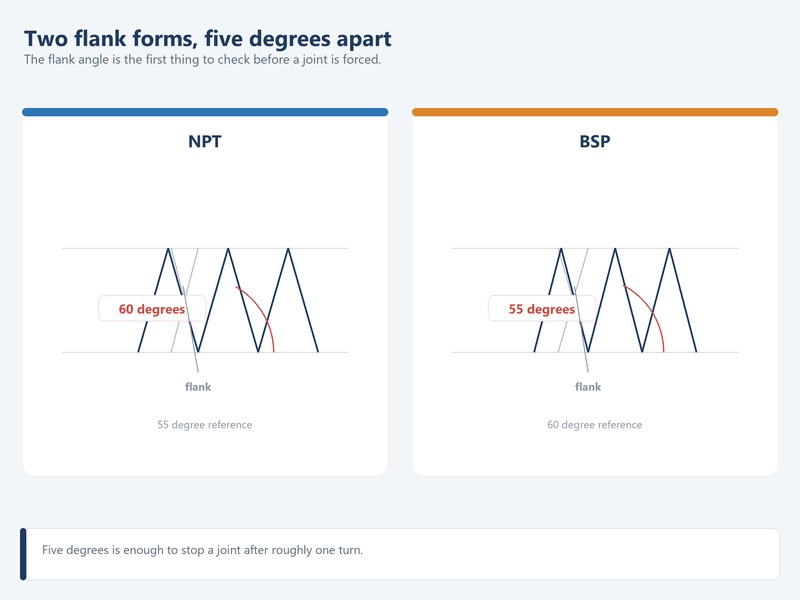
Figure 2. A 60 degree NPT flank and a 55 degree BSP flank differ by five degrees, which is enough to stop a joint after roughly one turn.
Pipe Thread Types Compatibility: Thread Together, Seal, or Bind
Compatibility is not a yes or no question. Two fittings can thread together and seal, thread together and leak, or refuse to engage at all. The middle case is the dangerous one, because the joint feels correct right up to the moment pressure arrives.
Tape shifts the picture slightly. PTFE tape lubricates and fills small voids on a taper thread, which is why it helps NPT and BSPT. On a parallel thread it does very little, because the leak path sits at the shoulder rather than on the flank.
Table 4. Compatibility matrix for common pipe thread types in air work
| Pairing | Threads together | Seals | Verdict |
|---|---|---|---|
| NPT male into NPT female | Yes | Yes, with tape or pipe dope | The standard US air connection |
| NPT male into NPTF female | Yes | Yes, dry | Acceptable, though not the designed pairing |
| NPT male into BSPT female | Only at the first threads | No | Different flank angle; the male binds after about one turn |
| NPT male into BSPP female | Roughly one turn on the small sizes | No | Never force it; the port has no seat and no taper |
| BSPT male into BSPP female | Yes | Only with a bonded seal | Correct washer, or use an adapter instead |
| BSPP male into BSPP female | Yes | Yes, at the washer or O-ring | The standard European air connection |
| NPSM male into NPSM female | Yes | Yes, on the washer inside the female | Normal for hose-end swivels |
| JIC male into JIC female | Yes | Yes, at the 37 degree cone | Normal for flare lines |
| JIC male into SAE 45 degree female | Partly | No | The cones touch on a line rather than on a face |
| ORB male into ORB female | Yes | Yes, at the boss O-ring | Normal for fluid power ports |
| NPT male into a metric port | No | No | An adapter is the only safe route |
The Honest Rule: Confirm the Family Before the Size
A 1/8 NPT male and a G1/8 female are both called 1/8, and neither the pitch nor the flank angle agrees. The well-known 1/8-size distinction is 27 threads per inch on NPT against 28 on BSP, which is why the two engage for about one turn and then lock.
That single example scales across the whole catalogue. The number stamped on a port describes a nominal bore, not a thread geometry, so it can never confirm that two fittings belong to the same family. Treat it as a naming convention, never as a compatibility test.
Thread types and sizes that look alike at a glance
The pairs below account for most of the damaged ports and warranty returns we see. Each row names what people attempt, what actually happens, why it happens, and the correct move.
Table 5. Classic thread types and sizes traps, with the correct fix
| What people try | What happens | Why | Correct move |
|---|---|---|---|
| 1/8 NPT male into a G1/8 female | Crosses about one turn, then binds | 60 degree form against 55 degree, 27 TPI against 28 TPI | Use the matching part or a 1/8 NPT to G1/8 adapter |
| BSPP joint wrapped in PTFE tape | Leaks at the shoulder even when tight | BSPP seals on a washer, not on the flank | Fit the correct bonded seal, then torque to avoid crushing it |
| Tapered NPT male into a BSPP port | Threads part way, then leaks or splits the port | The port has no taper and no seat for the flank | Use an NPT to BSPP adapter with its own sealing face |
| JIC male into a 45 degree SAE flare | Seals briefly, then weeps at the cone | 37 and 45 degree cones meet on a line, not a face | Match the cone angle or change the hose end |
| Two layers of tape on a small brass fitting | The body cracks at the port | Tape adds radial load the port was never sized for | One to three wraps clockwise, and never force the last turn |
NPT vs BSPT vs BSPP: Reading the Markings in Daily Work
The NPT vs BSPT vs BSPP question usually resolves without a caliper, because the markings on the body carry the answer. A port marked G is a parallel BSPP thread. The letters R, Rc and Rp indicate taper BSPT, and NPT often goes unmarked on a US-made body, where the shape of the body is the only clue.
A second clue is the sealing hardware. If the male has a soft washer, a bonded seal or an O-ring under the hex, the family is almost certainly parallel, and the thread is only holding the joint together. If it has bare metal flanks and a taper, the thread itself is the seal.
Because the families are fixed by national tooling history rather than by any technical advantage, the choice usually belongs to the machine you are connecting to. Our guide to NPT versus BSP threads takes the two-way comparison further, and the NPSM and NPT comparison covers the hose-end family that most often gets mistaken for a port thread.
Garden hose work adds its own family. GHT is a 3/4-11.5 NH thread that seals on a rubber washer. The GHT versus NPT comparison and the wider thread size chart for GHT, NPT, BSPP, BSPT and NPSH keep hose-end threads separate from machine port threads.
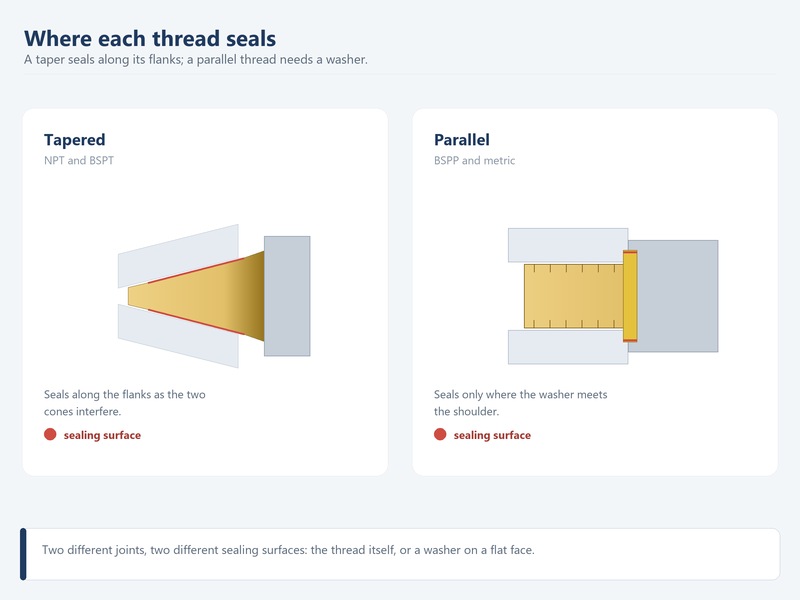
Figure 3. The taper thread seals along its flanks, while the parallel thread seals only where the washer meets the shoulder.
Adapters and Pipe Thread Types: Crossing Safely Between Standards
An adapter is the correct answer when the port on the machine and the thread on the hose end belong to different families and neither can be changed. It is the wrong answer when the real problem is a worn or cross-threaded port, because an adapter will not repair damaged threads and will hide the damage instead.
When you order, name both sides completely. The specification that saves a return is not the nominal size but the thread family on each end, plus the sealing surface the adapter itself provides.
Table 6. What to specify when ordering an adapter between two pipe thread types
| Specify | Why it matters | Example wording |
|---|---|---|
| Both thread families | Prevents the most common wrong order | 1/4 NPT male to G1/4 female |
| Both sealing ends | A taper end and a parallel end behave differently in the same port | Taper male, parallel female with a bonded seal |
| Seat hardware | Most adapter leaks are missing washers or O-rings | Supplied with a bonded seal for the G1/4 end |
| Material | Decides corrosion behaviour against the port | Nickel-plated brass body |
| Working pressure | Must meet the system, not just the compressor outlet | Rated above the system working pressure with margin |
The two-adapter rule finishes the job. Crossing from a US NPT port to a European BSPP hose end normally needs one adapter at the port and one at the hose end. A single body rarely carries a taper male on one end and the correct parallel female with a seat on the other. Two adapters keep each joint inside one standard. Three adapters start adding leak paths and leverage, and that is where we stop recommending the stack.
If the mismatch is inside one machine rather than across two standards, a different fitting is usually cheaper than a chain of adapters. Where two pipe fitting thread types must be joined, our hose adapter guide covers the hose-end families that meet ports in this situation.
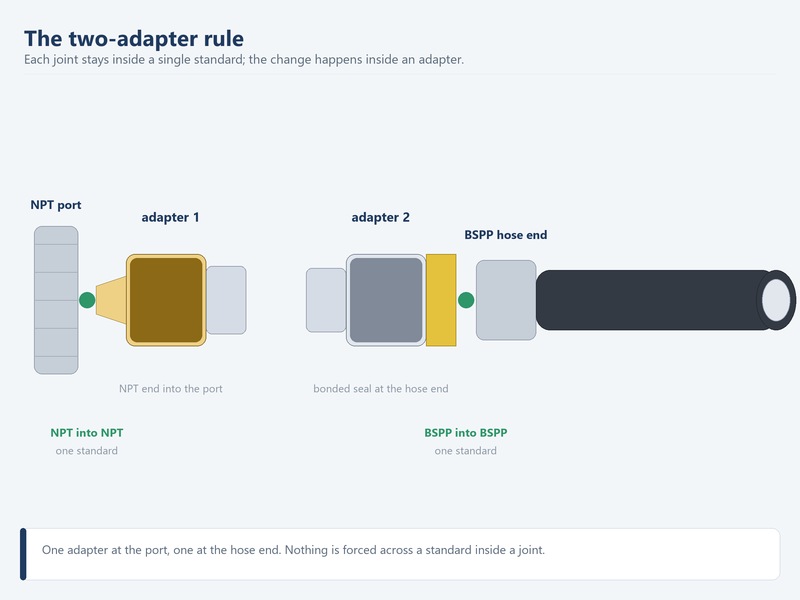
Figure 4. The two-adapter rule: one adapter at the port and one at the hose end, so each joint stays inside a single standard.
Identifying Which Pipe Thread Types You Have
Measurement comes before the matrix. You need the outside diameter at the thread, the pitch, and the taper before any row of Table 4 becomes useful, and guessing from a photograph wastes more time than measuring.
That procedure already has a home. Our step-by-step method for identifying air hose fittings by threads and sizes walks through the caliper reading, the pitch gauge and the taper check, and it ends with a lookup table. This page deliberately does not repeat it.
What belongs here is the order of operations. Identify the family first from the sealing hardware, then confirm it with the pitch, and only then compare the nominal size. Doing it the other way round is how a 1/8 NPT male ends up in a G1/8 port.
Corrosion and Galling Where Two Standards Meet
Thread families decide whether parts fit; materials decide whether they come apart again. Two stainless threads tightened against each other can cold-weld, and a stainless male in an aluminium port can seize within a season of humid workshop air. The pairings that come up most in our returns are these:
- Stainless male into stainless female: use an anti-seize compound on the flanks and keep the torque moderate.
- Stainless or brass male into an aluminium port: expect galvanic activity, keep the joint dry and inspect it yearly.
- Brass into brass: generally safe, but a taper joint still needs tape and a careful final turn.
- Zinc-plated steel into any port: check the plating at the thread, since a worn coating is where rust begins.
Table 7. Material pairings at a threaded air joint
| Material pair | Risk | Mitigation |
|---|---|---|
| Stainless into stainless | Galling and cold welding on assembly | Anti-seize on the flanks; do not over-torque |
| Stainless into aluminium | Galvanic corrosion and seized threads | Isolate where possible, keep dry, inspect annually |
| Brass into aluminium | Slow galvanic attack in damp air | Keep the joint dry and avoid standing water on the machine |
| Nickel-plated brass into steel | Low, provided both platings are intact | Do not assemble joints with damaged plating |
PTFE tape helps here as well as on the seal. It is a dry lubricant, so a thin wrap reduces the friction that causes stainless to gall in the first place.
Pipe Thread Types FAQs
I am ordering my first compressor fittings: what are the main pipe thread types in an air system?
A handful of families covers most workshop air. NPT is the North American taper thread at a 60 degree form, NPTF is its dryseal variant, and BSPT and BSPP are the 55 degree taper and parallel threads used across Europe and Asia. Add NPSM and GHT on hose ends, and JIC, SAE 45 degree flare and O-ring boss on higher-pressure lines. Size alone never identifies which one you have.
My 1/8 fitting starts in the port and then locks: why do two fittings with the same nominal size not interchange?
Because the number on a fitting names a nominal bore, not a thread geometry. A 1/8 NPT male and a G1/8 female share a nominal size while differing in flank angle and in pitch. The diameter may look close enough to start a thread, but the flanks will not match, so the joint binds or leaks. Always confirm the family before trusting a size.
My joint still weeps with tape on it: can PTFE tape make a BSPP joint seal?
No. BSPP is a parallel thread that seals on a bonded seal, copper washer or O-ring at the shoulder, so tape on the flanks does not close the leak path. Tape can still help by reducing friction during assembly, but the washer does the sealing. Fit the correct seal and torque the joint evenly instead of adding tape.
Two ports look identical and one weeps: what is the practical difference between NPT vs BSPT vs BSPP seals?
NPT and BSPT are both taper threads that seal on their flanks as the joint tightens, so they accept tape or pipe dope. BSPP is parallel and seals on a washer or O-ring at the shoulder. That is why NPT and BSPT sometimes interchange in an emergency with tape, while BSPP never does. The three also differ in flank angle, 60 degrees against 55.
My European machine has M5 ports and my tools are imperial: are metric thread air fittings interchangeable with inch fittings?
No, never metal to metal. Metric port threads to DIN 3852 and ISO 6149 are parallel and seal on a ring or an O-ring face, while miniature M5 and M6 joints use a captive seal. An inch male will not carry the right pitch or flank angle, so the joint either will not start or strips the port. Use a rated adapter.
I am fitting a European valve to a US compressor: will a 1/8 NPT fitting thread into a G1/8 port?
It will start, and that is exactly the problem. The two threads differ in flank angle and in pitch, so the male crosses roughly one turn and then locks, often damaging the port on the way out. If the port is salvageable, use a 1/8 NPT to G1/8 adapter with its own sealing face rather than forcing the original fitting.
A European machine, a US compressor and no way to change either port: when is an adapter the right answer?
An adapter is correct when a port and a hose end belong to different families and neither can be changed, which is common when European machines meet North American air lines. It is the wrong answer for a worn or cross-threaded port, because an adapter hides thread damage instead of repairing it. Replace the port or the fitting in that case.
One adapter still leaks at the second joint: what is the two-adapter rule?
Crossing between two standards usually takes one adapter at the port and one at the hose end, so each joint stays inside a single thread family. A single body rarely carries a taper male on one end and a parallel female with the correct seat on the other. Two adapters seal predictably; three add leak paths and leverage.
I inherited a machine with mixed ports: which thread families should never be mated?
NPT into BSPT or BSPP, BSPT into NPSM, a 37 degree JIC male into a 45 degree SAE flare, and an O-ring boss male into a plain straight thread all belong on the never list. Each pair either fails to seal, binds part way, or damages a port. Where a genuine cross-standard connection is needed, an adapter with a defined sealing face is the safe route.
I am specifying a new machine for two markets: how do I choose between NPT and BSPP for a new machine?
Choose to match the market and the service network that will maintain it, not the thread you happen to stock. North American buyers expect NPT on compressor ports and tool inlets; European and Asian buyers expect BSPP with a bonded seal, or BSPT on taper ports. When you plan a new machine, sort the thread types and sizes the shop already runs before ordering.
Final Verdict: Match Pipe Thread Types Before You Buy
The safe rule is short: identify the family first, then the size. Machines imported from Europe and Asia bring metric thread air fittings with them, and a shop that stocks only NPT will meet them the first week. Getting the family wrong is not a small nuisance, because a forced joint damages the more expensive half of the connection.
Before you order, work through this checklist:
- Confirm the thread family on the port and on the hose end, not just the nominal size.
- Check whether each joint seals on its flanks or at a washer, bonded seal or O-ring.
- Compare flank angles when a taper thread crosses a standard, and stop at the first resistance.
- Keep adapter stacks to two, one at each end, so every joint stays inside one standard.
- Match materials to the port, and treat stainless into aluminium as a corrosion case.
Once the family is settled, the sizing decision follows quickly, and the air hose fitting sizing, types and selection guide covers the sizes and styles for each family. If you are ordering for a market you have not supplied before, send the port and hose-end designations and we will return a matched list from the air hose collection, with samples before a bulk order.
HENGHUA is a professional manufacturer of air hose fittings, quick connect couplers, air hoses and hose assemblies, supplying distributors, retailers and OEM brands worldwide. Fittings are machined from brass, zinc-plated steel or stainless steel, thread-checked against NPT and BSP gauges, and pressure-tested to rated working pressure before shipment. The range covers 1/4, 3/8 and 1/2 in plugs and sockets in M-, A- and E-style profiles, plus hose barbs, NPT-to-BSP adapters, reducers, kits, spare O-rings and SAE J1402 air brake hose assemblies. Factory-direct pricing, short lead times for bulk orders, private labeling and OEM branding are available.
If you are sourcing fittings and want help matching a thread standard to your market, contact our team for a quote and samples.
About the author. Written by the HENGHUA engineering team, which designs and pressure-tests air hose fittings, quick connect couplers and hose assemblies for distributors, retailers and OEM programs. The team works daily with NPT, BSPT, BSPP, NPSM, metric port and flare threads, runs thread gauges against incoming and outgoing batches, and supports customers who are crossing between standards.






 English
  Spanish
  Portuguese
  French
  German
  Arabic
  Russian
  Indonesian
  Japanese
  Korean