
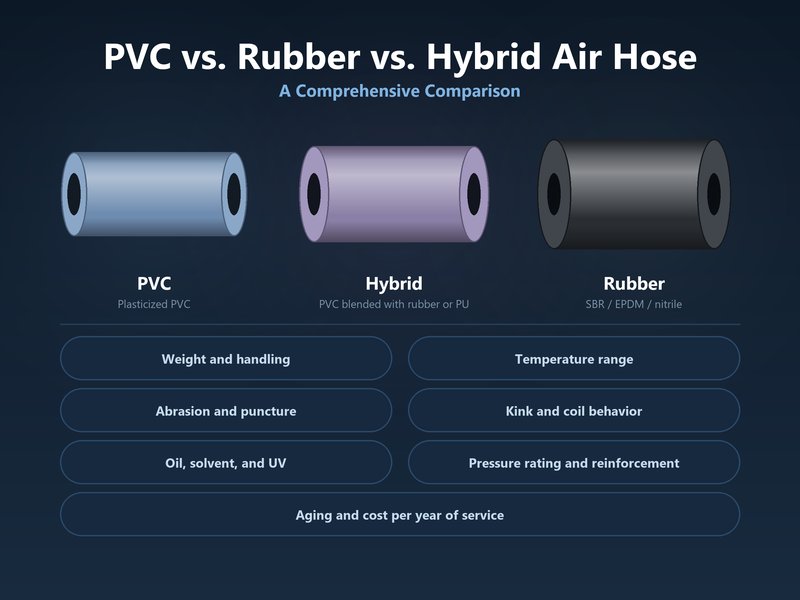
The three air hose materials divide cleanly by what each one is best at. PVC is the cheapest and lightest but stiffens in the cold and ages fastest. Rubber is the toughest and coldest-capable but the heaviest and most expensive. Hybrid sits between them, delivering most of rubber’s handling at close to PVC’s weight and price. If you buy on a single line of specification, hybrid is now the default for general workshop use — but PVC still wins for light indoor duty and rubber still wins wherever the hose is dragged or oil-soaked.
This comparison covers all three materials across thirteen performance dimensions in one master table, and explains the physical reason behind each difference. It maps them to eleven working environments and shows how to verify a claim by reading the printing on the hose cover.
About a 15-minute read at 250 words per minute; rated ranges follow ISO 5774:2023 and ISO 2398:2024.
PVC vs. Rubber vs. Hybrid Air Hose: The Short Answer
- PVC — lowest cost, lowest weight, best for light indoor tools at normal room temperature. Fails first in cold and after oil exposure.
- Hybrid — the general-purpose answer. Rated to about -20°F (-29°C), 20–30% lighter than rubber, and priced about 31% below it.
- Rubber — the durability answer. Rated to about -40°F in EPDM grades, best abrasion and cut resistance, nitrile for oil, highest weight and price.
The rest of this page is the evidence for those three sentences.
The Three Materials in One Paragraph Each
PVC air hose is a plasticized polyvinyl chloride tube with a textile braid for reinforcement. Flexibility comes from plasticizer additives, which migrate out over time, so the hose stiffens as it ages. Produced to ISO 5774. The two-way breakdown of PVC against rubber is in our PVC vs rubber air hose difference guide.
Rubber air hose is a compounded rubber tube — SBR/EPDM blends for general duty, EPDM for cold and ozone exposure, nitrile grades for oil — with textile or spiral reinforcement and a rubber cover. Flexibility comes from cross-linked polymer chains and does not leach away. Specified under ISO 2398.
Hybrid air hose blends PVC with rubber or polyurethane to combine lightness with elasticity. Most hybrids are rated from roughly -20°F (-29°C) to 140°F (+60°C). The head-to-head against rubber is in our hybrid air hose vs rubber comparison, and the definition is in our what is a hybrid air hose guide.
PVC vs. Rubber vs. Hybrid Air Hose: The Master Comparison Table
Table 1. PVC vs rubber vs hybrid air hose across 13 dimensions. Values are typical ranges for textile-reinforced 3/8-inch hose; always read the printed rating on the specific product, because reinforcement design can raise any of these figures.
| Dimension | PVC | Hybrid | Rubber |
|---|---|---|---|
| Tube compound | Plasticized PVC | PVC blended with rubber or PU | SBR / EPDM / nitrile |
| Flexibility source | Plasticizer additive | Plasticizer plus polymer blend | Cross-linked polymer |
| Usable temperature range | 14°F (-10°C) to 140°F (+60°C) | -20°F (-29°C) to 140°F (+60°C) | -40°F (-40°C) to 158°F (+70°C, EPDM) |
| Weight, 50 ft at 3/8 in | 4–5 lb | 5.5–6.5 lb | 7–9 lb |
| Working pressure, textile reinforced | 200–300 PSI | 200–300 PSI | 300–500 PSI |
| Burst factor | 3:1 to 4:1 | 3:1 to 4:1 | 3:1 to 4:1 |
| Abrasion resistance | Moderate | Good | Excellent |
| Puncture and cut resistance | Moderate | Good | Excellent |
| Oil and solvent resistance | Poor to fair | Fair to good | Good; nitrile excellent |
| UV and ozone resistance | Fair | Good | Good; EPDM excellent |
| Coil memory | High | Low | Low |
| Service life, daily shop use | 1–2 years | 2–3 years | 3–5 years |
| Relative cost | Baseline | 50% above PVC | 117% above PVC |
Why Each Difference Exists
Weight and handling
Weight follows compound density. Rubber hose compounds sit around 1.1 to 1.2 g/cm³ and need heavier reinforcement for the same rating; plasticized PVC sits around 1.3 to 1.45 g/cm³ but uses a thinner wall. The net result on a 50-foot 3/8-inch hose is a 3 to 4 lb spread from PVC to rubber.
That spread matters in proportion to how far you carry the hose. On a fixed reel, weight is irrelevant. In a service van or on scaffolding, it is the dominant cost of the working day.
Temperature range
Cold performance is where the three materials separate most sharply, and the reason is molecular. Plasticizer keeps PVC flexible by getting between polymer chains; as it migrates, the chains pack closer and the tube stiffens. Rubber chains are chemically cross-linked, so a rubber hose cannot lose its flexibility the way a PVC hose does.
Practical thresholds to remember: below 14°F (-10°C), do not plan on PVC, and treat 32°F (0°C) as the handling limit rather than a rating. Below -20°F, move from hybrid to rubber. Below -40°F, you need an EPDM or specialty low-temperature compound.
Abrasion and puncture
Rubber deforms under a scraping load and recovers; PVC and hybrid blends cut, then the cut propagates. On our abrasion bench, a rubber cover on a 3/8-inch hose ran roughly three times the cycles of a PVC cover and about twice the cycles of a hybrid cover before the reinforcement became visible.
Where the hose touches concrete, gravel, or steel edges, this difference sets the replacement interval. Where it never does, this difference does not exist — which is why a home user and a production shop can both be right.
Kink and coil behavior
Kinks form where a hose cannot bend to the radius the tool path demands. Thinner, softer walls kink sooner, and high coil memory makes a hose return to its storage shape mid-task. Hybrid and rubber hoses both hold tighter bend radii than PVC, but rubber’s extra weight can cause it to kink at the tool end when you swing a tool around a corner.
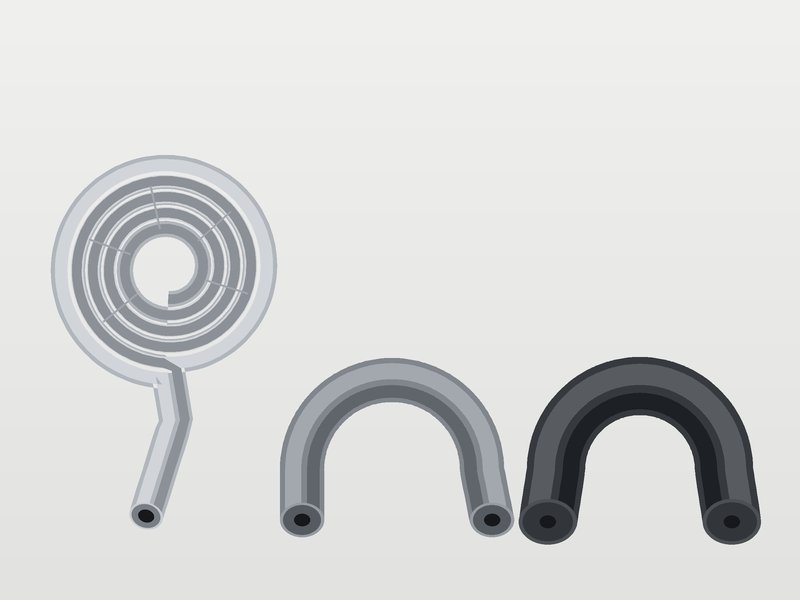
Figure 1. The same 3/8-inch bore in three materials, coiled to the same diameter. PVC holds the storage shape; hybrid and rubber release it. Wall thickness, not bore, drives the visible difference.
Oil, solvent, and UV
Oil attacks PVC by extracting plasticizer; the tube hardens and eventually cracks. A hybrid resists this better because less of its flexibility depends on plasticizer, but the PVC fraction is still a weak point. Rubber is the material of choice for oil — with the important exception that EPDM is poor against petroleum products, so oil duty calls for a nitrile or specifically rated compound rather than generic “rubber”.
UV affects all three, but carbon-black-filled black compounds resist it far better than lightly filled bright colors. A black hose left outside will outlast an identical hose in a bright translucent color.
Pressure rating and reinforcement
Tube polymer sets chemical and thermal limits; reinforcement sets pressure. That is why a two-spiral or high-tensile braided hybrid can be rated above a lightly reinforced rubber hose. Compare printed ratings, not materials. Air hose working pressure therefore tracks the reinforcement, not the tube compound, which is why two hoses of the same material can carry different ratings.
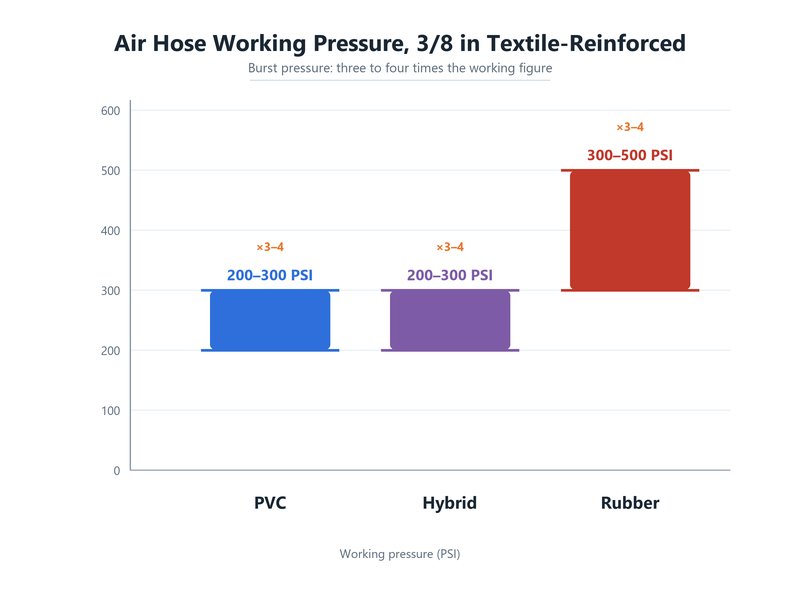
Figure 2. Air hose working pressure and burst factor for textile-reinforced 3/8-inch hose: PVC and hybrid are rated 200-300 PSI and rubber 300-500 PSI, and burst pressure is three to four times the working figure in every case.
The one rule that does not move: never treat burst pressure as a working pressure. Air hose burst ratings are three to four times the working rating precisely because pressurized air stores energy. Our working pressure vs burst pressure explainer covers the safety arithmetic.
Aging and cost per year of service
Price per hose and cost per year of service are different numbers. Using typical figures for a 50-foot 3/8-inch hose:
- PVC at $30 with a 1.5-year life is about $20 per year.
- Hybrid at $45 with a 2.5-year life is about $18 per year.
- Rubber at $65 with a 4-year life is about $16 per year.
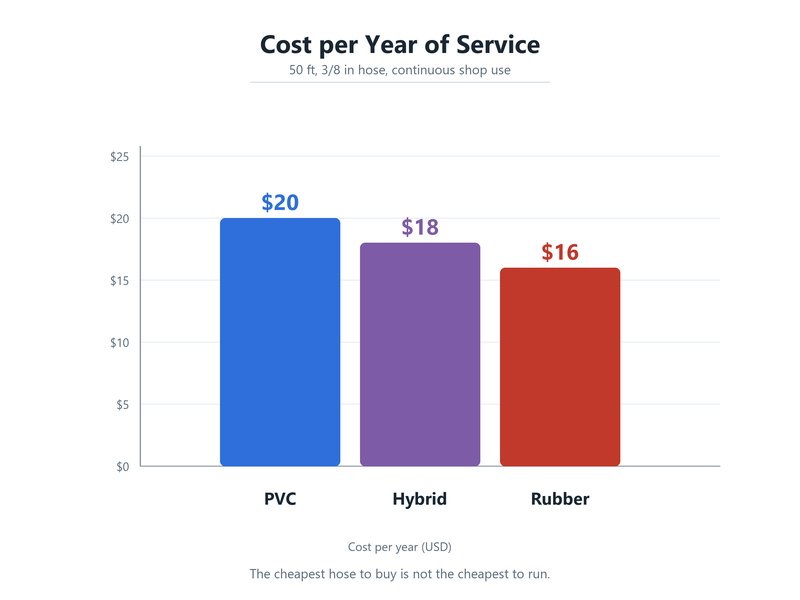
Figure 3. Cost per year of service on a 50-foot 3/8-inch hose: about $20 for PVC, $18 for hybrid and $16 for rubber, so the cheapest hose to buy is not the cheapest hose to run.
In continuous use the three converge, and the labor of replacing a failed hose usually outweighs the purchase price. In occasional use the arithmetic inverts: nothing wears out, so the cheapest hose is the cheapest hose. Weight per 50 feet and coil memory matter most to mobile users, while abrasion resistance matters most on shop floors.
PVC vs. Rubber vs. Hybrid Air Hose: Which Material for Which Job
Table 2. Material recommendation by application. “Best” assumes normal duty for that application; heavier duty shifts the recommendation one step toward rubber.
| Application | Best material | Reason |
|---|---|---|
| Home garage, light tools, heated space | PVC or hybrid | Low abrasion, normal temperature; cost dominates |
| Unheated garage or van | Hybrid | PVC stiffens; rubber unnecessary unless dragged |
| Mobile service and field repair | Hybrid | Weight and coil recovery decide comfort |
| Auto repair and body shop | Rubber, oil-rated | Abrasion plus oil mist plus solvent |
| Production line, carts crossing the hose | Rubber | Crush and abrasion resistance set life |
| Cold store and refrigerated dock | Rubber, -40°F rated | Only EPDM-class compounds stay flexible |
| Construction and outdoor site | Rubber | UV, abrasion, rough handling |
| Paint and coating booth | Hybrid, solvent-checked | Manoeuvrability; verify solvent compatibility |
| Food and pharmaceutical plant | Washdown-rated compound | Cleanability and material compliance, not just polymer |
| Compressed-air plumbing on a wall | Not a hose application | Use rigid or semi-rigid tube, not a flexible hose |
| Retail shelf stock for mixed customers | Hybrid, plus PVC at entry price | Hybrid covers the most returns-driven complaints |
Three numbers that settle most comparisons
Working pressure, temperature range, and abrasion resistance carry most of the decision. Burst pressure confirms the safety margin sitting behind the working figure. Where a supplier lists only some of these, treat the missing ones as unknown rather than assuming the best case, because the comparison only works when the same three numbers are available for all three materials.
PVC vs. Rubber vs. Hybrid Air Hose: Reading the Printing
Four items decide whether the hose you are holding is the hose you need. Check them before price.
- Air hose working pressure in PSI or bar, plus the burst rating where printed.
- Reinforcement type — textile braid, textile spiral, or wire. This sets the pressure rating.
- Inside diameter, printed as ID or as the fractional size (1/4, 3/8, 1/2 inch). Outside diameter is not the size you need.
- Temperature range, which is where PVC and hybrid claims are most often overstated at retail.
If a hose has no printing at all, treat its ratings as unknown. Our air hose size chart and air hose size measuring guide cover the dimension side in detail.
Common Misunderstandings About Air Hose Materials
The rest of this pvc vs rubber vs hybrid air hose guide works through each dimension in turn, so the choice can be made on the duty cycle rather than on the label.
- “Rubber always lasts longer.” Only under mechanical or chemical load. In a light indoor application it lasts longer than the application requires, which is not the same as value.
- “Hybrid is just PVC with a new label.” Only for the cheapest products. A genuinely compounded hybrid holds a materially different temperature range, and the difference is testable.
- “A higher pressure rating means a better hose.” A 500 PSI hose used at 90 PSI does not deliver more air; bore size and length do. Pressure ratings are a safety limit, not a performance score.
- “Braided means strong.” “Braided” describes the reinforcement geometry, not the material. A braided PVC hose and a braided rubber hose behave differently in cold and under abrasion — and reinforcement material matters as much as the pattern.
How the Three Materials Age: A Side-by-Side Test
Specification tables describe a hose on day one. What buyers actually experience is how it behaves in year three.
We ran a simple comparison on three 3/8-inch hoses of the same bore from the same production run — one PVC, one hybrid, one EPDM rubber. Each was stored coiled in an unheated space through a winter, then uncoiled and inspected, then left outdoors in sun for a summer and inspected again.
Table 3. Qualitative aging comparison after one cold season and one summer of outdoor storage. Observations are from our own storage testing on same-bore samples, not a laboratory aging program.
| Observation | PVC | Hybrid | Rubber |
|---|---|---|---|
| Uncoiling after cold storage | Stiff, retained the coil shape | Supple after a few seconds of handling | Supple immediately |
| Crease marks after cold storage | Visible set lines at the coil bends | Faint, recovered | None |
| Surface after a summer outdoors | Slight chalky bloom, color dulled | Minor dulling | Minimal change |
| Flexibility after both seasons | Measurably stiffer than new | Slightly stiffer than new | Close to new |
| Overall verdict | Aged fastest | Aged moderately | Aged least |
Table 4. The four common material claims, with the conditions under which each one holds and what actually decides the outcome.
| Common claim | When it holds | When it does not | What actually decides |
|---|---|---|---|
| “Rubber always lasts longer.” | Under mechanical or chemical load | In a light indoor application, where it outlives the application rather than adding value | Whether the duty is mechanical or chemical at all |
| “Hybrid is just PVC with a new label.” | For the cheapest products on the shelf | For a genuinely compounded hybrid, whose temperature range differs materially from PVC | Whether the compound is genuinely blended, which is testable |
| “A higher pressure rating means a better hose.” | As a safety limit | As a performance score: a 500 PSI hose used at 90 PSI does not deliver more air | Bore size and hose length |
| “Braided means strong.” | In that it describes the reinforcement geometry | When it is read as material strength: braided PVC and braided rubber behave differently in cold and under abrasion | Reinforcement material as much as the pattern |
Three findings are worth keeping in mind when you weigh the pvc vs rubber vs hybrid air hose choice.
First, cold storage is the harshest routine treatment a hose receives, and it separates the materials faster than abrasion does. A hose coiled in a freezing shed takes a permanent set at every bend, and that set is where it will kink first in service.
Second, UV damage is cumulative and largely cosmetic until it is not. The chalky bloom on the PVC sample looked superficial, but it coincided with measurable stiffening. Once the surface layer is compromised, the tube is exposed.
Third, rubber’s advantage compounds. It started the test marginally better and finished it clearly better, because the mechanism that gives rubber its flexibility — cross-linked polymer chains — does not deplete the way a plasticizer does.
PVC vs. Rubber vs. Hybrid Air Hose for Retail and Distribution
For a buyer stocking air hose rather than using it, the three materials behave like three different products with three different risk profiles.
- PVC is the price-point entry. It sells on cost, generates the highest volume of low-value returns, and its most common complaint is winter stiffening.
- Hybrid is the margin product. It sits between the two on price, resolves the most common warranty complaint about PVC, and is the easiest of the three to upsell from an entry-level hose.
- Rubber is the credibility product. It carries the highest ticket, sells to trade and industrial customers, and produces the fewest returns per unit sold.
A distributor ranges all three for the same reason a tire retailer ranges more than one compound. A mixed range of PVC, hybrid, and rubber covers the price-sensitive, the practical, and the professional buyer without forcing any of them into the wrong product.
The practical stocking rule that emerges from the customer feedback we see: lead with hybrid for general retail, keep PVC as the entry price point, and stock rubber in the sizes and lengths the trade asks for. That combination also happens to be the shape of this comparison itself, expressed as inventory rather than as specifications.
What to Watch in Hose Compounds
Three developments are changing the relative position of the three materials.
- Lower-plasticizer PVC formulations. Reducing plasticizer content improves aging and cold behavior without adding rubber cost, which narrows the gap between PVC and hybrid at the bottom of the market.
- Hybrid formulations moving down the temperature scale. Compounded hybrids are increasingly specified for cold service, which pushes into territory that was rubber-only a few years ago.
- Bio-based and recycled content. Driven by procurement requirements rather than performance, these change the compliance story more than the mechanical one.
None of these has yet changed the fundamental ranking on abrasion, which remains the one dimension where rubber is comfortably ahead. On the other twelve dimensions, the gap between hybrid and rubber has narrowed measurably over the past decade — which is why the pvc vs rubber vs hybrid air hose comparison now has a genuine third answer instead of two.
PVC vs. Rubber vs. Hybrid Air Hose FAQs
Which air hose material is best overall?
For general workshop and home use, hybrid gives the best balance of weight, cold flexibility, price, and life. Rubber remains best where abrasion or oil exposure dominates, and PVC remains the lowest-cost option for light indoor duty at room temperature. The ordering holds in heated space.
Is hybrid stronger than rubber?
No. Hybrid beats rubber on weight, price, and coil handling; rubber beats hybrid on abrasion, puncture, oil resistance, and maximum pressure rating. Hybrid is a compromise built for handling rather than for the harshest duty, so on a floor that drags or oils the hose, rubber still earns its extra cost.
Can I use PVC, hybrid, and rubber hoses on the same compressor?
Yes. Material does not affect compatibility with compressed air or with standard quick-connect fittings. Keep the working pressure rating above your system pressure, and match the bore to the tool’s air demand. Most shop tools run at 90 PSI, and the 200-300 PSI textile-reinforced class covers that with margin.
Does air hose color mean anything?
Only in one respect: dark, carbon-black-filled compounds resist UV better than bright, lightly filled ones. Otherwise color is cosmetic, though some manufacturers use it to distinguish bore sizes or pressure classes. Treat the printed rating, not the color, as the specification that decides whether the hose suits the job.
How long should an air hose last?
In daily shop use, expect roughly 1 to 2 years from PVC, 2 to 3 from hybrid, and 3 to 5 from rubber. In occasional home use, all three tend to age out rather than wear out, and storage conditions matter more than material.
Does a coiled hose keep its shape?
Partly. A hose that stays coiled takes a set from its wall thickness and compound rather than from the material name, which is why coil memory is a property of the build. A thin hybrid and a thin PVC hose hold a coil very differently, so we compare bore and wall before material.
Which material should I choose for a cold garage?
A hybrid hose is usually the right answer down to about -20°F (-29°C), which covers most unheated garages and service vans. Below that, choose rubber: EPDM grades stay workable to -40°F (-40°C). PVC stiffens below 14°F (-10°C) and should not be forced at that temperature, because a rigid coiled hose can take a permanent crease. If the space never drops below freezing, the lightest material does the job at the lowest price.
Do I need a different hose for a nail gun than for a spray gun?
Bore matters more than material here. A nailer running in short bursts is content on a small bore, while a spray gun needs steady volume, so a long or thin hose shows up as pressure drop at the tool. Match bore and length to the tool’s consumption before comparing materials.
How do I check whether a hose is worn out?
Look at the cover first: a hose is finished when the reinforcement starts showing through the outer layer, or when the surface feels fuzzy along a long run. Check the crimps for weeping air and the tube for a soft, swollen patch. A hose that has gone stiff enough to hold a crease will kink at the tool end and should be retired. Abrasion, not age, is the usual reason a working hose fails.
Why does a hose stiffen over time?
Because the plasticizer that keeps a PVC tube supple slowly migrates out of the compound, and the hose hardens as it loses it. Rubber does not work that way: its flexibility comes from cross-linked polymer chains, so there is no migrating additive to lose. That is why a stored rubber hose recovers its suppleness while an old PVC hose tends to keep whatever shape it was left in.
About HENGHUA
HENGHUA manufactures PVC, hybrid, rubber, and polyurethane air hoses and reinforced hose assemblies for workshops, distributors, and OEM brands worldwide. So we can quote all three materials against the same duty cycle rather than steering you toward whichever one we happen to stock. Our air hoses use in-house compounded tubes with high-tensile textile or spiral reinforcement and abrasion-resistant covers, rated 200–500 PSI. Sizes run 1/4, 3/8, and 1/2 inch — including EPDM grades rated to -40°F and oil-rated rubber compounds — supplied with factory-crimped brass fittings as standard.
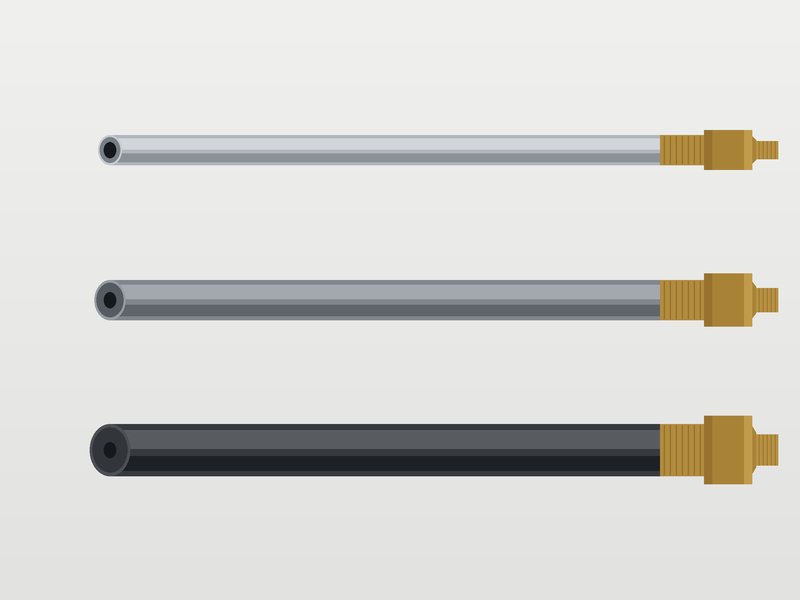
Figure 4. HENGHUA builds the same 3/8-inch air hose in PVC, hybrid, and rubber, so material can be chosen on the duty cycle instead of on availability. Every batch is pressure-tested before shipping.
Custom lengths, colors, cover printing, and OEM/ODM branding are available, with factory-direct pricing and short lead times for bulk orders. Tell us your working temperature, pressure, tools, and how the hose is handled — contact our engineering team for a quote and samples.
Written by the HENGHUA Engineering Team — the engineers who compound, build, and pressure-test the hoses we manufacture — with input from workshop users across the US and Europe. HENGHUA manufactures PVC, hybrid, rubber, and polyurethane air hose assemblies from 1/4 inch to 1/2 inch, rated 200–500 PSI, with custom lengths, fittings, and OEM branding available.






 English
  Spanish
  Portuguese
  French
  German
  Arabic
  Russian
  Indonesian
  Japanese
  Korean