
1. What a 4BN-WD Adapter Does
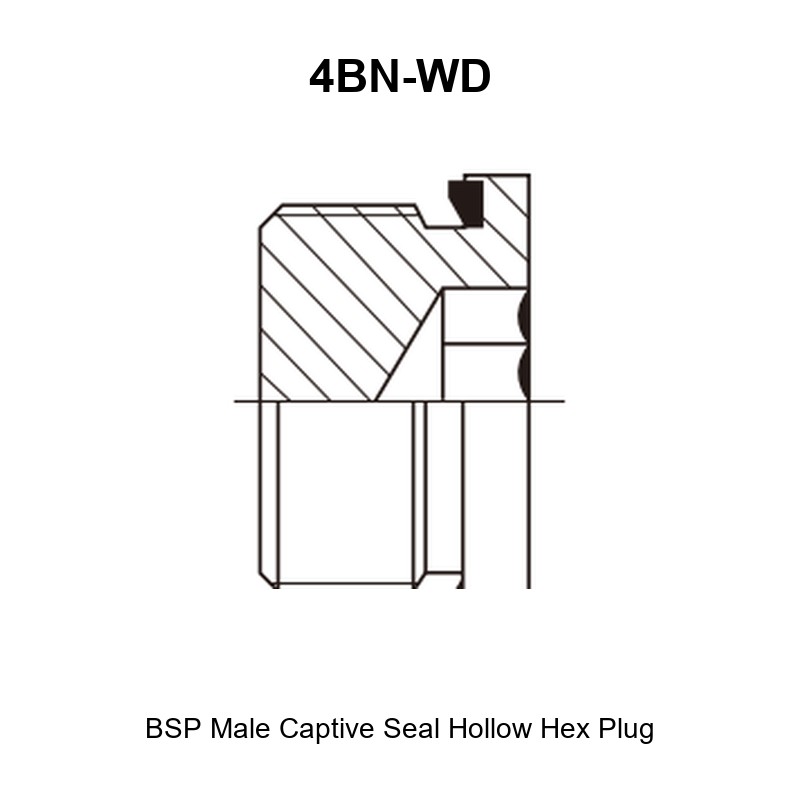
The 4BN-WD adapter is a single-ended BSPP male plug with a captive bonded seal and a hollow hex drive, used to close a hydraulic port that is not in use. It carries the same G (BSPP) parallel thread as the standard plug of the same size, so it fits the same ISO 228-1 ports on manifolds, valve blocks, pumps, cylinders and filter heads. The difference is the drive: instead of an external hex that needs a wrench and clearance around the port, the 4BN-WD plug has an internal hex recess that is turned with a hex key.
A plug has one interface only, so that interface decides whether the port stays dry. The thread form, the thread size and the sealing face must match the port exactly, because the joint between the plug and the port is the only barrier between the fluid system and the atmosphere.
Two features define this series. The captive bonded seal is retained on the plug, so the washer cannot be lost, dropped into the system or refitted dirty. The hollow hex keeps the outside of the plug close to the thread diameter, which lets the plug sit down inside a recessed or closely surrounded port where a wrench cannot reach.
2. 4BN-WD Specifications
2.1 Connection 1 — BSPP male stud end (into the port)
- Thread standard: ISO 228-1 parallel pipe thread, G series, the thread family used by ISO 1179 ports.
- Gender: male.
- Size range: G1/8″x28 up to G1.1/2″x11, eight sizes in the published table.
- Sealing: bonded seal washer (Dowty-type) pressed against the flat face of the port.
- Mating port: a flat-faced BSPP port with a spot face wide enough for the washer to seat square.
2.2 Connection 2 — hollow hex closing head (no line connection)
- Function: the head closes the stud end, retains the washer and carries the internal hex that drives the plug.
- Drive: internal hex, dimension S1 in the table, turned with a hex key.
- Seal retention: the washer is captured on the plug and stays with it during fitting and removal.
- Mating part: none. The head connects to no hose, tube or fitting.
2.3 Construction and Materials
The body is machined from bar stock on CNC lathes, with the internal hex broached or milled to the size shown in the table. Standard material is carbon steel with trivalent chromium zinc plating (Cr3+) for general hydraulic service; zinc-nickel plating, 304 stainless steel, 316 stainless steel and brass are available for corrosive and marine duties. The captive bonded seal is supplied in NBR, FKM or EPDM according to the fluid and temperature of the application, and each size has its own captive seal code so that replacement washers can be ordered separately.
2.4 Pressure and Temperature
Pressure is not fixed by the part number alone. It is governed by the thread size, the wall thickness of the plug, the sealing method used at the port and the body material, so working pressure for these sizes is confirmed per order by HENGHUA engineering, based on the sealing method, thread size and material selected. Seal material temperature limits apply as material facts: NBR approximately -30°C to +100°C, FKM approximately -20°C to +200°C, EPDM approximately -40°C to +120°C.
2.5 Part Number and Dimension Table
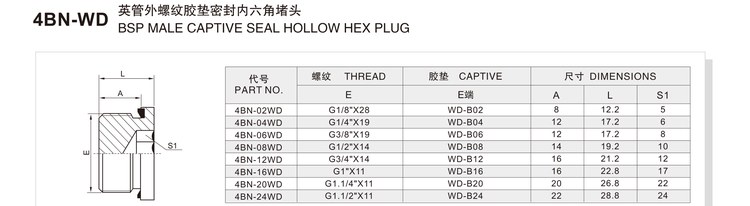
Every value below is taken from the published series chart. All dimensions are in millimetres. E is the thread designation of the stud end, the captive column gives the code of the bonded seal washer retained on the E end, A is the thread length, L is the overall length of the plug, and S1 is the hex across flats of the internal hex drive.
| PART NO. | THREAD E | CAPTIVE E END | A | L | S1 |
|---|---|---|---|---|---|
| 4BN-02WD | G1/8″x28 | WD-B02 | 8 | 12.2 | 5 |
| 4BN-04WD | G1/4″x19 | WD-B04 | 12 | 17.2 | 6 |
| 4BN-06WD | G3/8″x19 | WD-B06 | 12 | 17.2 | 8 |
| 4BN-08WD | G1/2″x14 | WD-B08 | 14 | 19.2 | 10 |
| 4BN-12WD | G3/4″x14 | WD-B12 | 16 | 21.2 | 12 |
| 4BN-16WD | G1″x11 | WD-B16 | 16 | 22.8 | 17 |
| 4BN-20WD | G1.1/4″x11 | WD-B20 | 20 | 26.8 | 22 |
| 4BN-24WD | G1.1/2″x11 | WD-B24 | 22 | 28.8 | 24 |
Note on thread notation: a designation such as G1.1/4″x11 means a 1 1/4 inch BSPP thread with 11 threads per inch. The number after the x is the thread pitch in threads per inch.
3. How to Read a 4BN-WD Adapter Part Number
A 4BN-WD part number has a fixed structure: series prefix, size code, and the captive seal suffix.
- 4B identifies a BSPP male plug for a 60° cone seat or bonded seal port.
- N marks the hollow hex version. The N plug has the same thread as the 4B plug of the same size, but it is driven by an internal hex instead of an external hex, so the outside of the plug stays close to the thread diameter.
- WD is the captive seal suffix. The bonded seal washer is retained on the plug, and the series name carries both features together.
- The two digits before WD are the size code, expressed as the nominal bore in sixteenths of an inch. 02 is 2/16 inch, or 1/8 inch; 04 is 4/16, or 1/4 inch; 08 is 8/16, or 1/2 inch; 12 is 12/16, or 3/4 inch; 24 is 24/16, or 1 1/2 inch.
- The captive seal code in the table identifies the washer, for example WD-B12 for the 3/4 inch size, so a replacement can be ordered without measuring the old one.
Worked example from the table: 4BN-08WD. The prefix 4B shows a BSPP male plug, N shows the hollow hex drive, WD shows that the bonded seal is captive on the plug, and 08 gives a 1/2 inch nominal bore, so the thread is G1/2″x14 with captive seal WD-B08. The thread length A is 14 mm, the overall length L is 19.2 mm, and the internal hex S1 is 10 mm, so a 10 mm hex key drives the plug.
4. Installation and Fitment
Clean the port and the spot face, then start the plug by hand for the first turns. Drive it with the correct hex key in the internal recess and tighten until the captive washer contacts the port face, then stop. The joint seals at the washer, so further rotation adds no sealing benefit and can crush the elastomer or overload the internal hex.
Use a hex key that fits the recess fully. An undersized key rounds the corners of the internal hex, and a worn key does the same even in a correctly sized recess. Keep the key square to the axis of the plug while tightening, because a tilted key loads only part of the recess. Because the plug body is smaller in outside diameter than a standard hex plug, the seating depth and the port counterbore should be checked before the plug is fitted into a recessed port.
Common fitment errors and their symptoms:
- Using a hex key that is too small or worn. Symptom: the key slips and the internal hex corners become rounded.
- Fitting a captive seal plug into a port with a 60° internal cone. Symptom: the washer bridges the cone and weeps at the head.
- Fitting the plug into a scored spot face or over old sealant. Symptom: leakage that continues after retightening.
- Fitting a hollow hex plug where the port counterbore is too shallow. Symptom: the plug bottoms out before the washer is compressed.
- Over-torquing a small size. Symptom: a distorted washer, a cracked port boss or a damaged internal hex.
Treat the captive bonded seal as a wearing part. Where the plug is removed for service, keep spare washers in the matching captive seal code and inspect the internal hex for rounding before reuse.
5. Applications and Industries
Typical applications and industries for this plug include hydraulic systems, water jetting equipment, oil and gas service equipment, industrial machinery, construction machinery, agriculture, marine hydraulics and material handling equipment.
Four concrete uses:
- Capping a spare port in restricted space. A port next to a casting wall, a pump flange or another fitting leaves no room for a wrench. This hollow hex plug closes that port with a hex key instead.
- Isolating an unused branch. When a circuit branch is removed during a rebuild, the port that fed it remains open. The hollow hex plug isolates it from the rest of the system without needing access around the port.
- Capping a line during commissioning. Sub-circuits are pressurised one at a time on a test bench while the remaining ports are closed, which allows part of a machine to be tested without dismantling the rest.
- Protecting a port during transport. Pumps, cylinders and blocks ship with their ports closed against moisture, dust and insects, and the low profile of the hollow hex plug keeps the protection inside the handling envelope of the machine.
6. Replacement and Cross-Reference Guide
Identify a replacement by standard and sealing method, not by the source of the original part. BSPP threads are defined by ISO 228-1 and BSPP port sealing geometry by ISO 1179, so any hollow hex captive seal plug that matches the thread, the washer size and the hex recess performs the same duty. Separate the thread families first: BSPP (parallel, G) to ISO 228-1, BSPT (taper, R) to ISO 7-1, JIS gas thread to JIS B 0203, and the metric and SAE families to their own standards.
Measure these three things before ordering:
- The thread. Measure the outside diameter of the male port thread and match it to the size code table, then confirm the pitch with a thread gauge. A parallel thread measures the same diameter along its whole length; a taper thread narrows toward the end.
- The seat and the spot face. A flat machined spot face takes a bonded seal washer, which is what this series is built for. A machined 60° internal cone takes a cone seat plug. Measure the spot face diameter to be sure the washer sits fully on it.
- The drive and the clearance. Check that a hex key can reach the port and that the key is available in the size S1 shown in the table. Where an external hex plug fits and a wrench is available, the standard series does the same job with the same thread.
7. Ordering, Packaging and Delivery
To place an order or request a quotation, send the series code, the full part number, the thread size, the captive seal code, the seal material, the plating or material grade, and the quantity. Example: 4BN-08WD, G1/2″x14, captive seal WD-B08 in NBR, carbon steel with trivalent chromium zinc plating, 500 pieces. Replacement washers can be ordered alone under the captive seal code. Sizes outside the published table are quoted as specials from a drawing or from the mating port dimensions.
Plugs are packed in sealed polyethylene bags inside cartons, with the part number, thread size, captive seal code, material and quantity printed on the label. Bulk cartons and labelled shelf packs are available for distributor stock. Sample orders are accepted so that the hollow hex plug can be validated in the recess it has to enter. Lead time is confirmed per order, since it depends on the size, the material grade, the seal selection and the order quantity.
8. FAQ
Q1. What is the difference between BSPP and BSPT, and can they be interchanged? BSPP is a parallel pipe thread to ISO 228-1, where the pressure-tight joint is not made on the threads; sealing comes from a bonded seal washer or a 60° cone seat. BSPT is a taper pipe thread to ISO 7-1, where the joint is made on the threads and needs a sealant. The two cannot be interchanged: a parallel plug in a taper port leaks, and a taper plug in a parallel port damages the port thread.
Q2. What is the difference between a 60° cone seat and a bonded seal, and which should I choose? A 60° cone seat seals metal to metal between the cone on the stud end and the cone in the port, as defined for BSPP stud ends in ISO 1179. A bonded seal washer seals on a flat face, with the elastomer bonded to a metal backing ring. Choose the geometry the port is machined for; this series uses the flat face bonded seal arrangement.
Q3. What is the difference between a solid hex plug and a hollow hex plug? A solid hex plug has an external hex and is turned with a wrench, so it needs clear space around the port. A hollow hex plug such as this series has an internal hex recess and is turned with a hex key, so the outside of the plug stays close to the thread diameter and the plug can sit in a recess or beside a casting wall. Both use the same thread and the same sealing method for a given size.
Q4. How do I identify the correct 4BN-WD adapter size? Measure the outside diameter of the male port thread and match it to the size code table; the two-digit code is the nominal bore in sixteenths of an inch, so 08 is 1/2 inch and the thread is G1/2″x14 with captive seal WD-B08 and a 10 mm internal hex. Confirm the pitch with a thread gauge and confirm that a hex key in that size can reach the recess.
Q5. What seal material should I select for my fluid and temperature? NBR suits mineral hydraulic oil and general service at approximately -30°C to +100°C. FKM suits higher temperatures and aggressive fluids at approximately -20°C to +200°C. EPDM suits water, water-glycol and steam service at approximately -40°C to +120°C, but is not the first choice for mineral oil. Match the elastomer to the fluid first and to the temperature second.
Q6. How is the working pressure of this adapter determined? Working pressure is governed by the thread size, the wall thickness of the plug, the sealing method at the port and the body material, so it is not one figure for the whole series. Working pressure for these sizes is confirmed per order by HENGHUA engineering, based on the sealing method, thread size and material selected.
Q7. What is the minimum order quantity and can I get samples? Sample orders are accepted so the plug can be validated in the actual recess before a production order is placed. Minimum order quantity depends on the size, the material grade and the seal selection, and is confirmed with the quotation. Send the part numbers and the expected annual volume so that the sample and the production batch are quoted together.
Q8. Can a 4BN-WD adapter be reused after it has been in service? The body is reusable if the thread is undamaged, the shoulder face is not scored, the captive washer is replaced and the internal hex is not rounded. The internal hex is the part most likely to suffer from repeated use with a worn key, so inspect it with the key before refitting. Order replacement washers in the matching captive seal code.
Browse the full Hydraulic Adapters range for the complete family, or contact us to request a quote, mill test reports, and samples.


 English
  Spanish
  Portuguese
  French
  German
  Arabic