
Why This Metric Male 74° Cone Plug Adapter Passes the Compliance Gate
A plug is the fitting nobody looks at until it weeps. It sits at the end of a branch line, under a machine guard, often in the least accessible place on the assembly — and if its cone angle or its seat diameter is wrong, it will weep slowly for a year and then fail an inspection. Every 4Q metric male 74° cone plug adapter is machined with the cone cut in the same setup as the thread, measured for included angle and seat diameter on a profile projector, gauged for thread fit, and dimensionally inspected so the hex and the overall length match the drawing. Plugs are pressure-tested on sample lots together with the adapters they are shipped with.
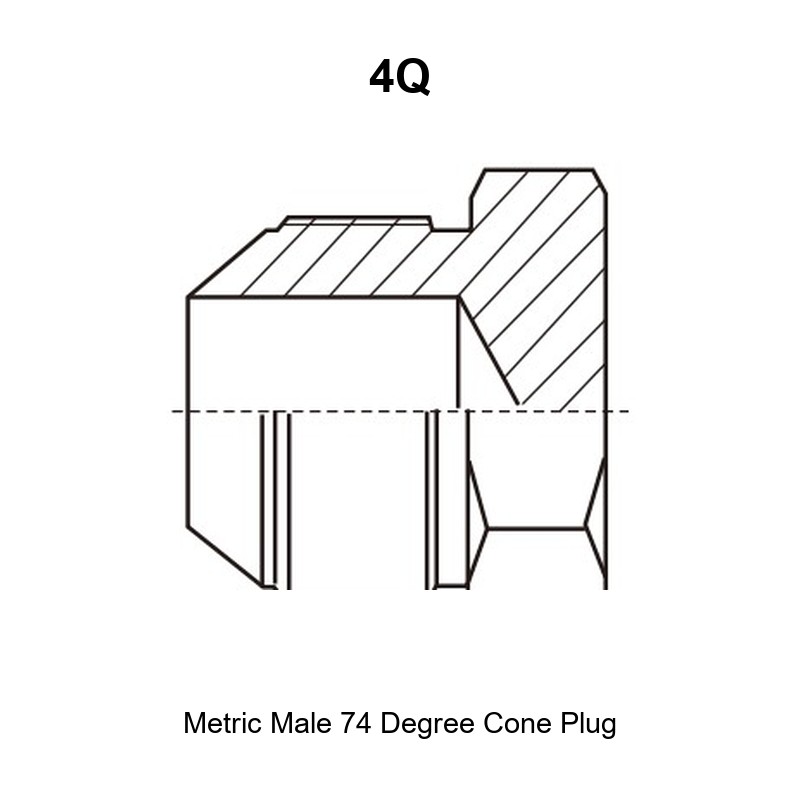
The part is a metric male 74° cone plug: a solid fitting with an external 74° cone that seats in a matching 74° cone port, with a hex for tightening. It is used to blank off an unused port or branch, to cap a manifold outlet that will be commissioned later, to seal a port during pressure testing, and to protect a machined seat during shipping and storage.
Core Advantages
- Uses the port’s own seat. The plug seals on the same 74° cone seat the tube connection would use, so no adapter and no second joint are needed to blank a port.
- Metal-to-metal, no elastomer. There is nothing to perish, nothing to replace at service, and nothing to fail at temperature.
- Compact and wrench-accessible. The hex is sized to the port size, so the plug sits low and can be tightened with a standard wrench.
- Pressure and temperature tolerant. The wide 74° cone tolerates temperature and fluid that would destroy a bonded washer or a soft seal.
- Complete-set option. The catalogue notes state that adding the suffix /RN supplies the plug as a complete set with cutting ring and nut (sleeve NB500-Q, nut NB200-Q) for use as a blanked tube-end connection.
Technical Specifications
What Is a 74° Cone Plug Adapter?
It is a solid plug with a metric male thread and an external 74° cone. When screwed into a matching 74° cone port, the cone seats against the port’s cone face and seals metal-to-metal; the thread provides the clamping load and the hex provides the drive. It is a plug, not a cap: a cap fits over an external thread or a male cone, a plug seats inside the port.
When to Use a Cone Plug, and When Not To
| Situation | Recommended |
|---|---|
| Unused port in a machined manifold | 74° cone plug (this family) |
| Branch line isolated during maintenance | Plug, tagged and recorded |
| Port to be commissioned later | Plug — the seat is preserved |
| Pressure testing an individual circuit | Plug or test plug per the test procedure |
| Port needs a permanent pressure boundary beyond the plug’s class | Isolate and blank a flanged or threaded connection instead |
| Port is a 60° cone, 37° flare or 24° cone seat | A plug for that seat — never this one |
A plugged port is still a live pressure boundary: it sees full system pressure and it is the first joint people forget when they hunt a leak. Record every plugged branch on the drawing and re-check the plug torque at commissioning and at the first service interval.
Cone Geometry — 74°, 60° and 37° Are Not Interchangeable
The plug seats on a 74° cone and nothing else:
| System | Included angle | Thread | Sealing location |
|---|---|---|---|
| Metric 74° cone (this family) | 74° | Metric | On the 74° cone face |
| 60° cone (DIN 3861 / ISO 1179) | 60° | BSP parallel (G) | On the 60° cone face |
| 37° flare (JIC, SAE J514) | 37° | UNF | On the 37° flare face |
| Metric 24° cone (DIN 2353) | 24° | Metric | On the 24° cone face |
The included angles differ, so the contact band falls at a different diameter and a different axial position in each case. A plug for the wrong system can be forced in a turn or two and will then either sit on an edge — and seep — or bottom out and leave the joint loose. Confirm the seat angle in the port before ordering, especially on a machine built to more than one standard.
Dimensional Data
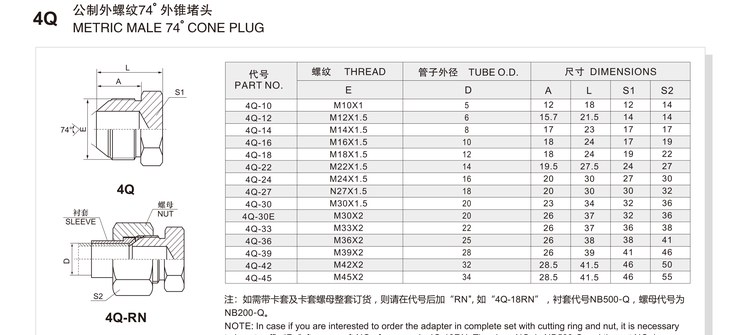
In the drawing, E is the plug thread, D the tube outside diameter that the port would serve, A the length from the end of the thread to the hex face, L the overall length, S1 the across-flats hex of the body and S2 the across-flats of the end. The drawing also marks the cone datum W at the 74° seat; W is not tabulated, so the engagement depth is confirmed against the port drawing for the specific application.
A is the dimension that decides whether the plug seats: it has to be long enough for the cone to reach the port seat before the hex approaches the port face, and short enough for full thread engagement. On counterbored ports and on shallow bosses, check A and L against the drawing rather than against the plug being replaced.
Full Dimension Table (Part Number Matrix)
Values as published in the HENGHUA catalogue drawing. Dimensions in millimetres.
| PART NO. | THREAD E | D | A | L | S1 | S2 |
|---|---|---|---|---|---|---|
| 4Q-10 | M10×1 | 5 | 12 | 18 | 12 | 14 |
| 4Q-12 | M12×1.5 | 6 | 15.7 | 21.5 | 14 | 14 |
| 4Q-14 | M14×1.5 | 8 | 17 | 23 | 17 | 17 |
| 4Q-16 | M16×1.5 | 10 | 18 | 24 | 17 | 19 |
| 4Q-18 | M18×1.5 | 12 | 18 | 24 | 19 | 22 |
| 4Q-22 | M22×1.5 | 14 | 19.5 | 27.5 | 24 | 27 |
| 4Q-24 | M24×1.5 | 16 | 20 | 30 | 27 | 30 |
| 4Q-27 | M27×1.5 | 18 | 20 | 30 | 30 | 32 |
| 4Q-30 | M30×1.5 | 20 | 23 | 34 | 32 | 36 |
| 4Q-30E | M30×2 | 20 | 26 | 37 | 32 | 36 |
| 4Q-33 | M33×2 | 22 | 26 | 37 | 36 | 38 |
| 4Q-36 | M36×2 | 25 | 26 | 38 | 38 | 41 |
| 4Q-39 | M39×2 | 28 | 26 | 39 | 41 | 46 |
| 4Q-42 | M42×2 | 32 | 28.5 | 41.5 | 46 | 50 |
| 4Q-45 | M45×2 | 34 | 28.5 | 41.5 | 46 | 55 |
Catalogue note: to order the plug as a complete set with cutting ring and nut, add the suffix “RN” after the part number — for example 4Q-18/RN. The sleeve is NB500-Q and the nut is NB200-Q.
Thread Size and Dash Chart
| Port / tube size | Thread | Note |
|---|---|---|
| 5 mm | M10×1 | Fine pitch |
| 6 mm | M12×1.5 | |
| 8 mm | M14×1.5 | |
| 10 mm | M16×1.5 | |
| 12 mm | M18×1.5 | |
| 14 mm | M22×1.5 | |
| 16 mm | M24×1.5 | |
| 18 mm | M27×1.5 | |
| 20 mm | M30×1.5 or M30×2 | 4Q-30 (fine) and 4Q-30E (coarse) — not interchangeable |
| 22 mm | M33×2 | |
| 25 mm | M36×2 | |
| 28 mm | M39×2 | |
| 32 mm | M42×2 | |
| 34 mm | M45×2 |
The 4Q-30 and 4Q-30E pair matters when plugging an existing port: M30×1.5 and M30×2 will not interchange, and the overall length differs (34 mm against 37 mm, because A changes from 23 to 26).
Material and Heat Treatment
Carbon steel bodies, machined from bar or forged, hardened according to pressure class and plated in trivalent chromium or zinc-nickel. Stainless 304 / 316L is available to order, and is the usual choice where a plug stays in place for years in a wet or corrosive environment. The cone is turned and finished in the same setup as the thread to hold concentricity.
Working Pressure and Operating Envelope
A plug is a pressure boundary and should be rated as one. The body rating follows the pressure class of the port size; a 4:1 burst ratio is typical. Because the plug is often the last joint to be considered, it is also the one most often left out of the circuit’s pressure review — include it.
Temperature Range
−40 °C to +120 °C for standard components; up to +200 °C with FKM in associated seals. The 74° cone has no elastomer in the sealing path, so the cone joint itself is not temperature-limited.
How to Read the Part Number Matrix
4Q-22 reads: family 4Q (metric male 74° cone plug), size 22 = a plug for a 14 mm tube port with M22×1.5 thread. 4Q-30E is the M30×2 version of size 30. Add /RN to receive the plug as a complete set with cutting ring and nut.
Selection and Ordering
Selection Checklist / Decision Table
| Requirement | Choose |
|---|---|
| Blank a 74° cone port | This family |
| Match the port thread only (tube size not used) | Identify size from E, not D |
| Port is 60° cone, 37° flare or 24° cone | A plug for that seat — never this one |
| Corrosive or wet location, long-term plug | Stainless 304 / 316L |
| Plug needed for a one-off pressure test | Same family; specify the test pressure |
| Thread is M30 — check the pitch | 4Q-30 (×1.5) or 4Q-30E (×2) |
Cross Reference Service
Send the port thread, a photograph of the port seat or the OEM part number and we will return the matching plug, including the pitch version for M30 ports.
Packaging and Logistics
Thread protectors, plastic bag, carton and pallet; certificates referenced to the heat number. Plugs are commonly ordered with adapters and shipped on the same pallet; air, sea and express channels are all available.
Installation and Fitment Guide
Step-by-Step Assembly
- Confirm the port is a 74° cone seat and that the thread and pitch match the plug.
- Clean the port cone and the plug cone. A film of paint or a burr becomes the sealing surface and the plug will weep.
- Lubricate the thread lightly; never apply sealant to the cone.
- Screw the plug in by hand until the cone contacts the seat.
- Hold the plug with the correct hex (S1 or S2) and torque to the specified value. The cone is metal-to-metal: under-torque leaves the cone short of contact, over-torque deforms both cone faces.
- Tag and record the plugged port on the machine drawing, and re-check the torque at commissioning and at the first service interval.
Torque and Sealing Notes
No sealant, no tape, no washer — a 74° cone plug seals on its cone and nothing else. Because the plug carries no fluid path, it is often assumed to be low-risk; in fact it is a live pressure boundary, and it should be torqued and recorded like any other joint. A plug that has been over-torqued once should be replaced, not re-used, because a deformed wide-angle cone cannot be recovered.
Installation Warnings
- Do not force a 74° cone plug into a 60°, 37° or 24° seat; it will damage the port.
- Do not use thread sealant as a substitute for a correct cone seat.
- Do not plug a port with the wrong pitch (M30×1.5 against M30×2) and expect the thread to hold torque.
- Do not leave a plugged branch undocumented; every plugged port is a joint that will be forgotten at the next inspection.
- Do not reuse a plug that has been over-torqued, galled or dented.
Applications and Industries
Plugs are used on machine tools, presses, injection-moulding machines, manifold blocks, hydraulic power units, mobile and agricultural machinery, marine systems and test benches — for blanking unused ports, capping outlets that will be commissioned later, sealing ports during pressure tests and protecting machined seats in transit. The metric male 74° cone plug adapter is the low-cost, high-reliability way to close a 74° cone port without an adapter and a second joint.
OEM Customization and Quality Traceability
Special lengths, special hex, alternative materials, drilled test plugs and customer plating are produced to drawing. Incoming material verification, first-article inspection, thread gauging, cone angle and seat diameter measurement, proof pressure testing on sample lots and final inspection are recorded against the order, with EN 10204 3.1 certificates on request.
FAQ
What is the difference between a plug and a cap? A plug seats inside the port on its own cone or thread; a cap fits over an external thread or a male end.
Will a 4Q plug seal a BSP port? No. It seats on a 74° cone. 60° cone, 37° flare and 24° cone ports need their own plugs.
Do I need a sealant or washer? No. The 74° cone is a metal-to-metal seat.
Which size do I need? Match the thread E and the port pitch. The D column tells you which tube the port would normally serve.
Is a plug rated for full system pressure? Yes — treat it as a live pressure boundary and rate it with the port class.
What is /RN? The plug supplied as a complete set with cutting ring and nut (sleeve NB500-Q, nut NB200-Q).
Request a Quote
Send the port thread and pitch, the material, the quantity and the working pressure. We will confirm the cone seat, the pitch version and the installed depth, and quote with the inspection documentation included.
Related products in this range: metric male 74° cone adapter 1Q · metric 74° cone to ISO 6149-3 adapter 1QH · 74° cone adapter with bonded seal 1QL · 74° cone to BSPT male adapter 1QT-SP · metric male 74° cone bulkhead adapter 6Q.
Browse the full Hydraulic Adapters range for the complete family, or contact us to request a quote, mill test reports, and samples.


 English
  Spanish
  Portuguese
  French
  German
  Arabic