
Why These Branch Tee Fittings with Swivel Nut Pass the Compliance Gate
A branch tee with a swivel nut is bought for one reason: the branch has to line up with a tube that cannot be rotated. If the nut binds, or the internal 24° seat is off-centre, that advantage disappears and the assembler ends up fighting the fitting. Every BC/BD branch tee we produce is checked so that the nut still turns by hand after the two run ends have been torqued to specification, the internal cone seat is measured on a profile projector, the two run threads are gauged 6g go / no-go, and the branch junction is sectioned on the first article of every lot to verify wall thickness at the stress concentration.
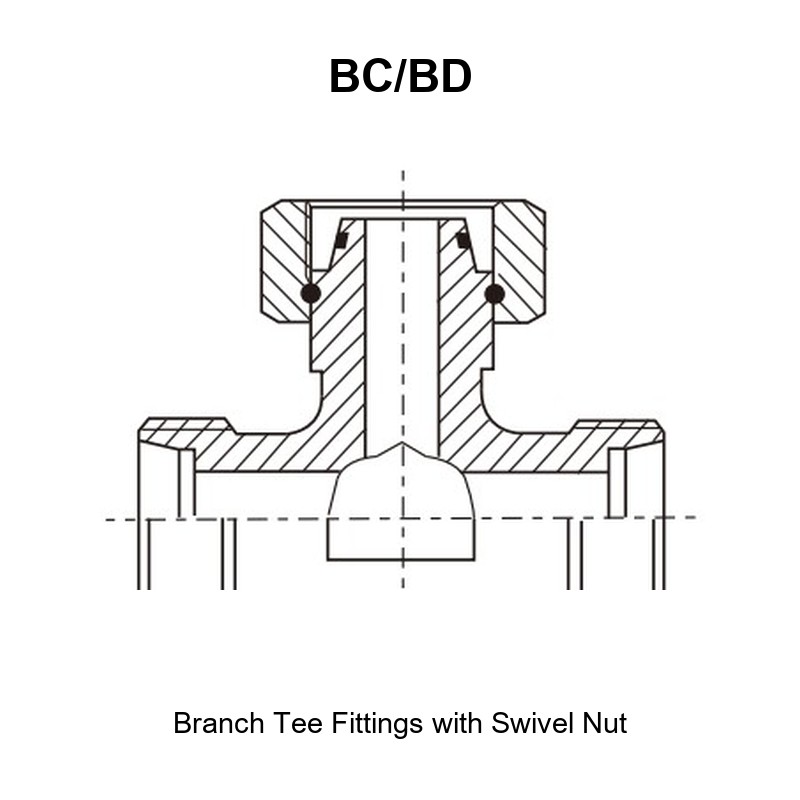
The fitting is a run tee with two metric male 24° cone stud ends (DIN 2353 / ISO 8434-1) in line, and a branch at 90° closed by a captive swivel nut with an internal 24° cone seat. “BC” is the light (L) series; “BD” is the heavy (S) series.
Core Advantages
- Independent branch alignment. The run joints can be torqued first; the swivel nut is then rotated onto the branch tube and tightened — no need to rotate the tube or the tee.
- Access in tight assemblies. The branch nut can often be reached with a socket where a fixed stud could not be turned at all.
- One forged body, no welds. The branch junction is forged, not welded or brazed, so there is no heat-affected zone at the highest-stress point of the fitting.
- Full L and S coverage. Tube 6 mm to 42 mm in the L series (31.5 MPa and 16 MPa) and tube 6 mm to 38 mm in the S series (63 MPa, 40 MPa and 31.5 MPa).
- Replaceable nut. The swivel nut is a separately manufactured part with its own inspection record and can be replaced without scrapping the tee body.
Technical Specifications
What Is a Branch Tee with Swivel Nut?
It is a three-way fitting: a straight run with a male 24° cone stud at each end, and a perpendicular branch closed by a swivel nut whose internal 24° cone seat seals against the cone of the tube end screwed into it. Unlike an equal tee — where the branch is also a fixed stud and its direction is fixed by the wrench position — here the branch direction is set by the tube, and the nut is turned to suit.
The Run Ends — Metric Male 24° Cone Studs
Both run ends are metric male studs with external 24° cones to DIN 2353 / ISO 8434-1 and 6g metric threads. In the BC range the thread follows the L (light) series — M12×1.5 for 6 mm tube up to M52×2 for 42 mm. In the BD range it follows the S (heavy) series, one size larger for the same tube OD, with heavier walls and a higher pressure class.
The Branch — Swivel Nut with Internal 24° Cone Seat
The branch carries a captive nut with an internal 24° cone seat. The nut rotates freely on the body, so the branch tube is presented, the nut is run on by hand until snug and then torqued — the run joints are never disturbed. The seat is metal-to-metal and does not use an elastomer or sealant.
Equal Tee or Branch Tee with Swivel Nut?
| Feature | Equal tees adapter (AC/AD) | Branch tee with swivel nut (BC/BD) |
|---|---|---|
| Run ends | Two male 24° cone studs | Two male 24° cone studs |
| Branch end | Male 24° cone stud | Swivel nut, internal 24° cone seat |
| Branch direction | Fixed by the stud torque position | Set freely by the tube, then locked by the nut |
| Assembly order | Decide branch direction before torquing any joint | Torque the run first, align the branch afterwards |
| Wrench access | Three wrenches, all on hexes | Two wrenches on the run, one on the branch nut |
| Typical use | Manifold blocks, fixed tube orientation | Pre-bent branch tubes, confined spaces, service work |
Choose the equal tee when the branch is a machined port in a block; choose the branch tee with swivel nut when the branch is a tube that is already formed and cannot be rotated.
Dimensional Data
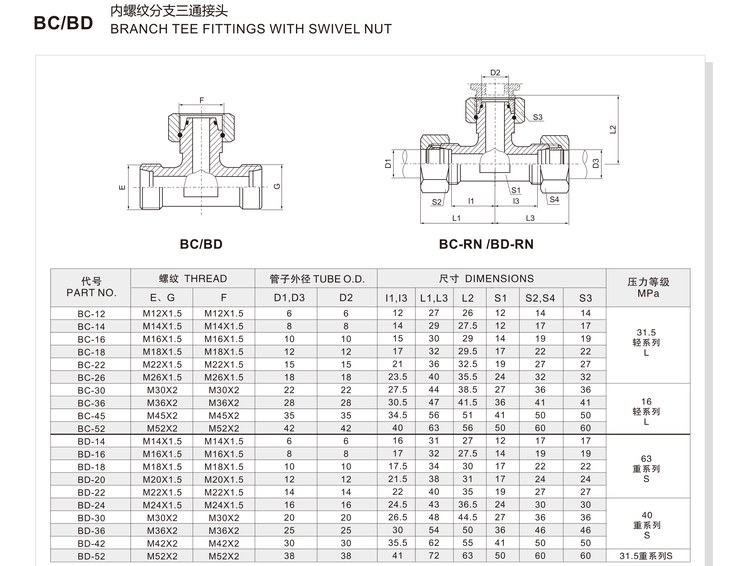
In the drawing, E and G are the threads of the two run ends, F the branch thread, D1 and D3 the run tube outside diameters, D2 the branch tube outside diameter, l1 and l3 the run stud reaches, L1 and L3 the run leg lengths, L2 the branch height to the nut face, S1 the body hex, S2/S4 the run end hexes and S3 the branch hex.
The run dimensions (L1 and L3) lie along one axis and the branch dimension (L2) along the perpendicular axis. They are not interchangeable: rotating the body to point the branch in a different direction also changes which run leg faces which way and which hex the wrench can reach. Check the branch direction and the run-leg dimensions in both the length and the height direction before ordering.
Full Dimension Table (Part Number Matrix)
Values as published in the HENGHUA catalogue drawing. Dimensions in millimetres.
| PART NO. | E, G (run) | F (branch) | D1, D3 | D2 | l1, l3 | L1, L3 | L2 | S1 | S2, S4 | S3 | Pressure MPa |
|---|---|---|---|---|---|---|---|---|---|---|---|
| BC-12 | M12×1.5 | M12×1.5 | 6 | 6 | 12 | 27 | 26 | 12 | 14 | 14 | 31.5 — L series |
| BC-14 | M14×1.5 | M14×1.5 | 8 | 8 | 14 | 29 | 27.5 | 12 | 17 | 17 | 31.5 — L series |
| BC-16 | M16×1.5 | M16×1.5 | 10 | 10 | 15 | 30 | 29 | 14 | 19 | 19 | 31.5 — L series |
| BC-18 | M18×1.5 | M18×1.5 | 12 | 12 | 17 | 32 | 29.5 | 17 | 22 | 22 | 31.5 — L series |
| BC-22 | M22×1.5 | M22×1.5 | 15 | 15 | 21 | 36 | 32.5 | 19 | 27 | 27 | 31.5 — L series |
| BC-26 | M26×1.5 | M26×1.5 | 18 | 18 | 23.5 | 40 | 35.5 | 24 | 32 | 32 | 31.5 — L series |
| BC-30 | M30×2 | M30×2 | 22 | 22 | 27.5 | 44 | 38.5 | 27 | 36 | 36 | 16 — L series |
| BC-36 | M36×2 | M36×2 | 28 | 28 | 30.5 | 47 | 41.5 | 36 | 41 | 41 | 16 — L series |
| BC-45 | M45×2 | M45×2 | 35 | 35 | 34.5 | 56 | 51 | 41 | 50 | 50 | 16 — L series |
| BC-52 | M52×2 | M52×2 | 42 | 42 | 40 | 63 | 56 | 50 | 60 | 60 | 16 — L series |
| BD-14 | M14×1.5 | M14×1.5 | 6 | 6 | 16 | 31 | 27 | 12 | 17 | 17 | 63 — S series |
| BD-16 | M16×1.5 | M16×1.5 | 8 | 8 | 17 | 32 | 27.5 | 14 | 19 | 19 | 63 — S series |
| BD-18 | M18×1.5 | M18×1.5 | 10 | 10 | 17.5 | 34 | 30 | 17 | 22 | 22 | 63 — S series |
| BD-20 | M20×1.5 | M20×1.5 | 12 | 12 | 21.5 | 38 | 31 | 17 | 24 | 24 | 63 — S series |
| BD-22 | M22×1.5 | M22×1.5 | 14 | 14 | 22 | 40 | 35 | 19 | 27 | 27 | 63 — S series |
| BD-24 | M24×1.5 | M24×1.5 | 16 | 16 | 24.5 | 43 | 36.5 | 24 | 30 | 30 | 63 / 40 — S series [to be confirmed] |
| BD-30 | M30×2 | M30×2 | 20 | 20 | 26.5 | 48 | 44.5 | 27 | 36 | 36 | 40 — S series |
| BD-36 | M36×2 | M36×2 | 25 | 25 | 30 | 54 | 50 | 36 | 46 | 46 | 40 — S series |
| BD-42 | M42×2 | M42×2 | 30 | 30 | 35.5 | 62 | 55 | 41 | 50 | 50 | 40 — S series |
| BD-52 | M52×2 | M52×2 | 38 | 38 | 41 | 72 | 63 | 50 | 60 | 60 | 31.5 — S series |
The [to be confirmed] cell sits on the size boundary between two pressure groups in the catalogue scan and is verified against the drawing at order.
Thread Size and Dash Chart
| Tube OD (D1, D2, D3) | L series (BC) thread | S series (BD) thread |
|---|---|---|
| 6 mm | M12×1.5 | M14×1.5 |
| 8 mm | M14×1.5 | M16×1.5 |
| 10 mm | M16×1.5 | M18×1.5 |
| 12 mm | M18×1.5 | M20×1.5 |
| 14 mm | — | M22×1.5 |
| 15 mm | M22×1.5 | — |
| 16 mm | — | M24×1.5 |
| 18 mm | M26×1.5 | — |
| 20 mm | — | M30×2 |
| 22 mm | M30×2 | — |
| 25 mm | — | M36×2 |
| 28 mm | M36×2 | — |
| 30 mm | — | M42×2 |
| 35 mm | M45×2 | — |
| 38 mm | — | M52×2 |
| 42 mm | M52×2 | — |
The swivel nut thread follows the same ladder as the run threads, so the branch tube end uses the same series as the run.
Material and Heat Treatment
Carbon steel bodies forged or machined from bar, hardened to the pressure class, and plated in trivalent chromium or zinc-nickel; the swivel nut is plated in the same batch as its body so that the pair does not gall or show a colour mismatch. Stainless 304 / 316L is available to order, and the nut can be supplied separately in a specified material.
Working Pressure and Operating Envelope
The pressure column is the working pressure of the connection, not a burst pressure; a 4:1 burst ratio is typical of the body. The branch junction of a tee is the highest-stress point of the fitting, and the branch is limited by the tube it carries as well as by the body class.
Temperature Range
−40 °C to +120 °C for standard components, up to +200 °C with FKM in associated seals. The 24° cone joint has no elastomer in the sealing path; the tube end and the fluid normally set the limit.
How to Read the Part Number Matrix
BC-12 reads: family BC (branch tee with swivel nut, L series), size 12 = 6 mm tube / M12×1.5 at the run ends and the branch. BD-14 is the S series equivalent: 6 mm tube, M14×1.5. The size number follows the series ladder, not the millimetre tube OD, so quote the tube size, the thread and the series when cross-referencing an OEM number.
Selection and Ordering
Selection Checklist / Decision Table
| Requirement | Choose |
|---|---|
| Branch tube is pre-bent and cannot be rotated | This family |
| Run must be torqued before the branch is connected | This family |
| Standard pressure, tube 6–22 mm | BC (L series) |
| High pressure, tube 6–16 mm | BD (S series) |
| Branch is a machined port in a block | Equal tees adapter AC/AD |
| Different sizes at the branch | Reducing branch tee — specify all three ends |
Cross Reference Service
Send the OEM number, the two run threads, the branch thread and the tube ODs, or a photograph of the assembly. We return a mapped part number with both run leg dimensions and the branch height filled in, and confirm that the swivel nut is on the branch.
Packaging and Logistics
The swivel nut is supplied fitted and staked so it cannot be lost in transit but still rotates freely on arrival. Thread protectors, plastic bags, cartons and pallets; certificates referenced to the heat number. Air, sea and express shipping available.
Installation and Fitment Guide
Step-by-Step Assembly
- Verify all three connections are metric 24° cone (DIN 2353 / ISO 8434-1) and that the thread sizes match the ordered series.
- Clean the two run cones, the branch seat and the mating tube ends. Remove swarf, paint and old sealant.
- Lubricate the threads lightly; never apply sealant to a 24° cone.
- Start both run threads by hand, then torque them to specification while holding the body by the S1 hex. Set the branch direction at this stage — the body cannot be rotated afterwards without releasing a run joint.
- Present the branch tube to the swivel nut. Turn the nut by hand until it is snug.
- Torque the branch nut with a wrench on the branch hex (S3), holding the body so the run joints stay undisturbed. Two wrenches, one joint at a time.
- Re-check all three joints after the first thermal cycle and after any maintenance that disturbs the assembly.
Torque and Sealing Notes
Three joints, three torque values, none of them sealed with tape or compound. The run ends and the branch nut are all 24° metal cone joints. Sequence discipline matters here: torque the run first and the branch last, and hold the body every time. Over-torque deforms the cone and the port; a deformed cone cannot be recovered by tightening further.
Installation Warnings
- Do not use the swivel nut to pull the branch tube into position against a misaligned run; align the tube first.
- Do not rotate the body after a run joint has been torqued; release the joint, re-position and re-torque.
- Do not mix 24°, 60° and 37° cone components.
- Do not use thread sealant anywhere on this fitting.
- Do not reuse a cone that has been over-torqued, galled or dented.
Applications and Industries
Branch tees with swivel nuts are used where a hydraulic line has to feed a secondary circuit from a pre-formed tube branch: mobile machinery, agricultural equipment, cranes, machine tools, presses, injection-moulding machines, hydraulic power units, marine systems and test benches. The branch tee fittings with swivel nut is the standard answer whenever the branch tube run is fixed and the fitting has to adapt to it rather than the other way round.
OEM Customization and Quality Traceability
Reducer combinations, special branch heights, special hex, locking nuts, alternative nut materials and customer plating are produced to drawing. Incoming material verification, first-article inspection with sectioning at the branch, nut-freedom checks after run torque, thread gauging, cone profile checks, proof pressure testing on sample lots and final inspection are recorded against the order, with EN 10204 3.1 certificates on request.
FAQ
How is this different from an equal tee? The branch here is a swivel nut with an internal cone seat, not a fixed stud — so the branch tube can be aligned after the run is tight.
Is the swivel nut captive? Yes. It is supplied on the body, cannot be lost, and rotates freely so the branch tube can be presented at any angle.
Does the branch joint need sealant? No. Sealing is by the internal 24° cone seat against the tube end cone.
Can I torque the branch first? It is possible but not recommended. Torque the run first, then the branch, so the run joints are not disturbed.
BC or BD? Same geometry, different series: L (light) for BC, S (heavy) for BD.
Can I replace just the nut? Yes. The swivel nut is a separate component and can be supplied on its own.
Request a Quote
Send the part number, the run and branch threads, the tube ODs, the material, the quantity and the working pressure. We will confirm the series, the swivel-nut configuration and the branch height, and quote with the inspection documentation included.
Related products in this range: equal tees adapter AC/AD · reducer tube adaptor with swivel nut 2C/2D · 90° elbow reducer tube adaptor with swivel nut 2C9/2D9 · 90° elbow fittings adapter 1C9/1D9 · metric male 74° cone tee adapter AQ.
Browse the full Hydraulic Adapters range for the complete family, or contact us to request a quote, mill test reports, and samples.



 English
  Spanish
  Portuguese
  French
  German