
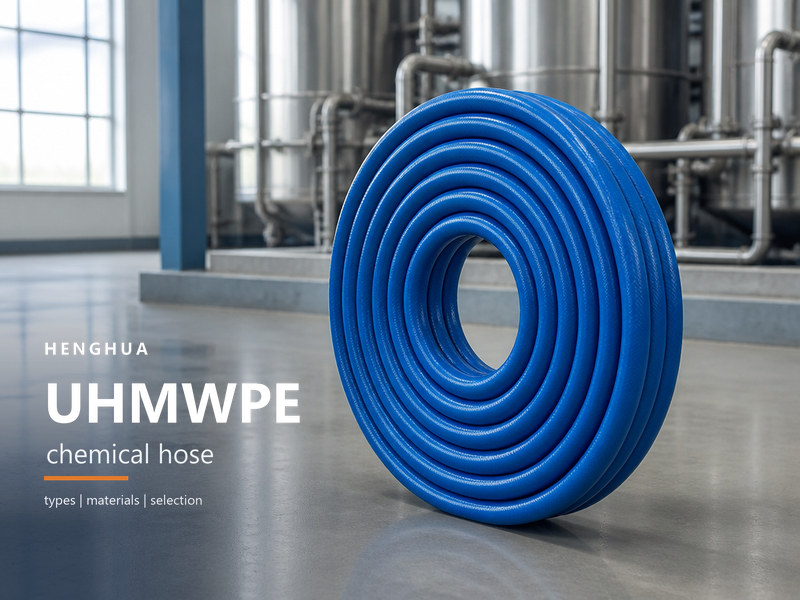
A UHMWPE chemical hose pairs an ultra-high-molecular-weight polyethylene liner with a blue EPDM cover to resist a wide range of industrial chemicals. Manufacturer data sheets commonly state that the liner handles about 98% of industrial chemicals, working from −40 °C to +120 °C at 150 PSI.
If you are checking whether one liner can carry your whole chemical list, the short answer is usually yes, and the exceptions are a short list you can screen in a minute. The rest of this guide explains why the very long polymer chains resist attack, what the temperature and pressure ratings actually cover, and exactly where UPE stops working.
About a 14-minute read at 250 words per minute; the ratings below are manufacturer planning values, so confirm the data sheet for your exact chemical.
What UHMWPE Chemical Hose Is and Why the Liner Leads
A UHMWPE chemical hose is a composite. It has a wetted liner made from ultra-high-molecular-weight polyethylene, one or more layers of textile reinforcement, an optional steel helix for suction duty, and an outer cover. Inside the hose body, only the liner is wetted. The reinforcement, helix, and cover exist to hold the liner in shape and shield it from the outside.
The liner-first rule matters during selection. Two hoses can share the same cover and the same braid yet behave completely differently, because their liners differ. Selection starts at the liner, not at the cover color or the fitting thread.
UHMWPE (UPE) belongs to the polyethylene family, the same family as the everyday polyethylene used in bottles and water pipe. The difference is molecular weight. A standard polyethylene chain carries a few thousand repeat units; a UHMWPE chain carries hundreds of thousands. Those very long chains are why the material resists abrasion and chemical attack far better than its lighter cousin.
Because the liner is the only barrier, its thickness and surface quality set the service life. A thin or scratched liner exposes the reinforcement to the chemical, and once the textile wets out, the hose fails from the inside.
For a wider view of how liners, reinforcement, and covers combine across hose families, see the guide to flexible hose materials.
Why Do Very Long Polymer Chains Resist Chemical Attack?
Chemical resistance in a polymer is mostly about chain length and chain packing. A UHMWPE molecule is a very long, unbranched polyethylene chain, and the chains entangle with one another instead of lying in loose bundles. The result is a dense, highly crystalline surface with very little free volume between molecules.
Aggressive chemicals attack a polymer by diffusing into it and breaking bonds. A dense surface slows that diffusion, because there are few gaps for the attacking molecules to enter. Polyethylene is also non-polar, so polar media such as acids, bases, and salt solutions have little chemical affinity for it. Water, dilute mineral acids, and alkaline solutions tend to run off rather than soak in.
Beyond packing, chain length adds a second benefit. When a chemical does break a bond, a very long chain loses only a small fraction of its strength, while a short chain can fail outright. This is why molecular weight, and not only chemical identity, drives the “handles about 98% of industrial chemicals” figure that manufacturer data sheets commonly quote.
The 98% figure is a datasheet summary of a standard compatibility table. It is a useful planning starting point, not a guarantee for every chemical at every concentration and temperature. The sections below show where the boundary sits.
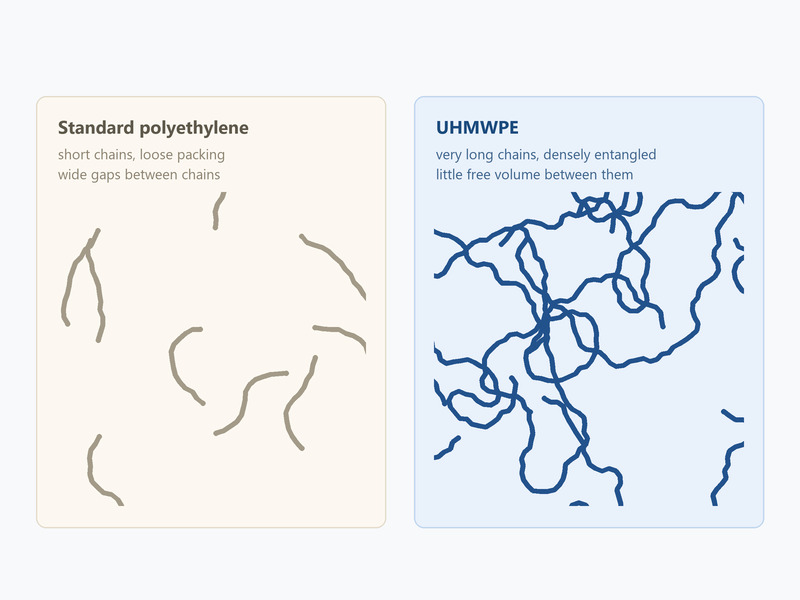
Figure 1. Long, entangled UHMWPE chains pack densely, which slows the diffusion of aggressive chemicals into the liner.
UHMWPE Hose Temperature Range: The −40 °C to +120 °C Window
The UHMWPE hose temperature range runs from −40 °C to +120 °C for continuous service. The cold end and the hot end fail for different reasons. Cold stiffens the polymer: below the low limit the liner loses flexibility, kinks at tight bends, and can crack. Heat does the opposite: the liner softens, its chemical resistance slowly drops, and permeation rises.
The upper limit is the one that surprises people. A material can survive a temperature and still be the wrong choice there, because chemical attack accelerates as temperature climbs. A UHMWPE hose temperature range of −40 °C to +120 °C describes the polymer itself, but the practical ceiling for an aggressive chemical often sits well below +120 °C.
Clean-in-place duty is the case that trips people up: a hot caustic wash can sit close to the liner’s practical ceiling with an aggressive medium, so the wash temperature and the caustic concentration both belong in the specification.
Use the window to compare liners, not to pick a working temperature. The table below lists the common liner and rubber materials side by side using planning values.
Table 1. Planning temperature windows for common chemical hose liner and rubber materials (continuous service; verify the data sheet).
| Material | Continuous Window (planning values) | Best Fit | Main Limit |
|---|---|---|---|
| UHMWPE (UPE) | −40 °C to +120 °C | Broad industrial chemicals | Strong oxidizing acids; hot aromatics |
| XLPE | −40 °C to +100 °C | Acids, bases, hypochlorite | Aromatic solvents |
| PTFE (polytetrafluoroethylene) | −70 °C to +260 °C | Widest chemical range | Molten alkali metals; elemental fluorine |
| EPDM (ethylene propylene diene monomer) | −40 °C to +120 °C | Acids, bases, ketones, steam | Petroleum oils; aromatics |
| NBR (nitrile rubber) | −30 °C to +100 °C | Petroleum oils and fuels | Ketones, esters, strong acids |
| FKM (fluoroelastomer) | −20 °C to +200 °C | Hydrocarbons, acids, heat | Hot bases, ketones, amines |
Compare the UHMWPE row with the PTFE row in Table 1. PTFE buys a much wider temperature span and wider chemical coverage, but it is the least flexible material in the group and costs more at the planning level. For many plant transfers, UPE sits in the practical middle: broad coverage at a lower planning cost than PTFE.
Note that the sibling XLPE liner has a narrower continuous window, −40 °C to +100 °C, and belongs to a different specification family. The XLPE chemical suction and discharge hose article covers that grade, its helix, and its own pressure class in detail.
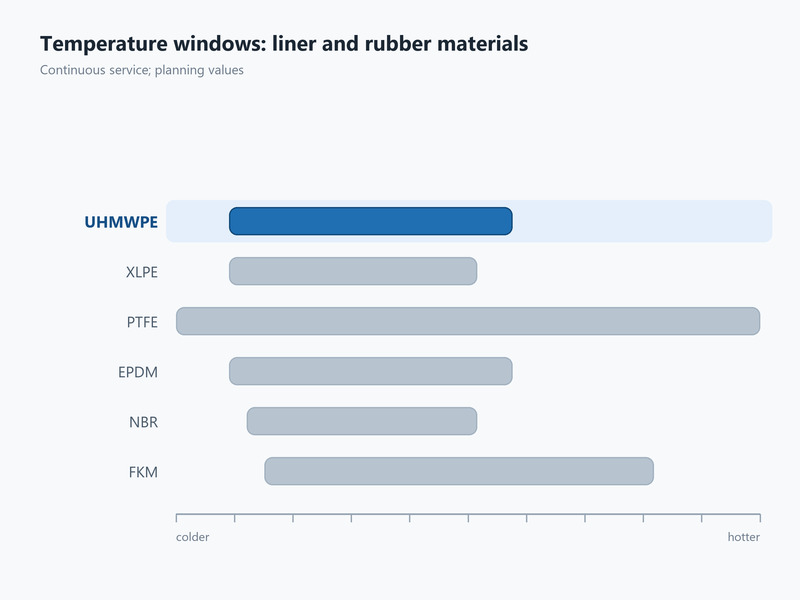
Figure 2. The UHMWPE window sits between XLPE and PTFE, and is wider than XLPE.
Chemical Hose 150 PSI: What the Pressure Class Really Means
The pressure class tells you the working pressure the assembly is built to carry continuously at its rated temperature. For chemical transfer, a chemical hose 150 PSI class is one of the most common ratings, and it equals about 10 bar. That matches the EN 12115:2021 working pressure of 10 bar for rubber and thermoplastic chemical hose, so the two references describe the same duty band.
Higher classes also exist. Some chemical hose is built to 16 bar, and some suction-and-discharge grades reach 17 bar. A chemical hose 150 PSI rating is not something you can raise by fitting a stronger coupling, because pressure capability lives in the reinforcement, not in the fitting.
Burst pressure is a separate figure. As a planning rule, the burst value lands at roughly three to four times the working pressure. That margin absorbs surges, water hammer, and the slow loss of strength that comes with age. It is a failure point, never a target.
Table 2. Common chemical hose pressure classes and the duty each one is planned for (planning figures).
| Class | Typical Duty | Burst Planning Value |
|---|---|---|
| 150 PSI | General chemical transfer | Roughly three to four times working pressure |
| 16 bar | Higher-pressure transfer | Roughly three to four times working pressure |
| 17 bar | Suction and discharge grades | Roughly three to four times working pressure |
The 17 bar figure belongs to specific suction-and-discharge products, not to every chemical hose. Confirm the class printed on the cover, and remember that a derated pressure at a higher temperature is lower than the label value.
What Do the Liner, Helix, and Cover Each Do?
The hose is built in layers, and each layer has one job. The liner contains the chemical. The textile reinforcement carries the pressure. The helix, when present, resists collapse under vacuum. The cover protects everything inside from abrasion, sunlight, and spilled product.
The cover is usually EPDM, a rubber chosen for weather and ozone resistance and for its own tolerance of acids, bases, and ketones. Cover color varies by maker; the same UHMWPE and EPDM build is sold in blue and in green. Quote the liner and cover material when you reorder rather than the color. Cover finish is a second choice: a corrugated cover flexes more and weighs less, while a wrapped cover resists abrasion better on drag routes.
The helix is what separates a delivery hose from a suction hose. A delivery-only hose (EN 12115 Type D) has no helix and is not built to resist vacuum. A suction-and-discharge hose (Type SD) adds a steel helix that keeps the bore open when the pump pulls. Choosing the wrong one leads to a collapsed liner.
The table below sets out the layers in order from the product side outward.
Table 3. Layer stack of the UHMWPE liner and the function of each layer.
| Layer | Material | Function |
|---|---|---|
| Inner liner | UHMWPE (UPE) | Contains the chemical; a light, smooth bore shows residue early |
| Reinforcement | High-tensile textile | Carries the working pressure |
| Helix | Steel wire in suction grades | Prevents collapse under vacuum |
| Cover | EPDM (typical) | Weather, ozone, and abrasion protection |
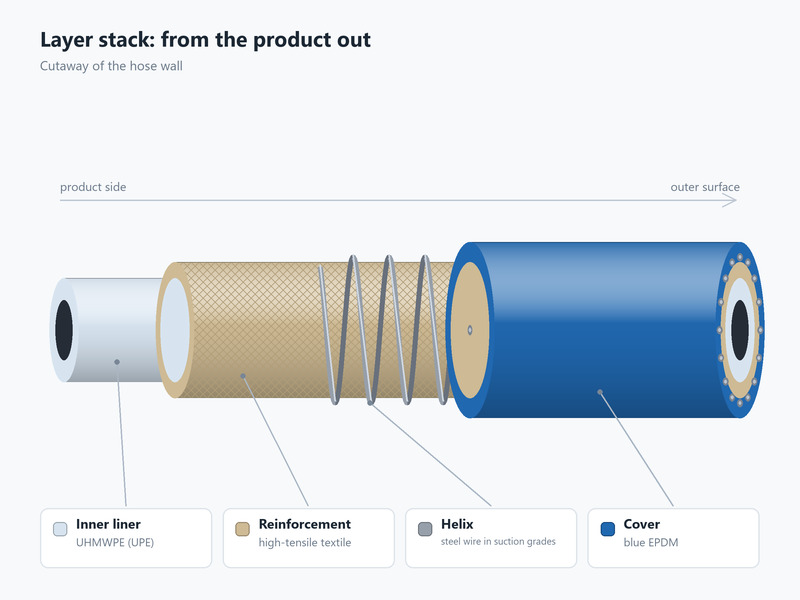
Figure 3. From the product out: the UHMWPE liner, textile reinforcement, an optional steel helix for suction, and a blue EPDM cover.
When vacuum duty is part of the job, the choice between delivery and suction construction decides whether the hose survives. The comparison of suction hose versus delivery hose shows how the helix changes pressure and vacuum behavior.
Where UHMWPE Chemical Hose Stops Working
No liner handles everything, and the UPE material is no exception. The 98% datasheet figure describes a broad planning range, and the remaining share is where UPE is the wrong answer. Knowing those cases protects the product and the people handling it.
Three groups need care:
- Clear the concentrated oxidizing acids first, because they attack the polymer chain directly.
- Then set aside hot aromatics such as toluene and xylene at elevated temperature.
- Finally re-check the chlorinated solvents, which behave the same way when the product is warm.
Scope: a UHMWPE liner suits the four families at the top of Table 4. The three below need a different liner before you order.
Table 4. Chemical families a UHMWPE liner handles well and families that need a different liner (planning guide).
| Chemical Family | Guidance for UPE | Note |
|---|---|---|
| Dilute mineral acids | Good | Common transfer duty |
| Bases and alkalis | Good | Sodium hydroxide, ammonia |
| Salt solutions | Good | Wide concentration range |
| Alcohols | Good | Typical solvent transfer |
| Strong oxidizing acids | Use PTFE | Concentrated sulfuric, nitric |
| Hot aromatics | Use PTFE or FKM | Toluene, xylene at high temperature |
| Some chlorinated solvents | Use PTFE, and confirm warm duty | Check the data sheet when warm |
The practical rule is simple: confirm the liner against the actual chemical, concentration, and temperature before you order. A compatibility table is a starting point, and the manufacturer data sheet is the final word.
Send the chemical, its concentration, the highest temperature, and the bore when you ask for a quote, because those are the four selection inputs. Get a quote and free samples.
Matching UHMWPE Chemical Hose to Common Chemicals
A UHMWPE chemical hose appears most often where one liner must cover many products. Chemical plants, tank farms, and wastewater sites move different media through the same transfer points, and a liner that handles a broad range simplifies hose inventory. Instead of stocking a separate hose for each chemical, a plant can standardize on one UPE construction and re-check only the boundary chemicals. If you unload tankers and drums on one stand, a single UPE liner removes the need to swap hoses between products.
Typical duties include:
- Loading and unloading tankers, rail cars, and drums
- Transfer between process vessels and storage tanks
- Pump discharge on mild acids, bases, and salt solutions
- Waste and effluent movement
For the full decision path from chemical type to hose construction, the chemical hose complete guide maps the whole selection process, from liner choice to fittings and inspection. If you stock hoses for resale, expect the questions to arrive as a chemical list rather than a part number, so keep a compatibility table within reach.
Sizing, Fittings, and Installation for UPE Hose
A UPE hose only performs as well as its installation. Start with bore size, because an undersized bore raises velocity and abrasion while an oversized bore wastes product and slows transfer. Common chemical hose bores are 3/4 in, 1 in, 1-1/4 in, 1-1/2 in, 2 in, 3 in, and 4 in.
The hose size selection guide covers the flow math behind those sizes. Once the bore is fixed, match the fitting to both the chemical and the pressure class. Order a UPE hose with factory-crimped ends to avoid the field-assembly errors that account for many early failures.
Three installation rules keep the line safe:
- Choose a fitting material that also resists the chemical, not just the liner.
- Route the hose so it does not kink at bends or drag over sharp edges.
- Ask for the minimum bend radius on the data sheet before you route a tight run.
The hose couplings guide explains how coupling type and material follow the chemical, and the clamp choice must match both.
For flammable or charge-generating products, bond and ground the assembly. Conductive and antistatic grades are classified under EN 12115 and tested to EN ISO 8031, with a conductive limit of 10⁶ Ω (M class) and an antistatic limit of 10⁹ Ω (Ω class). Where the plant classifies the line for static, follow the OSHA requirements for bonding and grounding.
How to Specify and Inspect a UHMWPE Chemical Hose
When you write the specification, put the liner first. Name UHMWPE (UPE), then the bore, the pressure class, the temperature range, the construction type (Type D or Type SD), and the electrical class. That single line removes most of the ambiguity that causes wrong deliveries.
A UHMWPE chemical hose specification should also state the test basis. EN 12115:2021 is the reference standard for rubber and thermoplastic chemical hose and hose assemblies, with Type D for discharge and Type SD for suction and discharge. Hydrostatic testing follows ISO 1402, pulse testing follows ISO 6803, and abrasion testing follows ISO 4649.
If the hose touches food or potable products, add the food-contact basis. Polyolefin food contact falls under FDA 21 CFR 177.1520, and plastic food-contact materials in the EU fall under EU 10/2011.
Inspection is a routine rather than a one-time event:
- Check the cover for cuts, blisters, and exposed reinforcement.
- Check the fittings for weeping and the crimp for movement.
- If you own the inspection routine, check the liner ends first: scratched bores, cracking, and discoloration all show up there.
- Replace, never repair, a hose with a damaged liner.
Retire a hose as soon as the liner is compromised. A chemical hose is a consumable safety item, and a patch on a chemical line is a leak waiting to happen.
Final Verdict: When UHMWPE Chemical Hose Is the Right Choice
A UHMWPE chemical hose is the right choice when you need broad chemical coverage from a single liner at a moderate planning cost. It earns its place on mixed-duty transfer points where acids, bases, salts, and alcohols share the same hose stand. It is a poor fit for the three families in the lower rows of Table 4, where PTFE or another liner belongs.
The honest reading of the 98% claim is this: manufacturer data sheets commonly state that a UHMWPE liner handles about 98% of industrial chemicals, so treat the figure as a screening tool. Confirm the actual chemical, concentration, and temperature against the data sheet before you commit.
If the duty fits UPE, it rewards you with a wide working window and a construction that can be built for suction when the pump pulls.
UHMWPE Chemical Hose FAQs
What is a UPE chemical hose used for?
A UPE chemical hose is used for general chemical transfer where one liner must cover many products. Before you standardize on one liner, screen the chemical list against the boundary families, because that is the step that decides whether a single hose covers the whole duty.
Does a UHMWPE liner really handle 98% of chemicals?
Manufacturer data sheets commonly state that a UHMWPE liner handles about 98% of industrial chemicals, so the figure is widely quoted. It is a datasheet summary of compatibility testing rather than a guarantee. The remaining share is not random; it concentrates in three families, and those are worth screening first. Confirm your exact chemical, its concentration, and its temperature against the supplier data sheet.
How hot can a UPE liner safely run?
The planning window is −40 °C to +120 °C for continuous service. Treat that as a material property: if your product is aggressive and the duty temperature sits in the upper part of the range, make the data sheet answer the question rather than the table.
What does a 150 PSI pressure class mean?
A 150 PSI class means the assembly is built to carry that working pressure continuously at its rated temperature. Read the class on the printed cover rather than from a catalog line, because the same bore can be supplied in more than one class. The burst value is separate, and it is a failure point rather than a usable limit.
Can a UPE liner be used for suction duty?
A UPE liner can handle suction duty, if the hose is built for it. The build to look for is the suction-and-discharge type, which carries a helix; a delivery-only hose is not made for vacuum and will collapse. Confirm the vacuum rating on the grade you order rather than inferring it from the pressure class.
What chemicals are not suitable for a UPE liner?
A UHMWPE liner is the wrong answer for three families: concentrated oxidizing acids, hot aromatics, and some warm chlorinated solvents. The first group attacks the polyethylene chain directly, while the other two swell or soften the liner at temperature. For those duties, a PTFE liner is usually the better answer. Screen every boundary chemical against the manufacturer data sheet before ordering.
How do I know if UPE is the right liner for my chemical?
Start from the chemical, its concentration, and the highest temperature it reaches. Check those three against a compatibility table, then confirm with the manufacturer data sheet. If the chemical falls in the avoid group, or sits near the temperature ceiling, select a different liner such as PTFE. Never rely on a single headline percentage.
What is the difference between UHMWPE and XLPE liners?
Both are polyethylene-based, but they are different materials with different windows. UHMWPE has much longer chains, runs −40 °C to +120 °C, and resists a broad range of chemicals. XLPE has a continuous service window of −40 °C to +100 °C, tolerates acids, bases, and hypochlorite well, but is not suited to aromatic solvents. Match the liner to the chemical list.
How should I store and inspect the assembly?
Store the hose coiled, out of direct sun, away from sharp edges, and above freezing. Inspect it as a routine: check the cover for cuts and blisters, the fittings for weeping, and the liner ends for cracking. Set the inspection interval by how aggressive the product is, not by the calendar.
About HENGHUA
HENGHUA is a professional hose and fitting manufacturer supplying global distributors, retailers, and OEM brands. The chemical hose line includes UHMWPE (UPE), XLPE, and PTFE liners alongside rubber constructions such as EPDM and oil-resistant synthetic rubber, all built with high-tensile textile reinforcement and an optional steel helix for suction duty.
We supply factory-crimped assemblies, custom lengths, fittings, cover printing, private label, and OEM/ODM. Commercial terms are factory-direct pricing, short bulk lead times, and warranty. Send your chemical list and we will quote against it. Get a quote and free samples.
About the author: The HENGHUA technical team writes practical guides on chemical hose materials, sizing, and safe transfer for plant engineers and distributors.






 English
  Spanish
  Portuguese
  French
  German
  Arabic
  Russian
  Indonesian
  Japanese
  Korean