


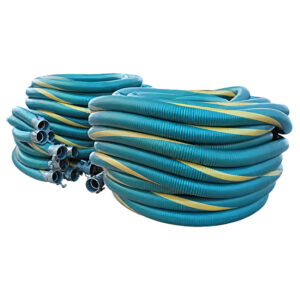
A dock composite hose has to do two jobs at once. It must stay flexible enough to follow a loading arm that rises and falls with the tide, and stay open enough that a 254 mm bore does not flatten under its own weight. This range covers 51 mm to 254 mm (2 in to 10 in) at 15 bar (218 psi) working pressure and 60 bar burst, with the temperature ceiling set by the liner, polypropylene in types A to C and PTFE in types D and F.
نظرة عامة على المنتج
This is a non-vulcanised, multi-layer thermoplastic hose for dock and jetty transfer of fuel oils and corrosive chemicals. In EN 13765:2018 it sits in the Type 4 large bore class, with a 4:1 design factor on burst. Its layers are compressed between two steel helices rather than bonded, which separates it from rubber hose.
In one sentence, the dock composite hose is a film liner in a fabric-reinforced carcass, between an inner helix that prevents collapse and an outer helix that carries hoop load, under a coated cover.
Three numbers frame the range: 15 bar at every bore from 51 mm to 254 mm, 60 bar burst, and a temperature ceiling set by the liner. Bore steps are 51, 64, 76, 102, 152, 203 and 254 mm.
The advantages follow from that build. A dock hose is dragged, bent over a saddle and left in salt spray, so the cover does the wearing and the helix the holding. Because the helix keeps the bore open, one hose handles discharge and suction draining.
Typical users are refinery jetties, tank farms, oil terminals, petrochemical plants and barge berths, running loading arms, saddles, tank truck stands and floating suction lines.
The problem it solves is the joint between a fixed steel pipe and a moving vessel. That joint absorbs surge, misalignment and tidal movement without kinking, and survives being set down on concrete. A braided rubber hose at 203 mm bore needs lift gear.
Quality is proven on the finished unit: every assembly is proof tested at 1.5 times working pressure, each crimp is recorded, and the hose traces to its material batch. The factory holds ISO 9001 and builds to EN 13765:2018.
Product Advantages of the Dock Composite Hose
- One family, five constructions. Types A to F cover fuel oil through aggressive chemicals.
- Flat 15 bar rating to 254 mm. Large bore does not mean a reduced pressure class here.
- Full-length flexibility. The 60 bar margin sits in fabric plies, not heavy wire.
- Abrasion-resistant cover. PVC-coated fabric takes the concrete and steel edge contact.
- Crimped flange assemblies. Fixed, floating and reducing flanges, swaged in house with records.
- Traceable batches. Markings link each unit to its material lot and proof test.
Applicable users: refinery and terminal maintenance teams, jetty operators, tank farm contractors, petrochemical plant engineers and distributors who stock large bore transfer hose.
Detailed Technical Specifications for Dock Composite Hose
| Hose code | القطر الاسمي | ID | Minimum bend radius | Working pressure | Burst pressure |
|---|---|---|---|---|---|
| DCH-01 | 2 بوصة | 51 mm | 225 mm | 15 bar (218 psi) | 60 bar (870 psi) |
| DCH-02 | 2.5 in | 64 mm | 245 mm | 15 bar (218 psi) | 60 bar (870 psi) |
| DCH-03 | 3 بوصة | 76 mm | 300 mm | 15 bar (218 psi) | 60 bar (870 psi) |
| DCH-04 | 4 بوصة | 102 mm | 400 mm | 15 bar (218 psi) | 60 bar (870 psi) |
| DCH-05 | 6 in | 152 mm | 751 mm | 15 bar (218 psi) | 60 bar (870 psi) |
| DCH-06 | 8 in | 203 mm | 951 mm | 15 bar (218 psi) | 60 bar (870 psi) |
| DCH-07 | 10 in | 254 mm | 1102 mm | 15 bar (218 psi) | 60 bar (870 psi) |
- Temperature: set by the liner. Types A, B and C carry a PP liner and types D and F a PTFE liner, so the ceiling depends on the build. Send the medium and temperature for written confirmation.
- معامل الأمان: 4:1 on burst as published. The 60 bar figure is exactly four times the 15 bar rating, so the numbers agree.
- Proof test: EN 13765:2018 calls for a routine test at 1.5 times working pressure, which is 22.5 bar at every bore.
- Vacuum: confirm the figure for the construction you order. Suction duty belongs in the order rather than in an assumption.
- Tolerances and testing: bore and concentricity to EN ISO 1307, proof to EN ISO 1402 on every assembly, impulse to EN ISO 6803 on samples.
- Lengths and ends: length is made to order, because the published sheet gives no standard figure. Flange drilling, floating and reducing flanges are matched to your manifold drawing.
- Outer diameter and weight: these follow the construction type and are confirmed on the approval drawing, since a type F hose is heavier than a galvanised type A.
الهيكل والمواد
- Inner helix: hot-dip galvanised steel wire in type A, PP-covered steel in type B, stainless steel in types C, D and F. It holds the bore round under vacuum and at a tight bend.
- Liner: polypropylene film in types A, B and C; PTFE film in types D and F for aromatic solvents, chlorinated compounds and oxidising acids.
- Carcass: multiple plies of woven fabric and thermoplastic film, mechanically compressed. Fabric carries axial load, film provides the permeation barrier.
- Cover: abrasion-resistant PVC-coated fabric, the layer that meets concrete, steel kerbs and jetty decking.
- Outer helix: hot-dip galvanised wire in types A, B and D, stainless in types C and F. It takes the hoop load and the outside abrasion.
- End fittings: crimped ferrules with fixed, floating or reducing flanges in carbon or stainless steel, plus camlock and threaded adapters.
Why the composite build holds up
The inner helix is a spring pushing outward against vacuum and against the flattening force of a tight bend. Without it, a 203 mm bore would ovalise the moment a pump pulled a slight negative head, and flow would drop before anyone noticed. The outer helix sits outside the wall, takes hoop load from internal pressure and absorbs the scrape of a dragged hose.
Between the helices sit the fabric plies. They take the axial load that tries to pull the ends apart, without the stiffness a wire braid would add. That is why the same hose is rated 15 bar with a 60 bar burst and still bends by hand over a 400 mm radius at 102 mm bore.
The liner is a separate decision from the strength. Polypropylene film is the economical choice for fuel oils and aqueous chemicals. PTFE film in a PTFE composite hose costs more but holds aromatics such as toluene that would swell a PP liner.
The cover is the wear part. On a jetty the hose is set on concrete, pulled over a steel sill and left in UV and salt spray. Coated fabric spreads that contact over a wide area, and the outer helix keeps the fabric from grinding into the carcass. When the cover scuffs through, the helix still protects the pressure-retaining plies.
Safety factor, proof pressure and burst margin
The published numbers are 15 bar working pressure and 60 bar burst, a 4:1 margin. EN 13765:2018 uses the same basis and asks for a proof test at 1.5 times working pressure, so a dock assembly is proofed at 22.5 bar. Proof testing finds a bad crimp; it does not prove the hose will last five years on a jetty.
When you compare quotations, ask four things. Ask for the burst figure as a number, not the phrase four to one. Ask at what pressure each assembly was tested, and whether every unit was tested. Ask which construction type the price refers to. Ask for the bend radius at your bore, because a hose bent tighter than that loses burst margin at the fitting first.
A margin is not a working allowance: running 15 bar continuously at the top of the range, with a solvent that softens the liner, consumes it.
Chemical Compatibility and Media Guide
Ratings apply to the liner of the type you select: polypropylene in A to C, PTFE in D and F. Where a medium is Limited or Not recommended for PP, the PTFE types are the right choice.
| متوسط | Rating | Note |
|---|---|---|
| Mineral hydraulic oil | Excellent | PP liner |
| Diesel | Excellent | Standard fuel oil duty |
| Gasoline | Good | Conductive build advised |
| Kerosene | Excellent | PP liner |
| Crude oil | Good | Watch aromatic content |
| Lubricating oil | Excellent | PP liner |
| Vegetable oil | Good | Clean before storage |
| Biodiesel B100 | Good | PP liner, confirm blend |
| Ethanol E100 | Good | Expect some permeation |
| Methanol | Good | Dry service preferred |
| Toluene | Not recommended | PP attacked; use type D or F |
| Xylene | Not recommended | PP attacked; use type D or F |
| MEK | محدود | Short transfer on PP; PTFE preferred |
| Acetone | محدود | Short transfer on PP; PTFE preferred |
| Ethyl acetate | محدود | PP swells; PTFE preferred |
| Dichloromethane | Not recommended | PTFE liner only |
| Trichloroethylene | Not recommended | PTFE liner only |
| Sulphuric acid 30% | Excellent | Ambient only |
| Sulphuric acid 98% | Not recommended | PP attacked; PTFE only |
| Hydrochloric acid 35% | Excellent | Ambient only |
| Sodium hydroxide 50% | Excellent | Warm caustic needs review |
| Ammonia 10% | Excellent | Aqueous grade |
| Sodium hypochlorite 12% | محدود | Oxidiser, confirm with engineering |
| Hydrogen peroxide 30% | محدود | Oxidiser, confirm with engineering |
| Phosphoric acid 85% | Good | Fertilizer grade |
| Nitric acid 65% | Not recommended | Oxidiser; PTFE only |
| Acetic acid 99% | Good | Ambient only |
| Ethylene glycol | Excellent | PP liner |
| Propylene glycol | Excellent | PP liner |
| Water | Excellent | PP liner |
| Sea water | Excellent | Stainless helices in splash zone |
| Steam condensate | Good | Below 100°C only, not a steam hose |
Three rules for reading the chart. Temperature derates everything, because a rating earned at 20°C is not the rating at 90°C and the PP liner feels it first. Concentration matters more than the name: 30% and 98% sulphuric acid behave like two products. Contact time matters too, since a flushed line sees far less attack.
Send concentration and temperature for the chart as a PDF.
Applications and Industries
- Refinery and terminal jetties. Marine loading arms, hard arms and jetty manifolds moving gasoline, diesel, kerosene and crude.
- Oil delivery and warehousing. Tank farm transfer lines, pump skids and floating suction assemblies.
- Petrochemical plants. Types D and F for aromatic solvents, chlorinated compounds and oxidising acids.
- Barge and coaster berths. Short ship-to-shore links at small ports without a full marine loading arm.
- Tank truck stands. Rack connections and bottom loading spurs; the petroleum suction and discharge composite hose covers the road and rail side.
- Dockside utilities. Bilge and slop transfer, ballast lines and washdown headers.
Selection Guide
Size, flow and pressure drop
Start from flow rate and permitted pressure drop, not from the pipe stub. At 15 bar with a 4:1 margin the bore is the limit, not the wall. A 102 mm line moving diesel at 3 m/s carries about four times what a 51 mm line carries at the same velocity, and dock transfer is usually sized for 2 to 3 m/s.
End fittings and hose assembly
Flanges are the default at a jetty: fixed, floating or reducing, in carbon or stainless steel, drilled to your manifold standard. A floating flange takes up bolt hole misalignment without twisting the hose, which matters at 254 mm where the hose cannot be rotated by hand. Every fitting is crimped in house with a digital swage record, and the assembly is proof tested as a unit.
How it compares
| Option | Bore range | Working pressure | Strength | احذر |
|---|---|---|---|---|
| Type A dock hose | 51 to 254 mm | 15 bar | Lowest cost per metre for fuel oils | Galvanised helices in salt spray |
| Type F dock hose | 51 to 254 mm | 15 bar | PTFE liner for aggressive chemicals | Highest cost, longest lead time |
| Marine composite hose | 50 to 250 mm | 14 bar | Heavy wall for open sea transfer | Heavier and stiffer at the same bore |
| Chemical marine hose | 50 to 250 mm | 14 bar | PTFE liner, stainless helices | Over-specified for clean fuel oil |
| Rubber suction hose | to 254 mm | Varies | Familiar, widely stocked | Heavy, stiff, limited vacuum and chemical range |
The composite advantage over rubber is weight and vacuum: a 203 mm rubber suction hose needs lift gear and still kinks.
What drives the price
Four things set the cost. Bore comes first, because material scales with diameter. Construction type comes second, since two stainless helices and a PTFE liner cost more than galvanised steel and polypropylene. Length and end configuration come third, with special flange drilling adding machining time. Order quantity comes fourth, and this is where wholesale buying changes the number: a terminal stocking every bore from 51 mm to 254 mm buys better than one ordering a single length.
Common selection mistakes
- Choosing the bore from the existing pipe stub instead of from flow rate and pressure drop.
- Ordering a PP liner for an aromatic product because the price looked better.
- Ignoring the minimum bend radius at the loading arm saddle, which shortens life at the fitting.
- Buying for pressure only, then finding the suction duty was never confirmed in writing.
Installation, Operation and Maintenance
Installation
- Respect the minimum bend radius: 400 mm at 102 mm bore, 1102 mm at 254 mm bore, measured to the inside of the bend.
- Support the run on saddles or a cradle. Unsupported horizontal spans sag and load the fittings.
- Leave a gentle slack loop at the flange so tide and vehicle movement pull on the loop, not the crimp.
- Never twist the hose to align bolt holes. Use a floating flange or rotate the mating stub.
- Keep the markings readable so the inspector can read the batch code.
- Pressure test the installed line at 22.5 bar before first transfer.
Inspection and retirement
- Check the cover every shift for cuts, deep scuffs and exposed helix. A scuff that reaches the wire is a retirement point.
- Look for bulges, soft spots and permanent flattening at the bend, which indicate carcass damage.
- Verify electrical continuity end to end on conductive builds against your site limit.
- Review every assembly at six years regardless of appearance, and retire earlier after continuous salt exposure or dragging.
- Keep the proof test certificate with the hose; it is the record that matters at audit.
Cleaning, storage and service life
Flush with a compatible solvent or water, drain, then cap the ends. Store coils flat on a rack, away from sun and ozone sources such as welding equipment, and never hang a 254 mm hose on a hook. Service life on a jetty is set by handling rather than pressure, which is why a dock composite hose earns its abrasion-resistant cover and outer helix.
Quality Assurance and Test Data
Incoming film, fabric and wire are inspected against the batch certificate. Film is extruded and slit, helices formed to bore diameter, and liner, carcass and cover laid up on the mandrel. The body is compressed with no cure, then ferrules are crimped on a calibrated press and the swage logged.
Proof testing runs to EN ISO 1402 at 1.5 times working pressure on every assembly. Impulse to EN ISO 6803 and bend to EN ISO 1746 run on samples, resistance to EN ISO 8031 on conductive builds. Batch traceability links the finished hose to film lot, fabric roll and wire coil.
Packaging is film wrap and a plywood case for LCL, or bubble wrap and a reel for FCL. Coils are marked with bore, construction type, batch number and test date, with custom labelling for OEM and ODM orders.
Standards and Certifications
| قياسي | What it covers | What it means for the buyer |
|---|---|---|
| EN 13765:2018 | Composite hose for hydrocarbons, solvents and chemicals | The 4:1 burst factor and 1.5x proof test |
| EN ISO 1402 | Hydrostatic pressure testing | Method behind each proof certificate |
| EN ISO 6803 | Impulse testing | Evidence of pressure cycling |
| EN ISO 8031 | Electrical resistance and continuity | Basis for conductive builds |
| EN ISO 1746 | Bend testing | Confirms behaviour at the radius |
| EN ISO 1307 | Dimensions and tolerances | Bore and length checks |
| IMO IBC Code | Bulk chemical carriage | Reference for terminal and ship compliance |
| OCIMF guidance | Ship-to-shore link practice | Design context for jetty connections |
| USCG 33 CFR 154.810 | US facility transfer rules | Reference for North American projects |
Company certifications held: ISO 9001, ISO 18752, MSHA, CE, CCS, ABS, DNV, API, GOST-R, RoHS, California Proposition 65 and MA. Scope is confirmed per order and market.
Frequently Asked Questions
What is the hose made of?
A thermoplastic film liner in a fabric-reinforced carcass between two steel helices, with a PVC-coated cover. Types A to F change the liner between PP and PTFE.
What does the 15 bar rating mean?
It is the maximum working pressure in continuous service at every bore from 51 mm to 254 mm. Burst is 60 bar, a 4:1 margin, and each assembly is proofed at 22.5 bar.
Can it handle suction as well as discharge?
The inner helix keeps the bore open, so the build tolerates vacuum. The figure depends on construction type, so state the suction duty on the enquiry.
What is the temperature limit?
The ceiling is set by the liner: types A, B and C use polypropylene, which loses chemical resistance as it warms, while types D and F use PTFE and hold up better at the top.
How do I know which chemical it can carry?
Use the table as a filter, then send the medium, concentration and temperature for written confirmation. Never rely on a generic list for an aggressive product.
How is it different from a rubber hose?
Rubber is vulcanised, heavy and limited in vacuum and chemical range. This build is assembled from thermoplastic film and fabric, so it is lighter, more flexible at large bore and available with PTFE.
Should I choose this or the marine composite hose?
Choose this range for jetty work at 15 bar with a 4:1 margin; choose the marine composite hose for ship-to-ship transfer where a thicker wall is specified.
What is the minimum order and lead time?
Standard specifications ship in about seven days from confirmation, and custom sampling takes 48 hours. Minimum quantity depends on bore, type and ends, so it is quoted with the offer.
How do I get a quote or a datasheet?
Send medium, concentration, temperature, pressure, bore, length and end connection through the contact form. We return a quotation, drawing and datasheet PDF.
Why Source Composite Hose from HENGHUA
We build composite hose in Hebei, on an 18,000 m2 production base with 8 high-speed lines and 25 million metres of annual output, shipping to 70+ countries. That scale is why a terminal can order seven bores of dock composite hose on one purchase order and receive them on one schedule, instead of chasing five suppliers.
The certification file matters as much as capacity: ISO 9001, ISO 18752, MSHA, CE, CCS, ABS, DNV, API, GOST-R, RoHS, California Proposition 65 and MA metrology accreditation, plus the documents a jetty project or customs broker asks for.
Assembly is in house. Ferrules are crimped on calibrated presses with digital records, flanges are matched to your drilling, and every assembly is proof tested at 1.5 times working pressure. Traceability runs back to the film lot, so an audit question has an answer.
For OEM and ODM work we handle custom labelling, private packaging, colour marking and drawing approval. Sampling takes about 48 hours and standard bulk orders about seven days, which keeps a shutdown or a new berth on schedule. Our sales engineers answer compatibility questions in writing rather than forwarding a catalogue.
Buying from the producer also removes a layer of distributor margin on a large bore assembly, which is where the saving is largest. Send your medium, temperature, pressure, size and end connection and we will tell you which type fits, and which does not.
اطلب عرض أسعار
Tell us the medium, its concentration, the service temperature, the working pressure, the bore, the length, the end connection, the quantity and the destination port. Those facts let us select the construction type for your dock composite hose, price the flanges and confirm lead time without a second round of questions.
With the quotation you receive the approval drawing, the datasheet PDF, the compatibility chart and, where a project needs it, a sample for bench approval. If the product is unfamiliar, send a safety data sheet and our engineers confirm the liner in writing.



 English
 Spanish
 Portuguese
 French
 German
 Arabic
 Russian
 Indonesian
 Japanese
 Korean