
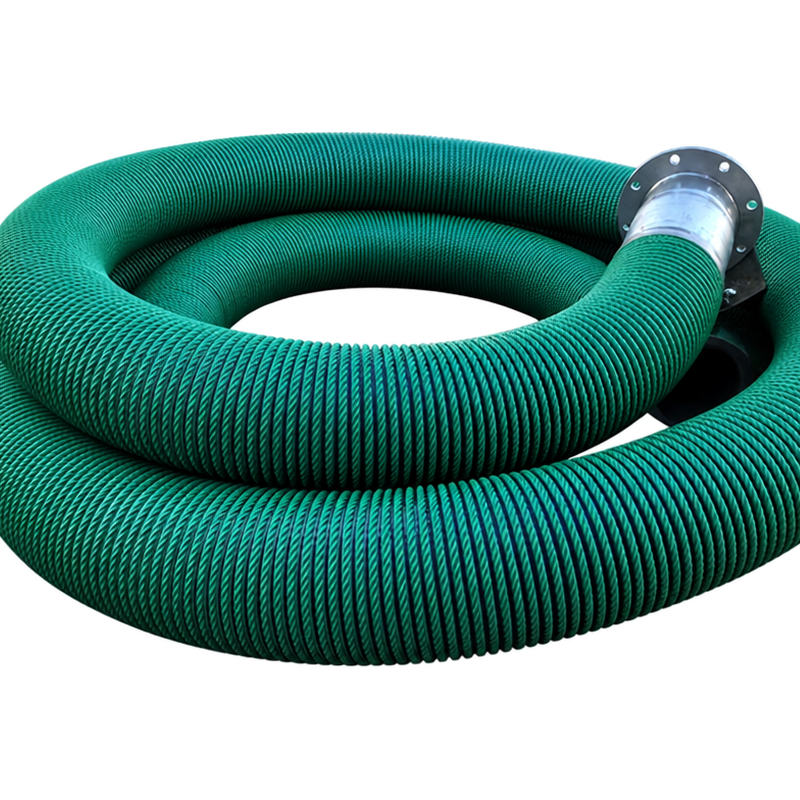

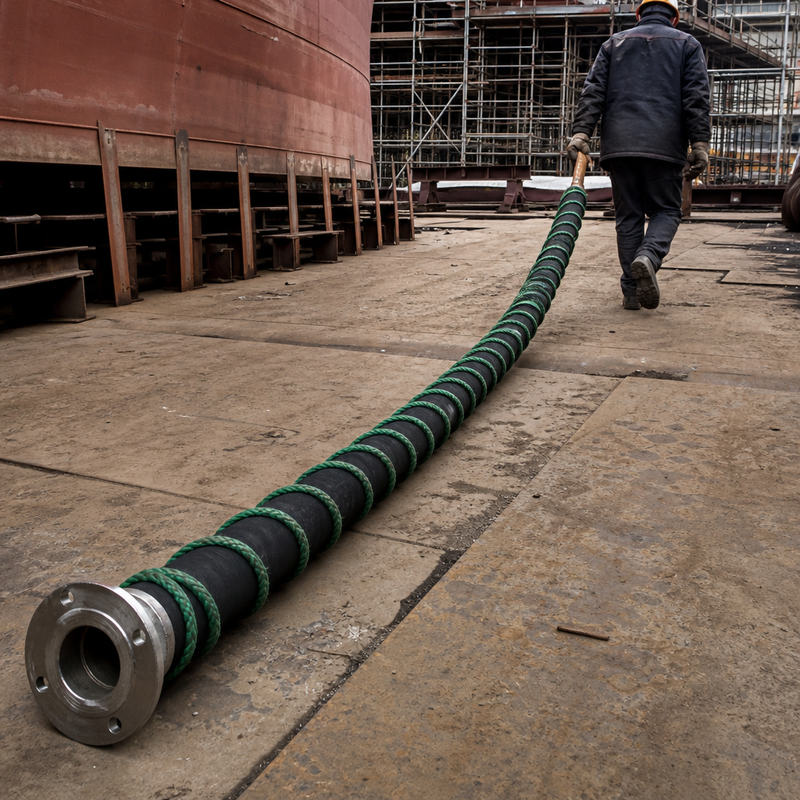
A composite hose nylon rope cover is a standard composite hose with a nylon rope spiralled around its outer cover, so the rope takes the wear that dragging, rubbing and sharp edges would otherwise put on the hose body. Bore runs from 25 mm to 254 mm (1 in to 10 in), working pressure from 10 to 34 bar (150 to 500 psi) depending on the base hose, and working temperature from -40°C to +100°C. Rope diameter, colour, length and end fittings are made to order.
نظرة عامة على المنتج
The product is a non-vulcanised, multi-layer thermoplastic hose: a liner, a fabric-reinforced carcass, two steel helices and a coated fabric cover, with rope wound over the cover. In the EN 13765:2018 frame it is a liquid-service hose, and 10 to 34 bar (150 to 500 psi) reaches from standard duty into heavy duty.
Construction is the base composite hose unchanged, plus a continuous nylon strand spiralled at a pitch set on the drawing and anchored under the fittings. That winding is what makes it a composite hose nylon rope cover rather than a plain covered hose.
Three numbers set the enquiry: 25 to 254 mm (1 to 10 in) bore, 10 to 34 bar (150 to 500 psi) working pressure, and -40°C to +100°C. Rope diameter and length stay open, so we quote them.
The rope stands proud of the cover, so abrasion lands on a layer that can be rewound and the assembly drags over concrete with far less pull.
Users are tank truck yards, marine decks, quarries, mines, cement plants and food plants, on dragged transfer lines and rack manifolds.
The problem it solves is cover wear. A plain composite hose scuffs through its PVC-coated fabric on gravel, exposes the outer helix, and retires with most of its pressure life unused.
Quality control follows the route used on every assembly we build: incoming film, fabric, wire and rope are inspected, each unit is proof tested, and helix continuity is checked. HENGHUA holds ISO 9001, MSHA, CE, CCS, ABS, DNV, API, GOST-R and MA certification.
Product Advantages of the Composite Hose Nylon Rope Cover
- Rope absorbs abrasion. The nylon winding meets concrete, gravel and steel edges before the cover does.
- Lower drag force. Rope slides over rough ground where a coated cover grips and tears.
- Rewindable outer layer. A worn rope is replaced while the pressure body stays in service.
- Stand-off from hot surfaces. The rope holds the cover off hot plate and pipe.
- Colour coded by line. Green, blue, red, yellow and white identify service at a glance.
- Proven core underneath. The base hose keeps its vacuum and pressure behaviour.
Applicable users: tank truck terminals, marine decks, quarries and mines, cement plants, steel mills, and food or beverage washdown areas.
Detailed Technical Specifications
| Bore mm (in) | Working pressure* | Working temperature | الطول | End fittings |
|---|---|---|---|---|
| 25 (1) | 10 to 34 bar | -40°C to +100°C | To order | Flange or to order |
| 50 (2) | 10 to 34 bar | -40°C to +100°C | To order | Flange or to order |
| 76 (3) | 10 to 34 bar | -40°C to +100°C | To order | Flange or to order |
| 102 (4) | 10 to 34 bar | -40°C to +100°C | To order | Flange or to order |
| 152 (6) | 10 to 34 bar | -40°C to +100°C | To order | Flange or to order |
| 254 (10) | 10 to 34 bar | -40°C to +100°C | To order | Flange or to order |
*10 to 34 bar (150 to 500 psi) is the range across the base hoses we offer. Your nameplate and test certificate carry the rating of the hose supplied.
- Outside diameter, bend radius and weight. Not fixed for a rope-covered build, because rope diameter and pitch change all three. We quote them on the order drawing, not as a printed figure.
- Temperature. The rope does not extend the -40°C to +100°C limit; it protects the cover.
- Burst and proof test. EN 13765:2018 sets a 4:1 burst factor and a routine proof test at 1.5 times working pressure. We test to that basis and issue the certificate.
- Vacuum and tolerances. Suction depends on the base hose, so state the level and we confirm in writing. Dimensions follow EN ISO 1307; length is cut to order.
الهيكل والمواد
- Inner helix. Polypropylene-coated steel, 316L stainless or hot-dip galvanised; resists vacuum collapse and keeps the bore open.
- Liner. Multiple plies of thermoplastic film, polypropylene for petroleum and general chemicals, PTFE against PP.
- Carcass. Woven fabric and barrier film, compressed between the helices; carries axial load and blocks vapor.
- Outer helix. Hot-dip galvanised carbon steel or 316L; carries hoop load and resists crushing.
- Cover. Abrasion-resistant PVC-coated fabric, the layer the rope is fitted to protect.
- Nylon rope. A continuous strand spiralled at fixed pitch, anchored at both ends under the ferrule.
Why the composite hose nylon rope cover holds up
A composite hose survives rough handling because the loads are split between layers. The inner helix is a steel spring: under vacuum it stops the wall collapsing, and bent hard around a kerb it keeps the bore round.
The outer helix carries hoop load from pressure and takes crushing load from a truck wheel or a dropped flange. Between the two, fabric plies carry the axial load, and the film liner decides the chemistry.
Because the layers are compressed and not vulcanised, there is no rubber-to-fabric bond to degrade, which is why the wall stays flexible at large bore.
The cover is the layer the site damages. It resists abrasion but it is thin and not structural, so once scuffed through the outer helix meets water and chloride. The rope holds it off the contact surface.
Safety factor, proof pressure and burst margin
EN 13765:2018 asks for a 4:1 factor between working pressure and burst, and a routine proof test at 1.5 times working pressure before the assembly leaves the factory. At a 20 bar (290 psi) rating that is a 30 bar (435 psi) proof test on every unit and a design burst margin of 80 bar (1,160 psi). The test is performed on the assembly you receive, not on a sample.
Ask for three documents: the proof certificate with serial number and test pressure, the base hose batch number, and the rope specification. A 4:1 margin is not a licence to run at the limit.
Chemical Compatibility and Media Guide
Header note: ratings describe the polypropylene liner of the base composite hose underneath the rope cover, at 20 to 25°C, not the nylon rope. Confirm medium, concentration and temperature in writing before ordering.
| متوسط | Rating | Note |
|---|---|---|
| Mineral hydraulic oil | Good | Ambient petroleum. |
| Diesel | Excellent | Base liner duty. |
| Gasoline | Excellent | Conductive build available. |
| Kerosene | Excellent | Also jet fuel. |
| Crude oil | Excellent | Water cut tolerated. |
| Lubricating oil | Good | Viscosity raises drop. |
| Vegetable oil | Good | Wash down after. |
| Biodiesel B100 | محدود | Swelling risk. |
| Ethanol E100 | محدود | Permeation rises. |
| Methanol | محدود | Confirm first. |
| Toluene | Not recommended | Aromatic; use PTFE. |
| Xylene | Not recommended | Aromatic; use PTFE. |
| MEK | محدود | Short transfer only. |
| Acetone | محدود | Confirm contact time. |
| Ethyl acetate | محدود | Confirm concentration. |
| Dichloromethane | Not recommended | Chlorinated; use PTFE. |
| Trichloroethylene | Not recommended | Chlorinated; use PTFE. |
| Sulphuric acid 30% | Excellent | Dilute acid suits PP. |
| Sulphuric acid 98% | Not recommended | Oxidising; use PTFE. |
| Hydrochloric acid 35% | Good | Control vapor at joints. |
| Sodium hydroxide 50% | Excellent | Moderate temperature. |
| Ammonia 10% | Good | Vent the line. |
| Sodium hypochlorite 12% | Not recommended | Strong oxidiser. |
| Hydrogen peroxide 30% | محدود | Confirm stabiliser. |
| Phosphoric acid 85% | Good | Rinse after transfer. |
| Nitric acid 65% | Not recommended | Oxidising acid. |
| Acetic acid 99% | محدود | Glacial; confirm temperature. |
| Ethylene glycol | Excellent | Coolant duty. |
| Propylene glycol | Excellent | Food grade loops. |
| Water | Excellent | Potable and process. |
| Sea water | Excellent | Rinse fittings after use. |
| Steam condensate | Good | Below +100°C only. |
Three rules apply: temperature derates every rating, concentration matters more than the name, and contact time decides the outcome. Send the medium, concentration and temperature for a written answer with the chart as a PDF.
Applications and Industries
Tank truck loading and unloading. Racked assemblies dragged across the yard and over the kerb.
Marine and barge transfer. Deck lines and ship-to-shore connections pulled along steel deck, over a coaming, and stowed wet.
Quarry, mine and aggregate plants. Slurry, fuel and washdown lines pulled over crushed rock that scuffs a coated cover through.
Cement, lime and steel plants. Coolant lines near hot plate and sharp structural steel, where the rope gives stand-off.
Food and beverage washdown. Lines dragged on concrete and hosed down daily, colour coded by service.
Rail and depot fuel points. Locomotive fuelling where the hose is dragged on ballast rather than carried.
Where the composite hose nylon rope cover earns its cost
A composite hose nylon rope cover earns its place wherever the hose is dragged and the path is abrasive. If the same hose is pulled more than a few metres over concrete each shift, the cover becomes the limiting part.
Selection Guide
Size, flow and pressure drop
Start with the bore that keeps velocity workable, then check the pump curve. A 50 mm (2 in) bore suits 20 to 40 m3/h of light product; 102 mm (4 in) suits 150 m3/h and above. Small bore at high flow means pressure drop and wear at the bends.
End fittings and hose assembly
Flanges are the standard end, usually fixed or floating to match the mating equipment. We also crimp NPT male, BSP male, cam and groove, tank coupling and 37 degree flare adapters in carbon or stainless steel, in house with digital records, to your flange standard.
How it compares
| Build | Abrasion on rough ground | الوزن | Best duty |
|---|---|---|---|
| Composite hose nylon rope cover | High, rope is sacrificial | Higher by rope mass | Dragged transfer on concrete or deck |
| Standard covered composite hose | معتدل | Lower | Carried or hung lines |
| Rubber suction and discharge hose | معتدل | Much higher | Fixed suction duty |
| High temperature composite hose | معتدل | Lower | Hot media near the ceiling |
| Fire retardant composite hose | معتدل | Lower | Flammable service |
Against a rubber hose of the same bore, the composite build is lighter, bends tighter and holds full vacuum without a wire cage.
What drives the price
Four things move the price: the base hose, the rope, the end fittings, and the length plus test regime. Bulk orders spread the set-up cost of a custom colour, so a wholesale or distributor requirement is easier to price than a single spare.
Common selection mistakes
- Treating the rope as a chemical upgrade, when the base liner still cannot take the solvent.
- Ordering to the flange face dimension without allowing for rope thickness at the ferrule.
- Running a rope-covered hose in salt spray without rinsing the fittings.
- Choosing rope colour for appearance only, and losing a free way to code services.
Installation, Operation and Maintenance
Installation
- Support the assembly so the rope does not rest on a sharp edge, with a protective sleeve at steel contacts.
- Keep the bend inside the radius on the order drawing, and never start the bend inside the ferrule.
- Leave a slack loop at the connection so movement at the arm does not pull the line taut.
- Test at 1.5 times working pressure before first service, or accept our factory proof certificate.
Inspection and retirement
- Inspect before each shift: rope for cuts, cover for scuffs to the helix, fittings for corrosion.
- Retire the assembly when the cover is breached over a wide area or a bend stays kinked after release.
- Rewind the rope when it is worn but the cover is intact; that is the economic point of the design.
- Review each assembly at six years, and record serial number, service and result.
Cleaning, storage and service life
- Drain and flush after a corrosive medium, then dry the bore before stowing.
- Store coiled, off the ground, out of sunlight, with ends capped; nylon is affected by ultraviolet.
- Service life depends on bending at the fitting, dragging distance and chemical exposure.
Quality Assurance and Test Data
Every composite hose nylon rope cover assembly follows one route. Incoming film, fabric, wire and rope are inspected against batch certificates, helices are formed to the drawing pitch, and the carcass is built ply by ply, then compressed without vulcanisation. The cover is applied and the rope is wound and anchored.
Bore and length are checked to EN ISO 1307, the assembly is proof tested at 1.5 times working pressure under EN ISO 1402, and continuity is measured under EN ISO 8031. Bend behaviour is verified to EN ISO 1746, and impulse testing to EN ISO 6803 is available.
The route card links rope, liner and helix batches to one serial number, so a question about a single assembly is answered from records. Packaging is film wrap then a plywood case or pallet for LCL, or bubble wrap and a reel for FCL.
Standards and Certifications
| قياسي | What it covers | What it means for the buyer |
|---|---|---|
| EN 13765:2018 | Thermoplastic hose for hydrocarbons | The design and test basis |
| EN ISO 1402 | Hydrostatic testing | Recognised proof and burst method |
| EN ISO 6803 | Impulse testing | Cyclic life on request |
| EN ISO 8031 | Electrical continuity | Helix continuity is measured |
| EN ISO 1746 | Bend testing | Bend behaviour verified |
| EN ISO 1307 | Dimensions and tolerances | Bore and length tolerances |
| IMO IBC Code | Bulk chemical carriage | Terminal reference |
| OCIMF guidance | Ship-to-shore practice | Marine layout reference |
| USCG 33 CFR 154.810 | Facility transfer hose rules | US terminal reference |
Certificates on file: ISO 9001, ISO 18752, CE, CCS, ABS, DNV, MSHA, GOST-R, API and MA, plus RoHS and California Proposition 65 declarations. Certificates are issued with the quotation on request.
Frequently Asked Questions About the Composite Hose Nylon Rope Cover
What is the hose made of?
A thermoplastic liner, a fabric-reinforced carcass, two steel helices, a PVC-coated fabric cover, and a spiral nylon rope over the cover. The layers are compressed, not vulcanised.
What does the pressure rating mean?
It is the maximum continuous working pressure of the base hose, 10 to 34 bar (150 to 500 psi) across the range, with a 4:1 burst margin behind it.
Can it handle vacuum?
Yes, if the base hose is built for it, because the inner helix resists collapse. State the level and we confirm in writing.
What is the temperature limit?
-40°C to +100°C for the assembly. The rope does not raise that ceiling, and above +100°C both liner and rope are outside their range.
How do I check chemical compatibility?
Start with the media table, then send the medium with concentration and temperature for written confirmation. Aromatic and chlorinated solvents need a PTFE composite hose liner instead of polypropylene.
How is this different from a rubber hose?
A rubber hose depends on a cured bond and usually needs a wire cage for vacuum. A composite hose is lighter, bends tighter and holds vacuum through its helix.
How does it differ from the standard composite hose?
A composite hose nylon rope cover differs only on the outside. Liner, carcass, helices and pressure rating are unchanged from the standard composite hose; the rope adds abrasion resistance, weight and diameter.
What is the smallest order you accept?
A single assembly is possible for a trial, with bulk quoted separately. Sampling runs on a 48-hour cycle, bulk on 7 days once the drawing is approved.
How do I get a quote or a PDF datasheet?
Send medium, concentration, temperature, pressure, bore, length, end connection and destination port through the contact form, and we return a quotation, a drawing and the datasheet PDF.
Why Source Composite Hose from HENGHUA
HENGHUA builds composite hose in Hebei, China, on an 18,000 m2 site with 8 high-speed production lines and 25 million metres of annual output. Scale matters here because the rope winding is a hand-finished step, and a factory that runs its own lines holds a pitch across a repeat order.
Certification is the second reason. We hold ISO 9001, ISO 18752, MSHA, CE, CCS, ABS, DNV, API, GOST-R, MA, RoHS and California Proposition 65, and supply type approval documents for marine projects. For a buyer handing a file to a safety officer, that is the difference between a supplier and a source.
Assembly capability is the third. We crimp ferrules in house with digital records, machine flanges to your drilling, and finish rope, cover and fittings as one assembly, proof tested at 1.5 times working pressure.
For OEM and ODM work we handle private labelling, custom rope colours, lengths, marking and packaging. Customers in more than 70 countries receive export documents and technical support from engineers who read the medium.
If you are comparing a producer, a distributor and a wholesaler on the same drawing, ask each for the proof certificate, the base hose batch and the rope specification. The quotes then become comparable, and the composite hose nylon rope cover you buy is the one you specified.
اطلب عرض أسعار
Send your medium, concentration, temperature, pressure, bore, length, end connection, quantity and destination port for a composite hose nylon rope cover to our sales engineers, and we return a quotation with a drawing, the proof test basis and the datasheet PDF. Tell us the rope colour and diameter if you already have a standard, or describe the route and we propose a winding that survives it. The compatibility chart, the certification pack and a sample for a trial route are available on request. Request a quote and we confirm the build in writing before production starts.


 English
 Spanish
 Portuguese
 French
 German
 Arabic
 Russian
 Indonesian
 Japanese
 Korean