
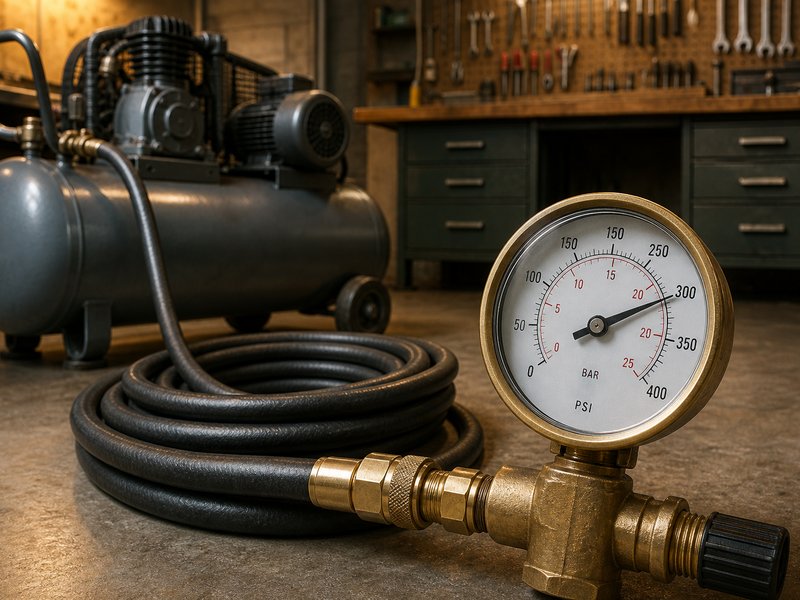
An air hose pressure rating is not one fixed number. It is a value established at a reference temperature of about 23 °C (73 °F), and the safe pressure falls as the hose runs hotter or colder than that reference. Reading one correctly means separating the working pressure a hose is built to carry from the burst figure at which it fails, then checking the temperature range the hose will see. The practical consequence for a buyer: the label figure is a ceiling at that reference, so ask the manufacturer for derating data whenever the hose runs near the top of its band.
Same Hose, Lower Safe Pressure as It Gets Hotter
A hose does not become weaker on the shelf. It becomes weaker when its material temperature moves away from the reference temperature at which the rating was measured. Heat softens the polymer wall and relaxes the textile reinforcement, so the maximum pressure the hose can hold safely falls. Cold acts on a different property: the wall stiffens, tight bends turn into kinks, and a brittle cover cracks instead of flexing.
The practical rule is short. The number stamped on the cover is a ceiling at a reference condition, not a license to run that pressure at every temperature the hose can survive. A hose marked 300 PSI and rated to +70 °C is not promising 300 PSI at +70 °C. It promises 300 PSI at the reference temperature, and a reduced figure at the top of its band. The manufacturer publishes that reduced figure as a derating table.
An air hose pressure rating has two parts: one line on the cover gives the starting value, the material temperature limits give the working window, and the published derating data gives the safe number inside that window. Miss the last part and you are guessing with a hose that can hurt someone.
Working Pressure and Burst Pressure: Reading an Air Hose Pressure Rating
Every air hose carries two pressure values, and confusing them is the most common reading error.
- Rated pressure — the maximum working pressure the hose is designed to carry continuously in normal service, at the reference temperature. This is the value you plan against.
- Burst pressure — the pressure at which the hose actually fails. It is measured, not recommended, and it sits well above the rated figure.
For most air hose, that failure point lands at roughly 3–4 times the rated figure. The gap is the safety factor, and it exists to absorb surges, water hammer, momentary spikes and the slow loss of strength that comes with age and heat. A 300 PSI hose with a 3x factor bursts near 900 PSI, but that is a failure point, not a target.
Why does the split matter when temperatures move? Because heat erodes both numbers at once. It lowers the pressure you may use, and it lowers the figure at which the hose finally gives way. The margin does not simply shift; the whole working envelope shrinks. If you want the fuller picture of how these two values relate in day-to-day selection, see the guide to air hose working pressure vs burst pressure.
Why Rating Is Fixed at a Reference Temperature
A pressure figure is only meaningful when the test conditions are fixed. Industry practice fixes them at about 23 °C (73 °F), roughly normal room temperature. At that point a new hose is tested to a defined pressure, and the manufacturer publishes the result. Without a stated reference, a pressure number would be meaningless, because 300 PSI measured at 20 °C and 300 PSI measured at 70 °C are not the same claim at all. Every air hose pressure rating is therefore a reference-temperature value first and a pressure value second.
Two physical effects drive the change. First, the polymer wall — rubber, PVC or polyurethane — softens as temperature rises, so it resists internal pressure less effectively. Second, the reinforcement layer loses part of its tensile strength, and the bond between layers can weaken. Together these effects reduce the pressure the hose can hold, which is exactly what a derating factor expresses.
What the Reference Temperature Does Not Cover
The reference temperature describes the hose material, not the air inside it and not the environment around it. A hose lying in a hot engine bay reaches a very different material temperature from the same hose lying in a shaded workshop. So identify the worst temperature the hose wall itself will reach — including the discharge end — not the room average.
Air Hose Pressure Rating and Temperature Range by Material
The air hose material sets the outer limits before any derating discussion begins. Rubber, PVC and polyurethane each have their own temperature range and their own pressure character. The table below uses the standard temperature bands and pressure bands applied across this site so that numbers stay comparable between articles.
Table 1. Material, standard, printed temperature band and typical pressure at the 23 °C (73 °F) reference (planning values; verify the printed marking).
| Material | Standard | Temperature Window | Typical Continuous Pressure |
|---|---|---|---|
| Rubber air hose | ISO 2398:2024 | −40 °C to +70 °C (−40 °F to +158 °F) | 300–500 PSI industrial; standard rated ceiling 25 bar (approx. 360 PSI) |
| PVC air hose | ISO 5774:2023 | −10 °C to +60 °C (14 °F to 140 °F) | 200–300 PSI consumer and light industrial |
| Polyurethane air hose | ISO 5774:2023 | −10 °C to +60 °C; some makers extend to −20 °C | 200–300 PSI typical |
| Hybrid air hose | — (no single published standard; supplied to manufacturer specification) | Depends on the blend | 200–300 PSI typical |
Note: hybrid constructions blend PVC with rubber, so performance sits between the two families and the supplier’s specification governs.

Figure 2. Rubber covers the widest temperature band; PVC and polyurethane trade range for lower weight and lower cost.
Note the shape of the rubber row. Rubber spans −40 °C to +70 °C, the widest temperature range of any common air hose material, and industrial rubber constructions are commonly rated 300–500 PSI. The standard’s own rated pressure ceiling of 25 bar (about 360 PSI) sits inside that band. PVC and polyurethane are narrower, −10 °C to +60 °C, and typically sit at 200–300 PSI.
Read the two-way caveat as well. The upper limit is about strength; the lower limit is about flexibility. A PVC hose rated to −10 °C is not comfortably flexible at −10 °C, because in practice its useful flexibility fades near 0 °C (32 °F). That gap between the printed number and real behavior is exactly why you should ask for published data instead of extrapolating.
For how material choice shifts temperature behavior in practice, the comparison guide to rubber vs PVC air hose covers the same logic across rubber and plastic constructions.
What Derating Means in Practice: Hot Compressor Air vs Cold Ambient
Put simply, a correct air hose pressure rating always has an implied temperature attached to it. Temperature derating means reducing the allowable pressure as the material moves away from its reference temperature. The direction is what people get wrong, so it is worth stating plainly.
Hot-Side and Cold-Side Are Different Problems
On the hot side, compressor discharge temperature is the hidden variable. Air leaving a compressor is hot because the compression process heats it, and that heat travels down the hose until the air cools. An aftercooler and a reasonable length of piping pull the temperature back down before the air reaches the tool’s normal use band near room temperature. But if the hose is short and close to the compressor, or the aftercooler is undersized, the hose wall can sit well above the reference temperature for long stretches. On that hose, the pressure you may use is lower than the label suggests.
On the cold side, the problem is not strength but flexibility. A cold rubber air hose is still strong, but a cold PVC hose stiffens, kinks easily and can crack at a bend. A kink is a flow restriction that raises local stress, and a crack is a leak waiting to happen. Cold-side derating is therefore a flexibility limit wearing a pressure costume.
An illustrative example, clearly hypothetical and not a product claim: imagine a hose rated 300 PSI at the reference temperature that a manufacturer lists for use at +60 °C. We deliberately do not print a derated number here, because inventing a percentage would misrepresent real product data. The illustration makes one point only — such a reduced figure exists, it is lower than 300 PSI, and only the manufacturer’s published derating table can supply it. Never scale an example like this to your own hose by proportion.
A single hose rarely sees one steady temperature. It sees the compressor’s hot discharge at one end, ambient air along its length, and the tool’s demand at the other. Rate it for the worst of those, not the average. That worst-case discipline is the same one discussed in hydraulic hose selection for extreme temperatures.
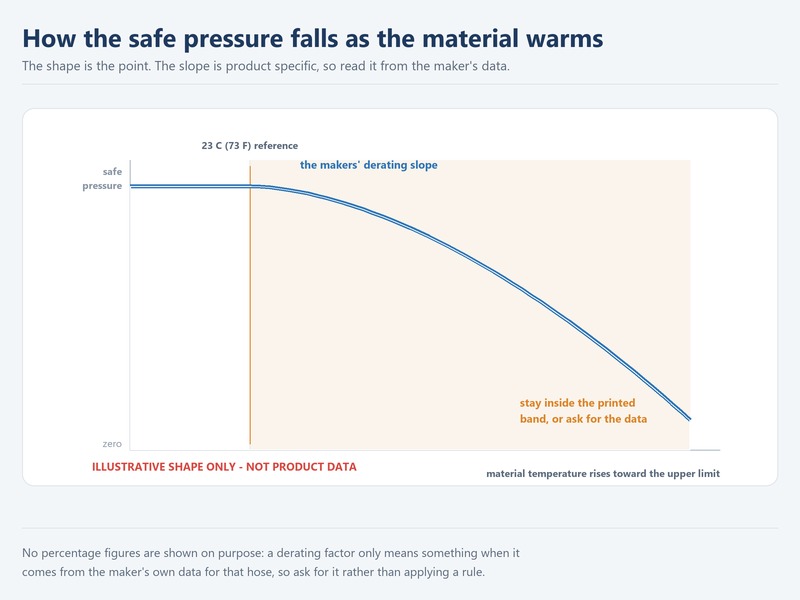
Figure 3. As material temperature rises toward the top of the range, the safe pressure falls; the exact slope comes from the manufacturer’s derating data.
Cold-Side Derating: Flexibility Loss Is a Pressure Problem
Cold is the side people ignore, because the hose still holds pressure. But a cold hose changes shape under handling that a warm hose tolerates.
Rubber air hose stays flexible across its full −40 °C to +70 °C span, which is why it is the default for unheated workshops and outdoor sites. PVC reaches −10 °C on paper, but its practical flexibility limit is closer to 0 °C (32 °F). Below that, a PVC hose stiffens, resists coiling and kinks at tight bends. A kink is a local blockage: pressure builds behind it, flow collapses, and the wall is stressed in a way it was never designed for.
Polyurethane sits between the two, with some makers extending the low end to about −20 °C. If you work in a cold climate and want a plastic hose, this is the point to verify on the datasheet rather than assume.
The safe habit for cold weather matches the habit for hot weather: depressurize before you coil, store the hose above freezing where possible, and let a cold hose warm before you stretch it. If a cold rubber air hose has cracked or hardened, replace it — do not tape it, patch it, or soften it with heat.
Reading the Cover: Pressure, Temperature, Standard, and Date
A compliant air hose pressure rating is only as useful as the marking that carries it, so the cover label is the first thing to decode. The marking is the only authoritative summary you have at the point of use.
Table 2. What each cover marking means and why it matters.
| Cover Marking | What It Means | Why It Matters |
|---|---|---|
| Working pressure | Maximum continuous pressure at the reference temperature | Sets the value you derate from |
| Burst pressure | Measured failure point, roughly 3–4x the rated figure | Confirms the safety factor, not a usable limit |
| Temperature range | Lower and upper material limits | Defines where derating begins |
| Standard reference | For example ISO 2398:2024 or ISO 5774:2023 | Tells you which test basis the numbers follow |
| Manufacture date or batch | Production traceability | Age affects rubber and warranty claims |
What Each Cover Marking Tells You
The air hose pressure rating gives the starting point. The temperature band tells you where that value stops being valid. The standard tells you the test basis behind it. The date tells you how old the air hose material is, which matters because rubber stiffens and ages even in storage. If a hose shows no pressure value, no temperature limits, or no standard, treat it as unrated until the supplier puts the data in writing.
If you meet a rating expressed in different units, what MPa and PSI mean in hydraulic hose ratings explains how to convert without losing the reference-temperature context.
How to Choose a Pressure Rating With Margin
Choosing an air hose pressure rating means finding the worst combination of pressure and temperature the hose will actually meet, then leaving margin above it — not matching the label to the gauge.
- Find the worst temperature, not the average — Identify the hottest and coldest material temperature the hose wall will reach, including compressor discharge temperature at the inlet end.
- Start from the system pressure, not the tool pressure — Size from the highest pressure anywhere in the line, then confirm what actually arrives at the tool.
- Check the temperature band against that worst case — If the worst case sits near an edge of the band, you need the manufacturer’s derating data, not the label value.
- Apply the manufacturer’s derating factor — Use published factors for the actual material temperature, and never guess a percentage.
- Keep a margin below the derated value — The safety factor protects against surges, but it is not a substitute for planning.
- Confirm the standard and the date — Match the rating to the standard you specified, and check the batch age.
Decision Rules for Sizing a Pressure Rating
Use these rules in order, and stop at the first one that changes your selection.
- If the air at the tool will stay near room temperature — size to the rated pressure with a normal margin.
- If the hose sits close to an uncooled compressor — treat compressor discharge temperature as the design condition and derate accordingly.
- If the hose runs outdoors in winter — check the cold flexibility limit, not only the pressure figure.
- If any part of the hose will approach the top of its band — never run rated pressure there; step up a pressure class or add cooling.
- If the supplier cannot provide a derating factor — treat the hose as unsuitable for that hot location.
Safety Boundary: Never Run Rated Pressure at the Top of the Range
Pressure ratings and temperature limits are not additive capabilities; they are a shared envelope, and the corner of that envelope is dangerous. The single most important rule is that a hose must never run at its rated pressure while its material temperature sits at the top of its band.
For any hose near the top of its band, the safe pressure rating is a reduced number, and only the manufacturer’s derating data can define it. Running maximum pressure at maximum temperature removes both margins at once and attacks the failure point directly.
If a hose shows a blister, a bulge, exposed reinforcement, a cracked cover, a weeping fitting, or a kink that will not relax, take it out of service and replace it. Hose is a consumable safety item, and the correct response to damage is replacement, never repair. Regulatory practice agrees: under OSHA 29 CFR 1926.302(b)(5), a hose must not be used above the manufacturer’s safe operating pressure.
Air Hose Pressure Rating FAQs
What does the air hose pressure rating actually tell me?
It tells you the maximum continuous pressure the hose is designed to carry at a reference temperature of about 23 °C (73 °F). It is not a promise at every temperature the hose can survive. Above the reference temperature, the safe pressure falls, and you need the manufacturer’s derating data to know the reduced figure.
Is rated pressure the same as burst pressure?
No. Rated pressure is the maximum you may use continuously; the burst value is the pressure at which the hose fails. The burst figure is typically about 3–4 times the rated figure, and that ratio is the safety factor. Never confuse the two, because the burst number is a failure point, not a service limit.
Why does a hot hose lose pressure capacity?
Heat softens the polymer wall and reduces the effective strength of the reinforcement, so the hose resists internal pressure less well. The pressure you may use drops, and the figure at which it fails drops with it. This is why the pressure rating and the temperature band must always be read together, never separately.
How does compressor discharge temperature affect my hose?
Air leaving a compressor is hot, and that heat soaks into the hose near the outlet. An aftercooler and a run of piping usually cool the air before it reaches the tool’s normal working band, but a short hose close to the compressor can stay hot. Measure or ask about compressor discharge temperature before you decide the hose is fine.
Can I just use a bigger safety factor instead of derating?
No. A bigger margin does not raise the safe pressure at high temperature, and it does not repair a softened wall or weakened reinforcement. The correct step is to obtain the manufacturer’s derating data for the material temperature you expect, then size below the derated value.
My hose runs outdoors from +35 °C summer to −20 °C winter — does one hose cover both ends?
A rubber air hose covers both ends: it stays flexible from −40 °C to +70 °C, so one hose suits that whole swing. PVC reaches −10 °C on paper, but its practical limit is nearer 0 °C, so it is wrong for a −20 °C winter.
Where do I find the derating factor for my hose?
Ask the manufacturer or supplier for the published derating data for the exact air hose material and construction you are buying. Do not extrapolate from another hose, and do not rely on experience with a different product. If the supplier cannot provide it in writing, treat the hose as unsuitable for that temperature.
Will running a hose hot affect the warranty?
Many manufacturers tie warranty coverage to using a hose within its stated pressure and temperature limits. Running rated pressure at the top of the temperature band can fall outside those limits, so check the warranty terms alongside the rating. The label value and the warranty conditions should be read as one document.
My compressor discharges straight into a 20 ft hose in an unaircooled garage — what pressure rating should I order?
Order for the discharge temperature, not the room. With no aftercooler the air arrives at the hose hot, so ask the supplier for the derating data at that temperature and choose a class that keeps margin on the reduced figure.
Ask for the Derating Data With the Quote
HENGHUA manufactures reinforced air hoses and complete hose assemblies for workshops, distributors, and OEM brands. Every air hose we build uses a high-tensile textile reinforcement layer with an abrasion- and oil-resistant cover, is rated 200–500 PSI, and leaves the factory with crimped brass fittings and a pressure test on every batch. We supply 1/4, 3/8, and 1/2 inch bore in rubber, PVC, polyurethane, and hybrid constructions, with custom lengths, fittings, colours, reels, and OEM/ODM branding.
Because we control compounding, extrusion, braiding, and crimping in one plant, lead times stay short for bulk orders and the specification on the label is the specification you get. If you are sourcing air hoses for retail, distribution, or industrial use, send us your specification and we will quote against it, including the published derating data for the material temperature you expect. Get a quote and free samples
Final Verdict: Rate the Hose for the Worst Case It Will See
A good air hose pressure rating is the one you can still defend at the worst temperature the hose will meet. Start from the reference figure, read the temperature band, ask for the derating factor, and size below the derated value with a margin. Do not run rated pressure at the top of the band, do not swap a bigger margin for real derating data, and do not repair a damaged hose that should be replaced.
If you are not sure which air hose material and construction fit your temperature and pressure, review how to choose an air hose and then send us your operating conditions. We will match the hose and hand over the published data with the quote.
Written by the HENGHUA engineering team, with input from workshop and maintenance teams across North America and Europe. HENGHUA manufactures reinforced air hoses and hose assemblies in rubber, PVC, polyurethane, and hybrid constructions, from 1/4 inch to 1/2 inch, rated 200–500 PSI, with custom lengths, fittings, colours, and OEM branding.






 English
  Spanish
  Portuguese
  French
  German
  Arabic
  Russian
  Indonesian
  Japanese
  Korean