
A tank truck hose, also called a road tanker hose, is the flexible line carrying chemical product between a road tanker and a loading rack, and it succeeds or fails on how that line is supported, sloped, bonded and drained.
This guide answers the questions that arise on a road tanker job: rack set-up, the choice between top and bottom loading, the vapor return path, bonding and grounding, hose support and slope, and the drain-and-disconnect routine that closes a job. Where a deeper question belongs to another page — rail cars, small containers, end connections or marine rules — we link to it instead of repeating it here.
All pressure figures are working-pressure ratings at 23 °C ambient; standard citations are to the current text of the named standard. About 13 min read.
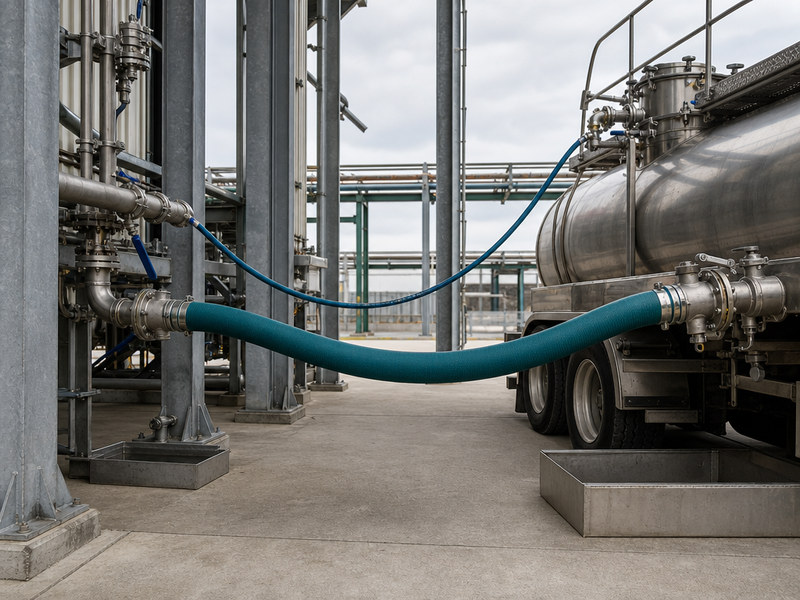
Figure 1. A hose assembly on a road tanker loading rack, with the vapor return line visible behind the product line.
What Does a Tank Truck Hose Have to Do on Every Road Tanker Job?
Every road tanker transfer is short, scheduled and high-consequence. The vehicle arrives loaded or empty, connects to a fixed rack, moves product in one direction, and leaves. The flexible line is the only part of that chain that is made and broken between every job.
The hose therefore has to do three jobs at once: contain the medium, absorb the relative movement between vehicle and rack, and give the operator a safe place to drain and clean. Fixed pipework does none of those, which is why the hose, not the pump, often sets the pace of a transfer. A loading and unloading hose is specified as a complete assembly, with both ends, a working-pressure rating and a test record. A bare length of tube carries none of that information.
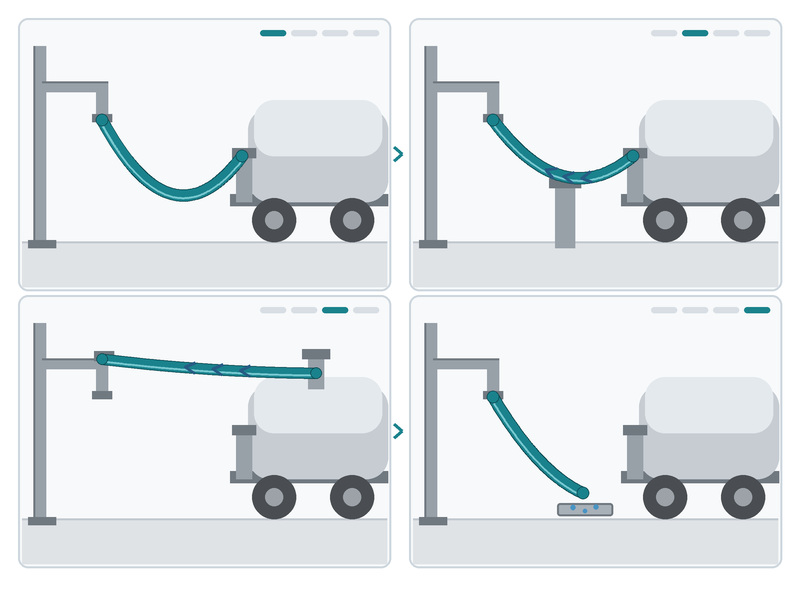
Figure 2. Hose position changes at each stage of a transfer; the drain position is the one most often skipped.
A tank truck hose faces four different duties in one job, and each stage stresses a different property of the same assembly.
Table 1. Hose duty at each stage of a road tanker transfer
| Stage | Line condition | What the hose must tolerate |
|---|---|---|
| Rack connection | Line empty, ends open to air | Hold its shape and accept a clean, dry break on every connection |
| Product transfer | Full line at working pressure, product moving | Carry working pressure with a safe margin and resist the medium at line temperature |
| Vapor return | Lower pressure, product vapor present | Return vapor without collapsing or permeating excessively |
| Drain and disconnect | Line draining, operator close to the break | Drain fully so the break is dry and the operator is not exposed to liquid |
Static head is the figure most often ignored on a road tanker job. A vertical drop from a high rack to a low connection adds pressure at the low end, and that head has to sit inside the working-pressure rating. The rating must cover the low end of that drop, where the pressure is highest.
Rack Set-Up Before You Connect a Tank Truck Hose
A rack is fixed equipment, but every transfer is only as good as the set-up done minutes before it starts. Four checks come before a coupling touches the vehicle:
- Confirm the medium, its concentration and its temperature against the hose’s chemical resistance data. A hose that carried one solvent yesterday may not be acceptable for the acid scheduled today.
- Verify that the assembly is within its test date and that its identification marking matches the job. An assembly past its test date is a defect, not a spare.
- Set the parking brake, chock the wheels and confirm the tank is isolated from its own pump or compressor.
- Lay the line out without kinks and without dragging the end across the apron; abrasion damage usually starts at the coupling.
The chemical resistance question is the one that catches distributors most often. Resistance data is specific to medium, concentration and temperature, so the same hose can be acceptable for one grade of a chemical and unsuitable for another. Check the manufacturer’s chemical resistance chart against the actual product, then confirm that the line temperature stays inside the hose’s rated window.
In our factory tests, a hose that passes the chemical resistance check can still fall outside its temperature window. We test at the line temperature, not only at ambient, and keep the medium with the record. That record is why we ask for the concentration and the line temperature, not just the product name.
Marking discipline is the second habit worth building. An assembly should carry its size, its rated working pressure and an identification code that ties it to a test record. When a driver cannot read that marking, the safe answer is to stop the transfer, not to guess. For the construction basics behind those markings, see our road tanker hose guide.
Which end of the rack does the risk sit on?
Most rack incidents happen at the vehicle end, not the rack end. The rack is bolted down, bonded and inspected on a schedule; the vehicle arrives with its own pump, its own valves and its own history. Treat the coupling at the vehicle as the location that needs the closest attention.
Top Loading and Bottom Loading: Tank Truck Loading Configurations Compared
Road tankers are filled from the top or from the bottom, and the choice changes how the hose is loaded and how vapor is handled. Top loading drops product through an open manhole or a sealed drop tube. Bottom loading pushes product in through a valve at the base of each compartment.
Top loading is simpler to inspect but exposes product to air and needs a drop tube to prevent splash filling. Bottom loading is closed and faster, but it needs vapor recovery and a sealed connection at every fill point.
Table 2. Top loading and bottom loading compared for road tanker transfers
| Feature | Top loading | Bottom loading |
|---|---|---|
| Vapor generated | Higher; filling is open or only partly closed | Lower; filling is closed and product enters below the liquid line |
| Connection at the vehicle | Manhole or drop tube; the operator works at height | Base valve or quick-disconnect coupler at ground level |
| Static charge risk | Higher where splash filling occurs; bonding is essential | Lower, but bonding and grounding are still required |
| Hose handling | Longer reach, more lifting and more load on the end fitting | Shorter, more stable and easier to support |
| Typical end practice | Cam and groove or flanged ends | Quick-disconnect or dry-break couplers |
A tank truck loading rack is usually built for one pattern, so the flexible line is often the only moving part in the chain. The hose must not become the path of least resistance for static charge, and it must not be kinked to reach a manhole. Where a compartment valve closes against a running pump, the pressure spike is felt by the hose first, so the hose needs working-pressure margin to absorb it.
The detail of how the flexible line is terminated belongs to a separate question. How an end is crimped, swaged, banded or bolted is covered in our guide to chemical hose assemblies and end connections, while the operation around that end is what we deal with here.
Where Does the Vapor Return Path Go on a Chemical Tank Truck?
A chemical tank truck that is bottom loaded is normally loaded against a vapor return line. As liquid enters the tank, displaced vapor must leave through a separate path, or tank pressure will work against the pump. On a chemical job this path is not optional, because the vapor may be the greater hazard than the liquid.
Vapor service is easier on the hose in one way and harder in another. Pressure is lower, so the burst question is relaxed, but permeation and collapse matter much more.
A vapor return line is still part of the containment system. A line that is undersized for vapor flow will slow the transfer and raise tank pressure; a line that collapses under vacuum will block the return and stall the job. Even at low pressure, the hose on a vapor path has to stay round and stay sealed.
Permeability is the second vapor issue. The relevant standard series names EN ISO 4080 as the method for determining permeability to gas, and that designation should be used as a test method only, never as a pass or fail limit. Any permeability figure that matters to your operation needs to come from a test on the actual hose construction.
Flexible hose is not automatically the right choice for a vapor path. Where a rack is dedicated to one duty and the vehicle stops in the same place every time, a fixed arm may serve better. The more a connection has to move, the more a flexible line earns its place.
Where the vehicle is a rail car rather than a road tanker, the vapor path and the hardware change completely. That case is covered in our guide to rail car chemical transfer.
For the reinforced line used when a tanker discharges straight into a storage vessel, the construction and rating rules are different again; see our bulk loading and drop hose guide.
Bonding and Grounding for Static Control
Static charge accumulates whenever product moves through a hose, and a chemical tank truck loaded or unloaded in the open air gives that charge nowhere obvious to go. Bonding connects the vehicle to the fixed piping so both sit at the same potential. Grounding connects that bonded pair to earth.
Order matters. The grounding connection is made before the hose is attached and removed after it is disconnected. A conductive or antistatic hose is part of the grounding circuit, not a replacement for it.

Figure 3. Bonding and grounding points on a road tanker; the ground connection is made first and broken last.
In chemical service the electrical question has a second dimension. A hose may be built as conductive, antistatic or non-conductive, and the right choice depends on the medium and on the installation’s own bonding scheme. Standards such as EN 12115:2021 define several electrical grades for chemical hose and name EN ISO 8031 as the resistance test method. The grade and the target resistance must come from the hose specification, not from a generic table.
The practical rule we give distributors is simple. State where the static charge goes before every transfer. Trace the path on the installation’s bonding drawing; a clamp that looks tight is not an electrically continuous circuit.
How Should a Tank Truck Unloading Line Be Supported and Sloped?
A hose that is supported badly is a hose that fails early. The rules are geometric and measurable. Support the line so it cannot kink, keep every bend inside the hose’s minimum bend radius, and slope the run so product can drain to one end.
The most common defect on a road tanker job is not a burst. It is a kinked or pinched line that chokes flow, overheats the pump and hides a pressure problem until something else fails. A proper hose clamp or saddle takes the weight off the coupling, where the reinforcement is thinnest.
Four geometry checks are worth making before any valve is opened:
- Support the line at intervals so its weight is carried by the rack or a saddle, not by the coupling.
- Keep every bend above the hose’s minimum bend radius; a flattened line is both a restriction and a wear point.
- Slope the run back to the drain point so liquid cannot pool in a low spot.
- Leave slack for vehicle movement only, and route that slack so the line stays clear of the ground and hot surfaces.
The hardware for the hose support is a selection problem of its own. Clamp type, material and tightening torque are set out in our hose clamp selection guide.
Slope is what makes the last stage of the job possible. A low point holds product after the pump stops, and the operator who breaks the coupling there is the one who gets wet. A run that falls steadily to the drain valve turns a hazardous break into a routine one.
Can the hose be too long?
Yes, and length is decided by the geometry of the worst parking position, not by the longest one. Extra length adds weight and creates low spots that hold product. Measure the farthest realistic vehicle position, add working slack, and stop there.
Sizing, Rating and Materials for the Tank Truck Hose
Size, pressure rating and material are the three specification decisions that decide whether a line is safe and whether the transfer is fast enough. They must be checked together, because a large bore that cannot take the pressure is no improvement at all.
Table 3. Specification checks for a chemical transfer hose on a road tanker
| Decision | What to confirm | Where the number comes from |
|---|---|---|
| Bore size | Line velocity matches pump capacity and rack design | Pump curve and rack data, then a hose size table |
| Working pressure | The highest of shut-off head, static head or relief setting | System design; the hose rating must exceed it |
| Temperature | Worst-case line temperature during the transfer | Product and ambient data against the hose’s rated window |
| Material and lining | Resistance to the actual medium and concentration | Manufacturer’s chemical resistance chart, not a generic list |
| Electrical build | The grade the installation’s bonding scheme requires | Hose specification and the standard’s resistance test method |
Composite thermoplastic hose to EN 13765 covers bore sizes from about 25 mm to 250 mm and working pressures from 4 bar to 14 bar across five types, with a rated temperature window from −30 °C to +160 °C. Annex A of that standard deals with inner-wall material selection against the chemical conveyed, which is the part a chemical operator uses most.
Rubber chemical hose to EN 12115:2021 comes as Type D and Type SD assemblies and in four electrical grades. It is rated for chemicals between −20 °C and +65 °C at working pressures up to 10 bar (about 145 psi), and it is fitted with metal ends.
Neither standard tells you the answer for your product. Both tell you the questions to ask, and the answers come from the medium, the concentration and the line temperature together. A hose that is oversized on pressure but wrong on material is still the wrong hose.
Bore selection is a separate exercise, and the method is set out in our hose size selection guide. If a tanker unloading hose also has to act as a suction line at the depot, construction matters as much as diameter; the difference between suction and discharge builds is explained in our suction and discharge hose guide.
Where the job calls for a full chemical transfer range rather than a single line, our chemical hose collection sets out the rubber, UHMWPE, PTFE-lined and composite options side by side.
Disconnect, Drain and Changeover After Tank Truck Unloading
The end of a transfer carries the highest risk, because the operator is closest to the product and the line is still full. The routine should be fixed and identical every time, so that a busy shift cannot shorten it. A distributor writing the procedure, a terminal supervisor auditing a shift and an EPC contractor sizing a new rack all need the same sequence in the same order.
Table 4. Drain and disconnect sequence after a road tanker transfer
| Step | Action | Why it matters |
|---|---|---|
| Isolate | Stop the pump and close the rack valve | Removes driving pressure before the line is opened |
| Depressurize | Open the vent or drain path with the hose still connected | Prevents a pressurized break at the coupling |
| Drain | Slope the line to the drain point and empty it | A dry break exposes the operator to far less product |
| Disconnect | Break the connection and cap or plug the ends | Keeps the tube clean and closed for the journey |
| Secure | Park the line on its rack or cradle, not on the apron | Abrasion and sunlight damage start on the ground |
Line clearance is the step that turns a good tank truck unloading job into a safe one. A transfer hose left full of chemical is a pressurized container with no relief valve, and the next person to open it carries the whole risk.
Changeover is a chemical-specific problem. When one vehicle leaves and the next takes a different product, the line must be cleared and, where the products are incompatible, cleaned before reuse. Two products meeting inside a shared loading and unloading hose can react, generate heat or form a solid that blocks the bore. Drain behavior is the reason slope and support belong at the start of planning, not at the end: a hose that cannot drain will always be broken while wet.
Tank Truck Hose FAQs
What is a tank truck hose used for?
It is the flexible line that connects a road tanker to a fixed loading rack so product can be transferred in or out. It carries the chemical during the transfer, absorbs the movement between a parked vehicle and a fixed rack, and returns displaced vapor on a closed loading system. It is disconnected between jobs, unlike fixed pipework.
What size hose do I need to unload a road tanker at a chemical depot?
Size follows the transfer rate you want and the pump you have, not the rack pipe diameter. A bore that is too small raises line velocity, increases pressure drop and slows the job. A bore that is too large adds weight and leaves more product in the line at disconnect. Measure the worst-case vehicle position, then size for velocity and handling together.
What pressure rating should a transfer hose have?
Rate the hose above the highest pressure it will ever see, not the pump’s nominal figure. That means the larger of the pump shut-off head, the static head created by the rack height, and the relief setting on the system. On a high rack, static head can be a significant share of the total, so it must be added rather than ignored.
Is top loading or bottom loading safer for chemical service?
Bottom loading is normally the lower-risk configuration for chemicals because it is closed, generates less vapor and keeps the connection at ground level. Top loading remains common where the product and the tank design suit it, but it needs a drop tube to avoid splash filling and careful bonding. Both configurations still require bonding and grounding.
Why must a chemical tank truck be bonded and grounded?
Product moving through a hose generates static charge, and a vehicle insulated from earth can hold that charge until it discharges as a spark. Bonding equalizes potential between the vehicle and the fixed piping; grounding connects both to earth. Make the ground connection first and remove it last, so the vehicle stays at earth potential throughout.
Does a road tanker hose need to be conductive?
Not always. Some installations use a conductive or antistatic hose as part of the bonding circuit, while others rely on external bonding and an insulating hose. The correct answer comes from the medium, the installation’s bonding scheme and the hose specification. EN 12115:2021 defines several electrical grades, so the grade must be confirmed rather than assumed.
How do I drain a loading and unloading hose before disconnect?
Stop the pump, close the rack valve, then open the vent or drain path while the hose is still connected so pressure is released safely. Slope the run to the drain point and let it empty. Only then break the coupling, cap or plug the ends, and park the line on its cradle instead of on the ground.
How often should a tank truck hose be re-tested at a chemical terminal?
Many terminals re-test transfer hose at least annually, with the whole external surface accessible during the test. The interval should also follow the medium, the transfer frequency and the manufacturer’s guidance. Any visible cut, bulge or soft spot is a reason to remove a hose before its next scheduled test.
Can one hose be used for several chemicals?
Only where the resistance data supports every product in the rotation, at the real concentration and line temperature. Resistance is product-specific, so a hose that suits one grade of a chemical may fail with another. Where products are incompatible, the line must be cleaned or dedicated between changeovers rather than simply reused.
What is the difference between a tanker unloading hose and a drop hose?
A tanker unloading hose connects a road tanker to a rack or receiving vessel and is handled and disconnected regularly. A drop hose is a heavier reinforced line used for bulk discharge, often larger in bore and built for a different pressure and abrasion duty. They are related products, but the construction and rating rules are not interchangeable.
What belongs on a tank truck unloading checklist?
Three phases, and each one has a stop condition. Before connecting: the test record must match the job. During transfer: a new kink, a leak or a pressure drift stops the job. Before disconnect: the drain proves the line is empty before the coupling is opened.
How should a tank truck loading rack be designed around the hose?
Design the rack so the hose never sets the geometry. Put the drain point at the low end and make every section fall toward it. Space saddles so the line cannot kink and keep the run clear of hot surfaces and traffic lanes. Size the connection height for the shortest and the longest vehicle the rack will ever take.
Next Steps: Building the Right Tank Truck Hose Assembly
A safe tank truck hose job comes down to a short list that is easy to audit. Fix the medium, concentration and temperature first. Then set the bore, the working pressure and the electrical build against the rack design. Support and slope the run, bond and ground in the right order, and drain before you disconnect:
- Confirm medium, concentration and temperature against the resistance data before every job.
- Include static head when you set the working-pressure rating.
- Support the line, respect the minimum bend radius and slope it to the drain point.
- Bond first, ground first, and remove the ground connection last.
- Drain fully before disconnect, confirm the line reads zero pressure, and never open a coupling on a line that is still pressurized.
HENGHUA is a professional manufacturer of chemical hoses, chemical hose assemblies, industrial hoses and hose fittings, supplying distributors, EPC contractors and OEM brands worldwide. Chemical hose construction covers rubber such as EPDM and other compounds, UHMWPE, PTFE-lined and thermoplastic composite builds.
Assemblies are terminated with crimped, swaged or banded hose ends, flanged ends to ASME or EN patterns, and cam and groove (camlock) couplings. Coupling bodies are supplied in carbon steel, 304 or 316 stainless steel, aluminum, brass and PP or PVDF where the medium demands it. Every assembly is hydrostatically tested to its rated working pressure before shipment and marked with its MAWP, size and identification code.
About the author. This article was written by the HENGHUA engineering and test team, which designs, builds and pressure-tests chemical hose assemblies for road tanker, rail, plant and marine transfer. The team supports distributors and EPC contractors with material selection, end-connection specification and factory test records.
To discuss a specification, send the medium, concentration, temperature, bore and connection details to our engineering team, and ask for factory-direct pricing, private labeling and OEM branding options through the HENGHUA contact page.






 English
  Spanish
  Portuguese
  French
  German
  Arabic
  Russian
  Indonesian
  Japanese
  Korean