
A UHMW hose wins on wear, not on temperature. Where a line carries an abrasive acid slurry, a crystallising salt or a mildly corrosive fluid, the polyethylene liner outlasts rubber and most other linings by a wide margin. Below about 80 °C it also carries alkaline duty better than any competing lining. Above that line, and wherever aromatic or chlorinated solvents appear, chemical resistance and permeation favour a fluoropolymer.
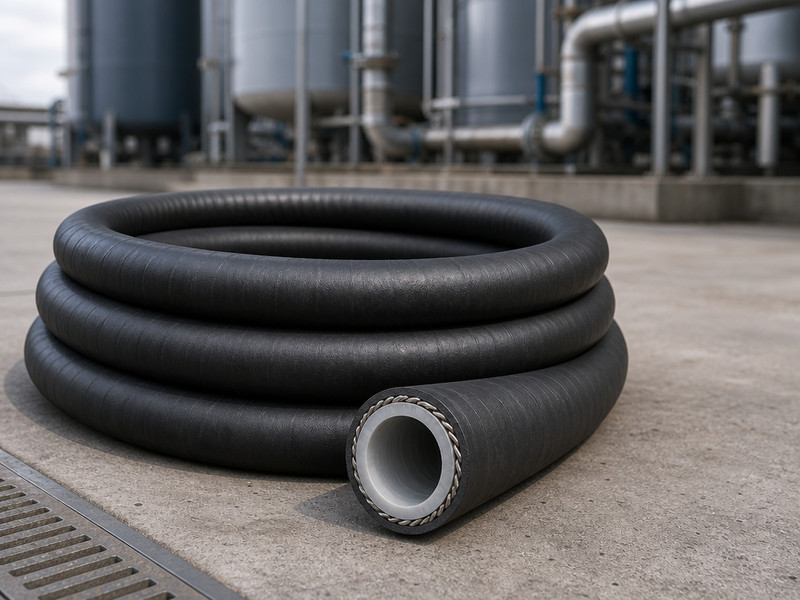
Figure 1. A UHMW lined chemical hose with a wire helix, coiled after service.
Where UHMW Hose Wins
A UHMW hose earns its place on wear, on alkali and dilute non-oxidising acid duty, and on vacuum service without collapse. Three limits end that service: heat, solvents and routing.
The reason is material rather than marketing. Ultra-high molecular weight polyethylene has an extremely long polymer chain, which gives it a combination of abrasion resistance and impact strength that no other common hose lining matches. The same long chain sets its limits: it softens well below the temperature at which a fluoropolymer lining still works.
Decide in that order. Ask whether wear or temperature is the binding constraint. If wear is binding and the temperature is ordinary, a UHMWPE liner is usually the best value available. If the temperature is high, no amount of abrasion resistance compensates for a liner that will soften and creep.
What UHMW Actually Is
UHMW stands for ultra-high molecular weight, and it describes a grade of polyethylene rather than a different chemistry. The molecule is the same as in an everyday polyethylene bottle; the difference is the length of the chain, which runs into millions of repeat units and gives the material its unusual toughness.
A polyethylene liner has a narrower temperature range than a fluoropolymer lining, and that gap is the single most important number on the datasheet.
The chain length is also why the material is processed differently. UHMWPE cannot be melted and extruded like ordinary polyethylene without losing the properties that make it useful, so liners are normally ram extruded or sintered rather than simply melted. The practical consequence for a buyer is that wall thickness and concentricity are worth checking, because a poorly made liner has soft spots.
Note the naming. UHMW, UHMWPE and UHMW-PE all appear on datasheets and mean the same family, which is why the product is also quoted as an ultra-high molecular weight polyethylene lined hose. In this guide the material is written UHMWPE and the finished product is written UHMW hose, following the way both forms are used in the industry.
Why UHMW Hose Outperforms Other Linings on Wear
Wear, not chemistry, is where the material separates from everything else. Three mechanisms explain most of the advantage.
How Good Is Its Abrasion Resistance?
Abrasion resistance is the headline property. UHMWPE resists sliding abrasion better than rubber, polyurethane and the fluoropolymers, which is why it is used in chutes, liners and wear strips as well as in hose. In a slurry line the gain is not marginal: the same duty that wears through a rubber tube in months can run for years behind a polyethylene liner. Abrasion resistance is measured to EN ISO 4649, so two suppliers can be compared on one scale rather than on two claims.
The cover takes the ground abrasion in most installations, so specify a grade with a fabric-reinforced cover and ask what it is rated against for weather and ozone.
Does the Liner Swell in Water?
The material absorbs almost no water, so the liner does not swell when it is used with aqueous products. Swelling matters because it changes the bore, traps product, and can delaminate a liner from its backing. This is one of the clearest advantages over nylon and some polyurethane grades.
Will It Survive Vacuum and Being Run Over?
The impact strength of UHMWPE means the liner resists point loads and does not crack when the hose is run over. Combined with a wire helix in the construction, it gives a hose that can be used on suction duty and then dragged across a yard without the tube being destroyed.
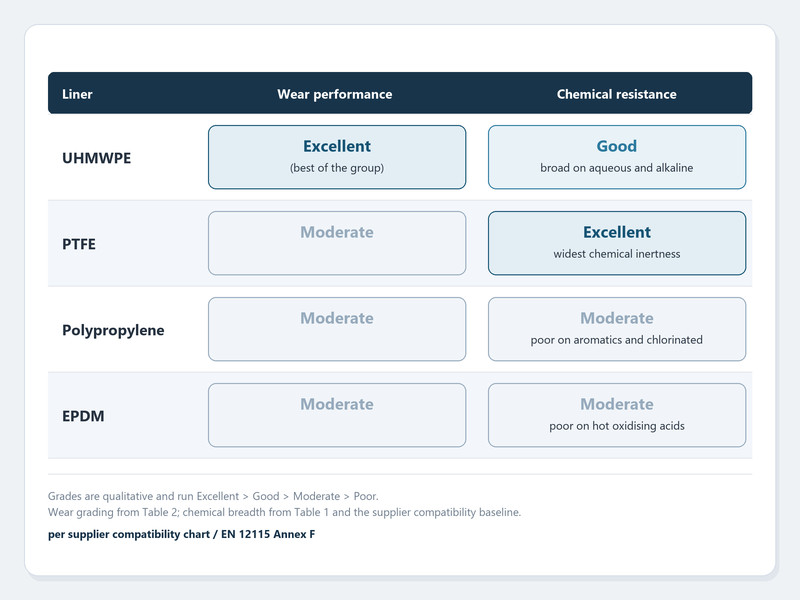
Figure 2. Lining materials compared on abrasion and on the products each lining tolerates.
Chemical Resistance Profile
This liner handles a broad set of aqueous and alkaline products and stops at the solvents. Table 1 maps the common cases.
Table 1. Chemical resistance of a UHMWPE liner by product family
| Product Family | Performance | Note |
|---|---|---|
| Strong alkalis | Excellent | One of the best applications for the material |
| Hydrochloric acid | Good | Suits dilute and moderate concentrations at moderate temperature |
| Sulphuric acid, dilute | Good | Concentrated and hot grades need a fluoropolymer |
| Aqueous salts and slurries | Excellent | The classic abrasion duty |
| Aliphatic hydrocarbons | Moderate | Acceptable for many transfer duties |
| Aromatic solvents | Poor | Swelling and loss of strength |
| Strong oxidising acids, hot | Poor | Attack accelerates sharply with temperature |
Read the table with concentration and temperature beside it, because chemical resistance is not a property of the material alone. Hydrochloric acid duty is a good illustration: the liner handles ordinary plant concentrations well and becomes a poor choice at high temperature, where a fluoropolymer takes over. Confirm every pairing against the supplier’s chemical compatibility table and the material list in EN 12115 Annex F; the ratings above screen a first conversation, not a release for service.
Temperature and Pressure Limits
Table 2 sets the polyethylene liner against the alternatives on the two figures that limit service.
Table 2. Temperature and pressure limits of common hose linings
| Lining | Continuous Temperature | Typical Working Pressure | Wear Performance |
|---|---|---|---|
| UHMWPE | Around +80 °C | To 16 bar in a reinforced build | Best of the group |
| PTFE | To about +260 °C | Higher, liner and braid dependent | Moderate |
| ECTFE | Around +150 °C | To 16 bar in a reinforced build | Good |
| Polypropylene | Around +100 °C | To 16 bar in a multilayer build | Moderate |
| EPDM | Around +100 °C | To 16 bar in a reinforced build | Moderate |
Two figures need a caveat before they are used. The temperature figure is the ceiling for continuous service, not a figure at which the full pressure still applies; permissible pressure falls as the liner warms, exactly as it does for any other polymer. The pressure figure describes a reinforced construction with a wire helix and a fabric or braid layer, not a plain tube.
A typical reinforced UHMWPE build is quoted at a working pressure around 16 bar with a corresponding burst figure of roughly 64 bar, a safety factor of four to one. Vacuum performance is usually quoted separately, in the region of 0.7 bar and verified to EN ISO 7233, and depends on how straight the hose is laid.
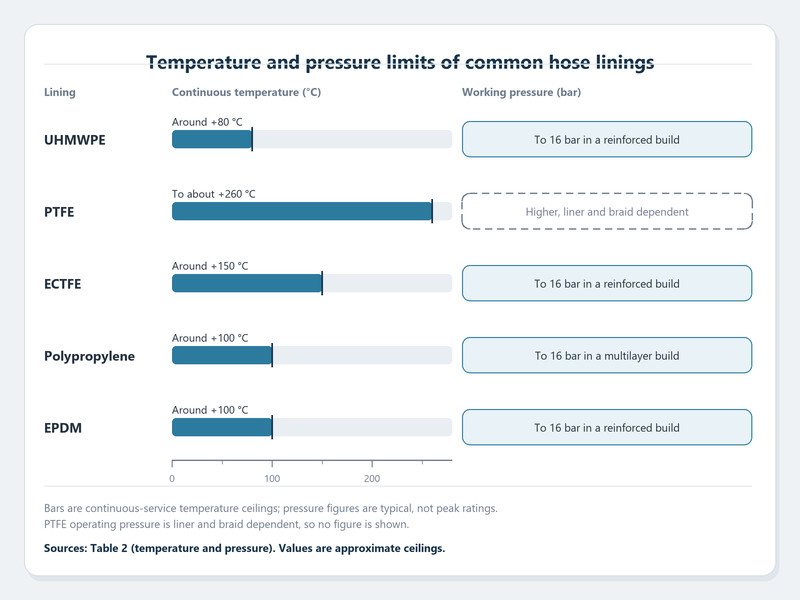
Figure 3. Where UHMWPE sits against other linings on temperature and pressure.
Permeation and Product Purity
Permeation is the slow passage of product through an intact liner wall, and UHMWPE behaves well here for two reasons. The first is low solubility: the material does not absorb the products it carries, so there is little dissolved product available to migrate. The second is thickness, because a sintered liner is usually built heavier than a film.
Permeation still applies here. Aromatics and chlorinated solvents permeate polyethylene more readily than aqueous products, and the rate rises with temperature in the usual way. In a hot line, the vapour that reaches the reinforcement can attack it from the inside, exactly as it does in other lined hoses. The same design controls apply: keep the temperature down, keep the wall thick, and let the space behind the liner vent.
Purity is the other half of the question. UHMWPE contains no plasticiser and does not depend on additives for its properties, which is why it is used in potable water and food handling applications. Grades for those duties are supplied with a REACH statement and a phthalate-free declaration; ask for it rather than assume it.
Where UHMW Hose Loses: Honest Limits
Use this liner inside one envelope, described below by three limits. The price is not one of the limits, because a polyethylene build costs less than a fluoropolymer one; the temperature range is.
The temperature range is the first limit. Above roughly 80 °C the liner softens, creeps under sustained pressure and loses much of the mechanical advantage that justified its cost. A hot duty belongs to a fluoropolymer, not to UHMWPE.
Solvent duty is the second limit. Aromatic and chlorinated solvents swell the material, and a swollen liner loses strength, changes bore and can delaminate. Where a solvent is present, the honest answer is a PTFE or ECTFE liner, even though it costs more.
Routing is the third limit. UHMWPE is a stiff material compared with rubber, so a UHMW hose has a larger minimum bend radius for the same bore. In a tight installation the bend radius may rule it out before chemical performance is considered.
Specifying a UHMW Hose for a Slurry or Acid Line
A short, complete specification removes most of the risk. Table 3 lists the fields, and each one changes the quotation.
Table 3. Fields to specify for a UHMWPE lined chemical hose
| Field | Why It Matters |
|---|---|
| Product and solids content | Solids decide the wear mechanism and the required liner thickness |
| Concentration | Changes the chemical resistance rating for the same product |
| Continuous and peak temperature | Sets the derated pressure and the choice of liner |
| Duty type | Suction duty adds a vacuum requirement and a helix |
| Bore and minimum bend radius | Determines whether the routing is feasible at all |
| End connections | Must match the mating equipment and carry the same pressure |
Five checks catch most specification gaps before the order is placed:
- Solids content — ask for the sieve range, not just a percentage; angular solids wear a liner faster than round ones at the same load.
- Concentration — quote the strongest strength the line will ever see, including wash and batch-up steps.
- Temperature — give continuous and peak figures separately, and expect the permitted pressure to be quoted at the continuous figure.
- Duty type — state whether the pump can ever pull suction on the assembly.
- Route — measure the tightest bend on site rather than reading it off a drawing, and compare it with the published bend radius for the liner.
Then confirm three things in writing. Ask for the permissible pressure at your operating temperature, ask which UHMWPE grade and thickness the quotation assumes, and ask whether the assembly includes a conductive path if the area classification requires one. Those three answers separate a serious quotation from a catalogue extract, and on hydrochloric acid duty they are what makes two offers comparable.
A UHMWPE-lined build is available to the conductive grade of EN 12115, written Type Ω/T: the lining is held below 10⁶ Ω and the resistance through the wall below 10⁹ Ω, both measured to EN ISO 8031. Confirm the grade against the area classification; a conductive lining still needs a bonded path to earth.
Where the duty is a hydrochloric acid line with solids in it, the fluoropolymer and UHMWPE options are worth comparing directly. The PTFE chemical hose selection guide for acid service works through the same decisions for the non-abrasive version of that duty. Where the pressure or vacuum requirement looks unusual, check the units first against the MPa and PSI reference, because a misread unit is a common cause of an over-specified hose.
Support the hose so its weight is not carried by the couplings. Keep the route inside the minimum bend radius in every position, including under load, and avoid dragging the hose across concrete during the connection. Where the line is moved between bays, store it on a rack rather than on the floor.
Two further habits matter on abrasive duty. Rotate the assembly end for end when it is reconnected, so wear is shared rather than concentrated at one point, and shorten the inspection interval where the solids are hard or angular. Site stores generally place a bulk order once a year and hold two spare assemblies, which keeps the price predictable and avoids a shortcut replacement when a hose is retired.
Comparing two offers for a wear-driven duty takes more than a unit rate. Ask both suppliers for the liner grade, the wall thickness, and the reinforcement and helix in the build. A price quoted for a thinner liner is lower for a reason, and the reason usually appears as a shorter service interval rather than as a fault.
A liner that wears unevenly is giving you information. Wear concentrated on one side of the bore usually points at a routing problem, a permanent bend, or a pump pulse that flexes the hose in one direction. Wear concentrated near a coupling often means the assembly is being dragged by its ends. Fixing the cause is cheaper than replacing the hose on a shorter interval, and the inspection record is what makes the pattern visible.
Three readers use the same hose differently. If you are the maintenance planner, the number that matters is the inspection interval, not the unit rate. If you are a distributor quoting a repeat annual volume, ask for the grade and wall thickness behind the figure. If you are an engineer laying out a new line, fix the route and the tightest bend before you fix the bore.
Safety: Stop-Use Conditions
Stop use and tag the assembly out of service when any of the following appears. The conditions to look for are:
- Cover damage — a cut that reaches the reinforcement.
- Wall damage — a bulge or blister where the liner has separated.
- Kinks — a crease that remains after the hose is straightened.
- Helix damage — broken or corroded wire.
- Fitting movement — any shift of the fitting on its tail.
- Liner swelling — any visible softening at a coupling.
Swelling deserves specific attention on this liner, because it is the signature of solvent attack. A liner that has swollen has already lost strength, even if the hose has not yet failed, and returning it to service simply moves the failure to a later shift.
Retirement also applies on schedule. The material is tougher than most, which can tempt operators to run it longer than the procedure allows. Set the interval from the duty rather than from appearance, shorten it where solids are abrasive, and record each inspection against the assembly identity so the history is visible.
UHMW Hose FAQs
Is a UHMWPE hose better than a PTFE hose?
Only on wear and only at moderate temperature. UHMWPE resists abrasion far better and costs less, which makes it the better choice for slurries, crystallising salts and dilute acids at ordinary plant temperature. PTFE wins on temperature and on solvent resistance, and it is the correct answer where the product is hot or aromatic.
What temperature can a UHMW hose run at?
Around 80 °C is the practical continuous ceiling for the liner, and that figure is the top of the quoted temperature range. Above that figure the material softens and creeps, and a fluoropolymer liner takes over. Ask the supplier for the derated pressure at your actual operating temperature rather than working from the ambient figure.
Do I need a wire helix?
If the line is used on suction duty, or if it may be run over or crushed, yes. The helix holds the bore open and carries the crushing load, and without it a UHMWPE liner is a stiff tube that will still collapse under vacuum. For pressure-only duty in a protected route, an unhelixed build can be adequate.
How does UHMWPE compare with polypropylene?
Both handle alkalis and dilute acids and both are unsuitable for aromatic solvents. UHMWPE is markedly better on abrasion and on impact, and polypropylene is slightly better on temperature tolerance and considerably cheaper. Where the product carries solids, the wear difference usually decides the purchase.
Can the liner be repaired if it is damaged?
No. A liner that has been cut, swollen, blistered or separated from the reinforcement cannot be repaired in the field, and a patch would create a crevice that traps product. Retire the assembly, record the cause, and address the routing or the duty that produced the damage.
What vacuum can it take?
A reinforced UHMWPE build is typically quoted around 0.7 bar of vacuum, and the figure assumes the hose is laid reasonably straight. Bending the hose tightly under vacuum reduces the resistance sharply, because the helix cannot hold an oval bore. Where suction duty is important, plan the route before choosing the bore.
How should I compare prices between suppliers?
Compare only when the liner grade and thickness, the reinforcement, the helix, the end connections and the pressure and temperature basis all match. Ask each supplier to state the permissible pressure at your operating temperature, because that single figure exposes most differences between apparently similar offers. Ask for the bulk order figure at the same time, so the repeat cost is visible before you commit.
Source UHMW Hose for Chemical Transfer
Buy on the binding constraint. If wear is the problem and the temperature is moderate, a UHMWPE liner is usually the most economical answer available, and specifying the grade and the thickness is what makes it repeatable.
HENGHUA manufactures chemical transfer hoses and complete hose assemblies for chemical plants, tank farms, distributors, and OEM brands. Every hose we build is specified by its lining, its reinforcement, and its cover, and the assembly leaves the factory with crimped or reusable stainless steel fittings, a hydrostatic proof test, and a documented pressure rating.
Our chemical hose range covers PTFE, FEP, polypropylene, UHMWPE, and EPDM linings from 1/2 inch to 8 inch bore, rated to 16 bar, with conductive and antistatic builds on request. Once the grade and thickness are fixed, a bulk order is usually cheaper per metre than buying lengths separately.
Because we control liner extrusion, winding, and fitting assembly in one plant, a bulk order moves quickly and the specification on the label is the specification you get. A clear specification also makes the price comparable between suppliers. If you are moving slurries or dilute acids for a tank farm, a distribution line, or OEM supply, send us your specification and we will quote against it. Get a quote and free samples.
Where the line also has to resist pressure and vacuum in one assembly, compare the multilayer composite construction and check the electrical grades defined for chemical hose if the area is classified. The clamp torque data is useful when the assembly has to hold under vibration.
Written by the HENGHUA engineering team, with input from chemical plant, tank farm, and maintenance teams across North America and Europe. HENGHUA manufactures chemical transfer hoses and hose assemblies with PTFE, FEP, polypropylene, UHMWPE, and EPDM linings, from 1/2 inch to 8 inch bore, rated to 16 bar, with crimped or reusable stainless steel fittings and OEM branding.






 English
  Spanish
  Portuguese
  French
  German
  Arabic
  Russian
  Indonesian
  Japanese
  Korean