

Three dimensions define a garden hose: the inside diameter that sets flow, the outside diameter that sets bulk, and the 3/4-inch GHT thread that almost every residential hose shares.
A garden hose size chart answers three separate questions at once. The first is the nominal inside diameter of the hose: 1/2, 5/8, 3/4 or 1 inch. The second is the flow rate that diameter can realistically deliver on a normal household tap. That works out to roughly 9 to 17 GPM at an open hose end on a 50 psi supply. The third is the thread on the end, which on nearly every residential hose is 3/4-inch GHT at 11.5 threads per inch. The size most North American homes settle on is 5/8 inch.
This guide puts all three in one place. It gives diameter tables in inches and millimetres, and published flow rate data side by side. The thread families are named as well: garden hose thread (GHT), National Pipe Taper (NPT) and British Standard Pipe (BSP). The adapter logic that connects them follows, along with the measurement steps that confirm what you already own. These figures describe round, reinforced garden hose; expandable and flat hose change shape under pressure and need their own measurement.
1. What Does a Garden Hose Size Chart Actually Measure?
Four different numbers get called “hose size”, and mixing them up causes most buying mistakes. Only one of the four decides how much water actually reaches your plants. A water hose sizes chart or a water hose diameter chart uses the same four measurements, because the terms describe the same product.
Four measurements sit behind the phrase garden hose size, and each answers a different question:
- Inside diameter (ID) — the water passage. Sold as 1/2, 5/8, 3/4 or 1 inch nominal, and the figure that governs flow.
- Outside diameter (OD) — the bulk of the finished hose. It follows wall thickness and reinforcement layers, not the nominal size alone.
- Завершить ветку — the coupling on each end. Residential North American hoses use 3/4-inch GHT whatever the ID happens to be.
- Length — normally 25, 50, 75 or 100 feet. Length never changes the diameter, but it does reduce the flow you actually receive.
1.1 Why the Number on the Label Is Only Half the Story
Nominal size is a label, not a measurement. ISO 1307, the international standard for rubber and plastics hose sizes, sets a permitted minimum and maximum inside diameter for each nominal bore. A hose sold as 5/8 inch is expected to land near 15.9 mm inside, but it is the tolerance band, not the nominal figure, that a factory actually works to.
Three practical consequences follow:
- A low-cost 5/8-inch hose can be measurably tighter inside than a premium one of the same nominal size, which is one reason two “identical” hoses flow differently. Garden hose sizes are sold by nominal bore, so the label never states the tolerance band it was built to.
- Consumer hose is usually sold by nominal ID, while industrial hose is specified by exact bore and tolerance — so a metric hose marked 16 mm is close to, though not identical with, a 5/8-inch hose.
- Expandable and flat hoses change shape under pressure, so a static garden hose size chart describes them less reliably than it describes a reinforced round hose.
1.2 Which of the Four Numbers Should You Check First?
For most buyers the answer is the end thread, not the diameter. If the coupling does not match your tap or your existing accessories, the hose is unusable no matter how good its flow is. After the thread, diameter and length together decide how long a job takes.
A sensible checking order for any purchase:
- Thread — confirm 3/4-inch GHT for North American residential taps, or the local equivalent in other markets.
- Diameter — choose the size that suits the job, then confirm your tap can supply it.
- Length — add only the length you need, because every extra 50 feet costs flow.
- Pressure and temperature rating — confirm the material suits your climate and your supply pressure.
2. Garden Hose Size Chart: Diameters in Inches and Millimetres
The nominal garden hose sizes are the core of any garden hose size chart. Each size is quoted in inches for North America and in millimetres elsewhere, and the two are not exact conversions of each other. A garden hose diameter marked 5/8 inch is listed as 15.9 mm because the millimetre figure is the inch value multiplied by 25.4 and rounded, not a separate specification.
Nominal garden hose sizes with inside diameter, typical outside diameter and standard end thread. Outside-diameter ranges span light PVC to reinforced rubber at the same nominal bore.
| Nominal size | Inside diameter (in) | Inside diameter (mm) | Typical outside diameter | End thread (North America) |
|---|---|---|---|---|
| 1/2 inch | 0.500 | 12.7 | 16–17 mm | 3/4 GHT, 11.5 TPI |
| 5/8 inch | 0.625 | 15.9 | 21–22 mm | 3/4 GHT, 11.5 TPI |
| 3/4 inch | 0.750 | 19.1 | 25–26 mm | 3/4 GHT, 11.5 TPI |
| 1 inch | 1.000 | 25.4 | 32–34 mm | 1-11.5 NPSH (straight, gasket-sealed) or 1-11.5 NPT |
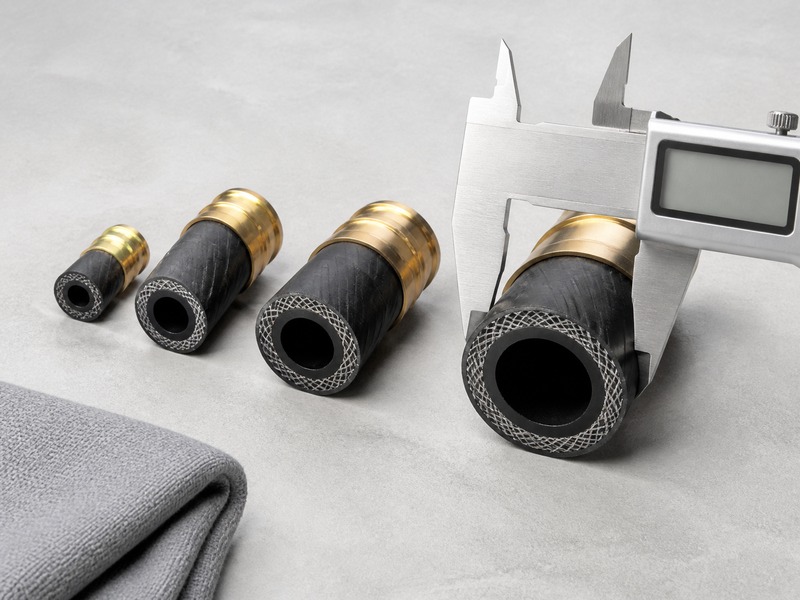
Inside diameter sets flow; outside diameter sets bulk. For 5/8-inch hose the nominal bore is 15.9 mm while the finished outside diameter is usually about 22 mm.
2.1 Standard Garden Hose Sizes and Their Metric Equivalents
Metric catalogues label the same hoses differently, and the mismatch causes real confusion at the tap. The four sizes convert as follows:
- 1/2 inch is 12.7 mm, and is commonly sold in Europe as a 12.5 mm hose.
- 5/8 inch is 15.9 mm, and is sold as 16 mm, or occasionally as 15 mm in older catalogues.
- 3/4 inch is 19.1 mm, and is almost always listed as 19 mm.
- 1 inch is exactly 25.4 mm, and is listed as 25 mm in most metric catalogues.
Diameter is only half of the specification, because the coupling is measured separately. Our garden hose fitting size guide covers that side of the chart in full.
2.2 How Much Water a Hose Holds at Each Size
Fifty feet of hose holds between about 1.9 and 7.7 litres, depending on bore. That volume sets how much water drains onto the patio when you lift the end of the hose. It also sets how heavy the hose becomes in use, and how much is still inside it when freezing weather arrives.
We calculated the volume held by 50 feet of each nominal size from the inside diameter, using the cross-sectional area of the bore:
- The 1/2 inch bore holds about 1.9 litres (0.51 US gallons).
- The 5/8 inch bore holds about 3.0 litres (0.80 US gallons).
- The 3/4 inch bore holds about 4.3 litres (1.15 US gallons).
- The 1 inch bore holds about 7.7 litres (2.04 US gallons).
The stored-volume step is worth noting: moving from 5/8 inch to 3/4 inch raises the water held in 50 feet by roughly 44 percent, the same ratio as the bore area.
2.3 Outside Diameter, Wall Thickness and Weight
Outside diameter varies with wall thickness and reinforcement layers, so ISO 1307 fixes the inside diameter only. For a clearance check — a reel, a wall clamp or a door gap — measure the hose you own.
Four points matter when OD and weight are part of the decision:
- A nominal 5/8-inch hose commonly measures about 7/8 inch, or 22 mm, outside. HENGHUA’s 5/8-inch builds sit in that band.
- The 3/4-inch size usually finishes near 25 mm, or 1 inch, across; that extra bulk is why it feels disproportionately heavy to drag.
- Weight tracks material more than diameter: at 5/8 inch bore, a 50-foot hybrid or polymer hose typically weighs 5 to 8 pounds dry, while a comparable rubber hose is generally 9 to 15 pounds.
- Clearance decisions — hose reels, wall clamps, door gaps — depend on outside diameter, not on the size printed on the label.
3. What Garden Hose Flow Rate Does Each Size Deliver in Gallons per Minute?
Garden hose flow rate depends on four things: bore diameter, hose length, supply pressure, and whatever is screwed onto the far end. On a normal household tap, most residential hoses free-flow somewhere between 9 and 17 GPM, with a typical figure near 12 to 13 GPM at an open end on a 50 psi supply. Published garden hose GPM figures for a 5/8-inch hose land inside that band almost every time. Change any one of the four inputs and the number moves.
The practical rule is easy to remember. Diameter decides the ceiling, length decides how much of that ceiling you keep, and the nozzle decides what actually comes out.
3.1 Garden Hose GPM: Published Values Side by Side
Published charts disagree, often by a factor of two, and the reason is almost always the test condition rather than a calculation error. Three widely published reference sets appear side by side at the same 50 psi supply pressure and the same 50-foot length.
Flow rate by diameter at 50 psi supply pressure and 50 ft of hose: published open-end discharge beside two modelled columns, one friction-only and one capped at 10 GPM of available supply.
| Hose diameter | Open-end discharge, 50 ft | Friction-only calculation, 50 ft | Supply limited to 10 GPM available | Open-end discharge (l/min) |
|---|---|---|---|---|
| 1/2 inch | 8 GPM | 14 GPM | 8.5 GPM | 30.3 l/min |
| 5/8 inch | 12 GPM | 24 GPM | 9.5 GPM | 45.4 l/min |
| 3/4 inch | 19 GPM | 40 GPM | 9.8 GPM | 71.9 l/min |
The friction-only column needs care: it reports what the hose could pass if the supply were unlimited, which is why it reaches 40 GPM for a 3/4-inch hose that few homes can feed. The supply-limited column shows what happens when the tap itself is the bottleneck: all three diameters converge near 9 to 10 GPM, because the pipe behind the tap, not the hose, is limiting.

At a fixed 50-foot length with an open end, published flow rises from about 8 GPM at 1/2 inch to about 19 GPM at 3/4 inch. That gain only appears when the tap can supply the water.
3.2 Why Do Published Garden Hose Size Charts Disagree?
Three variables explain almost every discrepancy between published garden hose size charts. Checking them takes a minute and saves a wasted purchase. Construction differences between hose types add a fourth, which our overview of types of water hoses sets out.
The three variables are:
- Supply-limited or friction-limited. A test run from a tap that can only deliver 10 GPM cannot show the difference between a 5/8-inch and a 3/4-inch hose, because both are starved. A test with an unlimited supply shows the full diameter effect.
- Free end or nozzle. Measured against the same hose with a bare end, a fully open nozzle passes roughly 80 to 90 percent of the unrestricted flow, while a fine mist setting delivers 20 to 30 percent. A typical impact sprinkler head draws 2 to 5 GPM.
- Assumed pressure. Charts quoting 40 psi and charts quoting 60 psi describe different systems. Flow rises with the square root of pressure, so doubling pressure adds about 41 percent, not 100 percent.
Length belongs on the same list. At a fixed flow rate, a 50-foot hose shows half the pressure drop of a 100-foot hose, so halving the length halves the friction penalty. Published guidance for a 5/8-inch hose at 50 psi puts the loss at roughly 10 to 15 percent going from 25 to 50 feet, and 25 to 35 percent going from 25 to 100 feet.
3.3 Garden Hose Diameter and Flow: The Scaling Rule That Holds
Garden hose diameter and flow rise at different rates: flow climbs more slowly than the bore area grows, and slower still than the diameter figure itself suggests. Comparing the published open-end garden hose GPM figures shows why.
Relative flow capacity by hose diameter: bore area calculated from the nominal inside diameter, published flow taken from the open-end discharge figures at 50 psi and 50 ft, both expressed against 5/8 inch as the reference size. 1 inch is excluded from the published-flow comparison because no comparable open-end figure is published.
| Hose diameter | Bore area vs 5/8 inch | Published flow vs 5/8 inch | Implied exponent |
|---|---|---|---|
| 1/2 inch | 0.64 | 0.67 | about 1.8 |
| 5/8 inch | 1.00 | 1.00 | reference size (1.00) |
| 3/4 inch | 1.44 | 1.58 | about 2.5 |
| 1 inch | 2.56 | n/a (not published) | n/a |
The practical reading is that flow scales somewhere between the 1.8th and 2.5th power of inside diameter. Bore area alone — the square of the diameter — underpredicts the 3/4-inch gain and overpredicts the 1/2-inch penalty. That spread is normal, because friction losses at the hose wall grow disproportionately in smaller bores.
For buyers the consequence is direct: upgrading from 1/2 inch to 5/8 inch typically gains about 50 percent more flow, and going on to 3/4 inch gives about 2.4 times the 1/2-inch figure. That is a larger step than the diameter numbers themselves suggest.
3.4 How Do You Measure Your Own Garden Hose Flow Rate in Two Minutes?
Published charts are a starting point, but your tap sets the real limit. A bucket and a stopwatch settle the question, and the same test also tells you whether a bigger hose would change anything at all.
Run the test in this order:
- Fit the nozzle and settings you actually use, because a nozzle changes the answer more than diameter does.
- Fill a container of known volume — a 5 US gallon bucket is convenient — and time the fill in seconds.
- Calculate flow as volume divided by time in minutes: 5 gallons in 30 seconds equals 5 ÷ 0.5, or 10 GPM.
- Repeat once with the tap fully open and the hose end bare, to separate a hose limit from a nozzle limit.
- Compare the two figures. If bare-end flow also caps near 10 GPM, the tap is the constraint and a wider garden hose will not help.
4. What Garden Hose Thread Size Do Garden Taps Use?
Garden hose thread size is the part of a garden hose size chart that catches people out, because the thread does not follow the hose. Three thread families dominate residential and light industrial hose work, and they are not interchangeable.
A garden hose end is a sealing surface, not a pressure joint. That distinction explains why garden hose thread is straight while pipe thread is tapered.
4.1 GHT: The 3/4-Inch Thread Every Residential Hose Shares
The North American garden hose standard is defined in ASME B1.20.7, Hose Coupling Screw Threads (Inch). It lists two relevant designations: 0.75-11.5 NH for cut or rolled thread of full form, and 0.75-11.5 NHR for garden hose applications where thin-walled material is formed to shape.
The four numbers that matter for GHT are:
- Nominal size — 3/4 inch, written 0.75 in standard designations.
- Threads per inch — 11.5, giving a pitch of 2.209 mm, which is coarser than pipe thread at the same nominal size.
- Male outside diameter — 1.0625 inch, or 26.99 mm, measured across the thread crests.
- Форма темы — parallel (straight), sealed by a flat rubber washer compressed against the mating face rather than by the thread itself.
Because a GHT joint seals on a flat washer rather than on the thread itself, it tolerates slight thread wear and repeated connection far better than a tapered pipe joint. It also means a missing or hardened washer is the first thing to check when a garden hose coupling leaks.
4.2 Why Does the Thread Not Change With the Hose Diameter?
One fact resolves most garden hose fitting confusion: hoses of 1/2, 5/8 and 3/4 inch nominal bore all carry the same 3/4-inch GHT coupling. The standard covers these three sizes together under one thread, so a 1/2-inch hose and a 3/4-inch hose from any mainstream brand screw onto the same tap.
Two consequences follow, and both save money:
- Accessories are diameter-independent. A spray nozzle, Y-splitter, timer or quick-connect set bought for a 5/8-inch hose fits a 3/4-inch hose, because the connection is defined by the thread rather than the bore.
- Hose diameter can be changed without changing the tap end. That is why replacement couplings and repair ends are sold by thread type, not by hose bore, on the coupling side.
A repair coupling is specified by two numbers. The barbed stem must match the hose bore, and the threaded end must match the tap. A repair kit therefore states the hose ID for the barb and the thread for the coupling.
4.3 GHT vs NPT vs BSP: Thread Types Compared
Three thread systems cover nearly every garden and light industrial water connection, and forcing them together damages threads. Form, pitch, male diameter reference and sealing method separate the three.
Comparing the thread families that meet on garden and light industrial hose — GHT, NPT, BSPP, and NPSH at 1 inch — by form, pitch and sealing method.
| Thread system | Typical designation | Form | Pitch | Male diameter reference | Seals on |
|---|---|---|---|---|---|
| GHT (NH / NHR) | 0.75-11.5 NH | Straight | 11.5 TPI (2.209 mm) | 1.0625 in / 26.99 mm | Flat washer |
| NPT | 3/4-14 NPT | Tapered | 14 TPI (1.814 mm) | 1.050 in pipe OD / 26.67 mm | Thread interference |
| BSPP (BSP parallel) | G 3/4 | Straight | 14 TPI (1.814 mm) | 26.44 mm | Шайба с клеевым соединением или уплотнительное кольцо |
| NPSH (straight pipe hose) | 1-11.5 NPSH | Straight | 11.5 TPI (2.209 mm) | 1.295 in / 32.89 mm | Gasket |
The mismatch that causes most trouble is 3/4 GHT against 3/4 NPT. Their diameters are within about 0.3 mm of each other, so the two threads start to engage and then bind. GHT into a tapered port feels loose and will not seal. NPT into a garden hose coupling feels tight and cross-threads, and a leaking joint usually follows. Our general hose thread size chart covers the same families outside the garden setting.
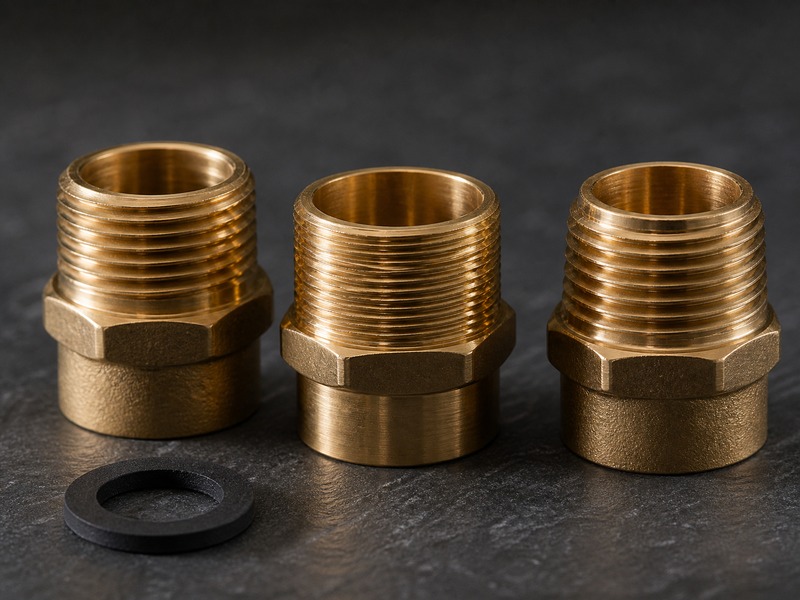
Garden hose thread size is straight and seals on a washer; NPT is tapered and seals on the threads. 3/4-inch GHT is 11.5 TPI, while 3/4-inch NPT and BSP are both 14 TPI.
4.4 When Does a 1-Inch Hose Switch to Pipe Thread?
The three common residential sizes share one thread, but the pattern changes at 1 inch. The standard series lists 1-11.5 NPSH for straight hose couplings in 1-inch size, intended for joining to standard pipe threads using a gasket.
That is where the confusion starts, because 1-inch NPT is also 11.5 threads per inch. The pitch matches; the form does not. NPSH is straight and gasket-sealed, NPT is tapered and interference-sealed, and the two will not hold pressure together without an adapter.
For anyone assembling a 1-inch run, the safe sequence is:
- Identify the port, not the hose. Markings on a valve or pump body usually state NPT, BSP or NPSH.
- Buy an adapter sized for both ends — for example a 1-inch NPSH hose coupling to 1-inch NPT male.
- Use the correct seal. A gasket joint needs its gasket; a tapered joint needs thread sealant, not a washer.
- To stop a leak at a tapered port, fit the matching adapter and apply thread sealant. Threads forced together at this step are permanently damaged and will still weep.
4.5 Quick Connect Fittings and Sizes
Quick connect systems are built on the same 3/4-inch GHT base, which is why plugs and sockets from different brands usually fit each other. The quick-release mechanism replaces the threaded joint, but the underlying connection at the tap or hose end is still GHT.
Four points are worth knowing before buying a set:
- The garden-hose end of the system is standardised at 3/4 GHT, so cross-brand mating generally works.
- Pressure washer quick connects use a different, larger profile and are not interchangeable with garden hose sets.
- Reduced-bore adapters exist for 1/4, 3/8 and 1/2 inch lines, and they restrict flow even when the hose itself is 5/8 or 3/4 inch.
- Metal bodies resist wear from grit better than plastic, but both depend on the O-ring or washer inside for sealing.
5. How Do You Choose a Garden Hose Size for Your Job?
A chart tells you what exists; the job tells you what to buy. Two factors dominate the decision — how much water the task needs, and how far the water has to travel.
5.1 Garden Hose Size by Task
Match the diameter to the demand rather than to habit, because a hose that is too large for the tap delivers no extra water and feels heavier to drag. Four garden hose sizes cover almost every residential job, from the smallest up. Where one general-purpose hose has to cover several of these jobs, a reinforced TPR (thermoplastic rubber) garden hose in 5/8 inch covers most of them.
A practical starting point for common jobs:
- Containers, patio pots and short runs: 1/2 inch, where low volume and easy handling matter most.
- General garden beds, borders and car washing: 5/8 inch, the best all-round balance of flow, weight and flexibility.
- Large lawns, filling pools or ponds, and long runs: 3/4 inch, when volume matters more than portability.
- Multiple sprinklers or drip zones fed at once: 3/4 inch, then check the tap can still supply the total demand.
- Nursery and light commercial watering: 3/4 inch or 1 inch, with the thread confirmed before ordering.
For a renter with a single outdoor tap and one hose, 5/8 inch covers everything without buying a second hose. For a balcony or terrace container grower, 1/2 inch is easier to coil and store between waterings. A homeowner running a large lawn or filling a pool needs 3/4 inch. A nursery or light-commercial operator feeding several zones at once needs 3/4 inch or 1 inch.
5.2 Matching Garden Hose Diameter to Length
Length and diameter trade against each other, and the trade is measurable. Friction loss rises with length, so a long run loses more of the flow the diameter allows. The usual fix for a long run is one step up in diameter rather than more pressure. Our hose size selection guide applies the same trade-offs to industrial hose.
The working relationship is straightforward:
- Under 50 feet, diameter differences are modest and any of the three common sizes will perform acceptably.
- From 50 to 100 feet, a step up in diameter recovers much of the loss that length introduces.
- Beyond 100 feet, expect a visible drop at the far end unless diameter is increased or the run is split.
5.3 When Is a Smaller Hose the Right Answer?
Wider is not automatically better. Smaller bore has real advantages that published flow charts do not capture, and three situations favour it.
Those situations are:
- Delicate watering, where a lower delivery rate avoids washing seedlings out of light soil.
- Long storage life on a reel, because a 1/2-inch hose coils into less space and weighs less to handle.
- Supply-limited taps — if a bare-ended hose already tests near 10 GPM, stepping up a size buys bulk rather than volume.
The step up works in the other direction too. A wider bore earns its extra weight when a bare-ended test already shows more than about 12 GPM available at the tap and the run is longer than 50 feet.
6. How Do You Measure a Garden Hose Size Correctly?
Measuring takes two tools and about a minute: a ruler or tape for the bore, and a caliper or thread gauge for the coupling. Measuring the outside of the hose is the one method that gives a wrong answer, because wall thickness and reinforcement layers sit between the outside surface and the water passage.
6.1 Measuring the Inside Diameter
Inside diameter is measured at a cut end or at the hose outlet, where the bore is exposed. A short length of straight hose gives the most reliable reading, because a coiled hose distorts the bore slightly.
Measure the inside diameter like this:
- Cut the hose square, or use a clean factory end, so the bore opening is a true circle.
- Measure across the opening in two directions, 90 degrees apart, and average the two readings.
- Compare the result against the chart: near 12.7 mm is 1/2 inch, near 15.9 mm is 5/8 inch, and near 19.1 mm is 3/4 inch.
- Treat a reading between two nominal sizes as tolerance, not as a different hose type. A 16 mm reading is a 5/8-inch hose.

Start at a square-cut end for the bore, and check the coupling as a separate dimension. The thread on a 1/2, 5/8 or 3/4 inch hose is the same 3/4-inch GHT in every case.
6.2 Measuring the Thread
Thread identification needs two numbers together: the outside diameter and the threads per inch. A 3/4-inch GHT and a 3/4-inch NPT thread are close enough in diameter to be confused by eye or by tape.
Confirm the thread using both dimensions:
- Measure the male thread outside diameter across the crests. GHT measures about 1.0625 inch, or 27 mm.
- Count the crests over a measured inch. A garden hose thread returns 11.5 of them; pipe threads at the same nominal size return 14.
- Check the form. A ruler laid along the thread shows GHT as parallel, while NPT tapers visibly from one end to the other.
- Look at the sealing face. A flat washer seat indicates garden hose thread; a bare tapered bore indicates pipe thread.
6.3 Reading a Metric or Imported Hose Label
Imported hoses often state millimetres, and some state the outside diameter instead of the bore. Getting this wrong is a common source of return shipments.
Check the label in this sequence:
- Look for the letters ID or the word bore, which confirm that a millimetre figure describes the water passage.
- Read a bare millimetre figure as bore on European hose, and as outside diameter on some Asian catalogue pages. Confirm it is marked ID or bore before ordering.
- Cross-check against the common bores: 12.5, 16, 19 and 25 mm cover 1/2, 5/8, 3/4 and 1 inch respectively.
- Confirm the coupling thread separately, since a metric hose sold in Europe may carry a 3/4-inch BSP tap connector rather than GHT.
When the label and the measurement disagree, trust the measurement. Our guide to what size is a garden hose fitting shows how the two readings are checked against each other.
7. Do Pressure and Temperature Ratings Change With Hose Size?
Diameter and thread get a hose connected; pressure and temperature ratings decide whether it survives. Neither rating can be read off a garden hose size chart, because both are properties of the hose construction rather than of the nominal size. Two hoses of identical bore can therefore carry very different ratings.
7.1 Working Pressure and Burst Pressure
Working pressure is the maximum pressure a hose is designed to see in normal service. Burst pressure is the pressure at which it fails during testing, and it is never an operating limit.
The relationship between the two is consistent across hose types:
- Burst pressure is normally three to four times the working pressure for a well-built hose, measured on a new hose at 20 °C with the coupling intact.
- Manufacturer-published working-pressure ratings for garden hose start around 200 psi for light-duty PVC and reach 600 psi for heavy-duty reinforced constructions.
- Household supply pressure is far lower — typically 40 to 60 psi at a North American residential tap, rarely above 80 psi. Confirm your own static pressure before sizing a long run. In service, age, UV exposure and kinking are the usual reasons a garden hose is replaced — not the supply pressure.
- Use a pressure washer hose for pressure washers and a garden hose for tap supply. Each is rated for its own service pressure, whatever the nominal bore.
- Diameter and pressure rating are independent. Raising garden hose diameter does not raise the pressure a hose can take, because the rating is set by the tube, the reinforcement and the cover.
- Age matters more than size. A hose stored in sun loses cover material every season, and its working pressure falls well before its bore changes.
7.2 Temperature and Material Limits
Temperature tolerance follows the tube and cover material. PVC stiffens as it cools and softens as it warms; rubber and rubber blends hold flexibility across a wider range. A polyurethane garden hose, for example, is commonly rated at 150 psi working pressure and a wider service-temperature band than PVC, both measured at 20 °C. Confirm the exact band with your supplier, because it is set by the compound, not by the bore.
Three habits protect a hose regardless of material:
- Drain the hose before freezing weather arrives, because trapped water expands and splits the tube.
- Store coiled hose out of direct sun, since UV degrades the cover before the reinforcement fails.
- Route hose clear of hot surfaces, and use a hose rated for hot water only when the supply itself is hot.
8. Frequently Asked Questions
What is the most common garden hose size?
5/8 inch is the most common garden hose size in North America, and it is the size most retailers treat as standard. It balances flow, weight and flexibility for general garden watering.
What is the standard garden hose thread size?
The standard garden hose thread size in the United States and Canada is 3/4 inch GHT, also written as 0.75-11.5 NH. It measures 11.5 threads per inch with a male outside diameter of 1.0625 inch, and it seals on a flat rubber washer.
Is a 5/8 inch hose better than a 3/4 inch hose?
Neither is better in absolute terms. A 5/8 inch hose is lighter and easier to handle and suits most residential tasks, while a 3/4 inch hose delivers more water and suits long runs, large lawns and filling pools. The tap often limits the difference.
How many GPM does a garden hose flow?
Expect roughly 9 to 17 GPM with an open end, and near 12 to 13 GPM on an average household supply. Published garden hose GPM tables for a 50-foot hose at 50 psi run from about 8 GPM at 1/2 inch to about 19 GPM at 3/4 inch.
Does hose length affect flow rate?
Yes. Friction along the hose wall grows with length, so a longer run delivers less water at the same supply pressure. Moving from a 25-foot to a 100-foot hose of the same bore typically costs 25 to 35 percent of the flow, measured at 50 psi.
Can I connect a garden hose to an NPT pipe thread?
Only through a GHT-to-NPT adapter. GHT is a parallel thread that relies on a flat washer for its seal, while NPT carries a taper and seals on the thread flanks. Their diameters are close enough for the threads to start engaging, so forcing them together damages both.
What size hose do I need for a sprinkler?
A 5/8 inch hose usually feeds one sprinkler well, while 3/4 inch suits several heads or a long run. Because a typical head draws only about 2 to 5 GPM, the supply pressure behind the tap often matters as much as the bore.
How do I measure my garden hose size?
Measure the inside diameter at a square-cut end in two directions and average the readings. Then confirm the coupling thread separately by measuring the male outside diameter and counting threads per inch.
What is the outside diameter of a 5/8 inch garden hose?
Figure on about 22 mm across a nominal 5/8 inch garden hose, though that dimension is not standardised. Wall thickness and the reinforcement count move it, so measure your own hose if clearance is tight.
Do all garden hoses have the same size fittings?
Almost all residential garden hoses in North America use the same 3/4 inch GHT fitting, regardless of whether the hose bore is 1/2, 5/8 or 3/4 inch. Diameter changes flow; it does not change the coupling thread.
What size is a 1 inch garden hose fitting?
A 1 inch hose does not use GHT. At that size the series switches to 1-11.5 NPSH, a straight gasket-sealed coupling meant to join pipe threads. Note that 1 inch NPT also runs at 11.5 TPI, but its taper makes it a different joint.
Does a bigger hose increase water pressure?
The tap sets the pressure. A larger diameter reduces friction loss, which raises the flow available at the far end, but it cannot raise the pressure your supply delivers. If the tap caps flow near 10 GPM, a wider hose adds weight without adding water.
9. About HENGHUA and How We Test
HENGHUA manufactures reinforced garden hoses, hose couplings and connecting fittings for distributors, retailers and private-label programmes. The diameters, threads and pressure categories referenced throughout this garden hose size chart are part of our standard production range, which is why the tolerances we work to match what we ship.
We test the three properties that decide whether a garden hose performs as its size chart claims:
- Bore accuracy — inside diameter is gauged against the nominal size and its tolerance band, not just checked for appearance.
- Thread compatibility — every GHT coupling is gauged to the 11.5 TPI standard and its washer seat is checked, because washer seating, not thread form, decides whether that joint seals.
- Pressure retention — couplings are pressure-tested above normal residential supply levels, and quick-connect sets are cycled to confirm seal retention before packing.
Our production covers 1/2, 5/8 and 3/4 inch bore in PVC, rubber and TPR blends, with GHT couplings as standard and NPT, BSP and quick-connect options on request. Hoses are supplied as coils or on reels, with custom lengths, colours and private-label packaging available for OEM and ODM orders.
If you are between two sizes, send us the job and the tap. Our engineers will confirm which bore and thread your market actually needs. Send us the bore, the thread you need, the working pressure and the run length. We will quote against that specification, and supply samples so you can verify fit on your own equipment before committing to a bulk order. Browse the HENGHUA garden hose range to see the standard sizes and thread options, or contact the engineering team for pricing, minimum order quantities and lead times.
About the author. Reviewed by a HENGHUA hose product engineer and prepared by the HENGHUA technical content team, which supports garden and industrial hose selection for distributors and OEM buyers. The dimensional data in this garden hose size chart follows ASME B1.20.7 for hose coupling threads and ISO 1307 for hose bore sizes.






 English
  Spanish
  Portuguese
  French
  German
  Arabic
  Russian
  Indonesian
  Japanese
  Korean