
A garden hose GPM reading is the volume flow rate of the hose in US gallons per minute, and a 5/8-inch hose on a typical outdoor tap (spigot) delivers roughly 5 to 10 gallons per minute. You can measure your own figure in about two minutes with a bucket and a stopwatch.
Four variables decide the number you actually get: inside diameter, supply pressure, run length and fittings, and the nozzle or sprinkler fitted to the end. This guide explains what the flow figure means, what to expect by size, and how to measure it yourself with a bucket and a stopwatch or with an inline flow meter.
> Scope: this guide covers residential outdoor taps at 20 to 80 psi and hose bores from 1/2 inch to 1 inch. Pressure-washer feed lines follow the same principles at higher pressure.
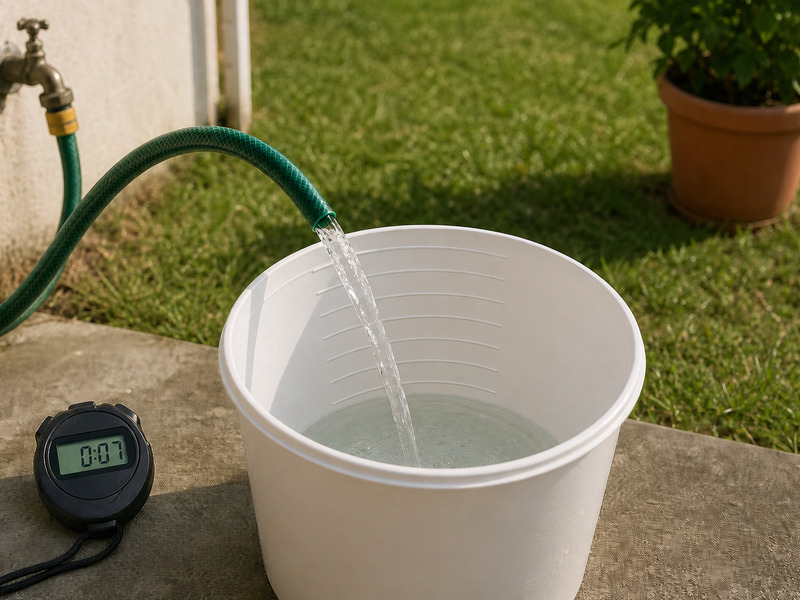
Fig. 1. Measuring outlet flow with a marked bucket and a stopwatch.
Most published output figures for garden hoses are quoted without their test conditions, which is why they appear to contradict each other. Once the inlet pressure, the hose length and the end device are fixed, the numbers become reproducible to within a few percent. The same procedures apply before purchase, after installation and when a sprinkler underperforms.
What Does a Flow Reading in Gallons Per Minute Actually Measure?
A flow rate is a volume divided by a time. When a hose is rated in gallons per minute, one US gallon equals 231 cubic inches, or 3.785 liters, and one minute is 60 seconds. A hose passing 10 GPM therefore moves 10 gallons, about 37.9 liters, every minute, which is the same as 0.167 gallons per second.
Flow rate is not the same as the total amount delivered. A hose running at 6 GPM fills a 30-gallon drum in five minutes, because 30 divided by 6 equals 5. That distinction matters when you are sizing a hose to fill a tank or a pool rather than to water a bed. For irrigation the rate matters; for filling it is the rate times the waiting time.
Why Flow Is Measured in Gallons Per Minute
Gallons per minute is the unit that matches how people use water: garden tasks are described in volume, and the timing is described in minutes. Metric markets use liters per minute, where 1 GPM equals 3.785 liters per minute. The two units describe the same physical quantity, so a hose quoted at 10 GPM is the same hose as one quoted at 37.9 liters per minute.
How GPM Differs From PSI
Pressure and flow are different quantities and they are measured with different instruments. Pressure, in pounds per square inch, describes the force pushing the water; it is read with a pressure gauge and it exists even when nothing is moving. Flow, in gallons per minute, describes how much water actually passes a point in a given time.
A system can hold high pressure and still deliver low flow. A long, narrow hose connected to a strong supply shows high pressure at the closed tap and poor output once opened, because friction in the hose absorbs the pressure that would otherwise drive flow. Static pressure describes the supply; only the flowing reading describes the output. You need the flowing pressure and the flow rate together to describe a hose system honestly.
Which Conditions Affect a GPM Reading?
Every flow figure is quoted under four conditions:
- The pressure at which the figure was measured.
- The length and inside diameter of the hose that produced it.
- The device attached at the outlet, such as a nozzle, sprinkler or quick coupler.
- The outlet design, which sets the spray pattern and reach independently of the flow rate.
Two hoses that both deliver 8 GPM can behave very differently in the garden. One may be rated at 40 psi and the other at 70 psi, or one may end in a fine misting nozzle and the other in an open bore. When you compare products, compare the conditions as well as the numbers.
What Is the Average Garden Hose GPM?
The average output of a garden hose falls between roughly 3 and 14 gallons per minute across the sizes sold for domestic use. Inside diameter (bore) is the strongest influence on where inside that band you land. The values below are calculated from bore area at an assumed velocity of 5 to 10 feet per second, the range typical residential pressure and hose length produce.
Calculated hose capacity by inside diameter at three assumed water velocities, using flow = area times velocity
| Nominal hose size | Inside diameter (inches) | Inside diameter (mm) | Flow at 5 ft/s (GPM) | Flow at 8 ft/s (GPM) | Flow at 10 ft/s (GPM) |
|---|---|---|---|---|---|
| 1/2 inch | 0.50 | 12.7 | 3.1 | 4.9 | 6.1 |
| 5/8 inch | 0.625 | 15.9 | 4.8 | 7.7 | 9.6 |
| 3/4 inch | 0.75 | 19.1 | 6.9 | 11.0 | 13.8 |
| 1 inch | 1.00 | 25.4 | 12.2 | 19.6 | 24.5 |
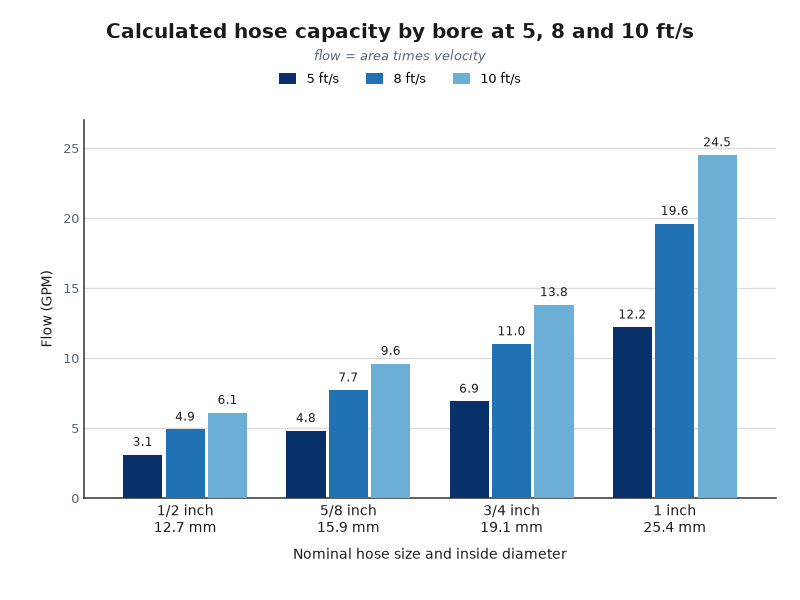
Fig. 2. Calculated hose capacity by bore at 5, 8 and 10 ft/s.
Capacity follows the bore area, not the nominal diameter. Going from 1/2 inch to 5/8 inch raises the capacity by about 56 percent, and going from 5/8 inch to 3/4 inch raises it by a further 44 percent. The jump is not proportional to the diameter; it follows the area, which grows with the square of the diameter. That is why a modest-looking step up in hose size produces a large change in output, and why the hose is often the cheapest place to find more flow.
How Does Hose Inside Diameter Set the Average Flow Figure?
The internal area of a round hose is π multiplied by the square of the inside radius. A 5/8-inch hose has an inside area of about 0.307 square inches, while a 3/4-inch hose has about 0.442 square inches, a difference of 44 percent. At the same water velocity the larger hose therefore carries 44 percent more water. The number that governs flow is the inside diameter; the diameter printed on a jacket reflects wall thickness and reinforcement.
Nominal sizes are also quoted in metric markets, and the conversion is a common source of confusion. If you work in millimeters, the reference chart at mm to inches conversion formula and chart covers the sizes used for hose and fittings. A hose marked 15 mm is close to a 5/8-inch bore, while 19 mm is close to 3/4 inch.
Why Do Two Hoses of the Same Size Quote Different GPM Figures?
Quoted flow figures for the same nominal hose size vary widely, and the variation is explained by test conditions rather than by disagreement about physics. A figure measured at 60 psi with a 25-foot hose and an open end will be much higher than a figure measured at 35 psi with a 100-foot hose and a spray nozzle attached. Neither figure is wrong; they describe different systems.
The three conditions that move a published number the most are inlet pressure, hose length and outlet restriction. If a listing or a guide does not state all three, treat the figure as an indicative ceiling rather than a performance promise, and measure your own installation instead. The bucket-and-stopwatch test below takes about two minutes.
Why 5/8 Garden Hose GPM Is the Common Benchmark
The 5/8-inch hose is the default residential size, so most quoted flow figures describe it. That makes 5/8 garden hose GPM numbers the natural reference point when you compare a new hose with an old one. A useful working assumption is 5 to 10 gallons per minute at residential pressure with an open end, with the higher figure requiring good pressure, a short run and unrestricted fittings.
If your hose is 5/8 inch and your measured output is well below 5 GPM, the hose is probably not the limiting component. The tap, the supply line or the end device is more likely to be the constraint, and the separate measurement steps later in this article show how to find out which one it is.
What Sets Flow Rate in a Real System?
A hose is one link in a chain that runs from the water main to the outlet, and the flow you measure is set by the most restrictive link in that chain. Most domestic systems have four links: the supply line and tap, the hose itself, the couplings and adapters, and the end device. Hose construction matters as well, because the different water hose types and how they are built behave differently under the same pressure.
How Does the Tap and Supply Line Limit My Hose Flow?
The tap is where most low-flow complaints begin. A half-inch copper supply line of assumed 0.545-inch internal diameter carries roughly 5.8 gallons per minute at 8 feet per second, or about 7.3 gallons per minute at 10 feet per second. Both figures are calculated from the pipe area at the stated velocities, which are design assumptions for this example rather than a rating for any one installation.
If your plumbing delivers 6 GPM at the tap, a 3/4-inch hose delivers at most 6 GPM, whatever its size. Measuring the tap first tells you whether changing the hose can help at all.
How Pressure and Friction Loss Interact
More pressure usually means more flow, but the relationship is not linear once water is moving. Friction against the hose wall converts pressure into loss, and that loss grows with the square of the water velocity. A short, wide hose at moderate pressure therefore loses very little, while a long, narrow hose can consume much of the pressure available at the tap.
A 5/8-inch hose running at 10 feet per second carries about 9.6 GPM. Under the Darcy-Weisbach relation with a smooth-bore friction factor of about 0.022 at 60 degrees Fahrenheit, that hose loses about 0.65 feet of head per foot. A 50-foot run therefore loses about 32 feet of head, which is about 14 psi. Doubling the length doubles that loss.
The friction loss above is why a 25-foot and a 100-foot hose of the same bore can differ by several gallons per minute on one tap. Length is not a detail; it is a flow variable.
Why Does Flow Drop When I Add a Quick Connector or Adapter?
Every coupling, elbow, tee and quick coupler adds local resistance. Fitting loss is usually expressed as an equivalent length of straight hose, so a single adapter can cost as much pressure as several feet of hose.
More importantly, a fitting can be narrower than the hose. A 5/8-inch hose fitted with a coupler whose bore steps down to 3/8 inch behaves like a 3/8-inch hose at that point, and the narrowest section sets the ceiling for the whole run. Checking bore diameters through the entire assembly matters more than checking the size printed on the jacket. Quick couplers for pressure equipment are a common place to find a real bore narrower than the hose, and the internal sizes are set out in this quick connect fitting guide.
Why Does a Nozzle or Sprinkler Lower the Flow at the Hose End?
The end device is often the strongest restriction in the system. Nozzle and sprinkler openings are small, and the flow through a fixed opening follows an orifice relationship in which flow varies with the square root of the pressure difference across it. That single relationship explains most of the surprise people feel when a nozzle rated for high pressure delivers less water than expected at low pressure.
A calculated example makes the point. An opening that passes 2.50 GPM at 40 psi passes about 3.06 GPM at 60 psi, because 2.50 multiplied by the square root of 1.5 equals 3.06. Raising the supply pressure by 50 percent raised the flow by about 22 percent, not by 50 percent.
The same logic runs in reverse. If you lower the pressure, flow falls by the square root of the ratio, which is why a tired pressure washer or a long feed hose can change the entire feel of a spray nozzle. Matching a hose and a nozzle to the pressure you actually have is covered in the pressure washer hose buying guide.
How to Measure Garden Hose Flow Rate Accurately
The bucket-and-stopwatch test is the reference method for a home. It needs no special tools, it is accurate to within a few percent when it is done carefully, and it works on any hose, tap or nozzle. The value of the method comes from running it at three points, because the comparison separates the tap limit from the hose limit from the device limit.
The three-point procedure below shows how to measure garden hose flow rate in a way that identifies the real constraint; record all three readings.
What You Need for a Bucket-and-Stopwatch Test
The equipment list is short and every item has a reason:
- A container of known volume, such as a 5-gallon bucket with molded gallon and liter markings.
- A stopwatch or a phone timer that reads to a tenth of a second.
- A pressure gauge that screws onto a standard hose thread.
- A tape measure for recording hose length, plus a notebook for the three readings.
A bucket without markings is still usable if you weigh it, because one US gallon of water weighs 8.34 pounds. Record the container weight first so you can subtract it.
The Bucket-and-Stopwatch Method, Step by Step
Follow the same sequence at every measurement point so the results stay comparable:
- Run the water for 30 seconds before testing so the flow settles and any air clears.
- Place the container under the outlet and start the timer at the moment the water enters it.
- Stop the timer when the container reaches a marked volume, then write down both figures.
- Repeat the test three times and average the results to reduce timing error.
- Record the pressure gauge reading while the water is running, not before.
Keep the container steady and the outlet at the same height each time, because hose height moves the outlet pressure. Consistency matters more than absolute precision.
How to Turn Your Reading Into GPM
The conversion is one multiplication. Flow in gallons per minute equals 60 multiplied by the gallons collected, divided by the time in seconds. If you collect 2 gallons in 15 seconds, the flow is 60 times 2 divided by 15, which is 8 GPM. The table below lists the results for common collection times so you can read a value straight off the chart.
Calculated flow rate from a measured collection time, using flow = 60 times gallons divided by seconds
| Water collected | Time to collect (seconds) | Flow rate (GPM) |
|---|---|---|
| 1 gallon | 20 | 3.0 |
| 1 gallon | 15 | 4.0 |
| 1 gallon | 12 | 5.0 |
| 2 gallons | 20 | 6.0 |
| 2 gallons | 15 | 8.0 |
| 2 gallons | 12 | 10.0 |
| 5 gallons | 30 | 10.0 |
| 5 gallons | 25 | 12.0 |
If your measured value sits between two rows, interpolate rather than rounding to the nearest row. A reading of 5 gallons in 27 seconds works out to 11.1 GPM.
How Accurate Is a Bucket-and-Stopwatch Flow Test at Home?
The accuracy of the bucket-and-stopwatch test is limited by timing and by how well the container volume is known. A hand-timed 15-second sample carries roughly 0.5 seconds of reaction error, which is about 3.3 percent of the sample. A 30-second sample halves that error to about 1.7 percent. Longer samples are therefore more accurate, but they also use more water.
Volume error matters just as much. A bucket marked to within 2 percent gives results to within about 2 percent. Weighing the collected water on a kitchen scale removes the volume question entirely.
How to Separate the Tap Limit From the Hose Limit
Three measurements, taken in sequence, separate the three limits in a hose system. Each one removes a component from the chain so the restriction can be attributed to a single part. The table below is the map for the whole procedure.
What each measurement point isolates in a garden hose system
| Measurement point | What it isolates | How to read the result |
|---|---|---|
| Tap with no hose attached | Supply limit | The maximum flow the plumbing can deliver at that outlet |
| Hose end with no nozzle fitted | Hose limit | Supply flow minus friction loss inside the hose |
| Hose end with the nozzle or sprinkler fitted | Device limit | The working flow the attachment allows at that pressure |
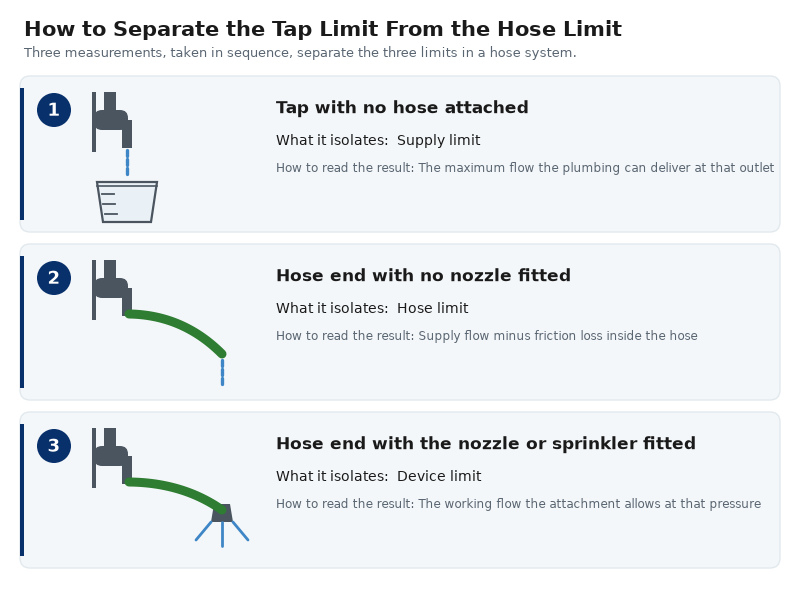
Fig. 3. The three-point test: bare tap, open hose end, nozzle fitted.
Test 1, the bare tap, gives the supply ceiling; test 2, the open hose end, gives the hose penalty; test 3, the hose end with the device fitted, gives the device penalty. A large drop between tests 1 and 2 points to the hose or its fittings, while a large drop between tests 2 and 3 points to the nozzle or sprinkler.
How Do I Tell Whether the Nozzle or the Hose Is Limiting Flow?
Test 3, the hose end with the nozzle fitted, explains most disappointing sprays. A sprinkler that covers a wide area divides the same flow across many small openings, so the flow at the hose end is unchanged while the delivery per square foot falls. Measuring at the hose end with the device removed shows how much of the loss belongs to the device rather than to the supply.
One caution applies to sprinkler testing. A single container under a sprinkler measures only the local rate; space several containers across the pattern.
How Do I Compare Two Hoses Fairly on the Same Tap?
Comparing hoses is only meaningful when the supply, the length and the end device are identical. Change one variable at a time, and use the same container volume and collection time for both hoses.
This is also the practical answer to how to measure garden hose flow rate when you are choosing between a 5/8-inch and a 3/4-inch hose. Run both on the same tap, with the same outlet and the same timer, and compare the results with the calculated average garden hose GPM band for each bore. If the readings are within a few percent of each other, the tap is the limit and the larger hose adds nothing.
How to Use a Flow Meter Instead of a Bucket
A flow meter is faster and gives a continuous reading, which makes it useful when you are adjusting a pressure regulator or balancing several outlets. Inline meters are fitted between the tap and the hose, while hose-end meters attach at the outlet. The four common options differ mainly in where they sit and what they display.
Comparison of flow measurement options for garden hose testing
| Method | Where it sits | What it displays | Main limitation |
|---|---|---|---|
| Bucket-and-stopwatch test | At the outlet | An average rate from one timed sample | Timing and volume error limit accuracy |
| Inline turbine meter | Between tap and hose | Instantaneous rate and total volume | Needs the correct thread and flow direction |
| Hose-end mechanical meter | At the hose end | Total volume, sometimes rate as well | Adds restriction and may not show live rate |
| Clamp-on ultrasonic meter | Outside a rigid pipe | Rate and total without contact with the water | Needs a straight run of pipe and a power source |
Every meter adds restriction, and each meter has a minimum reliable flow stated in its specification. Check the manufacturer specification for the flow range before you buy, and test the same point with a bucket once to confirm the meter is reading correctly. A pressure washer feed follows the same principles on a larger scale.
When Should I Record Static Pressure and Flowing Pressure?
Pressure should be recorded twice, because the two readings answer different questions. Static pressure is the reading with all outlets closed, and it describes what the supply can offer. Flowing pressure is the reading with water running, and it describes what the system is actually using. The gap between the two is the pressure consumed by friction from the tap to the gauge, so measuring only static pressure overstates performance consistently.
How to Read the Numbers You Get
A single reading means little on its own, but a set of readings is diagnostic. Compare the three values from the sequence above against the calculated band for your bore size. That tells you whether you are looking at a supply, hose or device problem, and each has a different remedy.
What a Low Reading Tells You
A low reading at the tap means the supply, not the hose, is the limit. Half-inch supply lines, long branch runs, partially closed valves and clogged screens all reduce the ceiling before any hose is attached. Fix the supply before the hose: clean or replace the outlet screen, and open any isolation valve fully. The reading rises once the supply improves.
A low reading at the hose end, with the tap already cleared, points to friction. The likely causes are excessive length, a bore narrower than expected, a crushed hose, or a chain of undersized adapters. Shortening the run, moving up one size, or replacing restrictive fittings each raise the flow, and their effects are additive.
What a High Reading Tells You
A high reading means the supply and the run are both healthy, and it usually reveals that the end device is the limiting factor. A device designed for a higher pressure than you have will underperform even though the hose is delivering well. The remedy is a device matched to your pressure rather than a larger hose.
A high reading also has a practical consequence for watering. A hose at 10 GPM fills a 30-gallon drum in three minutes. Spread over a 200 square foot bed, those 30 gallons add about 0.24 inches of water, because 30 gallons equals 4.01 cubic feet and 4.01 divided by 200 equals 0.020 feet. Delivering a full inch over the same bed would take about 12.5 minutes at that rate.
Why Does My Hose Deliver Less Water Than Its Label Claims?
Labels quote figures under stated or unstated conditions, and mismatches usually come from the conditions rather than from a faulty product. A hose labeled 12 GPM may be rated at an inlet pressure your tap never reaches, or with an open end and no fittings attached. Checking the three variables, pressure, length and outlet, resolves most apparent mismatches in a few minutes.
If a reading is far below any plausible value, look for a mechanical cause before blaming the rating. A kinked hose, a partially open valve, a blocked screen washer or a fitting with a reduced bore will each cut flow sharply, and each is visible on inspection. A water hose flow rate chart is only useful once those mechanical causes have been excluded.
Reference Values for Pressure and Flow
The table below gives flow through a fixed opening from 20 to 80 psi, following the orifice relationship used to rate nozzles and sprinklers.
How Pressure Changes Flow Through a Fixed Opening
The reference opening is assumed to pass 2.50 GPM at 40 psi. Every other value is calculated from that reference using the square root of the pressure ratio.
Calculated flow through a fixed opening as pressure changes, using flow proportional to the square root of pressure
| Pressure at the opening (psi) | Flow (GPM) | Change from 40 psi |
|---|---|---|
| 20 | 1.77 | minus 29 percent |
| 30 | 2.17 | minus 13 percent |
| 40 | 2.50 | reference value |
| 50 | 2.80 | plus 12 percent |
| 60 | 3.06 | plus 22 percent |
| 80 | 3.54 | plus 41 percent |
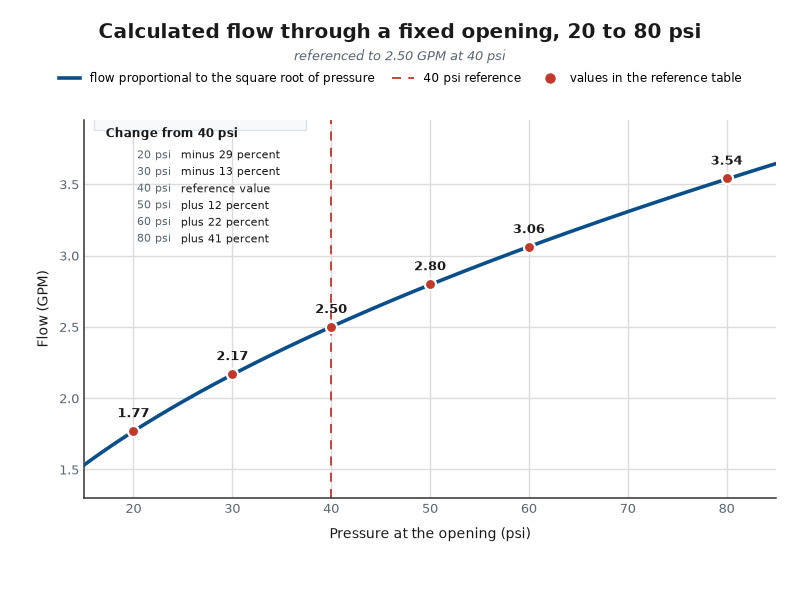
Fig. 4. Calculated flow through a fixed opening, 20 to 80 psi, referenced to 2.50 GPM at 40 psi.
Halving the supply pressure does not halve the flow; it reduces flow to about 71 percent of the 40 psi reference, because the square root of 0.5 is 0.707. Doubling the pressure raises flow to about 141 percent rather than 200 percent. Pressure changes therefore move flow much less than most people assume, which is why chasing a nozzle problem with a bigger pump is usually the wrong order of operations.
How to Use These Values in Practice
Measure pressure while the water is running, both when you are selecting equipment and when you are diagnosing a complaint. A nozzle rated at 60 psi that runs on a 30 psi supply passes about 71 percent of its rated flow, and the shortfall belongs to the pressure rather than to the nozzle.
How to Improve Flow at the Outlet
Once you know which link is holding the flow back, the improvements are usually cheap and quick. Work from the tap outward, because a restriction upstream caps everything downstream. Changing the hose first is the most common and least useful response to a low reading.
Which Fixes Come First at the Tap?
Remove or replace restrictive washers and screens at the tap, open any isolation valve fully, and check whether a vacuum breaker or anti-siphon device has a narrow internal bore. These parts cost little and take minutes to inspect.
Should I Shorten the Hose or Move Up a Size?
If the tap is clear and the hose is the limit, either shorten the hose or move up one nominal size. Shortening is free if the garden layout permits it. Increasing bore raises capacity by the square of the diameter ratio, so the step from 5/8 inch to 3/4 inch is worth about 44 percent, which is usually more than any fitting change can offer.
How Do I Match a Nozzle to My Actual Pressure?
A nozzle or sprinkler should be selected for the pressure you have rather than ordered for the pressure you wish you had. A device with a wider opening passes more water at lower pressure, and one with a narrower opening produces more velocity and a finer spray at higher pressure. Matching the device to the supply is usually the cheapest way to fix an unsatisfying spray pattern.
Часто задаваемые вопросы
What is a normal flow rate for a garden hose?
A normal garden hose flow rate falls between about 3 and 14 gallons per minute, depending on bore size and supply pressure. A 5/8-inch hose on a household tap usually lands between 5 and 10 GPM. The average garden hose GPM figure for that size sits near the middle of the band. If your reading is well below 3 GPM, check the supply before changing the hose.
How do you test a garden hose with a bucket and a stopwatch?
Run the water for 30 seconds to settle the flow, fill a marked container while timing it, then divide the gallons collected by the seconds and multiply by 60. Test at the tap, at the hose end with no nozzle, and at the hose end with the device fitted. The three results separate the supply limit from the hose limit from the device limit.
Does higher pressure always mean more flow?
No. Through a fixed opening, flow rises with the square root of pressure, so doubling pressure raises flow by only about 41 percent. Inside a hose the relationship is more complicated again, because higher velocity increases friction loss, which removes some of the pressure that produced it. Pressure helps, but it delivers diminishing returns and it is rarely the cheapest variable to change.
Why is my hose flow lower than its label?
Most labeled figures are quoted with an open end, a short hose and a stated inlet pressure. If your tap delivers less pressure, your hose is longer, or a nozzle is fitted, the real flow will be lower than the label without the product being at fault. On a gravity-fed or low-pressure supply, expect the low end of the band.
What is a typical 5/8 garden hose GPM at 40 psi?
At 40 psi with a 25-foot hose and an open end, a typical 5/8 garden hose GPM result sits around 7 to 9 GPM. That range is the calculated capacity of a 0.625-inch bore at 8 to 10 feet per second. Longer hoses, narrower fittings or a nozzle will each reduce the figure, and a shorter hose at higher pressure can exceed it.
Is a 3/4-inch hose always better than a 5/8-inch hose?
No. A 3/4-inch hose carries about 44 percent more water than a 5/8-inch hose at the same velocity, but only if the supply can feed it. On a tap that delivers 6 GPM, both hoses will deliver about 6 GPM, and the larger hose adds cost and weight for no gain. Measure the tap first.
How long does it take to fill a 5-gallon bucket?
The time depends entirely on the measured flow at that outlet. At 5 GPM a 5-gallon bucket fills in one minute; at 10 GPM it fills in 30 seconds; at 3 GPM it takes about 100 seconds. Timing the fill is itself a valid flow test, because flow equals 60 multiplied by the gallons divided by the seconds.
How do I know if my tap or my hose is the problem?
Measure the flow at the tap with no hose attached, then at the end of the hose with no nozzle fitted. If both readings are close, the tap is the limit and the hose is performing as well as it can. A large gap between the two readings points to the hose, its fittings or its length, and the fix belongs to the hose rather than the plumbing.
About HENGHUA
HENGHUA manufactures water hose, hydraulic hose and industrial hose for distributors, retailers, OEM programmes and private-label customers. The product brands include GLOBHOSE for high-performance hydraulic hose and FLEXMAX for flexible industrial hose. Production covers extrusion, reinforcement, vulcanization and assembly, with pressure and flow testing carried out at defined stages of the process.
Readers who need to confirm a garden hose GPM figure against a specification sheet, or who are sourcing hose in volume, can request dimensional data, rated working pressures and test records. Send your tap pressure, hose bore and run length through the contact page and our engineers will return the calculated flow band with the matching specification. Browse the range in the HENGHUA online shop.
Author: HENGHUA technical content team · Last updated: 20 September 2026






 English
  Spanish
  Portuguese
  French
  German
  Arabic
  Russian
  Indonesian
  Japanese
  Korean