
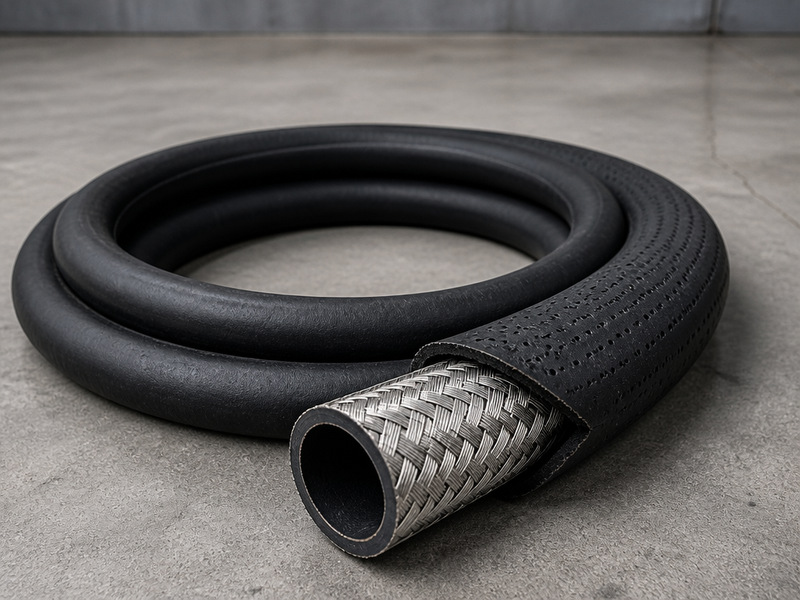
EPDM is the default tube polymer for saturated steam service, and the reason is simple. Its saturated, non-polar backbone resists hydrolysis and oxidation far better than general-purpose rubber. Heat alone rarely ends a hose; hot condensate resting against the tube does.
This guide explains what steam does inside a hose, why NBR, SBR, natural rubber, silicone and FKM all fall short, and how ISO 6134:2024 frames the requirements for an EPDM steam hose. It then covers the two temperature grades, the layers of a steam hose, the four failure modes that end service early, the tests buyers should demand, and when a hose must be retired.
Why EPDM Is the Standard for Saturated Steam
Three material properties explain why EPDM became the baseline for steam duty. Its backbone is fully saturated, so there are no reactive double bonds for heat and oxygen to attack. Its polymer is non-polar and hydrocarbon-free, so hot water cannot dissolve or swell it easily. Its compounding can also be pushed to a peroxide cure that holds up at continuous temperatures most rubbers cannot reach.
- Saturated backbone — with no carbon-carbon double bonds, oxidation has almost nothing to grab, so the chain resists heat aging.
- Non-polar chemistry — water and steam do not solvate the polymer, so swelling and softening stay low.
- Hydrolysis resistance — ester and urethane linkages are absent, so hot condensate cannot cut the chain by hydrolysis.
- Compounding headroom — a peroxide cure and mineral fillers support continuous service well above 150 °C.
For most plants the steam hose material decision comes down to one question: which polymer still holds its tensile strength after two years of wet heat?
EPDM wins that test, because its chemistry gives oxidation and hydrolysis nothing to work on. A steam hose lining of EPDM keeps its flexibility instead of hardening into a brittle tube, and that difference separates a hose that lasts years from one that cracks in months. An EPDM rubber hose also tolerates the repeated swing between hot steam and cold condensate that shortens the life of less stable compounds. The 230 °C construction guide shows how that chemistry is turned into a finished hose.
What Saturated Steam Does to a Hose Tube
Steam attacks a hose through three mechanisms that act at the same time. Hydrolysis, oxidation and permeation each work on a different part of the polymer, and all three accelerate as temperature rises. Understanding them tells you why a tube fails, and where to look when it does.
Temperature is the multiplier in all three cases. A reaction that is slow at 120 °C can be many times faster at 170 °C, which is why grade selection matters more than nominal pressure.
Hydrolysis: Hot Condensate Against the Tube
Hydrolysis is chemical attack by water itself. In a hose carrying wet steam, the tube sits in constant contact with hot condensate, and condensate is far more aggressive than dry heat. Polymers joined by ester or urethane linkages, such as polyester and polyurethane, are cut apart molecule by molecule. A steam hose lining of EPDM has no such linkages, so the reaction has no foothold. That single difference is why an EPDM tube survives where a general-purpose tube would soften, swell and finally split.
Oxidation: Heat Plus Oxygen
Oxidation is attack by oxygen at high temperature. Rubbers built on a diene backbone, such as natural rubber, SBR and NBR, carry carbon-carbon double bonds that oxygen attacks readily. Heat speeds the reaction, and the rubber gradually hardens, loses elasticity and cracks. The saturated backbone of EPDM removes those reactive sites, so oxidation has almost nothing to work on. That property lets an EPDM rubber hose serve hot, oxygen-laden steam lines for years rather than seasons.
Permeation: Gas Through the Wall
Permeation is the third mechanism, and it is the one most often overlooked. Steam molecules slowly pass through the tube wall and gather in the space between the tube and the cover. If that gas cannot escape, pressure builds under the cover and raises a blister. A steam hose failure is therefore often a cover defect before it is a tube defect. A pin-pricked cover vents the gas continuously, which is why the perforations are a specification rather than a flaw.
EPDM Steam Hose Materials Compared with Other Compounds
Only a few rubber compounds hold up in wet steam, and the gaps between them are wide. Choosing the right steam hose material is the first filter in any specification, and it decides the ceiling for every other choice. Table 1 compares the options buyers ask about most.
| Compound | Wet-steam performance | Main weakness | Typical duty |
|---|---|---|---|
| EPDM | Excellent up to 230 °C continuous | Not oil resistant (swells in mineral oil, diesel, gasoline) | Steam hose tube |
| NBR | Poor; hydrolyzes in hot condensate | Ester-type degradation | Oil and fuel hose |
| SBR | Poor; hardens and then cracks | Double bonds oxidize | Water and air hose |
| Natural rubber | Poor above 100 °C | Heat and oxygen aging | General service |
| Silicone | Moderate; hot air more than steam | Low tear strength | Hot-air ducting |
| FKM | Good in dry heat, but costly | Not a standard steam choice | Chemical and fuel |
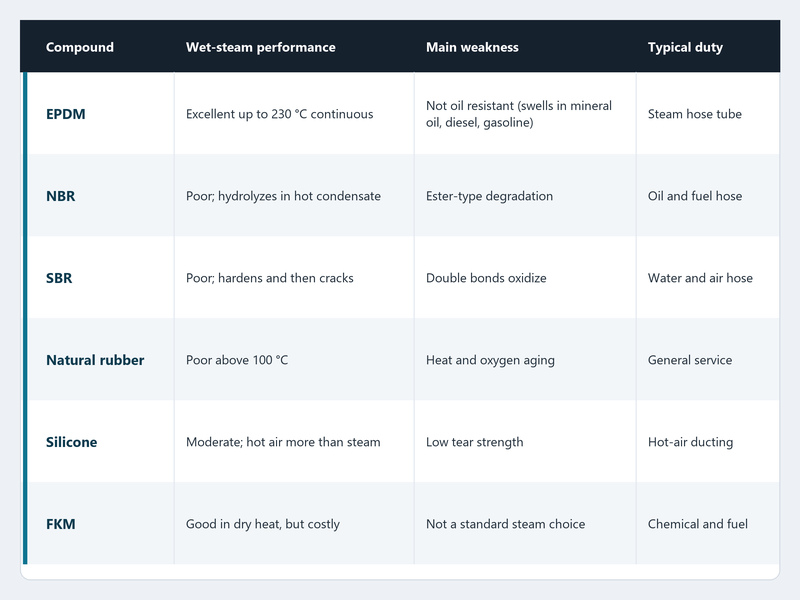
Figure 2. How EPDM, NBR, SBR, natural rubber, silicone and FKM compare on wet-steam performance.
For a wet-steam line, EPDM is the conventional choice, and the steam hose standard now assumes a tube that resists steam and hot condensate. NBR is an oil-and-fuel compound that hydrolyzes quickly in hot water. SBR and natural rubber lack the saturated backbone that oxidation demands. Silicone handles hot air but not hot water, and FKM is usually reserved for aggressive chemicals rather than steam.
Reinforcement cannot rescue a poor tube. The steam hose reinforcement carries the internal pressure, but it cannot protect a steam hose lining that the steam is already degrading. Material choice comes before every other decision, and no amount of wire or braid will compensate for a compound that cannot sit in hot condensate.
EPDM Steam Hose Construction: Tube, Reinforcement and Cover
Every steam hose is a stack of layers, and each layer has one job.
The Tube
The tube is the steam hose lining, the layer that touches the medium. In a steam hose it is seamless EPDM, and on the hottest grades it is peroxide-cured for extra heat resistance. The tube sets the temperature limit of the whole assembly, because a cover can be replaced but the tube cannot. This is where material chemistry does its work.
The Reinforcement
The reinforcement carries the pressure. Type 2 steam hose uses one or two layers of high-tensile steel wire braid, while Type 1 uses textile. A steel steam hose reinforcement is what lets the same bore hold much higher pressure without ballooning. The cover then protects that reinforcement from abrasion, weather and the handling loads of a busy plant floor.
The Cover
The cover is a smooth EPDM layer, pin-pricked along its full length to vent permeating gas. Color usually signals the grade, but color alone never proves a hose is steam-rated. On outdoor runs the cover carries the abrasion and ozone load, so its condition matters even when the tube is still sound.
What ISO 6134 Requires of an EPDM Steam Hose
ISO 6134:2024 is the international steam hose standard, now in its fifth edition and replacing ISO 6134:2017. It divides hose into Type 1 for lower pressure and Type 2 for higher pressure, and it marks covers as Class A or Class B. Class A means a cover grade without oil resistance and Class B means one that resists oil. That class describes the cover only, and it says nothing about steam resistance. A small suffix records the electrical property: M for a bonded hose and Ω for a conductive one.
The steam hose standard requires a tube resistant to steam and hot condensate, uniformly pin-pricked covers, and end connections that allow the clamping force to be adjusted. It prohibits quick-release couplings, because a coupling that cannot be re-tightened cannot be kept safe across years of thermal cycling.
The standard also sets the minimum steam hose reinforcement for each type. Type 1 relies on textile, while Type 2 requires steel wire, spiral or cord. That is why the same bore carries 6 bar in Type 1 at about 164 °C and 18 bar in Type 2 at about 210 °C. The industrial steam hose range is organized along those same lines.
Compliance is proven by testing, not by appearance. The steam hose testing regime includes a hydrostatic proof test at 1.5 times working pressure on every length, plus dimensional and adhesion checks. A marking line then records the standard, the type, the class and the pressure, so the hose can be identified long after the packaging is gone.
End connections deserve the same scrutiny as the hose itself. The standard’s requirement for an adjustable clamp exists because steam lines expand, contract and vibrate, and a fixed, one-time connection cannot follow that movement. Bolted safety clamps let a technician re-tighten the joint at a planned shutdown instead of discovering a leak under pressure.
EPDM Steam Hose Ratings: Temperature, Pressure and Safety Factor
Two continuous-temperature grades cover most steam work, and both share a pressure envelope. Table 2 sets out the numbers a buyer should read from the label.
| Grade | Continuous | Intermittent | Working pressure at rated temperature | Burst pressure | Safety factor | Saturated service covered (temperature-limited) |
|---|---|---|---|---|---|---|
| EPDM 170 °C | −40 °C to +170 °C | 210 °C | 250 psi (17 bar) | 2,500 psi (about 172 bar) | 10:1 | about 7 bar g |
| EPDM 230 °C | −40 °C to +230 °C | 250 °C | 250 psi (17 bar) | 2,500 psi (about 172 bar) | 10:1 | about 26 bar g |
The 170 °C grade covers continuous service to about 7 bar g, where steam reaches roughly 170.5 °C. The 230 °C grade reaches about 26 bar g, with 25 bar g corresponding to roughly 226 °C. A common mistake follows from those numbers. Steam at 17 bar g sits at about 207 °C, so the 170 °C grade does not cover it and the 230 °C grade is required. Selecting on pressure alone, without checking the temperature at that pressure, is what causes that error.
Pressure and temperature cannot be read separately. A hose holding 250 psi at ambient temperature may hold far less at 230 °C, because heat softens the compound and reduces the load the reinforcement can share. That is why the working pressure on a label is always tied to a temperature, and why rated values quoted without a temperature beside them are incomplete.
Both grades share the same pressure envelope. Working pressure is 250 psi (17 bar), burst pressure is 2,500 psi (about 172 bar), and the safety factor is 10:1. Steam hose testing confirms those figures on every batch, and the ratio is far stricter than the 4:1 used for hydraulic hose and the 3:1 used for pneumatic hose. The saturated and superheated steam comparison explains where the rubber envelope ends: above it, a PTFE-lined hose rated to about 260 °C or a corrugated metallic hose takes over.
Four Failure Modes That Retire an EPDM Steam Hose Early
Most steam hose failures fall into four patterns, and each one has a cause a buyer can control well before the hose is fitted.
- Cover blistering — permeating gas trapped under a cover that was not pin-pricked pushes the rubber away from the reinforcement.
- Lining separation — a closed end or a vacuum condition lets dissolved gas expand at the tube interface, so the steam hose lining separates from the reinforcement as popcorning.
- Heat aging of the tube — sustained over-temperature service hardens the lining until it cracks instead of flexing.
- End-fitting failure — a clamp without adjustable clamping force, or a quick-release coupling, works loose under thermal cycling.
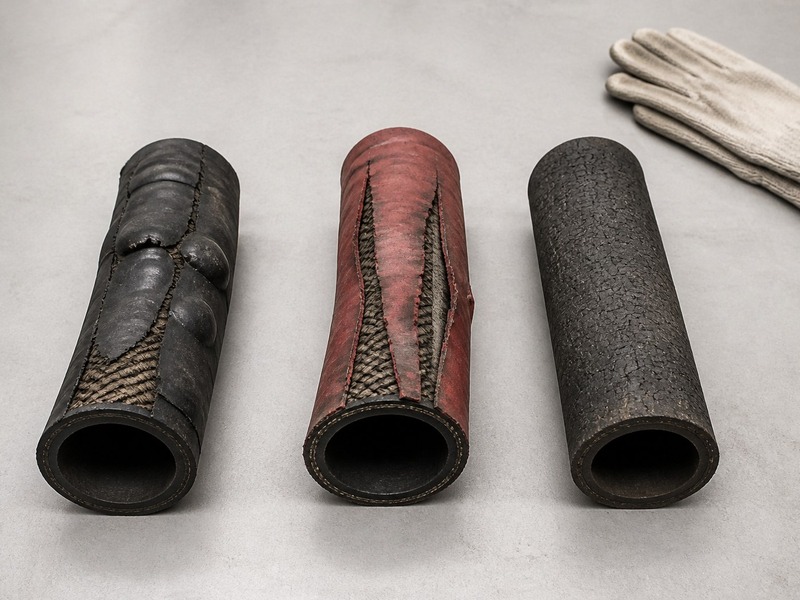
Figure 3. The four ways a steam hose ends its life early: cover blistering, lining separation, heat aging and end-fitting failure.
Blistering and separation both trace back to gas that could not vent, so the cover and the end conditions matter as much as the tube. Heat aging is a rating question, because a hose run above its grade always hardens early. Fitting failure is an installation question, and it is the most preventable of the four. Most steam hose failure that looks sudden has in fact been building for months.
Length and routing also decide how long a hose lasts. A run that is too short pulls on the fittings every time the line heats up, and a tight bend kinks the tube from the inside. Give the hose a bend radius that matches its grade, support it along the run, and leave slack for thermal growth.
A steam hose that has blistered, separated, hardened or leaked at the fitting has reached the end of its life. Stop using it: the rule is replace, never repair, because a steam hose cannot be repaired, patched or re-crimped in the field. Never tape or clamp over a damaged cover, and never return a failed length to service because it still holds at cold pressure.
A structured hose failure analysis will usually trace the cause back to one of these four patterns. The deep EPDM steam hose failure library covers those patterns in more detail.
Is Every EPDM Hose a Steam Hose?
No, and the distinction matters. EPDM is versatile, so an EPDM rubber hose may be a radiator hose, a water hose, a food hose or a washing hose. None of those is built for steam, and none carries a steam rating.
To be a steam hose, the same rubber needs the right tube, a steam hose reinforcement rated for the pressure, a pin-pricked cover and a verified rating to a steam hose standard. A hose that lacks any one of those is an ordinary EPDM rubber hose sold into the wrong duty, and that is one of the most common causes of premature steam hose failure.
EPDM Steam Hose FAQs
Is EPDM the best steam hose material for wet steam?
For wet steam, EPDM is the conventional tube polymer. Its saturated backbone resists hydrolysis and oxidation, so it holds strength in hot condensate. Other compounds may cost less, but they age faster in wet heat. Where oil is present as well, EPDM is the wrong choice, because it swells in mineral oil, diesel and gasoline.
Is every EPDM rubber hose suitable for steam?
No. EPDM rubber is used for water, food and automotive hose as well. Only a hose with a steam-resistant tube, a steam-rated reinforcement, a pin-pricked cover and a verified temperature and pressure rating is a steam hose. Buying on the compound name alone is risky.
What does a steam hose standard require?
ISO 6134:2024 requires a tube resistant to steam and hot condensate, uniformly pin-pricked covers, and end connections with adjustable clamping force. It prohibits quick-release couplings. It also warns that superheated steam shortens service life, and that closed ends or vacuum can cause popcorning and lining separation.
How is a steam hose tested?
Every length receives a hydrostatic proof test at 1.5 times working pressure. Testing also covers dimensions, adhesion between the layers, and the pressure at which the hose bursts. A steam hose testing record should be available for each batch a buyer receives, along with the date code printed on the cover.
What causes a steam hose failure at the fitting?
Fittings see the same pressure as the hose, plus thermal cycling and handling loads. A clamp that cannot be re-tightened, or a coupling that is not rated for steam, works loose as the hose expands and contracts. Use a bolted safety clamp and check torque at every shutdown.
Can a failed steam hose be repaired?
No. A steam hose that has blistered, separated or hardened cannot be repaired in the field. Replace it. Patching a cover hides damage without restoring strength, and the lining is usually worse than the outside suggests. Nor does a new crimped fitting help: cutting back the damaged end does not restore the lining that has already degraded.
What grade do I need for 17 bar steam?
Use the 230 °C grade. Steam at 17 bar g is about 207 °C, which is above the continuous limit of the 170 °C grade. The 170 °C grade covers roughly 7 bar g at most. Both grades share a 250 psi (17 bar) working pressure, so the temperature rating is what decides, and the high-temperature EPDM hose page lists the sizes it is built in.
EPDM Steam Hose Manufactured and Tested in One Plant
A steam hose is only as reliable as the process that makes it. When the steam hose material, the reinforcement, the cover and the end fittings all come from one plant, the steam hose testing that proves each length never leaves the maker’s control.
HENGHUA manufactures reinforced industrial hose and complete hose assemblies for plants, distributors and OEM brands. Our EPDM steam hose range covers 3/8 inch to 4 inch bore, rated 250 psi (17 bar) working pressure with a 10:1 burst safety factor.
The construction is a smooth steam-resistant EPDM tube, one or two layers of high-tensile steel wire braid, and a pin-pricked cover that vents permeating gas instead of blistering. Every length is proof-tested at 1.5 times working pressure before it leaves the plant, and each batch is date-coded. Because compounding, extrusion, braiding, vulcanization and crimping all happen in one plant, bulk lead times stay short. Send us the working pressure, the steam temperature, the bore and the end connection, and we will quote against them.
We supply cut lengths, crimped ends, protective sleeves, colour coding and OEM branding. Get a quote and free samples
Final Verdict: Specify EPDM for Saturated Steam and Verify the Standard
For steam service, EPDM remains the reference tube polymer, and the standard tells you how to verify it. Specify an EPDM steam hose by grade, pressure rating and certification, not by color or by price alone. Confirm the tube, the steam hose reinforcement, the pin-pricked cover and the adaptable end connection.
Then ask for the steam hose testing record and the batch date code. If a supplier cannot show those documents, keep looking, because the certificate matters as much as the hose. Send us the duty and we will quote the grade that fits it, with free samples on request.
Written by the HENGHUA engineering team, with input from plant maintenance and steam-system reliability teams across North America, Europe and South East Asia. HENGHUA manufactures reinforced industrial hose and hose assemblies, including an EPDM steam hose range from 3/8 inch to 4 inch bore. Those assemblies are rated 250 psi (17 bar) working pressure with a 10:1 burst safety factor, and are supplied as cut lengths or as fully crimped assemblies. Fittings, protective sleeves, colours and OEM branding are available on request.

 English
  Spanish
  Portuguese
  French
  German
  Arabic
  Russian
  Indonesian
  Japanese
  Korean