
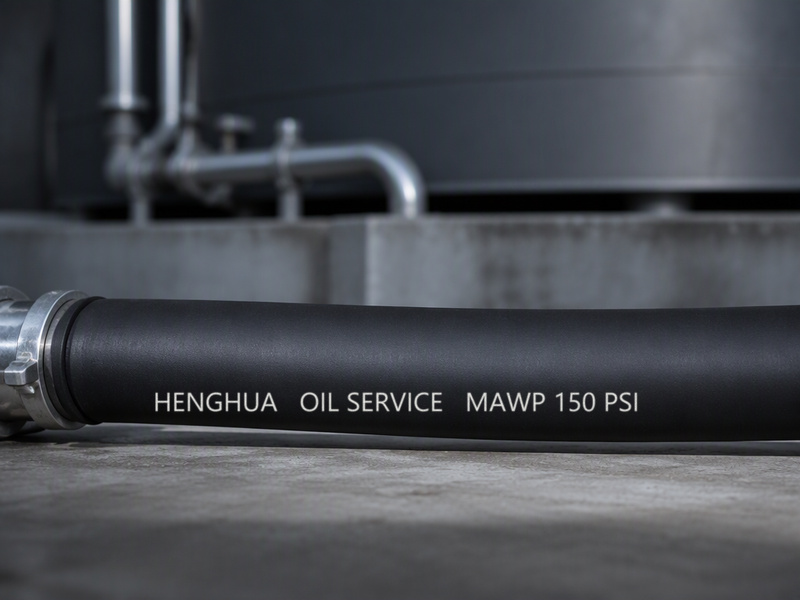
A chemical hose marking must state the service the hose is approved for and its maximum allowable working pressure (MAWP), and it must not state burst pressure or test pressure at all. Electrostatic performance is set by the electrical grade of the hose construction, and it is confirmed by measurement rather than by anything printed on the cover.
Two document families govern this field. In the United States, 33 CFR 154.500 fixes what a facility chemical transfer hose must carry. In Europe, EN 12115:2021 assigns four electrical grades on top of the mechanical hose types. This guide joins the two, unpacks the ISO 8330 vocabulary, and explains what a continuity check actually proves.
1. What a Chemical Hose Marking Must Carry
A marking is a statement of approved service, not a specification sheet. It tells the next operator which products the hose may carry and how hard it may be worked. The values that matter most to a burst failure are deliberately kept off the cover.
Read a marking together with the hose record. A mark that cannot be tied back to a record is only half an identification, and hose identification is one of the first things a facility audit tests. That is why chemical hose marking and record-keeping are examined as a single subject.
1.1 Data the facility rules require
The rules ask for three groups of information, and each group has a home:
- Each product the hose may carry, written by name; or the words OIL SERVICE; or the words HAZMAT SERVICE—SEE LIST followed immediately by a symbol keyed to the facility operations manual.
- The maximum allowable working pressure, marked on the hose.
- The date of manufacture and the date of the latest test required by 33 CFR 156.170.
The date of manufacture and the latest test date do not have to appear on the hose itself. 33 CFR 154.500(f) allows them to live in the vessel or facility hose records instead, provided the hose is marked so it can be identified with those records. That is why a serial or tag matters as much as the printed text.
1.2 Data that must stay off the cover
The same rules are explicit about what must not be printed. Burst pressure and test pressure must not be marked on the hose, and both are recorded elsewhere.
That prohibition is easy to underestimate. A burst figure printed on a cover invites an operator to treat it as an operating limit, which it is not. The design burst pressure of a transfer hose assembly must be at least four times a stated sum, by 33 CFR 154.500(a). That sum is the relief-valve setting pressure, or the maximum pump pressure where no relief valve is fitted, plus the static head pressure of the system at the point where the hose is installed. The MAWP, by 33 CFR 154.500(b), must be greater than that same sum.
The practical split is simple. Marking states the approved service and the working limit; the paperwork holds the proof. That division keeps an operator from reading a destruction test as a daily ceiling.
Table 1. Chemical hose marking content required by 33 CFR 154.500(e) to (g).
| Пункт | Requirement | Where it lives |
|---|---|---|
| Product list | Each product by name, or OIL SERVICE, or HAZMAT SERVICE—SEE LIST with a manual-keyed symbol | On the hose |
| MAWP | Maximum allowable working pressure, marked | On the hose |
| Date of manufacture | Required but may be off the hose | Hose or records |
| Latest 156.170 test date | Required but may be off the hose | Hose or records |
| Burst pressure | Must not be marked | Records only |
| Test pressure | Must not be marked | Records only |
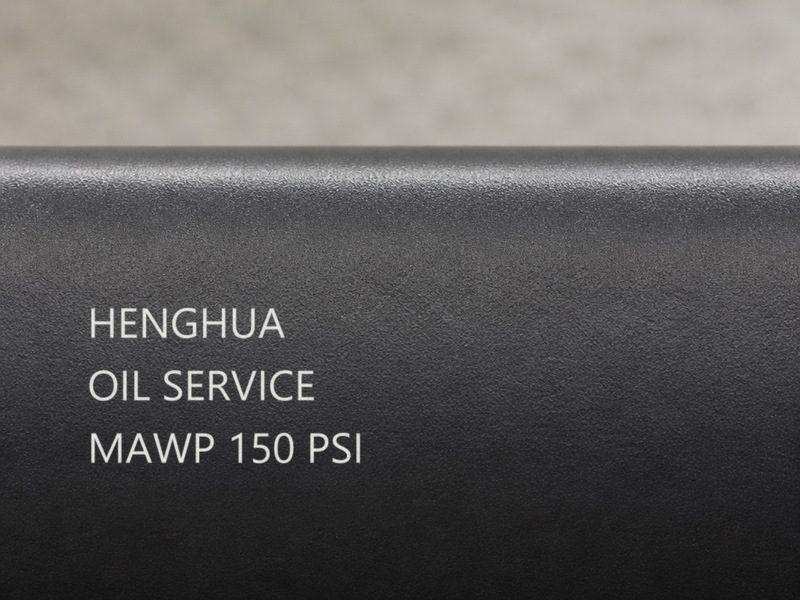
Figure 1. A compliant marking block keeps service, MAWP and dates readable and leaves burst and test pressure off the cover.
2. Chemical Hose Marking Rules at US Facilities: 33 CFR 154.500(e) to (g)
The facility rules are read together, not one paragraph at a time. Paragraphs (e), (f) and (g) of 33 CFR 154.500 divide the marking duty into service, dates and prohibitions. A marking that satisfies one paragraph and breaks another is not compliant.
2.1 The three acceptable service statements
The rule offers three acceptable forms of service statement:
- List every product the hose may carry, by name.
- Mark the hose OIL SERVICE where that is the actual duty.
- Mark HAZMAT SERVICE—SEE LIST and place a symbol that is keyed to the facility operations manual.
The HAZMAT SERVICE—SEE LIST option is the one that needs discipline. It is only compliant when the symbol on the hose points to a current list in the operations manual. If that list is stale, the marking is worse than useless, because it implies coverage the hose no longer has.
2.2 Marking sits on an assembly, not a tube
A facility transfer hose is treated as an assembly, and the end connections are part of what has to comply. 33 CFR 154.500(d) requires the connections to be full threaded, or flanges meeting ANSI B16.5 or B16.24, or quick-disconnect couplings meeting ASTM F1122.
The reason is continuity of pressure rating. A hose cannot be stronger than the joint that terminates it, and the marking describes the assembly that the joint completes. This assembly view also explains the electrostatic rules later in this article, because continuity is a property of hose plus fittings. For the chemical hose range this practice applies to, see the chemical hose category.
3. Why Electrostatic Control Matters in Chemical Transfer
Flow through a hose separates charge. Hydrocarbon and solvent streams in particular can accumulate static on the tube wall, on the fittings, or on a conductive helix that is not connected to ground. The hazard is not the charge itself but the spark it can release near a flammable atmosphere.
Guidance documents describe the practice rather than a single number. NFPA 77 is the recommended practice on static electricity; API RP 2003 addresses ignitions from static, lightning and stray currents; IEC 60079-32-1 covers electrostatic hazards. For marking limits, use the product standards and the transport regulations.
A static conductive chemical hose solves one part of the problem and leaves another. The conductive path only helps if it reaches ground, which is why a static conductive chemical hose is specified together with a checked ground connection rather than on its own.
Static builds fastest where flow is turbulent, where a filter or fine screen strips charge off the liquid, and where a line is filled into a tank that already holds spray or mist. Keeping the transfer rate low at the start of a fill, and keeping every conductive part bonded, reduces the chance that a spark finds a flammable atmosphere.

Figure 2. A static conductive chemical hose only dissipates charge when its end fittings reach the same ground point.
4. Electrical Grades Under EN 12115:2021: M, Ω, M/T and Ω/T
EN 12115:2021 covers rubber and thermoplastic hose assemblies for liquid or gaseous chemicals in the range −20 °C to +65 °C at a working pressure of 10 bar or less. It defines two assembly types, D and SD, and four electrical grades on top of them. For US readers, that 10 bar ceiling is about 145 psi, calculated from the conversion 1 bar = 14.50 psi.
The EN 12115:2021 envelope of −20 °C to +65 °C matters as much as the 10 bar pressure ceiling. The electrical grade is claimed for the hose as specified; the service list decides the chemicals it may carry. A grade is a construction property.
The four grades are defined by how the conduction path is made:
- M — electrically bonded. Continuity is obtained through bonding wires that run the length of the assembly and are connected at the end fittings, and the measured value describes that bonded path when tested to EN ISO 8031:2020.
- Ω — electrically conductive, with a lining resistance of 10⁶ Ω or less. Conduction is obtained through conductive materials built into the hose rather than through a wire run.
- M/T — as M, plus a through-wall electrical resistance of 10⁹ Ω or less.
- Ω/T — as Ω, plus a through-wall electrical resistance of 10⁹ Ω or less.
The /T suffix in EN 12115:2021 is the part buyers miss. It adds a second path, from the tube through the wall to the cover, so that a charge cannot sit on an inner surface that the bonding wire never touches.
5. The Numbers Behind the Symbols: ISO 8330 and EN ISO 8031
Two limit systems are often quoted side by side, and they do not say the same thing. ISO 8330 defines the vocabulary and its limits; EN ISO 8031 defines how resistance is measured. Quoting a limit without its method makes the number meaningless.
Under ISO 8330, an electrically conductive or anti-static hose is one whose resistance is below 10⁶ Ω, which is one million ohms. An electrically bonded hose, and an electrically continuous hose, are both defined below 10² Ω, which is one hundred ohms. Those figures belong to the vocabulary, and they describe different quantities than the EN 12115 grade letters do. The trade term static conductive hose refers to that same ISO 8330 definition, and the standard term is the one to quote in a specification.
Table 2. ISO 8330 vocabulary limits set against the EN 12115:2021 electrical grade limits.
| Term or grade | Source | Resistance limit |
|---|---|---|
| Electrically conductive / anti-static hose | ISO 8330 | Below 10⁶ Ω (1,000,000 Ω) |
| Electrically bonded hose | ISO 8330 | Below 10² Ω (100 Ω) |
| Electrically continuous hose | ISO 8330 | Below 10² Ω (100 Ω) |
| M (electrically bonded) | EN 12115:2021 | Bonded path through the assembly wiring; tested to EN ISO 8031 |
| Ω (electrically conductive) | EN 12115:2021 | Lining resistance of 10⁶ Ω or less; testing refers to EN ISO 8031 |
| M/T and Ω/T | EN 12115:2021 | As M or Ω, plus through-wall resistance of 10⁹ Ω or less |
EN ISO 8031:2020 is the method, not the limit. It describes how the resistance measurement is taken, including where the probes are placed and how the assembly is prepared. A figure of 10⁹ Ω quoted from one method cannot be compared directly to a figure quoted from another.
Grade claims usually appear on the hose as the letter or symbol itself, so the marking and the electrical grade meet in the same place. A chemical hose marking that carries the M or Ω symbol is stating a construction property; the purchaser’s task is to confirm that the construction suits the service list.
Material choice feeds into all of this, and it is worth separating electrical grade from chemical compatibility. The fluid compatibility reference covers how EPDM, FKM and NBR behave with different media, while the wider industrial hose category covers the surrounding product lines.
6. What a Hose Continuity Test Proves — and What It Does Not
A hose continuity test measures whether a low-resistance path exists from one end fitting to the other. That is all it measures. It confirms that the assembly, as tested, provides the path its claimed grade describes.
It cannot show any of the following:
- That the reading will still hold after the hose has been flexed, aged, or exposed to the chemical.
- That the crimp or clamp between fitting and hose will keep its contact over the service life.
- That the hose is actually connected to ground in service.
- That charge cannot build on an isolated liner or a dry internal surface.
Table 3. What a hose continuity test proves and what it leaves open.
| Question | Answered by a continuity test? | What answers it |
|---|---|---|
| Is there a low-resistance path end to end? | Да | The measured value against the claimed grade |
| Is the assembly still within grade after service? | Нет | A re-test after flexing and exposure |
| Is the hose grounded at the transfer point? | Нет | Inspection of the bonding and grounding connection |
| Is the result traceable to the hose? | Нет | Marking plus the hose record |
A short re-test interval after the first months of service is a practical way to catch a crimp that is loosening. Compare each reading with the earlier value for the same hose, not only with the grade limit, because a rising trend is a warning that a single pass-or-fail check will miss.
7. Bonding and Grounding as a System, Not a Fitting
Bonding and grounding are two different actions that are often spoken of together. Bonding connects conductive parts to one another so they sit at the same potential. Grounding connects that bonded system to ground, so accumulated charge can drain away.
A hose bonded to a nozzle but not grounded still holds charge. The failure mode is common at temporary transfer points, where a clamp is applied to a painted surface or a corroded boss instead of bare metal.
Practical checks at a transfer point include:
- Verify the ground connection point is bare metal, not paint or scale.
- Confirm the hose fitting, not just the hose body, is inside the bonded path.
- Inspect the bonding conductor and clamp for corrosion before each transfer.
- Record the continuity reading against the hose identification, not against the shift.
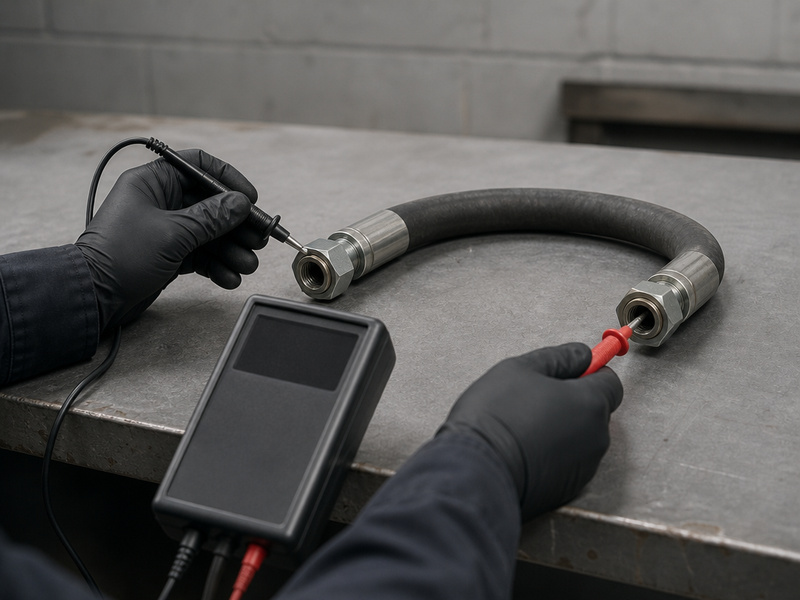
Figure 3. A hose continuity test is a point-in-time measurement between end fittings, not a pressure test.
8. Chemical Hose Identification, Records and Re-Inspection
Hose identification is the thread that ties marking, testing and records together. A serial or tag on the hose lets a test result, a manufacture date and a service list point at the same physical item. Without that thread, a test report is an orphan document. Chemical hose marking only does its job when it points back to that same record. Selections from the chemical hose range are built to the service list that the marking names.
Two rules drive the re-inspection calendar. Under 33 CFR 156.170(f)(1), a facility must test and inspect transfer hoses annually, or not less than 30 days before the first transfer made more than one year after the previous tests and inspections.
Before any of that, 33 CFR 156.170(c)(1) sets the condition standard. A nonmetallic transfer hose must have no unrepaired loose covers, kinks, bulges or soft spots; no gouges or cuts penetrating the first reinforcement layer; and no external deterioration. It must not burst, bulge, leak or abnormally distort under a static liquid test pressure of at least 1.5 × MAWP.
The test fluid is constrained as well. 33 CFR 156.170(e) limits it to liquids compatible with the hose tube as recommended by the hose manufacturer. Pressure gauges used must read within 10 % of actual pressure, by 33 CFR 156.170(c)(3).
Table 4. HENGHUA chemical hose range as published, with the site-wide design basis.
| Пункт | Published value |
|---|---|
| Chemical discharge hose | 150 psi |
| Chemical suction and discharge hose | 150 psi and 250 psi |
| Inside diameter program | 3 mm to 102 mm (1/8 in to 4 in) |
| Design safety factor | 4:1 site-wide |
| In-house test laboratory | Burst testing to ISO 1402 and impulse testing to ISO 6803 |
Часто задаваемые вопросы
What must a chemical hose marking show?
At a US facility, 33 CFR 154.500(e) and (f) require the service, the maximum allowable working pressure, the date of manufacture and the date of the latest required test. The last two may sit in the hose records instead, provided the hose is marked so it can be identified with them. Burst pressure and test pressure must not be marked at all under 154.500(g).
Why is burst pressure not marked on a chemical hose?
Under 33 CFR 154.500(g), burst pressure and test pressure must not appear on the hose, and both are recorded elsewhere. Printing a burst figure invites an operator to treat it as an operating limit, which it is not. The design burst basis under 154.500(a) is at least four times the relief-valve setting pressure, or the maximum pump pressure where no relief valve is fitted, plus the static head at the installation point.
What do the M and Ω grades mean in EN 12115:2021?
EN 12115:2021 defines four electrical grades for chemical hose assemblies rated for −20 °C to +65 °C at a working pressure of 10 bar or less. M is electrically bonded and Ω is electrically conductive. M/T and Ω/T carry the same construction plus a through-wall electrical resistance of 10⁹ Ω or less. Electrical testing refers to EN ISO 8031:2020.
How do ISO 8330 limits compare with the EN 12115 grades?
The two systems describe different quantities. ISO 8330 defines an electrically conductive or anti-static hose as one below 10⁶ Ω, and an electrically bonded or electrically continuous hose as one below 10² Ω. The EN 12115:2021 M grade instead describes a bonded path through the assembly wiring, and the /T grades add a through-wall limit. Always confirm which document a quoted number belongs to.
What does a hose continuity test measure?
It measures whether a low-resistance path exists from one end fitting to the other. It confirms that the assembly, as tested, provides the path its claimed grade describes. It is a single measurement at one moment, taken with the probes at defined positions. It is not a pressure test and it says nothing about the mechanical condition of the tube or cover.
Does a passing continuity test prove a hose is safe to use?
No. A static conductive chemical hose can pass a continuity check and still be misused. The test does not prove the in-service ground connection is intact, does not predict how the crimp or clamp will behave after flexing, and does not rule out charge on an isolated liner or a dry internal surface. Bonding, grounding and inspection answer those questions.
What is the difference between bonding and grounding?
Bonding connects conductive parts to one another so they sit at the same electrical potential. Grounding connects that bonded system to ground, so accumulated charge can drain. Both are needed. A hose bonded to a nozzle but not grounded still holds charge. At temporary transfer points, confirm the ground point is bare metal before the transfer starts.
How often must facility transfer hoses be tested?
Under 33 CFR 156.170(f)(1), a facility must test and inspect transfer hoses annually, or not less than 30 days before the first transfer made more than one year after the previous tests and inspections. The hose must also meet the condition standard in 156.170(c)(1), including no unrepaired loose covers, kinks, bulges or soft spots, and no leakage under static liquid pressure of at least 1.5 × MAWP.
Which test fluid and pressure apply to a transfer hose?
The test pressure follows 33 CFR 156.170(c)(1): the hose must not burst, bulge, leak or abnormally distort under static liquid pressure of at least 1.5 × MAWP. The fluid is limited by 156.170(e) to liquids compatible with the hose tube as recommended by the manufacturer. Pressure gauges must read within 10 % of actual pressure under 156.170(c)(3).
Which documents guide electrostatic control?
NFPA 77 covers static electricity as a recommended practice, API RP 2003 addresses ignitions from static, lightning and stray currents, and IEC 60079-32-1 covers electrostatic hazards. Treat all three as guidance on practice and risk assessment. The measurable requirements a buyer can hold a hose to come from the product standards, such as EN 12115:2021, and the test method EN ISO 8031.
If I specify a hose for a tank terminal, which EN 12115 grade should I ask for?
State the type first, then the grade, and put both in the enquiry. EN 12115:2021 sets two assembly types, D and SD, and four electrical grades, M, Ω, M/T and Ω/T, and the electrical grade is a property of the hose as specified. Where the area classification calls for a through-wall path, ask for a /T grade and confirm the figure against the datasheet.
What changes if the hose is not conductive?
A hose that is not conductive carries no built-in path for charge. Charge then has to be drained by bonding the fittings and the equipment on both sides, and by grounding the bonded system. That is why the bonding path and the ground connection are checked at the transfer point rather than assumed from the hose grade.
About HENGHUA
HENGHUA manufactures chemical, steam, water, oil, material-handling and multipurpose hose for distributors, plant operators and OEM programs. The published chemical range includes chemical discharge hose at 150 psi and chemical suction and discharge hose at 150 psi and 250 psi. Inside diameters run from 3 mm to 102 mm (1/8 in to 4 in), with a 4:1 design safety factor applied site-wide.
The plant covers 35,000 m² with 95 production lines, 320+ employees, 45 QC inspectors and 25 R&D engineers holding 30+ patents, and it is capable of 20 million m per year. Quality management is registered to ISO 9001, IATF 16949 and ISO 14001. The in-house laboratory runs burst testing to ISO 1402 and impulse testing to ISO 6803.
To discuss a marking, grade or continuity requirement against your own specification, contact the team or read more about HENGHUA. Related background sits in the industrial hose selection guide and the flexible hose materials reference.






 English
  Spanish
  Portuguese
  French
  German
  Arabic
  Russian
  Indonesian
  Japanese
  Korean