
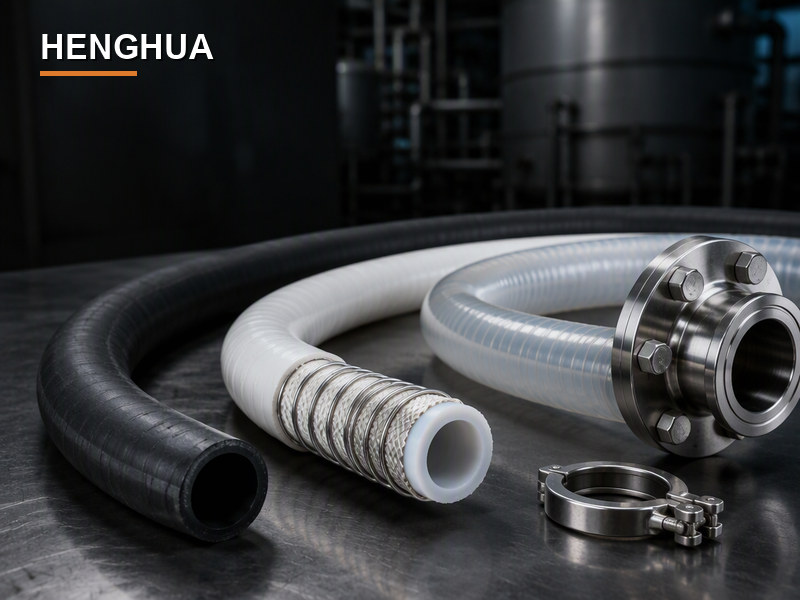
Choosing a chemical hose material comes down to four questions: what the medium attacks, how hot or cold the line runs, how the hose is handled, and what it costs over its working life. Rubber, PTFE and UHMWPE are the three liners most chemical plants weigh.
None of the three is automatically the right purchase. The liner with the widest chemical resistance is often the most expensive and the least flexible, so it can be the wrong answer for a simple caustic transfer line. This comparison scores each chemical hose material on chemical coverage, temperature window, pressure and flexibility, and cost per year of service. The short answer: rubber wins on mild, cool duty, UHMWPE covers the broad middle of a mixed list, and PTFE earns its cost on aggressive solvents and hot streams.
About a 14-minute read at 250 words per minute; each section ends with a table you can take into a supplier conversation.
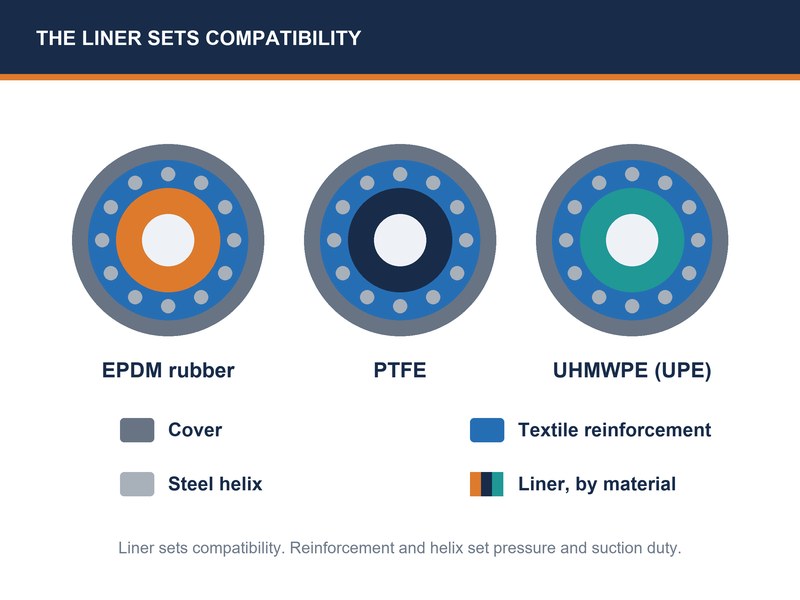
Figure 1. The liner decides chemical compatibility, while the reinforcement and helix decide pressure and suction duty.
How Do the Three Chemical Hose Material Families Compare?
A chemical hose is a composite. A liner touches the medium, a reinforcement carries the pressure, and a cover protects the assembly. The liner material sets compatibility, and that is the part this comparison is about. The three families below cover the great majority of industrial chemical transfer duty.
Table 1. Chemical hose material comparison at a glance. Temperature and pressure values are planning figures; verify the manufacturer datasheet for the exact construction.
| Material family | Continuous temperature window | Chemical coverage | Pressure context |
|---|---|---|---|
| Rubber, EPDM (ethylene propylene diene monomer) | −40 °C to +120 °C | Acids, bases, ketones, alcohols, ozone and steam; not petroleum-based oils or aromatics | Common ratings 150 PSI (about 10 bar) and 16 bar |
| Rubber, oil-resistant (NBR; nitrile butadiene rubber) | −30 °C to +100 °C | Petroleum-based oils and fuels; not ketones, esters, strong acids or ozone | Common ratings 150 PSI (about 10 bar) and 16 bar |
| PTFE (polytetrafluoroethylene) | −70 °C to +260 °C | Widest chemical inertness; molten alkali metals and elemental fluorine excepted | Common ratings 150 PSI (about 10 bar) and 16 bar |
| UHMWPE (UPE; ultra-high-molecular-weight polyethylene) | −40 °C to +120 °C | Manufacturer data sheets commonly state about 98% of industrial chemicals; not strong oxidizing acids | Common ratings 150 PSI (about 10 bar), 16 bar and 17 bar |
Table 1 shows the trade-off that runs through this comparison. The material with the widest coverage also carries the widest temperature window, the highest cost and the lowest flexibility. Nothing in this trade-off is free. A specifier who reaches straight for PTFE often pays for coverage that the line will never use.
The family name is only a starting point. Within rubber, an EPDM compound and an oil-resistant synthetic rubber compound behave almost as differently as two separate materials, which is why this comparison keeps them apart rather than treating rubber as one bloc.
Chemical Coverage: Matching the Chemical Hose Material to the Medium
Chemical coverage is not a single score. It depends on concentration, temperature and contact time, so the honest answer is always a compatibility chart rather than a slogan. Even so, the medium class narrows the choice quickly, and the matrix below shows where each liner is strong and where it is not.
Table 2. Chemical coverage by medium class. Ratings are qualitative planning guidance drawn from published compatibility data; confirm each medium against the manufacturer’s chart.
| Medium class | EPDM rubber | Oil-resistant rubber (NBR) | PTFE | UHMWPE (UPE) |
|---|---|---|---|---|
| Mineral acids and alkalis | Suitable | Ограниченный | Suitable | Suitable |
| Strong oxidizing acids | Ограниченный | Avoid; use PTFE | Suitable | Avoid; use PTFE |
| Petroleum oils and fuels | Avoid; use NBR or PTFE | Suitable | Suitable | Suitable |
| Aromatic and chlorinated solvents | Avoid; use PTFE | Ограниченный | Suitable | Limited at high temperature |
| Ketones and esters | Suitable | Avoid; use EPDM, PTFE or UHMWPE | Suitable | Suitable |
| Steam and hot water | Suitable | Ограниченный | Suitable | Ограниченный |
Table 2 acts as a filter, not a verdict. A line that carries nothing but caustic at ambient temperature does not need the widest liner in the catalog. A line that swings between a solvent and an acid within the same shift does need it. This is where the uhmwpe vs ptfe debate usually starts, because both liners clear the broad middle and separate mainly on solvents and oxidizing acids.
How to Read a Compatibility Chart
A compatibility chart is a starting point with conditions attached. Before you trust a single row, confirm four things. First, the concentration the chart assumes, since a dilute acid and a concentrated one behave differently. Second, the temperature the rating was measured at, because many charts rate at ambient. Third, the contact time, because a splash and a permanent immersion are different duties. Fourth, whether the rating covers the liner alone or the full hose, since the cover and reinforcement also matter.
Table 2 maps each medium class to the four liners in outline only. For the complete medium-by-medium table, see how to choose a chemical hose for each product (planned URL — publish before linking).
Temperature Window: The Range Each Chemical Hose Material Tolerates
Temperature is the second dimension, and it interacts with the first. A liner that is safe on its own can fall outside its window on a hot line, and a hot line can turn a marginal chemical fit into a failure. The values below are continuous-service windows, and they are planning figures rather than absolute limits.
Table 3. Continuous service temperature windows (planning figures). Short excursions and steam cleaning can differ; confirm every value with the manufacturer.
| Material | Lower continuous limit | Upper continuous limit | Practical note |
|---|---|---|---|
| PTFE | −70 °C | +260 °C | Widest window; highest cost and lowest flexibility |
| UHMWPE (UPE) | −40 °C | +120 °C | Wide coverage; not for strong oxidizing acids |
| EPDM rubber | −40 °C | +120 °C | Good for acids, bases and steam; not petroleum oils |
| Oil-resistant rubber (NBR) | −30 °C | +100 °C | Best for oils and fuels; not ketones or ozone |
| FKM (fluorocarbon rubber) | −20 °C | +200 °C | Hydrocarbons and high temperature; not hot alkalis |
| XLPE (cross-linked polyethylene) | −40 °C | +100 °C | Acids, bases and hypochlorite; not aromatic solvents |
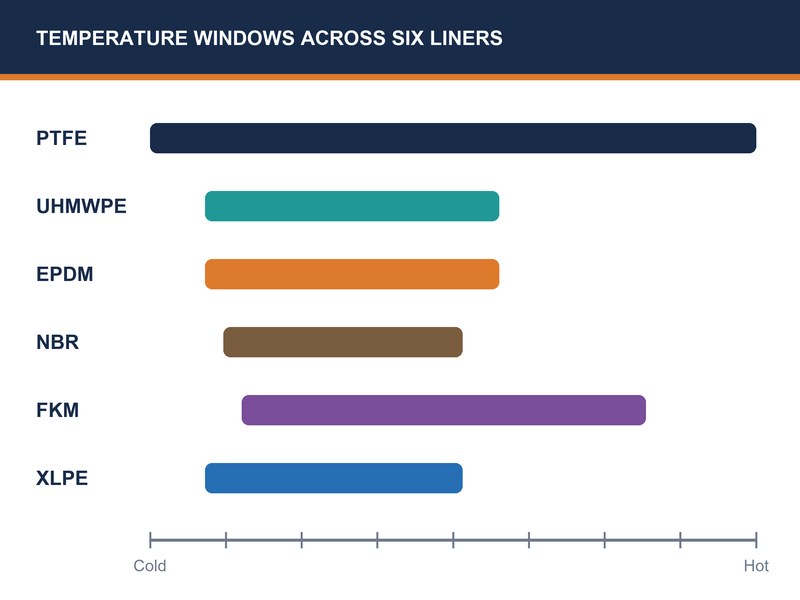
Figure 2. PTFE owns the widest temperature window, UHMWPE and EPDM share a practical band, NBR trades range for oil resistance, FKM for hydrocarbons, and XLPE for hypochlorite.
Two rules keep the temperature choice honest. First, design for the worst wall temperature the line will see: a line beside a hot process runs hotter than one across the plant. Second, read the upper limit as a limit on strength and the lower limit as a limit on flexibility, since a cold hose can crack at a bend even while it still holds pressure.
A wide temperature window has to be earned by the medium. A liner that tolerates a hot stream but reacts with it is the wrong choice at every temperature, so coverage and temperature have to be read together.
Pressure and Flexibility: What Each Chemical Hose Liner Material Delivers
Pressure and flexibility depend on the liner inside the chemical hose construction, and they also depend on the reinforcement wrapped around it. A discharge hose (Type D under EN 12115:2021) relies on textile reinforcement. A suction and discharge hose (Type SD) adds a steel helix so that the bore resists collapse under vacuum. The chemical hose liner material is usually not the part that limits pressure, but its bend behavior is what an operator feels every day.
Table 4. How the liner interacts with duty, reinforcement and pressure. Pressure values are planning figures drawn from common chemical hose ranges.
| Duty | Typical liner choices | Reinforcement and structure | Common pressure context |
|---|---|---|---|
| Chemical discharge (Type D) | EPDM, NBR, XLPE, UHMWPE, PTFE | Textile reinforcement, no helix | 150 PSI (about 10 bar) to 16 bar |
| Chemical suction and discharge (Type SD) | UHMWPE, XLPE, PTFE, EPDM | Textile cords plus steel helix for vacuum | 150 PSI (about 10 bar) to 17 bar |
| Fuel and oil transfer | NBR, FKM, PTFE | Textile reinforcement; antistatic wires for flammables | 150 PSI (about 10 bar) to 16 bar |
| High-temperature chemical | PTFE, FKM | Textile reinforcement, often PTFE-lined | 150 PSI (about 10 bar) to 16 bar |
Burst pressure sits well above the working figure, commonly at about three to four times it as a planning value. That margin is not a target for operation. It exists to absorb surges and pressure spikes. The standard that verifies a chemical hose is EN 12115:2021. It sets a working pressure of 10 bar and a service range of −20 °C to +65 °C, and it separates Type D from Type SD duty.
Flexibility is where the honest trade-off bites. A rubber liner bends easily and tolerates repeated handling. A UHMWPE liner stays workable in the field. A PTFE liner is the stiffest of the three and the least forgiving of tight bends, which is a real cost in a crowded plant. The liner lineage from rubber up to PTFE, and the point at which that step is worth taking, is covered in the guide to moving from acid hose to PTFE hose (planned URL — publish before linking).
Cost per Year of Service: Ranking Each Chemical Hose Material
Purchase price is the wrong headline. The number that matters is cost per year of service, and it blends the liner price, the service life, the downtime of a change-out, and the risk cost of a wrong choice. Because real prices depend on bore, length, fittings and order volume, every figure here is qualitative and every ranking is a planning figure rather than a measured score.
Table 5. Qualitative ranking across the four selection dimensions. Rankings are planning guidance based on relative material cost, published temperature and chemical coverage, and expected flexibility and handling behavior; they are not measured scores.
| Dimension | Rubber (EPDM / NBR) | PTFE | UHMWPE (UPE) |
|---|---|---|---|
| Chemical coverage breadth | Moderate to wide, medium dependent | Widest | Wide, about 98% per manufacturer data sheets |
| Temperature window | Moderate, up to +120 °C for EPDM | Widest, −70 °C to +260 °C | Moderate, −40 °C to +120 °C |
| Pressure and flexibility | Good flexibility, standard ratings | Lowest flexibility, standard ratings | Good flexibility, standard ratings |
| Cost per year of service (one duty, one bore) | Lowest purchase cost, medium life | Highest purchase cost, long life | Medium purchase cost, long life |
Table 5 exposes the trap. PTFE wins two dimensions outright, yet it sits last on flexibility and first on purchase cost. On a room-temperature caustic line with gentle routing, a rubber chemical hose can deliver the lower cost per year of service, because it costs less to buy and the medium never threatens it. The more chemically universal liner is not automatically the right purchase; it is the right purchase only when the medium or the temperature actually demands it.
A fair rubber vs. PTFE hose comparison therefore has to fix the duty first. Set the medium list and the temperature, then judge both liners on the same line. Bring in the UHMWPE vs. PTFE view at that point and the middle ground often opens up: broad coverage, a temperature window that matches EPDM, and better flexibility than PTFE at a lower price. For the deeper case on that material, see the guide to why a UHMWPE liner handles most industrial chemicals (planned URL — publish before linking).
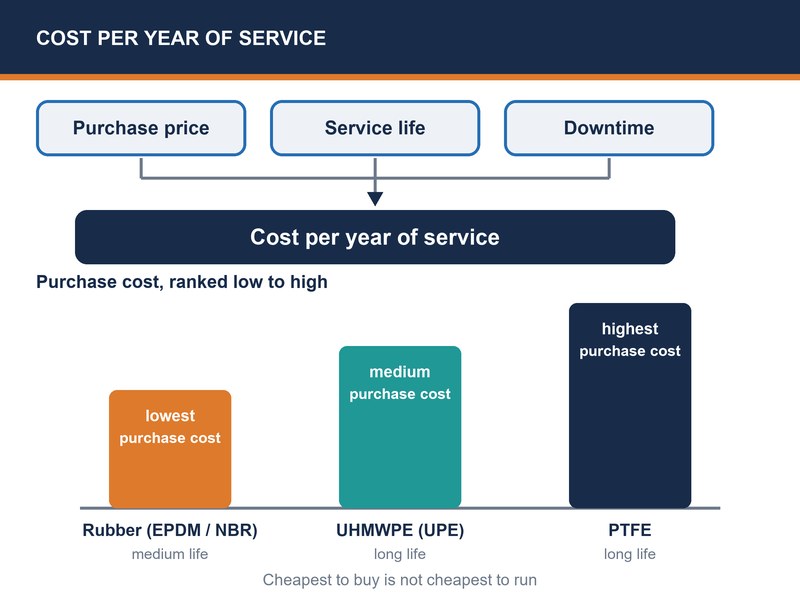
Figure 3. Cost per year of service blends purchase price, service life and downtime, so the cheapest liner to buy is not always the cheapest to run.
Decision Rules: Choose Rubber, PTFE, or UHMWPE When …
The head-to-head comparison reduces to a short rule set. Work down the list and stop at the first rule that matches your line:
- Choose rubber when the medium is a simple acid, alkali, alcohol or petroleum product.
- Choose UHMWPE when the medium list is long or mixed and the temperature stays between −40 °C and +120 °C.
- Choose PTFE when the medium is a strong solvent or an oxidizing acid, or the stream runs hot.
- Choose a Type SD suction and discharge hose when the line must resist vacuum collapse.
- Choose the wider liner only when your own specification proves the need.
Common Selection Mistakes With Chemical Hose Material
Most poor choices are not exotic. They repeat the same four errors, and each one is avoidable at the quotation stage:
- Over-buying the liner: a PTFE liner on a mild, cool line adds cost and stiffness without adding safety.
- Under-buying the liner: a rubber liner on a solvent or a hot oxidizing acid fails early, whatever its family is known for.
- Reading temperature alone: coverage, temperature, pressure and handling must be scored together, because strength on one can hide weakness on another.
- Ignoring static: flammable transfer needs bonding and grounding, and a non-conductive container needs a grounded metal dip tube or rod.
Two further guides cover what this comparison leaves out. For how the liner, reinforcement and cover work as one set, the flexible hose materials guide walks through the layers of a hose. For the compatibility logic that splits elastomer families, the NBR vs EPDM vs FKM inner tube selection guide shows how rubber families divide.
Final Verdict: Matching the Chemical Hose Material to the Job
The comparison ends where most buyers actually start, with a medium list and a temperature. Score the chemical hose material against both, then check pressure, duty and handling. Rubber wins on purchase cost and flexibility. PTFE wins on coverage and heat. UHMWPE wins the middle, and it wins there often.
If an earlier rubber vs. PTFE hose comparison did not settle your case, add UHMWPE to the shortlist and judge all three on your real conditions rather than on a catalog headline. As a closing check, revisit whether the widest liner is genuinely required, because the more chemically universal choice is the right one only when the duty demands it. The general question of how a liner family affects hose function sits in the guide to what industrial hoses are used for. The wider map of liner choices is in the chemical hose complete guide (planned URL — publish before linking).
Then confirm the decision on paper:
- List every medium the line will carry, with its concentration and temperature.
- Score the three liners on coverage, temperature, pressure and handling for that list.
- Pick the lowest-cost liner that clears every dimension with margin.
- Record the standard, the pressure rating and the bonding method in writing.
Chemical Hose Material Comparison FAQs
Which of the three liners is the most chemically resistant?
PTFE is the most chemically resistant of the three. It tolerates the widest range of acids, bases and solvents across the widest temperature window, from −70 °C to +260 °C. Molten alkali metals and elemental fluorine are the well-known exceptions. A liner with that much coverage also carries the highest cost and the lowest flexibility, so it is not the automatic default for every line.
Should I choose UHMWPE vs. PTFE for a mixed chemical list?
For a mixed list, UHMWPE usually covers the broad middle at a lower cost and with better flexibility. Manufacturer data sheets commonly state that a UHMWPE liner handles about 98% of industrial chemicals. Move to PTFE when the list includes a strong oxidizing acid, an aggressive solvent, or a hot stream above the UHMWPE ceiling of +120 °C.
When should I choose rubber instead of PTFE or UHMWPE?
Choose rubber when the medium is a straightforward acid, alkali, alcohol or petroleum product and the temperature stays inside the rubber window. EPDM suits acids, bases and steam, while oil-resistant synthetic rubber suits oils and fuels. On a cool line with gentle routing, rubber can cost less per year of service than either plastic liner.
How do I compare a rubber vs. PTFE hose fairly?
Fix the duty before comparing the two liners. Set the medium list, its concentration and the wall temperature, then score both liners on the same line rather than on a catalog headline. Compare purchase cost against expected service life, downtime and risk. PTFE costs more and lives longer, while rubber costs less and flexes easily, so the outcome turns on whether the medium demands PTFE at all.
What temperature can each chemical hose liner handle?
Continuous-service windows differ widely. PTFE spans −70 °C to +260 °C, the widest of the three. UHMWPE and EPDM both reach +120 °C, with EPDM starting near −40 °C and UHMWPE near −40 °C as well. Oil-resistant rubber stops near +100 °C. All of these are planning figures, so confirm the exact limit with the manufacturer for your construction.
Does the chemical hose liner material change the pressure rating?
The liner material does not set the pressure rating. Pressure is carried mainly by the textile reinforcement, and a suction and discharge hose adds a steel helix for vacuum duty. Common chemical hose ratings are 150 PSI (about 10 bar), 16 bar and 17 bar. What the liner changes is compatibility, temperature range and flexibility, which decide whether the hose suits that duty at that rating.
Can one hose handle both suction and discharge duty?
One chemical hose can handle both duties if it is built for it. A Type SD suction and discharge hose carries a steel helix that stops the bore from collapsing under negative pressure, so it can load and unload. A plain Type D discharge hose has no helix and is not suitable for suction. Where a line has to do both, specify the suction and discharge construction from the start.
How do I check compatibility for a specific chemical?
Use the manufacturer’s compatibility chart, and read the conditions attached to each row. Check the concentration the rating assumes, the temperature it was measured at, the expected contact time, and whether the rating covers the liner alone or the full hose. A splash duty and a permanent immersion are different, so confirm both against your real service.
Why is PTFE less flexible than rubber or UHMWPE?
PTFE is a rigid polymer with a high melting point, which is exactly what gives it the widest temperature and chemical window. That stiffness makes it the least forgiving of tight bends and the hardest to route in a crowded plant. Rubber and UHMWPE both bend more easily, so where routing is tight the stiffer liner can add installation effort even though it is stronger.
What should I verify before ordering a chemical hose?
Confirm five items in writing. The liner material and its compatibility with every medium on the list. The continuous temperature window for the worst wall temperature. The pressure rating and the duty type, discharge or suction and discharge. The bonding and grounding method for flammable transfer. Finally, the standard the hose is tested to, such as EN 12115:2021, plus the fitting and clamp specification.
About HENGHUA and Our Chemical Hose Line
HENGHUA is a professional hose and fittings manufacturer supplying distributors, retailers and OEM brands worldwide. Our chemical hose line includes UHMWPE (UPE), XLPE and PTFE liners as well as rubber (EPDM and oil-resistant synthetic rubber) constructions, built with high-tensile textile reinforcement and a steel helix for suction duty. We offer factory-crimped assemblies, custom lengths, fittings, cover printing, private label and OEM/ODM. Commercial terms are factory-direct pricing, short lead times on bulk orders, and a warranty. Get a quote and free samples
Written by the HENGHUA hose engineering team. Our engineers size and specify chemical hose assemblies for transfer, loading and process duty. Send your medium list, temperature and bore, and we will propose a liner, a construction and a fitting set.






 English
  Spanish
  Portuguese
  French
  German
  Arabic
  Russian
  Indonesian
  Japanese
  Korean